
alternatively, things I want handled.
Digital resilience and preservation. The problem here is the fragility of digital content systems.
Resilience. If electricity goes out, how long does it take for us to restore communication and power? How easy is it to cause outage? Can we turn our phone off for more than a day, two days, a week, a month? See Nashville for a recent example for why I’m worried about this.
Content preservation. Much of historical accounts is now preserved digitally. We take crawler services like Wayback Machine for granted - what will happen to content in 50, 100, 150 years? Who will decide on what to and when to maintain? Are we ok with the implicit privatisation of libraries (implicit in a few people end up deciding what digital content to archive, and people default to these accounts due to a lack of alternatives)? On a personal level, if something bad happens to your cloud storage provider, do you have content backups? See Azure and Gmail 2020 outage for a recent example of not having access to a scarily large amount of your own content. Deleted Twitter replies is a minor but frustrating example of this. [2]
Decreasing reliance on AdTech for digital monetization. The problem here is that ads lower content and experience quality, and that there are not many great monetization alternatives for content-driven companies. See summary at end of bullet point. One possibility is transitioning to subscription-based models (e.g traditional media approach on digital monetization or Substack itself). Would you pay Facebook and Twitter a monthly fee if they promised no ads, and no data sharing?
Ad models create problems in digital content distribution. When I talk about ads here, I mean exclusively platform ad displays, and not sponsored creator posts. Lots of people have made smart observations on this topic. I won’t try to substantiate that ads enhanced social media polarisation (beware: USC paper linked in the Wired article is a draft) or monopolised product marketplaces. I also won’t try to substantiate that ads monetization necessitate privacy trade-offs (DuckDuckGo is one such counterexample). That this article needs to exist or that Apple adding user privacy features cost companies ad revenue hopefully say enough.
For one reason or another, advertisement is the default primary monetization model for content-based tech. companies. These companies include Google (70.7% total revenue from ads), Tencent (16%, mostly WeChat), Facebook (98.5%), Twitter (86%), Snapchat (62.6%), ByteDance (60%), and Reddit ($119 million, unk. total) for a total combined ad revenue of $ 214 billion USD est. 2019.
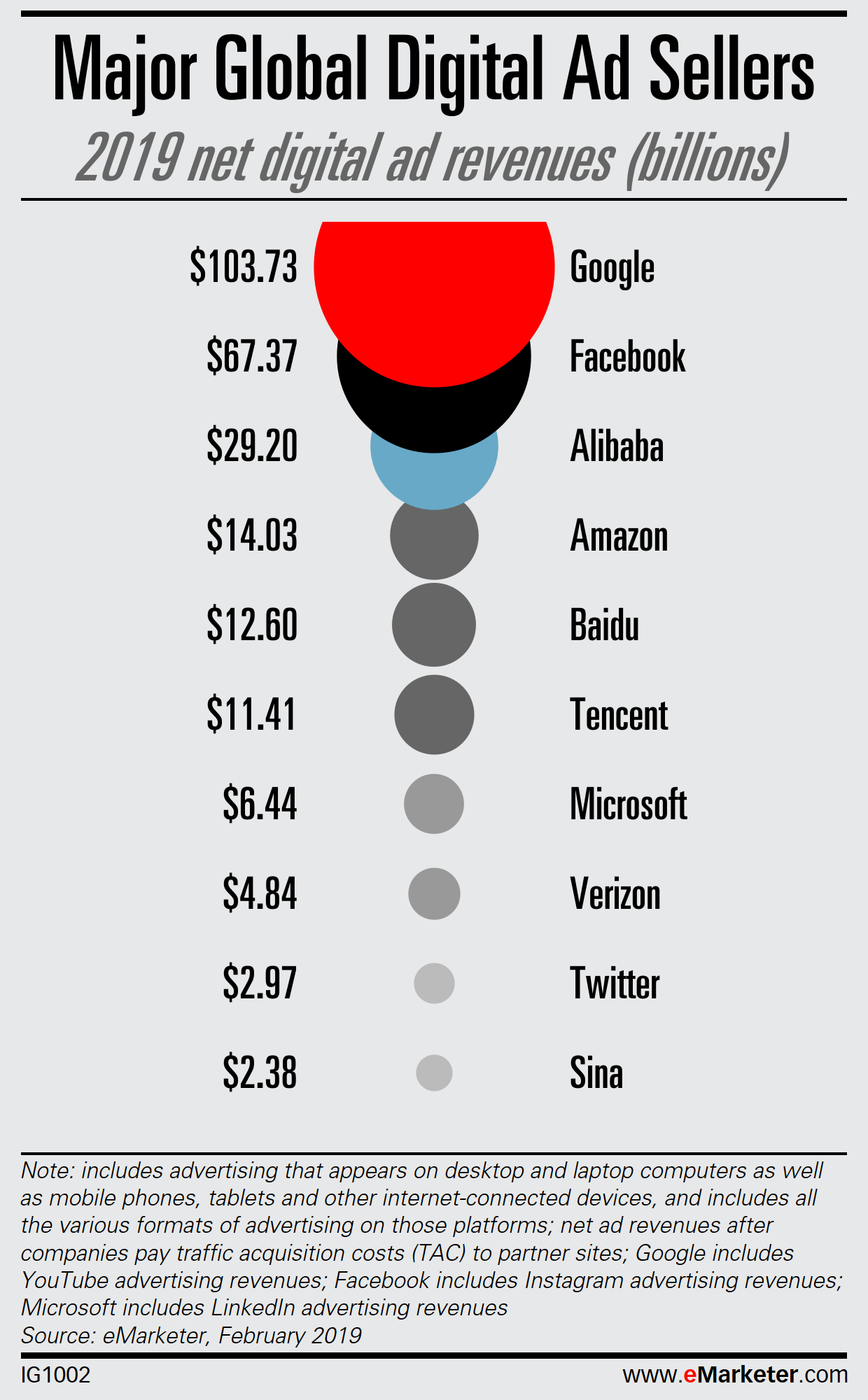
To my untrained marketing eyes, ads bundled with content and search isn’t the most ideal solution for users or advertisers (see Search case study). Proctor & Gamble cut their digital ads. spending by $200 million in 2018, with little to no impact on its revenue. Given that intent to buy is difficult to proxy well, some doubt is cast on the effectiveness of digital ads for advertisers.
Ads fund much of our digital content. If ads become unbundled from media and search, how we consume content would be vastly different. Mark Zuckerberg himself published a 2019 note citing a desire to find a non-ad based monetization model for messages that allows for more privacy (ironic given the things we know about WhatsApp in 2021). I’m not sure if the answer here is trying other monetization models (e.g. subscriptions), or a separate, ads-only platform for users with intent to buy. Whoever cracks this can change digital content and platforms as we know it.
Case Study: Better Search. Google (88.14%) and Bing (6.18%) take up roughly 95% of the worldwide search engine market in 2020 [source: statista]. At a glance, it seems unwise to challenge search incumbents, given the sheer size of compute and engineering ingenuity that has gone into the making. However, there are unchallenged assumptions in the current landscape that could pave way for a much different future.
Ads are annoying for users. AdBlock extensions are popular for a reason. People shown a given Google ad click on average only 2% of the time. The difference to me between a relevant search result and platform-generated ad spot is that the former has every intent to buy, while the latter does not necessarily measure intent. It’s possible to show only product search results, and sell bidding spots for those exclusively (e.g. Amazon but for every store), without embedding it into the rest of platform content. When there is no intent to buy, ads are annoying for users.
Ads aren’t effective for ad purchasers without user intent to buy, which is often not the case. Even the most committed, financially viable user may not want to click away to a vacuum ad link on YouTube (the same is not necessarily true for sponsored YouTube creator content). See previous P&G example. If as a seller, you need to spend lots on ad budgets, 200 SEO factors to filter intent to buy, and multiple site pop-ups to force users to abandon their ad-blockers, maybe you’re forcing an impossible sell. It shouldn’t have to be this complicated.
So why is search (and media) bundled with ads? Brief History Tangent. There are lots of other problems associated with ad-based search I won’t mention here. Personalized digital ads has now become a complicated central art form to campaigns and marketing, but when and why did it get this way?
Rise of ad-giants: Sergey Brin and Larry Page in their original 1998 paper (paper which presented Google for the first time to the world) did not like ad-based business models.
“For this type of reason and historical experience with other media, we expect that advertising funded search engines will be inherently biased towards the advertisers and away from the needs of the consumers …
In general, it could be argued from the consumer point of view that the better the search engine is, the fewer advertisements will be needed for the consumer to find what they want. This of course erodes the advertising supported business model of the existing search engines. However, there will always be money from advertisers who want a customer to switch products, or have something that is genuinely new. But we believe the issue of advertising causes enough mixed incentives that it is crucial to have a competitive search engine that is transparent and in the academic realm.”
This attitude shifted (largely seemingly thanks to Bill Gross and GoTo.com in one way or another). In the first Google shareholder letter, the founders remarked that “Advertising is our principal source of revenue, and the ads we provide are relevant and useful rather than intrusive and annoying.” Ad-based search has since seemed to be taken for granted as the way of life (even for engines such as DuckDuckGo).
While I was not in the rooms where media startup founders decided to choose ads for monetization, from what we know it seems that even champions of ads are wary of its limitations. Perhaps it is time to question the default.
Tl;dr: Ads models bundle separate problems that may have better individual solutions. It is the default monetization model, but perhaps for a lack of a better alternative. For an industry that moves fast and breaks things, perhaps it is time to move fast and break free from ad models.
Governance OKRs. The problem here is that we don’t have a good incentives framework for performance outside of polls and approval. [3]
Consensus on need, no consensus on action. Why are there problems that a majority find important but aren’t incentivized or paid to work on (e.g. why does it take so long and so much energy for negative externalities such as climate change to be recognized and regulated)? The tempting default seems to be inaction when there is a consensus on need but no consensus on approach.
Governance Performance Dashboards. I will preface this with 1) governance problems are not only in the government 2) I don’t believe that optimizing metrics is the end-goal, but rather a good barometer for what’s missing 3) not everything that can be quantified should be quantified. 4) My knowledge of government systems is North American-centric.
To my knowledge, much of the elected legislative branch relies on public opinion (e.g. election results, polls, social media) as one barometer for performance. There aren’t many other easily viewable performance metrics meant for representatives to indicate how much progress they’ve made towards their platform. While plans for 90 days in office and general plans exist, overall progress made through sponsored bills or initiatives in even a single week in politics can be difficult to track. We wouldn’t fire employees for underperforming if they were not given clear, mutually understood goals, but we fire legislators (by not electing them) even if they aren’t given clear avenues for regular feedback outside of polls. Though far from perfect, a legislator dashboard where core campaign platforms each have a quarterly quantitative metric (e.g. how many clauses drafted towards a certain goal) may be a place to start.
On the other hand, not having clear performance metrics also prevent the public from keeping legislators regularly accountable come election time without editorialized summaries. While report cards exist (thanks to Nik Marda for some of these links: 1, 2, 3, 4), they may not come at the frequency or consistency desired. One other example for increasing citizen input outside of polls is crowdsourced policy (e.g. Stanford’s Participatory budgeting platform project.)
Read the original article

Comments
On ads: the fundamental problem with them is that most people don't realize that they are paying for digital content and free social services anyway, albeit indirectly, since the ad spendings are included in the prices of consumer products. Even if you use an ad blocker you pay for the ads you don't see anyway.
In fact the more we use free social platforms and digital content, the more we pay for it from our pockets. On top of that, we also enrich the platforms themselves, that is the middleman. See that $100 billion revenue figure for Google alone? That's also us, the consumer's money.
So one opportunity for disruption is I think targeting the middleman, i.e. the platforms. You can offer cheaper ads to the advertisers by being more efficient than Google that burns absurd amounts of money on their mostly awkward and useless "moonshot" projects.
I think you can in principle be more efficient than Facebook too, by employing 100x less engineers if you focus on one task and do it well.
In other words, the problem of "killing" Google or Facebook doesn't necessarily mean building literally alternatives to their products, but rather by creating more efficient advertisement platforms. Pick whatever method of keeping the users' eyes on the screens and be less greedy, more efficient.
> most people don't realize that they are paying for digital content and free social services anyway, albeit indirectly, since the ad spendings are included in the prices of consumer products
That's a zero-sum argument that's a bit disingenuous. If you make widgets, and it costs you $5 to make a widget, you can sell 10 of them at $20/pop to the consumer for a total profit of 10 * (20-5) = $150. If you spend $100 on advertising, but that advertising helps you sell to 100 consumers, then you can sell them instead for $10/pop and make 100 * (10-5) - 100 = $400 profit, so you make more profit AND cut the price in half, so everyone wins.
The problem is that advertising is so unfocused that it has both littered the public space and been unable to prove, in many or most cases, that it actually succeeds in its goal of improving both profits and reducing prices.
By mojuba 2021-01-1510:42 I agree, the inefficiency of advertisement might be the main reason for the surplus we are paying (also let's not forget the platform - the middleman).
However:
> been unable to prove, in many or most cases, that it actually succeeds in its goal of improving both profits and reducing prices
Neither has it been able to prove the opposite. The long-term effects of brand awareness are difficult to measure. Anecdotally, I've seen cases when a very expensive billboard didn't move the download figures even by an iota but local people began talking about the company casually and even recognizing some of the employees on the streets, telling them how they like the product.
Actually I don’t agree with zero-sum argument, but your example seems to be equally wrong.
Every widget you sell with advertisement is one widget sold less for competitor (or something totally else)
Advertisement is not increasing the money consumer can spend totally. So basically you are trying to steal someoneelses share
> Every widget you sell with advertisement is one widget sold less for competitor (or something totally else)
Not exactly. It's true that consumers sometimes make choices between competitors, like deciding to go to one fast food chain or another. But oftentimes consumers make a choice about how much money to spend vs save. If a consumer has $500 in discretionary funds, the consumer can decide to buy a simple, no-frills, commoditized "meets-my-needs" product and save the $400 for later. Or the consumer can decide to spring for the ultra-deluxe $500 product and save nothing.
Discretionary income is far higher than most people realize. Nobody needs to buy soft drinks, new cars (i.e. instead of a used car), new clothes (instead of sewing up old ones), yet another new video game (instead of a library of millions of older titles that are still as entertaining as they were when they were first released), or a million other things that you see if you look at people's financial decisions. People do so largely because of desire that has been aroused in them by marketers.
"Discretionary income is far higher than most people realize."
You just said that. Basically most of the people not saving money. Imagine if noone was saving money (or if it ignorable), this spending you get has to come from somewhere, so you need to cut something to spend on my widget.
When I said competitior, I didn't mean another widget maker, it can be anything else you are spending your money on. Even you can maybe skip eating lunch, so widget maker stealing from the restaurant.
There is no win-win in this actually.
By solatic 2021-01-165:58 > Basically most of the people not saving money. Imagine if noone was saving money (or if it ignorable), this spending you get has to come from somewhere, so you need to cut something to spend on my widget.
Actually, savings are at an all-time high right now. People aren't spending because they're waiting for the pandemic to be over. It's true that the poor are living paycheck-to-paycheck, but that's generally true in normal times as well. In the pandemic, more people have become poor, but by no means has literally everyone become poor. Most people are still working, and the ones who are working, are saving.
Even in normal years, when the economy is good, there are always people saving.
By sokoloff 2021-01-1511:54 > Pick whatever method of keeping the users' eyes on the screens and be less greedy, more efficient.
Being greedy for your users’ limited life is at least as bad as whatever Google does, IMO.
By totemandtoken 2021-01-1517:30 Possibly, but that strikes me as the path of most resistance. You are competing to create a more efficient market than one engineered by thousands of employees over a long period of time. I really doubt that one individual or even a handful of experts can create a mechanism design that's more efficient than what Goggle's developed for the better part of a decade and a half.
This is the issue with monopolies - They are the market.
By NullPrefix 2021-01-159:152 reply >ad spendings are included in the prices of consumer products
No ads and no price haggling are big reasons why Tesla is so popular.
Apple too
Also, the lack of options. It's much easier to buy from Apple or Tesla (even though I don't use any Apple products except a Mac Mini), simply because the number of options are less. At this point, I don't know the difference between a Vostro, a Latitude and an XPS.
I don't know where you live, but in France there are plenty of Apple ads. Some are run by third parties ( e.g. telecoms advertising you can get the latest iPhone with them, mostly in the form of a huge Apple ad with a small logo of the operator actually advertising ) but most are not.
By yoz-y 2021-01-1511:11 Exactly. During holiday season half of ads are for Apple.
By PointyFluff 2021-01-1516:52 Doubt.
I have trouble connecting the contents of this post to the title. The scopes of the problems are bigger than the scopes of individual startups.
Eg. the ad based monetization model problem calls for a better model _for the entire industry_. That's not a problem a startup can solve. That's a monetization model.
Similar for government problems. How could a startup solve that?
By michaelscott 2021-01-1518:41 Agreed, most of these problems are so core and fundamental to human nature or societal infrastructure one could add "solve world peace" or "solve world hunger" to this list and it would fit right in. This isn't to say they shouldn't be attempted and many are trying, but I wouldn't make a "companies I wish existed" list with ideas so broad in scope.
"Consensus on need, no consensus on action. Why are there problems that a majority find important but aren’t incentivized or paid to work on (e.g. why does it take so long and so much energy for negative externalities such as climate change to be recognized and regulated)? The tempting default seems to be inaction when there is a consensus on need but no consensus on approach."
This is so true, and it's crazy how simple some of these solutions could be. For many things, it's a matter of pricing in negative externalities into the cost of products. Like for example a sugar tax for unhealthy foods or increasing the price of gas by estimating the environmental offset. Naval said it pretty well on: https://nav.al/externalities
By kodah 2021-01-1512:52 > This is so true, and it's crazy how simple some of these solutions could be.
Maybe. I worked for a water startup that was the very first company, globally, to make a fully automated and digital water meter to solve the worlds water problems that most people don't even know they had. I worked there as a junior and then came back ten years later to be a Director. I learned a few things:
- Most people don't know they have water scarcity, water delivery, or water cleanliness problems. In fact, many people in big cities think their water is the best and are shocked when I tell them about how we deal with lead-based service lines. I have a picture somewhere of one of our meters, which were entirely plastic, looking like it was powder coated from the inside in a pure auburn color.
- Big money is often not attracted to municipal projects because the competition is fierce and the audience is limited to a few reviewers. As a Director I was constantly having to produce white papers to counteract misinformation. One that comes top of mind is one of our competitors kept referring to RC4 as a "modern and robust cipher", which was perplexing to me. I found out it's because they used it in their devices and did not have a cryptoengine to be able to make use of modern ciphers.
- Many cities didn't want out of the SCADA game. They were unable to accept that new systems, built on the same principals, using modern technologies could replace the millions they had sunk into these solutions. Sunk cost, although a fallacy, is a factor. Interestingly, our most innovative solutions occurred in rural parts of the country, due to a lack of prior investment, which net us bigger wins but smaller publicity.
I'll try to add some more if I think of them.
By jpttsn 2021-01-1513:48 I don’t understand this one. TFA requests a way to agree on problems without requiring commitment on solutions?
If so, I think that’s terrible. It’s easy to agree that I need to lose weight, but that won’t help get me to the gym.
Worse, I could drum up support for some worthwhile cause but neglect to tell supporters that my favorite solution has horrible side-effects.
By sokoloff 2021-01-1511:58 When the convenience is enjoyed immediately and any negative effects suffered much later, it can be a tough sell to get people to, from their current baseline, sacrifice even further now for a better outcome 20 or 50 years from now.
Applies to retirement savings, diet/exercise, climate, and many other things.
By anovikov 2021-01-158:15 But these are mandated by governments. In many cases, governments are interested and sometimes whole nations' existence is dependent on climate change NOT being addressed...
