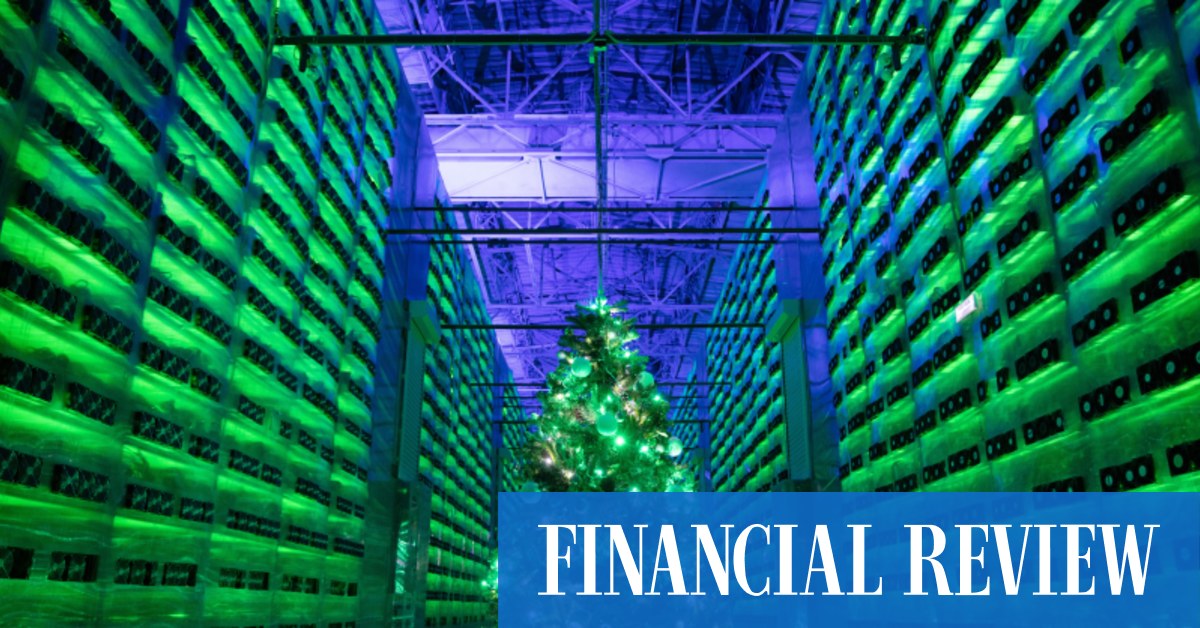
ESMA’s vice-chair has criticised the method of minting bitcoin that is using more renewable energy.
That requires significantly more energy than the proof of stake model, where the number of parties signing off trades is much smaller.
“The solution is to ban proof of work,” said Mr Thedéen, who is also director-general of Sweden’s Financial Services Authority and chair of sustainable finance for international body Iosco. “Proof of stake has a significantly lower energy profile.”
Industry-wide shift needed
Mining has become a highly lucrative and competitive business, with the amount of computing power dedicated to the process running at record levels, according to Blockchain.com.
China banned the process in May but activity has scattered across the world and there are now several publicly traded companies focused on the practice, such as Canada’s Hut 8.
“We need to have a discussion about shifting the industry to a more efficient technology,” Mr Thedéen said, adding that he was not advocating a wholesale ban on crypto.
“The financial industry and a lot of large institutions are now active in cryptocurrency markets and they have [environmental, social and governance] responsibilities,” he added.
His comments were made after Swedish authorities first floated the idea of banning the practice in November last year, noting the rising amount of renewable energy being devoted to cryptocurrencies while stating that “the social benefit of crypto assets is questionable”.
“[We call for] the EU to consider an EU-level ban on the energy-intensive mining method proof of work,” the Swedish financial regulator said in November.
Bitcoin is now a national issue for Sweden because of the amount of renewable energy devoted to mining.
— Erik Thedéen
Cryptocurrency mining has been attracting growing criticism for its impact on the environment. The practice accounts for 0.6 per cent of the world’s total energy consumption and burns more electricity annually than Norway, according to data from the Cambridge Bitcoin Electricity Consumption Index.
Faced with mounting criticism and the ban in China, miners have upped the share of renewable energy they use for powering their computers and pushed into countries with plenty of wind and solar power, such as Sweden and Norway.
“Bitcoin is now a national issue for Sweden because of the amount of renewable energy devoted to mining,” Mr Thedéen said.
Without intervention, he warned, a significant amount of renewable energy would go towards creating units of bitcoin instead of moving traditional services away from coal-powered energy sources.
Swedish regulators, citing estimates from Cambridge University, also noted that mining a single unit of bitcoin consumes the same amount of energy as driving a medium-sized electric car 1.8 million kilometres.
“It would be an irony if the wind power generated on Sweden’s long coastline would be devoted to bitcoin mining,” Mr Thedéen said.
Ethereum, the second-largest digital asset, has said it will migrate to the proof of stake model in June.
Financial Times
Read the original article

Comments
By throwawayffffas 2022-01-199:384 reply I am all for a ban too, if not because of the power waste then because of the semiconductor shortage.
Every wafer that doesn't become bitcoin miners can become something else.
By DickingAround 2022-01-1916:211 reply If you worry about the power waste, have a CO2 tax. You don't think some people's use of power is right, but perhaps they don't think your use of power is right. Is that really something you don't want to be a fundamental right, this concept of being able to use electricity as you see fit?
The idea of banning something because of a chip shortage is an even more extreme attack on the rights of others. One person makes specialized bitcoin mining chips (they can't be used for anything else), another person buys them. And you want to bring people with guns into it because maybe the person making the chips could be making them for whatever you want? Please, think deeply before asking for force and violence to be involved in a bunch of people peacefully going about their own ways and interests.
It's not about waste; it's a matter of managing an energy shortage while simultaneously trying to threaten Russia with sanctions and whilst being dependent on Russian gas.
A CO2 tax won't help when the issue is that the grids simply can't keep up with demand.
But it’s all about personal freedoms. It’s not important there’s a planet wide climate emergency, that there’s a massive decline in wildlife population - all these things don’t matter as long as we’re all free to dick around and do what ever we want without the spooky regulators with guns telling us what to do.
By fogihujy 2022-01-1918:18 Well, to be frank, it's not about the environment, and barely about national security: some places in Europe -- southern Sweden being the most notable example -- has severe energy shortages to such an extent that new businesses have to go elsewhere when they want to expand.
Other parts of Europe has a power surplus, but the grid's capacity simply isn't high enough to transfer all of it to the locations where it's needed.
As it turned out, the environmentalists' push to kill nuclear power wasn't that great since the plants were in the areas where the power was actually consumed.
By DickingAround 2022-01-1918:591 reply If they really are low on power, for whatever reason, it's time to raise prices. I know people like fixing the price below what the actual market rate would be but it causes a lot of problems. And Europe in particular isn't doing itself any favors by shutting down clean nuke plants and relying on fossil fuel Russia, of all countries. They need to re-think how they're managing their energy before it's too late. And "we allowed someone to use their computer a lot so let's ban that" is not a root cause here.
By fogihujy 2022-01-1919:26 No doubt about it; shutting down the nuclear plants ahead of schedule was simply a bad decision, and I don't think anyone is claiming that crypto actually caused the current energy crisis in Europe.
It's a mess caused by a whole lot of varying factors, ranging from public utilities being sold out to international cartels who pocketed the income without investing in grid improvements, to the EV rollouts, to power plants being decomissioned. On top of that, you have Russia flexing their muscles, and if that conflict somehow escalates then Russian gas imports will be weaponized. I suspect the EU would like to be the ones doing the weaponizing and that means reducing the energy usage and fast.
Under those circumstances, proof-of-work crypto is simply low-hanging fruit and banning it will have a relatively large impact with a fairly small number of people being hit. People will prefer that to even higher energy prices, regardless if it's morally right or not.
I think we need the government to decide exactly what technical parts should be produced with the production of semiconductors. Maybe they can make a 5 year plan for exactly what parts to produce and who gets them. Then we don't have to worry about any newtech coming in and disruping our current lives! /s
By drekk 2022-01-201:11 You're right, profit is the only ethical concern and government should step back and let the invisible hand of the free market sort itself. If it's economical to use child slaves for chocolate cultivation the government has no business stepping in to regulate business. If we can build faster pollution machines that make even more digital drug money who cares that researchers can't get GPU clusters for cancer research?
Might makes right and profit is king. If you want "innovation" you must let JP Morgan Chase Stanley Rockefeller dictate the productive forces and foreign policy of the largest industrial power in the world! /s
By solarman5000 2022-01-1915:174 reply "Wahh free market sucks.. Let's bring government in so they can force the market to change for me"
By qalmakka 2022-01-1915:54 Without government intervention, a completely free market would quickly cause the world to revert to feudalism. There should be a balance between freedom of enterprise and common sense.
By thehappypm 2022-01-1915:42 Government bans people from burning trash, this is pretty similar.
By MomoXenosaga 2022-01-1916:54 Does anyone even large scale mine in the EU?
I was under the impression most of these cryptocurrency assholes are in corrupt countries where energy prices are either low or its easy to steal electricity.
By toraway1234 2022-01-1915:23
By Proven 2022-01-1914:46 Then pay for it to become something else, instead of trying to use the government to steal it for you.
By usrbinbash 2022-01-197:386 reply The entire world should ban it. Burning the energy requirement of a nation to do less than 1M transactions per day, when credit cards alone handle 1 BILLION transactions per day, is absurd.
By DickingAround 2022-01-1916:335 reply It is if you think it's as simple as 'processing a transaction'. Anyone can design a system that records a transaction. It's very hard to make one that can't be deleted and can't be reversed. Doing this unlocks some amazing things, in particular hard, inflation resistant money.
And if you don't think inflation resistance is important, consider how many poor people have been robbed by those who just print more money and give it to their friends. It's been happening for centuries. It has destroyed whole countries just just once or twice but many times. Coin clipping to fund wars is as old as coins. So is stealing people's money at the point of a sword.
On the outside it might not appear 'efficient' when you don't have to implement all the same features bitcoin has. But if you actually try to build a system with these features, there is no better way so far.
By drekk 2022-01-201:16 You can reverse it, it's called a 51% attack. It's also too volatile to transact with. If I have $100 today I know it's not going to be $90 next week, then $65 the following, then $250 after that. This also makes it a shitty store of value.
Just be honest with what it is — a speculative asset everyone is hoping to get in "on the ground floor of". It only has value today because you can convert it to fiat, do you really think people would still use it if that were to change?
By eternityforest 2022-01-1920:34 Bitcoin can absolutely be stolen at the point of a sword, and unlike with a bank, they can't just reverse it.
In some countries, bitcoin might be better... but there's got to be ways to help them that don't involve the whole world mining.
It might not have inflation, but I suspect that if the whole world switched to CC we would still have poverty, still have slave labor type wages for some, and all the usual stuff.
Bitcoin specifically seems to have a built in regressive tax in the form of transaction fees. Even sales tax is a bit better because that has exceptions for most essentials. This punishes those who rarely ever make transactions above 100$ and rewards those who make large ones regularly.
By usrbinbash 2022-01-2010:20 > Doing this unlocks some amazing things, in particular hard, inflation resistant money.
What does immutability of the underlying record have to do with fluctuations in the tokens market value?
By pipodeclown 2022-01-1916:56 Look the central point of fiat currencies is that it provides for monetary control to governments, which includes a measure of inflation.
If you truly believe that replacing that with a non-state controlled currency that does not allow for monetary control is something government will allow or is even something that the general public would want, you're diluting yourself and are way to deep into the crypto bubble.
The only reason you hear anything positive about cryptos from the general public is because they think they can make a quick buck.
By maxerickson 2022-01-2013:42 The lack of a mechanism for reversing transactions isn't a feature, it's a misfeature.
When someone told me all of that energy behind Bitcoin produces less than 20 transactions per second I thought they were joking.
4, actually. By design.
This is fixed with off-chain transactions, which negate the benefits of using a blockchain in the first place.
I guess we should ban christmas lights in the US too then. They also use more energy than whole countries - https://phys.org/news/2015-12-christmas-energy-entire-countr...
By YATA0 2022-01-1919:57 The study linked in your sourced article uses data from 2008. It's becoming exceedingly difficult to find incandescent Christmas lights these days. A quick check on two of my local big box store websites shows that non-LED Christmas lights are not even available for sale. LED lights use an order of magnitude less energy, so the current energy consumption is going to be quite different.
By floatingatoll 2022-01-1916:55 That’s a good idea; if you write that up as a blog post and submit it to HN, I’d read it!
By BoiledCabbage 2022-01-1917:111 reply Do they also suffer from high exponential growth in energy usage?
By floatingatoll 2022-01-1917:161 reply No, but they are definitely an excessive use of incandescent bulbs in the United States. It’s too bad they haven’t figured out how to make cheap LED strands that are more diffuse and in warm colors, as this is a significant energy burden for both homeowners and the country’s electrical grid.
Your point that their usage doesn’t accelerate over time is valid, but as the link notes, this is still a significant energy burden on the country and should be addressed over time. It can be worked on in parallel to efforts to curb the growth of crypto coin energy waste, so there’s no harm in encouraging reductions to both.
By YATA0 2022-01-1919:58 >It’s too bad they haven’t figured out how to make cheap LED strands that are more diffuse and in warm colors, as this is a significant energy burden for both homeowners and the country’s electrical grid.
They have figured it out. It's becoming exceedingly difficult to find incandescent Christmas lights these days. A quick check on two of my local big box store websites shows that non-LED Christmas lights are not even available for sale. LED lights use an order of magnitude less energy, so the current energy consumption is going to be quite different.
You’re looking at it the wrong way. It’s not primarily a technology for transactions. Number of transactions doesn’t scale with the number of miners, the amount of value that can be securely stored in the network does.
Environmental concerns are a temporary issue & Bitcoin is moving to renewables faster than most anything else for a variety of reasons.
An outright ban is an absurd policy aimed at being punitive towards something people have an irrational hatred for. If you care so much about the environment just have reasonable energy policies such as a carbon tax and nobody would mine BTC with fossil fuels because it would be too expensive. Plus then you’re improving every other industry too instead of attacking cryptocurrency and making an insufficient impact on CO2 emissions in the process
By nicbou 2022-01-205:38 So what is it for? I keep seeing this argument, but it the end it seems like it's wasting a ridiculous amount of energy while not being particularly good at anything.
The energy being renewable doesn't mean much if it still wastes it. It could be used for something actually useful.
By usrbinbash 2022-01-207:16 > It’s not primarily a technology for transactions.
Well, what else is it for? All the things to be "put on the chain" (including transactions btw.) already existed in a more efficient form.
> Environmental concerns are a temporary issue
The environment is a concern for as long as humanity exists in it. And Carbon emissions are far from the only problem Mining causes:
https://www.bbc.com/news/technology-58572385
37,000 tonnes of waste per year. That's 37,000 tonnes of electronics for which raw materials must be gathered and processed, which must be assembled, transported.
> Bitcoin is moving to renewables faster than most anything else for a variety of reasons
https://www.sfchronicle.com/opinion/openforum/article/Bitcoi...
https://ohiorivervalleyinstitute.org/bitcoin-mining-breathes...
https://fortune.com/2022/01/05/kazakhstan-internet-bitcoin-m...
https://www.marketplace.org/shows/marketplace-tech/some-stat...
And even without that: It's just a giant waste of energy. Using the Energy requirements of a nation to process less than 0.5M transactions a day, when credit cards alone process 1B in the same time?
If we have surplus electricity, we can use it to power desalination plants, lower energy prices in underserved communities or literally just pump water uphill to store it. Almost everything is a better use than burning through tons of hardware, just so computers can scream SHA256 hashes at each other.
Also, one bitcoin transaction takes as much energy as 1.5 million visa transactions[0].
[0] https://www.statista.com/statistics/881541/bitcoin-energy-co...
I don't think that 1.5mm figure is accurate.
Assuming the power consumption for 1 BTC transaction is 1173 kWh as stated in the article, then we are off by a few orders of magnitude.
This is enough energy to run an IBM z15 mainframe at maximum configuration (~30kW consumption) for ~39 hours [0].
I am 100% certain that Visa can process more than 1.5 million transactions on such a platform in that amount of time.
[0]: https://ibm-zcouncil.com/wp-content/uploads/2020/01/IBM-z15-... (See page 88)
By eternityforest 2022-01-1920:371 reply I'm guessing there's probably several such maiframes spread out all over the place. One would presumably not want to store all the world's money on one server.
At the very least banks all have their own, right? And would they not want redundancy?
1.5 million might stil be a bit low though.
By bob1029 2022-01-1921:02 > One would presumably not want to store all the world's money on one server.
That's not how any of this works. Money is not stored anywhere in particular, unless we are talking about physical currency or commodities.
The entire point of a mainframe is to be able to centralize critical things (like credit card processing) that simply cannot be allowed to fail.
Most large banks and credit card processors operate their own pile of magic and then settle after the fact. It's not like VISA's IBM is the one big money bin that everything runs through.
> 1.5 million might stil be a bit low though.
In my scenario above, 1.5 million is a joke. That max spec machine could easily handle tens or hundreds of billions of credit card transactions in that timeframe.
It's wrong to see it as power consumption per transaction. The power used is to secure the monetary network. So for VISA you would have to factor in all their offices, running systems, employees, security etc. used to secure their financial network.
By floatingatoll 2022-01-1917:13 Those resources use a significantly lower total amount of energy per annum and per transaction relative to cryptocoins, as they do not depend on brute force scans of cryptographic hash spaces in order to perform and secure transactions.
By nicbou 2022-01-205:40 I'd still assume that Visa uses less power than Austria.
It’s also a system that is built on centralized systems. Is this really ideal? Do you really trust governments to handle the monetary system? No currency in the history of the world has survived in the long run.
The number of transactions has nothing to do with the energy spent on mining. Besides, the LN can already handle millions, if not billions, of transactions per second. You’re parrot
By usrbinbash 2022-01-1912:183 reply > Do you really trust governments to handle the monetary system?
Yes I do. Why? Because they handled it for hundreds of years, and it works all day everyday.
> No currency in the history of the world has survived in the long run.
Yes, so?
> The number of transactions has nothing to do with the energy spent on mining.
The number of transactions is a measurement of efficiency.
> Besides, the LN can already handle millions, if not billions, of transactions per second.
Only between 2 parties, after opening a channel between them, which requires: A transaction. And neither party can use any of the funds transmitted via the payment-channel in the wider network until the channel gets closed, which requires: Another transaction.
The banking system imposes no such limitations: A transfer can be initiated at any time to any IBAN in the world, with no prior agreement, the energy cost is miniscule, and the moment the transfer is completed, the funds are available to the other party for transactions to whatever other IBAN they want.
> Yes I do. Why? Because they handled it for hundreds of years, and it works all day everyday.
Do you mean to say that you are fine and dandy with your purchasing power eroding over time?
All governments eventually start tinkering with the money supply. It's all well and good that you trust your government to do the right thing, sadly that's not the case for a large portion of the worlds population. Have you seen Turkey lately? Lebanon?
> The number of transactions is a measurement of efficiency.
The number of transactions would be the same, regardless of energy spent on mining. Be it 1 joule or a million.
> Only between 2 parties, after opening a channel between them, which requires: A transaction. And neither party can use any of the funds transmitted via the payment-channel in the wider network until the channel gets closed, which requires: Another transaction.
This isn't correct. The Lighning Network isn't just a channel between two parties. It's a network of channels between participants that allows you to transfer to any part of said network. You can open a channel to someone and never close it. Why would you? There are channels that are multiple years old at this point.
> The banking system imposes no such limitations: A transfer can be initiated at any time to any IBAN in the world, with no prior agreement, the energy cost is miniscule, and the moment the transfer is completed, the funds are available to the other party for transactions to whatever other IBAN they want.
This is really looking at the current banking system with rose-coloured spectacles wouldn't you say? What about the billions of people that do not have access to banking? You don't think there's any value in those people being able to use something like Bitcoin to interact with the wider international markets?
By usrbinbash 2022-01-1918:30 > Do you mean to say that you are fine and dandy with your purchasing power eroding over time?
The Euros purchasing power has remained stable even through the worst financial crash in recent history.
So yeah, I think I'll be fine.
Hello, I'm Venezuelan, I have clients in the United States (I'm a software development).
Show me how to open a bank account using this monetary system that you love so much, so I can receive payments from those clients and feed my family.
With Bitcoin I can open an account from my bedroom, for free.
And I assume you then exchange your Bitcoin to USD or VEF, and proceed to use the standard monetary system. Or do you pay for your groceries with BTC?
By CogitoCogito 2022-01-1917:10 > And I assume you then exchange your Bitcoin to USD or VEF, and proceed to use the standard monetary system. Or do you pay for your groceries with BTC?
/u/danlugo92 wouldn't necessarily need to open a bank account. There's always the black market. Maybe bitcoin to cash is the best approach?
> Or do you pay for your groceries with BTC?
In some places I can yeah. Most that do accept crypto go the Binance route.
I fail to see how this is all relevant, you're just moving the goal posts now.
By agubelu 2022-01-1918:49 How is asking whether you can actually spend a currency moving the goal posts?
I think a better example of moving the goal posts would be how Bitcoin has gone from “currency", to "store of value", to "digital asset".
By solarman5000 2022-01-1915:212 reply >Because they handled it for hundreds of years, and it works all day everyday.
Yeah that great depression that started in 1929 and sank the world, the stagflation of the 1980's, the crisis in 2008, the 7% inflation this year, all evidence the govt does a great job handling it
By throwaway946513 2022-01-1915:37 If we're going to discuss crushing inflation and prices, shouldn't we also consider BTC and other coin's wild volatility? 60k one day, 40k the next. That's not a very stable system either.
I think you’re conflating the economy and the monetary system. The latter is part of the former, but only part.
Money itself is mostly done fine. Mostly: There are exceptions, but (outside of wars) I know if only a handful of examples where governments had something less stable than Bitcoin.
How is it fine? Even a currency like the USD has lost most of it's value over time: https://howmuch.net/articles/rise-and-fall-dollar
I guess you could call it stable. A stable decline!
Indeed it has.
First: That, within certain bounds, is deliberate — a small level of inflation helps the rest of the economy by encouraging spending. The last thing you want is people HODLing their paycheques.
Second: your link shows an average halving time of the US dollar purchasing power of 22.5 years. Bitcoin has about the same price today as it was 6 and 12 months ago, but was about double that 3 and 9 months ago. Even the Brexit referendum’s effect on the GBP would be hidden in the noise of BTC’s volatility.
First: Ok, so. Let's imagine that there was a perfect sound money. One that couldn't be tinkered with, one that couldn't be debased. Would you still need to "encourage spending"? I definitely do not think that's a given. I'd even argue that the need to intervene in the economy by playing with the cost of money is a symptom of the current system.
Second: Yes. No one is denying that Bitcoin is volatile. If you pick any arbitrary period of time you can come up with whatever statistic you want. This is not sound argument IMO.
1. Crudely speaking, money that stays in a savings account acts like money destroyed, i.e. deflation. Deflation encourages more people to do the same, because the effective savings interest rate is ≈ $nominal_interest + $inflation, leading to a spiral.
Except: money stuck in savings accounts also means the money isn’t spent on goods & services, so fewer jobs are supported, so productivity goes down, which is effectively +ve inflation even with the money supply perfectly fixed, but fewer jobs also encourages more savings and also triggers a spiral.
Which effect dominates (+ve or -ve inflation) depends on other factors, but both ways are a spiral of economic pain.
2. What? This is specifically about which is worse, how can you not make this type of comparison?
By ben_w 2022-01-2114:05 And now it’s too late to edit, I see an error:
> $nominal_interest + $inflation
Should either be:
> $nominal_interest - $inflation
Or:
> $nominal_interest + $deflation
Some currencies have survived for centuries.
But that's hardly a concern. When currencies fail, it's usually just another symptom of a deeper problem. Imagine Germany in the late 1920s with Bitcoin. There would still be mass unemployment, there would still be riots on the street, the Rheinland was still occupied, the government would still have to pay reparations, US companies would still be unwilling to continue investments in Germany. Almost none of the problems were caused by monetary policies.
And if a government destroys their monetary system with monetary policies alone, they can just introduce a new currency. That's not a apocalyptic measure.
By vintermann 2022-01-1914:291 reply > Almost none of the problems were caused by monetary policies.
Exactly. In that case, hyperinflation was a willed policy to get at anything of value, regardless of how destructive it would be in the long term, so that it could be shipped abroad (in this case, as war reparations). Making people dip into safe assets, trade them for rapidly worthless currency just to get by, is the whole point of hyperinflation.
Maybe an asset-rich person could get by for a while trading directly in his assets, but sooner or later they, or who they traded with, would have to deal someone who was forced to use government currency. At which point they would have to trade something valuable for something (rapidly) worthless: mission accomplished as far as foreign creditors are concerned.
I'm sorry but I can only answer that by saying that it's complete nonsense. It's not even wrong because all its assumptions are historically incorrect.
By vintermann 2022-01-2013:38 I think you should explain what historical assumptions are wrong then? because I have been looking for counterexamples for a while.
Can you give me an instance of hyper (say, > 100% monthly) inflation where the government wasn't desperately paying off foreign creditors, or were otherwise desperate to ship value abroad?
> No currency in the history of the world has survived in the long run.
The pound sterling has been running since 1489. https://corporatefinanceinstitute.com/resources/knowledge/fi...
By bitxbitxbitcoin 2022-01-1914:442 reply And is it still redeemable for a pound of sterling silver?
I don’t think 600 years counts as long run when it comes to world history.
By throwaway946513 2022-01-1915:44 Computers have existed for nearly 70 years. Bitcoin has existed for what... 13 years?
While the GBP value has changed over the course of 600 years, (of course it would, peoples and governments change in that same timeframe) hasn't a BTC as well?
If I sell an item worth $60,000 USD for 1 BTC, the next day the 1 BTC could be worth $40 or $50,0000 USD. Surely such volatility cannot be useful for a common currency.
"Stable coins exist" - and yes, they do - but if a stable coin is pegged to a currency, why do you not just use said currency?
By mbg721 2022-01-1914:48 I don't know what a reasonable expectation is for the longevity of a currency; I mean, in dog-years, I'm dead.
By vintermann 2022-01-1914:17 > Do you really trust governments to handle the monetary system?
I have no choice; my wages are paid in their currency, and they demand taxes in the same.
So I take on very little additional risk in using their money for everyday things.
Buying cryptocurrency, on the other hand, would expose me to a ton of new risks I'm not currently exposed to: to get remotely robbed with no recourse, that it should collapse in value by the time I would want to spend it.
It would not alleviate the risk from government at all: I can try keeping it secret from them, not declare it (which is illegal, risky, and gives additional headaches at the point I would want to spend it). Or I could let them know, which would leave me just as exposed to their old shenanigans.
Yes I do.
I trust our proof of stake 100% more than arbitrary Bitcoin miners who mine bitcoins somewhere.
At least our normal currency has real stake like people saving money to afford a car, people working and paying of the house they life in, salaries etc
We already have a very well functional proof of stake system.
By pjc50 2022-01-1912:42 Indeed. The bitcoin maximalists, like the goldbugs, dream of somehow surviving a collapse in which all that breaks down and they are the sole escapees, rather than seriously engaging with the problems and their fellow citizens. Getting their skin out of the game.
In some cases it's trauma-informed; they are, or know, people who really have experienced that kind of social collapse. It happens a lot in South America. People who grew up behind the Iron Curtain legitimately don't trust their governments either.
>Do you really trust governments to handle the monetary system?
Where do you think the monetary system actually came from?
By kevinak 2022-01-199:30 Does it matter? Not sure I follow, can you elaborate?
By KptMarchewa 2022-01-1911:541 reply Currencies have been existing literally thousands of years more than banks.
By emteycz 2022-01-1916:53 Yes indeed - currencies (not monetary systems) based on precious metals, such as the Groschen or Thaler.
That doesn't have much in common with the "gold standard" monetary system as it was in the USA. That emerged from a monetary system of private banks that issued their own banknotes.
And it has practically nothing in common with the modern quantitative easing monetary system that is orchestrated by public and private banks.
By TheGigaChad 2022-01-1910:30
This really is getting quite tiring. It’s such a red herring.
I’d suggest reading this article by Nic Carter to get the other sides POV: https://www.newsweek.com/bitcoin-mining-americas-most-misund...
This article is literally garbage.
It completely ignores that what Bitcoin is doing is a total waste.
Yes Bitcoin might use energy which might not could be used otherwise but it is literally better for our environment not to use this energy instead of creating heat and hardware garbage.
He also tells a lie that Bitcoin miners are happy to only consume excess energy while Bitcoin miner do the total opposite: they consume as long as it is financial success NOT as long as the energy is unused.
He even tries to make the new York Bitcoin power plant 'green' by stating that it also creates heat for the neighborhood and just bluntly ignores that this power plant consumes natural gas to calculate worthless hashes and heat.
The fact is that plenty of countries ban Bitcoin mining because it disrupts there power network, because it undermines the financial control and because what also happens that people are now able to steal power.
And yes in the USA there are people doing Bitcoin mining today and also paying for ac to cool it down and no one is doing Bitcoin mining because it's green (which it isn't) but because the energy price is lower as the hype of Bitcoin.
That's the only reason.
And it's the most shittiest reasons to burn through energy and hardware.
Fuck you Bitcoin miners fu
By usrbinbash 2022-01-1912:28 > Yes Bitcoin might use energy which might not could be used otherwise
Even using the electricity to literally just pump water uphill would be a better use than to pump it into the blorkchain:
https://en.wikipedia.org/wiki/Pumped-storage_hydroelectricit...
And if the world is looking for something to do with surplus electricity:
https://en.wikipedia.org/wiki/Desalination#Energy_consumptio...
Considering the fact that 1/10th of the worlds population have no access to safe drinking water, this would be a far better use ;-)
yeah we get it, it doesn't matter if any of those points improve or stop happening because at the end of the day your goal post will continue moving to "bitcoin is a total waste because I don't respect it anyway"
and thats not an absolute for everyone.
It's the fundamental problem of Bitcoin right now.
Right now and for a few years already this is ongoing and is hurting people and our planet.
And I did put up clear arguments don't put 'i don't respect it's in my mouth. I did not say that.
I'm not saying crypto coins itself is nothing we should research but we don't need to support Bitcoin to continue researching the technology or the idea behind it.
By vmception 2022-01-1914:12 Okay, you're right you didn't say that.
I don't feel that bitcoin is a total waste although I do feel their development roadmap and consensus making community hamper its competitive ability, in comparison to competing crypto coins.
I appreciate that you shared this, but I remain entirely unconvinced. His argument is "pff it's not that bad".
By kkjjkgjjgg 2022-01-199:362 reply No it isn't. Among other things he claims that the energy grid needs energy taken off from it at times (yielding pockets of negative energy prices), and Miners could stand ready to do that. He writes more stuff, certainly more than "it's not that bad".
If only we had something else to do with that energy... https://en.wikipedia.org/wiki/Flywheel_energy_storage https://en.wikipedia.org/wiki/Pumped-storage_hydroelectricit... https://en.wikipedia.org/wiki/Battery_storage_power_station and others https://en.wikipedia.org/wiki/Grid_energy_storage Or just distributing that energy long-distance to other places where it's needed.
Taking that energy off the grid is literally an incentive to not add any of those solutions which we will need in the future unless we finally agree to go nuclear.
the reason these things are not accomplished is because it costs more to do them than the energy is worth, which is the only reason it hasn't been done
if bitcoin mining makes you suddenly notice that you want these logistical nuances subsidized, after a hundred years of never noticing, then fine, compete with the miners at energy producing sites and legislatively that way
> after a hundred years of never noticing, then fine
What are you even talking about? The issue of peak vs base load/generation is known for ages and getting only more relevant for planning these days since most renewables are not constant output.
I'm talking about captured energy that was wasted directly into the atmosphere because it was uneconomical to send it somewhere else. You're talking about peak and base load.
By viraptor 2022-01-2213:11 That is extremely related. We have the extra captured energy because we have base load handling plants that can't scale down quickly enough. This is not a new effect or something people suddenly started caring about.
By marcellus23 2022-01-1913:251 reply > Miners could stand ready to do that
“Could,” or “are”? How many miners are doing this? How many would even want to?
By kkjjkgjjgg 2022-01-1916:02 So far one issue has been getting one's hands on mining hardware in a reliable way, I think. Yesterday I heard Intel wants to offer mining hardware, so that could perhaps make it easier to install a miner in your wind farm or whatever.
