
Or How Competition Returns to Elite Colleges
Politicians sometimes talk about breaking up companies, but it rarely happens. There are lots of reasons for this. Firstly, a lot of companies are really hard to break up. Sometimes this is just a natural fact about companies. But other times, break ups are made artificially harder. For example, Facebook (now Meta) deliberately made itself hard to break up as a defensive business strategy. Essentially, when political discourse about breaking up Big Tech started heating up, Facebook worked on integrating Messenger into Instagram and its other products. It tried to tie all the code together in a hard to untangle web so that regulators would get scared by the challenge and give up on untangling the company’s previously separate product lines.
Beyond business challenges inherent to breaking up firms, there are also legal challenges. Essentially, breaking up companies on antitrust grounds is nearly impossible because the courts have adopted a radically narrow standard of consumer harm. Further, courts hate to drastically intervene in markets. As a result, few antitrust cases ever result in breakups anymore. Because of the challenges inherent in breaking up firms, natural, artificial, and legal, breakups rarely happen. This is why when politicians talk about breakups, few voters really believe them.
But elite colleges are different. They’re quite easy to break up, and you don’t need to go through the courts. Essentially, the key component of elite colleges isn’t their campuses, nor is it their professors, nor is it even their qualified student bodies. There are plenty of campuses, professors, and qualified students to go around. The key component of elite colleges is their resources, also known as endowments. These resources enable elite colleges to maintain strong brands by being ranked higher than other schools. The endowments allow elite colleges to afford things that other schools can’t. Furthermore, the large endowments operate through flywheel effects, because the more resources a school has, the higher its ranking, and therefore the more resources it is likely to attract from donors and others.
To break up elite colleges therefore, all you need to do is break up the endowments. Siphoning resources from school endowments is actually quite easy. You don’t have to file an antitrust suit. Instead, all you need to do is pass legislation. Congress could literally just tax the hell out of large endowments. It could then take those resources and endow new colleges. For example, if you assessed a 100% tax on every dollar above $10 Billion dollars at every single elite college endowment, you could endow dozens of new elite colleges. With one piece of legislation you could grow the size of elite college enrollment by an order of magnitude (10X).
For example, Harvard’s endowment is worth something around $50 Billion. If this year, you assessed a tax on Harvard for $40 Billion, you would leave Harvard with a $10 Billion dollar endowment, and enough money to endow four new Harvard caliber schools with $10 Billion dollars each. These new endowments could then go and buy or build new campuses. Instead of just one Harvard, we would now have five. You could repeat the process with Yale, Stanford, Princeton, MIT, Penn, and others too. Dozens of new elite colleges would emerge. Heretofore dead capital stuffed in treasure chests at elite colleges would finally become productive again. This project could instantly reawaken a vigorous competition for students, professors, and new programs.
There will be plenty of critiques of such a policy as unsustainable from the status quo alarmists, and in future posts I’m happy to address such concerns. But having outlined a practical and possible pathway towards breakups, let me expand on why this is so important.
The elite colleges argue that they keep small class sizes because not everyone can handle the work. This is obviously false. Anecdotally, I think its fairly clear that in the fierce competition for limited seats, plenty of students get denied at top schools who could handle the work there. Further, there’s a reason that we’ve seen a new class of schools emerge. If you randomly took students from what has increasingly been dubbed “Ivy-Plus”, “New Ivies”, or “Hidden Ivies”, and swapped them with students at other slightly higher ranked schools, the academic results would be negligibly different, if different at all.
The impact of this seat scarcity has been higher prices at elite colleges, which has eventually trickled down into higher prices at other schools also. Scarcity of seats leads to systemically higher prices. As we obviously want systemically lower prices, we have to start thinking about reducing the scarcity of seats at elite colleges.
Some might say there are other ways to expand enrollment that aren’t so drastic as breakups, but these types of solutions are actually inferior. For example, taxing endowments annually at a higher rate if they don’t expand seats to incentivize larger class sizes has been tried, and it hasn’t really worked. But even if the annual tax rate was jacked up, and it did work, it still would be an inferior solution because while such a incentive-tax might increase enrollment, it wouldn’t solve for the underlying structural issues of which low-enrollment is but one symptom.
Essentially, we have low enrollment because elite colleges are hyper obsessed with prestige. The prestige obsession is currently resolved, at-least partially, through rankings that rarely change much year after year because nothing really happens in higher education that would make anyone rethink the brand hierarchy that has slowly ossified in the public mind. But if you begin breaking up old endowments and endowing new schools, suddenly there will be a reason for students and parents to turn away from the rankings to more carefully assess the new programs being created and the new competition taking place for the best thinkers and best students.
Further, break-ups is the best solution to the winner-takes-most market structure of elite education. Essentially, schools like Harvard, Stanford, and Yale have so much money that they will always be near or at the top of the prestige competition. As a result, they will always attract future donations from big billion dollar donors who want to associate themselves with some of that prestige. Therefore, elite endowments correspondingly grow more than others. The result is that resources agglomerate towards to top. This extra capital becomes dead capital as endowments get bigger and bigger but schools like Harvard do nothing with these extra resources because they see no reason to expand enrollment. Essentially, the surplus money goes into a piggy bank with no productive plans apart from stock market speculation. This might seem harsh so let me be more fair. Sometimes, endowments speculate in art markets also. Basically, this money is taken out of productive circulation. At least, this is what we’ve seen over the last few decades.
Also, this winner takes most market structure is bad for innovation because Harvard, Yale, and other top schools don’t have to do anything particularly special to attract new capital. They don’t have to innovate in teaching. They don’t have to prove particularly successful with new innovative research. They don’t have to do anything apart from harvest their old brand names for new money. This might be why we’ve seen so little innovation in teaching methods in higher education for centuries. Essentially, lecture halls, exams, and midterms are all centuries-old methods. Can nothing better be invented? Surely it can, but there is currently no reason to try.
When new elite colleges are endowed, and competition begins on roughly equal terms by these elite schools, we will see far more seats, far less charged in tuition, far more offered in financial aid, and far more innovation in teaching.
Frankly, if you think low prices and more options makes for a better system, you should support breakups. If you prefer high prices and less options, don’t subscribe to this Substack. It’s probably not for you.
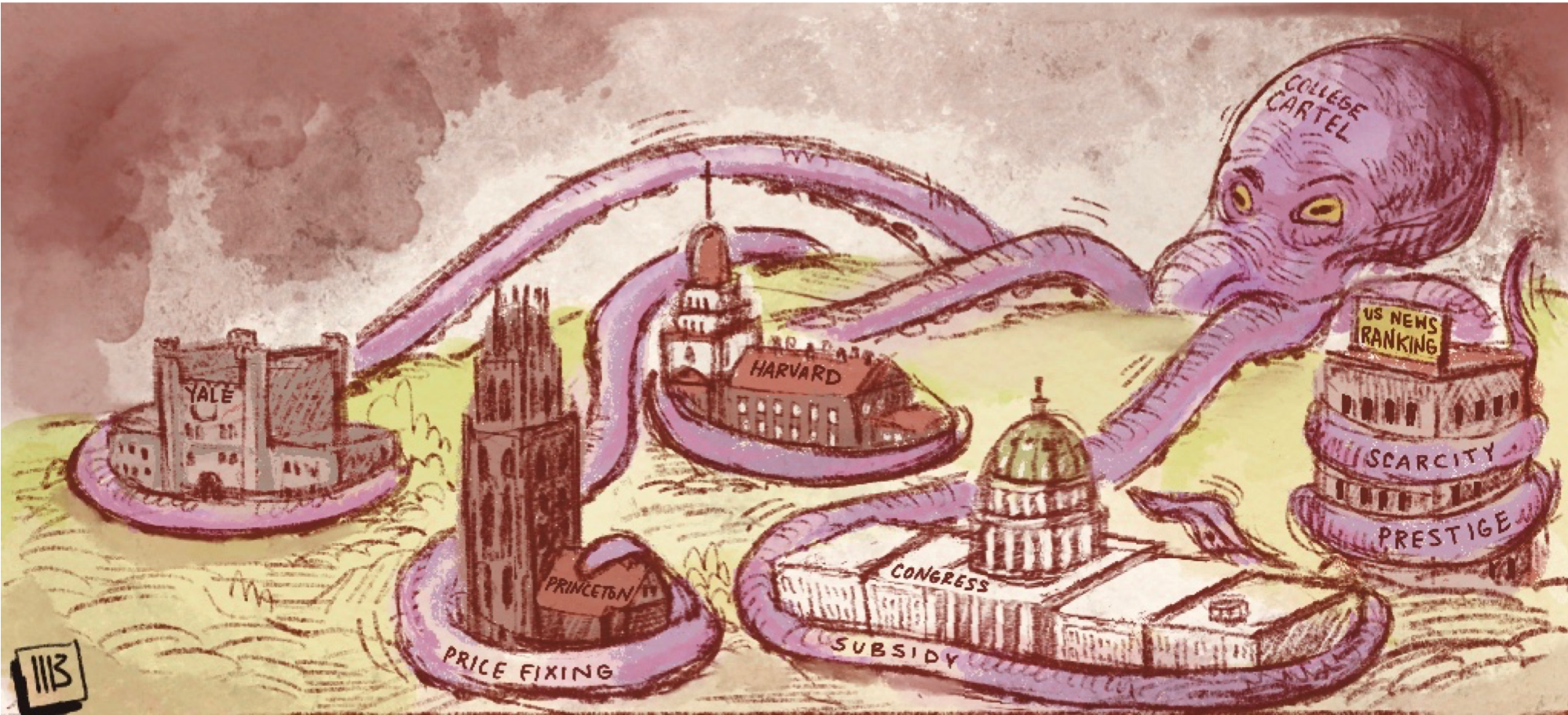
Break-Up the College Cartel!
Read the original article

Comments
By buzzy_hacker 2022-06-022:537 reply Tangential to the suggestion of taxing endowments, I like Michael Sandel's idea of turning admissions into a lottery once a threshold is met. E.g. anyone with a GPA above x and a SAT score above y with a personal essay judged to meet quality level z (simplifying for illustration) is told that they have passed the acceptance threshold and are entered into the random lottery. The threshold should be set so that students who are prepared enough to succeed in the school are entered into the lottery and those who are not sufficiently prepared are not entered.
Then the freshman class is simply selected by choosing the number of available spots by random from those who have passed the threshold and entered the lottery.
It seems this would take a lot of pressure off high school students since meeting this threshold would be a well-defined goal. Once they've met it, they can start investing their time, energy, and resources into other pursuits like passion projects or time with friends, which would be a boon to mental health.
And the admissions process is essentially random anyway for the elite colleges, assuming you have sufficiently high scores. Making it explicitly random would take some (perhaps undeserved) prestige, status, and exclusivity away from the degrees from these schools -- not that the schools aren't good, or that it isn't hard to get in, but that there are many more who are just as well qualified that do not as there are who do; a fact that would be more well-recognized in society if the lottery approach were adopted. Of course, the elite schools don't want their status (and therefore degree value) tarnished so we're unlikely to see this happen of their own accord.
The problem with that lottery is that it still doesn’t solve the problem of artificial scarcity. There is no reason why a “Harvard” level class is restricted to just a room full of people. We totally have the technology and capabilities to scale it to the masses and make education vastly cheaper but we choose not to for some reason. I think part of YC’s philosophy is basically this. Think making startups accessible rather than just some elite institution for wealth preservation.
> The problem with that lottery is that it still doesn’t solve the problem of artificial scarcity.
This is assuming it's a problem that can be solved with simple tweaks or "startup disruption". It's an issue very much related to conspicuous consumption as education >in the Ivy League/cohort< is now a luxury good. Modeling a "prestige" factor helps account for the inequality [0].
Freakonomics[1] just did an episode on this, but I've come across similar data points else where. It's a stamp of not just a good education, but a social credential implying you have connections or money.
You can already get an equivalent education to one you might get at Harvard (or better in some majors) at many other public/private universities. The key here is the human connections you form, which go on to pay dividends later given the point above.
MOOCs were the golden child a decade ago, and they are working to some extent, but they're not breaking the elite walled garden of premier higher education.
[0] https://www.nber.org/papers/w29309
[1] https://freakonomics.com/podcast/the-university-of-impossibl...
I’d imagine they work nicely for software engineering, but even then a lot of jobs out there are requiring degrees and might attribute too much ti the brand of college. Some sort of objective skill evaluation that is also officially recognized must be implemented in addition to actual knowledge acquisition. As I understand it if you are a doctor and capable in every way if you don’t have the degrees you can’t even be tested?
By pas 2022-06-0211:43 > but even then a lot of jobs out there are requiring degrees and ...
yes, and that's basically the crux of the problem. this is a social coordination problem, not a problem of education.
the trivial solution is to "outlaw" this by blinding the prestige credentials of the candidate (so only show a standardized thing like 3 year applied maths bsc) and only ask about previous experience (2 years working as data scientist) or whatever
"obviously" people will try to game this (though other universities can then copy what comes out of the fancy universities)
of course this could quickly lead to the rise of alternative prestige/reputation networks, but if the whole job application is standardized (so it becomes very hard to identify the candidate) then at least it gives a chance for folks to get in the door.
then only the usual biases remain, and the usual unfair questions (and typically the most disadvantaged candidates have the least chance to know about what kind of questions are discriminatory, and even if they know most of the time they don't have the time/energy to do anything about it)
Harvard is a good example of artificial scarcity. They have an extension school[1], where they advertise that you'll be given a Harvard education, by Harvard faculty, virtual or at the Harvard campus. It has somewhat open-enrollment, and thousands of people enroll every year. They're happy to take their money, but the students aren't allowed to say they're a Harvard graduate, they have to say they're "Harvard Extension School" graduates.
Harvard knows it's whole mystique is based on elitism and the artificial scarcity it creates by denying people admission.
By maneesh 2022-06-026:07 I'm finishing my masters with Harvard Extension School and it's mostly as you say. It's good curriculum, pretty good professors (in comparison to my Stanford undergrad) but open-enrollment + Harvard's famous grade inflation does make it somewhat of a back door.
> We totally have the technology and capabilities to scale it to the masses
If you're an undergraduate at Oxford[0] or Cambridge[1] you can expect to have multiple weekly sessions where two or three students get a session with a professor or postgraduate to go through material that's been presented in lectures.
Does this scale? Based on my experiences (six years in total, three on each side of the table as it were) I very much doubt it.
[0] https://www.ox.ac.uk/admissions/undergraduate/student-life/e... [1] https://www.undergraduate.study.cam.ac.uk/courses/how-will-i...
By CuriouslyC 2022-06-0213:033 reply It can, very easily. Have students watch a lecture and read the accompanying text, then have them take a quiz, then have a review session where the most missed quiz questions are covered, along with popular questions submitted beforehand. Finally, set up study groups to let peers answer easy questions, and have virtual office hours/email for the few remaining difficult questions that peer groups can't answer.
The only thing that doesn't scale is on campus life, and that's meaningless to the degree that college is nominally about.
By logifail 2022-06-0213:15 > Have students watch a lecture and read the accompanying text, then have them take a quiz, then have a review session where the most missed quiz questions are covered, along with popular questions submitted beforehand. Finally, set up study groups to let peers answer easy questions, and have virtual office hours/email for the few remaining difficult questions that peer groups can't answer
With respect, I don't believe that approach could work for the combination of the type of material covered and the type of (often open-ended) questions and discussions that resulted from it.
One of the questions I recall being asked to solve for a first-year Physics tutorial was "estimate the change in the length of the Earth's day if all the vehicles in the UK were to swap to driving on the right hand side of the road instead of on the left"
By forgotusername6 2022-06-0213:15 What you are describing doesn't really compare. I'm sure it would do a reasonable job, but focused individual attention is really hard to replace. Most of what you've described happens at Oxbridge in addition to tutorials/supervisions.
By jkingsbery 2022-06-0210:42 Having had small classes undergrad and larger classes where I went to grad school, scaling a class is not simple, the experience changes. With larger class size comes less in interactive lectures, more reliance on TAs (of varying quality) instead of professors, and different kinds of assignments. We don't have an easy way to scale these things yet.
By scld 2022-06-0210:47 The main reason is that the vast majority of the benefit of the Harvard is not the class but the name on the diploma. Signaling and status do not scale.
By buzzy_hacker 2022-06-023:461 reply I completely agree with you. I think it would be best to expand class sizes in addition to this lottery.
By chrischen 2022-06-025:21 Yea or do virtual classes or even video classes with distributed TAs that answer questions.
By chipgap98 2022-06-0210:44 I think there are a lot of reasons why it can’t scale but none of them are related to the time spent in a Harvard class room.
The social connections and the culture are the key parts of elite colleges. I don’t think you can scale that with online classes.
By flashgordon 2022-06-0218:44 One thing I have always found wierd is why is the "personal essay" (which is easier to game by folks who have the right connections/support groups/etc) a criteria for getting into a college? It almost feels like this is very hard to establish a transparent bar for, no? Cant colleges does exploit this aspect to get around randomness?
By 1270018080 2022-06-025:39 I'm sure the legacy students at Harvard (1/3 of each class) and their parents would love this.
no one, especially not some random contemporary, owns the idea of using a lottery once a threshold is met. that concept has been thrown around for millenia to pick lots of all sorts. i've even suggested it as a reasonable approach to hiring right here on hn, and didn't even need to crib the idea off anyone else to do so. it's a rational solution for a decision system under high, but not unbounded, uncertainty.
By buzzy_hacker 2022-06-0214:241 reply Not saying Michael Sandel owns the idea, I first heard it in his book Tyranny of Merit.
By clairity 2022-06-0216:28 so reference the book, which is more useful, rather than some rando name.
By cm2187 2022-06-0211:51 It would also have the merit of distributing the best students to other colleges and eliminating (at least the perception) that those top college short list are a relevant filter when selecting CVs. The focus will be on the student, not the credentials, as it should be.
By TrackerFF 2022-06-027:34 While I support lotteries in many different applications - I wonder if this may lead to people simply wasting years on trying to get in. Or alternatively, those qualified will keep applying until they get in.
By ceeplusplus 2022-06-023:07 This is done entirely to admit fewer Asians as a form of racial discrimination. See: Lowell High School.
It's not endowments that makes elite universities elite, it's a combination of social cachet, alumni networks, and brand. Cambridge, Oxford, and Sorbonne have been elite universities for centuries, and it's not mainly from their endowments. It's because if you are [smart|powerful], you want to go to a school with other [smart|powerful] people and you know [smart|powerful] people will be going there. A larger marketing budget isn't going to get people to look at a resume and pick the University of Phoenix over Harvard.
By Glawen 2022-06-0210:14 I think it is more vicious than this, as a powerful person, you want your children to continue in the same sphere. Except that children are not necessarily as good as you. So you create a system where powerful people can put their children and perpetuate the family standing without risks of being overrun by gifted lower class children.
The situation as seen from France is odd. Here, elite STEM universities are free, and the very best ones even pay their students. Having legacy admissions would be unthinkable; it's the opposite of meritocracy. And you don't need to "socially" prepare since birth with all the right extra-curricular activities.
Also all the exams are blind/anonymous, and recruitment strictly based on grades. Or at least they used to be.
Despite this the French system has a very low rate of social mobility, and the overwhelming majority of students in top colleges come from parents within the system.
Now there are good reasons for social background to be sticky (not the least because I don’t buy the tabula rasa theory that your genes account for nothing in your intellectual capacity, and for the part they don’t, well how your parent raised you should matter), but it is implausible that such concentration is a natural outcome (the respective size of elite vs non elites in the country is such that even with a high natural stickiness, you should still see half or at least a third of a top college generation coming from non elite families, I think France is in the <5% territory).
Having graduated decades ago and not living in France, I follow it from afar, but it looks like the government is actively trying to eliminate the meritocracy part of the system. By preventing elite high school from selecting their own students, by creating as many parallel admissions to colleges that were purely competitive exams based.
I have mixed feelings about it. One one side I like the idea of a cursus to be purely merit based. On the other side the obsession of the French with education is unhealthy, where your career at 50 is still determined by an exam you sit 30 years before, and this tendency of having clubs within clubs for the elite to run the country with little competence or accountability (again an exam you did when you were 20 doesn’t qualify you for everything) has lead to fuck ups after abuses after frauds. I would prefer a decentralised german style system where (from what I understand) what matters is the student, not the name of the college.
By matthewdgreen 2022-06-0212:50 The desire to pass advantages to our children is one of the most powerful driving forces in the human psyche. Any system that isn't adversarially designed and constantly-tuned to fight this desire will eventually succumb to it.
By 908B64B197 2022-06-0216:01 > and for the part they don’t, well how your parent raised you should matter
I think you nailed it.
There's a strong cultural component to doing well in school. Just the parent's perception of schooling matters a lot (is reading for fun something they do or encourage?). And of course there's a lot of implicit knowledge about test taking and what really matters at school. Someone who navigated these exams before will be a much better guide for sure.
> By preventing elite high school from selecting their own students, by creating as many parallel admissions to colleges that were purely competitive exams based.
How much of that is to increase racial diversity?
> On the other side the obsession of the French with education is unhealthy, where your career at 50 is still determined by an exam you sit 30 years before, and this tendency of having clubs within clubs for the elite to run the country with little competence or accountability
Maybe that's why there are so many French expats here in the Valley!
Considering that the US universities consistently rank among the top and they do produce the significant portion of the groundbreaking innovation and technology, maybe the American model has a merit?
If you think about it, legacy admissions strengthens the connection of the alumni(which is likely to have significant career progress at the time of their offspring attends college) with the institution and gives them reasons to protect and the school from political hostilities. The legacy admission students give access to their successful parents connections. It should be nice to have the kids of Google founders as classmates, for example. Don't you think?
It's not like the tests for admission can %100 accurately test the talents of the candidates anyway. Maybe diversity in admission is an actual strength that rest of the world lacks?
What makes an institution elite anyways? I would say its legacy(the alumni) and its future(the candidates). There might be a healthy balance of giving up some resources from the future to keep the connections with the past strong.
By 21723 2022-06-0210:58 > Considering that the US universities consistently rank among the top and they do produce the significant portion of the groundbreaking innovation and technology, maybe the American model has a merit?
There's a long discussion to be had here, but... let me try to give the short version. Sure, the US does some things right. Mostly, though, it's momentum. The US made some very good decisions between 1940 and 1990 and academia evolves slowly, so it's only been in the past decade that we've started to see the loss of relevancy.
> If you think about it, legacy admissions strengthens the connection of the alumni(which is likely to have significant career progress at the time of their offspring attends college) with the institution and gives them reasons to protect the school, and the legacy admission students give access to their successful parents connections. It should be nice to have the kids of Google founders as classmates, for example. Don't you think?
This is a pretty naive view, and I say this as someone whose peer group is at least 50% elite college grads.
Smart poors and legacy kids don't really mix. When the mixing does occur, it's predatory. The truth is that, by age 18, people who know they are and where they fit into society, and the rich kids have already been socialized to see us as the enemy, the teeming masses, the poors who exist to be exploited then discarded.
If you want to "make connections", you have to do it in the first two years of prep school. Beyond that, it's too late. Those fuckers will never let you in. You have a better chance (still low, but nonzero) at violent overthrow with a large enough rabble armed with AK-47s.
That said, you're not wrong that it benefits smart poors that rich brats also attend the same schools. It's a fog-of-war effect. At the individual level, you don't know if a person got in because they were smart or because they were rich. Thus, the rich brats look like they might be smart, and the smart poors end up with enough of a rich brat veneer to make it, at least, into middle--possibly lower-upper, if they don't make mistakes--management.
By strikelaserclaw 2022-06-0214:221 reply I would postulate US universities ranking among the top and producing groundbreaking innovation and technology is more a function of US being a cultural, economic hegemony for the past 80 years than it having some magical "system" that works. Before WW2, when you think of groundbreaking research you think of USA as a backwater compared to Europe. It is also my feeling that this American system is going to unravel in tandem with its economic/cultural collapse if nothing is done to heavily modify the rigged system.
By Longlius 2022-06-0214:39 The USA was hardly a backwater compared to Europe before WW2. Princeton had a world-class mathematics department where people came from all over the world to study and research, among them Alan Turing (whose collaborations with Alonzo Church turned out to be very important to this website).
And even before the 20th century, American scientific acumen was fairly well-regarded. Benjamin Franklin's reputation in Europe was partially based on his scientific achievements.
Europe's disdain for the Americas was almost always rooted in a belief of cultural superiority, not a belief that American science or engineering was weak.
By matthewdgreen 2022-06-0212:54 In my research field (CS), large universities have a big advantage. They have more resources (valuable for systems fields) and more students. Even if Harvard may have stronger undergrad students overall than random-U, their candidate pool of undergrads->potential PhD students tends to be much smaller. This isn't absolutely a rule (some smaller schools do very well in specific areas) but it's definitely a force I've noticed.
By throw0101a 2022-06-0211:111 reply > Considering that the US universities consistently rank among the top and they do produce the significant portion of the groundbreaking innovation and technology, maybe the American model has a merit?
Britain had quite a lot of innovation during the 1800s when it coïncidentally also had one of the larger/est economies. As the economy of the US got larger and larger in the late-1800s / early-1900s all of a sudden it also coïncidentally started inventing a whole bunch more things.
How much of the innovation and technology from having the largest economy in the world and the most money/capital to throw around?
Certainly there needs to be a certain culture present, especially individualism and capitalism, but how much is 'brute size' a part of the equation?
By strikelaserclaw 2022-06-0214:25 Aren't most of the Phd's in STEM in America foreign born? If America no longer had this "brute force", then those people will likely go to the new cultural/economic capital of the world and a new country will rise which "innovates heavily"
French universities absolutely do have legacy admissions. It's called admissions paralleles (or sur dossier), you can pay your way in with minimal effort and get the same diploma upon graduation.
By rtpg 2022-06-029:59 Admission sur dossier rarely happens at the engineering schools (which is where most elite go). Or it’s an extremely small sliver of the population (usually people who transfer from universities or other programs).
Polytechnique has 32 university admissions compared to ~300 from the entrance exams.
Harvard is 1/3rd legacies!
