
MyPowerbank hacks Santander bikes so London's homeless can charge their phones

2023-10-0112:24193142www.dezeen.com

Central Saint Martins graduate Luke Talbot has created a portable charger that can be hooked up to rental bikes to allow people experiencing homelessness to charge their phones for free.

Central Saint Martins graduate Luke Talbot has created a portable charger that can be hooked up to rental bikes to allow people experiencing homelessness to charge their phones for free.

On display as part of the Design Transforms exhibition at CSM during London Design Festival, MyPowerbank was designed to slot onto the chain of any Santander bicycle – rentable bikes provided by Transport for London – parked in one of the 800 docking stations across the capital.
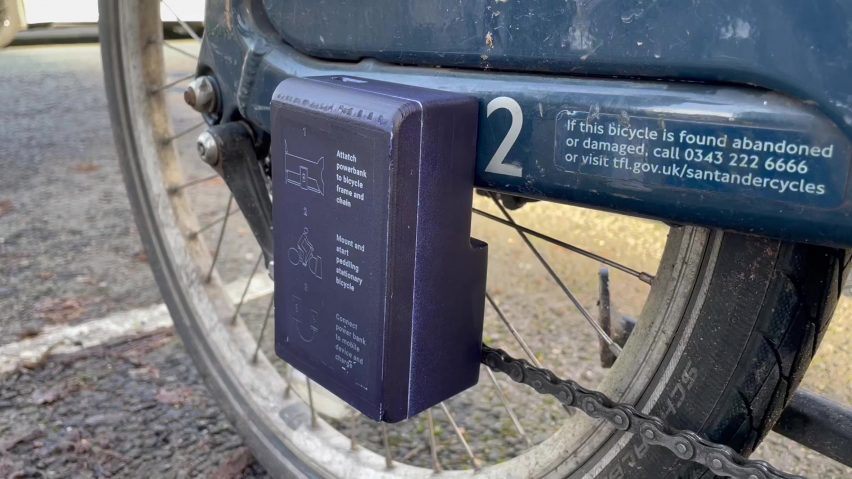
MyPowerbank by Luke Talbot attached to the frame of a Santander bike
MyPowerbank is charged up using Santander city bikes

Talbot's product takes advantage of the fact that, without having to pay to take out one of these bikes, their chain will still move when pedalling backwards. This can power up the tiny pedal-powered generator contained in the portable charger.

The electricity generated in the process is then stored in MyPowerbank's internal batteries, with around 25 minutes of pedalling equating to one full phone charge.
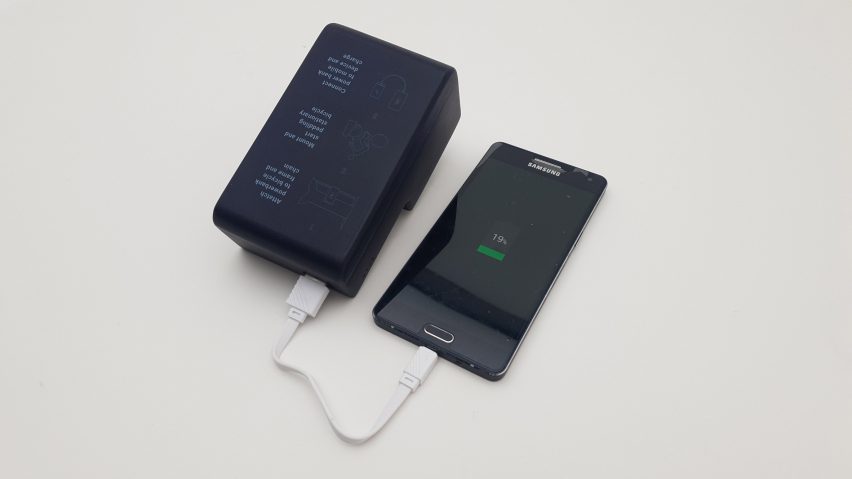
Portable charger hooked up to a phone
Luke Talbot created the design for London's homeless

While most homeless people own a phone, Talbot conducted interviews with people sleeping rough across London and found that many struggle with finding a place where they can actually charge the device.

This can restrict their access to crucial digital services, from texting and banking to applying for benefit schemes.
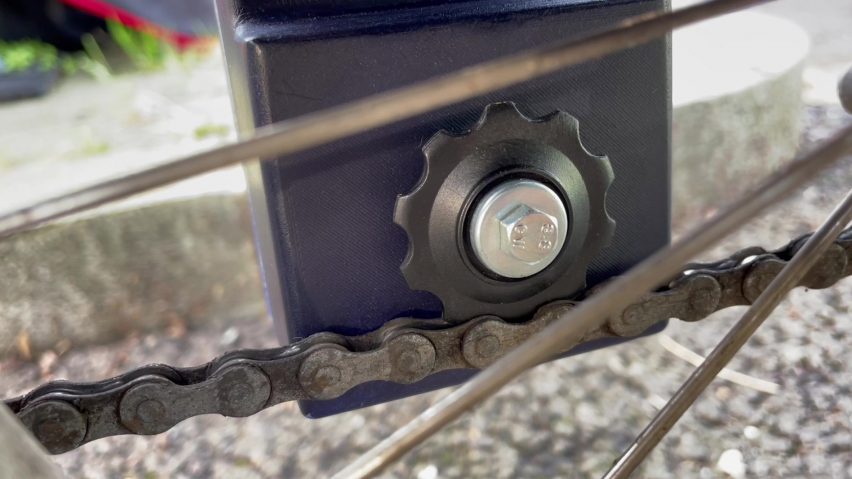
Gear on back of MyPowerbank by Luke Talbot sat on top of a bike chain
The powerbank's gear is designed to slot onto the bike chain

"When they started bedding down at night, becoming rough sleepers, a phone was their biggest priority because without that everything is so much harder," he told Dezeen.

"Every facet of our daily life revolves around the convenience of what a phone can do for us, from Google Maps to transferring money to messaging our friends, which keeps us sane," he continued. "They're just so life-or-death crucial."

The project was born out of Talbot's research into how urban infrastructure, often designed to make life hard for homeless people, could be hacked for their benefit.

In particular, his design was inspired by the blow-up homeless shelters of American artist Michael Rakowitz, which are inflated using buildings' hot air vents.

"I really fell in love with this idea of having this city that was designed against a certain group of people to segregate them socially, taking what the city gives away for free and using it against itself," he explained.

MyPowerbank by Luke Talbot attached to the frame of a Santander bike
An internal magnet connects the power bank to the bike's metal frame

MyPowerbank works using an integrated dynamo like the kind commonly used to power bike lights, which turns kinetic energy from pedalling into electric energy.

A small gear at the back of the device is designed to slot onto the bike's chain, while an internal magnet clips onto the metal frame.

"The chain spins that gear, the gear spins the dynamo and the dynamo charges the two lithium-ion batteries inside," Talbot said. "The thing I like about it is that it's not new fancy tech, it's actually really old tech that's been reformatted for a new purpose."
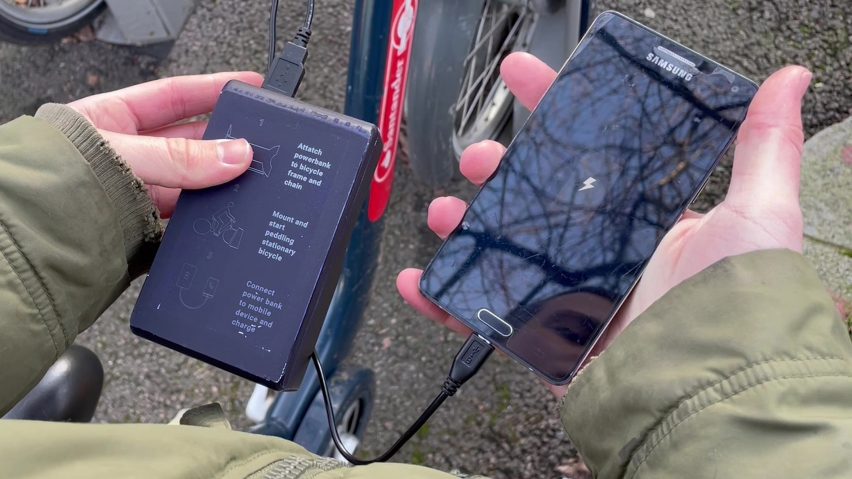
Hands holding a phone that's being charged via a powerbank
A full phone charge requires 25 minutes of pedalling

Talbot's working prototype features a 3D-printed shell, finished in the same navy blue as the Santander bikes' frames so as not to draw undue attention, while instructions are printed in UV ink so they are legible at night.

He built the dynamo from scratch using a Youtube tutorial and the two batteries, which each hold up to four full charges, are reclaimed from old powerbanks.

After being named one of the winners at this year's MullenLowe NOVA Awards, Talbot is now using his prize money to help make the design production-ready and cut down on the pedalling time needed per charge.
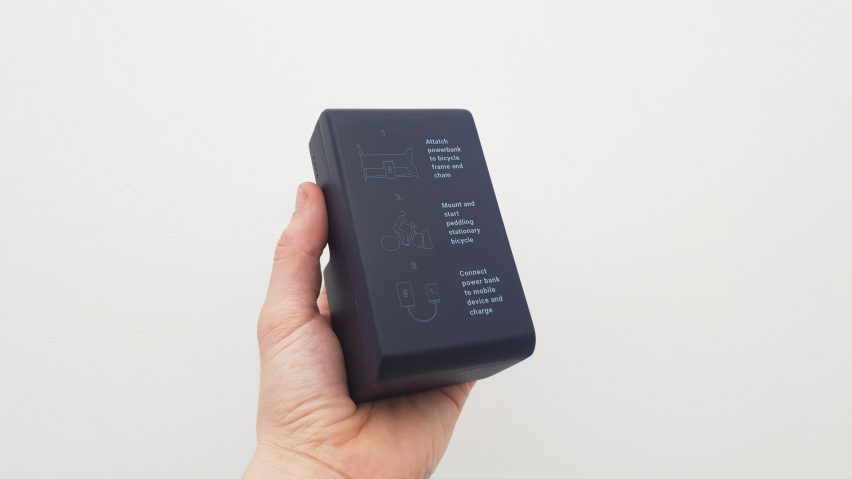
Hand holding MyPowerbank by Luke Talbot
Talbot is hoping to get the design production-ready

With components being sourced in bulk, he believes the powerbanks could be manufactured in collaboration with a charity or NGO for as little as £3 and distributed by homeless shelters to those who are most in need.

"Hopefully there'll be a circular repair system behind that so if it's broken, they could give it back to the shelter and the shelter would send it back to whoever ends up running it," Talbot said.

Other standout projects from this year's London Design Festival include a traditional West African bench reimagined as a giant game of Oware, a handbag made from bacterial leather and a furniture collection crafted from a single car.

Design Transforms was launched as part of London Design Festival and is on show at Central Saint Martins' Lethaby Gallery until 15 October. See our London Design Festival 2023 guide on Dezeen Events Guide for information about the many other exhibitions, installations and talks that took place throughout the week.


Read the original article

Comments

  • By spaintech 2023-10-0113:337 reply

    While I applaud the intent to bring the issue of homelessness to the forefront of the media, I feel like this project is more about gaining self attention for the project rather than solving the issue all together. The ~20GBP for the 18650 or 27500 batteries, the probably ~5GBP of the PCB needed, ~15GBP for the chain hardware and magnets, you are looking for a >40GBP to put this together, you can today get a <10GBP USB hand crank, and you don’t have to use the words “hack” and name “Santander” on your blog. I’f there was intent, then a volume buy, with a go-fund-me campaign, you can get them hand cranks for <2GBP in volume, and it would have had a real impact… I hate it when serious matters are used just to draw attention to one self, IMHO.

    • By Kye 2023-10-0116:361 reply

      This is the same mistake the OLPC people made. When you're broke and struggling to feed yourself, you aren't going to waste precious calories cranking to charge a battery. You're going to bum enough off someone to have a calorie-rich drink while you charge in a coffee shop or find a public outlet you can sneak some juice off of.

      • By KennyBlanken 2023-10-0122:292 reply

        I met a number of people involved in OLPC and every single one of them was an insufferably smug tool with a massive white-savior complex. Kids in Africa didn't need a hand-crankable laptop. They needed clean water to survive infancy, light to be able to study by, and to not be captured and turned into soldiers.

        • By FirmwareBurner 2023-10-0210:00

          >every single one of them was an insufferably smug tool with a massive white-savior complex.

          Silicon Valley nailed it.[1]

          These tech people thinking they're "saving Africa" with crankable laptops are just like the former Crypto pundits you'd see roaming around here in the comments preaching how crypto will save Africa from poverty.

          [1] https://youtu.be/ETi_UpG8D_k?si=2EgVaMer-_bFOg2M

        • By sambazi 2023-10-027:29

          > light to be able to study by

          this was the point of olpc?

    • By tomstuart 2023-10-0114:301 reply

      It’s a student project, so the primary intent is to do the work necessary to graduate.

      • By fullspectrumdev 2023-10-0117:171 reply

        It’s from CSM, a fairly well regarded art college, so you are right on the money.

        You see a lot of interesting projects like this come from art colleges - technically quite neat, with a “social message” or theme, but usually not going to translate well to the real world.

        That being said. I could see myself actually using something like this in a pinch.

        • By watwut 2023-10-0117:56

          Which I think is 100% ok for art or tech school or project. They are not supposed to be experts in social help, sociology or whatever. They kinda lack training for that. The are supposed to show practical skills and come up with an idea of a project that would demonstrate them.

    • By dom96 2023-10-0114:00

      I don’t see it as self promotion. Also regarding hand cranking: pedalling is almost surely far less strenuous and more efficient

    • By forgotusername6 2023-10-0114:401 reply

      In the article it says he hopes to manufacture it for £3. Not sure whether that price is realistic.

      • By WarOnPrivacy 2023-10-0115:02

        You may be right. Others in this thread mention he's a student. Learning about manufacturing costs should be well worth the time spent.

    • By mcpackieh 2023-10-0115:422 reply

      > USB hand crank

      Are any of those actually effective for charging a phone? I used to have a hand cranked radio, but radios built for this only need a minuscule amount of power. Does anybody have real experience using one of these to charge a phone? How long does it take?

      • By keep_reading 2023-10-0116:592 reply

        I have an emergency radio / USB-C battery combo thing with like 5000mah and the math on the hand crank says I'd have to crank it continuously for like 48 hours to charge it. It's completely useless. I'd die from exertion just trying to charge it if I was stranded.

        • By kmeisthax 2023-10-0117:472 reply

          You don't need to crank the whole 5000mAh, you just need to crank enough for your phone to get a phone call or two out, and that's assuming the battery wasn't already charged prior.

          • By mynameisvlad 2023-10-0117:52

            I mean, sure, the person you replied to wouldn’t but if this was your primary method of charging your device, as the original comment suggested, then you would need to crank the whole 5000mAh. Multiple times, since I assume you’ll want your phone charged more than twice.

          • By imtringued 2023-10-0123:41

            If a phone call or two was enough to end homelessness then it would have ended a long time ago.

        • By Kirby64 2023-10-0119:301 reply

          5000mAh battery at 3.7V nominal has roughly 18-20Wh of juice. Your crank would only be putting out 400mW of power if it truly took 48 hours to charge.

          Internet seems to think most hand cranks can output somewhere between 5-15W, which would mean you'd only take 1.3-4 hours to fully charge said pack. Plenty of juice in an emergency situation, and certainly plenty for a phone call or something. Maybe that's a big giant crank thing though, and the tiny plastic crap ones only put out the wattage you're talking about though.

      • By nimos 2023-10-0116:571 reply

        iPhones charge at 20watts. Doing that sustained by hand is probably fairly tiring but would be trivial wattage for say biking. From my experience the hand crank radio's would be pretty futile for charging a phone. There are some charging specific devices out there that can generate decent power.

        https://www.amazon.ca/Powerhouse-Watt-Hand-Crank-Generator-Q...

        • By rzzzt 2023-10-0117:032 reply

          There was a video a few years ago in which a professional cyclist is connected to a generator (bike included) and their continuous power output was around 100 W which they could maintain for a few hours. But it would be unreasonable to expect this amount of exertion from an untrained person.

          Edit: weeeelll. I'm either thinking of a different one or completely messed up the numbers and duration: https://youtu.be/S4O5voOCqAQ

          • By nimos 2023-10-0117:151 reply

            Assuming my exercise bike wattage is accurate I think most decently fit people could average 100 watts for an hour with a bit of sweating but not like, full on panting. 20 watts is low enough that it's awkward to generate that little power in terms of speed/resistance.

            • By olenczyk 2023-10-0411:26

              After 6 months of training I went from 150W/h to 200W/h. For most bikes, 100W is like riding 18-20km/h.

          • By snovv_crash 2023-10-0117:11

            Yeah, pro cyclists can put out 400W for an hour. The 20W it takes to charge a phone is less effort than walking, it's honestly the bare minimum a grandma puts into a bike to get it to roll down the road.

    • By imtringued 2023-10-0123:351 reply

      Don't tell me you have never used a hand crank. The bicycle dynamo thing is stupid, but at least the expectation is that you charge while you are on the go without thinking too much about it. It makes your bicycle slower, but that is about it. Meanwhile your idea requires hours upon hours of doing nothing but handcranking.

      • By FearNotDaniel 2023-10-0212:08

        > the expectation is that you charge while you are on the go

        Not at all, according to the article text. The expectation is that you will pedal backwards for 25 minutes on a stationary bike, without paying to remove it from the docking station. And slightly further down it says the colour is chosen to match the bike "so as not to attract attention". Doesn't really add up.

    • By tmpX7dMeXU 2023-10-0113:59

      Computer people have the biggest case of “everything looks like a nail”.

  • By netsharc 2023-10-0114:062 reply

    Man, when I saw "hack" I thought the Santander bikes are e-bikes, and the hack would be a device that leeches power off their batteries...

    • By op00to 2023-10-0114:571 reply

      Same! Like, the bikes are charging via some inductive method, and the battery sucks off that. That’d be cool as hell!

      • By doublesocket 2023-10-0115:121 reply

        They have some sort of battery that powers the lights. I wonder if the dock also charges those?

        • By chedabob 2023-10-0116:27

          They're powered by a dynamo, so probably only have the tiniest of batteries or capacitors necessary to keep the low-power lights on when not moving.

    • By kioleanu 2023-10-0114:58

      Nope just a fancier dynamo

  • By Waterluvian 2023-10-0113:406 reply

    Homeless people are known for having so much free time and energy that an hour of pedalling is a better solution than the two cents of wall power needed to charge things while they sit and correspond with potential employers, deal with paperwork, pay bills, figure out their kid’s school plans, and working out how to keep their healthcare without a full address.

    I dunno… this “idea” feels so ignorant that it’s basically offensive.

    • By gnsdrths 2023-10-0113:524 reply

      I'm American so as ignorant as I'm sure this sounds... Are the people who become homeless in London doing so for significantly different reasons than over here? Because most of the homeless in my city (a fairly large California coastal) aren't significantly engaged in any of the things you're alluding to and frankly would probably be happier with a bike that charged their phones since the ones who aren't just living in tents outside the 'clinic' typically roam the tourist districts to pan handle. The main issue I imagine that might be inconvenient for them is the ease of theft.

      • By Waterluvian 2023-10-0113:541 reply

        I’m not sure of the demographics in your region but are you sure your perception of homelessness is correct? Or is it just a bias where you only see the ones who aren’t busy trying to dig out?

        • By gnsdrths 2023-10-0114:154 reply

          Most of the homeless in my city migrated here from outside of the city (and often State) to come here for our weather, services, and lax attitude towards drug use as far as demographics go. We're a navy town so there's also a tragic sub-group of veterans with mental health issues but the bulk of our homeless (we actually use the term "transient" as side context) don't fall into this category and mainly came here for the conveniences. I'm sure there are some who are trying to "dig out" as you say but it's certainly not most of them and for the ones who aren't trying to do so a bike with charging capabilities would be both a mobility boost (again assuming theft wasn't a concern) and a general utility boost (smartphones are largely ubiquitous amongst our homeless and are actually extremely valuable as tools since they're both navigation aids and access points for online services offered to them in my city). This is why I was asking what the demographics of the homeless in London are like since if they resemble our population then the bike wouldn't be such a terrible idea (but I'm also still unsure about the practicality since while some of our homeless ride bikes most get around via public transit and so just putting chargers on busses would probably be more pragmatic as a service to them).

          • By gilleain 2023-10-0114:34

            I don't know the demographic breakdown of London homelessness, but I do walk around the city (of Westminster) a lot and have read the Big Issue a fair bit. There are all sorts of reasons to be homeless in London, including (in no particular order):

            * Drug/alcohol problems * Domestic abuse * Prison * Mental problems * Financial disaster

            Obviously there is overlap between these, and some can cause the others. Also note that being 'homeless' does not just include literally sleeping on the streets (as many do) but also staying in temporary hostels, couch-surfing, and so on.

            London is not the sort of climate that it is comfortable to sleep outside, even in a tent. It is difficult to imagine many people that would be 'transient' on the street given any alternative options. Of course it is possible, and there are long-term homeless people who might even plausibly enjoy some of the benefits of the 'freedom to live under a bridge', but I _suspect_ the majority are in a very bad place and want to get out of it.

          • By blacksmith_tb 2023-10-0118:081 reply

            The statistics I've seen (on California[1]) suggest that homeless folks are generally locals, not migrants? But I agree that just providing some usb ports on public transit (likely also in stations or at stops) would be a low-cost/high-benefit approach. For human-powered approaches, I will say that old OLPC hand crank was a good design, since it clamped to a table or railing, which allowed for clever 'hacks' like hoisting a bucket or water bottle and letting the weight coming down turn the shaft [2]. Still less practical than just plugging in, to be fair.

            1: https://californiahealthline.org/news/article/california-hom...

            2: http://www.olpcnews.com/hardware/power_supply/two_awesome_ex...

            • By mulmen 2023-10-0119:002 reply

              I would love to see a USB port that can withstand public transit use. Just as a design exercise that would be fascinating.

              • By blacksmith_tb 2023-10-022:24

                Not an EE, but my gut says "modular, replaceable" would be essential. As they wear out, have drinks spilled in them, etc. someone with only hand tools should be able to pop them out and slot in new working ones (probably with minimal security bolts, just to keep bored riders with pocket screwdrivers taking them apart).

              • By summarity 2023-10-024:16

                That’s standard in say Berlin busses. Just a small pod with two connectors. Probably gets replaced once damaged enough.

          • By DoctorOetker 2023-10-0217:56

            > so a bike with charging capabilities would be both a mobility boost (again assuming theft wasn't a concern) and a general utility boost.

            From article: > Talbot's product takes advantage of the fact that, without having to pay to take out one of these bikes, their chain will still move when pedalling backwards.

            There is no mobility boost. It warms my heart someone is trying to think of ways for the homeless to recharge any portable electronics, but I think buying a solar panel, battery, charge management electronics would be of more immediate help.

            Regarding the issue of theft, a sort of exoskeleton with styrofoam panels to stay warm during winter, and a heat exchanger to keep not just temperature but also inside humidity under control would be very welcome. But it seems not much research is going into housing in the shape of a suit, nor in clothes designed to be worn for very long durations at a time.

          • By jeffbee 2023-10-0118:031 reply

            Every aspect of your statement is false and you can't have gained this understanding from speaking to actual homeless people in California. California homeless are from their local area and they just ran out of money. This has been demonstrated over and over again. For example, of Alameda County's 10k homeless individuals, 82% were living in Alameda County before they became homeless and 96% were living in California at that time. They don't come to our county for the services, because there aren't any. The idea that homeless people migrate around to find good weather and free stuff is just propaganda. No significant subpopulation of homeless people does that.

            • By denton-scratch 2023-10-0118:40

              None of the homeless people in my town seem to be from here. They don't speak with the local accent; they speak with the generic London "druggie" accent. (The local accent is quite easy to recognize)

              This is a nicer town than London, generally; at least, it is in the centre, where the homeless people concentrate. The police seem very tolerant of homeless tent-dwellers. There was a small encampment around the corner from where I live, camped directly outside the courthouse and opposite the police station (!), for about two months. I found them rather intimidating - they were very shouty.

      • By HWR_14 2023-10-020:16

        I'd imagine panhandling gets money that the desperately need. It's not an idle activity that can be replaced by "generate electricity" at no cost to them.

      • By tmpX7dMeXU 2023-10-0114:001 reply

        I’m all but certain that this says a lot more about perception than the actual attributes of people sleeping rough in your area.

        • By exabrial 2023-10-0114:311 reply

          I'm all but certain you're certain you're incorrect.

          I would invite you to do a ride along with your local police, local EMS / Fire Rescue if allowed, to develop a more informed opinion, as they spend a significant amount of time interacting with the homeless population.

          • By enragedcacti 2023-10-0119:552 reply

            Have you considered that people who are called specifically to emergency situations might not have the most representative sampling?

            • By DANmode 2023-10-020:46

              Possibly a better view than the rose-colored glasses perspective many have from viewing the "comfortable" homeless.

              No one's perception of the homeless in these discussions seem to take into account the person that died last week, I guess is what I'm getting at.

            • By exabrial 2023-10-0319:19

              I would invite you to prove the opposite is true actually, because what I said seems far closer to reality.

    • By vidarh 2023-10-0114:26

      Note that the person who made this actually interviewed homeless people about whether or not this was a problem beforehand. Whether that extended to running the idea past them to see if they thought it was helpful as well, I don't know, but that he even bothered to listen in the first place makes it stand out.

    • By FollowingTheDao 2023-10-0114:26

      As someone who is homeless, I agree. This is a solution looking for a problem.

      Most people do not know how easy it is to access a power source in most towns and cities.

    • By GaryNumanVevo 2023-10-0119:02

      not to mention, making someone who's probably food insecure spend calories pedaling to make 2 cents of power is pretty bleak

    • By imtringued 2023-10-0123:44

      I completely agree. The cost of the device probably pays for years of electricity.

    • By op00to 2023-10-0114:59

      “Hey, person discarded from society! We don’t think you’re worth housing, or having reliable access to electricity. Instead, pull yourself up by the bootstraps and pedal your way to being a participant in the rat race!”

HackerNews