A post by Zach Leatherman (zachleat)
As Netlify distances itself from Jamstack in an attempt to survive a VC-funded battle with Vercel, they have also rebranded the Jamstack Community Survey to a more generic The State of Web Development report (behind an email signup form). It should be called the Netlify Community Survey (as the results only represent Netlify customers) but I digress.
A few disclaimers before we get started:
- I am the creator and maintainer of Eleventy.
- From 2020–2023 I was employed by Netlify.
- In 2021 I worked on the Jamstack Community Survey results website (but was not involved in the survey data collection nor the results content).
Problems #
This year’s report has a few changes to the presentation of results that I think have traversed the report into territory that I called “intellectually dishonest” on Mastodon. My default in these situations is to let these things go but enough people have tagged me on this—while also drawing some damaging conclusions from the disingenuity in this report—that I feel the need to weigh in (though frankly I’m a little annoyed that I need to spend time on it at all).
My primary beef with this year’s report is on page 10 (of 13) and features a section on rendering frameworks and site generators, with one and only one chart documenting changes in satisfaction score versus change in usage.
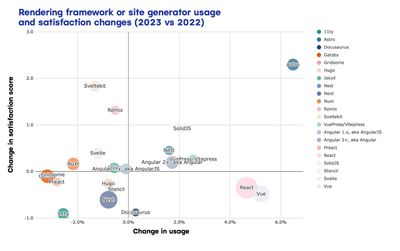
This chart looks bad for Next. It also looks bad for Eleventy. But the bigger problem here is that this chart shows changes without any context of absolute scores. Next might have gotten some caveats in the text written in the section but 11ty did not.
In previous years, the report discussed absolute scores prior to deltas because this context is important.
(I also took special note that the label for Gatsby—a framework purchased by Netlify and under very recent criticism for languishing investment—was obscured behind Gridsome)
On page 32 (of 39) of the report buried deep into the Appendices section the report finally includes the real scores (conveniently unordered):
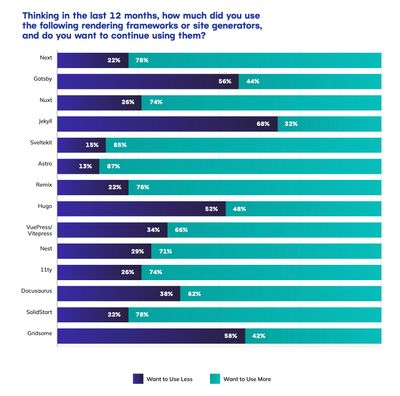
Now we learn that Next.js is ranked #3 (tied with SolidStart and Remix) for satisfaction and 11ty is ranked #6 (tied with Nuxt).
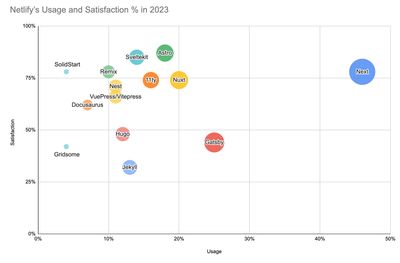
Here’s what the chart looks like using absolute values for satisfaction percentages and usage, painting a story that Netlify probably doesn’t want to share:
Without ascribing malice #
I am aware that Netlify has historically employed a Data Scientist with statistics and data analysis background to conduct this survey and prepare the report. This person departed the company months ago. The Data Scientist in question was very good at documenting and publishing the survey and report’s methodology and you can see one such (2022) document.
The 2023 report did not include a methodology document.
The 2022 methodology document reported how the data was collected (sources) and margins of error and included the following notable section at the end:
Conclusions we cannot draw:
We do not believe these results are indicative of preferences amongst web developers as a whole. We are also not making claims as to:
- Popularity (or not) of Netlify products and services, given bias in respondents
The 2023 report name change to The State of Web Development seemingly goes against the first point.
The 2023 report also goes against the second point by eschewing any mention of bias. It (surprisingly) includes a section on the popularity of Netlify itself:
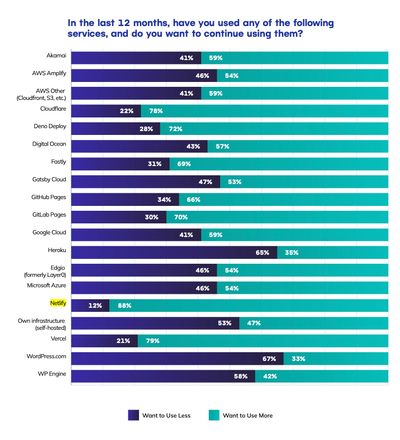
I was taken-aback that Netlify would publish statistics to show what percentage of Netlify customers want to use Vercel more—but apparently it’s 79%.
Conclusions #
Importantly: After Eleventy’s Netlify-induced setbacks this year, we are back on our feet and we will continue to punch far above our node_modules weight-class. Many of the alternative frameworks discussed here are VC-funded with full-time developers and have millions in funding. We don’t.
Eleventy’s project goals are different: stay focused, keep our core feature set small, and ruthlessly minimize our external dependencies for a long-term future.
On Astro (since folks have asked), I will say that Astro and Eleventy share the same zero JavaScript footprint vision for the web and in that regard we are allies in the web development framework melee.
Reading the report, it’s clear that Netlify has a vested interest in elevating Astro because Astro is best poised to dethrone Next.js. If Astro wins, Netlify wins. Perhaps surprisingly I also believe that if Astro wins, Eleventy wins! It is not a zero-sum game and I know that 2022 Netlify believed this (even if 2023 Netlify does not).
Appreciate y’all—and keep building for the web!
Read the original article

Comments
By canacrypto 2023-12-2015:092 reply I was a happy Netlify user for years until they silently took down my app without warning. They blocked my account based on a bogus DMCA claim, the details of which point to a DIFFERENT app with a similar name. Unacceptable behavior from a hosting provider. I'll never use them again.
This seems like human error. How did they handle it when you contacted them?
By canacrypto 2023-12-2017:02 Oh, that's the best part. The support team sent me an incoherent message semi-explaining the ban and then blocked my email preventing me from responding to explain their mistake! Just stone-walled with no path for remediation. And just to be clear, I was not being rude/aggressive in my messages or anything like that.
By canacrypto 2023-12-2017:03 Nope, the other app they mistake for mine was taken down too. Maybe with just cause, I don't know. All I know is my app was unrelated and innocent.
By coolhand2120 2023-12-2015:502 reply As someone who has pissed away thousands of team hours working with the next.js abomination I’m very happy to see Astro take off. I keep thinking “this looks like one of my very first terribly architected, organically created messes”. Astro may not be better, but just statistically speaking you probably aren’t going to be worse. Next is a house of cards. The architecture is as bad as the code base. The only features anyone wants are perpetually in beta. The documentation is probably the only thing worse than the runtime. We dropped SSR and used prerender.io to accomplish SEO and look back at that decision as a great one. I want to try Astro, looks more professional and propose built. Not at all interested in SaaS hosting.
By poisonborz 2023-12-2017:39 Anything specific? We use Next very successfully, and, well it almost became the main way to use React nowadays... pretty good track record for an "abomination". It's not 100% there, I dislike some features built around Vercel offerings (eg. middleware) but it's... a good idea.
Is this specific to Next.js app router? The pages router has been quite good to me, but the app router is something that matches your experience.
By mattgreenrocks 2023-12-2021:291 reply As an outsider: what exactly is it about "routers" that justifies so much change? Aren't there plenty of established designs to copy from other stateful UI frameworks?
I think supporting React Server Components is at the core of this issue. A ton of changes were necessary to support RSC and a different router is just one of many things that changed. Important features have been sacrificed to make it happen. You for instance no longer have access to the request/ response object in middleware or layouts. Currently playing with Remix as an alternative.
By 0xblinq 2023-12-2321:06 We are using Remix at work. We are super happy with it. None of the nonsense artificial limitations of Next, great integration with express, and a really simple model which, if you ever used a traditional “MVC” framework, will make you feel right at home.
By mattgreenrocks 2023-12-2015:531 reply Thought experiment: assume the worst: next.js + eleventy is in decline; what does it change in the short-term? It is likely that people using those frameworks are getting things done in them. To me, the fact this whole discussion is happening illustrates how fickle devs are in this particular ecosystem.
It's like nobody wants to be caught dead using something that might not be the new hotness.
React and NextJS are hardly "new hotness".
React has been dominant for at least ten years and NextJS for a good fraction of that.
By mattgreenrocks 2023-12-2021:28 You may be nit-picking here, but it underscores my point: this tech isn't going anywhere, and fretting about it is not productive.
