
Apparently, the expression "surfing the internet" was introduced by a librarian, and yes, riding waves was an inspiration for the iconic term.
Meet Jean Armour Polly.
In March 1992, the internet was still a very primitive "activity."
Still, the Master in Library Science had already published an article called "Surfing the Internet" in the University of Minnesota Wilson Library Bulletin.
"In casting about for a title for the article, I weighed many possible metaphors," Jean Polly once wrote.
"I wanted something that expressed the fun I had using the internet, as well as hit on the skill, and yes, endurance necessary to use it well."
"I also needed something that would evoke a sense of randomness, chaos, and even danger. I wanted something fishy, net-like, nautical."
"At that time, I was using a mouse pad from the Apple Library in Cupertino, California, famous for inventing and appropriating pithy sayings and printing them on sportswear and mouse pads (e.g., "A month in the Lab can save you an hour in the Library")."
"The one I had pictured a surfer on a big wave. 'Information Surfer,' it said. 'Eureka,' I said and had my metaphor."

"I'll Never Get Rich From 'Surfing'"
For absurd reasons, the 12,000 copies of the Wilson Library Bulletin were destroyed.
Only a few issues were spared, so Jean decided to upload her article on NYSERNet's FTP space. In 14 hours, her work had over 500 downloads.
A few months later, in March 1993, unaware of Jean's article, Tom Mandel of the former Stanford Research Institute (SRI) wrote an executive overview of the internet called "Surfing the Wild Internet."
Meanwhile, Jean's article has been updated and distributed via Project Gutenberg. You can actually read the original text online at gutenberg.org/ebooks/49.
It features one of the first free internet guides, but like Jean Armour Polly once said, "I'll never get rich from 'surfing.'"
In 2001, Jean Polly wrote "The Internet Kids & Family Yellow Pages," a guide to safely searching the Internet.
She can still be reached via her official website at netmom.com.
Jean Polly is often credited with coining the famous expression "surfing the internet."
But according to Ron Mion, the architect of the marketing strategy for the IBM Personal Computer, the concept was originally published five months before her article.
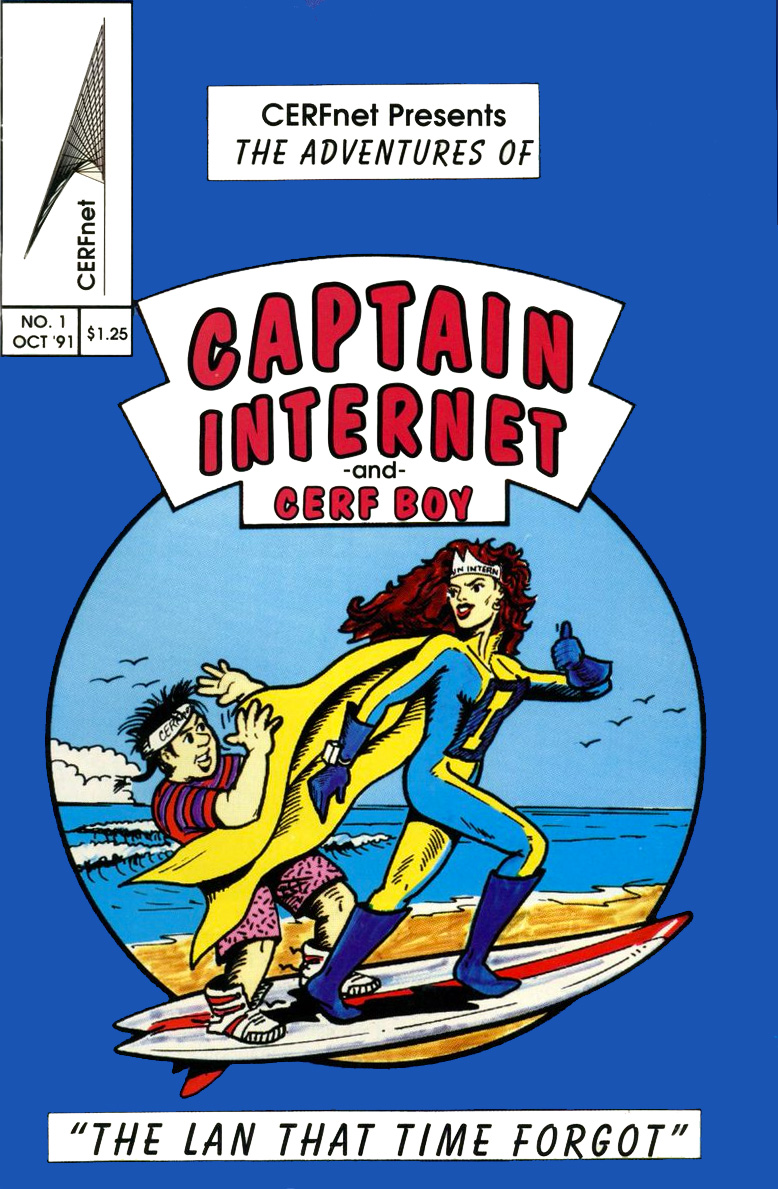
CERFnet, one of the first internet service providers (ISP), started publishing a comic book in October 1991 called "The Adventures of Captain Internet and CERF Boy."
The comic book depicted Captain Internet and her sidekick, who avidly surfed the internet.
"When the National Science Foundation (NSF) undertook to convert the military's ARPAnet into something that all US citizens - and the world - could use, they contracted with General Atomics in San Diego to expand the internet's infrastructure," Mion tells SurferToday.
"In turn, General Atomics (GA) retained my firm, Systems Marketing Associates, to develop a business plan for broadening the Internet."
"That turned out to be the worst business plan I have ever written. Within a year, the number of internet users had exceeded my five-year projection. However, despite my poor forecast, the internet has managed to survive."
With several decades of experience in technology marketing, Mion originated the concept, the phrase, and the initial "Intel Inside" branding campaign that Intel has been using for more than 30 years.
General Atomics provided the infrastructure for CERFnet.
CERFnet was based in San Diego, a surfing mecca, founded by Susan Estrada, an Internet Hall of Fame pioneer.
CERF - pronounced "surf" - stands for the California Education and Research Federation.
Interestingly, it is also a reference to Vinton Cerf, one of the fathers of the internet.
"Back in 1989, CERFnet was going to be called SURFnet, but a company in the Netherlands already had the name, so they couldn't use it," Vinton once told.
"They called me to ask if I minded if they could use CERF for the California Educational Research Foundation."
"I wondered whether if they messed up it could be embarrassing, but parents name their kids after people, so I thought: 'Why not?'"
Eventually, CERFnet was acquired by AT&T, and when Vinton asked if he could have his name back, they refused.
"Perhaps now I'm at Google, they'll say yes. Or maybe just quote me a big number," concluded Cerf.
So, Estrada could more rightly be the woman who coined the phrase "surfing the internet."
One thing is clear: the internet is graphically tied to the art of surfing.
Words by Luís MP | Founder of SurferToday.com

