NASA's problems with launch tower for SLS are getting worse

2024-08-282:114530arstechnica.com

"NASA officials informed us they do not intend to request a fixed-price proposal."

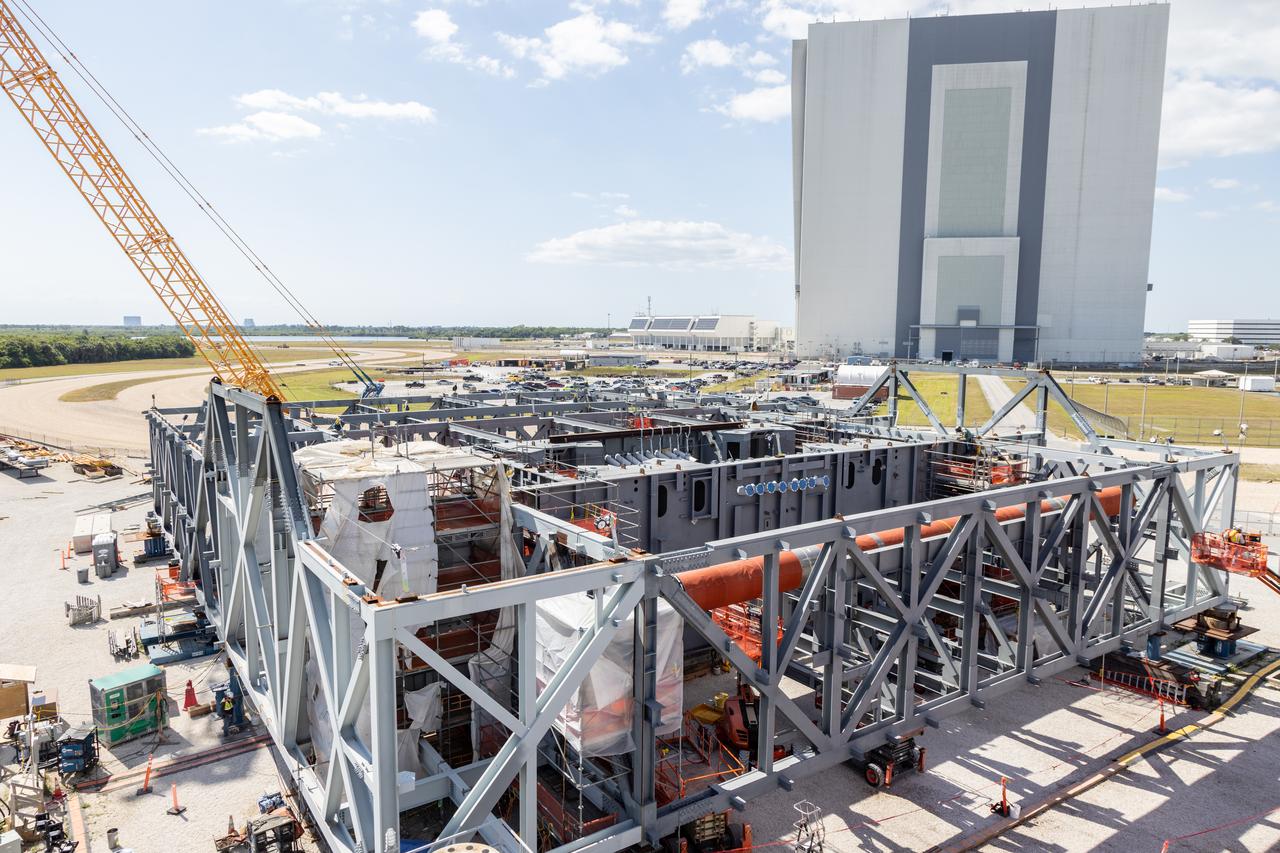
Teams with NASA’s Exploration Ground Systems Program and primary contractor Bechtel National, Inc. continue construction on the base of the platform for the new mobile launcher at Kennedy Space Center in Florida on Wednesday, April 24, 2024.
Enlarge / Teams with NASA’s Exploration Ground Systems Program and primary contractor Bechtel National, Inc. continue construction on the base of the platform for the new mobile launcher at Kennedy Space Center in Florida on Wednesday, April 24, 2024.

NASA's problems with the mobile launch tower that will support a larger version of its Space Launch System rocket are getting worse rather than better.

According to a new report from NASA's inspector general, the estimated cost of the tower, which is a little bit taller than the length of a US football field with its end zones, is now $2.7 billion. Such a cost is nearly twice the funding it took to build the largest structure in the world, the Burj Khalifa, which is seven times taller.

This is a remarkable explosion in costs as, only five years ago, NASA awarded a contract to the Bechtel engineering firm to build and deliver a second mobile launcher (ML-2) for $383 million, with a due date of March 2023. That deadline came and went with Bechtel barely beginning to cut metal.

According to NASA's own estimate, the project cost for the tower is now $1.8 billion, with a delivery date of September 2027. However the new report, published Monday, concludes that NASA's estimate is probably too conservative. "Our analysis indicates costs could be even higher due in part to the significant amount of construction work that remains," states the report, signed by Deputy Inspector General George A. Scott.

Bigger rocket, bigger tower

NASA commissioned construction of the launch tower—at the express direction of the US Congress—to support a larger version of the Space Launch System rocket known as Block 1B. This combines the rocket's existing core stage with a larger and more powerful second stage, known as the Exploration Upper Stage, under development by Boeing.

The space agency expects to use this larger version of the SLS rocket beginning with the Artemis IV mission, which is intended to deliver both a crewed Orion spacecraft as well as an element of the Lunar Gateway into orbit around the Moon. This is to be the second time that astronauts land on the lunar surface as part of the Artemis Program. The Artemis IV mission has a nominal launch date of 2028, but the new report confirms the widely held assumption in the space community that such a date is unfeasible.

To make a 2028 launch date for this mission, NASA said it needs to have the ML-2 tower completed by November 2026. Both NASA and the new report agree that there is a zero percent chance of this happening. Accordingly, if the Artemis IV mission uses the upgraded version of the SLS rocket, it almost certainly will not launch until mid-2029 at the earliest.

Why have the costs and delays grown so much? One reason the report cites is Bechtel's continual underestimation of the scope and complexity of the project.

"Bechtel vastly underestimated the number of labor hours required to complete the ML-2 project and, as a result, has incurred more labor hours than anticipated. From May 2022 to January 2024, estimated overtime hours doubled to nearly 850,000 hours, reflecting the company’s attempts to meet NASA’s schedule goals.

Difficult to hold Bechtel to account

One of the major takeaways from the new report is that NASA appears to be pretty limited in what it can do to motivate Bechtel to build the mobile launch tower more quickly or at a more reasonable price. The cost-plus contracting mechanism gives the space agency limited leverage over the contractor beyond withholding award fees. The report notes that NASA has declined to exercise an option to convert the contract to a fixed-price mechanism.

"While the option officially remains in the contract, NASA officials informed us they do not intend to request a fixed-price proposal from Bechtel," the report states. "(Exploration Ground Systems) Program and ML-2 project management told us they presume Bechtel would likely provide a cost proposal far beyond NASA’s budgetary capacity to account for the additional risk that comes with a fixed-price contract."

In other words, since NASA did not initially require a fixed price contract, it now sounds like any bid from Bechtel would completely blow a hole in the agency's annual budget.

The spiraling costs of the mobile launch tower have previously been a source of frustration for NASA Administrator Bill Nelson. In 2022, after cost estimates for the ML-2 structure neared $1 billion, Nelson lashed out at the cost-plus mechanism during testimony to the US Congress.

"I believe that that is the plan that can bring us all the value of competition," Nelson said of fixed-price contracts. "You get it done with that competitive spirit. You get it done cheaper, and that allows us to move away from what has been a plague on us in the past, which is a cost-plus contract, and move to an existing contractual price."

The plague continues to spread.


Read the original article

Comments

  • By glzone1 2024-08-285:471 reply

    Wild. But it's a pattern with these contracts.

    As a reminder, for SLS they decided to modify an exiting launch tower (ML-1). The original estimate to modify the tower was $54 million. Final cost will likely be $1 billion. And delayed of course. It's only going to get a few launches.

    You can see where this is going.

    Then they decided to do a new launch tower, ML-2. This tower is only 7 feet taller. They planned to incorporate lessons learned from the mess of ML-1 (haha). Started at $400M. Now going to be $2.7 billion (and delayed of course badly).

    These cost+ deals especially with multiple contractors are like rotting fruit that attracts maggots that glom on and provide negative value. Something that would take a day to a week elsewhere could be literally months. Every incentive is to move slowly. The contractor layers and paperwork needs on even basic changes are totally massive. The other thing that really jumps out is usually speed - these things will take FOREVER.

    I once even saw something about 8 track data recording in a govt contract, It's wild what is stacked into these things. The overhead to do anything can be wild. I once worked a govt job, and we needed an ipad for whatever reason (think something like foreflight on an ipad - most normal people would just buy an ipad to run foreflight). For all sorts of dumb and dumber reason, an ipad could not be purchased. I'd estimate $25K - $50K maybe went into trying to buy this damn ipad and coming up with workarounds. Can only go through central IT which wasn't even selected for price performance, has no customer service, and doesn't have apple SKU's. That's just the beginning. By the time you've wasted attorney time, contracting teams time on this ipad purchase and your own time, your managers time, all the downline folks time... the mind boggles. I think the final solution was to do a contract with a third party for a service, who could then buy the ipad and install the app on it as long as that part of the contract was less than some capital item threshold, and then that third party could enter into another agreement to make it available for their use. But the time to do this, then the time to come up with the agreement to use the ipad owned by this third party... total joke! I understood why teachers buy their own pencils. I'm sure a school can provide them, but a teacher probably doesn't want to deal with the headaches!

    • By disillusioned 2024-08-287:271 reply

      Fire everyone at NASA involved in "project management" that allowed this to happen:

      >For the ML-2 project’s first 5 years, NASA lacked a reliable cost and schedule estimate, making it difficult for the Agency to accurately identify ML-2 budget requirements, be accountable to Congress and other stakeholders, and accurately measure project and contractor performance.

      Absolute dereliction of duty and complete incompetence. Bechtel has literally no _true_ incentive to deliver on time: the "awards" are folly and they've been awarded some of them even despite this abysmal performance. Instead, you can inflate the "cost" part of "cost plus" and just continue to suck on the teat of the taxpayer, while blaming supply chain and other challenges, all to not build what amounts to a several hundred foot tall elevator. (Obviously a gross simplification; I understand there are interconnected data, electrical, hydraulic, fluid, and other systems, along with being immediately adjacent an extremely high-thrust launch, but _still_.)

      • By dessimus 2024-08-2811:06

        >Fire everyone at NASA involved in "project management" that allowed this to happen

        Do you think this is unique to NASA? The military itself has many such expenditures. If anything, this is a result of Senators and Reps putting their fingers in to extract taxpayer money at best "for their district," but more likely for their cronies/lobbyists.

  • By JCharante 2024-08-283:411 reply

    Why do governments allow cost follow pricing? Companies should bid a final price and pay for insurance that covers unexpected costs/delays.

    • By vimax 2024-08-284:513 reply

      How do you expect insurance companies to create actuarial tables for one-off government R&D projects?

      • By tedunangst 2024-08-285:14

        Insurance companies manage to find ways to price insurance for Hollywood actors storming off set.

      • By JCharante 2024-08-292:51

        Same way insurance companies insure satellite launches. Lots of guesses and getting another insurance company to underwrite their insurance deals.

      • By NavinF 2024-08-289:15

        Just estimate the probability of payout. Yes you can do this for non-repeating, hard-to-model events: https://www.astralcodexten.com/p/in-continued-defense-of-non...

        I do it all the time without making actuarial tables, as do insurance companies.

  • By NavinF 2024-08-282:141 reply

    >$2.7 billion. Such a cost is nearly twice the funding it took to build the largest structure in the world, the Burj Khalifa, which is seven times taller.

    > NASA officials informed us they do not intend to request a fixed-price proposal from Bechtel

    • By gexla 2024-08-283:442 reply

      It seems a significant addition to the cost overruns is labor. Maybe this is a good example of the cost reality of bringing manufacturing back to the US. Given a difficult timeline, the US workers would need to be putting in a lot of overtime. Many of the laborers who took part in building the Burj Khalifa were being paid less than what the US workers would spend on a meal.

      https://en.wikipedia.org/wiki/Burj_Khalifa

      Edit: Here is the NASA report.

      https://oig.nasa.gov/office-of-inspector-general-oig/audit-r...

      • By jiggawatts 2024-08-284:06

        > It seems a significant addition to the cost overruns is labor

        Only because they're billing for a ridiculous amount of time. Estimated completion time of 2027!? Wat?

        SpaceX has already built three and is planning more. By the time Bechtel completes their single tower, SpaceX will have half a dozen and a Moon colony.

        The contract should be torn up and the people that signed it barred from holding executive positions for life.

      • By omoikane 2024-08-285:001 reply

        The article seems to be using the cost of Burj Khalifa without accounting for inflation. $1.5 billion in 2009 would be about $2.2 billion in 2024.

        NASA's project is still expensive, but not quite twice as expensive as Burj Khalifa (unless the budget overruns again).

        • By disillusioned 2024-08-287:23

          The OIG report is projecting it could be as much as $2.7 Billion all said and done.

HackerNews