In the early 1990s, two Russian artists named Vitaly Komar and Alexander Melamid took the unusual step of hiring a market research firm. Their brief was simple. Understand what Americans desire most in a work of art.
Over 11 days the researchers at Marttila & Kiley Inc. asked 1,001 US citizens a series of survey questions.
What’s your favourite colour? Do you prefer sharp angles or soft curves? Do you like smooth canvases or thick brushstrokes? Would you rather figures that are nude or clothed? Should they be at leisure or working? Indoors or outside? In what kind of landscape?
Komar and Melamid then set about painting a piece that reflected the results. The pair repeated this process in a number of countries including Russia, China, France and Kenya.
Each piece in the series, titled “People’s Choice”, was intended to be a unique a collaboration with the people of a different country and culture.
But it didn’t quite go to plan.
Describing the work in his book Playing to the Gallery, the artist Grayson Perry said:
“In nearly every country all people really wanted was a landscape with a few figures around, animals in the foreground, mainly blue.”
Despite soliciting the opinions of over 11,000 people, from 11 different countries, each of the paintings looked almost exactly the same.

Komar and Melamid, People’s Choice
After completing the work, Komar quipped:
“We have been travelling to different countries, engaging in dull negotiations with representatives of polling companies, raising money for further polls, receiving more or less the same results, and painting more or less the same blue landscapes. Looking for freedom, we found slavery.”
This, however, was the point. The art was not the paintings themselves, but the comment they made. We like to think that we are individuals, but we are much more alike that we wish to admit.
30 years after People’s Choice, it seems the landscapes which Komar and Melamid painted have become the landscapes in which we live.
This article argues that from film to fashion and architecture to advertising, creative fields have become dominated and defined by convention and cliché. Distinctiveness has died. In every field we look at, we find that everything looks the same.
Welcome to the age of average.
Let’s dive in.
Interiors all look the same
In 2011, Laurel Schwulst was planning to redecorate her New York apartment when she began searching the internet for interior design inspiration.
Before long, the designer had stumbled on the perfect research tool: AirBnB. From the comfort of her home the app gave her a window into thousands of others. She could travel the world, and view hundreds of rooms, without leaving her chair.
Schwulst began sharing images to her Tumblr, “Modern Life Space”. The blog became an ever-expanding gallery of interior design inspiration. But something wasn’t right.
“The Airbnb experience is supposed to be about real people and authenticity. But so many of them were similar, whether in Brooklyn, Osaka, Rio de Janeiro, Seoul, or Santiago.”
Schwulst had identified an AirBnB design aesthetic that had organically emerged and was quickly spreading through the platform’s properties. White walls. Raw wood. Nespresso machines. Eames chairs. Bare brick. Open shelving. Edison bulbs. The style combines the rough-hewn rawness of industrialism with the elegant minimalism of mid-century design.

International Airbnb Style
But Schwulst wasn’t the only one to identify the trend. Aaron Taylor Harvey, the Executive Creative Director of Environments at Airbnb had spotted something similar:
“You can feel a kind of trend in certain listings. There’s an International Airbnb Style that’s starting to happen. I think that some of it is really a wonderful thing that gives people a sense of comfort and immediate belonging when they travel, and some of it is a little generic. It can go either way.”
This “Modern Life Space” or “International AirBnB Style” goes by a number of other names. It’s known as the Brooklyn Look, or according to the journalist Kyle Chayka, AirSpace:
“I called this style “AirSpace”. It’s marked by an easily recognisable mix of symbols – like reclaimed wood, Edison bulbs, and refurbished industrial lighting – that’s meant to provide familiar, comforting surroundings for a wealthy, mobile elite, who want to feel like they’re visiting somewhere “authentic” while they travel, but who actually just crave more of the same: more rustic interiors and sans-serif logos and splashes of cliche accent colours on rugs and walls.”
Perhaps this seems inevitable. Isn’t it obvious that a global group of hosts all trying to present their properties to a global group of travellers would converge on a single, optimal, appealing yet inoffensive style?
AirSpace, however, isn’t just limited to residential interiors. The same tired tropes have spread beyond the spaces where we live, and taken over the spaces where we work, eat, drink and relax.
In an in-depth investigation for The Guardian, Chayka documents how the AirSpace style of interior decor has become the dominant design style of coffee shops:
“Go to Shoreditch Grind, near a roundabout in the middle of London’s hipster district. It’s a coffee shop with rough-hewn wooden tables, plentiful sunlight from wide windows, and austere pendant lighting. Then head to Takk in Manchester. It’s a coffee shop with a big glass storefront, reclaimed wood furniture, and hanging Edison bulbs. Compare the two: You might not even know you’re in different spaces. It’s no accident that these places look similar. Though they’re not part of a chain and don’t have their interior design directed by a single corporate overlord, these coffee shops have a way of mimicking the same tired style, a hipster reduction obsessed with a superficial sense of history and the remnants of industrial machinery that once occupied the neighbourhoods they take over.”
And this isn’t just a trend that we can see in British coffee culture. The same trend has been identified in cities from Bangkok to Beijing and from Seoul to San Francisco.

According to The Verge:
“The coffee roaster Four Barrel in San Francisco looks like the Australian Toby’s Estate in Brooklyn looks like The Coffee Collective in Copenhagen looks like Bear Pond Espresso in Tokyo. You can get a dry cortado with perfect latte art at any of them, then Instagram it on a marble countertop and further spread the aesthetic to your followers.”
Once this interior design style became dominant in the world’s coffee shops, it began to spread throughout the wider hospitality sector.
Anne Quito, for example, writes about how the hipster makeover has made its way to restaurants in Quartz:
“Established restaurants are getting the hipster makeover. Traditional restaurants like Dickey’s Barbecue in Dallas, eateries in Toronto’s Chinatown and even the 47-year-old roadside diner chain Cracker Barrel—in the guise of its new biscuit joint Holler & Dash—are embracing chalkboard menus and reclaimed wood look to attract the affluent, design-savvy millennial.”
So, the interiors of our homes, coffee shops and restaurants have begun to converge upon a single style. But when we move outside, the story doesn’t get much better.
Architecture all looks the same
The anthropologist Marc Augé coined the term “non-place” to describe built environments that are defined by their transience and anonymity. Non-places, such as airports, service stations and hotels, tend towards utilitarian sterility. They prioritise function and efficiency over a softer sense of human expression and social connection.
In 1995, the Professor of Architecture and Urban Design at Harvard University, Rem Koolhaas, published an essay titled The Generic City:
“Is the contemporary city like the contemporary airport— ‘all the same’? Is it possible to theorise this convergence? And if so, to what ultimate configuration is it aspiring? Convergence is possible only at the price of shedding identity. That is usually seen as a loss. But at the scale at which it occurs it must mean something. What are the disadvantages of identity, and conversely, what are the advantages of blankness? What if this seemingly accidental, and usually regretted, homogenization was an intentional process, a conscious movement away from difference toward similarity?”
That opening question takes Augé’s idea of the sterile non-place and applies it to the city as a whole. Koolhaas, in effect, is arguing that soulless is becoming the default design direction of all urban architecture.

Almost 30 years after the publication of The Generic City I think it’s clear Koolhaas’ fears were well founded. Architecture’s march towards blank homogeneity is perhaps most obvious in the quick build, low-cost apartment blocks that have rapidly spread across the United States.
Justin Fox writing for Bloomberg:
“Cheap stick framing has led to a proliferation of blocky, forgettable mid-rises. (…) These buildings are in almost every U.S. city. They range from three to seven stories tall and can stretch for blocks. They’re usually full of rental apartments, but they can also house college dorms, condominiums, hotels, or assisted-living facilities. Close to city centers, they tend toward a blocky, often colorful modernism; out in the suburbs, their architecture is more likely to feature peaked roofs and historical motifs. Their outer walls are covered with fiber cement, metal, stucco, or bricks.”
This architectural style, characterised by boxy forms and unconvincing cladding, goes by names such as Fast-Casual Architecture and McUrbanism. But perhaps most commonly, these buildings are known as five-over-ones.
When Justin Fox drove across the US, he realised that they were not specific to one city or state. They were everywhere. And they were proliferating:
“In 2017, 187,000 new housing units were completed in buildings of 50 units or more in the U.S., the most since the Census Bureau started keeping track in 1972. By my informal massaging of the data, well over half of those were in blocky mid-rises.”
But why is this the case? Why are the majority of large American buildings succumbing to the same style?
Coby Lefkowitz offers four reasons in his essay, “Why Everywhere Looks the Same”. First, unlike in the early 20th century, developers are increasingly constrained by building codes. Second, rapidly rising land costs cause developers to pack as many properties as possible into every site. Third, the rising barriers to entry have caused the industry to consolidate. And fourth, developers seek to reduce their costs by reusing the same plans across multiple sites:
“It would be disappointing enough to fail in gracing a land as physically beautiful as the US with the built companions it deserves. But it’s downright shameful that we deprive ourselves of living in interesting, meaningful, and wonderful places, given the thousands of precedents for inspiration worldwide, and many hundreds within our borders. Instead, we’ve copied and pasted our society from the most anodyne, the most boring, and the most bleh. We’ve all seen them. Covered with fiber cement, stucco, and bricks or brick-like material. They’ve shown up all over the country, indifferent to their surroundings. Spreading like a non-native species.”

America’s five-over-one architecture
Cities once felt rooted in time and place. The Victorian grandeur of London. The Art Deco glamour of New York. The neon modernity of Tokyo. But with anodyne architecture spreading across the United States, cities are beginning to lose their contextual identities. They are all starting to look the same:
“Institutional developers march forward, ignorant of what makes Portland, Maine different from Portland, Oregon, or Philadelphia from Kansas City. Unique local traditions? Completely different climates? Hah! Joke’s on us. A box fits just as well in any of these places.”
And it isn’t just the design of our residential buildings but our professional ones as well.
In an article for Grist, Heather Smith describes the homogeneity of the office parks she’d pass on the way to her mother’s place of work and how present day Silicon Valley feels so similar.
“All the offices and factories along the way to my mom’s office were smaller versions of the same thing — set back from the road, behind deep rectangles of rolling green lawn, no sidewalks. Sometimes clusters of begonias added accent marks, or regimented little bushes pruned into spheres or squares.”
Smith continues:
“I thought about this recently when I went driving through Silicon Valley, because I was surprised at how similar it was to the neighborhoods that I had grown up in. Not that it was an exact replica (…). But the architecture was the same — the same low-slung buildings, set back from the street by parking lots, each complex its own self-contained bubble, separated from the road by a row of trees.”
So, the places where we live and work have begun to converge upon a single style, but we’re also seeing the same trend occur in the way we travel between them.
Cars all looks the same
In 2015, the ex-Chairman of BBH London, Jim Carroll recalled his realisation 32 years earlier that aerodynamic tests had begun to make all cars look alike:
“Some of you will recall the day in 1983 when we woke up and noticed that the cars all looked the same. There was a simple explanation. They’d all been through the same wind tunnel. We nodded assent at the evident improvement in fuel efficiency, but we could not escape a weary sigh of disappointment. Modern life is rubbish.”
In Carroll’s opinion, because all vehicles underwent the same wind tunnel tests, manufacturers were independently converging on the same optimal set of forms, proportions and dimensions. And as a result, homogeneity in car design was increasing.
What Carroll didn’t realise was that things were about to get a lot worse.
Sat at a red light, Drew Magary took the opportunity to scope out some new car ideas. Suddenly he saw an SUV that looked attractive. But he couldn’t quite see the badge. Another car was blocking his line of sight:
“Maybe it’s a Bimmer,” I said to the dog. “It kinda looks like one.” It wasn’t. It was a Hyundai Santa Fe, which kinda resembles the Acura RDX, which kinda resembles the Volvo XC60, which kinda resembles the BMW X3. (…) These four models are all 75 inches wide, 66 inches high (save for the Volvo, which is 65), and they only differ in length by a maximum of three inches. They all have rear quarter windows smaller than a porthole on a submarine. They all have chrome accents to increase the glam factor by, like, five percent. And they all abhor right angles, (…). They’re spiritual clones, and they’re not exceptions in being so.”

The wind tunnel effect (Source: Adrian Hanft, User Zero)
But why do so many modern cars look the same?
Jim Carroll’s wind-tunnel theory is certainly one reason. Another is that the automotive giants increasingly share vehicle “platforms” between the many brands that they operate. And Ian Callum, who led design at Jaguar-Land Rover for two decades, provides a third theory.
“There was a time when you could identify the country the car came from. But today, basically every company makes cars for basically every country (…). Cars are now designed for the broadest possible audience, across the broadest number of countries, to be manufactured in the most efficient possible way.”
Callum continues:
“Before the typical car designer can even begin sketching out a model, they’re given specs from the packaging department (…). The measurements might vary within millimetres. These strict dimensions are agonisingly chosen to please the needs of the wind tunnel, to adhere to government safety regulations, to properly accommodate the average American family’s collective weight of 78,000 lbs., and to allow for enough cargo space for all their crap.”
These three theories explain why the three-dimensional design of cars has been converging over time. But they don’t explain why the colour of cars has converged as well.
According to data shared by Jökull Solberg, around 40% of cars sold in 1996 were monochromatic (black, white, silver or grey). 20 years later that figure had increased to 80%.
There are many suggestions for why this might be. Perhaps these colours come as standard and everything else is an optional upgrade. Perhaps brighter colours fade more quickly. Maybe people buy less vibrant colours when times are more turbulent. Maybe the resale market for monochromatic cars is more buoyant. Or maybe the pared-back design of smartphones informed stylistic trends in the auto industry.
Regardless, the result is the same. Where once carparks were a kaleidoscope of reds, blues and greens, today they capture a sea of desaturation.
And what’s more? The visual identities of car brands seem to be following suit. In September 2020, Vauxhall released a modernised, minimal marque. According to Henry Wong at Design Week:
“Vauxhall unveiled its new logo last week, a “confidently British” look, which reworks the griffin icon and introduces a blue-and-red colour scheme. Most prominent is its new flat styling — a simplified version of the logo’s previous 3D look. Vauxhall calls the redesign the “progressive face of the brand”.”
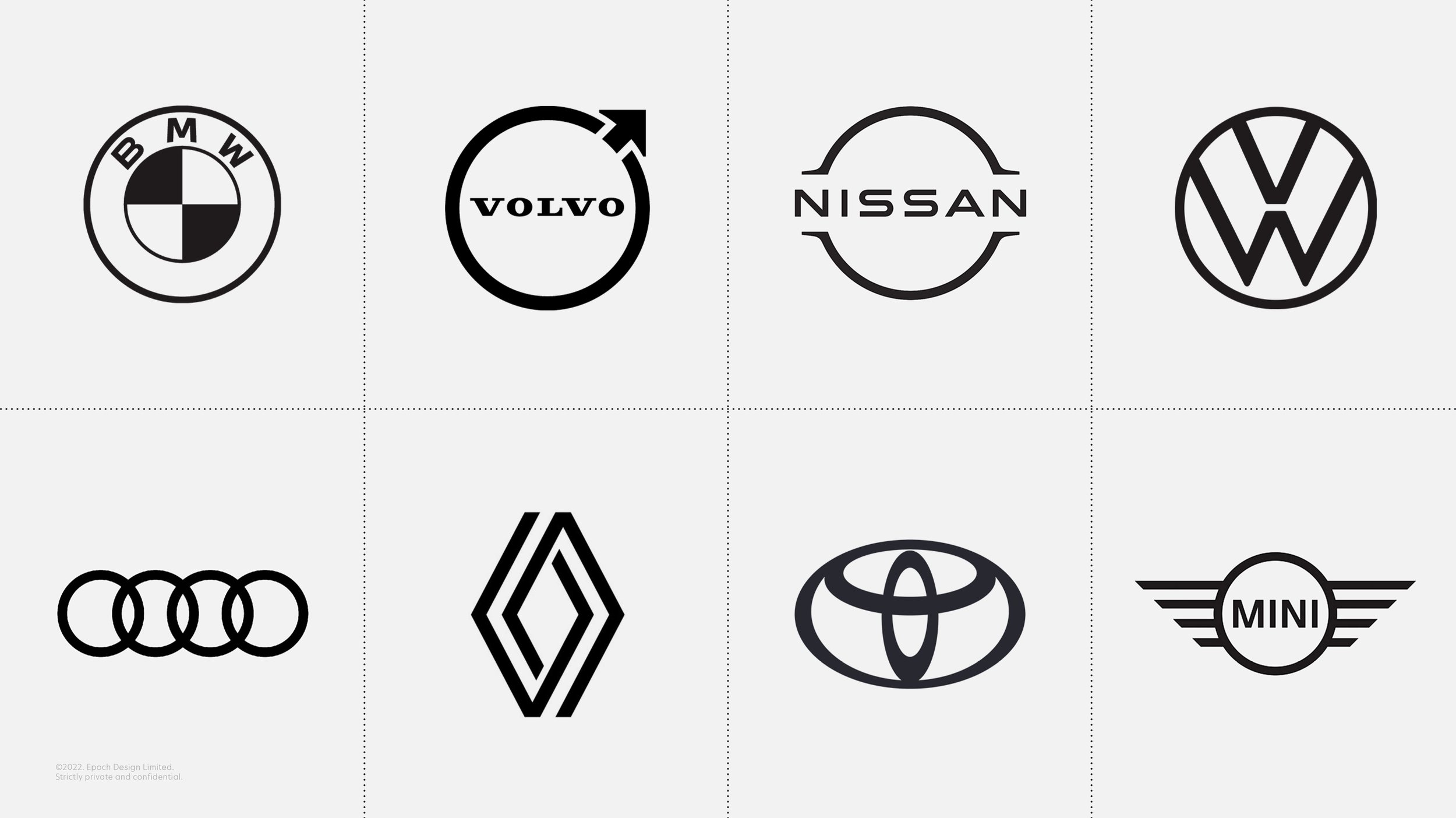
The “blanding” of automotive brand identities
Vauxhall had ditched a logo that looked like a chrome sculpted bonnet badge and replaced it with a flatter, thinner, altogether simpler execution. But they weren’t the only one. As Wong says, at least five other major manufacturers had charted a similar course:
“It’s a familiar story within car branding of late. Audi first unveiled a minimalist-inspired rebrand in 2018, but it’s been followed by a host of other marques in the past year. Volkswagen, BMW, Toyota, Nissan have all revealed new branding and each with a flat logo.”
So, the cars we drive, their colours and their logos have begun to converge upon a single style, but we’re also seeing the same trend occur in the way we look ourselves.
People all look the same
In December 2019 the journalist Jia Tolentino set about investigating a troubling trend. Many celebrities and influencers had started to resemble each other.
“This past summer, I booked a plane ticket to Los Angeles with the hope of investigating what seems likely to be one of the oddest legacies of our rapidly expiring decade: the gradual emergence, among professionally beautiful women, of a single, cyborgian face. It’s a young face, of course, with poreless skin and plump, high cheekbones. It has catlike eyes and long, cartoonish lashes; it has a small, neat nose and full, lush lips. It looks at you coyly but blankly, as if its owner has taken half a Klonopin and is considering asking you for a private-jet ride to Coachella.”
The look that Tolentino is describing is the result of (at least) three conspiring trends. The growing market for injectable treatments is driving a trend for physical enhancements. The rise of apps such as FaceTune is driving a trend for digital enhancements. And make-up techniques such as “strobing” and “contouring” are driving a trend for cosmetic enhancements. Over the last decade, these trends have developed in parallel, each feeding and fueling the other.
Starting at the top, Tolentino discusses the rising accessibility of beauty treatments such as Botox and fillers:
“Twenty years ago, plastic surgery was a fairly dramatic intervention: expensive, invasive, permanent, and, often, risky. But, in 2002, the Food and Drug Administration approved Botox for use in preventing wrinkles; a few years later, it approved hyaluronic-acid fillers, such as Juvéderm and Restylane, which at first filled in fine lines and wrinkles and now can be used to restructure jawlines, noses, and cheeks. These procedures last for six months to a year and aren’t nearly as expensive as surgery. (…) You can go get Botox and then head right back to the office.”
But the cost of achieving this look, which has become known as “Instagram Face”, is even lower than one may imagine. Whilst the average price per syringe of filler is $683, social sharers can now use apps to achieve similar results.

Rebecca Jennings writing for Vox:
“Instagram Face is so ubiquitous that there are now special filters that give you the look digitally if you can’t afford the real thing. (…) Almost no one is born with Instagram Face — by virtue of it being associated with a digital platform, the look is always mediated and performed — and even those who have it naturally still use tools like FaceTune to enhance their already algorithmically perfect features.”
Finally, these physical and digital enhancements are complemented by a third, altogether less dystopian, trend: cosmetic enhancements. Here make-up, and an almost endless supply of YouTube tutorials, are used to alter the perceived bone structure of a face.
Julia Brucculieri for the Huffington Post:
“Social media influencers these days are starting to look like beauty clones. You know the look: a full pout, perfectly arched eyebrows, maybe some expertly applied eyeliner, topped off with a healthy dose of highlighter and cheek contouring. With a few makeup brushes, a contour palette and some matte lip color, you can be well on your way to looking like everyone else.”
So where did all of this begin?
According to the make-up artist Colby Smith, Kim Kardashian is patient-zero of Instagram face. Ultimately, he says, every social media star’s goal is to look like her.
And Smith isn’t the only one to hold this opinion. Writing for The Cut, Kathleen Hou offers a similarly provocative opinion.
“Instagram’s beauty posters tend to look like they’re all the same woman, and that woman is Kim Kardashian. Thanks to hundreds of “Get the Look” tutorials, it’s never been easier to strobe and contour yourself into a facsimile of the star. So, no wonder there’s a cloning effect.”
This may seem like an exaggeration. There is, however, a truth at the centre of the assertion.
When The New Yorker interviewed Beverley Hills based plastic surgeon Jason Diamond, he claimed around a third of all his patients aspire to become a Kardashian doppelgänger:
“I’d say that thirty percent of people come in bringing a photo of Kim, or someone like Kim—there’s a handful of people, but she’s at the very top of the list, and understandably so.”
And we haven’t only started to look alike from the neck up. Dame Vivienne Westwood, the late fashion designer best known for bringing the counter-cultural punk scene onto the catwalk, comments on the way clothing has started to conform:
“Everybody looks like clones and the only people you notice are my age. I don’t notice anybody unless they look great, and every now and again they do, and they are usually 70. We are so conformist, nobody is thinking. We are all sucking up stuff, we have been trained to be consumers and we are all consuming far too much. I’m a fashion designer and people think, what do I know? But I’m talking about all this disposable crap.”
So, the way we look and the way we dress has begun to converge upon a single style. But when we look at the content we consume, the story doesn’t get much better.
Media all looks the same
In the early 2010s, French blogger Christophe Courtois began curating movie posters that conformed to strikingly similar formulas.
Rom-coms often used a guy and a girl standing back-to-back against a white background. Horror films featured a close up of an eye. Action films opting for a lone character, dressed in black with their back to the camera.
Courtois’ series perfectly illustrates how, in the 21st Century, every genre of film sticks to a relatively narrow set of clichés, codes and conventions that promoters slavishly abide by.

Christophe Courtois’ cinematic clichés
In Hadley Freeman’s book Life Moves Pretty Fast, Oscar winning director Steven Soderbergh argues that this is the natural result of testing:
“If you've ever wondered why every poster and every trailer and every TV spot looks exactly the same, it's because of testing. It's because anything interesting scores poorly and gets kicked out. (…) I've tried to argue that maybe the thing that's making it distinctive, and score poorly, actually would stick out if you presented it to these people the way the real world presents it. And I’ve never won that argument.”
But is the homogenisation of Hollywood a new phenomenon?
To find out Adam Mastroianni analysed the top 20 grossing films in every year since 1977 and coded whether each was part of a “multiplicity” (i.e. a sequel, prequel, franchise, spin-off, reboot etc.).
What he found was surprising:
“Until the year 2000, about 25% of top-grossing movies were prequels, sequels, spinoffs, remakes, reboots, or cinematic universe expansions. Since 2010, it’s been over 50% ever year. In recent years, it’s been close to 100%.”
Mastroianni continues:
“In 2021, only one of the ten top-grossing films (the Ryan Reynolds vehicle Free Guy) was an original. There were only two originals in 2020’s top 10, and none at all in 2019.”
A further finding for the research was that the revenue generated by the top 20 movies was, until 2015, around 40% of that generated by the top 200. Since then however that 40% figure has begun to climb even higher, crossing the 60% threshold in 2021.
In short, the top 20 films are becoming both bigger and more alike.
But this isn’t just happening in film. In every corner of pop culture, a smaller number of “blockbusters” is claiming a larger share of the market. What were once creative powerhouses have become factories of the familiar.
Take books.
“It used to be pretty rare for one author to have multiple books in the top 10 in the same year. Since 1990, it’s happened almost every year. No author ever had three top 10 books in one year until Danielle Steel did it 1998. In 2011, John Grisham, Kathryn Stockett, and Stieg Larsson all had two chart-topping books each. (…) In the 1950s, a little over half of the authors in the top 10 had been there before. These days, it’s closer to 75%.”
You can see this creative convergence for yourself when you next visit a bookstore. In fiction you’ll see many popular books following a “girl with…” naming convention. Of course, there’s Larsson’s “The Girl with the Dragon Tattoo”, but we’ve also seen Paula Hawkins’ “The Girl on the Train”, M. R. Carey’s “The Girl With all the Gifts” and A. J. Grayson’s “The Girl in the Water”.
In non-fiction, if you visit the self-help category, you’ll notice that every book title seems to include a swear word. We have Mark Manson’s “The Subtle Art of not Giving a Fuck”, Sarah Knight’s “The Life Changing Magic of Not Giving a Fuck” and Alexis Rockley’s “Find your Fuck Yeah.”

Video games are no different.
In the late 1990s, 75% or less of the best-selling video games were franchise instalments. Since 2005, it’s been closer to 100%.
I’ll quote Keith Stuart, writing for The Guardian, at length:
“The absence of the E3 expo in Los Angeles for the past two years has left a gigantic vacuum in the video game calendar. Last week, the industry did its best to fill that gaping content maw with three online events – the Summer Game fest, the Xbox and Bethesda showcase and the PC gaming show. They were underwhelming for many seasoned players. Major reveals included a remake of The Last of Us, a remake of Call of Duty: Modern Warfare II, Street Fighter 6, Final Fantasy XVI and news about the reimagining of the classic role-player System Shock.”
So, our movies, books and video games have all begun to look the same. But it’s not just the content we consume. When we look at the content brands produce the story doesn’t get much better.
Brands all look the same
In 1982 the American fashion photographer Irving Penn shot an ad for Clinique that became known as “the shelfie”. The advert is simply a photograph of the inside of a medicine cabinet. A bright white background. Glass shelves. Bottles of pills. And a few well branded Clinique products.
Since this iconic 80s ad, many other brands have created their own shelfies, including Selfridges, e. l. f. and Billie. But this isn’t the only tried and tested trope.
Here’s AIGA Eye on Design:
“There are many more oft-mimicked setups like the shelfie currently bouncing around the zeitgeist; one omnipresent shot includes objects placed on a mirror reflecting the sky, giving the illusion of a product floating in midair. Another example uses a dense pattern of water droplets to refract a single item into a series of psychedelic miniatures, while yet another places subjects in front of faux scenic backdrops reminiscent of a low-budget Sears photo studio. Each of these distinct setups is utilized broadly and across industries, with the same composition and concept seen on the Instagram feeds of a major beverage syndicate and an indie skincare brand alike.”

In an article for The Cut, titled The Tyranny of Terrazzo, Molly Fischer pushes this thought one step further.
Whilst there is the shelfie trope and the mirror trope and the water droplet trope, these layouts all seem to share a surprisingly consistent style of art direction. They might be compositionally different, but they are conceptually alike:
“And then there are advertisements, making up a visual world of their own. The products on view (cookware, supplements, stretchy clothes) occupy blank pastel landscapes manipulated by a diversity of hands. These aren’t ads that bellow or hector; they whisper, in restrained sans-serif fonts, or chastely flirt, in letters with curves and bounce. They’re ads, sure, but they’re so well designed. In this era, you come to understand, design was the product. Whatever else you might be buying, you were buying design, and all the design looked the same.”
Whilst Clinique’s original Shelfie hails from the 80s, it wasn’t until the 2010s that it became a more widely adopted style. And the majority of companies who did so were digital-first, DTC brands.
Elizabeth Goodspeed argues this is because these brands are more likely to draw inspiration from the same vast online sources. The result, she says, is a “moodboard effect”:
“This kind of visual homogeneity is a common occurrence in the art direction world, where ubiquitous styles operate less like trends and more like memes; remixed and diluted until they become a single visual mass. In today’s extremely-online world, the vast availability of reference imagery has, perhaps counterintuitively, led to narrower thinking and shallower visual ideation. It’s a product of what I like to call the “moodboard effect”.”
So, designers use the same online platforms, draw inspiration from the same sorts of imagery and, in turn, create broadly the same types of adverts.
But it isn’t just advertising that is causing brands to all look the same. Their visual identities are converging as well.
In December 2018, Thierry Brunfaut and Tom Greenwood published an article in Fast Company where they coined a new word: Blanding.
“The worst branding trend (…) is the one you probably never noticed. I call it blanding. The main offenders are in tech, where a new army of clones wears a uniform of brand camouflage. The formula is sort of a brand paint-by-numbers. Start with a made-up-word name. Put it in a sans-serif typeface. Make it clean and readable, with just the right amount of white space. Use a direct tone of voice. Nope, no need for a logo. Maybe throw in some cheerful illustrations. Just don’t forget the vibrant colors. Bonus points for purple and turquoise. Blah blah blah.”
Companies like AirBnB, Spotify and eBay have all dropped colourful logos with expressive typography for a straighter, stricter, altogether more muted, alternative.

The homogeneity of modern brands
Ben Schott writing for Bloomberg:
“Visually, blands are simple, neutral and flat. The palette is plain and pastel (with the occasional vibrant splash); the mood is upbeat and happy, or pensive and cool, but never truly real; the dress-code is smart-casual. Bland people are stock-photo attractive (or quirkily jolie laide). (…) Complex products and technical processes are illustrated by cute cartoons or Noun Project icons. Bland logos are confident but cute, utilizing an array of tweaks and twists to provoke the all-important “smile in the mind”.”
While the tech sector has led the way on blanding, we see the trend towards flatter, more lifeless, identities playing out in categories from the high-end world of fashion to the more mass world of personal care.
In a November 2021 article, title Distinction Rebellion, Contagious claimed that more and more brands seem content to drift along in a sea of sameness:
“Look up any new corporate brand identity unveiled over the past decade and you will almost certainly find yourself staring at a flattened and simplified version of the company’s old logo. The aesthetic has become so ubiquitous that it’s acquired its own name – blanding.”
So, advertising and brand identities are becoming more and more alike. But so too are the taglines brands employ.
Shai Idelson, Strategy Director at ad agency BBH, collected a list of 27 brands whose taglines follow the “Find Your X” sentence structure. These include Lucozade’s “Find Your Flow”, Rightmove’s “Find Your Happy” and Volvic’s “Find Your Volcano”.
Idelson says:
“I love end-lines. The delicate art of capturing a meaningful thought about a brand or a product in as few words as possible. A great end-line will touch my heart and stay in my memory forever. I still remember some from my childhood. But in the last few years, something happened to end-lines. (…) The linguistic similarity is staggering.”
The same “insight” that sits behind the 27 taglines (that young consumers celebrate individuality above all else) has also led to the “X, Your Way” end line construction. We have Nespresso’s “Indulge, Your Way”, Sonos’ “Sound, Your Way”, Dunelm’s “Dun, Your Way” and many, many more.
And so brand adverts, identities and taglines are all starting to look the same. But where does this all leave us?
Conclusion
So, there you have it. The interiors of our homes, coffee shops and restaurants all look the same. The buildings where we live and work all look the same. The cars we drive, their colours and their logos all look the same. The way we look and the way we dress all looks the same. Our movies, books and video games all look the same. And the brands we buy, their adverts, identities and taglines all look the same.
But it doesn’t end there. In the age of average, homogeneity can be found in an almost indefinite number of domains.
The Instagram pictures we post, the tweets we read, the TV we watch, the app icons we click, the skylines we see, the websites we visit and the illustrations which adorn them all look the same. The list goes on, and on, and on.

UGC all looks the same (Source: Insta Repeat)
There are many reasons why this might have happened.
Perhaps when times are turbulent, people seek the safety of the familiar. Perhaps it’s our obsession with quantification and optimisation. Or maybe it’s the inevitable result of inspiration becoming globalised.
Regardless of the reasons, it seems that just as Komar and Melamid produced the “people’s choice” in art, contemporary companies produce the people’s choice in almost every category of creativity.
But it’s not all bad news.
I believe that the age of average is the age of opportunity.
When every supermarket aisle looks like a sea of sameness, when every category abides by the same conventions, when every industry has converged on its own singular style, bold brands and courageous companies have the chance to chart a different course. To be different, distinctive and disruptive.
So, this is your call to arms. Whether you’re in film or fashion, media or marketing, architecture, automotive or advertising, it doesn’t matter. Our visual culture is flatlining and the only cure is creativity.
It’s time to cast aside conformity. It’s time to exorcise the expected. It’s time to decline the indistinguishable.
For years the world has been moving in the same stylistic direction. And it’s time we reintroduced some originality.
Or as the ad agency BBH says.
When the world zigs. Zag.
Notes
A big thank you to Toby Ososki for his guidance and support on this piece.
This article is based on a talk I gave at the West of England Design Forum in November 2022.
To demonstrate how AI tools will only make this trend worse, Tim O’Neill asked Midjourney to output images in the categories covered in this article. The results are surprising.
This article featured in newsletters from Neil Perkin, Alex Morris, Packy McCormick, Barry Ritholtz, Tim Ferris and The Browser. Thank you all.
This article was referenced in articles by Samuel Scott at The Drum and Tyler Cowen at Marginal Revolution. It’s also been covered by Vice, Inc and Yahoo!
This article was referenced in talks by Chris Barth at the Most Contagious 2024 conference and by both Lisa Smith and Adam Morgan at Cannes Festival of Creativity in 2024.
This article was referenced in System 1 Group’s report, The Extraordinary Cost of Dull.
Kurt Anderson’s essay You Say You Want A Devolution, in Vanity Fair, and Jason Farago’s article Why Culture Has Come To A Standstill, in The New York Times, are excellent.
Paul Skallas (‘refinement culture’) and Derek Thompson (’moneyballification’) do a great job of exploring how different sports teams have gradually adopted a narrower set of playing styles.
Since writing this article I’ve come across related ideas in economics (hotelling’s law), geography (central place theory), politics (median voter theory) and sociology (mimetic isomorphism).

