
Ocean Iron Fertilization

2025-04-1514:058594www.whoi.edu

Iron fertilization is a technique that would artificially add iron to the ocean’s surface, triggering massive blooms of phytoplankton that could remove substantial amounts of carbon dioxide from the…

Iron fertilization is a Carbon Dioxide Removal (CDR) technique that would artificially add iron to the ocean’s surface to stimulate growth of phytoplankton. Scientists are researching the viability of this technique to mitigate climate change. Illustration by Jack Cook, ©Woods Hole Oceanographic Institution

All organisms require nutrients to live and grow, and those living in the open ocean are no exception. Tiny phytoplankton drift on the water’s surface, converting sunlight, water, and carbon dioxide from the atmosphere into food and oxygen. Like other photosynthetic organisms, such as land plants, these tiny algae and cyanobacteria require nutrients for photosynthesis to occur. On land, nitrogen and phosphorous are often the limiting nutrients, but in many parts of the open ocean, these nutrients are generally available. It’s other, trace nutrients that are missing, and iron is one of the key players in this system.

Adding small amounts of iron to the ocean’s surface can trigger a bloom of phytoplankton big enough to be seen from space. Such additions happen naturally, such as when winds blow dust from the Sahara Desert or ash from a volcanic eruption. When the plume of dust or ash settles over the ocean’s surface, it triggers massive blooms of phytoplankton that remove substantial amounts of carbon dioxide from the atmosphere. Iron fertilization is a Carbon Dioxide Removal (CDR) technique that would mimic this natural system, artificially adding iron to the ocean’s surface to stimulate growth of phytoplankton.
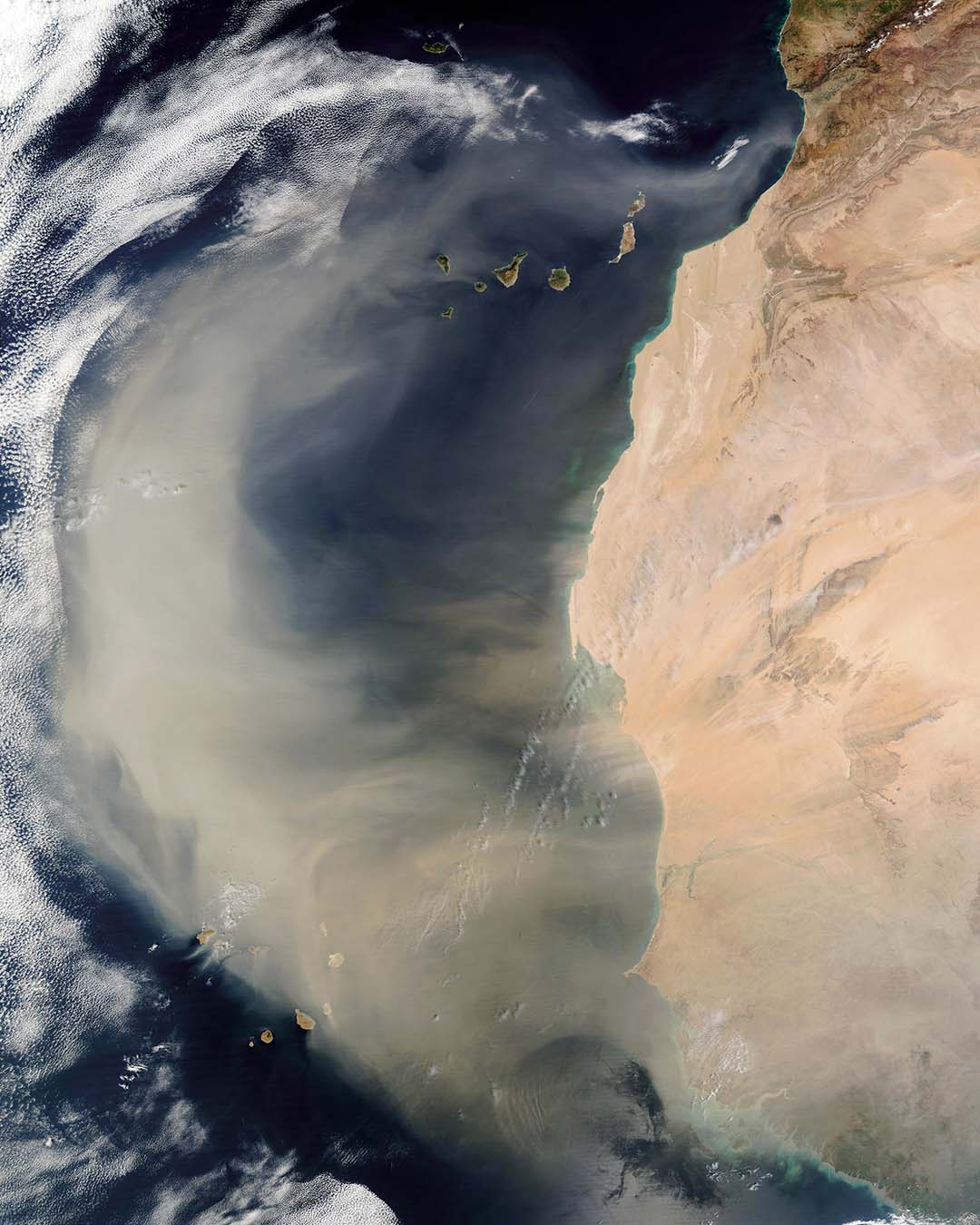
The oceans are often naturally fertilized by dust storms like this one in 2003, which covered a vast swath of the Atlantic Ocean with a plume of iron-rich dust from the Sahara Desert, extending more than 1,000 miles (1,600 kilometers), from the Cape Verde Islands (lower left) to the Canary Islands (top center). (Image courtesy of Jacques Descloitres, MODIS Rapid Response Team, © National Aeronautic and Space Administration)

Because iron is a micronutrient, phytoplankton need only trace amounts for it to have a massive impact. Ash from the 2008 eruption of Kasatochi in the Aleutian Islands created an algal bloom that is estimated to have removed 10 million tons of carbon from the sunlit zone. Soot from the 2019-2020 Australian wildfires caused a bloom between New Zealand and South America that may have removed as much as 150 to 300 million tons of carbon.

Ice core records also show a link between iron-rich dust and changes in climate. During times when large amounts of dust settled over the ocean, global temperatures dropped, with an estimated 60 billion tons of carbon drawn out of the atmosphere during these events. Many scientists argue that the iron dust contributed, at least in part, to the development of past glacial periods.

If relatively small amounts of iron can be added to the ocean’s surface to effectively remove large amounts of carbon dioxide from the atmosphere, iron fertilization has the potential to play a pivotal role in reducing additional impacts associated with climate change. But it will only work if the carbon removed from the atmosphere sinks to the ocean depths, where it will be locked away for at least a century. This would buy time for a full transition from fossil-fuels to renewable sources of energy.
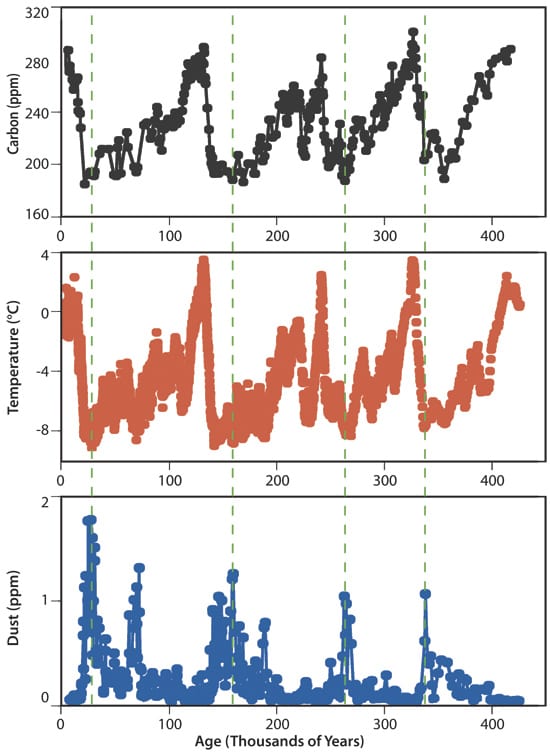
THE IRON-CLIMATE CONNECTION?Climate records extracted from ice at the Vostok station in Antarctica extend back 400,000 years. They consistently link low atmospheric carbon dioxide levels (top) with low air temperatures (middle), and high levels of iron-rich dust (bottom)?and vice versa. That supports the ?iron hypothesis.?
(Figure by J.R. Petit, et al., Nature )

In the 1990s and early 2000s, a series of experiments tested iron fertilization in the open ocean. These tests consistently found that adding iron led to phytoplankton blooms, However, the extent to which that carbon sank to the depths wasn’t always measured, and the phytoplankton were not able to use all of the iron for growth before the mineral sank.

Researchers did document changes in phytoplankton communities, with diatoms becoming more abundant than many other types of phytoplankton. These algae can be up to 1,000 times larger than cyanobacteria, allowing them to take up more carbon dioxide via photosynthesis. Diatoms create silica-based glass-like shells that add weight, increasing the likelihood that they will sink faster than other, smaller phytoplankton when they die. Their fast growth rates and loss to the deep sea bodes well for potential removal of carbon from the atmosphere and its sequestration deeper in the ocean.

Some diatoms, however, release toxins that can contribute to harmful algal blooms, although these did not occur following any of the field experiments. In addition, iron fertilization has the potential to alter where and how nutrients are allocated in the marine ecosystem. Until experiments are done to test these potential outcomes and determine how much carbon can be sequestered in the ocean depths, iron fertilization should not be put to use as a method of slowing climate change.

Early iron fertilization experiments faced resistance, due to the many unknowns. Despite this, scientists are returning to the idea as one CDR tool that should be on the table in the fight against climate change. They are currently working to create codes of conduct, so that research can be conducted in a transparent manner to better understand both intended and unintended consequences of adding iron to the ocean’s surface.

New technologies using autonomous platforms and sensors now exist that allow scientists to fully investigate the potential for iron to remove atmospheric carbon and track the subsequent movement of that carbon through the ocean. Because iron fertilization would be relatively inexpensive, it could be an important part of a suite of CDR activities aimed at removing excessive amounts of carbon dioxide from our atmosphere. But it’s important to remember that such approaches do not replace the need for immediate and major reductions in the use of fossil fuels that produce carbon dioxide in the first place.

[ ALL ]

Is ocean iron fertilization back from the dead as a CO2 removal tool?

To slow climate change, some want to ‘engineer the ocean’

[ ALL ]

WHOI researchers report progress on projects funded by the Ocean Climate Innovation Accelerator

Global warming is “unequivocal,” the Intergovernmental Panel on Climate Change (IPCC) reported in November 2007. Human actions—particularly the burning of fossil fuels—have dramatically raised carbon dioxide and other greenhouse gases…

Debating the idea of fertilizing the ocean with iron can feel a little like riding a seesaw. On the up side is iron’s eye-catching potential to set off enormous plankton…

In this age of satellites, it’s fairly easy to answer the basic question of whether adding iron to the ocean can stimulate a plankton bloom. When storms over land blow…

  “Give me half a tanker of iron, and I’ll give you an ice age” may rank as the catchiest line ever uttered by a biogeochemist. The man responsible was…


Read the original article

Comments

  • By jandrewrogers 2025-04-193:414 reply

    I’ve been following this research since the 1990s. My recollection is that a consensus emerged that it is less effective than originally hypothesized and there are some adverse side effects that would be difficult to manage. This is why it fell out of favor.

    As I recall, while it does cause significant blooms in the areas that you seed, it also induces nutrient depletion in other regions, suppressing growth there and potentially damaging ecosystems that developed around the natural nutrient gradient. It became apparent that the “free lunch” wasn’t actually free and it was mostly just rearranging where things grew based on the interaction of various nutrient gradients. The net effect is therefore much smaller than originally thought and there is a risk that it inadvertently reduces the output of important fisheries due to complex oceanic chemistry interactions that are not fully understood.

    I don’t think much has changed with respect to our understanding of it. It is currently filed under “probably a bad idea” as far as I know. But that’s why we do the science.

    • By emmelaich 2025-04-194:393 reply

      How does it cause depletion in other areas?

      FWIW, I think the danger of excessive blooms is overstated. Most of the ocean is a desert nutritionally.

      • By jandrewrogers 2025-04-195:233 reply

        The flow and distribution of nutrients in the ocean follow weak gradients from their underlying sources in a kind of thermodynamic equilibrium. Some areas will have nutrient excesses based on geography, geochemistry, and limitations on consumption rate due to dependencies on other nutrients.

        If iron is the rate limiting ingredient, then when you seed an area with iron a bunch of other nutrients are consumed in the process that currently are not being consumed. This changes the chemical equilibrium driving those other nutrient flows in the ocean and may stop critical nutrients flows into areas that rely on them. Any major local change to nutrient balance changes the equilibrium and thermodynamic gradients of the entire system.

        In hindsight this is kind of obvious. There are similar equilibrium problems in large chemical reactors too and the ocean is just a giant reactor vessel to a first approximation. I think the original assumption was that the ocean is so big that no one would notice but long distance effects on local nutrient balances were observed such that increased sequestration productivity in one area was at least partially offset by losses of productivity in other areas due to new nutrient bottlenecks.

        In principle modeling the entire system would allow one to inject the right nutrients at the right handful of spots to maximize aggregate sequestration performance with minimal risk. Building such models is still very much beyond us.

        • By ksec 2025-04-1912:361 reply

          Sorry about a naive question. If additional nutrients causes imbalance due to taking nutrients from other areas. Cant we add those nutrients in as well?

          I am starting to think China will be the first to experiment with this in large enough scale.

          • By ruined 2025-04-1916:42

            theoretically yes, but this draws you away from the original objective of effective sequestration

        • By spwa4 2025-04-1913:512 reply

          Wouldn't this only be an effect that happens on a small scale? It means that you'll see large changes elsewhere from small blooms in the ocean because of depletion elsewhere. Ok. But that cannot occur if you do this to an entire ecosystem (which can be the ocean, sure, but perhaps doing it to a large lake first would make more sense.

          Second aren't we already doing large scale iron fertilization of the oceans? Not "intentionally" but simply rivers with human economic or residential activity along them.

          • By staplers 2025-04-1915:46

              aren't we already doing large scale iron fertilization of the oceans
            
            Usually the opposite actually. Dams impede a massive amount of sediment from flowing into the oceans. Most large rivers near humans have multiple dams at this point.

          • By mystified5016 2025-04-1914:35

            It's kind of too obvious to notice, but the ocean is largely contiguous and interconnected. Any "local" effect can be distributed clear across the planet by ocean currents in a matter of days.

        • By 1W6MIC49CYX9GAP 2025-04-196:312 reply

          How does consumption of a nutrient stop its production?

          • By chii 2025-04-199:24

            It's not stopping the production, but changing the flow.

            suppose there's a flow of nutrients of type A from area one to area two. Currently, iron is the chokepoint in nutrient consumption of A, so that A is never completely consumed while going from one to two.

            By adding excess iron into area one, or in the middle of the region between this flow from area one to two, you now have the possibility to consume A completely as iron no longer limits A's consumption.

            So what happens to area two's consumption of A, if it became more scarce? May be nothing - or may be you now have another choke point of resources that wasn't there previously, leading to a change. If you weren't sure if this change would occur, or dont know, perhaps adding iron to area one is not a good idea, until such outcomes have been studied and acertained first.

          • By baruch 2025-04-196:47

            I only use my common sense here, but it doesn't stop the production it just prevents the transport from the source to the destination through the area that was previously iron deficient and couldn't use the fully the other nutrient which passed on to another area.

      • By thatcat 2025-04-194:582 reply

        In iron sulfate fertilization you're only adding two nutrients (iron and sulfur). Now that nutrient is in excess in one area so metabolic uptake of all nutrients increases locally, creating a concentration gradient that reduces nutrients available elsewhere. This leads to one of the other limiting nutrients like phosphorus or nitrogen preventing growth of other life forms in another location since the concentration gradient created by the phytoplankton sucked it away. Also sulfur concentration changes metabolic pathways through epigenetic effects so there are other effects just within the phytoplankton that depend on the species that happens to be present that will determine what the exact concentration gradient would look like. The dynamic of nutrients shifting of the metabolome makes modeling and risk assessment difficult since some species are known to produce toxins which can bioaccumulate. https://en.wikipedia.org/wiki/Phycotoxin

        • By elmolino89 2025-04-199:52

          Not sure if it's a time to cry about the loss of a bush of roses when the forests are burning. Any natural iron supplementation like blowing the dust from Sahara or a river carrying out to the ocean waters full of red soil should be causing similar effects. Granted, rivers are likely carry other nutrients, often in excess, but this also does disrupt what grows or not in the surrounding areas.

          Iron fertilization may still be pointless since the effectiveness is being debated afaik. On the other hand if it does work well for a competitive price compared to other methods, I would rather have a fish in the middle of the ocean full of algal neurotoxins and lower global temperature than the same fish cooked. No need to at it though.

        • By pfdietz 2025-04-1912:40

          Adding sulfur as a nutrient to the ocean is unlikely to have much effect, as seawater already contains about 3 ppm sulfate, thousands of times the concentration of iron.

      • By canadiantim 2025-04-1916:36

        It causes hypoxic zones in the water near the blooms, because the excessive blooms take up all the oxygen in the water leading to hypoxic and deadly conditions afterwards. That's why you often see so many dead fish around excessive blooms, all the oxygen is used up.

    • By ErigmolCt 2025-04-198:01

      Totally agree: it's filed under "promising but risky" for a reason

    • By aaron695 2025-04-1910:00

      [dead]

    • By singularity2001 2025-04-197:181 reply

      @grok what are some papers supporting this rather negative take and are there other papers that refute the skepticism?

      • By hedora 2025-04-2023:15

        Why would you specify ask it to only look for propaganda?

  • By init7 2025-04-195:091 reply

    When a big systemic circle is imbalanced, we often feel that adding a smaller circle of push or nudge will balance it.

    But there are wobbly second order effects and the curves finally settle in the third order, often further away from our initial imagination.

    Iatrogenics is the branch of science studying outcomes where interventions make the situation worse off.

    Not a judgement on this or any other method, but a recurring pattern to be aware of.

    • By dr_dshiv 2025-04-1911:412 reply

      …yet, it is also an excuse for not trying to address problems with technology. “The precautionary principle” has paralyzed Europe, for instance.

      • By rglullis 2025-04-1912:27

        > “The precautionary principle” has paralyzed Europe, for instance.

        A lot of modernity problems would be solved if those in power learned to sit on their hands and do nothing.

      • By simmerup 2025-04-1914:58

        Paralyzed Europe in what respect?

  • By lumost 2025-04-1916:031 reply

    I'd love to see some small scale experiments in geoengineering. Despite multiple climate agreements, over my life time - I have not seen any actual progress on climate change outside of technological advancement. Technology such as wind, solar, BEVs, and similar appear to be coming far too slowly to avoid catastrophe. Perhaps China's recent push on BEV and similar technologies will tip the scale, but I am skeptical.

    Human's have been geoengineering for millenia via clear cutting of forests, bio engineering of crops, fertilization of fields, damming of rivers, and other activities. While there will certainly be consequences and side effects, even a partial sequestering of ~20B tonnes of CO2 per year would meet the Kyoto protocol.

    Are the consequences of Geo Engineering so disastrous that we should accept the worst case scenarios of global warming.

    • By slashdev 2025-04-1916:201 reply

      Doomberg has this theory that worldwide consumption of a source of energy never decreases, any fossil fuels extracted will be burned somewhere, and green regulations or subsidies just shift around who does the burning. Adding new sources of energy to the mix only reduces the rate of growth in fossil fuel consumption, but it still goes up.

      Oil consumption didn't reduce coal consumption, it just added a new energy type. Same for natural gas.

      So far they've been right. Decreased coal usage in developed countries has been offset by increased coal usage, of the now cheaper coal, in developing countries. German electric consumers are effectively subsidizing Chinese and Indian consumers.

      Eventually that will turn around, if only because we start running out of fossil fuels, and the thesis will fall apart. But it will take far longer than we have, and we have far more fossil fuels than we can afford to extract and burn. That means the ONLY way to address climate change, which is a global problem, is through technological innovation. Regulation is a dead end, and just looking at the track record of regulation so far, it's hard to deny that.

      That means making green alternatives that are better, and we're making some good progress on that. Electric cars are better in most ways for most uses except price. Solve that last one and they'll quickly displace combustion vehicles for most uses. Range is already good enough most of the time for most of the people.

      It may also mean doing some geoengineering to soften the impact of global warming that will continue for multiple centuries if we don't intervene.

      • By matthewdgreen 2025-04-1918:071 reply

        I think you're drawing the wrong conclusion from this set of facts and claims.

        What I think you're saying is:

        1. The only solution to this problem is technology that gives us alternatives to fossil fuels.

        2. However, even if this technology becomes ubiquitous and cheap, it won't solve the problem by itself. Absent some forcing function, people will continue to use fossil fuels as long as they're convenient and available.

        All of which may be true. But then you make the weird third claim:

        3. Regulation is a dead end, and just looking at the track record of regulation so far, it's hard to deny that.

        It seems to me that the only possible implication you can draw from facts (1) and (2) is that we are going to need massive amounts of regulation to discourage fossil fuel usage, since it won't drop organically even when sustainable alternatives are cheap and available.

        PS As a totally unrelated note, here's a chart of global whaling activity. https://ourworldindata.org/whaling

        • By slashdev 2025-04-2013:101 reply

          That's a fair point, but the thing about regulation is it only works for one country at a time. For whaling we could make a law and apply it to the whole world, and most countries complied only because there were no whales left and no money to be made in it anymore. That's the real reason whaling ended.

          With climate change, I don't think it's possible, and the current track record seems to back me up. When Europe enacts green legislation, the fossil fuels are just consumed elsewhere. It hasn't reduced consumption, just moved it. So, no, I don't see how we can regulate a way out of this problem. I think the only viable option is to innovate.

          Maybe I'm too cynical, but that's the way I see the situation.

          • By matthewdgreen 2025-04-2016:221 reply

            Honestly I kind of have to disagree with your entire premise.

            We’re seeing pretty dramatic decreases in emissions across any advanced society that took major regulatory action to decrease emissions. EU emissions in 2023 were 37% lower than in 1990, despite population increases. A good chunk of the early drops were due to fuel substitution, but now increasingly they’re due to the deployment of renewables. In 2024, about 47% of the EU’s total electricity generation for the year came from renewable sources! These are incredible results, especially if you compare them to a decade or two earlier. If you’d told me that in a matter of 15-20 years, the EU’s pro-renewable industrial policy would have achieved these results (say back in the late 2000s) I would have been very surprised. Yet here we are, and the numbers keep jumping every year. So I would not say “regulatory approaches haven’t worked,” I would say “wow, this is one of the most effective regulatory interventions that human beings have ever devised.”

            The reason global emissions haven’t dropped is because China’s emissions kept rising during this time. However: now we’re seeing a similar process unfold in China, just at a much larger scale. There the central government is massively subsidizing and encouraging the deployment of renewables. Current estimates are that China’s emissions may have already plateaued and are entering a structural decline. Again, yes, a lot of this is due to technology being available. But the rapid deployment of the tech is a function of strong government intervention.

            We are going to reach a point very soon where 90%+ of any modern nation’s energy can be supplied using renewables, nuclear and storage. It’s actually coming very fast. (And that 90% is really only capped by intermittency issues, not because there are major limits on what we can generate.) At that point we’ll be into the very substantial “mop up” phase where we try to work through the remaining high-emissions industries. This will require massive amounts of regulatory intervention, since most of the barriers will be due to the need to replace existing infrastructure on an expedited schedule.

            • By slashdev 2025-04-2017:031 reply

              The developing world, including especially China and India are building out massive amounts of coal power still: You can see the data for yourself: https://globalenergymonitor.org/projects/global-coal-plant-t...

              It's possible that will turn negative at some point, but I think that would only be through innovation when coal power isn't economically competitive anymore.

              > We are going to reach a point very soon where 90%+ of any modern nation’s energy can be supplied using renewables, nuclear and storage. It’s actually coming very fast.

              That's exactly my point. We have to get there. Until we do, regulations will just move the consumption around. If it's not Europe it's China, if it's not China it's India, if it's not India it's Africa, etc.

              I still think the only we get out of this is make green energy much more economically competitive - the full cost of green energy including the cost of dealing with it's intermittent nature. We're not there yet, and it's a very hard problem to solve, because the more intermittent energy you add to the mix, the more expensive it gets to solve the intermittency.

              I don't see regulation ever getting us there, except for those cases where it helps drive the innovation faster. Which comes back to my premise that the only way out is through innovation.

              • By matthewdgreen 2025-04-2020:121 reply

                If you look closely at what China is doing, you’ll see that they’re building out a massive fossil-backed renewable grid. The new coal they’re constructing consists of modern dispatchable coal that can be spun up and down quickly to supplement the variability of renewables. They’ve also proposed a scheme of capacity payments [1] to pay coal plants for not generating. This is more or less the same as what Europe and the US have been doing, except we’ve been using natural gas instead of coal (and of course the scale of China’s renewable buildout utterly dwarfs what the West has done.)

                The important thing here is that this makes economic sense. Coal is not cheaper than renewables and doesn’t really compete well with them when both are available (especially as the price curve for new renewables keeps dropping) but until storage is vastly more available, fossil backing is pretty much the only way to build out a renewable grid.

                My big worry is not that “regulation won’t work” (I think we’ve already pushed ourselves over the economic tipping point where renewables and storage are pretty much inevitable.) My fear is that it will come too late, and that we’ve been much too optimistic about our carbon budgets.

                [1] https://www.raponline.org/blog/changing-how-coal-power-plant...

                • By slashdev 2025-04-2022:551 reply

                  That’s the official narrative out of China, and it’s a hopeful one. It doesn’t fit the data though, at least so far. China is constructing record amounts of coal power and consuming ever increasing quantities of coal. https://www.carbonbrief.org/chinas-construction-of-new-coal-...

                  But even if they manage to turn that around decades from now, the coal will go to India or Africa, it’s not going to stay in the ground until it’s really uneconomical (and even then more likely to be replaced by natural gas than renewables.) Again, some countries may achieve success with regulation in isolation, but what matters is what the whole world does. There I think regulation doesn’t work because we don’t have one government, but instead many competing nations. Tragedy of the commons rules more often than not. This is where we disagree. The data is currently on my side, fossil fuel consumption is at record levels and increasing still. I think your position is this will change at some point in the future, with the help of regulation.

                  Renewables are way cheaper than coal power in many places, but at the extreme they basically need backing by equal fossil fuel infrastructure as they come to dominate the grid. Because you have to have electricity when the sun isn’t shining and the wind isn’t blowing. When you add that to the costs, then they don’t currently win. Fixing that is the innovation that can solve this, which I think we both agree on.

                  • By matthewdgreen 2025-04-214:001 reply

                    According to the same source (site), it looks like emissions in China have plateaued in Q3 2024 as compared to Q3 2023. So we’re already seeing some effects. https://www.carbonbrief.org/analysis-no-growth-for-chinas-em...

                    I agree with you that the coal capacity buildouts are worrying. The best we can hope is that China has just structurally misallocated a bunch of funds, and when it comes time to burn that coal, continued improvements in renewables and storage will make all those plants unprofitable. That’s what’s happening most other places.

                    • By slashdev 2025-04-2115:03

                      I don’t share your optimism, but I admire it. For all our sakes, I hope you’re right.

HackerNews