
A tale of suspiciously cheap ADS1115s
For almost all of my embedded work I’ve used the ADCs included with microcontrollers. These are cheap, relatively fast, and not particularly good. While they sport impressive-sounding 12- and 16-bit readouts, the effective number of bits (ENOB) is usually around 8 or 9.
Recently I’ve been playing with the ADS1115. It’s a dedicated ADC from TI module which plausibly delivers 16 bit accuracy.
One really cool thing about the ADS111x family is a dynamic range feature that gives you up to 20 times finer measurement for small amplitude voltages. It’s accuracy where it matters.
The ADS1115’s programmable gain amplifier lets you shrink the full-scale range from ±6.144 V down to ±0.256 V. That means a single LSB can represent as little as ~7.8 µV (0.256 V ÷ 32768). Compare that with a microcontroller ADC with a fixed 3.3 V range: 9 ENOB steps are ~6 mV.
Another nice thing is that it uses an internal voltage reference. The RP2040, for example, requires an external 3.3V analog reference.
But there’s something fishy about the pricing of the ADS1115. At quantity 1K it’s around $4 from Digikey, yet $0.60 on LCSC. That’s quite a spread. I picked up breakout boards from Amazon for $2.97 if you buy four, and I very much think these are made with the $0.60 parts from LCSC or similar.
I’ve also ordered this very handsome breakout from Adafruit, which I assume uses the pricier version of the ADS1115. I’ll report back next week.
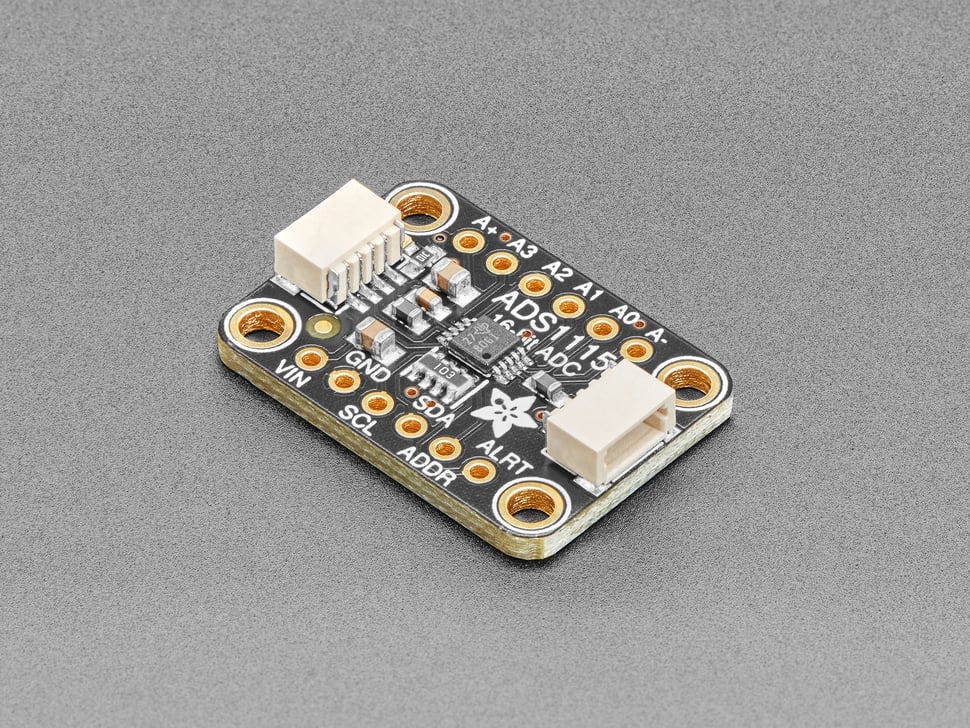
So how bad are these cheap ones? I hooked one up to an I²CMini and my trusty precision DC voltage source and tried to find out.
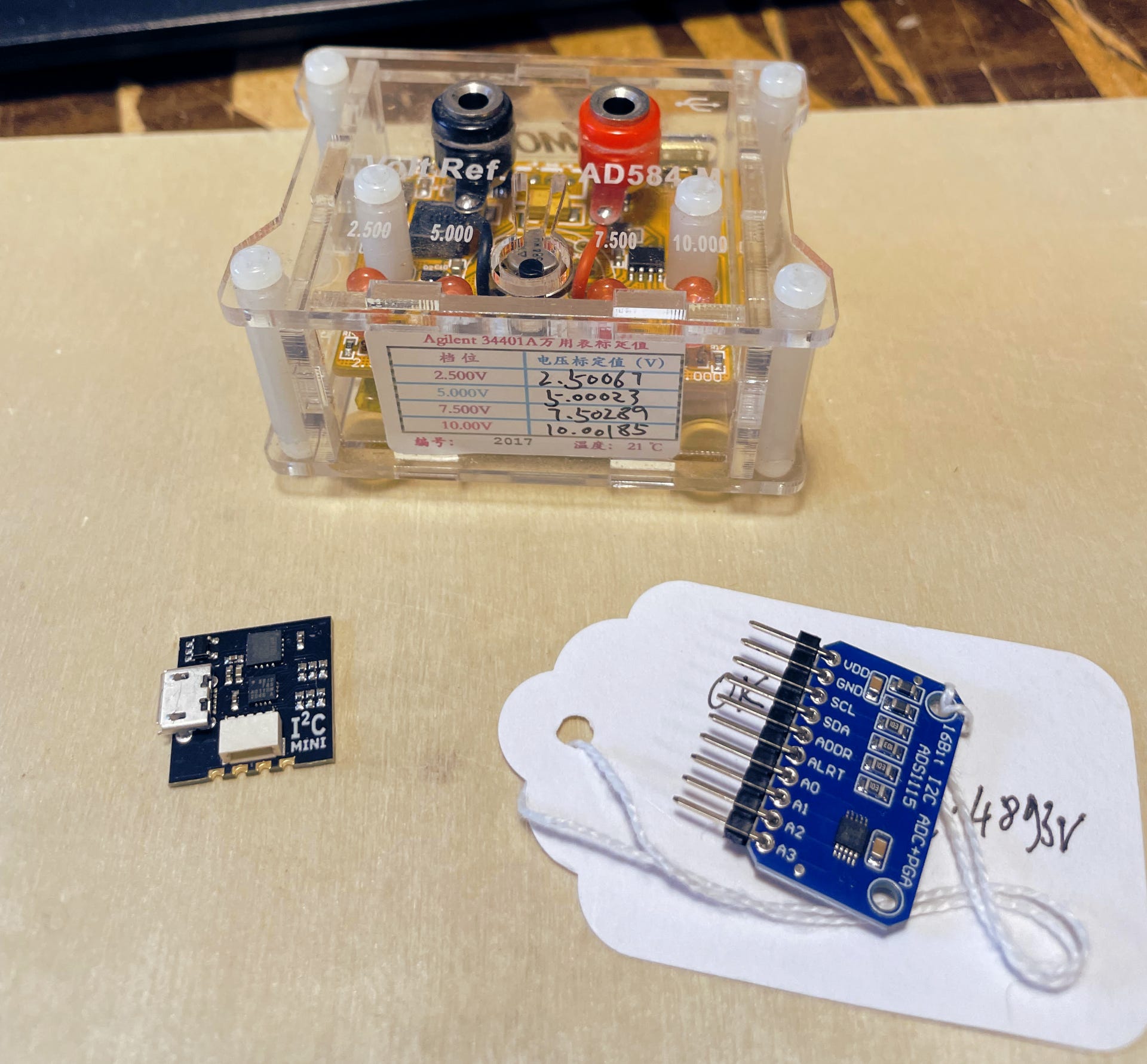
First check, are these functioning according to spec, or are they a cheaper part that’s being passed off as an ADS1115, as reported on forums?
As far as I can tell, they behave as if they are real ADS1115s. The readout is true 16-bits. The PGA (Programmable Gain Amplifier) appears functional. The readout rate is variable from 8 to 860 samples per second, and this approximately matches the TI datasheet.
I tested mostly in differential mode, and with the two inputs tied together, the ADC read consistently zero. With a calibrated 2.5V differential, the ADC measured very close to 2.5V, and with the polarity reversed gave exactly the same number negated. So far so good.
But closer inspection showed some deviations.
The TI datasheet says that the Data Rate, DR is ±10% of the nominal. So at 8 samples per second mode, samples should arrive 7.2 - 8.8 times per second. Three of the ADCs were close but slow (6.5-7 samples per second). One of the ADCs was nowhere near: 300 samples per second. That one didn’t get any further testing; there’s obviously something broken with its timing system. (But how many end users would actually notice that it’s running faster (and hence noisier) than it’s meant to?)
Looking more closely at the actual measurement, my calibrated 2.50067V source was being reported by the ADS1115 as 2.4883V. That’s a 12 mV error, and a 0.5% difference. Much bigger than the claim in the TI datasheet:
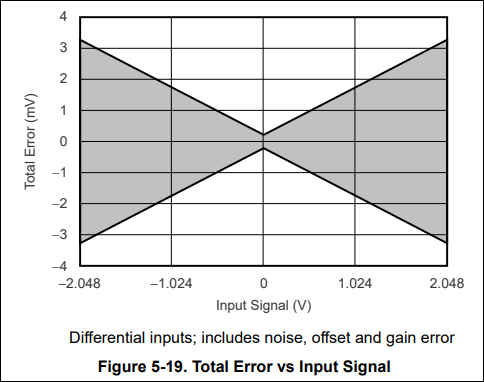
This isn’t quite the catastrophe that it might seem. After a simple linear correction on the MCU, I was getting results accurate to within 10 µV.
So what’s going on with the cheap parts? My best guess is that these are either quite good copies, or failed parts that somehow made their way into the hobbyist supply chain. When the more respectable part arrives next week I’ll put it through the same tests and report the result. However I only bought one of these, because it’s 4X the price!
Thanks for reading.
Read the original article

Comments
Should be easy to compare - sand down both the cheapo and a legit one (with a similar datecode) with fine sandpaper, clean with isoprop and shove under an optical microscope - you can then tell how similar/dissimilar the dies are, you don't even have to look for markings or anything super legible, or even sand them to the same metal layer.
Clones tend to be vastly different - different technology node, architecture, die size, etc. - that's because they are generally functional clones, not mask clones.
(also, as a general shoutout to the low tech sandpaper technique for exploratory work, here's a sanded down RP2350 thrown under a clapped out SEM: https://object.ceph-eu.hswaw.net/q3k-personal/484e7b33dbdbd9... https://object.ceph-eu.hswaw.net/q3k-personal/3290eef9b6b9ad... )
I have done this a bunch of different times, mostly to resolve sourcing disputes. Dissolving in boiling sulphuric acid/nitric acid will make quick work of most epoxy packaging
IMO, I have mostly seen mislabeling, rebinning, and passing off obvious QC rejects.
example from many years ago: https://www.youtube.com/watch?v=e6DfBuPwAAA
> Dissolving in boiling sulphuric acid/nitric acid will make quick work of most epoxy packaging
That's the better method of course (results wise), but it's not nearly as accessible, hence my recent evangelism of the virtues of 2000 grit sandpaper.
By throwup238 2025-10-1421:051 reply I prefer Japanese sharpening stones or those DMT diamond whetstones. It’s relative easy to 3d print a jig that converts a woodworking honing guide into an IC holder and you get a feel for how many passes to do very quickly before slowing down and checking each pass.
By q3k 2025-10-1423:28 That's a super interesting idea! I'll also have to try that.
I like it. I've used sandpaper to solve some interesting problems in the past as well with great success. I suspect we are only seeing the beginnings here in a trend of high-tech applications of fine grit paper.
I expect it's much easier to acquire fine sandpaper, yet my inner child yearns for laser decapping. (Or I suppose more than "decapping", depending on the depth.)
By jacquesm 2025-10-1420:55 High power lasers are becoming more and more affordable. Laser ablation is definitely an option but you really want to have some proper fume extraction around that.
By BertoldVdb 2025-10-1422:02 Laser decapping will destroy the die, except if you have a rare package that does not mix glass in the epoxy.
You could still compare the internal structure of the package and bonding, but the die itself is mostly destroyed.
By supportengineer 2025-10-1421:041 reply I'm off to build an MCP so AI can control the sandpaper
You may as well start off with one of these then:
https://phillipscorp.com/india/phillipsgrinding/phillips-sur...
All you need is a serial port and some G-codes.
Surface grinders generally don’t use CNC, they are a simple machine.
By jacquesm 2025-10-1510:48 In the 1950's, yes. But these days they definitely are CNC based.
By Dries007 2025-10-158:45 This is a fun playlist of a conversion of a manual machine to CNC:
https://www.youtube.com/playlist?list=PLDlWKv7KIIr9rlCwZ9K43...
I've heard that boiling epoxy in molten colophony for a few hours, like a long-cooked version of rosin potatoes, will also dissolve it. I haven't tried it myself. Colophony is much more expensive than sulfuric or nitric acid, but safer to handle (when not molten) and often easier to get.
I did not know that. Pine rosin is such lovely and versatile stuff. And sure enough:
https://m.youtube.com/watch?v=pIpxawdUb4I&t=30m18s
…plus it smells much better; and, as you mention, it’s useful for potatoes too!
https://bittersoutherner.com/feature/2022/the-elusive-roots-...
By kragen 2025-10-153:54 These slides from the talk say it only takes 5–20 minutes. I'm not sure it will smell better when you heat epoxy to the specified 320–360°. I'm interested in hearing whether anyone else has tried this.
I appreciate the effort, but the bar is already very high when you recommend a SEM in the same breath.
By q3k 2025-10-1510:07 The SEM was cheaper than an optical microscope or a fume hood though :).
(also I don't recommend a SEM in the first post, a cheapo USB 'microscope' will do, I just happen to have had SEM images on hand)
By Tade0 2025-10-1422:41 There was a sandpaper expert in that company associated with sour-tasting fruit which shall not be named. I believe you guys have met, though I think by that time he already pivoted to making the perfect cheesecake.
By hinkley 2025-10-1421:44 <NileRed voice> …I wanted to look at this chip… so first I put it in a jar of hot nitric acid.
It may not even be a clone. As the author said, it could just as easily be production line items that were tested and found to be outside of spec tolerances and resold off-label.
By q3k 2025-10-1417:44 Well, that's the point of the experiment, to figure out if it's a clone or a reject :).
By throwup238 2025-10-1417:481 reply TI makes all their analog stuff in house so that's unlikely. That's far more common for fabless companies that send their parts off to an outside fab.
What does TI do with their out-of-tolerance products? Straight in the garbage?
By throwup238 2025-10-1417:57 Yes, though depending on the product line it may be binned into lower quality parts first. Remember though, the marginal cost of these chips is so small the packaging is usually more expensive than the silicon. They often get tested before the wafer is even sliced up so any waste is hardly worth mentioning until you get into modern processes with large error rates and huge chips like CPUs.
TI isn't patterning $10000 wafers at 3nm with massive chiplets and questionable yield, they are making mostly commodity ICs on cheaper processes - they can afford to discard rejects.
I think the implied question is do they discard, or do they destroy.
Discarded things tend to get lost. Lost things tend not stay in the Anduin forever.
By LeifCarrotson 2025-10-1419:12 > "Discarded things tend to get lost. Lost things tend not to stay in the Anduin forever."
I'll have to put that on a warning label near our non-conforming-product containment shelf!
By pinkmuffinere 2025-10-1419:39 Lol I love the deep cut to LOTR! Took me a sec but then brought me so much joy. Viva la nerds!
By mikewarot 2025-10-150:27 Not only that, leakage goes way up as you shrink the transistors, an ADC on a 3nm wafer would require a complete redesign, if it could be made to work at all.
By Arubis 2025-10-1419:24 Binned wafers are viable source material for photovoltaics.
I don't know if we can ping people here, but this looks like something that would be right up Ken Shirriff's alley.
> These are cheap, relatively fast, and not particularly good. While they sport impressive-sounding 12- and 16-bit readouts, the effective number of bits (ENOB) is usually around 8 or 9.
I don't think that's quite accurate for reasonably modern MCUs. You can typically shake 10+ bits out of them, but you need to take a lot of precautions, such as providing very stable external reference voltage and shutting down unneeded subsystems of the chip.
They're still not as good as standalone ADCs, but they're at a point where you can actually use them for 90% of things that require an ADC.
In cases where you need more bits, there's a lot more that must go into the design, which is what gives me a pause about the article. There's nothing about the PSU the author is using or how he managed the MCU noise and RFI. So I don't know if the findings here are that these are knock-off devices with worse specs, or if his overhead LED lamp is causing a lot of interference.
By parsimo2010 2025-10-1421:12 I think you might both be right- the author may be thinking of lower cost MCUs only aiming for tolerable ADC performance, while you might be thinking of all MCUs, even higher cost.
The RP2350 has 9.2 ENOB on a 12 bit ADC. Sure, you might be able to decimate multiple samples to get more bits out of them, but the spec sheet supports the author's claim (https://www.raspberrypi.com/documentation/pico-sdk/hardware....). There are even lower cost MCUs like the CH32V003 that have even worse ADC performance.
On the other hand, some MCUs can definitely do 10+ bits, such as the STM32H7 line which gets 13+ ENOB from a 16 bit ADC. This is impressive, but the H7 MCUs are literally an order of magnitude more expensive than the RP2350, so they might not be something the author tinkers with much. https://www.st.com/resource/en/application_note/dm00628458-g...
Hey, you can also arrange 2 GPIO pins in 1st order sigma delta topology with two external resistors, a capacitor and disabled hysteresis.
With RP2040 (and an LDO for supply), using two such channels for pseudo differential measurement (the second one just tracks threshold noise) I typically obtain 16 ENOB at 1 kHz, more at DC.
It is critical to avoid any periodic activity on the chip, though. Putting cores to sleep and then waking them up again causes huge spurs. One has to e.g. sleep for random intervals to spread them around. Same with flash. USB can be used, it's noise doesn't normally exceed -100 dB for me.
Fun stuff!
PS: I have not tested DC accuracy. One would likely use a channel with reference and hope that GPIOs are well matched. Could be used to e.g. sense CC lines on USB or analog joysticks and other non-critical, low accuracy stuff.
By nerdsniper 2025-10-159:17 Can you post any resources for understanding this? I have basic understanding of circuits.
Is this essentially trading time resolution for voltage resolution? Would just doing an exponentially weighted moving average in firmware achieve the same results?
By magicalhippo 2025-10-1421:01 I tested a few STM32F103 dev boards, using a Siglent SDM3055 multimeter and Siglent SPD330X power supply.
The chip has a 12bit SAR ADC. Layout and board design mattered a lot, but even the worst ones had 10 bits worth, and the best one had nearly 12 bits effective.
That was without doing too much on the software side, meaning the other modules weren't running, besides a single serial output. On the bad boards the serial affected it, but on the good board very little.
I was planning on using (genuine) ADS1115s for a project but ended up going with an STM32g071 instead. It was cheaper, easier to source at the time (surprisingly) and much more flexible. The newer STM32g/h series ADCs have fewer hardware/software footguns than the old f103 et al.
By kragen 2025-10-152:48 What are the worst footguns on the STM32F103/GD32F103/CH32F103 ADC?
By ryukoposting 2025-10-1422:311 reply Glad I wasn't the only one thinking this.
The paragraph ending with "Compare that with a microcontroller ADC with a fixed 3.3 V range: 9 ENOB steps are ~6 mV" also seems to insinuate that no MCU has an analog reference that's independent from the supply, which just isn't true at all. Hell, NXP has a few that have a built-in programmable reference.
By bobmcnamara 2025-10-153:19 > NXP has a few that have a built-in programmable reference
Those also depend on the noise of the supply, see PSRR graph if available.
By throwup238 2025-10-1417:473 reply > So what’s going on with the cheap parts? My best guess is that these are either quite good copies, or failed parts that somehow made their way into the hobbyist supply chain.
The vast majority of counterfeit chips I've seen were from ghost shifts but IIRC TI fabs all their analog parts in house, I doubt they're ghost shift parts or failed QC.
I think its probably a relabeled ADS1015.
Interesting, most of the counterfeits that affect me (eg. FTDI, STM32 clones) have been just straight up clones developed from scratch, not excess inventory / ghost shifts / packaged rejects. I guess it might be a digital/mixed-signal split, with the two worlds having different issues?
(also interestingly the STM32 clones I've seen had stacked die flash because they didn't fab them in a technology that could also do flash, so you can easily tell the counterfeit from sanding down the package and looking for an extra set of bonding wires; it's also a cool place to access the internal flash bus if you wanna bypass some readout protection :) )
By throwup238 2025-10-1418:071 reply I remember the mess with FTDI clones back when I was still a hobbyist and buying stuff from eBay, but ever since I’ve started doing EE professionally I rarely run into anything that bad. You’re not going to make a clone Marvell processor for example, but I’ve run into several ghost shift runs from a distributor.
I don’t usually buy from electronics markets in Shenzhen either so that probably helps.
By londons_explore 2025-10-1421:28 Buy in bulk from the Shenzhen markets and sellers will be pretty clear that you're getting a clone, and will give you samples of that specific clone so you can QA your product with them. (Some popular devices have multiple clone suppliers).
I now always buy clones where possible - whilst not all features are implemented and some specifications won't be met, the devices seem to match the original for reliability, and sometimes even come with their own cloned modded datasheet.
By jamesbowman 2025-10-1417:572 reply Author here. I did consider this, as others have reported getting ADS1015 marked as ADS1115. If it were an ADS1015 the readout would be truncated at 12 bits. These parts definitely delivered 16 bits of readout.
I worry about the demo boards being radically different in terms of layout etc. Even if you're using the same interface and power supply, the PCB may be affecting performance.
Getting full spec performance out of an ADC requires having good layout power supply routing etc.
I would transplant the chips from PCB A to PCB B and vice versa. See if the performance follows the chip or the PCB.
Also check power consumption before / after board swaps. If they are fakes, that would be significantly different.
By londons_explore 2025-10-1421:33 It doesn't take much crosstalk from some clock signal into the signal you're measuring to really mess stuff up...
Many of these Dev boards are not produced with as much care or knowledge as the chip design itself.
By throwup238 2025-10-1418:181 reply Ah oops I missed that. Maybe an ADX111A then?
Oh my - good find, and also, eek.
Analogy: https://datasheet.lcsc.com/lcsc/2302211830_analogysemi-ADX11...
TI: https://www.ti.com/lit/ds/symlink/ads1115.pdf
Analogy's datasheet is directly cribbed from TI's (see TI Fig. 7-7 / Analogy Fig. 22½, pg. 18).
This already passes my "run away screaming" threshold for trust, but a decapping would help me understand whether they've stolen the physical design (bad) or just cloned it (bad).
See also: https://community.element14.com/members-area/f/forum/53365/n...
"Stealing" the physical design is legal after 10 years in the US (https://en.wikipedia.org/wiki/Integrated_circuit_layout_desi...), or 20 years if there's a patent, and that's how we avoided having a single giant company own everything and halt innovation forever in the First and Second Industrial Revolutions. So I would say that stealing the physical design is good.
By kragen 2025-10-1517:06 (I guess it was also important that at the time it was illegal for one company to own another, which was a significant obstacle to the rise of conglomerates like Standard Oil.)
> or just cloned it (bad)
What's wrong with cloning a chip functionality-wise? This is basically how the industry has operated since its infancy, and what gave us jelly bean logic parts and transistors, x86 and the PC revolution, ...
(just talking about the cloning part here, not counterfeit markings or datasheet copyright infringement, or copying mask work)
By mschuster91 2025-10-1420:101 reply If it's an open clone that can be reasonably distinguished from software side and from looking at the part and it doesn't violate IP laws other than software patents, no biggie.
Every clone of any sufficiently complex Thing will have subtle quirks and edge cases compared to the original and as long as I can work around them for only that specific clone model, that's easy.
But clones that have no way of determining if the part is a clone? That's bad to even exist because unscrupulous actors will go and repackage "legitimate clone" chips into faked originals if the price difference is big enough.
By userbinator 2025-10-1519:27 that can be reasonably distinguished from software side
That defeats the point of it being a clone. 100% the same is the goal.
By gsmecher 2025-10-1421:23 There's nothing wrong with an open clone when everybody is acting in good faith. (In fact, "good faith" does not even necessarily mean "according to the letter of the law in $jurisdiction". Sometimes the law is an ass.)
However, there's nothing more toxic to an OEM than a vendor relationship founded on dishonesty. I know I shouldn't trust them, they know it too, and even if it seems advantageous at first I shouldn't be surprised when they turn on me.
Since these parts are being sold as genuine TI parts, I don't care whether the clone is physically faithful or just functionally faithful - I should treat it like it's poisonous.
By userbinator 2025-10-154:521 reply Apparently you haven't seen what the datasheets of 7805 regulators look like; or to use a far more complex example, LCD controllers. I do find it amusing that AnalogySemi's datasheet uses basically the same fonts as Linear Technology's, but copy-paste is the norm in the industry, and many companies will require that parts in their design always have a second-source manufacturer, if not more.
By duskwuff 2025-10-154:58 I've seen some datasheets which were copy/pasted to the extent that some of the example schematics still used the name of the original part.


