When a stadium adds AI to everything, it's worse experience for everyone

2025-10-2019:3816795a.wholelottanothing.org

I just got back from a 24hr trip to Los Angeles to catch my favorite Portland Thorns team, watching them clinch their playoff spot in a match at BMO stadium in downtown Los Angeles. In May of 2024, I…

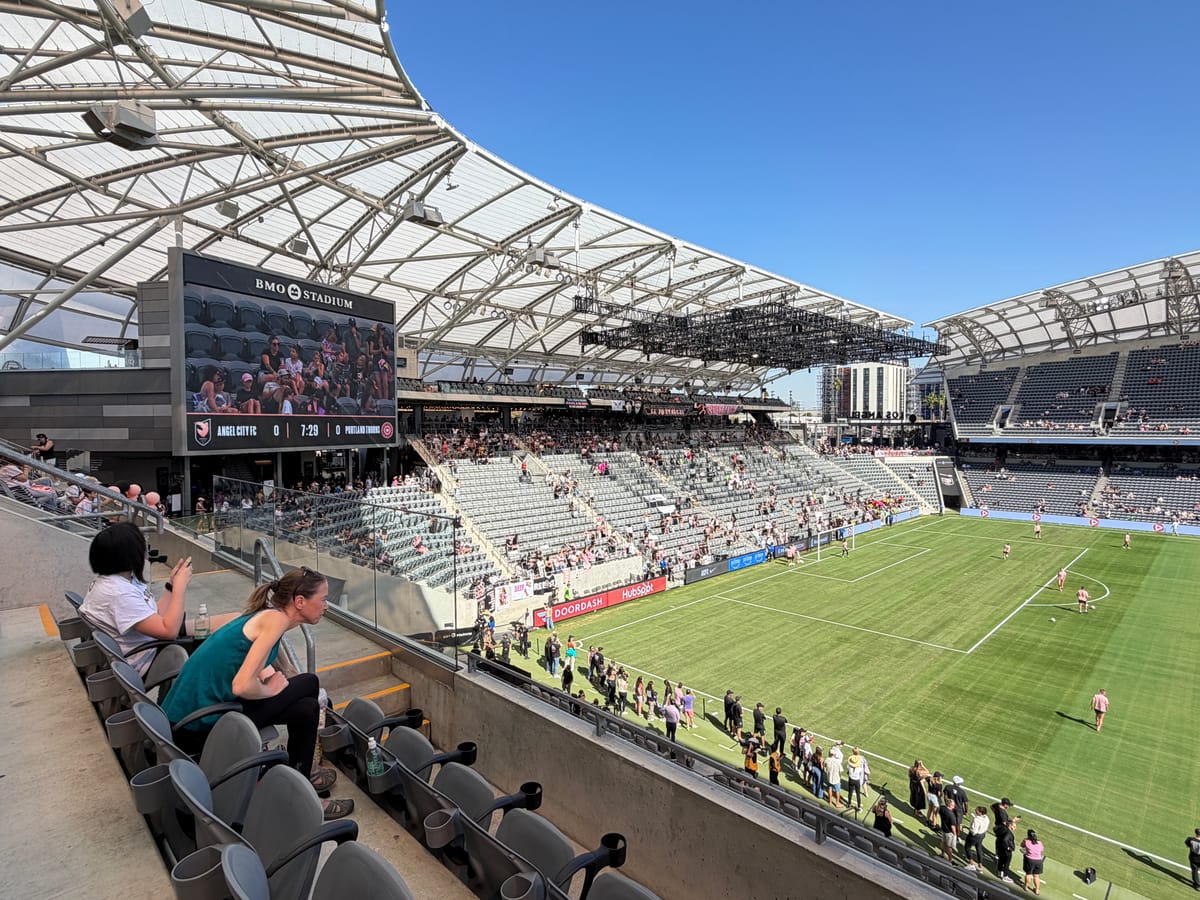
I just got back from a 24hr trip to Los Angeles to catch my favorite Portland Thorns team, watching them clinch their playoff spot in a match at BMO stadium in downtown Los Angeles.

In May of 2024, I did the same trip to catch a match on Mother's Day, but I accidentally chose bad seats in the sun and it was hot and uncomfortable. Ultimately, it partially inspired my wife and I's book reviewing every NWSL soccer stadium so other fans wouldn't suffer the same fate when flying across the country to catch their favorite team.
Me and my pal Greg yesterday

This year, I got better seats in the shade and enjoyed the game. But overall? The experience of being in the stadium was worse a year later. After thinking about it on the flight home, I think the reason was the stadium's rush to automation and AI in several places.
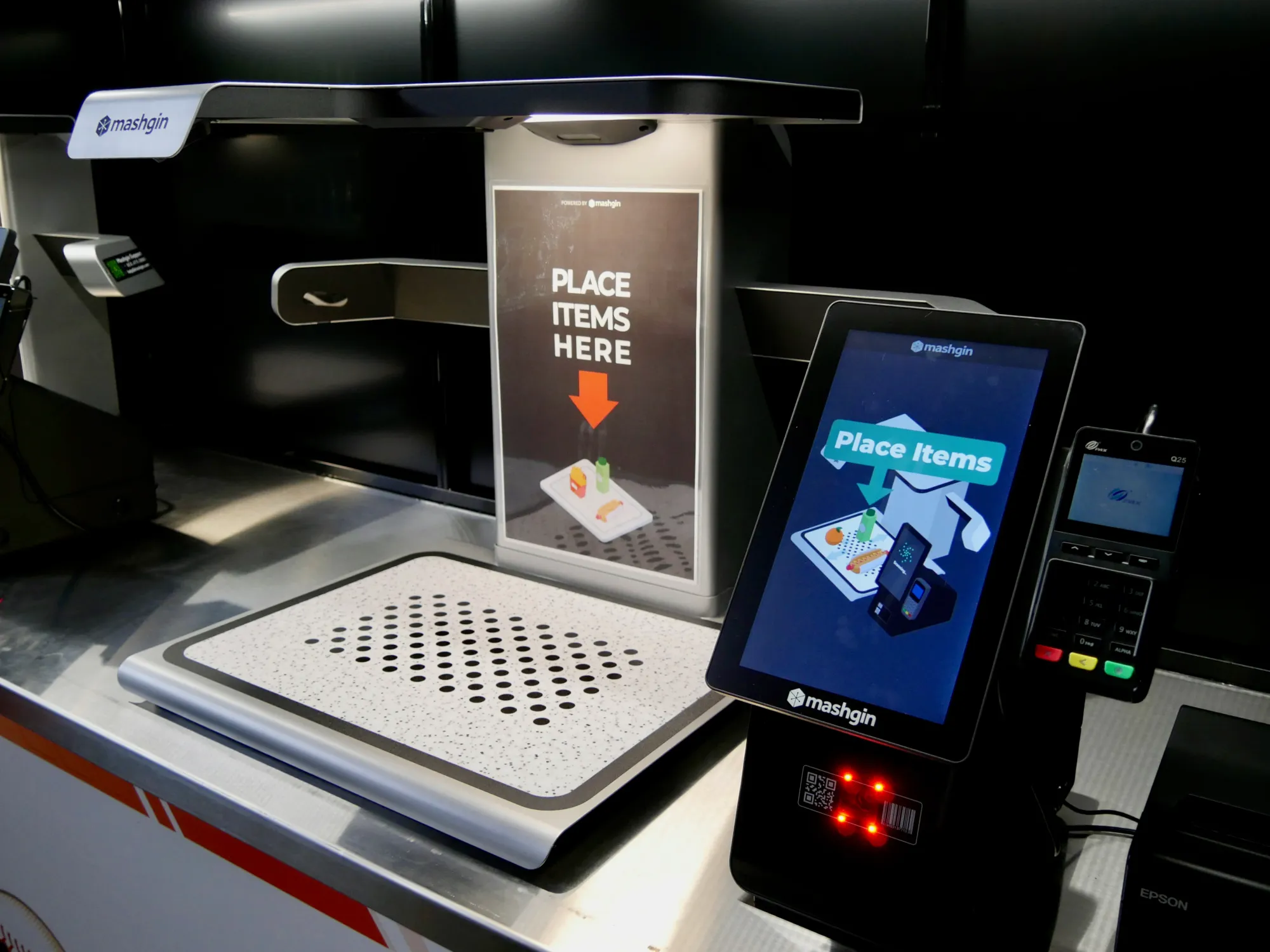
Spoiler alert: deploying camera/AI recognition for everything isn't great

Every concession stand, including the ones that didn't even serve hot food, used the apparatus in the photo above to control all checkouts. I assume these are expensive units, because most places that used to have several checkout lanes only had one of them, requiring everyone to checkout through a single location.

Here's how they worked in the stadium yesterday: You place all your items on the white shelf with some space between them. Although they were clearly designed to be a self-checkout experience, the stadium had a staff member rearrange your items, then for about 30 seconds the kiosk would be thinking. After, it would pop up all items on the menu, and the staff member would have to tap to confirm what each item was. Then another 30 seconds to calculate and move the purchase to a point of sale/tap on the side, then you'd pay.

Overall, this added at least one, if not two full minutes to every transaction that didn't normally have those delays. Lines were unbearably long, and it was a hot day in LA yesterday, at 87ºF/30ºC. I bought food and drinks several times over the the course of the day and had to endure the process multiple times.

When you add object recognition, you're incentivized to reduce choices

Here's an unintended consequence of moving all your concession stand checkouts to computer vision: it's easier if you have less things on offer.

Case in point: Let's talk about my favorite concession stand at BMO last year, a place that served rotisserie chicken with waffle fries and chicken sandwiches. Here's our meal from 2024, it was well-seasoned, came with great sauces, and was one of the best meals I had at a stadium in my entire nationwide tour, which is why I remembered it.
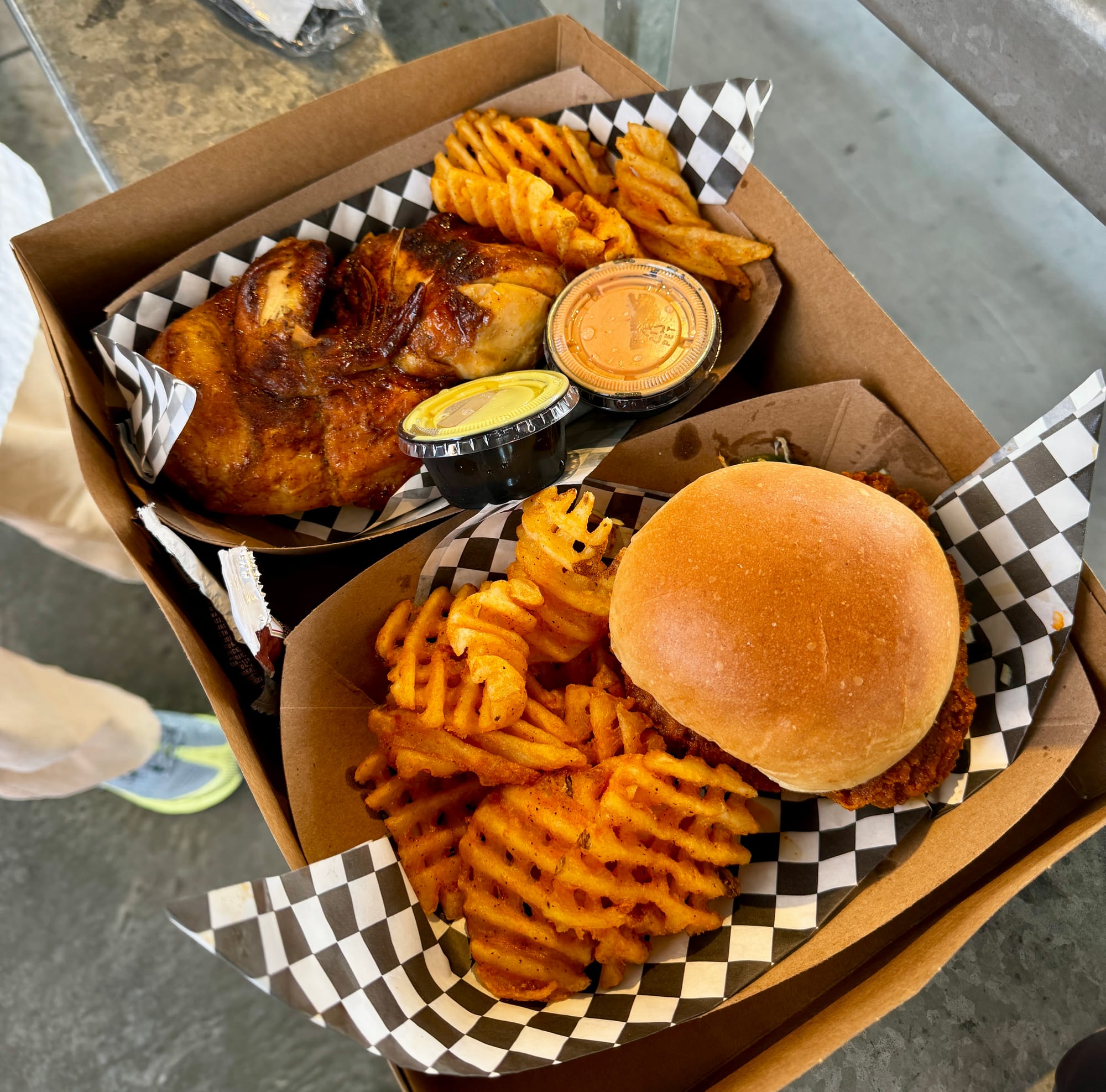
I returned to the same concession stand yesterday and here's their new menu:
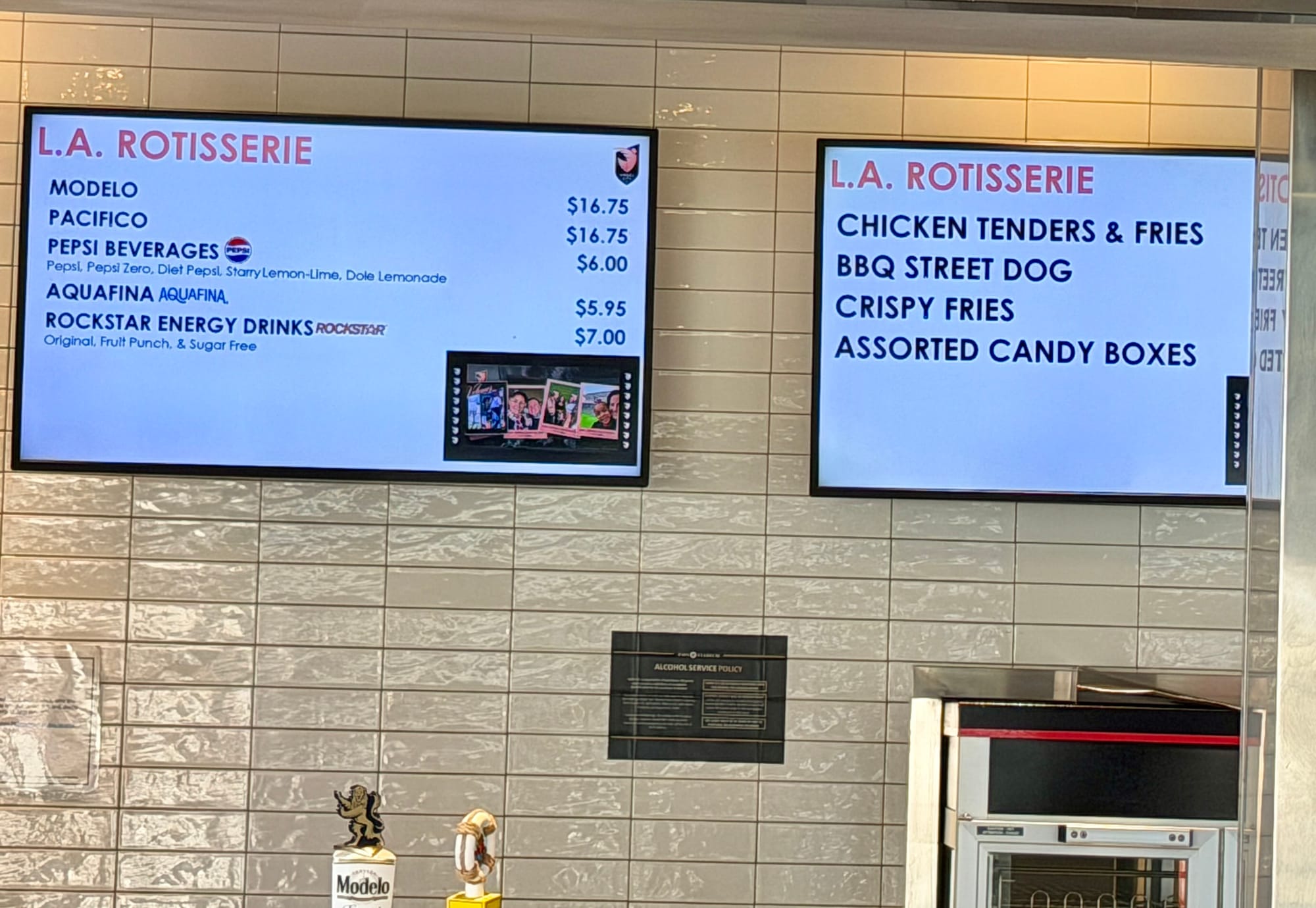
When your checkout stand relies on computer vision, it's probably confusing to have half a dozen different menu items that fans can enjoy. But if you could condense it to just chicken tenders, fries, a hot dog, and boxes of candy, your computer vision-based checkout system will probably work faster since it has to do less work with the obvious shapes of each of those items.
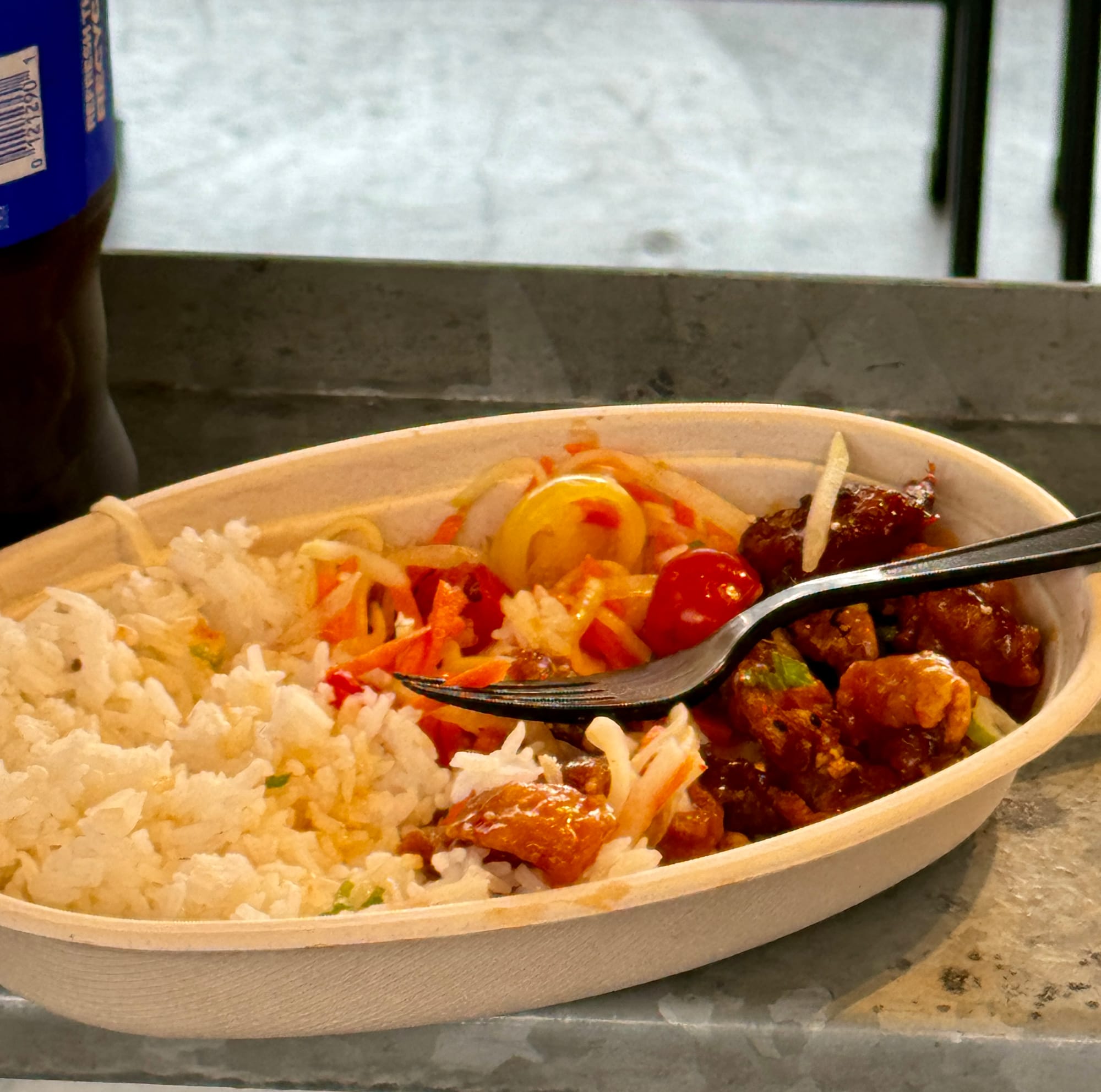
Looking through my photos from my 2024 visit, I saw a variety of food options including smashburgers and a Korean BBQ rice bowl I also tried, pictured above.

Then I realized varied foods would be difficult for computer vision to decipher, so why not get rid of most options? Walking around the stadium yesterday, the menus were basically all hot dogs, pizza, nachos, and chicken tenders.

Even quick service options sucked

As I said, it was a hot day, I was constantly parched, and I ended up drinking four bottles of water over the course of three hours. Each time, I had to go through the automated checkout gauntlet, and each time it required a long wait in a line, while I missed bits of the match.
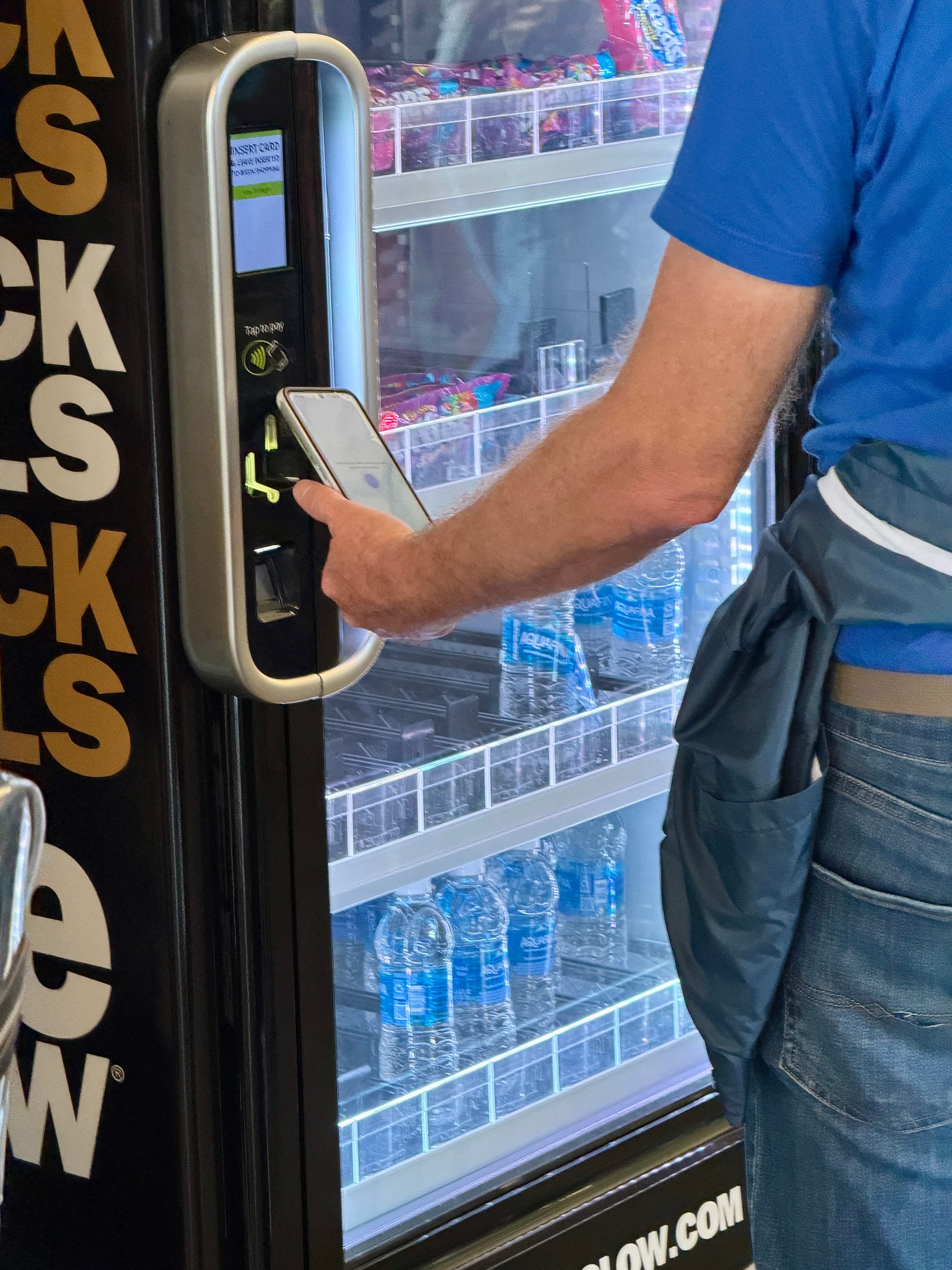
Late in the game, I wanted to get water quickly and they had these "vending kiosks" that were fully automated. You'd tap your phone on the locked door, it would unlock, you'd grab items, then close the door. Next, you had to stand there for about 2 minutes while it said "calculating checkout" before showing you a receipt on the screen.

What was supposed to be fast was very slow. The person in front of me bought two items and saw she got charged for three. Since there were no paper receipts, she took a photo of the machine before going to the guest services to complain. I missed ten minutes of the game getting water.
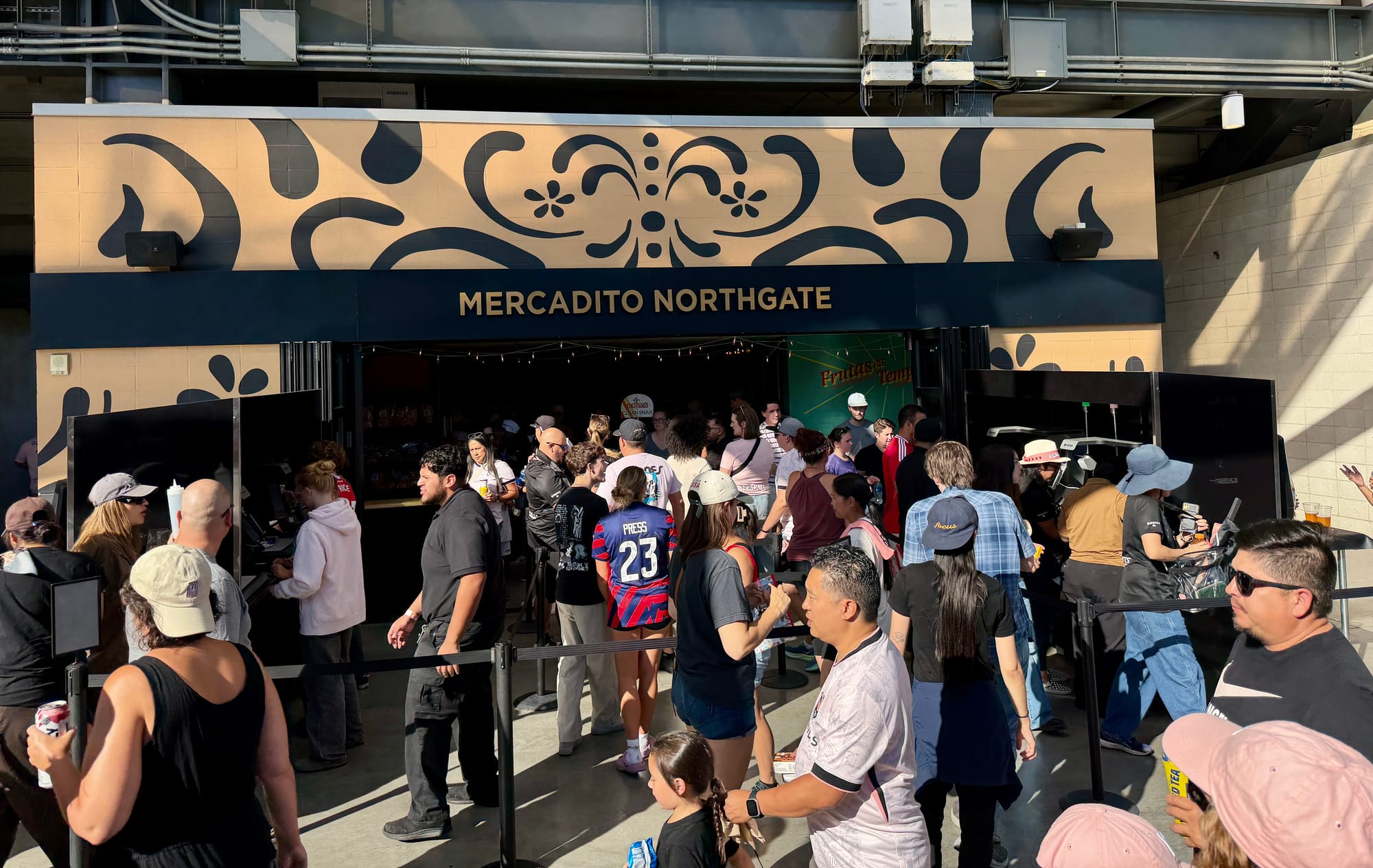
This was a quick service "market" style place and last year, you'd just grab stuff off a shelf, and checkout quickly from staff at multiple registers. This year, it had a long line snaking all over because of the slow AI/camera checkout kiosks.
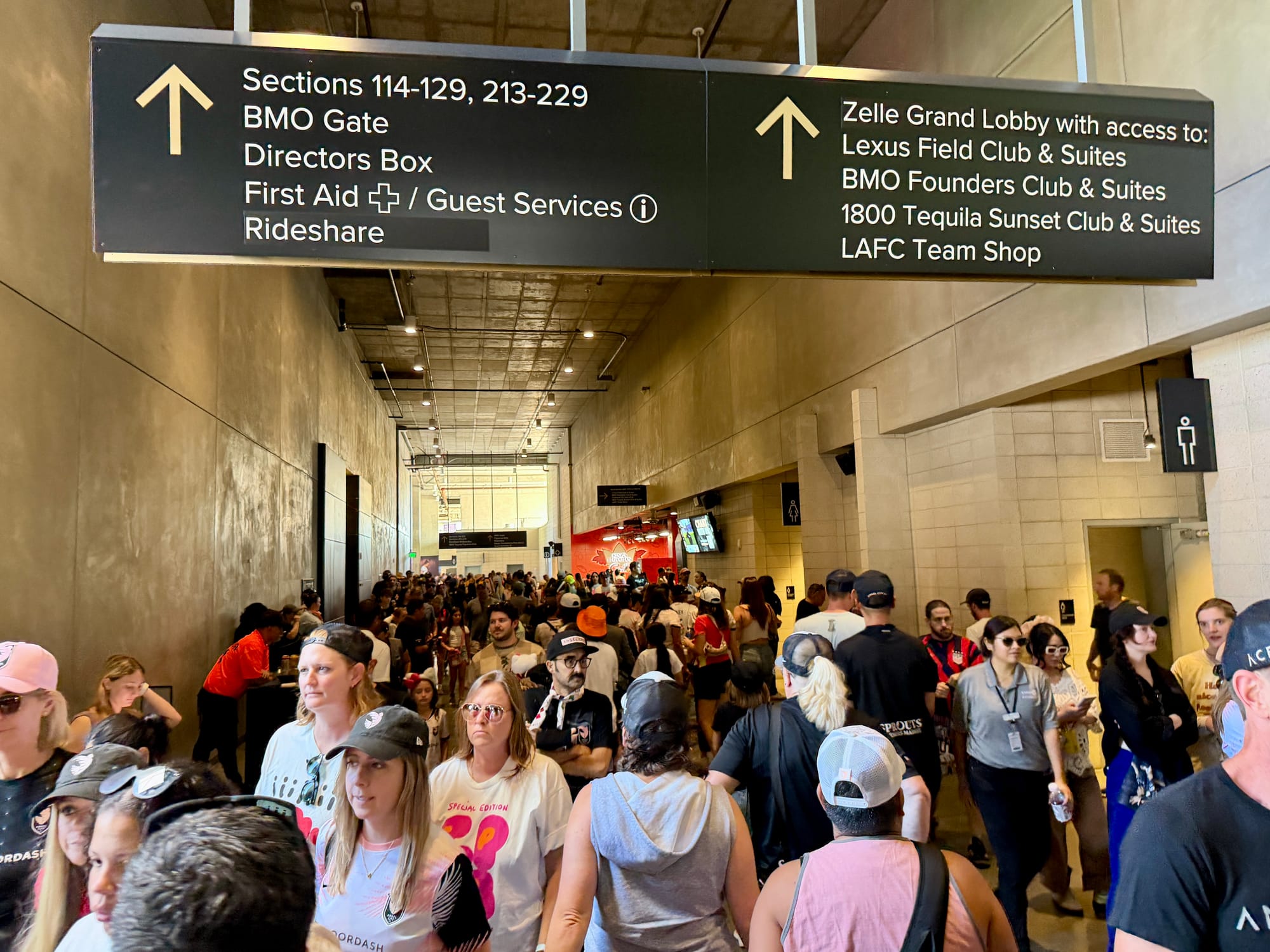
It was a busy game, being the last home match for the fans and I would guess there were around 17,000-18,000 people in attendance. When it's nearly 90ºF/30ºC, heat exhaustion becomes a problem for crowds. When it takes people ten minutes to buy a bottle of water (I didn't see automated water fillers at the restrooms), the embrace of slow AI/Camera-based checkout systems starts to become a health and safety issue for the crowd.

A year later visiting the same stadium, I got worse food, slower service, and a worse overall experience. On the bright side, the billionaire stadium owners probably got to reduce their staff in the process while maybe increasing profits.

The company behind the kiosks claims they are 400% faster than human checkers and result in a 25% increase in profits. After experiencing it in person yesterday, I think those numbers are bullshit. Human checkers are clearly faster and smoother, and I bet they sold more food and drinks when people could get them quickly.

And the portions? They were so small!


Read the original article

Comments

  • By Someone1234 2025-10-2020:3410 reply

    I was recently at an events center, that has replaced all of their vending machines with machines that require me to install an app(!) to purchase a product. Literally, didn't take cash or credit - just via app.

    Per the marketing on the side, this is meant to be for my benefit in order to earn "points" and get offered "deals." I don't think I have to tell you that I did NOT install the app, and just walked further to buy one from a vendor.

    There is a massive arrogance problem within tech. Everyone thinks their product should be the center of everyone else's universe. The best products are invisible/get out of the way.

    • By clan 2025-10-2021:084 reply

      The arrogance is not that they think they're the center of the universe. It is much worse.

      I hear a lot of talk about how much pain you can inflict on people and how to extract the most value from that. Last I heard it was from a couple of media types discussing radio commercials. No care for their actual product for the end user - but an evaluation of how much people would suffer before tuning away.

      Actual professional pride and care is sooo last century.

      • By svachalek 2025-10-2021:132 reply

        Sadly. It's like how modern bridges can be built with less materials than old ones, now that we can calculate precisely the minimum we use pretty much exactly that. Things have gone exactly the same way with consumers over the past 30 years, businesses have learned exactly how badly they can treat you and step up to that line at every opportunity.

        • By throwaway48476 2025-10-2021:204 reply

          Bridges are public goods. If the public spends less on material they can afford to build additional bridges and create value for more people.

          • By potato3732842 2025-10-2022:141 reply

            >If the public spends less on material they can afford to build additional bridges

            Except what happens is that now that we can build them cheaply they waste the same amount of money by turning what could have been simple I beams into a mirror finish exercise in "art" nobody asks for and was bike-shed into oblivion until the whole budget and more was used up. So the public doesn't actually reap any benefit. It just makes work for more parties on the dole. We don't actually get more bridges. We get a bigger racket.

            • By throwaway48476 2025-10-2022:233 reply

              Its not the fault of the engineers, they just did a job. The parasites come from elsewhere. I read that in order to build a reactor in the UK they spent 350 pages in the plan discussing how jobs would be given to various minority groups. Everything government touches is a racket now.

              • By fragmede 2025-10-210:52

                Thankfully (maybe) LLMs.ate great at generating text,which is believe will help streamline some of the more paperwork-generating processes.

              • By gruez 2025-10-213:25

                Source? A section about how it benefits minorities seems plausible but 350 pages does not.

              • By kulahan 2025-10-2022:572 reply

                Who even reads all of that? Is it just all in there so someone who says "I really care about <extremely rare ethnic minority>, so I want to make sure they're represented", or is someone actually sitting down and reading 350 pages of job allocations??? I can't imagine a worse punishment, honestly.

                • By potato3732842 2025-10-210:21

                  Some poor fucking secretary has to read all that shit so that their boss can be advised whether the application is compliant. It won't actually be analyzed unless those sections are sub-par at which point bickering over them becomes a lever the government can pull to extract more flesh. The applicant is forced to go back and say "well we'll hire a minority" or whatever to shore up that section.

                • By throwaway48476 2025-10-2023:111 reply

                  On a society level I think everyone realizes the ship is sinking and just looting everything they can before running for the lifeboats.

                  Bureaucracies became a spoils system. In the 60s the civil rights movement would boycott companies and then demand favors. Minority groups realized the moral weakness of western society and are just in it to loot whatever they can. For them the 350 pages of spoils are very important.

          • By ggreer 2025-10-2121:351 reply

            Bridges are not public goods. Public goods are non-excludable and non-rivalrous. Bridges are both excludable (people can be prevented from crossing unless they pay a toll) and rivalrous (only so many people can use a bridge at once). This makes them a private good. Yes bridges are funded by governments with revenues collected from taxes, but that doesn't change their economic classification.

            And the main cost of bridges is not materials, it's design, permitting, and construction. For example: Adjusted for inflation, the new San Francisco Bay Bridge span cost $8.6 billion. Its 450,000 cubic yards of concrete weigh around 1.3 million tons, for a cost of around $6,000 per ton. Concrete is $50-75 per ton, so that's 1% of the cost.

            • By clan 2025-10-229:221 reply

              That was a very narrow definition of a public good.

              Not preventable? (Excludable)

              Not limited in supply? (Rivalous)

              What can even be defined as a public good. Can air even be a public good by this definition? Even arguing in good faith I cannot wrap my head around this.

              A hospital? Limited capacity even with socialized medicine. Not a public good?

              Is this just an (to me) alien and extreme libertarian viewpoint I cannot fathom or am I missing something deeper?

              The concrete example stands. But a world in which we do not consider bridges a public good seems rather dystopian to me. I grant you that some of those might be private. But considering all to be private and just with a handwave acknowledge that most are publicly funded seems... Odd...

              • By ggreer 2025-10-2214:53

                I am using the Econ 101 definition.[1] Examples of public goods include lighthouses, knowledge, a common language, and national defense.

                The reason for the different classification is because public goods obey different economic laws. For example: because public goods are non-excludable, they have the free rider problem.

                1. https://en.wikipedia.org/wiki/Public_good

          • By _9ptr 2025-10-2021:351 reply

            You're right. If the minimum amount is actually the minimum and not less than necessary, you don't need to exceed that.

            What the poster before wanted to imply was that we sacrifice safety or sustainability or some value other than material/money (which may well be true).

            • By throwaway48476 2025-10-2021:381 reply

              Usually something is sacrificed in the name of extractive profit. With public spending it's just less taxes.

              • By clan 2025-10-229:56

                I sort of get your point. But it is not a given.

                Everybody tries to maximize their budgets.

                Less taxes is not the default. You will most likely get something else.

                When extractive profits is involved you will never get a cheaper bridge unless there is fierce competition. Tenders are narrowly defined so you do not see the offers that you can build 2 bridges for the price of one.

                In good markets governments keep the bridge building market hot enough so you have the supply ready for the next large projects. That is what keeps the price of big infrastructure projects down.

                Hence there is a very good argument for not simply returning the tax dollars.

                I do believe in Free markets. But I do believe in good governance as well.

                A good example around here is that the knowledge and lessons learned from building the Storebælt Link[0] made the Oresund bridge[1] get in pretty much on budget. Whereas German political fuckery delayed the Fehmarn belt project[2] and will go hugely over budget both due to missing momentum but also due to inflation

                [0] https://sundogbaelt.dk/en/about-us/finance-economics/constru... [1] https://sundogbaelt.dk/en/about-us/finance-economics/constru... [2] https://en.wikipedia.org/wiki/Fehmarn_Belt_fixed_link

          • By lotsofpulp 2025-10-2022:38

            And

            > businesses have learned exactly how badly they can treat you and step up to that line at every opportunity.

            Will help numbers in your 401k or pension plan go up.

        • By m463 2025-10-2021:28

          it's like bridge constructor, real life entertainment...

          https://www.gog.com/en/game/bridge_constructor

      • By HWR_14 2025-10-2022:45

        Those two discussing it probably felt a great deal of professional pride they can get the volume to within a tenth of a decibel of the maximum tolerable volume before someone changes the channel

      • By goda90 2025-10-2021:50

        >a couple of media types discussing radio commercials

        Relevant Simpsons clip: https://www.youtube.com/watch?v=VdMjqcjMVTc

      • By throwaway48476 2025-10-2021:18

        I call it the 3M strategy. Misery Makes Money

    • By m463 2025-10-2021:371 reply

      I think of a friend who worked at a bank, and a colleage decided to show him "how the world really worked"

      He got out a big printout and started showing the different demographics and their habits.

      "<ethnic> woman, with a little bit of college" - she will get a credit card, charge it up to the limit, then make the minimum payment... forever.

      "<ethnic> man, no college" - he will get a credit card, charge it up to the limit, might make one payment, never make another payment ever.

      Then he went on to say, corporations will slant their advertising to target demographic #1 with credit card advertisements. They will make their advertisements disappear from view from demographic #2.

      I kind of wonder if the whole vending system is slanted around these kinds of things. Sports fan, uses phone indiscriminately for everything, sell him an impulse snickers bar with an app, then load him down with ads for payday loans.

      • By mattgreenrocks 2025-10-2022:081 reply

        Nothing against sports fans, but your comment made me wonder if all the grocery stores hopping on the “game day” wave for advertising campaigns are doing so bc their data shows that sports fans are easier to sell to.

        • By bombcar 2025-10-210:16

          They’re certainly (stereotypically) much less likely to know the “normal” price for something than their (stereotypically) wives do.

          So, yes, way easier to sell to.

    • By reaperducer 2025-10-2021:142 reply

      replaced all of their vending machines with machines that require me to install an app(!) to purchase a product

      I saw this at a Simon mall recently.

      I took a picture of the machine. Across the front of the door is a banner which reads:

        1. Scan the QR code
        2. Create profile
        3. Scan again to unlock door
        4. Close the door
        5. You're one drink closer to a free drink!
      
      I'm not going to jump through hoops like a circus animal for a Mr. Pibb. I used the water fountain instead.

      • By xdfgh1112 2025-10-217:29

        In Japan they are also pushing an app for vending machines, but you immediately get three free drinks (then nothing after). It got me to sign up anyway.

    • By pjmlp 2025-10-218:18

      In Germany this has gone much worse lately.

      We had a card for earning points across multiple brands of supermarkets and other kinds of consumer shops.

      One of those chains, Rewe, decided they didn't want to share the points with the others and went ahead, creating their own mobile app for consumer points.

      The remaining chains, not wanting to stay behind, decided to do exactly the same.

      Now almost every chain has withdrawn from the card program, moved into their own little app, and expect every customer to install all their apps.

      I refuse to follow along, and get into interesting discussions, because employees naturally following orders that they have to nag everyone, cannot understand that I rather pay more than installing and giving my data to every chain in exchange for a few euros in discounts.

    • By OptionOfT 2025-10-2021:551 reply

      It's all about the pop-ups & tracking. The same reason that McDonald's wants you to install their app.

      • By pants2 2025-10-222:21

        I recently went into a McDonald's for the first time in years to just order a drink. The guy at the register informed me I couldn't place an order at the front and had to use the kiosk. The kiosk was full of dark patterns to try to get me to install their app. It took me around 5 mins between navigating the kiosk menus and waiting for my number to get called just to give me a medium drink. Something that would have been 20 seconds at the counter. I'll be avoiding McDonald's at all cost from here on out.

    • By nitwit005 2025-10-2023:401 reply

      It's not tech related. Previously, they all did this with various cards. People were walking around with a giant stack of loyalty or store credit cards in their wallet with a rubber band wrapped around it.

      There is a store I shop at where every purchase, they ask every single customer if they "have a phone number with them", which they can type in on the point of sale device. I've waited behind people trying to remember their old phone number.

      • By 1718627440 2025-10-2114:061 reply

        That didn't come with all the tracking and privacy implementations though.

        • By nitwit005 2025-10-2116:521 reply

          But of course they do. A big part of those schemes is to track all people's purchases. They also sold that data.

          • By 1718627440 2025-10-2118:361 reply

            A paper card with a stamp doesn't even have a name on it and the only copy of it existing is owned by the costumer. The only information e.g. the baker has is what names he has in brain.

            • By nitwit005 2025-10-2121:41

              The cards I was referring to were plastic cards with magnetic strips.

    • By influx 2025-10-2021:105 reply

      Lumen Field in Seattle just installed some Amazon Just Walk Out vendors this year. I'm happy to report you don't need to be logged into Amazon or have an app. I double clicked my phone to swipe my Apple Pay before I walked in, grabbed a beer and walked out.

      It was fantastic.

      • By bgirard 2025-10-2021:301 reply

        The big issue I have with this experience is that you don't get a clear charge price before you leave. So you have to check a page either some minutes or hours later and hope that the total is correct. Like the article said, I don't love the idea of being charged for 3 overpriced bottles of water when I only took two. I'd rather just settle my transactions in the moment than try to remember what my total was and dispute things later from memory on the occasional times it's wrong.

        • By teeray 2025-10-214:22

          > you don't get a clear charge price before you leave. So you have to check a page either some minutes or hours later and hope that the total is correct

          Oh, I’m very much sure this is a feature. Because, you see, only some percentage of people will actually look at the receipt. Some fraction of them will notice the error. Some fraction of those people will actually be motivated to spend their time on the phone clawing back an extra $8 water. The complement of that small percentage is a lucrative chance to sell the same overpriced water more than once.

      • By sleazebreeze 2025-10-2022:193 reply

        Aren't all these transactions checked by a human after the fact? IIRC I interviewed someone who worked on this and thats what they said.

        • By canucker2016 2025-10-2023:391 reply

          from https://www.cnn.com/2024/04/03/business/amazons-self-checkou...

             Amazon had used roughly 1,000 humans in India, according to some news reports, to help monitor accurate checkouts. The company told CNN it’s “reducing the number of human reviews” while developing the “Just Walk Out” technology. Amazon said besides data associates’ main role in working on the underlying technology, they also “validate a small minority” of shopping visits.

          • By vrighter 2025-10-218:35

            So they released the product before they even developed it. The sad state of software nowadays

        • By tumnus 2025-10-211:16

          Yes, it was the mechanical turk solution.

      • By robotnikman 2025-10-2021:19

        At the very least the is how it should be done. Having to download and install an app, then login, then connect payment info, etc... Sounds like such a pain I wouldn't even bother.

      • By kridsdale3 2025-10-2022:42

        Climate Pledge Arena has these too. I love them! No lines, no human interaction. Grab your M&M's and beer and GTFO.

      • By bombcar 2025-10-210:17

        Any store is a Just Walk Out if you’re ballsy enough.

    • By frogperson 2025-10-2021:07

      I agree with the arrogance. I am just so tired of poor software consuming hours to troubleshoot. technology was supposed to makes things easier, not turn every interaction into a chore or a debug session.

    • By 2ICofafireteam 2025-10-2112:59

      I believe vending machine operators that take card payment have to deal with a lot of charge-backs. Perhaps this is a workaround?

    • By fortran77 2025-10-2119:45

      How on earth can this be ADA compliant? That may the the best front to fight these abominations.

  • By ryandrake 2025-10-2020:327 reply

    > You place all your items on the white shelf with some space between them. Although they were clearly designed to be a self-checkout experience, the stadium had a staff member rearrange your items, then for about 30 seconds the kiosk would be thinking. After, it would pop up all items on the menu, and the staff member would have to tap to confirm what each item was.

    Maybe we're just calling all forms of automation and computer vision "AI" these days because it's sexy. Anyway: any automation that requires a human staff member to intervene to complete every run is not automation: It's just adding unnecessary technology and making the process worse. Imagine if each grocery store self-checkout required a human staff member to scan items, re-arrange things, and confirm checkout.

    • By mablopoule 2025-10-2020:48

      > Maybe we're just calling all forms of automation and computer vision "AI" these days because it's sexy.

      Funny thing is, at first it was the other way around! 'Computer Vision' has always been a sub-field of AI, but the term was more widely used by academics during a previous AI winter as a way to avoid the tainted 'AI' label.

    • By TSUTiger 2025-10-2021:262 reply

      They do that at Circle K[0] today using the same tech from Mashgin. It's meant to be a self-checkout, but you literally have one employee standing and watching this one checkout (sometimes 2-3, but usually 1-2). It's not always accurate, requires some hand-holding at times, and slows down the already slow lines at Circle K. It's a bit faster than the article implies and does not require a staff member, but still slower than a human would be.

      Meanwhile over at QuikTrip, there's one person checking out two people at a time. Suffice to say, if both stores are available, I will always choose the QT.

      [0]: https://www.youtube.com/watch?v=-c1kbWAttus

      • By kulahan 2025-10-2023:00

        I use circle-K because it's like 3 blocks from me. The self-checkout seems to work fine. I buy alcohol on the rare occasion I drink, and even then the cashier just steps to the side for one moment to check my ID, presses a button, and then goes back to what he's doing with someone/something else. It never overcharges me, at least, and it always seems to pick things up in just a couple moments. I suppose I take the time to space them out a bit, but I always seem to have a perfectly reasonable experience.

        That being said, I see the same one-person-two-registers thing at 7-eleven, and it's very, very fast.

      • By rsynnott 2025-10-2112:23

        ... In what possible way is this better than a normal self-checkout machine with a barcode reader, of the sort that's been around since the 90s?

    • By ToucanLoucan 2025-10-2020:571 reply

      > It's just adding unnecessary technology and making the process worse.

      Oh it's not JUST that, I'm sure it's also a data-harvesting scheme, because what isn't these days?

      • By nicbou 2025-10-217:11

        And at one point or another, a way to upsell in ways that employees refuse to do. See the McDonalds kiosks.

    • By olliepro 2025-10-2022:29

      > any automation that requires a human staff member to intervene to complete every run is not automation

      Not strictly true. Barcode readers are used by humans and are definitely automation. The ironic part though is that the automation going on here is literally object classification, which humans are good at.

      The play may be to collect data and make their system better.

    • By russdill 2025-10-2021:02

      I've used one of these at Lihue airport. It was slightly finicky, but fine and required no staff member assistance.

    • By neilv 2025-10-2021:42

      I came here to paste that quote. It sounds like a disaster of poor HCI around not-ready-for-prime-time tech implementation. That's not even a great PoC demo to get funding, much less deploy into production.

      Maybe they were emboldened because many companies still can't even do decades-old UPC barcode scanner self-checkouts well?

      The closest self-checkout to working reasonably well I see regularly would be at Whole Foods Market, at least just using the low-tech UPC and scale. I only have a few nits about it.

      (Though, within the last week, the usual duct-taped-on off-the-shelf hand scanner apparently saw the wrong barcode on the front of the product label (yes, some brand did that), which wedged the station, and the employee who came over seemed like they might think I was trying to defraud the store. I've coded for a few of those scanners before, and they provide a mix of automagical easy high-value behavior and major pitfalls. There are a few kinds of interfaces, and a large fleet of settings, and you really have to wrestle the device to the ground, to make every scenario bulletproof. If the integrator wasn't careful, for some of them, you can even reprogram or brick them with an in-band barcode, and disabling this feature is buried among the numerous settings.)

      The worst self-checkout I'm currently exposed to is the dumpster-fire of a major chain, which goes out of its way to fill the UI with garbage, and then doesn't do even basic sensing and state flow right. They really need to look at WFM design, and then go even further in that direction, and get the state model right. While making sure that no one's bonus is tied to garbage and dark patterns on the screen.

      (Also, for return customers who nope right out of the self-checkout headache, and go to the human checkout, or get directed to it by the attendant who's glaring at all the self-checkouts, they need clean their CC terminal keypad that's visibly caked with crud, like maybe it hasn't been disinfected in a year. Especially since they mandate repeated use of it when it should default to working with just a card tap/swipe, for a high-traffic location for many sick people.)

    • By baggachipz 2025-10-2020:542 reply

      > Imagine if each grocery store self-checkout required a human staff member to scan items, re-arrange things, and confirm checkout.

      They always have at least one person going between each self-checkout kiosk helping confused and upset customers. Meanwhile, 1 traditional checkout lane is open with a long line. Self checkout is great to use if you know how and have a handful of items, but it sucks with a full cart due to space constraints and the bag scales being finicky.

      • By reaperducer 2025-10-2022:251 reply

        Meanwhile, 1 traditional checkout lane is open

        I wish. The Wal-Mart near me no longer has staffed checkouts between 6am (opening time) and 8am. That's two hours in the morning of robots-only. I don't know about in the evenings.

        traditional checkout lane is open with a long line.

        I use the traditional check-out line whenever I can because where I live, the self-check line is almost always longer. It's not hard to keep an eye on the last person in the self-check line when you go to a real register to see which is faster.

        I'm not a fireman on call. I'm OK spending an extra 45 seconds in a traditional line to keep a low-skilled human being employed.

        • By ryandrake 2025-10-2022:341 reply

          I don't even think it's about going faster. In my experience, a traditional checkout staff is much faster than the self-check out. First of all, it's fantastically batched and pipelined. While the person in front of me is being checked out, I load all of my groceries onto the conveyer. Then, when it's my turn, the clerk does one motion over and over very quickly, and puts it on another conveyer that whisks it out of the way. When there's dedicated bagging staff, it's even more parallel.

          Contrast that with self-checkout: There is no conveyer. You have to reach into your cart, grab one item, run it across the scanner, and place that item in a bag, then reach back over into the cart, grab one item, and so on. No pipelining at all.

          I go the traditional staffed checkout route for the speed.

          • By jerlam 2025-10-2023:39

            This probably doesn't work for groceries, but Uniqlo (a clothing retailer) tags all their items with RFID. You put all your items in the "checkout box" at the same time and just pay, no scanning required.

            Here's a video of it in use: https://www.youtube.com/watch?v=GqPfYnVKwGI

      • By dwd 2025-10-213:252 reply

        Australia has had self-checkout in supermarkets and larger retailers for nearly 2 decades now.

        Usually you will have a single staff member responsible for 4-10 checkouts to override the machine when your product doesn't register a weight, or you move items off the scale too quickly, and it wants them to check it.

        It generally just works and is a lot quicker if you're just scanning a few items; surprised it hasn't really taken off in the US.

        Most of the issues these days are when they introduce new features like less tolerance on the weight (sometimes adjusting already scanned items trips an error) or auto-scanning fruit and vegetables.

        • By wildzzz 2025-10-214:11

          I think the major difference is whether or not the machine weighs the bagging area. When it's not weighing it, you can scan fast and any weirdness is ignored. If it does check the weight, you have to not only deal with wrong weights in the system but also moving anything around or very light items will trip the alert. Generally the nicer the neighborhood, the better chances you'll have finding a non-weighing self-checkout.

          I'm not stupid, I know why these measures exist but there's likely a smarter way to let the small things go. Find a way to add percentages to the alerts so that it won't trigger if I rearrange the bags. Factor in the price of an item as well so that it's triggering on meat that doesn't weigh right versus a can of beans.

        • By Izkata 2025-10-2114:47

          Depends on the location. My grocery store has had self checkout for a decade or so and I'd say more than half of people use it.

  • By bgirard 2025-10-2021:221 reply

    > The person in front of me bought two items and saw she got charged for three. Since there were no paper receipts, she took a photo of the machine before going to the guest services to complain. I missed ten minutes of the game getting water.

    I wish payment processors / consumer protection would have a significant penalty for sloppy overcharges. I've had to deal with sloppy overcharges like this (one for over $1,000) and you lose a lot of time and the outcome is just 'oppsies, my bad'. There's very little repercussion for sloppy overcharges so it's easy for them to perpetuate.

    • By Doxin 2025-10-217:06

      Back in the olden times overcharging like that would be dealt with the same way as theft would. I'm not entirely convinced it's the wrong way to go about things. It's how the concept of a bakers dozen came to be. Better give everyone 13 in a dozen, just in case you ever miscount.

HackerNews