
3 innovators reimagining how we fly
Dear Rational Optimist,
The Wright brothers first sputtered into the air in 1903.
Concorde broke the sound barrier in 1969.
Only 66 years separate these two photos:
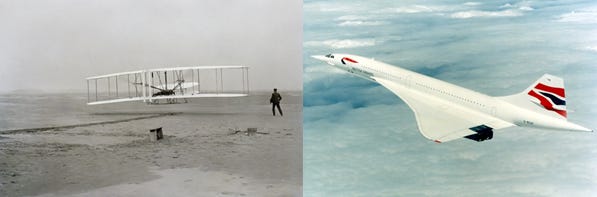
But in the 56 years since Concorde debuted, aviation innovation has been stuck in a rut. Planes have gotten safer but slower. The fastest commercial passenger jet currently operating, the Boeing 747-8, flies half as fast as the Concorde.
I felt the pain personally on my recent trip from Abu Dhabi to LA. 24 hours door-to-door. We have the technology to reduce that to under 10. Why don’t we?
Three reasons: noise, regulation and cost. As I’ll show you, all three are at various stages of being solved by some of the smartest and most dedicated founders I’ve ever met.
For a full primer on supersonic flight, read my colleague David Galland’s excellent Deep Dive. In this essay I’ll focus on the exciting progress made in supersonic in the last six months, led by two companies I just visited (Boom Supersonic and Astro Mechanica) and one startup whose founder I recently interviewed (Hermeus).
All three are moving fast. All three will change how we fly. And they have big plans to usher in “Supersonic 2.0,” where anyone can catch a quick, affordable supersonic flight almost anywhere on earth.
Who will win?
The evolution
Earlier this year Boom Supersonic’s XB-1 became the first privately developed jet to break the sound barrier.
Importantly, nobody on the ground heard a thing, thanks to Boom’s application of a concept called “Mach cutoff.” By flying at the right altitude and using AI software to measure atmospheric conditions, Boom ensured the loud sonic boom curved upward and dissipated into the sky, rather than disturbing people below.
Noise problem solved.
A few months later in June, likely as a result of Boom’s quiet supersonic demonstration, we got the regulatory change we needed.
Since 1973 all supersonic flight, noisy or not, has been banned over land in the US. On June 6, Executive Order 14304 restored our right to fly supersonic, “provided the aircraft do not produce an audible sonic boom on the ground.”
Two weeks ago I flew to Denver to meet the man who’s done the most to make supersonic 2.0 a reality: Boom CEO Blake Scholl.
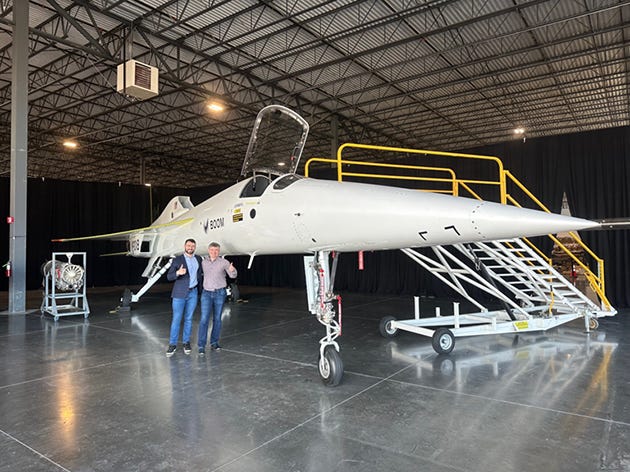
Blake embodies the “bits to atoms” shift underway in America. Before founding Boom, he was designing internet coupons for Groupon.
With no aerospace background, Blake taught himself the necessary skills and built a team of believers. Within a decade, his team created a working supersonic jet from scratch.
Boom’s XB-1 test jet was one-third the size of its planned full-sized supersonic jet, called Overture. Overture will be sleek and needle-nosed, designed to solve the Concorde’s Achilles’ heel: cost.
Concorde tickets would cost upward of $20,000 in today’s money. The big problem: Its engines guzzled fuel like a race car going full throttle. Fuel comprised roughly half the cost of operation. And Concorde burned 52% of its fuel just taxiing and taking off!
That’s because it essentially used rocket boosters bolted to a jet engine, which were incredibly inefficient at low speeds.
To solve that, you need a new engine.
Translation: Building airplane engines is hard.
Boom is designing and manufacturing its own engine called Symphony.
I saw Symphony’s parts scattered around Boom’s factory. One nickel alloy cylinder alone weighed 500 pounds. It’s amazing a chunk of metal this big can make it into the sky.
Fully assembled, a Symphony engine will weigh 14,000 pounds—heavier than Boom’s entire XB-1 test plane. And Overture will have four Symphony engines!
Symphony is a non-afterburning turbofan that’s essentially a really good version of what we already know works. It takes the proven, reliable jet engine architecture used for decades and optimizes it for one specific mission: cruising at Mach 1.7.
Symphony solves the efficiency problems that turned Concorde into a cash incinerator. Blake says a NYC-London round-trip ticket will cost $5,000, roughly the cost of a business-class ticket.
Which brings up a question: Who will be Boom’s customers?
Boom is going straight for the commercial market—it will make airplanes and sell them to airlines like United and American. It’s already booked 130 orders.
Blake’s pitch to airlines is enticing: “You’re already flying this route with a 300-seat plane where 80+ people in business class generate most of your profit. Give those passengers a supersonic plane, cut the flight time in half, and charge the same price.”
The last successful US airplane manufacturer was Douglas Aircraft, founded in 1921.
I believe Boom will break the century-long drought and succeed. In this sense it could be the “Tesla of the skies.”
But it’ll be at least five years until we’re flying on its supersonic jets. Here’s how I see the timeline.
Overture’s first test flight will be in three years. Boom is cleverly working alongside the FAA to ensure as smooth a regulatory approval process as possible. This will speed things up.
Still, Overture will have to conduct thousands of hours of real test flights over probably two years before it’s FAA-certified.
My estimate: You and I will be able to cruise at Mach 1.7 over the clouds on a Boom Supersonic jet in 2033.
The revolution
Down a narrow back alley in San Francisco, Astro Mechanica founder Ian Brooke and his team of engineers and machinists are quietly remaking the future of flight.
Astro Mechanica is the antithesis of the decades-long, committee-driven process suffocating legacy aerospace. Boeing’s last major “new” plane first flew in 2009. Talk about an innovation famine.
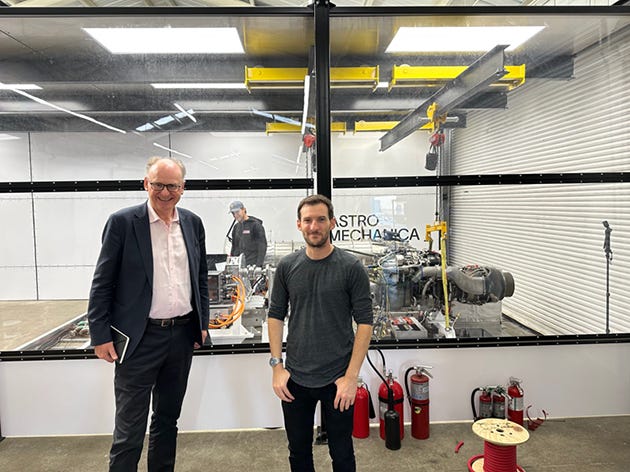
Ian earned his pilot’s license at 17 and admits his core motivation is simple: “I just want to fly a fast plane.” Here’s a picture I snapped with Ian and ROS Honorary founder, Matt Ridley in Astro’s San Francisco testing site:
Ian told me a quick story that sums up Astro Mechanica’s ethos:
A pottery teacher divided his class into two groups.
One would be graded on the quantity of pots they produced, the other on the quality.
At the end of the term the best pots all came from the quantity group. While the quality group theorized and talked, the quantity group learned by doing.
In other words, there’s no substitute for actually doing the thing. Building. Tinkering. Iterating.
Like Boom, Astro is making its own engine. Unlike Boom, it’s rethinking the jet engine from scratch.
In traditional jet engines, the fan, turbine and compressor are all connected. They are efficient at cruise speed and terrible at everything else.
Astro’s turboelectric adaptive engine is a chameleon. It’s part jet, part electric fan, part rocket.
For takeoff and landing it behaves like an efficient turbofan, sipping fuel. When it goes supersonic it morphs into a powerful ramjet. To potentially go hypersonic (5X the speed of sound) in the future, it transitions into rocket-like mode with no moving parts.
This technology is new. It only works because of breakthroughs in electric motor power density, which have improved 15X over the past decade.
What’s most impressive is Astro has already gone through three rapid engine iterations:
Gen 1 engine: proved electric compression could produce supersonic exhaust.
Gen 2 engine: validated efficient subsonic performance.
Gen 3 engine: combines both into a single system, now hot-fire testing.
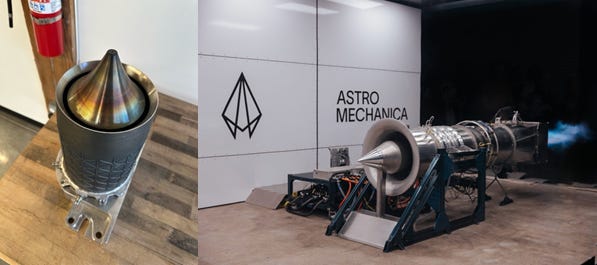
All that innovation quicker than it takes Boeing to update a tray table.
Astro Mechanica is also designing its engines from the get-go to run on better, cheaper, cleaner fuel.
Today’s jets burn kerosene. Now picture an extremely cold, clear liquid that would instantly freeze your finger if you touched it. That’s liquefied natural gas (LNG), which is cooled to about -260°F. At this temperature, the gas shrinks and becomes a liquid that can be transported.
LNG was never a viable fuel because it wasn’t widely available. Thanks to the fracking boom and LNG export infrastructure buildout, it’s now abundant. Compared to kerosene, LNG burns 30% less CO₂ and offers 60% more range.
Most importantly, LNG is 10X cheaper than kerosene.
Ian emphasizes supersonic “is not interesting if it’s not affordable.” The goal is: “Everyone gets to fly supersonic, priced like Southwest. San Francisco to Tokyo, Mach 2+, for under a thousand bucks.”
Cheap fuel and efficient engines are the first two pillars of how Astro will achieve this. The third pillar is blowing up the old airline model and reimagining how we fly.
Building a new engine is just the start for Astro Mechanica. It also plans to operate the airline. Ian’s vision is Uber for supersonic jets:
On-Demand Flights: Forget fixed schedules. Book flights when you need them like you’d hail a ride.
Smaller Airports: Utilize thousands of underused regional and private airfields, bypassing the cattle-call congestion of major hubs. Closer to home, faster ground time.
More Jets: Small, private jet-sized supersonic aircraft dispatched dynamically based on demand. No more flying empty seats across oceans.
Suddenly, the economics work. Small planes, cheap fuel, efficient engines, point-to-point travel, anywhere on Earth. Ian says, “We can go everywhere three times faster and at the same price.”
Astro’s first customers won’t be airlines. It’s tackling the defense market first. Its ability to go hypersonic (5X the speed of sound) is very useful for military applications.
Ian told me the Pentagon is the perfect first customer because it will pay high prices and really cares about speed.
Consider the Pacific Ocean. It’s easy to imagine a scenario where the military needs to reach Taiwan ASAP. Right now, moving assets there takes days of slow flights and mid-air refueling. Astro will be able to get there hypersonically in hours.
Defense is the perfect steppingstone to building a commercial jet. It’s less regulated, meaning you can move fast and break things. You can prove your engine works at extreme conditions and bring in cash to fund civilian aircraft development.
Astro is already recognizing millions of dollars in defense revenue and ramping fast.
I believe starting with defense allows Astro Mechanica to innovate faster than Boom.
Start with defense. Then move into the private jet market. Finally, bring supersonic travel to the masses.
The dark horse
When I asked AJ Piplica, founder of Atlanta-based hypersonic jet startup Hermeus, to summarize the mission he didn’t hesitate for a second “we’re building the world’s fastest airplanes.”
For most of aviation history, we’ve lived in a world capped at roughly Mach 0.8, the cruising speed of modern airliners. Concorde nudged that to Mach 2; the SR‑71 briefly touched Mach 3. Then we stopped. Hermeus wants to jump to Mach 5, five times the speed of sound. That’s fast enough to make New York–London a 90‑minute hop.
Everything Hermeus does hangs off one big technical problem. Engines good at taking off from a runway melt at high speed, and engines good at going fast can’t take off from a runway.
Remember, Concorde burned 52% of its fuel just taxiing down the runway. That inefficiency killed supersonic travel.
Hermeus’ answer is an engine called Chimera. It’s a hybrid, with two engines strapped together. One that’s efficient at low speed, and another that can take you five times the speed of sound.
Hermeus uses a “turbojet” from an F-16 fighter jet for takeoff and acceleration to Mach 3. Then in just five seconds, the turbine shuts down, and air is funneled directly to a hypersonic “ramjet”, launching you to Mach 5.
Like Astro Mechanica, Hermeus plans to test its technology in the defense world before building commercial airliners. AJ told me “to build a commercial jet is an incredibly high bar. You have to move extremely slowly. The defense market allows you to go fast.”
FAA certification takes at least half a decade to prove every system is 100% safe for passengers. Going after the defense market first allows Hermeus to…
I asked AJ what killed previous hypersonic programs.
“We guessed the future and got it wrong. Aerospace engineers would pick some super hard feature, then spend a decade trying to build it. Rapid iteration is the key to making hypersonic work.”
Most aerospace programs spend a decade or more before anything flies. Hermeus is taking a page out of SpaceX’s playbook, with rapid, iterative development, aiming to build a new test aircraft every year.
They call this the Quarterhorse program. It’s an escalating series of aircraft, each designed to de‑risk a different piece of the hypersonic puzzle.
Hermeus first jet, “Mk 1” flew last May. It went from clean‑sheet to flight‑ready in just over a year.
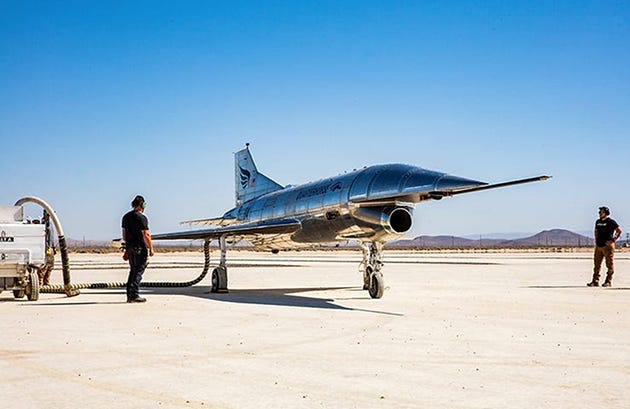
The goal was proving this weird shaped plane could remotely take off and land. Tick!
AJ said Quarterhorse Mk 2 should fly someone in the first quarter of 2026. Mk 2 will be similar in scale to an F‑16 fighter jet and will go supersonic.
It will de-risk the “precooler”, a crucial piece of tech that will allow its turbine to run faster than designed without melting, bridging the gap to ramjet speeds.
Then in 2027 we have Mk 3 to look forward to, which will test the turbojet-to-ramjet transition in flight. If successful, it will break the airspeed record held by the SR-71 Blackbird.
Every flight brings Hermeus closer to its first revenue generator: a reusable, autonomous military aircraft called “Darkhorse” that can reach Mach 5.
This is a capability America badly needs. China and Russia have done 10x more hypersonic tests than the US in the last decade.
AJ believes “speed is the new stealth.” Radar and computing are advancing faster than stealth coatings, so the reliable way to survive in contested airspace is to be so fast that enemies can’t react in time.
Then in the 2030s, Hermeus wants to debut Halcyon, a 20‑passenger Mach 5 jet capable of making New York–London a 90‑minute hop. A game changer, but at least 10 years away.
The more money Hermeus makes from defense, the faster it can develop Halcyon. And the sooner you and I can travel around the world at Mach 5. I’m in!
I believe all three will be major players in Supersonic 2.0.
Boom is perfecting the jet engine. It’s building a better Concorde in a sustainable and profitable way. Boom slots perfectly into the existing airline market and may be the first to get you across the Atlantic in time for breakfast.
Astro is reinventing the jet engine and how we fly. Its path to success is bolder and longer. Astro Mechanica’s more revolutionary engine designs could make it the more valuable company a decade from now.
Hermeus is the dark horse in the race. Its willingness to innovate fast and break things could leapfrog any competitors stuck at the drawing board.
Like Astro, Hermeus is using the anti-Concorde strategy: prove the tech works in defense, where customers are willing to pay premiums for speed, then bring costs down for commercial passengers.
Ultimately, we all win. Especially us frequent long-haul flyers.
Keep in mind, in 1976 you could fly from New York to London in 3.5 hours. In 2025, it takes seven hours. We went backward.
Now the regulatory wall is cracking. The technology is better than ever. The capital is flowing. The teams are building.
It’s supersonic 2.0 time.
I asked AJ, Ian and Blake why they’re dedicating the best years of their lives to building supersonic jets.
For AJ it started when he saw Lockheed’s C-5 Galaxy aircraft at an air show when he was a kid. It made him want to build things that fly.
Ian is a purist. He wants a really fast plane. Nobody is building it. So he had to step up.
Blake, a dad of four, wants his kids to be able to have friends all over the globe. He wants to live in a world where grandparents can visit their grandkids living halfway across the world for a weekend. (Me too, Blake!)
He added: Before the jet age, it took days to reach Hawaii on a boat. The jet engine literally created the Hawaiian vacation.
Supersonic will do the same for the rest of the world. It will turn Sydney into a weekend trip, make global sports leagues (like the NFL) possible, and unlock all sorts of wonderful opportunities we haven’t dreamt up yet.
Tell me in the comments what you would do if you could travel anywhere in the world in just a few hours. And be sure to click “like” and “restack” to help us spread rational optimism.
—Stephen McBride
Read the original article

Comments
Regarding the “supersonic is now viable because LNG” argument, but for a different reason than usual.
Even if supersonic flight becomes cheaper via new fuels or propulsion, that doesn’t reset the baseline. The same advances (materials, engines, fuel handling, manufacturing) will also apply to subsonic aircraft, where the physics are already far more energy-efficient. So if supersonic gets “cheap,” traditional jets will get much cheaper. Airlines will always arbitrage toward the lowest energy-per-seat-km for most routes, and supersonic flight is structurally disadvantaged there (drag, noise, routing constraints).
Historically, faster transport doesn’t replace slower transport wholesale; it creates a premium tier while pushing the mass market down to a lower cost/energy equilibrium. Concorde didn’t kill widebodies, widebodies got cheaper. My intuition: supersonic may of course exist as a niche (time-sensitive, premium), but its biggest impact would be indirect, accelerating efficiency gains that make conventional aviation even more dominant and cheaper.
By credit_guy 2026-01-073:251 reply That is not quite true. The advantages of LNG are much more important for high supersonic jets (Mach 2.5 and higher) than for subsonic jets. There are disadvantages too, and they are quite significant for all jets, but altogether the tradeoff is worth it at high speed long endurance supersonic jets.
Here's why. LNG offers 2 main benefits. The first is the higher energy density (53.6 MJ/kg vs 43 MJ/kg, so 25% more [1]). Airplanes are subject to the rocket equation, even if they are not rockets. The rocket equation says that the mass of the fueled vehicle is the mass of the vehicle at the end of the trip times the exponential of delta-v divided by the exhaust velocity. For airplanes, it is not exhaust velocity, but "effective exhaust velocity", because they borrow a lot of reaction mass from the atmosphere (the air used as oxidizer, and more importantly, the bypass air). The effective exhaust velocity is very high for subsonic airplanes, and much lower for high supersonic airplanes. The delta-v for subsonic airplanes is lower than the delta-v for supersonic airplanes because of the lower drag (although not as much lower as one would expect, because they need a higher attack angle). Overall, the benefit from the high energy density LNG is much more pronounced for high supersonic jets.
The second benefit is the use of the cryogenic LNG to cool off the engine. For very high speed engines, this is huge. So huge that the famous (but never materialized) SABRE engine was supposed to use liquid hydrogen, which is stored at much lower temperatures.
The disadvantage of LNG is, surprisingly, not the need for cryogenic storage. It is the lower volumetric energy density. It is 22% lower than that of jet fuel. The rocket equation does not care about volumes, only about mass, but larger volumes means bigger airplanes, so more drag.
So, for subsonic airplanes the advantages of LNG are not all that important, while the bulkier tanks are a pretty big downside. For high supersonic jets, the advantages of LNG are so high that they simply open up possibilities that are not there with jet fuel. The fact that the LNG is cheaper is a nice thing to have, but it's really not that important, since the economics of high supersonic jets are more impacted by the construction cost and very high maintenance cost than by the fuel cost.
[1] https://en.wikipedia.org/wiki/Energy_density#Chemical_reacti...
By masklinn 2026-01-0620:50 > Airlines will always arbitrage toward the lowest energy-per-seat-km for most routes
That's a second order effect from fuel being the primary cost, and thus the primary lever to either make more profit or improve competitivity.
If airlines could triple their profits by doubling their fuel burn they'd happily do that.
By K0balt 2026-01-0714:58 Surprisingly, at least in theory, and probably in practice with better technology, supersonic travel can be as efficient or even more efficient than subsonic flight. Supersonic travel opens up higher altitudes, higher altitudes means less air resistance.
The ultra high altitudes of LEO satellites showcase the steelman example, traveling effortlessly through the vanishingly thin atmosphere at hypersonic speeds with extreme efficiency even though the fuel expenditure to get them there was high.
For more reasonable hypersonic travel, at 100k feet, the “wind” force at 3375mph is only as much as you would feel at 400 mph at sea level… so you can exert the force needed to fly at 400mph, but for that same energy you are going 3375mph.
Of course there is a lot of tech needed to take advantage of these efficiencies, but it’s not a matter of faster = less efficient. As for economies, a jet that can fly LA to NY in 70 minutes, with an hour of turn at each end, could make 10 trips a day, potentially cutting the number of aircraft needed to cover a given route or route rotation by a factor of 4.
Obviously this is not currently practical on so many levels, but there is nothing fundamentally stopping us from achieving that level of service, given enough knowledge and technical capability.
If we ever want to achieve that level of understanding and competence, we will have to work on it when it seems impractical. Remember, it was in a single persons lifetime between flying precariously in glorified kites and supersonic flight.
By c_o_n_v_e_x 2026-01-0621:192 reply I agree with your market analysis. Private jets are often referred to as "time machines" given how much time HNW / exec travelers can save. There's a market segment that's willing to pay a high premium for reduced travel time.
Hm... I don't know that I buy your argument, since just as you point out, traditional jets are already very optimized. One would assume there's less slack to pick up.
By HPsquared 2026-01-0620:31 Aeronautical engineering isn't that linear. A technology suited to one application may not be helpful in another. It's one of those "hardware is hard" fields.
By MattGaiser 2026-01-0619:543 reply And even then, it is only so premium. As you could have a speedy economy seat on the Concorde or a lie flat bed on a widebody by the time Concorde left service. The speed benefit largely goes away if I can travel while sleeping.
> Historically, faster transport doesn’t replace slower transport wholesale; it creates a premium tier while pushing the mass market down to a lower cost/energy equilibrium.
If that were true, we’d all be taking trains and boats everywhere. We aren’t.
You are missing an important factor in the baseline here, the cost of time.
Right now, a cheap 7 hour each way round trip between NYC and London is ~500$.
Halve it to 3.5 hours each way with a supersonic plane, saving a total of 7 hours.
Now, the real question is then, what's one hour of your time worth to you or whoever is paying for your flight?
If improvements to subsonic aircrafts bring down the price to 200$ instead of $500, people would still be willing to pay 200$ + 7 * $HOURLY for a faster flight.
Even with a low-ish estimate of $HOURLY = 50, it would make sense to take the supersonic fight if the price was $500, which it could conceivably be brought down to, and the market has already validated to be willing to pay.
Want to reduce the time it takes to get somewhere? Reduce the security circus at airports. This will cut off way more of the travel time for the majority of flights, wothout the downsides of supersonic planes.
By recursivecaveat 2026-01-0618:588 reply It seems like there's not enough interrogation of how much time supersonic could actually save you. 3 hours of flying from LA to Seattle, 2.5 with climb and approach removed. If you cut it in half, 1h15m saved. On the flip side, how long does it take to get to the airport, park, though security, board, deboard, massive buffer time because flights are expensive and you don't know what might delay you, god forbid you have baggage to check and pick up. Flying at twice the speed might reduce the time to fly by less than 20%. Taking small on-demand supersonic flights from regional airports as suggested is definitely not a solution btw, because it's a pipe dream.
Being on the actual plane is the most uncomfortable part of the entire experience, for me at least.
Others may disagree, but I'd rather cut an hour from the flight than the entire commute/parking/security/airport waiting. (Assuming conditions on the actual plane were the same.)
By seanmcdirmid 2026-01-0620:271 reply Seattle to Beijing is like 12+ hours now that Russian airspace is closed. There is a lot of time to save.
LA to Seattle is not worth it. The real gains are in London to NYC, or Tokyo to LA, or maybe Rio de Janeiro to Miami.
No one is flying supersonic over land at least in the US. Going over the oceans is where it would happen.
By zamadatix 2026-01-0620:36 The one note about Astro Mechanica towards the middle is referring to long haul flights from smaller airfields because they'll have a smaller private jet sized plane. It was not referring to short haul flights, nor was the rest of the article.
I don't believe the economics for that will at all work out the way they are pitching, but it has no relation to how much supersonic makes sense for a domestic short haul.
By hermitcrab 2026-01-0623:121 reply I am guessing this is really aimed at the 1%, who don't have to get to the airport 3 hours before a flight.
Rory Sutherland commented that, insteading of spending billions on high speed trains, why not spend a few million on making the experience nicer. Better carriages, more staff, nicer stations.
He used 24 hour LA to Dubai as an example?
Why would you pick a 3 hour flight?
By grishka 2026-01-0722:34 It's for much longer distances.
There are flights between St Petersburg and Moscow. About 10 daily. It's about 1 hour. Together with everything you described, it's more like 4 hours. A high-speed train is also 4 hours. So the only people who choose to fly are those who have a connection or those who couldn't get a train ticket because those are always in high demand.
> Concorde burned 52% of its fuel just taxiing and taking off
and later in the article:
> Remember, Concorde burned 52% of its fuel just taxiing down the runway.
Setting aside that these are completely different claims, the author does not cite this claim at all and it fails my personal gut check. Where is this information coming from?
The claim in the article, "Concorde burned 52% of its fuel just taxiing down the runway", is completely wrong and kind of ruins my confidence in the article. A Concorde used less than 1% of its fuel taxiing down the runway, not 52%.
Source: Air France Flight 4590 Accident Report states that the plane had 95 t of fuel on board when the aircraft started out and used 800 kilos of fuel during taxiing (page 17) and 200 kilos after taxiing before takeoff (page 159). https://www.faa.gov/sites/faa.gov/files/2022-11/Concorde_Acc...
(Since there's a bunch of discussion about how to reduce taxiing consumption, I'll point out that one tonne of aviation fuel is about $700, so there's not much money to be saved by creating battery-powered tugs or whatnot.)
As far as takeoff, "at the start of cruise 20% of the total fuel burnoff will have been consumed while only 9% of the total distance will have been covered." From "Operation Experience on Concorde", a paper by the Design Director. While 20% is a lot, it is much less than 52%. https://www.icas.org/icas_archive/ICAS1976/Page%20563.pdf
Yes, it sounds like the repetition of a mangled version of the SR71 stories. Burning 45 tonnes of fuel on the runway would be completely insane.
Checking various links on taxiing burn yields about 2 tonnes which is a lot more realistic and reasonable (a previous HN comment indicates the 767 burns about a tonne taxiing: https://news.ycombinator.com/item?id=24283386 concorde burning twice that sounds fair)
The OP might have gotten confused reading articles like https://simpleflying.com/concorde-fuel-consumption/ stating concorde burned half its tank from the gate to cruise (mach 2 at FL600)
By prof-dr-ir 2026-01-0619:182 reply The article is just generally sloppy.
> .. my recent trip from Abu Dhabi to LA. 24 hours door-to-door. We have the technology to reduce that to under 10.
The direct flight (by Emirates) takes 16h15 mins, so that leaves 7h45 mins not in flight. If we want to bring that down to 10 hours just by making the flight supersonic then that would require a flight time of 2h15, corresponding to a (ridiculous) speed well over Mach 4.
