
You’ve probably seen this famous graph that breaks out various categories of inflation, showing labor-intensive services getting more expensive during the 21st century and manufactured goods getting…
You’ve probably seen this famous graph that breaks out various categories of inflation, showing labor-intensive services getting more expensive during the 21st century and manufactured goods getting less expensive.
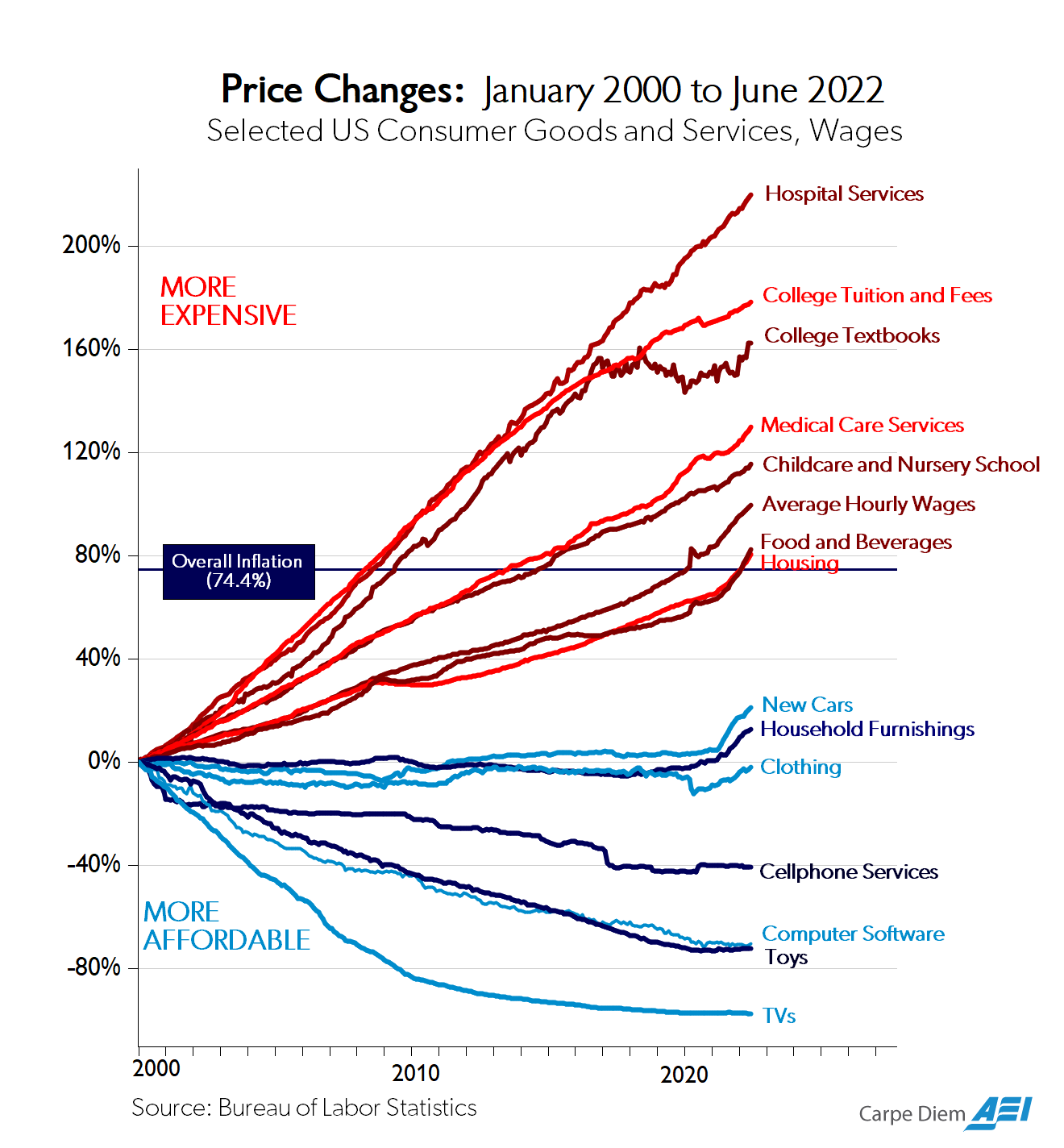
One of the standout items is TVs, which have fallen in price more than any other major category on the chart. TVs have gotten so cheap that they’re vastly cheaper than 25 years ago even before adjusting for inflation. In 2001, Best Buy was selling a 50 inch big screen TV on Black Friday for $1100. Today a TV that size will set you back less than $200.
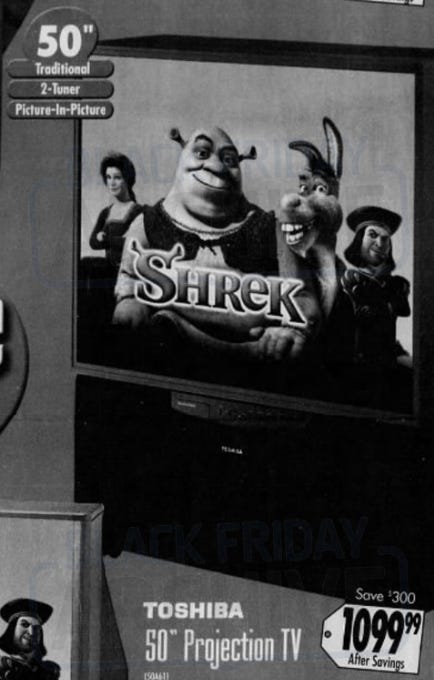
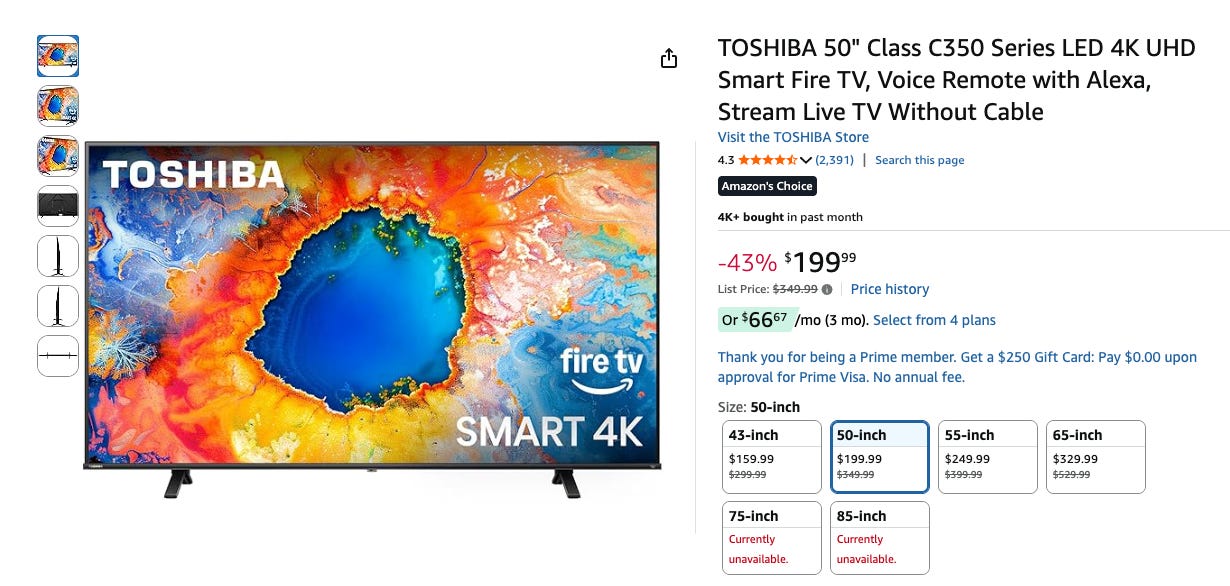
The plot below shows the price of TVs across Best Buy’s Black Friday ads for the last 25 years. The units are “dollars per area-pixel”: price divided by screen area times the number of pixels (normalized so that standard definition = 1). This is to account for the fact that bigger, higher resolution TVs are more expensive. You can see that, in line with the inflation chart, the price per area-pixel has fallen by more than 90%.
This has prompted folks to wonder, how exactly did a complex manufactured good like the TV get so incredibly cheap?

It was somewhat more difficult than I expected to suss out how TV manufacturing has gotten more efficient over time, possibly because the industry is highly secretive. Nonetheless, I was able to piece together what some of the major drivers of TV cost reduction over the last several decades have been. In short, every major efficiency improving mechanism that I identify in my book is on display when it comes to TV manufacturing.
How an LCD TV works
Since 2000, the story of TVs falling in price is largely the story of liquid crystal display (LCD) TVs going from a niche, expensive technology to a mass-produced and inexpensive one. As late as 2004, LCDs were just 5% of the TV market; by 2018, they were more than 95% of it.
Liquid crystals are molecules that, as their name suggests, form regular, repetitive arrangements (like crystals) even as they remain a liquid. They exhibit two other important characteristics that together can be used to construct a display. First, the molecules can be made to change their orientation when an electric field is applied to them. Second, if polarized light (light oscillating within a single plane) passes through a liquid crystal, its plane of polarization will rotate, with the amount of rotation depending on the orientation of the liquid crystal.
LCD screens use these phenomena to build a display. Each pixel in an LCD TV contains three cells, which are each filled with liquid crystal and have either a red, green, or blue color filter. Light from behind the screen (provided by a backlight) first passes through a polarizing filter, blocking all light except light within a particular plane. This light then passes through the liquid crystal, altering the light’s plane of polarization, and then through the color filter, which only allows red, green, or blue light to pass. It then passes through another polarizing filter at a perpendicular orientation to the first. This last filter will let different amounts of light through, depending on how much its plane of polarization has been rotated. The result is an array of pixels with varying degrees of red, blue, and green light, which collectively make up the display.
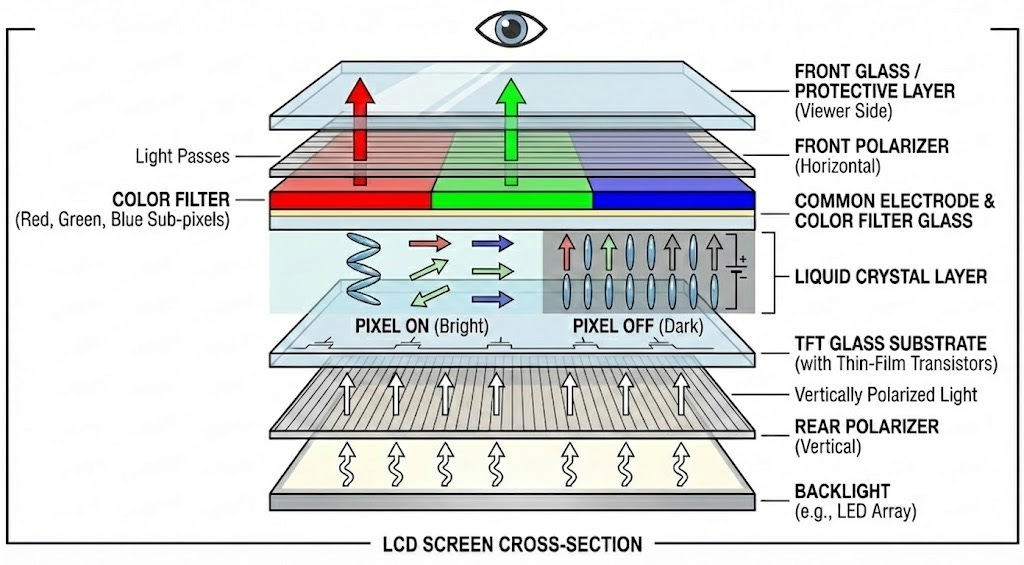
On modern LCD TVs, the liquid crystals are combined together with a bunch of semiconductor technology. The backlight is provided by light emitting diodes (LEDs), and the electric field to rotate the liquid crystal within each cell is controlled by a thin-film transistor (TFT) built up directly on the glass surface.
Some LCD screens, known as QLED, use quantum dots in the backlight to provide better picture quality, but these otherwise work very similarly to traditional LCD screens. There are also other types of display technology used for TVs, such as organic LEDs (OLED), that don’t use liquid crystal at all, but today these are still a small (but rising) fraction of total TV sales.
It took decades for LCDs to become the primary technology used for TV screens. LCDs first found use in the 1970s in calculators, then other small electronic devices, then watches. By the 1980s they were being used for small portable TV screens, and then for laptop and computer screens. By the mid-1990s LCDs were displacing cathode ray tube (CRT) computer monitors, and by the early 2000s were being used for larger TVs.
Steadily falling LCD TV Cost
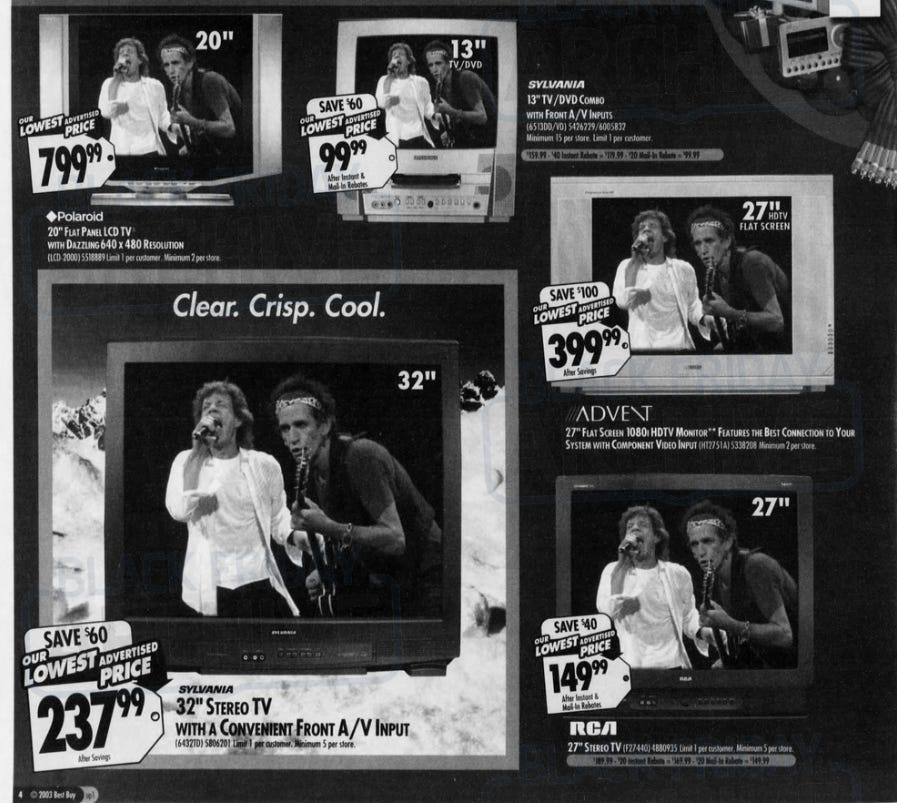
When LCD TVs first appeared, they were an expensive, luxury product. In this 2003 Black Friday ad, Best Buy is selling a 20 inch LCD TV (with “dazzling 640x480 resolution”) for $800. The same ad has a 27 inch CRT TV on sale for $150. (I remember wanting to buy an LCD TV when I went to college in 2003, but settling for a much cheaper CRT).
How did the cost of LCD TVs come down?
LCD TVs start life as a large sheet of extremely clear glass, known as “mother glass”, manufactured by companies like Corning. Layers of semiconductor material are deposited onto this glass and selectively etched away using photolithography, producing the thin film transistors that will be used to control the individual pixels. Once the transistors have been made, the liquid crystal is deposited into individual cells, and the color filter (built up on a separate sheet of glass) is attached. The mother glass is then cut into individual panels, and the rest of the components — polarizing filters, circuit boards, backlights — are added.
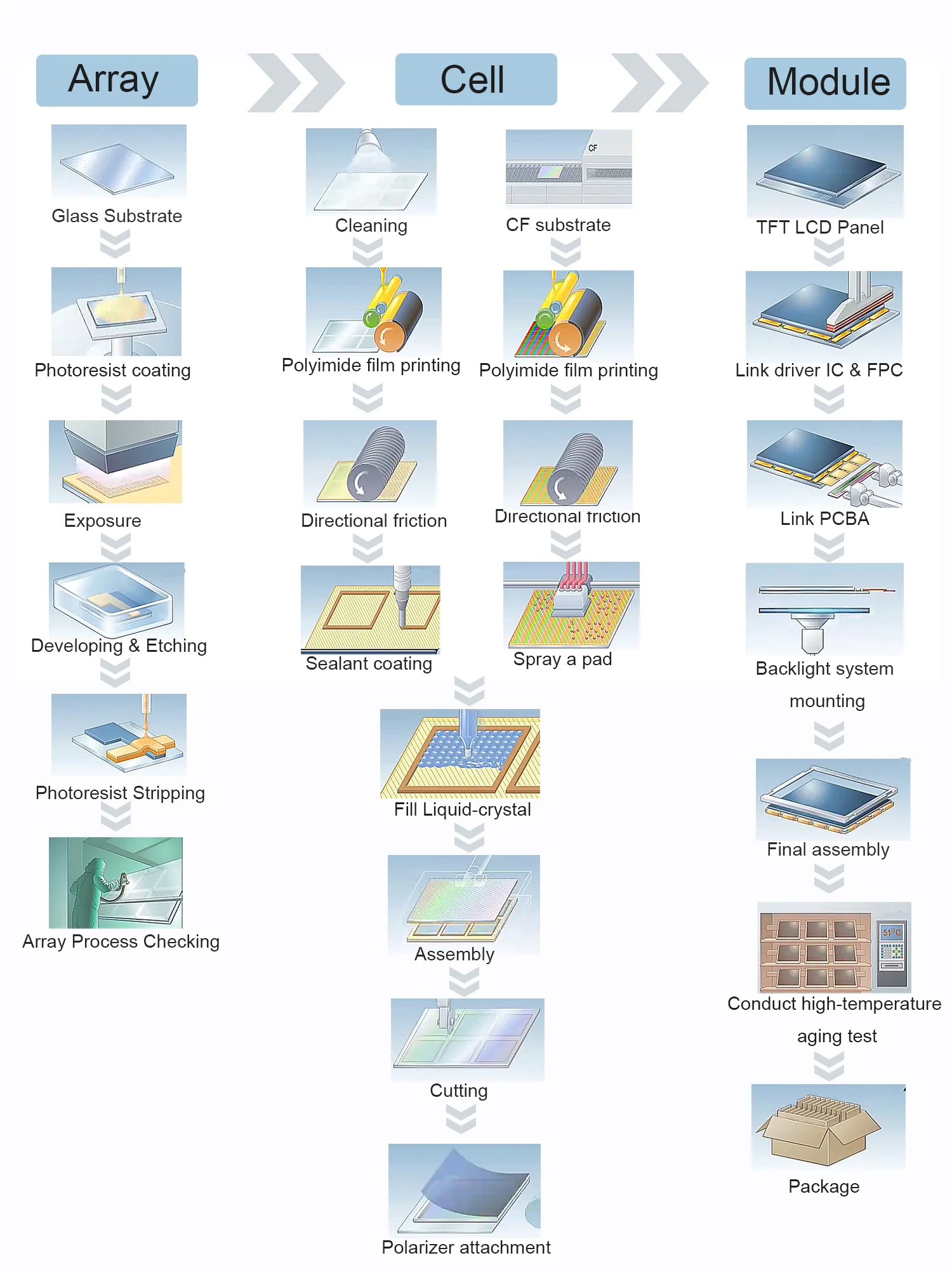
A key aspect of this process is that many manufacturing steps are performed on the large sheets of mother glass, before it’s been cut into individual display panels. And over time, these mother glass sheets have gotten larger and larger. The first “Generation 1” sheets of mother glass were around 12 inches by 16 inches. Today, Generation 10.5 mother glass sheets are 116 by 133 inches, nearly 100 times as large.

Scaling up the size of mother glass sheets has been a major challenge. The larger the sheet of glass, and the larger the size of the display being cut from it, the more important it becomes to eliminate defects and impurities. As a result, manufacturers have had to find ways to keep very large surfaces pristine — LCDs today are manufactured in cleanroom conditions. And larger sheets of glass are more difficult to move. Corning built a mother glass plant right next to a Sharp LCD plant to avoid transportation bottlenecks and allow for increasingly large sheets of mother glass.
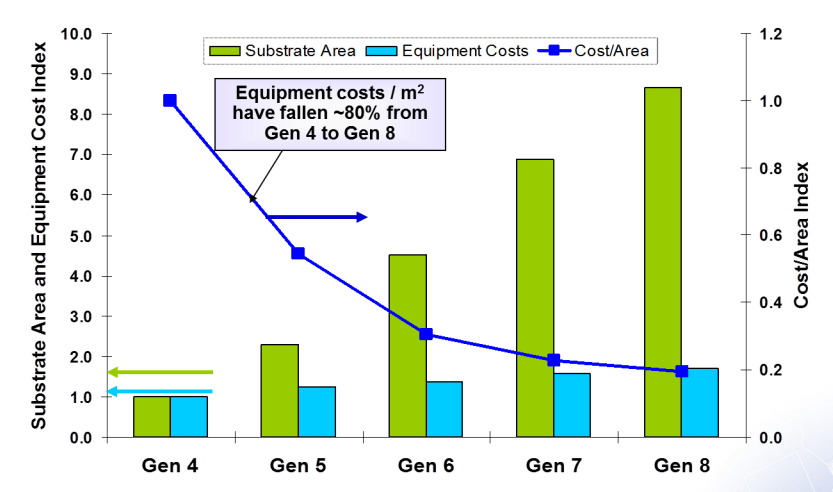
However, there are substantial benefits to using larger sheets of glass. Due to geometric scaling effects, it’s more efficient to manufacture LCDs from larger sheets of mother glass, as the cost of the manufacturing equipment rises more slowly than the area of the glass panel. Going from Gen 4 to Gen 5 mother glass sheets reduced the cost per diagonal inch of LCD displays by 50%. From Gen 4 to Gen 8, the equipment costs per unit of LCD panel area fell by 80%. Mother glass scaling effects have, as I understand it, been the largest driver of LCD cost declines.
LCDs have thus followed a similar path to semiconductor manufacturing, where an important driver of cost reduction has been manufacturers using larger and larger silicon wafers over time. In fact, sheets of mother glass have grown in size much faster than silicon wafers for semiconductor manufacturing:
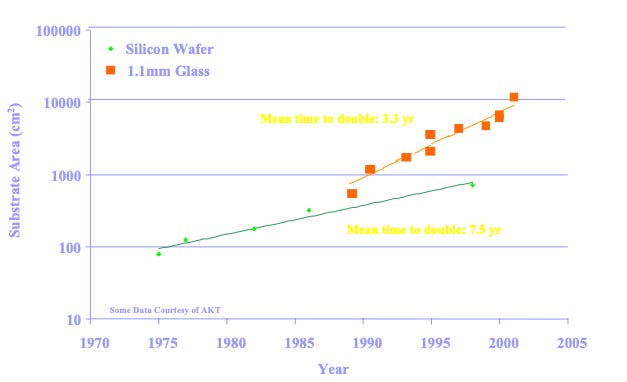
LCDs are thus an interesting example of costs falling due to the use of larger and larger batch sizes. Several decades of lean manufacturing and business schools assigning “The Goal” have convinced many folks that you should always aim to reduce batch size, and that the ideal manufacturing process is “one piece flow” where you’re processing a single unit at a time. But as we see in several processes — semiconductor manufacturing, LCD production, container shipping — increasing your batch size can, depending on the nature of your process, result in substantial cost savings.
At the same time, we do see a tendency towards one piece flow at the level of mother glass panels. Early LCD fabs would bundle mother glass sheets together into cassettes, and then move those cassettes through subsequent steps of the manufacturing process. Modern LCD fabs use something much closer to a continuous process, where individual sheets of mother glass move through the process one at a time.
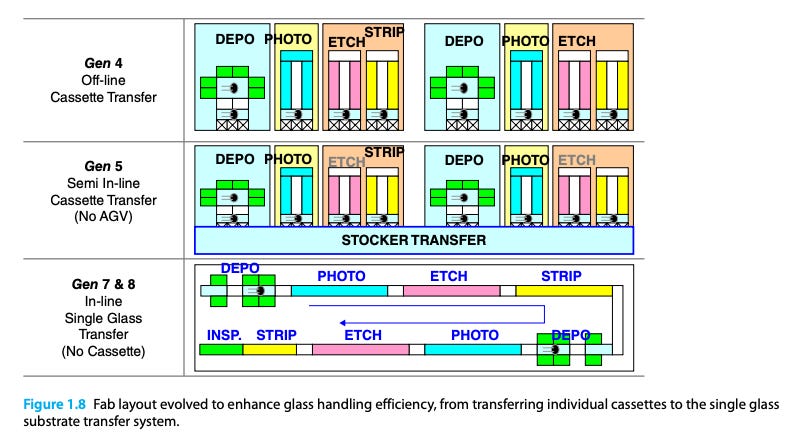
Outside of larger and larger sheets of mother glass, there have been numerous other technology and process improvements that have allowed LCD costs to fall:
“Cluster” plasma-enhanced chemical vapor deposition (PECVD) machines were developed in the 1990s for depositing thin film transistor materials. These machines were much faster, and required much less maintenance, than previous machines.
Manufacturers have found ways to reduce the number of process steps required to create thin-film transistors. Early operations required eight separate masking steps to build up the transistors. This was eventually reduced to four.
Thanks to innovations like moving manufacturing operations into cleanrooms and replacing manual labor with robots, yields have improved. Early LCD manufacturing often operated at 50% yield, where modern operations achieve 90%+ yields.
Cutting efficiency – the fraction of a sheet of mother glass that actually goes into a display — has increased, thanks to strategies like Multi-Model Glass, which allows manufacturers to cut displays of different sizes from the same sheet of mother glass.
The technology for filling panels with liquid crystal has improved. Until the early 2000s, displays were filled with liquid crystal through capillary action: small gaps were left in the sealant used to create the individual crystal cells, which the liquid crystal would gradually be drawn into. It could take hours, or even days, to fill a panel with liquid crystal. The development of the “one drop fill” method — a process in which each cell is filled before the sealant was cured, and then UV light is used to cure the sealant — reduced the time required to fill a panel from days to minutes.
Glass substrates were gradually made more durable, which reduced defects and allowed for more aggressive, faster etching.
More generally, because LCD manufacturing is very similar to semiconductor manufacturing , the industry has been able to benefit from advances in semiconductor production. (As one industry expert noted in 2005, “[t]he display manufacturing process is a lot like the semiconductor manufacturing process, it’s just simpler and bigger.”) LCD manufacturing has relied on equipment originally developed for semiconductor production (such as steppers for photolithography), and has tapped semiconductor industry expertise for things like minimizing contamination. Some semiconductor manufacturers (like Sharp) have later entered the LCD manufacturing market.
LCD manufacturing has also greatly benefitted from economies of scale. A large, modern LCD fab will cost several billion dollars and produce over a million displays a day.1 It’s thanks to the enormous market for LCD screens that these huge, efficient fabs can be justified, and the investment in new, improved process technology can be recouped.
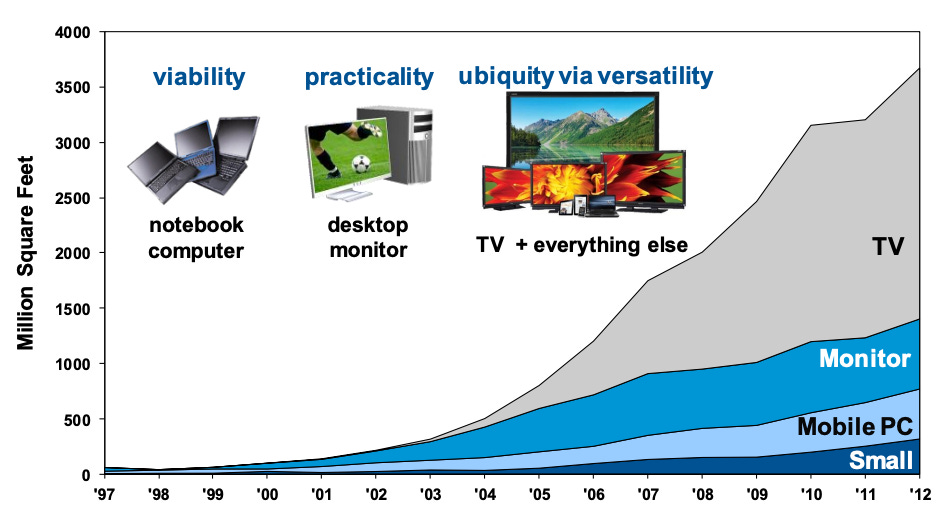
Falling LCD costs have also been driven by relentless competition. A 2014 presentation from Corning states that LCD “looks like a 25 year suicide pact for display manufacturers.” Manufacturers have been required to continuously make enormous investments in larger fabs and newer technology, even as profit margins are constantly threatened (and occasionally turning negative). This seems to have partly been driven by countries considering flat panel display manufacturing a strategic priority — the Corning presentation notes that manufacturing investments have been driven by nationalism, and there were various efforts to prop up US LCD manufacturing in the 90s and 2000s for strategic reasons.
Conclusion
Those who have read my book will not find much surprising in the story of TV cost declines. Virtually all the major mechanisms that can drive efficiency improvements — improving technology and overlapping S-curves, economies of scale (including geometric scaling effects), eliminating process steps, reducing variability and improving yield, advancing towards continuous process manufacturing — are on display here.
Read the original article

Comments
By mark_l_watson 2026-01-0814:105 reply Most smart TVs have advertisements and spyware that yields additional profits. Same with some electronic devices: Apple devices and Windows laptops sold directly by Microsoft have less advertising and spyware, but at a higher price.
Years ago I got so fed up with the smart TV experience that I bought a $200 dumb TV at Walmart, only had one HDMI input and terminals for a local antenna - hooked an Apple TV into it and had such a good experience.
It is easy to lose sight of how much money is made by collecting data on people and advertising.
By burnt-resistor 2026-01-0815:141 reply The simplest answer is to buy a quality TV and not hook it up to WiFi, and use another smart platform. HDMI CEC works pretty well to discard the garbage TV "smarts" and replace it with something Android-based, Apple TV, or something else HTPC/free open like Jellyfin or Emby.
I have a Sony Bravia with an Android stick and Samsung QLED with an Apple TV. Less ads-ish and spying, but not totally out of the walled gardens. Already have a Plex lifetime and shoved stuff on a RAID10 NAS, so I'm okay with it as-is. I like that remote UPnP-basted casting works, at least with my login. Maybe Jellyfin or Emby have slight advantages in some areas, but it's the devil you know™.
By sceptic123 2026-01-0815:181 reply Does Android TV not come with spyware?
By afavour 2026-01-0815:20 Depends what flavor you get. Much like Android itself different manufacturers bundle different crap with their hardware. I used to have an Nvidia Shield and it was a wonderful vanilla implementation. But I've since switched to Apple TV.
Computer monitors have been getting a lot better while being cheaper, with no ads or services. You can get a high resresh rate 4K ips for about $200 nowadays. Display tech is just advancing faster than other tech at the moment
By croon 2026-01-0910:28 Huh, interesting. My experience has always been that computer monitors have been more expensive than TVs, even when panels are ostensibly the same. I've attributed it to comparative volume in TV consumers and desktop computer consumers.
At this point (as opposed to a decade ago) there's arguably no difference between a TV and a monitor anymore outside of packaging and the bundling of a remote and input defaults.
By bitshiftfaced 2026-01-0815:051 reply How does this work with respect to using a remote? I know something like a Roku remote would work display-wise, but you usually program it to use the signal that the your brand of TV responds to. That way you can use the Roku/whatever remote to turn on the actual TV and control audio. Speaking of, how does audio work for this set up?
By afavour 2026-01-0815:08 HDMI standards allow plugged in devices to control the power state of the TV. e.g. my Apple TV will turn the TV on when I press a button on the aTV remote and will turn the TV off when I turn the Apple TV off.
Audio is a separate challenge, I'm not sure what you'd do there. Do computer monitors have eARC outputs? None of the ones I have do. Again if you had an Apple TV you could pair it with a HomePod (or pair of them) to avoid the issue but that's a niche solution.
By WmWsjA6B29B4nfk 2026-01-0816:32 Samsung already makes a bunch of "smart monitors", putting there the same software they use on TVs. Not sure about other manufacturers, but would be surprised if they don't catch up soon.
By Fnoord 2026-01-0815:01 Many laptops with Windows preinstalled came with all kind of bloatware to 'enhance' the user with software they 'need'. Desktops too, but with laptops (and smartphones) it is more noticeable due to battery.
> Most smart TVs have advertisements and spyware that yields additional profits.
Something I just realized is TV companies can very accurately put a price point on a specific buyer - household size, TV watch time, content being watched, TV lifetime usage, etc and calculate how much the buyer is worth in their eyes.
profit_tv = sale_cost + lifespan_tv*ad_revenue_per_household - production_cost
> Windows laptops sold directly by Microsoft have less advertising and spyware
Really? It’s a little hard to believe. I’d think the easier thing to do is to put the same adware everywhere instead of segmenting out the MSStore-sold devices. Do you have a citation for this?
By mark_l_watson 2026-01-0815:46 Manufacturers add ‘apps’ and other spyware. My understanding is Microsoft direct sales don’t have the extra apps, etc. That said, I have not been a Windows user for over 15 years.
By hnuser123456 2026-01-0820:40 Non-MS manufacturers get offers from e.g. McAfee to pre-install a nagware version of their software for a kickback. I have an ASUS ROG laptop, and even if I run a full Windows Reset, I get a prompt to install McAfee during OOBE setup, right after being prompted to subscribe to office/copilot/365/onedrive/game pass/etc.
By dostick 2026-01-0815:07 Apple devices having advertising and spyware - that’s, you know, not true. You would stretch that tv has it, but that’s part of optional tv app.
One point is that the things that have increased in cost are more heavily regulated/government controlled than the items that haven't.
I did hear an interesting quote from someone techy that said "If you punch a whole in a plasterboard wall, it is now cheaper to buy a TV to cover the hole than get someone to repair the plasterboard."
> One point is that the things that have increased in cost are more heavily regulated/government controlled than the items that haven't.
> I did hear an interesting quote from someone techy that said "If you punch a whole in a plasterboard wall, it is now cheaper to buy a TV to cover the hole than get someone to repair the plasterboard."
Isn't that Baumol's cost disease (https://en.wikipedia.org/wiki/Baumol_effect), not regulation? As manufactured goods get cheaper, labor gets relatively expensive. The expensive part of patching a hole in a wall is not the materials, it's having a guy come and do that work. There's no opportunity for automation or economies of scale with having a guy come over to your house to deal with your specific situation, but there are tons of those in a factory.
An even cheaper way of covering the hole than a TV is to hang up a rough piece of drywall without competent installation.
Also, I'd be wary of quotes from "someone techy," tech people can be pretty shallow and stupid, and it's pretty obvious that whoever was said that quote was going for shock/cleverness and sacrificed truth and understanding.
By rahimnathwani 2026-01-0817:111 reply
It's not obvious from the quote, which just states something that is obviously true, and doesn't attempt to explain it.and it's pretty obvious that whoever was said that quote was going for shock/cleverness and sacrificed truth and understandingBut ... Andreessen has elsewhere claimed it's due to regulation: https://pmarca.substack.com/p/why-ai-wont-cause-unemployment
But ... more recently his firm has explained they know what Baumol's cost disease is: https://a16z.com/why-ac-is-cheap-but-ac-repair-is-a-luxury/
Is Andreessen the source of the OP's quote?
He does have his head up his ass, so I wouldn't be surprised [1]. However, he doesn't really say anything close enough in either of the articles you linked.
[1] FFS, he really implies day care is expensive because regulation is preventing "technology [from] whipping through" the sector like it has in TV manufacturing. I don't want to live in his nightmare fantasy.
But in the spirit of deregulation and techno-utopianism, here's an idea to use technology to slash day care prices that's held back by evil government regulation: lock kids in padded rooms while their parents work. Maybe stick a TV on the wall playing Cocomelon. It requires no labor for supervision, and the kids can't get hurt because the room is padded. That's a "technological innovation" that will "push down prices while increasing quality," for certain definitions of "quality."
By rahimnathwani 2026-01-0818:351 reply
Check the first paragraph of the first article. It says 'Source: Marc Andreessen' and links to a YouTube video where they discuss it.However, he doesn't really say anything close enough in either of the articles you linked.By palmotea 2026-01-0818:38 I don't know how I missed that. Thanks.
I’d need to see evidence of unreasonable regulatory burden pushing costs up. I take claims like this on a case by case basis because it’s rarely so linear.
Businesses always claim “regulation makes prices higher” but deregulation has not resulted in cheaper goods over time in aggregate. Consumer electronics seem to be a pricing exception and I think it’s largely automation and outsourced production as the regulations haven’t changed substantially in some time.
Yeah, I'm not aware of any regulation preventing new painters/drywallers from entering the market that would drive up costs.
This is a pretty straightforward example of the Baumol effect, where _anything_ bespoke (not manufactured) requiring a human is simply going to cost more. The materials for patching drywall/plaster are tiny, it's the cost of the person that is expensive because overall cost of living is rising. The cost of outsourced labor (which you can leverage when making a TV, but can't for local labor) also probably plays a role.
In fact, I bet you could find someone to fix the drywall/plaster much cheaper than the cost of a TV. You just won't like the quality of the work.
By ryandrake 2026-01-094:14 You can also do drywall and plaster yourself. It's not that hard.
By red-iron-pine 2026-01-0916:38 > deregulation has not resulted in cheaper goods over time in aggregate
letting evil corps get away with anything leads to them jacking up prices anyways -- who would have guessed?
No, this is a goods v services thing.
The most critical determinant of the cost of things is "do you absolutely have to do this in a Western country by people who are legally entitled to work there, and even worse, in or near a major city?"
I don't have references, but I suspect that the people working in the TV factory do not find that the TVs are cheaper than finding a local plasterer. The TVs can be easily imported to the West from somewhere cheaper. The labour cannot, and there's an entire regulatory infrastructure dedicated to keeping such labour expensive. So you see price rises in all the labour-intensive non-exportable industries; trades, healthcare, education, law enforcement, hospitality, and so on. While anything that can be put on a boat gets comparably cheaper.
(this is my variant on the Baumol Cost Disease argument, which is in the graph in the article already)
By rahimnathwani 2026-01-0817:14
I wonder whether this is true of Tesla factories in the USA? If you have a very badly wrecked Tesla with some valuable salvageable parts, would it be cheaper to buy a new Tesla or to pay someone to replace the 80% of parts that need replacing.but I suspect that the people working in the TV factory do not find that the TVs are cheaper than finding a local plastererI suspect the new one would be cheaper.
Automation and economies of scale matter, not just labour costs.
By rahimnathwani 2026-01-0815:161 reply
Marc Andreesson: https://www.youtube.com/watch?v=E_1cTlLpNMg&t=4262sI did hear an interesting quote from someone techyBy gadders 2026-01-0816:23 Thank you. I thought it was a VC but couldn't remember who.
By Someone 2026-01-0814:25 > One point is that the things that have increased in cost are more heavily regulated/government controlled
But what’s cause and what’s effect?
Things that get cheaper over time don’t need price regulation to ensure that people who need them can afford to buy them, for example.
By rascul 2026-01-0815:21 > I did hear an interesting quote from someone techy that said "If you punch a whole in a plasterboard wall, it is now cheaper to buy a TV to cover the hole than get someone to repair the plasterboard."
Quicker, also.
Now let's compare reliability/longevity of things that are more regulated than not.
I don't care how cheap TVs are if I have to buy a new one every 1 or 2 years.
By xnx 2026-01-0815:16 > I have to buy a new one every 1 or 2 years
Is that a problem? I've probably purchased 7 TVs over the decades and only had one fail (replaced under warranty).
By lesuorac 2026-01-0815:19 It's definitely cheaper for me to run to home depot and buy plaster and paint then it's to go to Walmart and buy a TV I'd like.
Although in reality, I'd just go in my basement and get the leftover supplies ...
Alternatively, I could just buy a blank electrical cover (or a picture) and put it on the wall.
By alvah 2026-01-0814:17 "One point is that the things that have increased in cost are more heavily regulated/government controlled than the items that haven't."
This is one of the central theories behind Kartik Gada's ATOM concept. He may come across as a bit of crank to some, but he has some interesting ideas.
I think economies of scale, while only mentioned in the penultimate paragraph in TFA, is an underrated factor. Whenever something looks like alien technology but is available for $200-300, I assume an economy of scale helped.
TFA goes into the industrial engineering efforts associated with LCD manufacturing, but I don't think those wins would have shown up without a huge market for TVs.
It's the largest reason by a gigantic margin. Economies of scale are exponential in manufacturing. Things get exponentially cheaper as you make more of them.
CRTs got cheap too (relatively speaking), but the scale was smaller back then. The bulkiness and high power requirements of CRTs limited their use to a narrower set of applications, and the overall global economy was smaller. They never saw this scale.
Today the number of TVs plus commercial displays plus phones plus laptops plus gaming consoles plus cars plus consumer appliances with screens is just gigantic, and they all use flat panel displays. While there are different variations on flat panels there are ultimately only a few core technologies and there's a lot of overlap in how the fabrication process works for all of them. They are all delicate sandwiches of micro-electronics and light-modifying layers and various exotic materials that block, reflect, or emit light.
By chii 2026-01-0814:42 > Things get exponentially cheaper as you make more of them.
not all things.
Things that can scale are things that have a non-linear scaling production output vs input. For the LCDs (and semi-conductors), the area of the output is squared, if you increased the size of the production by a linear amount (let's say, the glass width). But the work required is not quadrupled!
Things that are linear in scaling - e.g., a burger cooked, does not scale the same way (at least, not for a McDonalds burger) - it's a one to-one, even if you tried to make it scale up by having more cooks/more machines etc. Cars, to a similar degree, but the fixed cost of a car factory/assembly line vastly out weight the lack of scaling i suppose, and so cars did get cheaper but not from the scaling manufacturing, but from cheaper components, and more automated steps etc.
Global standardisation surely helped too. In the CRT era, there was a functional difference between NTSC and PAL CRTs.
By jonhohle 2026-01-0814:39 Not only that, but NTSC and VGA (and higher) CRTs. I had a 1600x1200 CRT on my desk in 1999. HD CRTs existed, but were basically always out of reach for most people. PVMs fo broadcast and medical were different still.
Now LCDs are used at effectively every scale - tiny embedded systems, watches, phones, tablets, laptop displays, monitors, TVs, projectors, and even billboards. CRTs can’t scale like that.
By PearlRiver 2026-01-0814:261 reply How many CRTs could you put in one standard sized shipping container versus LCD panels?
By NoMoreNicksLeft 2026-01-0814:294 reply Saw a box at Costco the other night, looked like it was a queen-sized mattress. I doubt that they're less bulky than CRTs, just shaped different.
The largest CRT had a 43” viewable screen and had a volume of 0.75m³. A 43” LCD TV has a volume around 0.025m³. I’m not saying you could fit 30 packaged LCD TVs in the space of one CRT, but the volume is completely different. If you don’t think LCDs are less bulky, you probably never had a CRT.
By NoMoreNicksLeft 2026-01-0816:082 reply But the size of the box is what, again? We're not measuring the volume of the tv, but the volume of the tv's box. I've never seen a tv box less than about 10" deep. Most are more like 14". They're what, even for a 43", nearly 5ft long by 4ft. That's 20 cubic feet, or something like it, for the crappy little smallest tv that they sell at Walmart. That would compare what, to a 13" crt (similar price points and so on). That probably fit in a box that was 8 cubic feet.
None of you are looking at this right. We were talking about how much space to ship one of them. And here you are talking about how thin the tv is when you stare and gawk at it, not the box it came in. Reddit-tier commentary.
Again, I’m going to disagree. Boxes for CRTs were massive. I had to RMA my 19” CRT in college and it was heavy, but worse was how wide and tall the box was. I had no car so had to painfully lug it a few blocks to the post office. I can’t quickly find package dimensions, but did find a YouTube video of a guy packaging a 13” trinitron for sale second had. The volume of the box was approx 0.075m³. The retail packaging for a 13” LCD currently available is 0.012m³. I have a 65” TVs that came in a box approximately 68”x38"x8". That’s rough equivalent to the package volume of a 24” CRT.
Costco wasn’t selling 24” CRTs, though, they were selling 27” & higher up to projection. These were massive, maybe three to a palette at most. CRTs needed to get deeper as they got larger, so their packaging grew in all three dimensions. LCDs only get bigger in two dimensions.
Either you never dealt with CRTs, or you’ve forgotten just how massive they were. I still have 25” Trinitron in the corner of my office. It is a production to move it. I could fit at least four of the package boxes for the 27” monitor I just bought for my in laws in footprint of that display.
By NoMoreNicksLeft 2026-01-0819:282 reply >I had no car so had to painfully lug it a few blocks to the post office. I'm sure that it was awkward, and it without a doubt was heavy. But heaviness is only one factor in shipping difficulty, the other is volume. For comparable tvs, flatscreens are going to outdo them on that count.
>The retail packaging for a 13” LCD currently available is 0.012m³. I
That's what, to hang on the back of a minivan front seat for the kids to watch? Or a computer monitor? No one is buying televisions like that. Could you even find one retail that small?
>I have a 65” TVs that came in a box approximately 68”x38"x8". That’s rough equivalent to the package volume of a 24” CRT.
And both of those are comparable, are they not? That's about the max (non-gargantuan) television people get, and the 24" crt was pretty close to the max size back in the day.
>Either you never dealt with CRTs, or you’ve forgotten just how massive they were. I still have 25” Trinitron in the corner of my office.
You're being unfair in this comparison. That Trinitron isn't a tv is it, it's a monitor right? The CRT televisions were rarely Trinitrons, even most 25" televisions are half it's size. If you have to stoop to corner cases to win the argument, did you really win?
By jonhohle 2026-01-094:41 The 13” Trinitron was a TV. Believe it or not, it’s not easy to find the retail package dimensions for CRTs anymore (maybe Crutchfield pages on the Wayback machine have them).
My 25” Trinitron is a TV. It’s no bigger than any other 25” TV of the time (maybe even a little smaller since it’s a late model) I’m being absolute genuine and trying to be as fair as possible.
I’ve spent a lot of time with TVs and monitors. I kept my CRT monitors for far too long because they had better resolution than any LCD panels well into the 2000s. I still have two CRTs for retro games and AV (the previously mentioned Trinitron and a beloved 12” PVM). I have to move them, find space for them, maintain them.
I’m not trying to win anything, just share my experience. I could easily fit inside of a 19” CRT box (curled up). I could barely cover my legs with a 19” LCD box.
...No, even the CRT TV my parents picked up off the side of the road in about 2001 was something like 30" diagonal.
They got much bigger than that.
> That Trinitron isn't a tv is it,
You're just going to assume that? There were absolutely Trinitron TVs.
If there's anyone being uncharitable here, it's you.
By NoMoreNicksLeft 2026-01-0919:251 reply >You're just going to assume that? There were absolutely Trinitron TVs.
And yet you didn't answer the question.
By danaris 2026-01-0920:27 In case you didn't read the usernames, I'm not the one with the Trinitron TV.
Sure, LCD TVs come in boxes that have padding.
So did CRT TVs.
The padding was probably a lower percentage of the volume, because they were honkin' great cubes to start with, but don't try to pretend that LCDs in boxes come to the same size as (or even remotely comparable to) equivalent-viewing-size CRTs in boxes.
By jonhohle 2026-01-094:44 The other thing is that TVs are nearly trapezoidal prisms, but the boxes are nearly cubes. There’s a lot of dead space to fill with some structure, especially if the boxes need to be stackable.
By Ekaros 2026-01-0819:12 Also I wonder if there was some density limit too. Were CRTs more dense and if they were was it enough to be limiting factor in shipping.
By dylan604 2026-01-0815:05 You doubt they are less bulky? A screen the size of something you claim as large as "queen-sized mattress" would dwarf the largest of CRTs. It would also be drastically lighter. I'm guessing the weight of the thing would still be manageable by one person if not for the awkwardness of the size. Modern TVs are damn near weightless when compared to CRTs. Even your "queen-sized mattress" example could fit so many more into a shipping container than you could with CRTs. Even if the CRTs could fit more with respect to volume, their weight would quickly become a limiting factor.
"less bulky". I'm flabbergasted at the implication
By afavour 2026-01-0815:11 They are absolutely, 100% less bulky than CRTs. If you saw a box the size of a queen mattress it was presumable for a massive screen. A CRT that's 100" or whatever would be insanely large and weigh so, so much.
I don’t understand. You doubt that LCDs are less bulky than CRTs? How is that possible?
By NoMoreNicksLeft 2026-01-0816:141 reply Because we were talking about how much space they take up in a shipping container, not in your living room. That means comparing the boxes they ship in, not the tv themselves.
By xnorswap 2026-01-0816:55 CRTs were often deeper than they were wide, they were incredibly bulky in all dimensions.
It's not as if CRTs didn't also have package and padding.
