2026-01-1616:208593www.shimmer.care
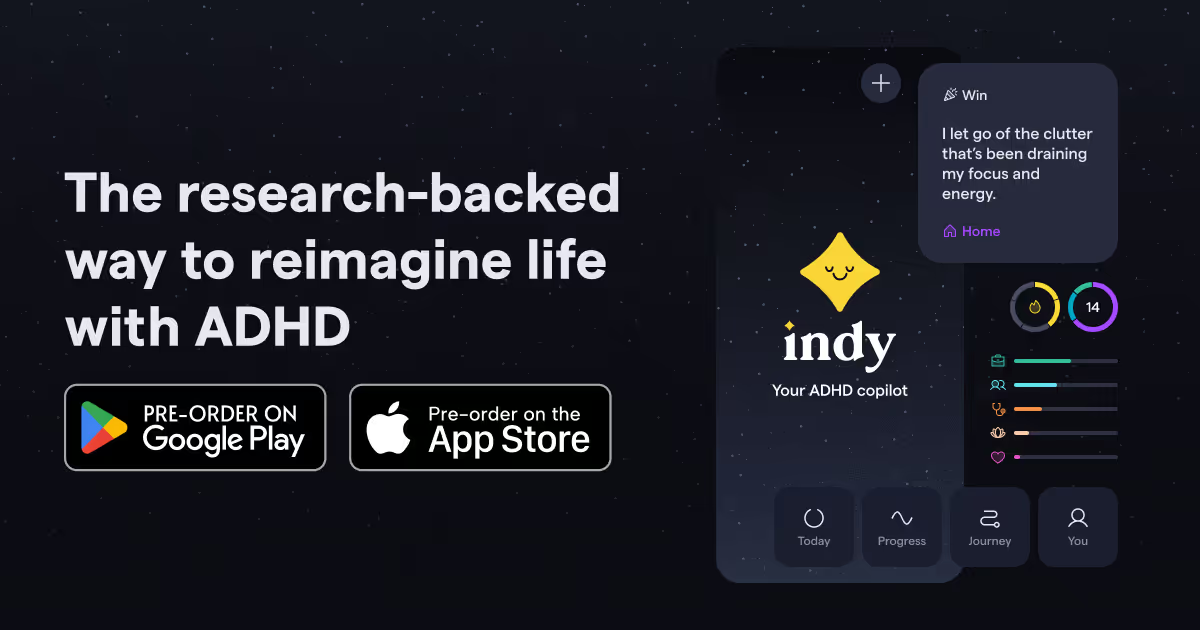
Built from lessons learned after 80,000+ ADHD coaching sessions, Indy gives you the structure you need, daily support that keeps you accountable, and momentum you can actually sustain.
Read the original article

Comments
I need assistance with task retrieval, time management, and working memory. I do not need an app that makes me feel guilty, and quantifies it with pretty charts. We are not lacking in knowledge, and track data isn't particularly useful. Especially if you're ability to consistently engage with an app is not there. No amount of notifications and prodding will work to solve overwhelm and and distraction.
What we need is assistive technologies that complement our deficits. I won't use an app to just log I did something, but I will use an app if it's crucial to do that activity, and it makes it easier for me to do so.
By Fr0styMatt88 2026-01-174:031 reply When you say assistive technology, what kind of things are you thinking about?
I don't have ADHD myself but I'm heavy into home automation and am just interested in it in general, since I think there's so much potential for smart tech to actually improve the lives of those with ADHD.
Some things that come to mind:
- Washing machine alerts you if you have accidentally done washing and forgotten to take it out.
- Household lights change colour consistently throughout the day to assist with time blindness; house goes into wind-down mode at night automatically at the same time. Music starts automatically when you should be getting up out of bed. Coffee machine starts brewing coffee (if that's your thing).
- Doomscrolling pits like Instagram and Tiktok are disabled except for very specific times of the day.
- Extremely low friction note taking (eg- smartwatch, recorder pin) that's instantly available, searchable and automatable.
- Airtags for finding misplaced items quickly.
Also goes without saying -- when you know one person with ADHD.... you know one person with ADHD. What works for any particular person is going to be mostly unique, or at least a unique combination of things.
Essentially, anything that a) puts cues in your environment to help steer you in the right direction and b) requires very little executive function to access.
Is that on the right track?
By tormeh 2026-01-176:09 Yes, this makes sense, at least to me. But the issue is that this is a lot of stuff working together and not just another app.
By sureglymop 2026-01-178:131 reply I have adhd myself and I am designing assistive technology for myself.
My software is basically "self spyware", a (mouse/key/browser history/etc) logger for linux. In a way like an open source (though not yet) microsoft recall but even more extensive and with better search and no AI. The idea is to:
1. Be able to put in small notes easily and quickly without having to think of name, tags, etc.
2. Be able to recall what I did, when I did it and what else I did around that time, with _time_ being the main link. So you don't have to semantically link things together like in e.g. obsidian. You can, but using locality of reference should already provide good results.
I wrote some code already for the keylogging parts. Where I got stuck is when thinking about/designing the parts that require cryptography. When I have more free time I definitely want to get back to it.
What I found I need most due to my adhd:
1. A way to do anything "in the moment". Let's say I'm about to procrastinate on my phone but know I have to write an email. Then I must have the ability to do that very quickly right from my phone. If mentally the task of "turning on my laptop" and doing it there seems like too much, I won't do it. So the "preparation friction" to do any task must be as small as possible. This is somewhat a difficult problem but technologically it requires everything to be cross platform and easily accessible.
2. A way to very quickly confirm what I already did before or confirm that I already did something. I have to constantly confirm it because I can't remember if I did. This part is what my software tries to address.
By CastFX 2026-01-179:32 As ADHD dev that thought about something similar (but never worked on it) I'd love to see the code. Please make a post when you intend to release it as opensource, it seems super interesting
By misswaterfairy 2026-01-1718:11 Agreed. This app feels like work, which for ADHD-PI sufferers will stop using almost immediately, forget to use it entirely, or use it inconsistently and then feel bad/guilty for failing then give up anyway.
> No amount of notifications and prodding will work to solve overwhelm and distraction.
+1000. Depending on the 'flavour' of ADHD one suffers, an app that requires data to drive graphs only creates more noise, which is a killer for ADHD brains, especially those with the 'hyperactive' traits of the disorder.
Less bells and whistles. Not more.
By christalwang 2026-01-170:211 reply thanks for this feedback - curious what current assistive technologies you use right now? totally agree on complementing our challenges, and there are definitely a lot of apps that do pieces of it (we have some of these features on our roadmap to integrate in) but what we've found through coaching and our members is that a big part of their barrier to reaching the life they want is around self worth, noticing wins / patterns in little wins over time, and coming up with / remembering strategies across different life areas. the goal here is not to choose one or the other but to support both types of needs
By misswaterfairy 2026-01-1718:26 Not OP, but a notepad, a calendar (both I already get for free on my phone), and medication.
Your app interesting, but the tracking data and linked data required is an absolute non-starter for me. Privacy is key, especially for those who are really sensitive about revealing their ADHD diagnosis or symptoms. I know of people who have been discriminated against because of their ADHD diagnosis.
By shrini11 2026-01-3014:30 [dead]
As an ADHD person, this app looks like a repackaging (with nice design) of all the stuff I’ve built up over years - habit tracking, daily/weekly/yearly reflection, detailed task management, etc.
This isn’t for me (because I’ve already built a system that works), but this looks like something that would be very useful. For the target user who does feel stuck and hasn’t successfully built their system, this looks like a phenomenal product.
I appreciate the emphasis on self-reflection and perhaps the implied focus on continuous improvement.
Over the last few years I implemented a weekly self-review + planning practice (think solo agile retrospective), and my life has been on a steady trajectory of improvement since.
Edit: commenting on the product concept, not the company, pricing, or concerning tracking practices.
By christalwang 2026-01-1617:10 Glad to hear you've built a system that works for you! We've also heard from a lot of our beta users that they've tried to cobble together something similar, and a lot of their feedback and ideas is what we used to build this initial version (in collaboration with our Research Lab to integrate the latest methods too). Many of them weren't able to push their self-built systems over the finish line or maintain it, due to ADHD challenges though. Our goal is to build a flexible enough system that it can be adapted for various learning styles (in practice we're still far off from where we want to be) and continue building agents on top of it that make science-backed exercises and methods more accessible. A lot of the best practices are currently gated behind long textbooks and scattered PDF worksheets so I'm really excited about making this more accessible. For example, this week we're working on an "energy accounting" agent that's widely used (in varying formats) across ADHD practitioners that many ADHDers know they want to do theoretically but haven't found the way to follow through on it.
I love the weekly self review and planning practice you mention; I do a similar one with myself and my co-founder each week and have started moving that process into Indy recently!
By alienreborn 2026-01-1618:111 reply Do you mind sharing your system that worked for you in detail or re-direct any good posts that detail them? Appreciate it.
Here is my template from obsidian that I use for my weekly reflection - customize reflection based on your values and priorities. I have goals to improve work-life balance, social connections (social isolation was a factor driving poor outcomes, and through deliberate consistent effort I have solved this problem).
Hyper scheduling: https://dev.to/maxpatiiuk/series/32301 (I stumbled upon this and implemented a form of it, although mostly I just like the colors in my calendar)
Yearly reflection: https://yearcompass.com/
Weekly reflection:
```md ## Preparation
- [ ] Review year compass - [ ] Review journal entries from the week - [ ] Review last week's reflection
## Quick summary
> *Headline for the week*:
## Basic planning
- [ ] Set up outline of the week in Outlook - [ ] Plan a fun weekend activity: - [ ] Plan to visit one new restaurant: - [ ] Plan one meet up or social activity:
## Values-based reflection
1. Health: - 2. Resilience: - 3. Social connection: - 4. Mindfulness: - 5. Adventure: -
## Retrospective
1. Went Well - 2. To improve - 3. Plan to improve/action items -
## Other notes
- ```
Daily reflection/journal:
```md
_Created: {{date}} {{time}}_ ({{date:DDD}}/365)
Gratitude (I am for three items):
Healthy Living Plan:
- Diet: - Exercise: - Work+Learning:
Daily reflection:
- Overall wellbeing (1-10): - Career: - Lifestyle hygiene: - Rose and thorn:
Journal:
```
I use TickTick because of the habit-tracking feature. Used to be todoist loyalist but it sucks for habits. https://help.ticktick.com/articles/7055781878401335296
Key habits I track:
- meditation (I combine with a fancy LED face mask to help reinforce the habit via my desire to combat wrinkles and acne - the cryoglow is better at acne than wrinkles so far) - exercise (you can add notes) - evening leisure time (if I don’t have dedicated leisure time, I end up revenge bedtime procrastinating/doomscrolling) - stretching (there are two simple band stretching exercises that solved what I thought would be life-long neck and shoulder pain)
When I really struggle with productivity, I find the pomodoro system is a good bootstrap, and TickTick makes it easy to start. I like seeing the pomos on the built-in calendar.
By mikestorrent 2026-01-1620:152 reply I have a ton of respect for your approach. That said, as someone without ADHD, it seems somewhat odd that an inability to kick off executive function would be well addressed by adding an additional activity that requires executive function. Like, if I had to plan my day out with this document before doing things, I think I'd grow to dread the process, and be even more stymied - i.e. if it was hard to go clean the kitchen, why wouldn't it be hard to go write my dayplan?
Yet, I do hear this sort of thing works for people. I'd love to know more about what you experience and why this helps.
By n8cpdx 2026-01-1620:50 TickTick gives me reminders to do some of these things - daily reflection is a “habit” and weekly reflection is a recurring task. That helps me not forget. There’s still value in doing the daily plan regardless of whether I do it right after I wake up (things are going well) or if I do it many hours later when I realize my day has not gone well and I want to get back on track.
The calendars and checklists really help with not forgetting things, and getting back on task once distracted. I can have 100 adhd moments; the system can’t prevent that, but it can help me find my way back to shore when I’m lost at sea.
I don’t really struggle with kitchen cleaning, but sometimes I do set out to clean the kitchen and end up folding laundry or scrolling instead. I can do that but if I haven’t checked off “clean the kitchen”, I know to come back to it.
The weekly reflection is a chore but I set aside time for it, and I keep doing it because it works. I can spend an hour doing deep reflection, or I can rush through it, there is value either way. It is really just a check list, and check lists are very ADHD friendly.
Separately, I find that physical and mental health improve performance regardless - so a system that improves these factors _is_ a system that helps with ADHD. Getting to bed on time, and building the system that produces that outcome, is an ADHD-friendly system. I struggle with this, but I try to get better over time by experimenting and adjusting.
The reality is that the system will not solve ADHD problems, the system is just a tool - you still have to do the work. Same for the app that is being shared.
By BigglesB 2026-01-187:05 I have ADHD & use a very similar kind of daily notes template. I think the reason that it works for me at least is that it shortcuts some of the "not knowing where to start" executive function issues at the start of the day. I only need to remember one thing: open a new daily notes template. The checklist itself chains other good habits off the back of that, reminding me to e.g. make sure I've taken my meds, make coffee, put music on, think about what I've done recently & if there's anything to pick up again or dive back into & what I'm going to do for the day etc.
Yes, it can feel like a chore at times (especially forcing myself to do more in-depth periodic reflections) but without a system like this, I quickly find myself completely rudderless & my mental health & productivity both collapse pretty quickly.
You'll actually hear quite frequently that people diagnosed relatively late in life went under the radar for so long exactly because we developed our own massively over compensating systems like this & can appear (externally at least) to almost have the exact opposite of "executive function issues"!
Some ADHD folks have something called "justice sensitivity"[0]. Put plainly, we get more bothered than neurotypical folks by actions and events we view as morally wrong.
I can't say for certain that this is caused by my ADHD or not, but I have a "sensitivity" to dark patterns. That is to say, dark patterns bug me more than they probably should.
Hiding the pricing until after signup is a dark pattern. It's a clear case of the company optimizing for their interests over mine and they are therefore unworthy of my trust (or so my brain tells me). After all, what other user-hostile design decisions are they going to make?
What ends up happening is that my brain puts its guard up, and keeps it up. It's constantly on the lookout for more subtle tricks and corner cutting.
Furthermore, I'm offended that they think I'm that stupid (but that's probably the developer in me and not my ADHD).
The landing page piqued my interest but then let me down. Hard. Not because $40 a month (as reported by another user here) is too much, but because I find dark patterns to be morally repugnant.
[0] https://edgefoundation.org/the-fairness-imperative-adhd-and-...
P.S. I struggled to write this as its first thing in the morning and I haven't even had coffee.
By Aurornis 2026-01-1620:56 "Justice Sensitivity" isn't a condition or a binary trait that you either have or you don't. It's a measurement in some psychological studies where they ask subjects to rate subjective injustices. The study that page links actually shows the ADHD kids having lower perpetrator justice sensitivity so it's not really that simple either, which I'll expand on below.
That Edge Foundation website isn't a good resource. It's SEO filler content for them to feed their coaching sales funnel.
The actual study it linked is more informative. They surveyed a group of kids about their reaction to different scenarios of injustice and also ADHD traits. They found a positive correlation between ADHD and sensitivity to injustice from the victim perspective, but substantially lower sensitivity to injustice from the perpetrator perspective.
Given that this study was purely in 10-19 year olds (mostly children) and the opposite results for victim and perpetrator injustice, I suspect it's just measuring emotional maturity among the kids. The study also noticed a high correlation with angry and anxious responses, which further supports the correlation to emotional and interpersonal maturity.
By christalwang 2026-01-1617:49 I just wanted to clarify, this app is COMPLETELY FREE. There is no cost.
The cost you're seeing is for our other product that includes live body doubling (co-working) sessions that are guided by our ADHD coaches. I think I might remove that link or move it to the bottom. Sorry for the confusion!
By christalwang 2026-01-1617:59 And just to add, I also have the justice sensitivity! Because of that, even our other service (ADHD coaching) has all the prices VERY clearly on the home page. It includes the monthly price in big font and a clear summary of what's included in each package. https://www.shimmer.care/
