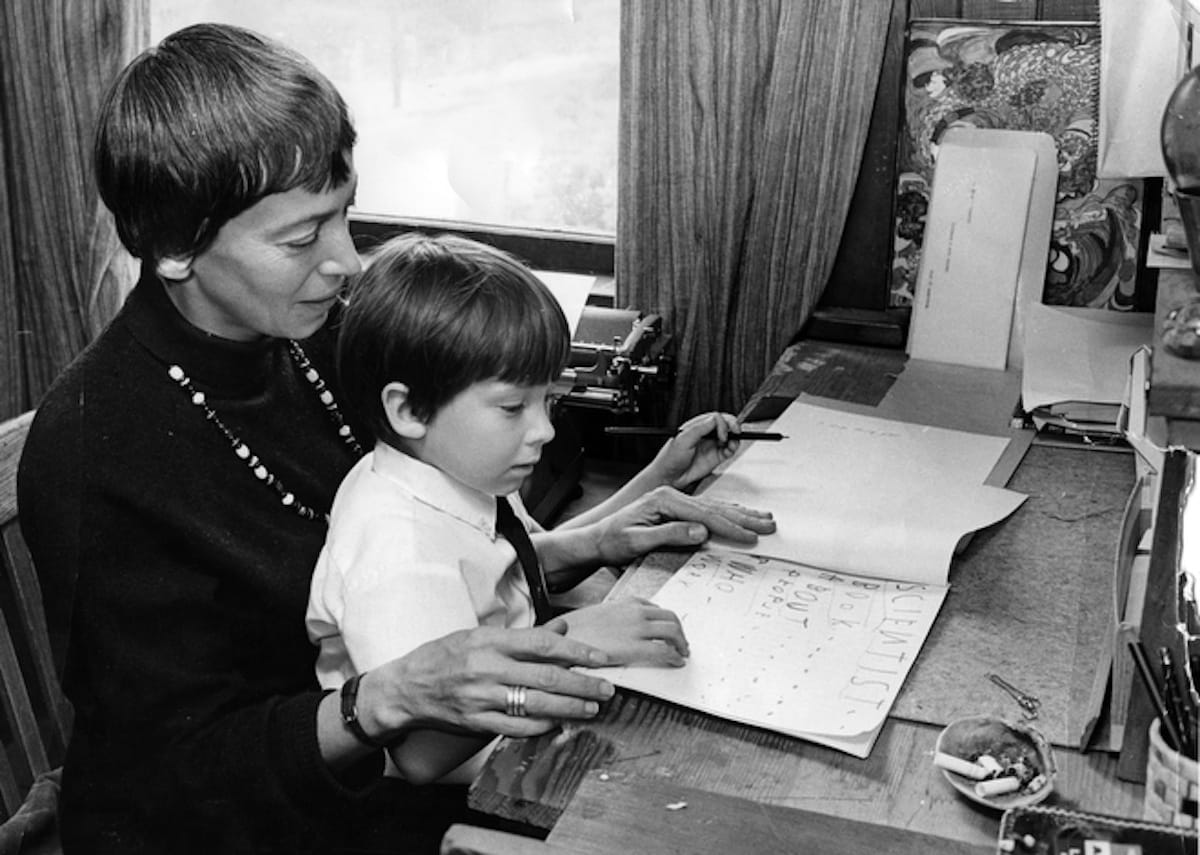
I would never have proposed this exhibition in her lifetime. This is, after all, a writer who said in an interview, “Don’t shove me into your damn pigeonhole, where I don’t fit, because I’m all over.”
PORTLAND — Under an acrylic case in an exhibition I curated about my mother, the writer Ursula K. Le Guin (1929–2018), sits the first typewriter she purchased. Compact and impossibly heavy, the machine comes from an era of word production so distant as to feel alien. The keyboard has no exclamation point. To create the favorite punctuation of tyrants and optimists, one must type an apostrophe, then backspace and type a period.
The Underwood waited in my parents’ attic for decades as Ursula and the world moved on to electronic typewriters and eventually to computers. I hoped visitors to A Larger Reality, at Oregon Contemporary through February 8, could experience a little of the residual magic that I find clings to it, pecking out whatever they please, taking home the original and leaving a carbon copy for posterity.
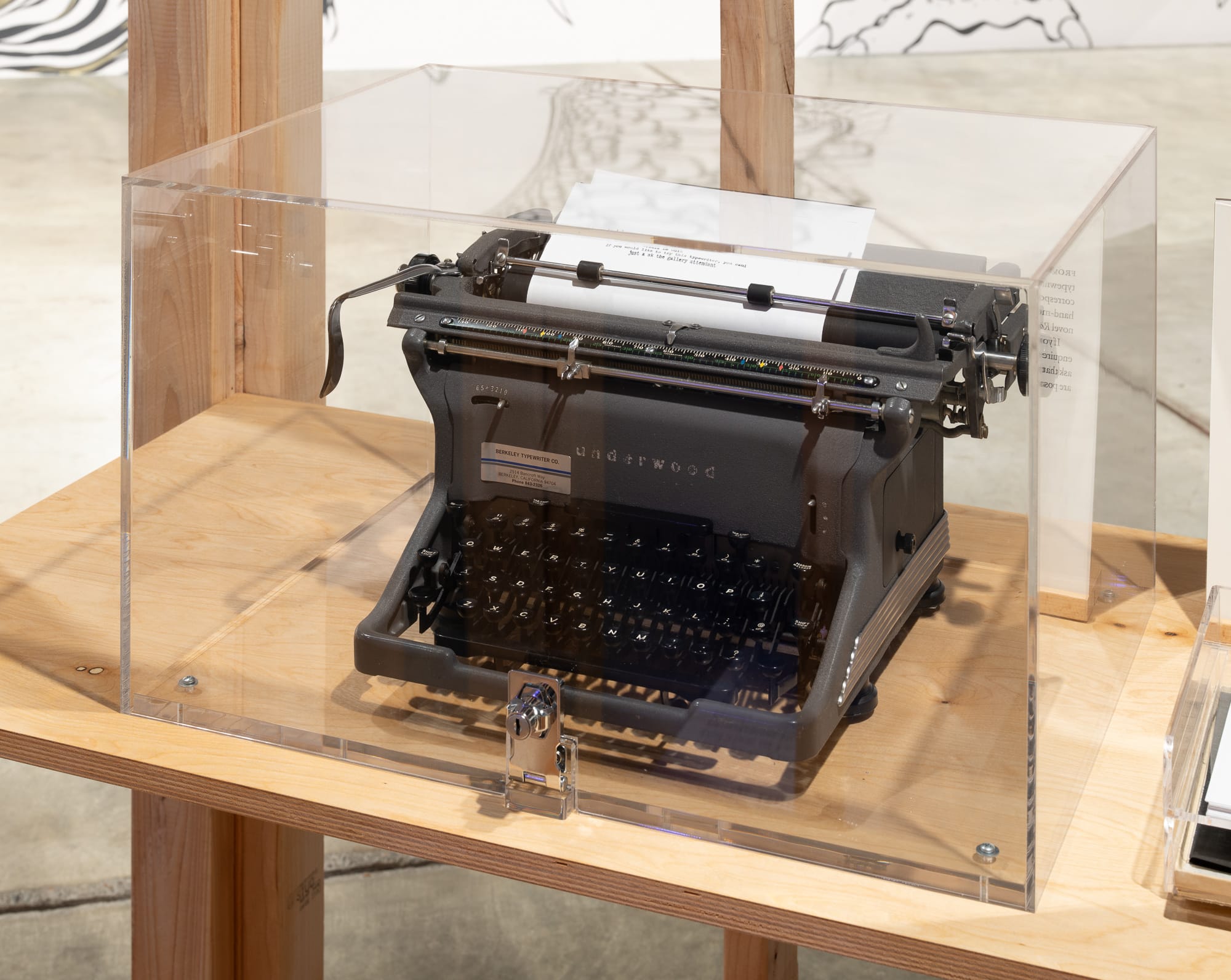
I’m happiest when the case is removed and the gallery is filled with the sound of metal meeting paper. Visitors who’ve never used a manual typewriter, or who don’t touch type, peck tentatively. Others engage physically, producing the familiar percussive clack-clack sound of my childhood. Either way, I feel I’m sharing not just a machine but a sacred trust with strangers who love my mother’s writing and words in general.
People type poetry, memoir, fiction, epistles, articles, political statements, and fan mail on the Underwood. Some offer short tributes to Ursula or variations on “I can’t believe I’m typing on Ursula K. Le Guin’s typewriter.” Others compose prose or poetry on the spot. A few write nothing, go home to draft several pages, and return later to type something polished.
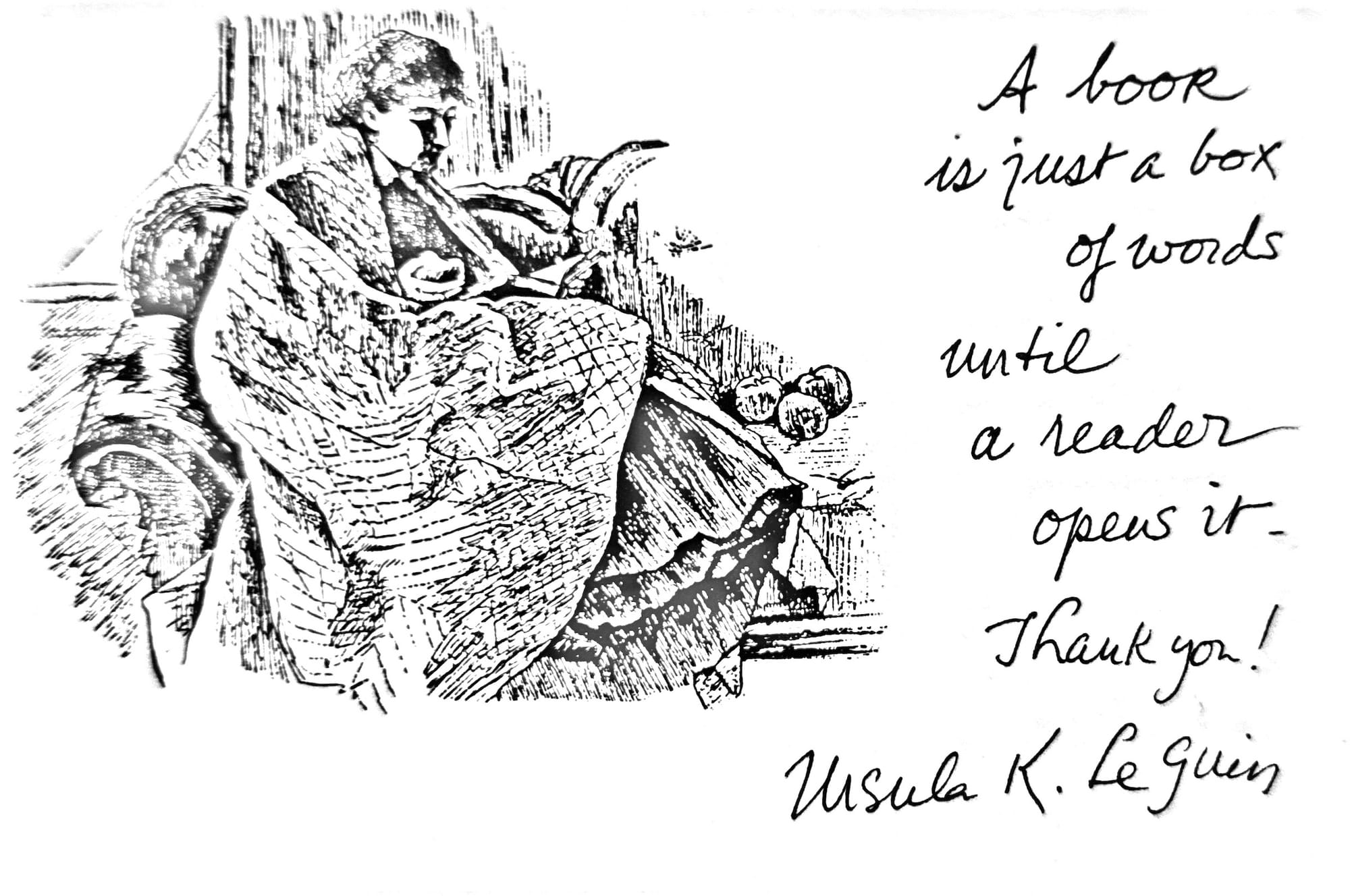
One visitor’s letter wondered how Ursula would feel knowing that her writing and cultural presence are no longer her own after death. The question is apt for me as curator and literary executor. Even a very private writer, while she is alive, exercises a restraining influence on people’s ability to misinterpret her words or life story. I can take comfort in my mother’s respect for the agency and necessity of readers in creating literature. For many years, her stock fan mail reply was a thank-you note, in her handwriting, acknowledging that “a book is just a box of words until a reader opens it.”
Over the past year, I’ve experienced cycles of grief and joy as I pored over my mother’s letters, manuscripts, and drawings to exhibit. I listened to hours of her voice, recreated an oak tree from her childhood and the room she wrote in from my childhood home. Curating an exhibition about your parent is a strange experience. Many visitors intuit this; the most common question I’m asked about the exhibition is what my mother would think about it.
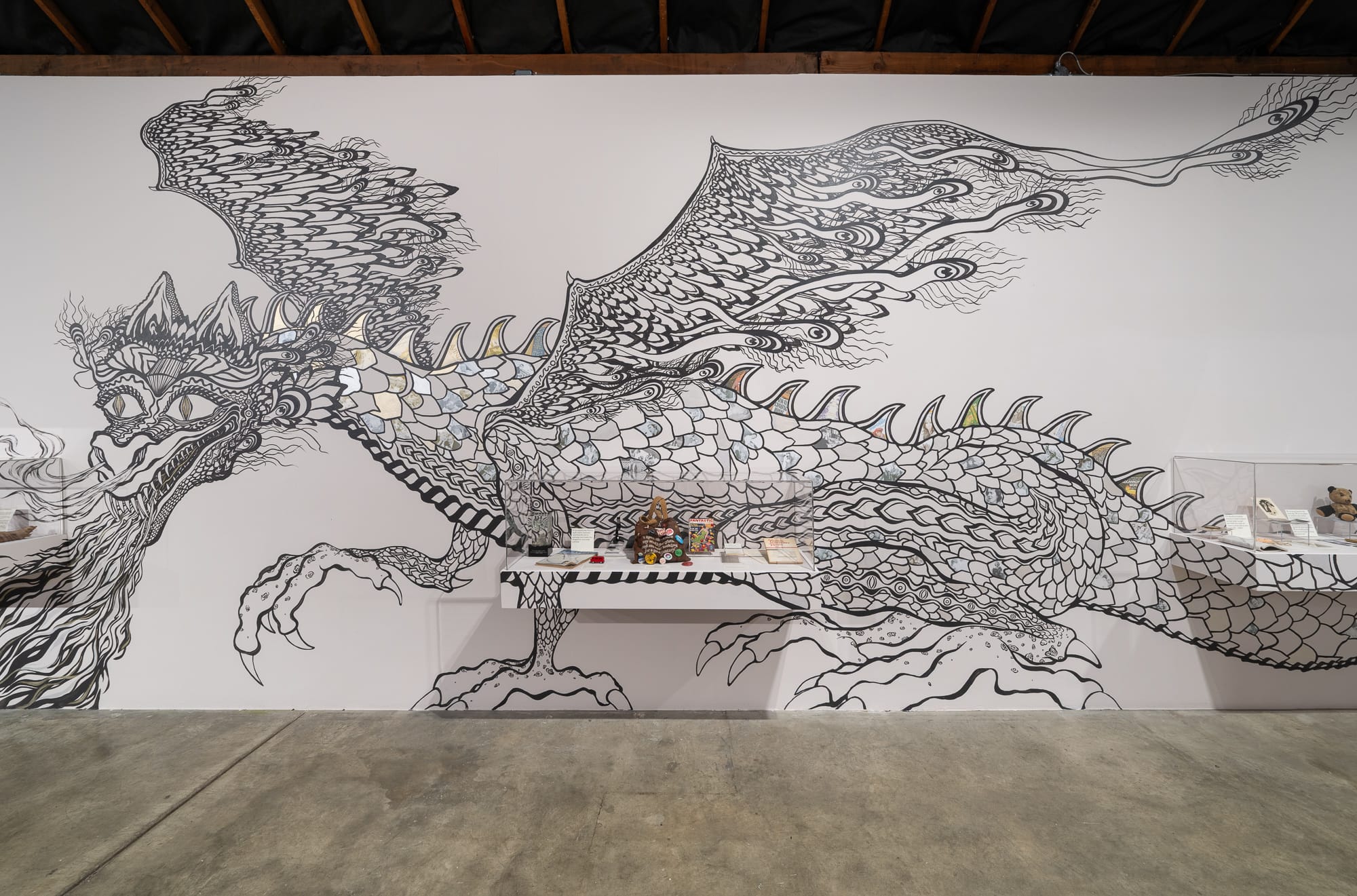
Honestly, I have no idea. I’ve learned not to second-guess my decisions by constantly asking myself, “What would Ursula do?” I would never have proposed this exhibition in her lifetime, for fear that she might see it as reductionist. This is, after all, a writer who said in an interview, “Don’t shove me into your damn pigeonhole, where I don’t fit, because I’m all over. My tentacles are coming out of the pigeonhole in all directions.” Biographical and retrospective exhibitions exist in large part to assert and codify who an artist is. That is, at some level, a type of pigeon-holing.
This icon-production takes various forms, from hagiography to “objective” centrism to critique. True, if anyone is going to codify my mother, I prefer it to be me. I’m granted an advantage due to proximity and memory. But my version of Ursula is just one version. Even her version of herself was not authoritative. My mother remade herself, through her art, constantly and over decades. She revised everything from her early centering of male characters, to her use of he/him as the default pronoun in an imagined ambisexual world, to her critique of a Kazuo Ishiguro novel. Rather than worship an immutable icon, we should aspire to her willingness to learn and change.
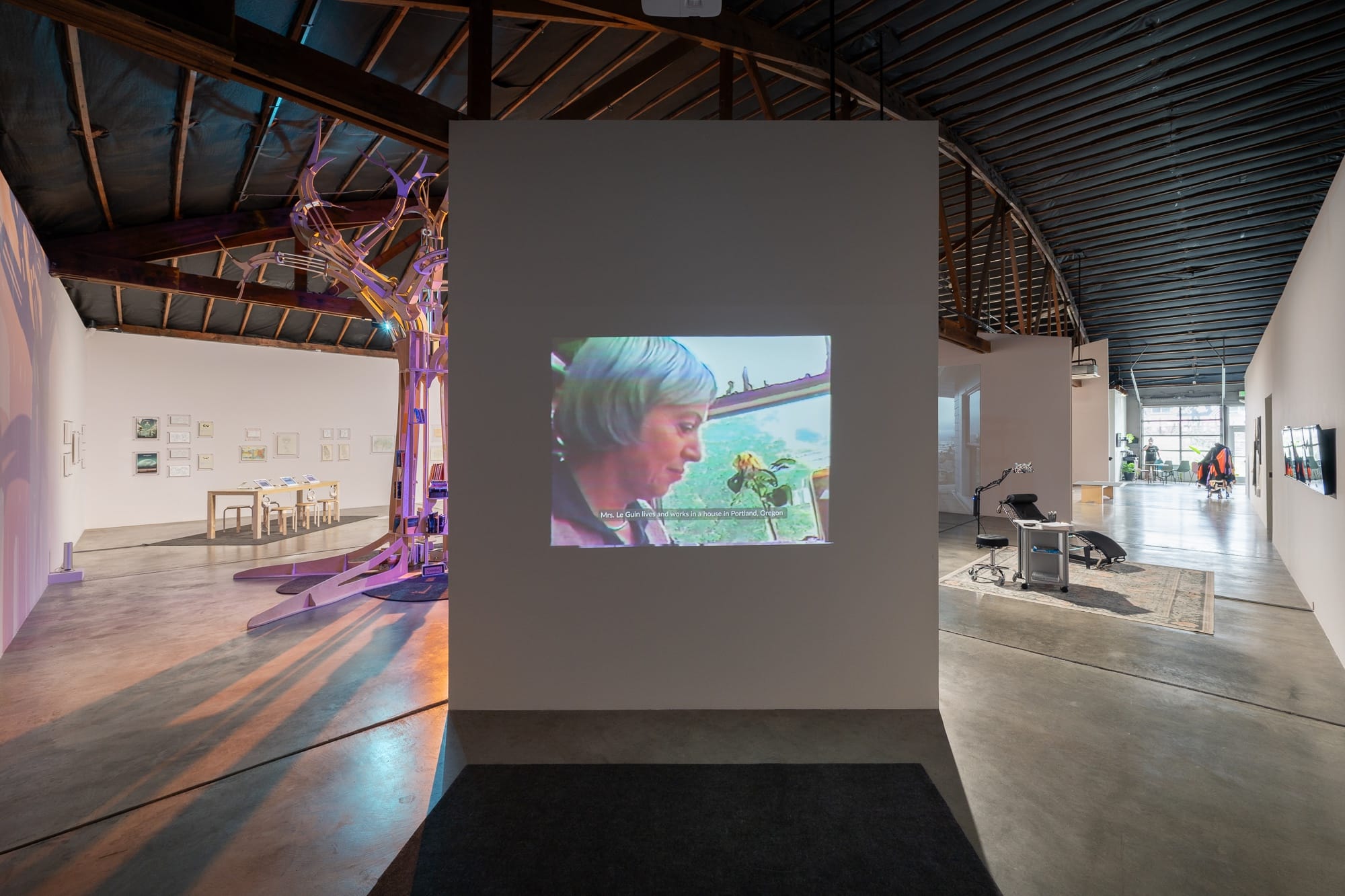
From a technical, curatorial perspective, however, the mandate of narrative was my greatest hindrance. We’ve had it drummed into us that humans learn through stories, so anyone in an educative role must tell a story. For biographical exhibitions, however, linearity flattens the subject and condescends to the audience. I would go so far as to say this may be true for linearity imposed on any kind of exhibition.
My mother had something useful to say on this subject. Her essay The Carrier Bag Theory of Fiction (1986), long a touchstone for writers, has recently become one for curators as well. Ursula posits, to simplify, that the reduction of narrative to linear, techno-heroic stories of conflict and conquest doesn’t serve us well. The hero’s journey remains a default model for storytelling in our culture, including for exhibitions. Ursula argues that the carrier bag, a humble yet capacious tool for gathering, is a better model for storytelling.
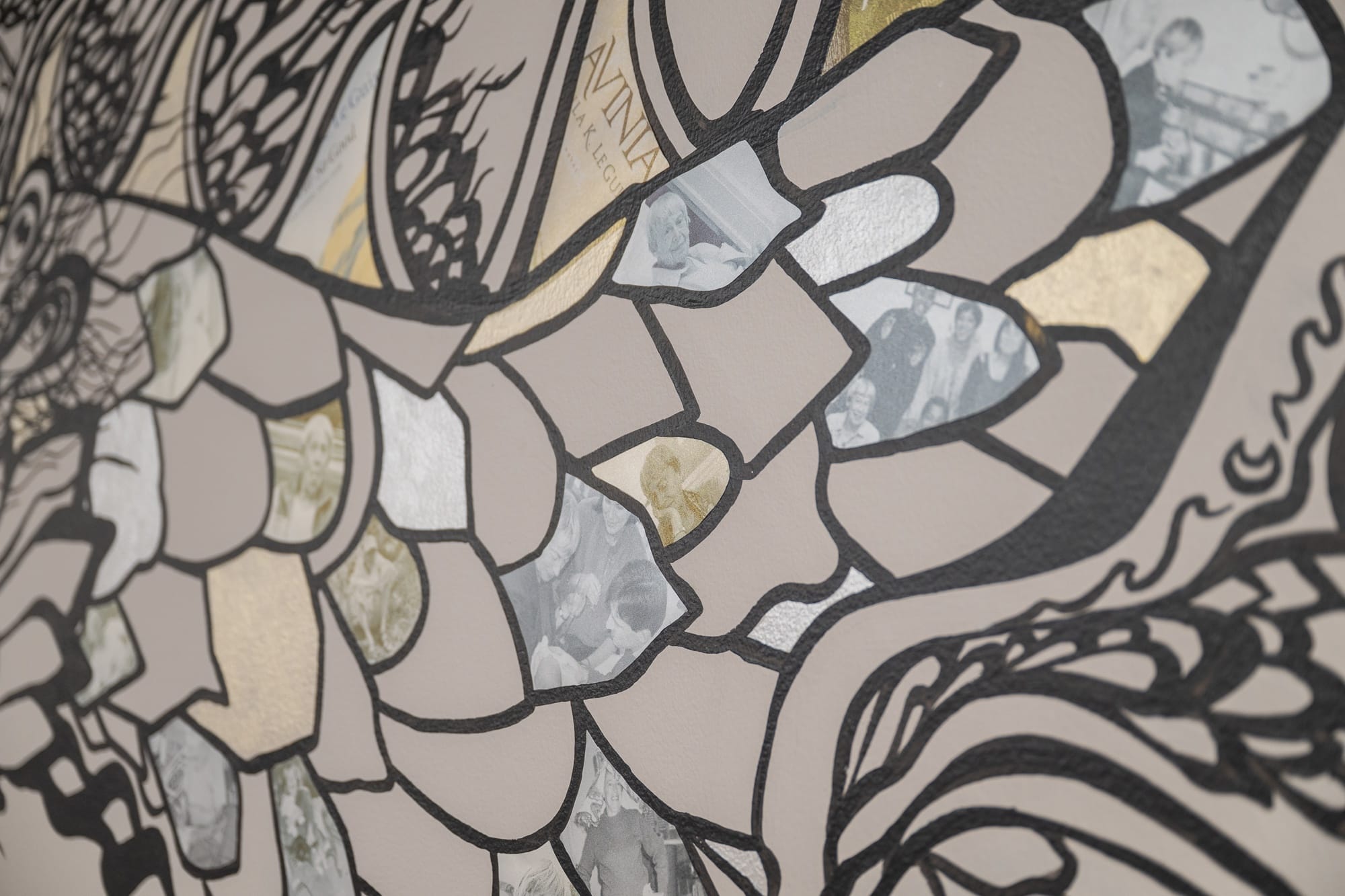
Exhibitions can be superb carrier bags for culture and knowledge. Few experiences offer so many chances for discursion and recursion, negative space and introspection. A carrier bag can expand to make room for the needs of the moment, for participation, spectacle, and immersion. In a carrier bag, none of these qualities, in balance, is antithetical.
For my part, releasing myself from the need to tell a tidy story about my mother led to an exhibition that is wordy, baggy, and inconclusive — but also, I believe, engaging and true to the subject.
Read the original article

Comments
I remember Le Guin speaking at my university around 1990. She was amazingly open about her writing process. While she did not directly answer questions about the “meaning” of her writing, she did facilitate the discussion about her work’s meaning, and asked the audience challenging questions.
Of all my time at uni, I wish I had a recording of this event.
I understood from students who had attended a writing workshop with her earlier in the day, that she was gifted teacher.
By nestorD 2026-02-0819:06 Her book Steering the Craft, is very much her writing workshop distilled into book form.
Le Guin's characterisation of magic and the power of Names remains one of my favourite treatments of the themes in modern fantasy. Earthsea remains one of my pleasures.
I could never really get into LeGuin. It's been a long while since I tried reading Earthsea but it seems like a very mediocre fantasy novel with a plot that struggles to actually go anywhere. Apparently it's trying to preach some kind of political message about racism, and doing it poorly -- I didn't get that message at all when I read it, and only later learned about the racial aspect of it.
If you want to write good fantasy, it helps a lot to include: Huge exploding fireballs. Cool-looking protagonists mastering the battlefield with confidence and style. World-altering stakes.
LeGuin has none of the above, and overall just seems kinda...mid. I'm confused why so many people seem to gush over Earthsea.
(Notwithstanding the above, it's okay with me if you happen to like LeGuin -- I'm not trying to be the taste police. I'm posting because I'm trying to figure out what all the fuss is about, and wondering if I'm missing something -- so dissenting opinions are welcome!)
By zanellato19 2026-02-0823:061 reply > f you want to write good fantasy, it helps a lot to include: Huge exploding fireballs. Cool-looking protagonists mastering the battlefield with confidence and style. World-altering stakes.
Maybe for people that don't subscribe to this, something a bit less... Action-y makes it more interesting.
By gcanyon 2026-02-092:46 Something about how you phrased this makes me think you might appreciate Master of Five Magics by Lyndon Hardy. There are five kinds of magic, each with their own unique source, style, and pretty rigorous rule set, and the protagonist sets out to learn them all (unheard of, if not outright forbidden).
By monkeycantype 2026-02-0923:10 One of my favourite conversations I ever had with another human being, was with someone who was telling me about a book he was reading, which he evidently loved very much. He spoke almost no English, and I spoke absolutely no Cantonese, so the entire fifteen minute conversation was conducted with gesture, intonation and the phrases: 'one man' 'many mans' 'some kung fu' 'many _(* n)_ kungfus!'
I love the left hand of darkness, the dispossessed, all the hainish books, but I have never loved any book as much as my conversation partner loved his book about many many Kung Fus.
The author has a background in Taoism. That book didn’t really make sense to me until I started practicing Zen.
Like most things in that tradition, it’s less about a “message”, and more about learning something about yourself. Cf meditation.
By AlotOfReading 2026-02-092:291 reply Le Guin is one of the most intentional authors out there. Her works, Earthsea included, smack you in the face with deliberate messages.
By Herring 2026-02-0918:33 Yes, because you don't understand them. That's basically the difference between Western and Eastern style religions. Here it's not a theory, it's a path. It's about you. When she writes “To light a candle is to cast a shadow”, what does that mean to you? How does that affect the way you live your life? Your relationship with others? To take it as a simple "message" is like going to the gym to stare at the weights.
By jenniferCrawdad 2026-02-0822:561 reply please do not feed the troll everybody
By lovich 2026-02-094:51 I can’t tell because of my age whether everyone forgot this lesson or that the younger crowd is now online and never learned it.
By poulpy123 2026-02-0912:29 Quick someone invent a time travel machine to explain to Tolkien he has been doing fantasy wrong !
By kjs3 2026-02-092:17 If you ever move out of your moms basement, and maybe have a real relationship with another human, try reading these things again and see how you feel.
[edit] spelling
By mark_l_watson 2026-02-0812:551 reply Interesting perspective of someone curating an exhibit for their famous mother. I am a fan of her writing, but strangely I most often go back to Le Guin’s audio book reading of ‘Lao Tzu: Tao Te Ching’ with short musical interludes and small sound effects. 100% satisfying to listen to.
By dtgriscom 2026-02-0813:47 Thanks for the tip. My local library has it; I'll grab it tomorrow.
