
VoxRay Games has added a new Crystal Cathedral world and grenades alongside a wealth of other assets and world building features while Voxile goes 40%-off on Steam
Voxile, the co-op, ray traced, micro-voxel, survival-crafting game from VoxRay Games, has just released its largest update yet: THE BUILDER’S UPDATE (release notes here). You can check out the Steam demo here and Voxile is now 40% off on Steam until March 9th.
Keep up with all the latest updates in VoxRay Games Discord Channel.

I first met Wouter von Oortmersen for lunch in downtown San Francisco in July of 2023. Friends had put his studio on my radar (shout out to Dan Levine and Jeffrey Rosen) so when we connected on LinkedIn, I was excited to arrange an in-person meeting.
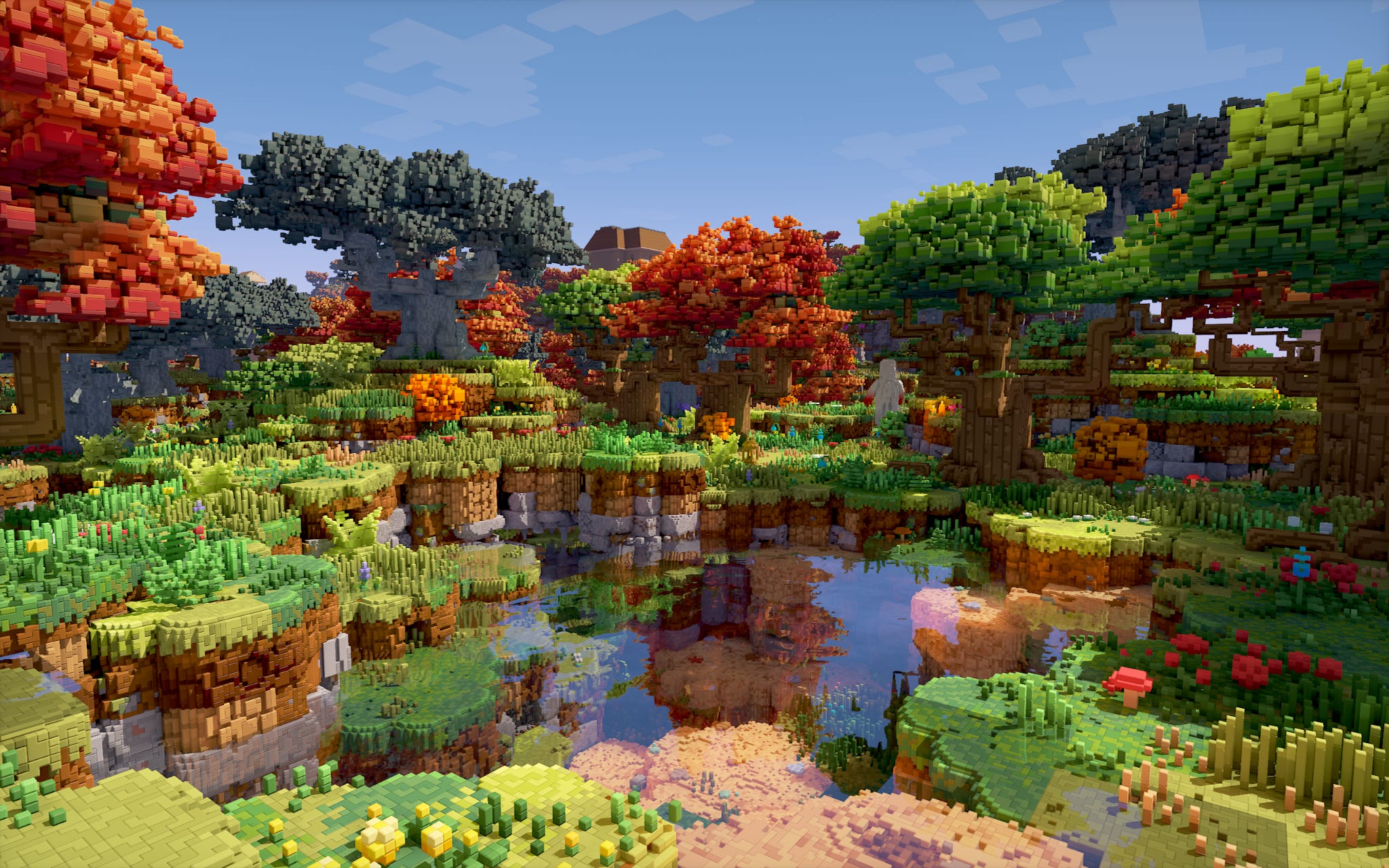
I expected to spend the afternoon chatting casually about high-level gamedev and design. I had seen video of Voxile’s high-fidelity, ray traced, global illumination with reflections. So my plan was to ask for a Steam key and then boot it up on my gaming rig when I got home. Instead, Wouter brandished a slender laptop from his backpack (with no wall power outlets in sight) and in seconds, the Voxile demo loaded up and was sustaining high frame rates without jitter in all its high-definition glory.
I climbed up from the tranquil beach to forage in the forest but was violently interrupted by an angry skeleton. After losing substantial health, I smashed him into pieces. As I caught my breath… I realized that the sun was arcing through the sky while all the shadows (even the shadows on the little voxel blades of voxel grass) were dynamically updating in real-time. Soon the sun had set and now the glow of flickering torchlight and phosphorescent mushrooms made the engine even more beautiful.

“Is this Unity or Unreal?” I asked even though I knew I had never seen anything like it before.
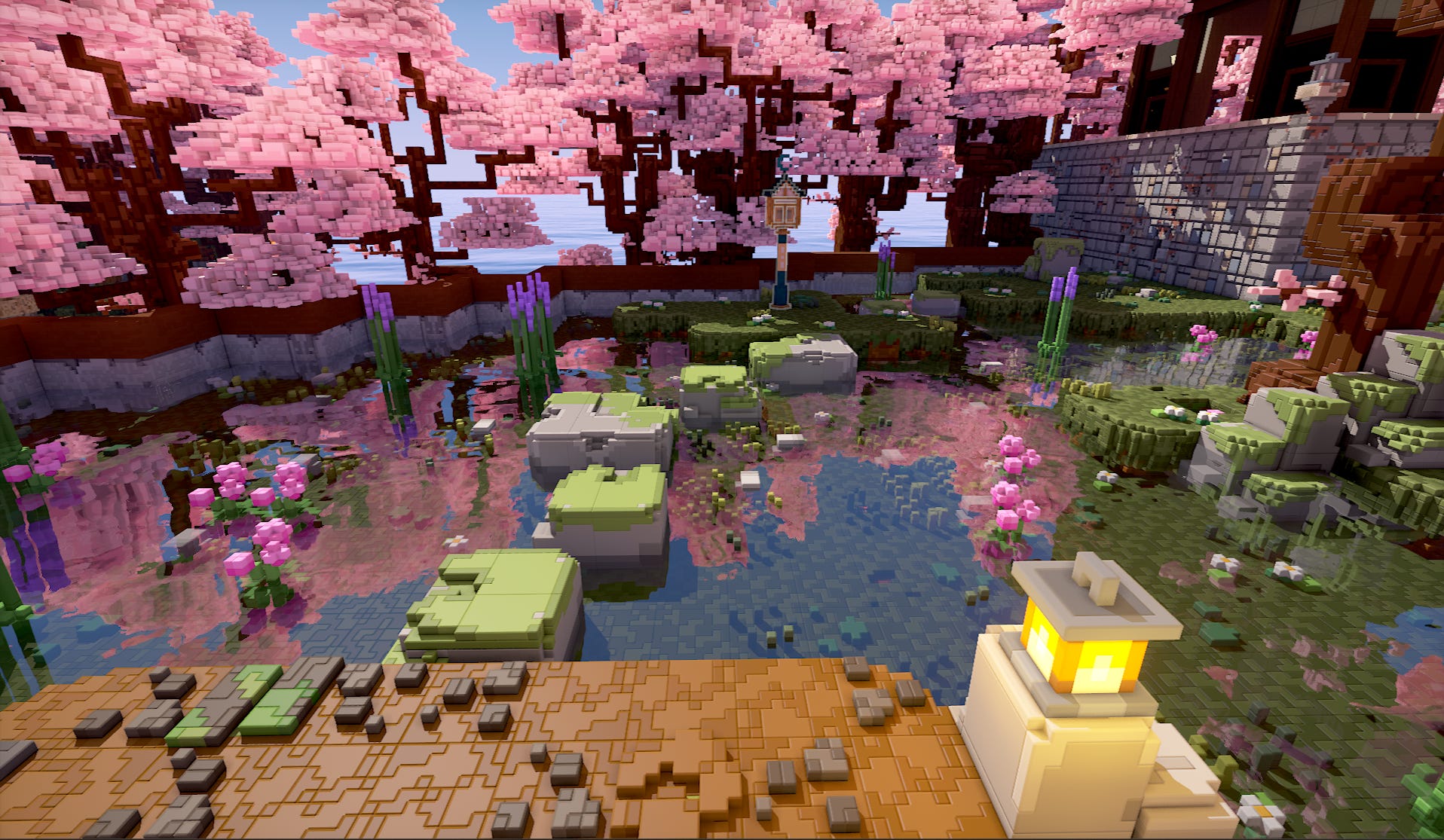
“Neither,” Wouter replied. “VoxRay Games uses our own custom engine written in our own custom programming language, Lobster.”
Wouter’s accomplished career had driven him to this moment (just check out his github). There are very few game developers who have the talent, intelligence and fortitude to tackle game development at both the engine and language level. Let’s be clear, before Jai was a twinkle in Jon Blow’s eye: Wouter had invented and helped design nine languages: Amiga E, FALSE, Bla (created during his Masters in Computer Science), Aardappel (invented during his PHD research), WadC, SHEEP, CubesScript, CryScript and Restructor.
Lobster is Wouter’s tenth language and was built from the ground up to enable prototyping games like Voxile. It amalgamates everything Wouter has learned at companies like: Amiga Inc., Crytek (building the original Cryengine for Far Cry), Maxis (SimCity), Gearbox (Borderlands 2) and Google (where he helped design Web Assembly and invented FlatBuffers while working on LLVM and Android VR/gaming tech). If you’re technical, I recommend you watch some of Wouter’s lecture videos (linked above and below) to understand just how much Wouter knows about game engine coding and languages.
Wouter also believes in giving back to the greater gamedev ecosystem (something that is really important to EGG and its community). He wants to share his knowledge and his joy for games with others. Beyond all his open source contributions to major projects, he was also one of the creators of SMU Guildhall, teaching students how to build engine components (such as shader systems, skeletal character animation, scripting compilers) while supervising their Master’s projects. At DICE this year, I watched as a former student, upon seeing his former professor, ran across the room to thank Wouter for teaching him game development and inspiring him to start his successful gamedev career (he is now an executive at a prominent company).
In his spare time, Wouter made the 3D Cube Engines including Cube 2/Sauerbraten with Lee Salzman for Mac, Windows and Linux (now open-sourced with over 1,000,000 downloads). It’s a performant multiplayer, deathmatch engine (like the Quake engine) but also enables real-time, multiplayer, map editing (and this was in the year 2000 almost a decade before Minecraft would make this a core mechanic).
After years of experience, Wouter decided it was time to form VoxRay Games and up-res, voxel-based world crafting. He successfully raised venture capital led by the well-known VC firm Accel. When he offered EGG a chance to join his round, it was a no-brainer for us to participate as well.
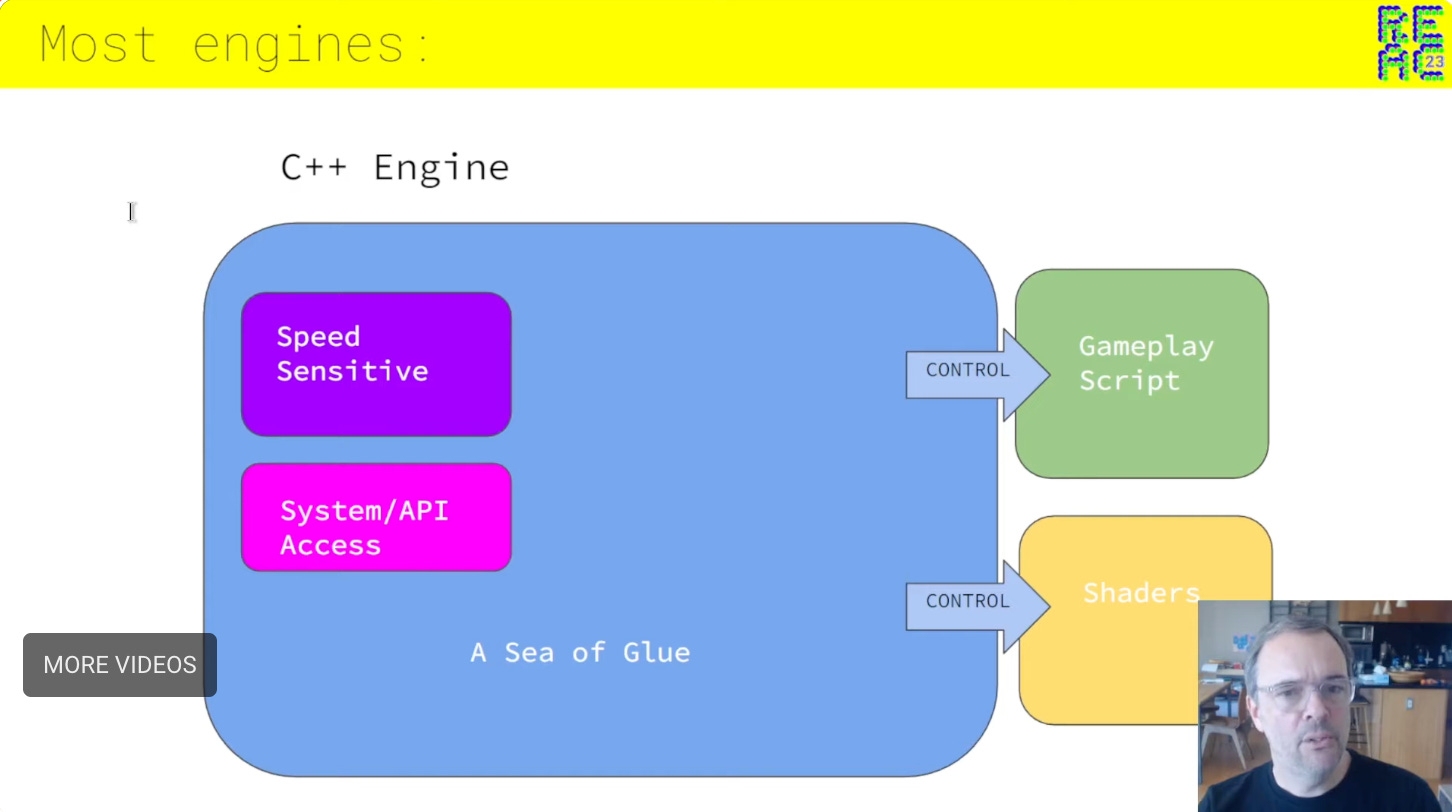
Most game engines interact with programming languages similar to the image below.
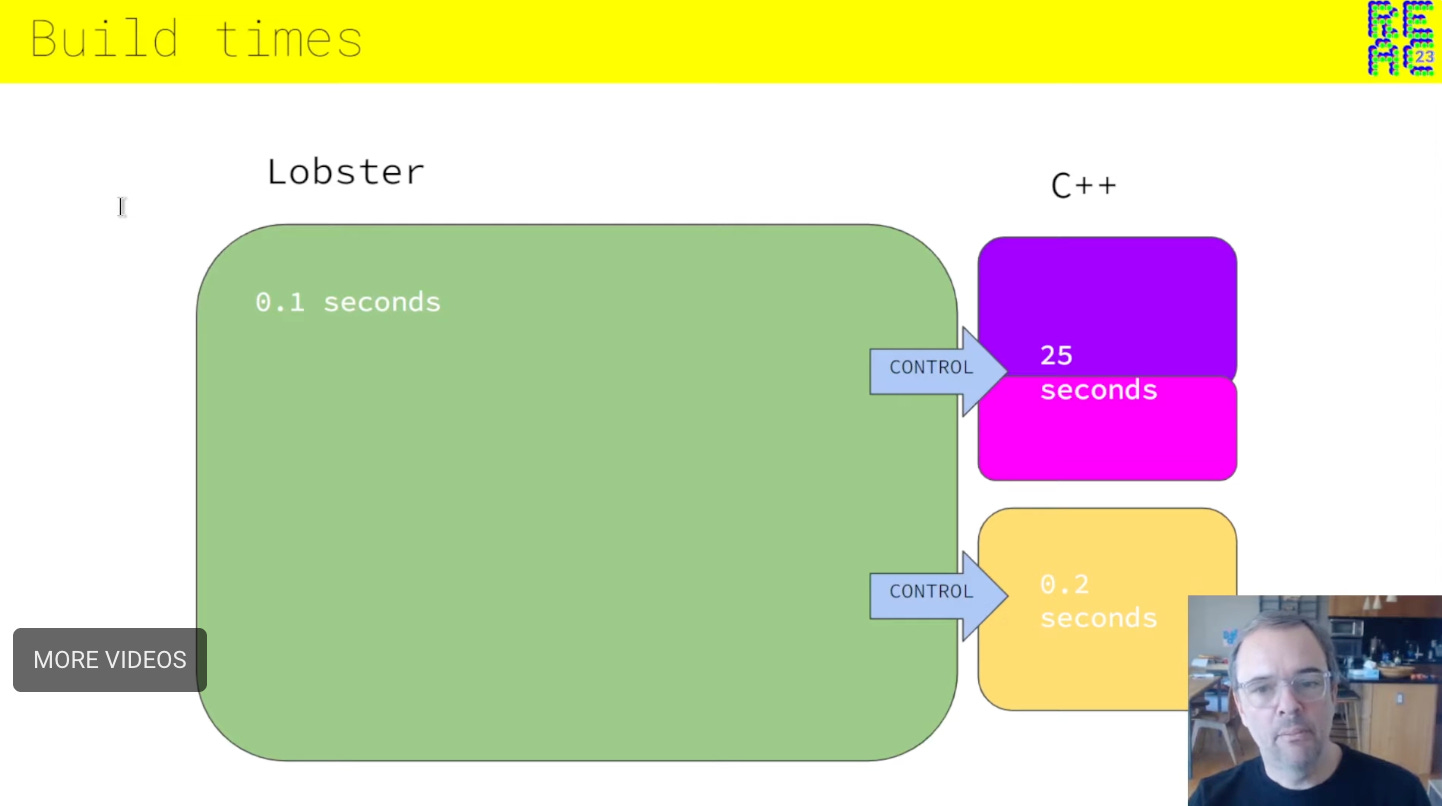
However, a game engine written in Lobster can be built like following diagram. Unlike Jai, which aims to replace 100% of C++, Wouter’s design paradigm only replaces 90% of it. C++ is still used with Lobster but it’s relegated to the leaf nodes of the call graph.
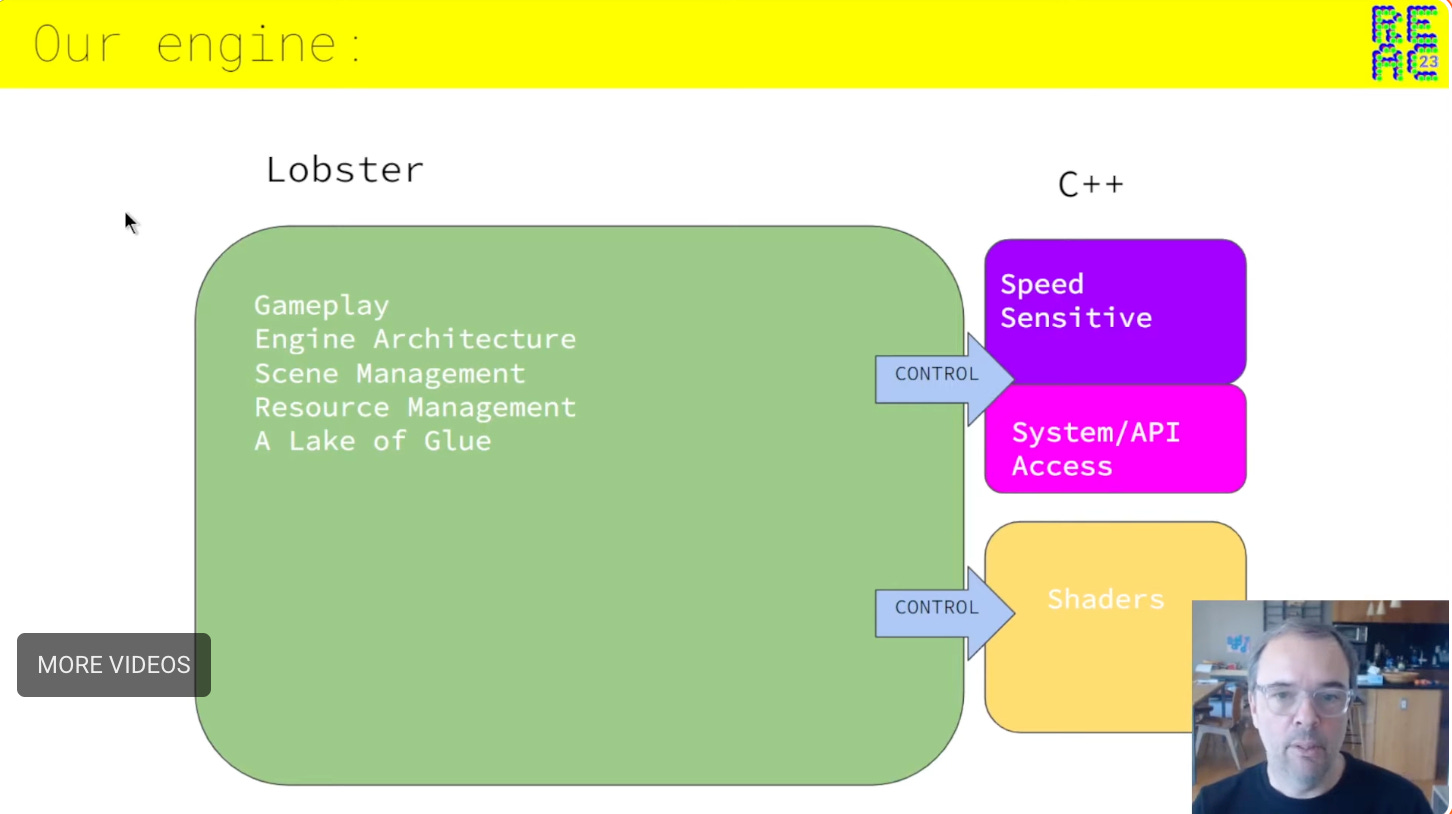
The result is record-speed compile times even after substantial changes to the code base. Cold start times are generally well under 2 seconds for Voxile. Nine out of ten changes in the VoxRay codebase don’t need to touch the C++ code at all. Most languages have either good static typing and performance or fast startup times but it’s very rare for them to have both. Lobster has both.
Lobster is therefore ideal for fast, iterative prototyping without rigidly confining the user to a particular engine architecture. Wouter himself has been able to quickly craft wildly different game ideas (each with bespoke engines instanced in Lobster) to “find the fun”. You can check out his many prototype ideas here.
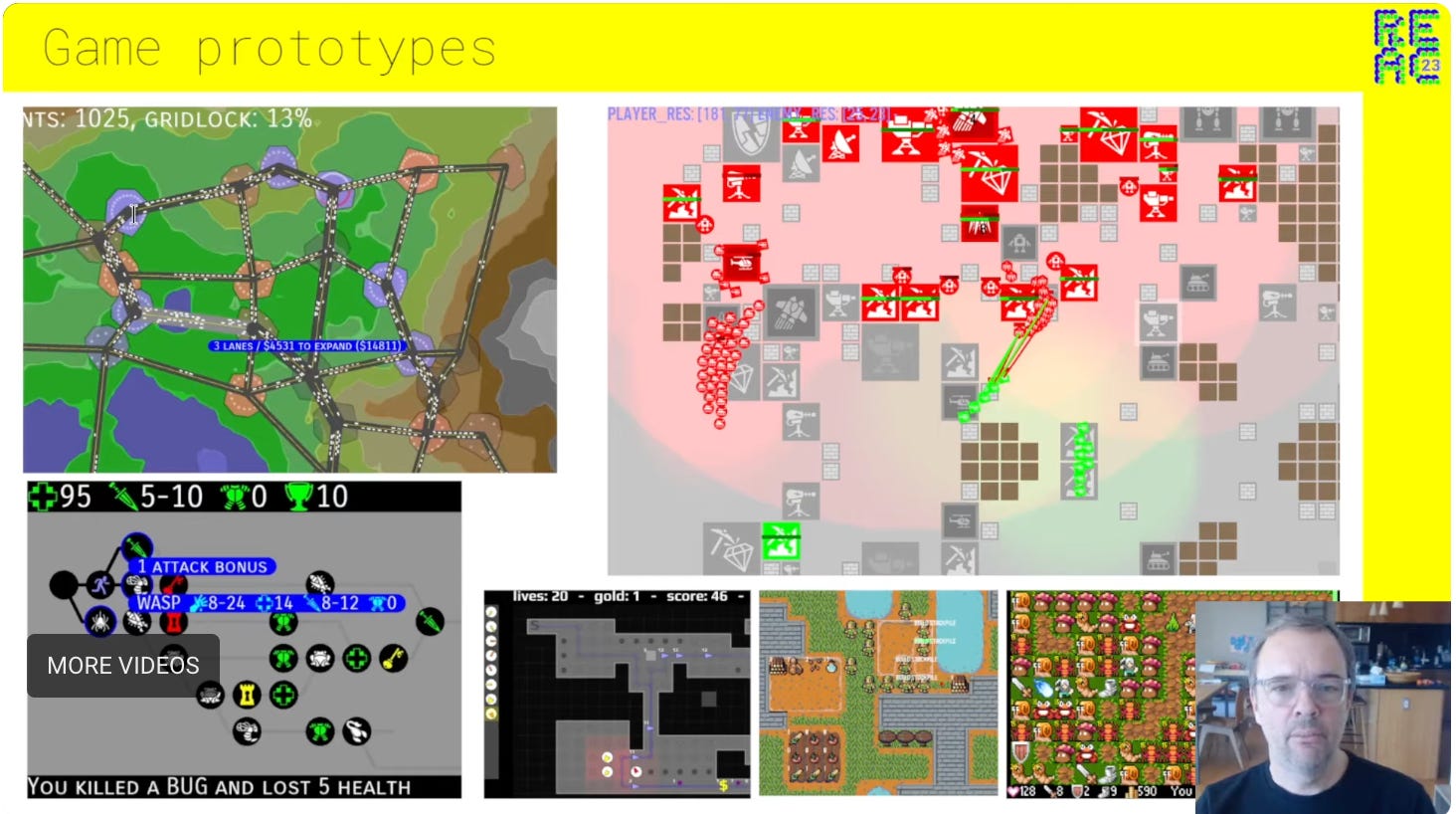
Voxile emerged from this prototyping crucible as the project with the most compelling gameplay and prettiest graphics.
Wouter has explained that his design goals for Voxile involve a growing list of foundational engine features that yield emergent properties:
3D Volumetric Worlds: Polygonal meshes are like a hollow shell without substance. Building and destroying are integral parts of Voxile and they are seamless, molecular properties of the entire micro-voxel world. I fondly remember Red Faction from my childhood but even that was essentially a veneer of polygons used to simulate the destruction of pre-scripted set pieces whereas EVERYTHING in the Voxile world is buildable and destructible.
Performant Ray Tracing: Dynamic shadows, global illumination, ambient occlusion and reflections are all built in to Voxile’s graphics pipeline and create a wonderful visual style. Art and design workloads are reduced because the engine automatically makes all the voxels look and feel right.
Co-op Multiplayer: Both world crafting and destruction happen seamlessly and persistently in real-time. This opens the door for group gameplay and modding experiences like you find in Valheim, Minecraft, Helldivers, Peak, and more... For example: a level where you build a fortress with your friends by day before you have to defend it from zombie raiders at night can be trivially constructed in Voxile.
Quest and Inventory Systems: Wouter has mentioned being heavily inspired by Fallout. Each Voxile world map can offer the player RPG-style quests, progression and upgrades.
Tactile Combat: Weapons are juicy and responsive. Melee weapons have weight and impact to them while customizable range weapons, guns and explosives (why would Wouter add grenades to a “Builder’s Update”!?) cause procedural voxel damage. Just like the world, enemies exhibit voxel-based damage modeling. The result is like Soldier of Fortune’s visceral damage system.
UGC: The modding potential for Voxile is obvious and expansive. Making custom assets is like playing with Legos.
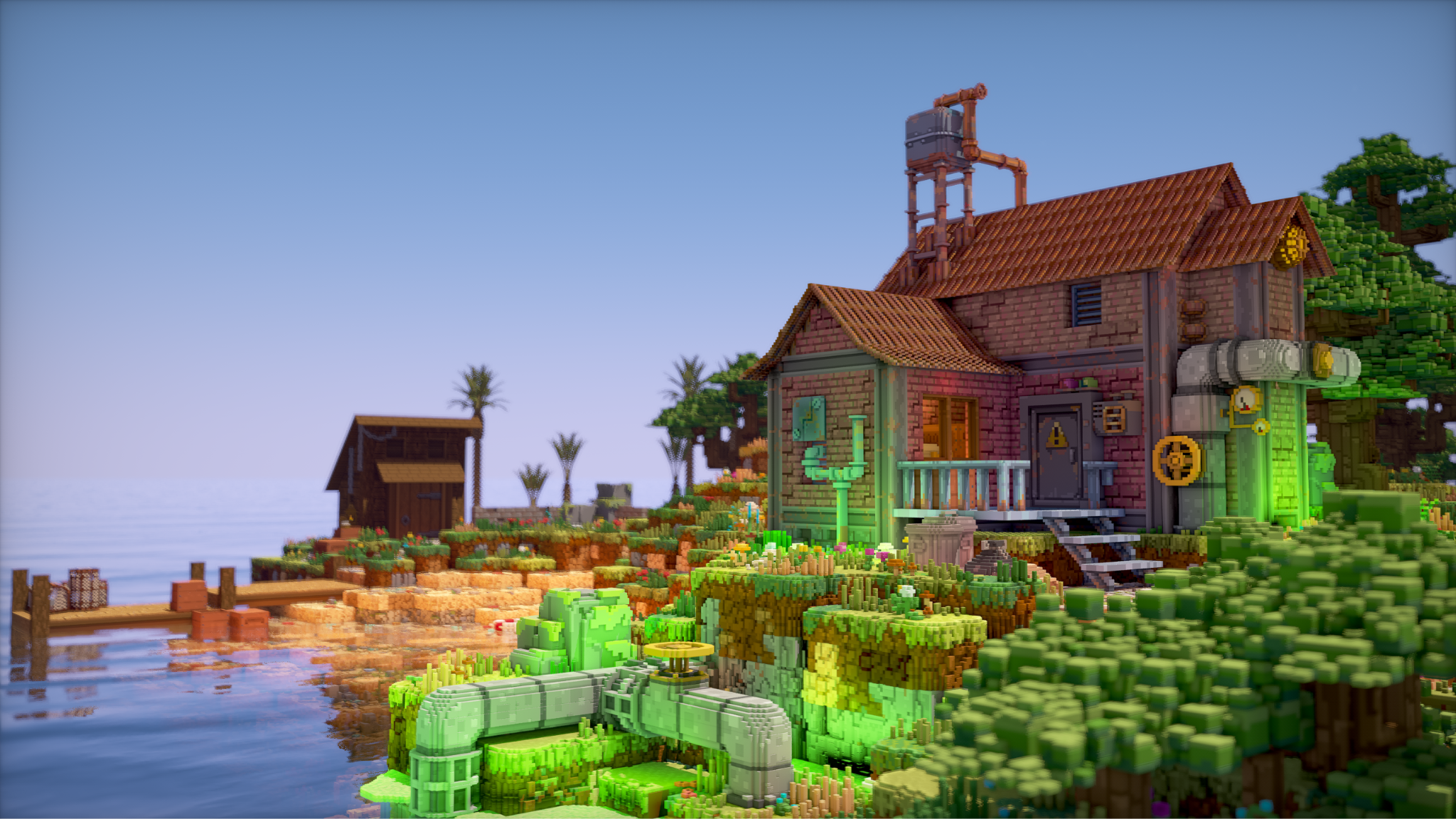
Just look at the way the look and feel of the game changes dramatically across worlds.
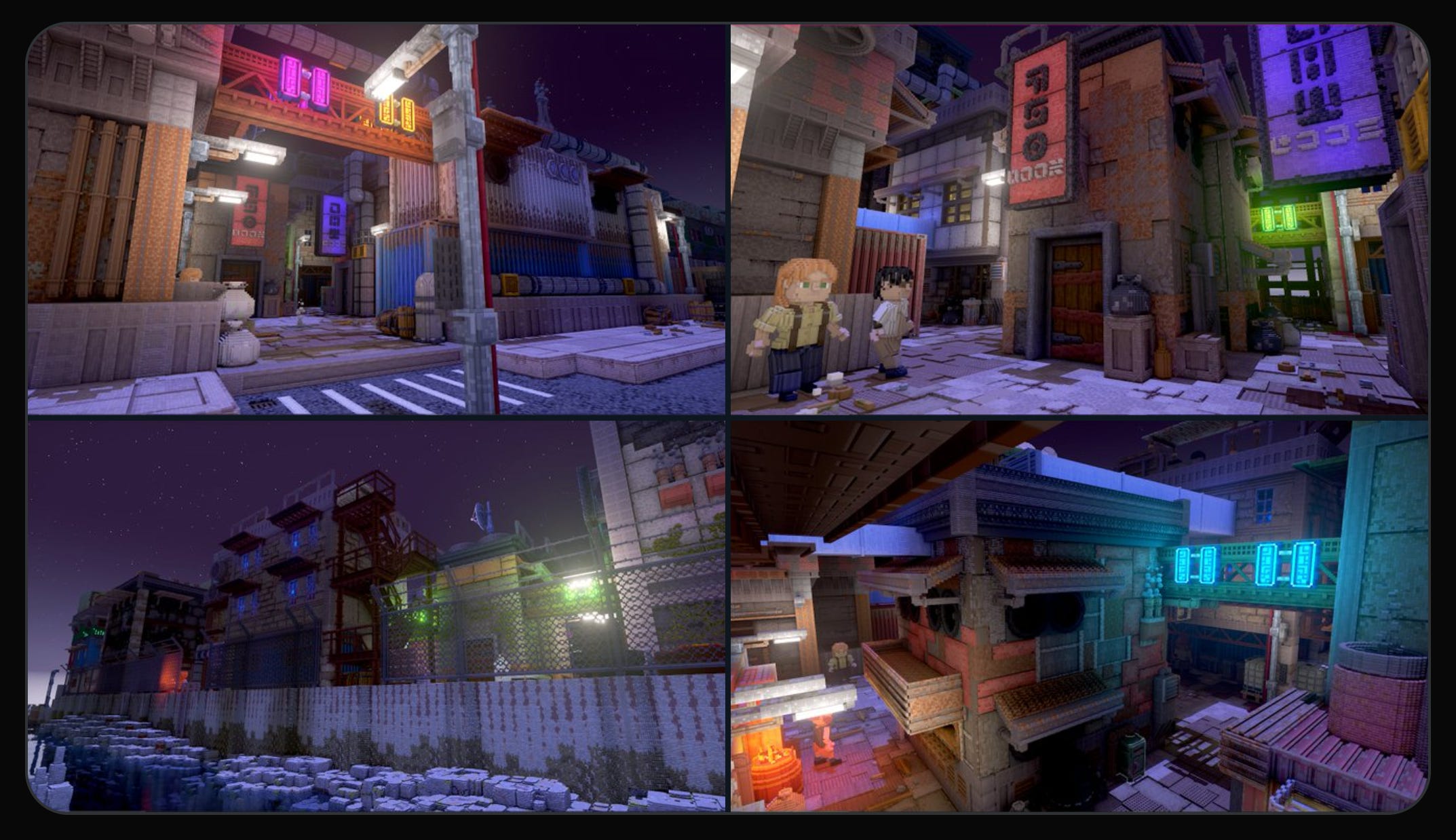
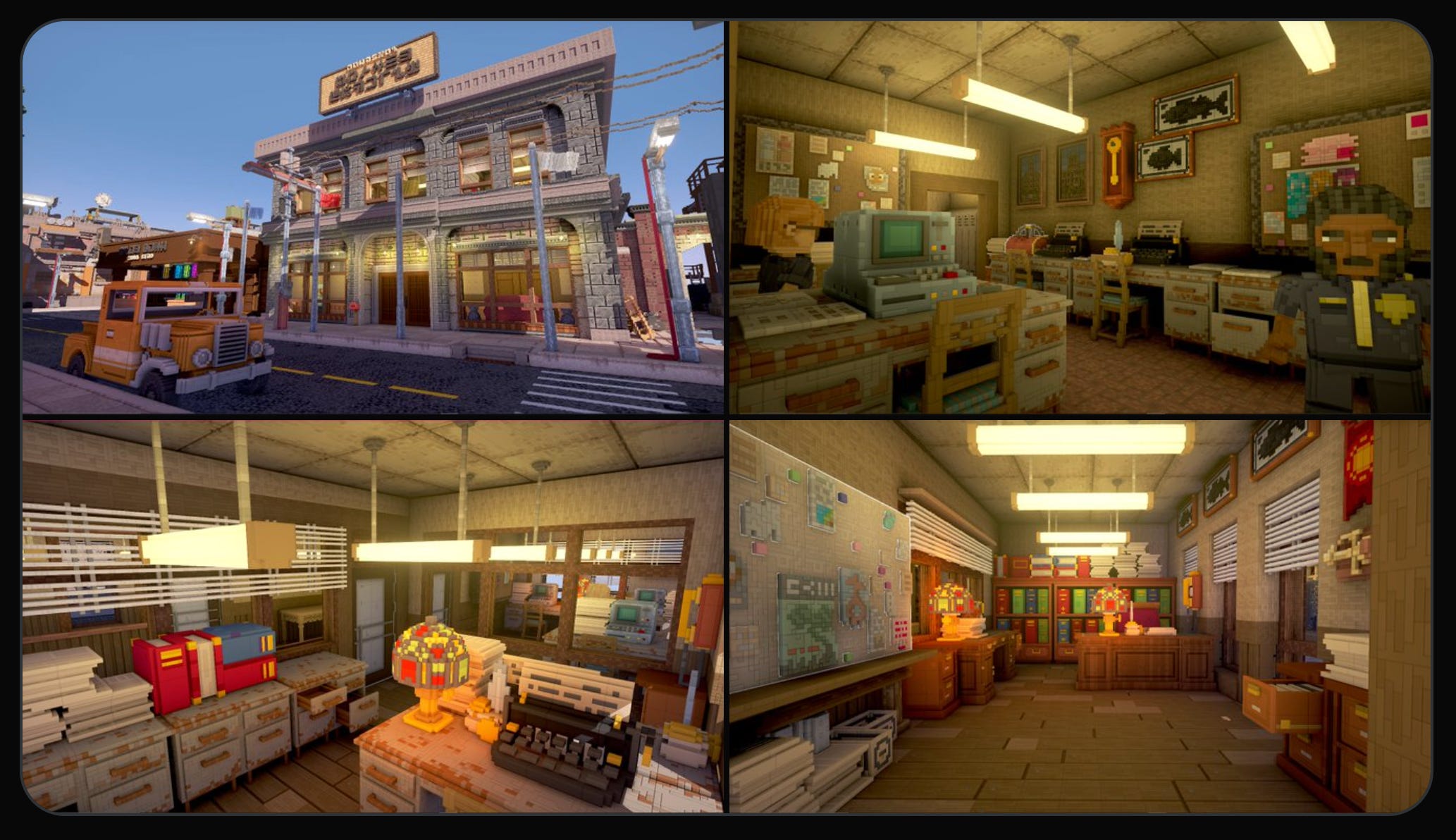
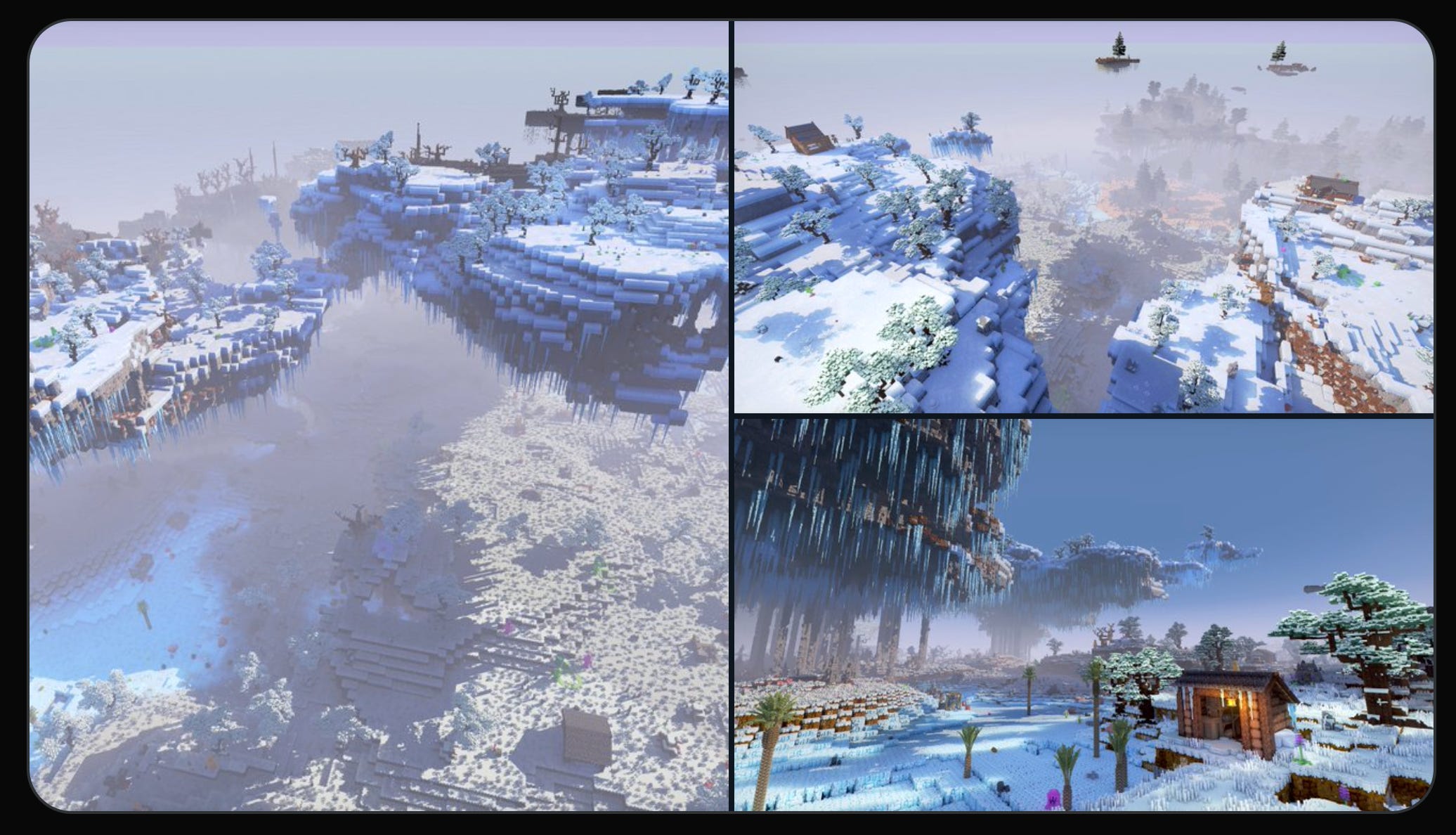
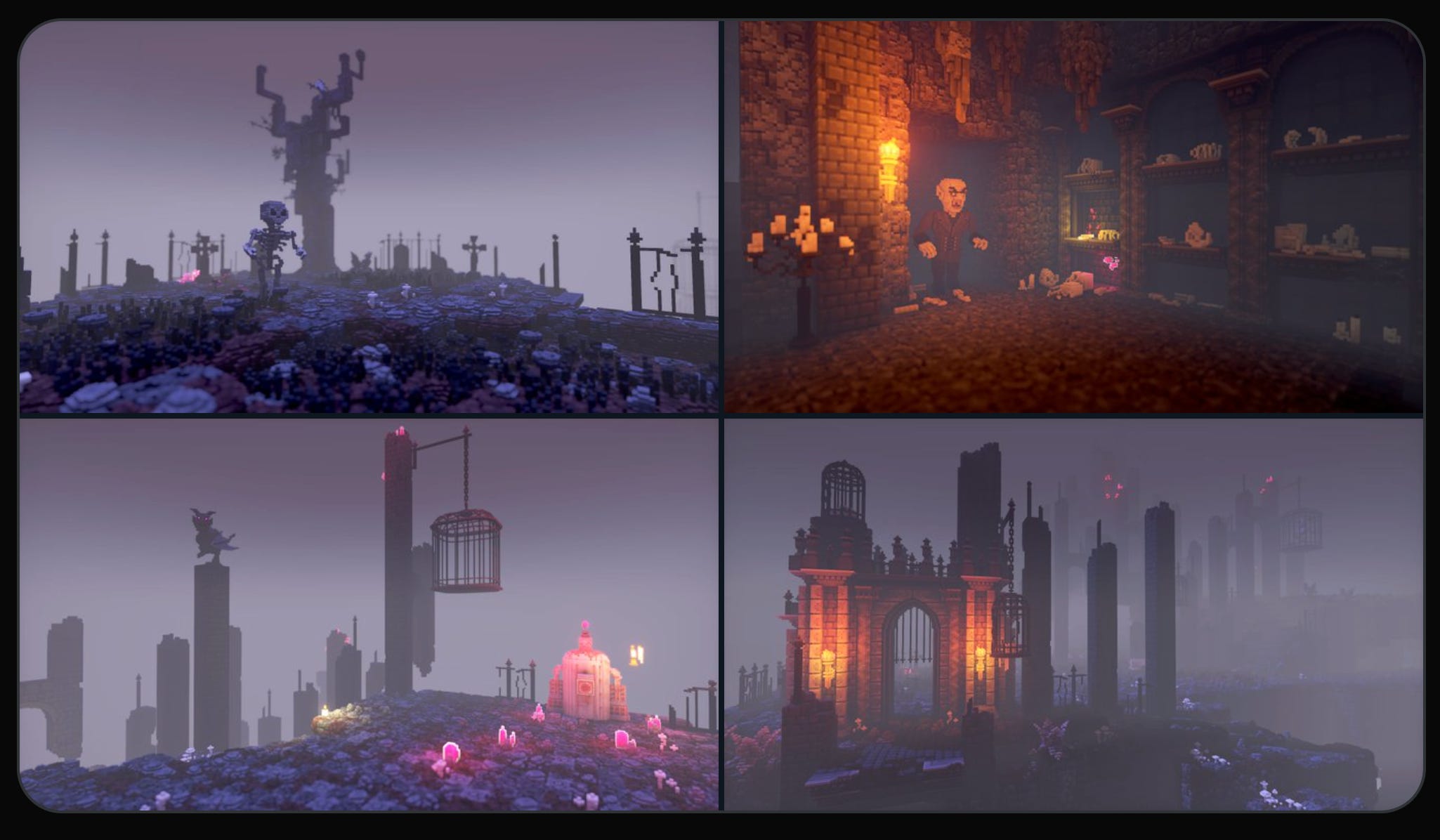
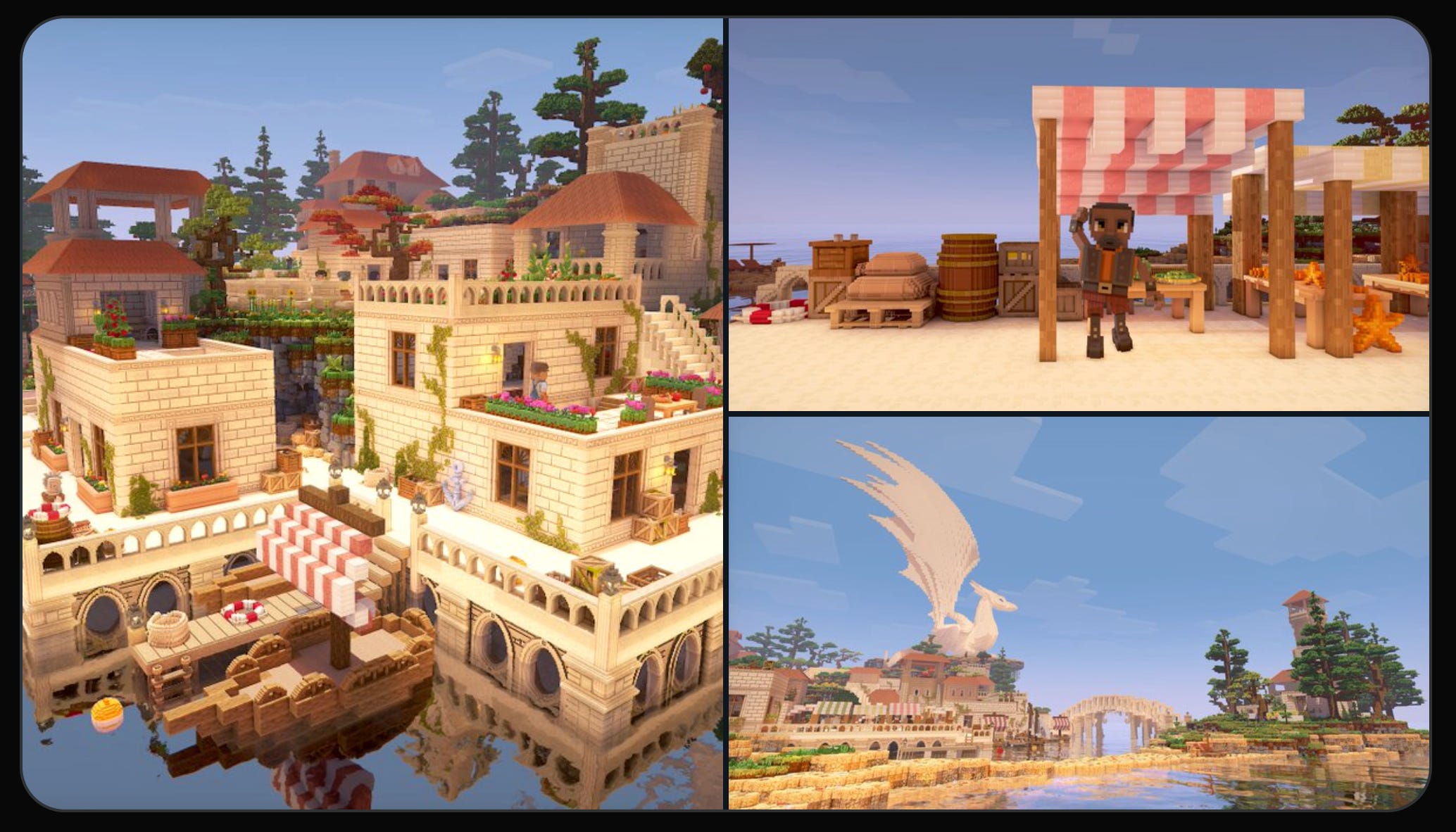
As new worlds get created, the prefabbed assets they contain become recyclable modules for future level design and modding (à la LittleBIGPlanet).
While Wouter has never publicly stated any plans whatsoever to use AI, it’s clear that with his skill and control over the language, the engine and the game, he could add any number of procedural world generation features to Voxile in the future… stuff that most other gamedevs could only dream of (or at the very least they’d have to submit a feature request ticket to their game engine provider).
In an industry that is hungry for growth and innovation, Wouter has created a full-stack, farm-to-table game technology that is truly one-of-a-kind. Everyone should take a moment to check out the free Voxile Demo and if you like the content or want a rich sandbox to mod your own worlds in… you should consider supporting his studio by buying the game on Steam now for 40% off. You can join the public VoxRay Games Discord channel to keep tabs on their latest news. Wouter, congrats again on The Builder’s Update! EGG is excited by what you have built and to go on this journey with you.
Read the original article

Comments
By spacemarine1 2026-03-0321:102 reply The founder, Wouter, has created or helped design 10 programming languages. Voxile is built in his newest language: Lobster. Wouter has been a major contributor to WASM and LLVM while also inventing flatbuffers. He’s worked at Crytek, Gearbox and Google among many other places. I’ve never seen anything like Voxile.
By thot_experiment 2026-03-0411:071 reply Cube 2: Sauerbraten too! Definitely spent some evenings playing that with my roomies back in the day before we invariably went back to Q3. What an insane resume.
By dinkblam 2026-03-0412:42 I have fond memories of porting Cube, Sauerbraten and AssaultCube to the Mac back in the day. Given what i've seen from Wouter back in the day i am not surprised he is still on it full steam…
Indeed! Thanks for also linking my discussion with Wouter His early work on Cube engine and Amiga-E are still awesome to look at.
By repelsteeltje 2026-03-049:51 I remember learning about Bla, a functional programming language for Amiga wrote for his master's thesis.
I'm a long time Unity developer that in the past year picked up Godot. The speed at which Godot loads compared to Unity is staggering, it's just so much faster. When I returned to Unity I raised that my flow state was constantly being broken in a way that it wasn't when using Godot.
Entering flow is one of the beautiful things I love about programming. And being knocked out of it often feels like a physical jolt.
Lobster seems to take the idea of optimisation and speed to new levels. Entering and remaining in flow must be even easier. First though, I'll need to put the time into learning enough to be able to do it!
By gslepak 2026-03-042:13 Thanks for mentioning Lobster. This guy seems to have learned many lessons of language simplification and design. Looks like a promising language and I wish it success.
Ref: https://aardappel.github.io/lobster/language_reference.html
Lobster doesn’t seem that different from Lua in that regard? I won’t say it isn’t impressive, but I’m having a hard time believing the hard part of this thing was calling from an interpreted to a static language.
Edit: I was mistaken about what Lobster is (potentially compiled instead of jit), but the main point stands.
Yeah,
I'm working on an indie game project and just got frustrated with Unity, I'm porting everything over to Godot.
I even learned about using Kotlin with Godot today [0] and I am really hopeful this is stable (it seems so), because I favor a more functional style of programming and C# ends up making everything 5 times more verbose than Kotlin.
By nmeofthestate 2026-03-0411:381 reply I do wonder whether Kotlin is sufficiently different from C# to make it worth developing in Godot in a non-standard way.
By LelouBil 2026-03-052:02 For me, it does.
I find Kotlin way easier to read back than C#, and for the cases where I would have reached for GDScript for its simplicity, I can use Kotlin and have still a lot of simplicity, while also having type-safety.
> I favor a more functional style of programming and C# ends up making everything 5 times more verbose than Kotlin.
As if you can't program C# functional style.
By thot_experiment 2026-03-0411:12 > As if you can't program C# functional style.
This, I was really impressed recently when I met a C# dev who was also a programmer (as opposed to your standard C# SaaS dev who just copy pasted from the framework docs and stack overflow and was fully automated by Claude in 2025) and he showed me how nice the language has gotten since I last used it over a decade ago when it was just Microslop Java. They've really put in work and it has a lot of great functional constructs now.
By LelouBil 2026-03-052:00 Sorry, I mean that writing functional code in C# is way more verbose than in Kotlin.
C# is already more verbose because it lacks things like union types (and so you need to have a fallback branch in every switch) and for example everything needs to be nested in a class.
Then you also have the fact that there is no "val" keyword (which makes things clearer imo) and the fact that it's generics type inferencing is only based on method arguments, which really adds a lot of noise to almost all generic functions.
I was using LanguageExt [0] in C# and I am now using Arrow [1] in Kotlin, and while LanguageExt is really nice for addressing some C# shortcomings, for me this is night and day.
By MBCook 2026-03-042:42 So true.
Recent changes to Xcode have meant that on device debugging now launches WAY slower for me every time.
Once it’s going it’s fine. But an extra 20 seconds every time you start the app just kills things for me. It was never instant but now it’s trash.
I get taken out of flow every time I submit my prompt to Claude. How’d you work around that?
By sixo 2026-03-045:30 Not every conversation is about AI. This one isn't.
By kranner 2026-03-042:21 Are we just assuming nobody is programming commando anymore?
By animuchan 2026-03-047:43 If the flow is just typing prompt after prompt into AI, I guess just ignore that it's running and keep typing? Or open a new tab and keep typing. Why does Claude even break the typewriter flow thing that's going for you?
By mef51 2026-03-042:35 You can try not using Claude
About the Lobster language used: The first thing I do when encountering a new language is look at the memory management, since what I want to do with a piece of code is usually build and manipulate data in a safe and efficient manner, so this is central. I am happy to see Lobster seems to be trying to take a new(ish) and pragmatical approach to memory management and that there is a whole document describing it in detail (https://aardappel.github.io/lobster/memory_management.html) which means the language creator agrees that this is important. Also happy to see the language seems to support fast memory management in a multi threaded environment, which is absolutely not self evident in many languages.
Thanks for sharing, it's indeed a great way to quickly see what a language has to offer.
From what I understand, the main innovation of Lobster here is that `class Foo` is a boxed type, while `struct Bar` will be inlined. I'm not sure I see how that's an improvement over using either `Foo` or `Box<Foo>` on instantiation. It also does reference counting by default, and tries to optimise it out at compile time by assigning a single owner and borrow.
We often see complains that Rust's ownership puts a lot of burden on the programmer, but there is really a point at which it clicks and we stop having to fight the borrow checker almost entirely.
By Aardappel 2026-03-0420:20 Lobster is meant to be a more high level language than Rust, so encoding what you want 99% of the time in the type made sense. It also makes it easier for people to read, knowing that common types like int2 are always by value.
That said, it be easy to have annotations to force the other use case, just so far that has not been needed :)
