
OR: the long overdue forest fire

If you ever want a good laugh, ask an academic to explain what they get paid to do, and who pays them to do it.
In STEM fields, it works like this: the university pays you to teach, but unless you’re at a liberal arts college, you don’t actually get promoted or recognized for your teaching. Instead, you get promoted and recognized for your research, which the university does not generally pay you for. You have to ask someone else to provide that part of your salary, and in the US, that someone else is usually the federal government. If you’re lucky—and these days, very lucky—you get a chunk of money to grow your bacteria or smash your electrons together or whatever, you write up your results for publication, and this is where the monkey business really begins.
In most disciplines, the next step is sending your paper to a peer-reviewed journal, where it gets evaluated by an editor and (if the editor sees some promise in it) a few reviewers. These people are academics just like you, and they generally do not get paid for their time. Editors maybe get a small stipend and a bit of professional cred, while reviewers get nothing but the warm fuzzies of doing “service to the field”, or the cold thrill of tanking other people’s papers.
If you’re lucky again, your paper gets accepted by the journal, which now owns the copyright to your work. They do not pay you for this! If anything, you pay them an “article processing charge” for the privilege of no longer owning the rights to your paper. This is considered a great honor.
The journals then paywall your work, sell the access back to you and your colleagues, and pocket the profit. Universities cover these subscriptions and fees by charging the government “indirect costs” on every grant—money that doesn’t go to the research itself, but to all the things that support the research, like keeping the lights on, cleaning the toilets, and accessing the journals that the researchers need to read.
Nothing about this system makes sense, which is why I think we should build a new one. In the meantime, though, we should also fix the old one. But that’s hard, for two reasons. First, many people are invested in things working exactly the way they do now, so every stupid idea has a constituency behind it. Second, our current administration seems to believe in policy by bloodletting: if something isn’t working, just slice it open at random. Thanks to these haphazard cuts and cancellations, we now have a system that is both dysfunctional and anemic.
I see a way to solve both problems at once. We can satisfy both the scientists and the scalpel-wielding politicians by ridding ourselves of the one constituency that should not exist. Of all the crazy parts of our crazy system, the craziest part is where taxpayers pay for the research, then pay private companies to publish it, and then pay again so scientists can read it. We may not agree on much, but we can all agree on this: it is time, finally and forever, to get rid of for-profit scientific publishers.
The writer G.K. Chesterton once said that before you knock anything down, you ought to know how it got there in the first place. So before we show for-profit publishers the pointy end of a pitchfork, we ought to know where they came from and why they persist.
It used to be a huge pain to produce a physical journal—someone had to operate the printing presses, lick the stamps, and mail the copies all over the world. Unsurprisingly, academics didn’t care much about doing those things. When government money started flowing into universities post-World War II and the number of articles exploded, private companies were like, “Hey, why don’t we take these journals off your hands—you keep doing the scientific stuff and we’ll handle all the boring stuff.” And the academics were like “Sounds good, we’re sure this won’t have any unforeseen consequences.”
Those companies knew they had a captive audience, so they bought up as many journals as they could. Journal articles aren’t interchangeable commodities like corn or soybeans—if your science supplier starts gouging you, you can’t just switch to a new one. Adding to this lock-in effect, publishing in “high-impact” journals became the key to success in science, which meant if you wanted to move up, your university had to pay up. So, even as the internet made it much cheaper to produce a journal, publishers made it much more expensive to subscribe to one.
The people running this scam had no illusions about it, even if they hoped that other people did. Here’s how one CEO described it:
You have no idea how profitable these journals are once you stop doing anything. When you’re building a journal, you spend time getting good editorial boards, you treat them well, you give them dinners. [...] [and then] we stop doing all that stuff and then the cash just pours out and you wouldn’t believe how wonderful it is.
So here’s the report we can make to Mr. Chesterton: for-profit scientific publishers arose to solve the problem of producing physical journals. The internet mostly solved that problem. Now the publishers are the problem. These days, Springer Nature, Elsevier, Wiley, and the like are basically giant operations that proofread, format, and store PDFs. That’s not nothing, but it’s pretty close to nothing.
No one knows how much publishers make in return for providing these modest services, but we can guess. In 2017, the Association of Research Libraries surveyed its 123 member institutions and found they were paying a collective $1 billion in journal subscriptions every year. The ARL covers some of the biggest universities, but not nearly all of them, so let’s guess that number accounts for half of all university subscription spending. In 2023, the federal government estimated it paid nearly $380 million in article processing charges alone, and those are separate from subscriptions. So it wouldn’t be crazy if American universities were paying something like $2.5 billion to publishers every year, with the majority of that ultimately coming from taxpayers.
(By the way, the estimated profit margins for commercial scientific publishers are around 40%, which is higher than Microsoft.)
To put those costs in perspective: if the federal government cut out the publishers, it would probably save more money every year than it has “saved” in its recent attempts to cut off scientific funding to universities. It’s unclear how much money will ultimately be clawed back, as grants continue to get frozen, unfrozen, litigated, and negotiated. But right now, it seems like ~$1.4 billion in promised science funding is simply not going to be paid out. We could save more than that every year if we just stopped writing checks to John Wiley & Sons.
How can such a scam continue to exist? In large part, it’s because of a computer hacker from Kazakhstan.
The political scientist James C. Scott once wrote that many systems only “work” because people disobey them. For instance, the Soviet Union attempted to impose agricultural regulations so strict that people would have starved if they followed the letter of the law. Instead, citizens grew and traded food in secret. This made it look like the regulations were successful, when in fact they were a sham.1
Something similar is happening right now in science, except Russia is on the opposite side of the story this time. In the early 2010s, a Kazakhstani computer programmer named Alexandra Elbakyan started downloading articles en masse and posting them publicly on a website called SciHub. The publishers sued her, so she’s hiding out in Russia, which protects her from extradition. As you can see in the map below, millions of people now use SciHub to access scientific articles, including lots of people who seem to work at universities:
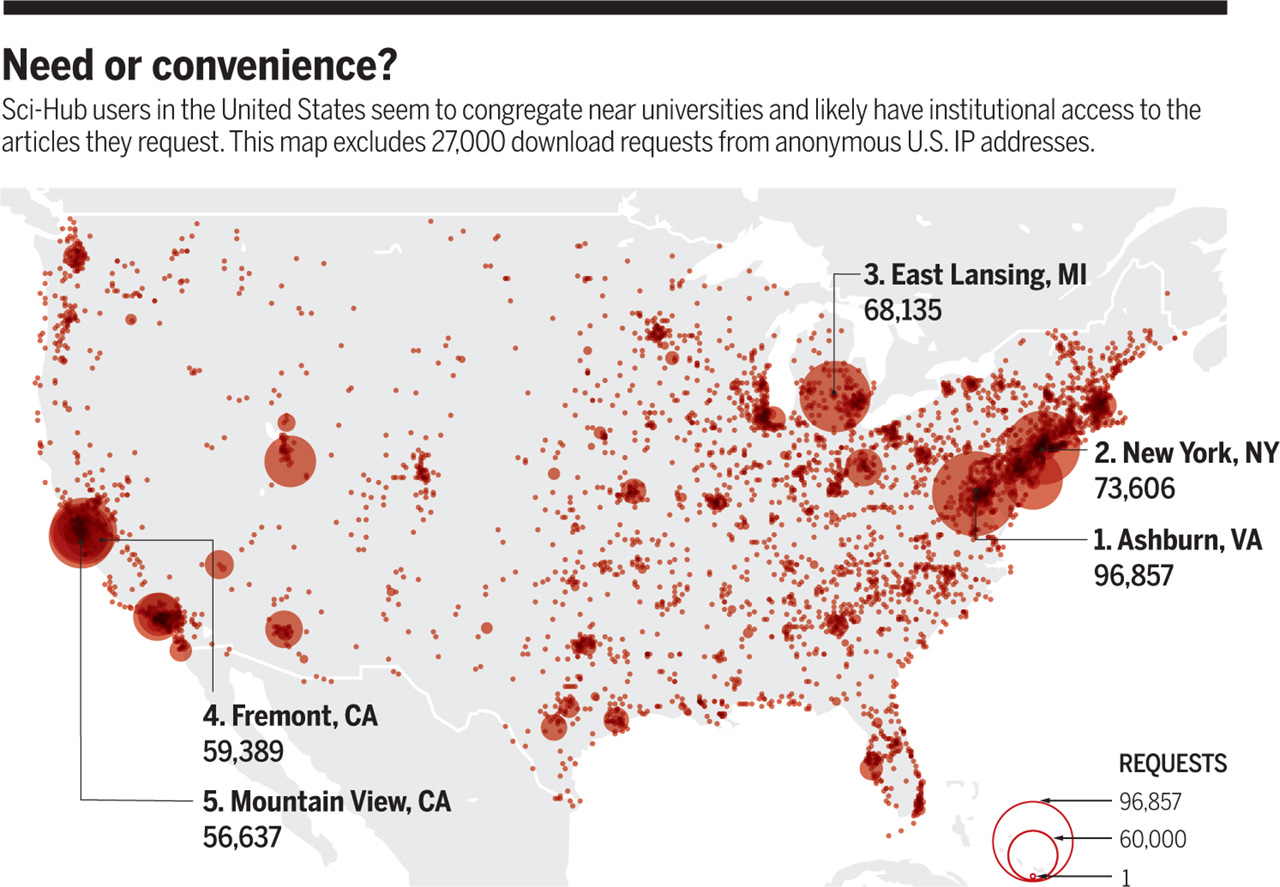
Why would researchers resort to piracy when they have legitimate access themselves? Maybe because journals’ interfaces are so clunky and annoying that it’s faster to go straight to SciHub. Or maybe it’s because those researchers don’t actually have access. Universities are always trying to save money by canceling journal subscriptions, so academics often have to rely on bootleg copies. Either way, SciHub seems to be our modern-day version of those Soviet secret gardens: for-profit publishing only “works” because people find ways to circumvent it.

In a punk rock kind of way, it’s kinda cool that so many American scientists can only do their work thanks to a database maintained by a Russia-backed fugitive. But it ought to be a huge embarrassment to the US government.2
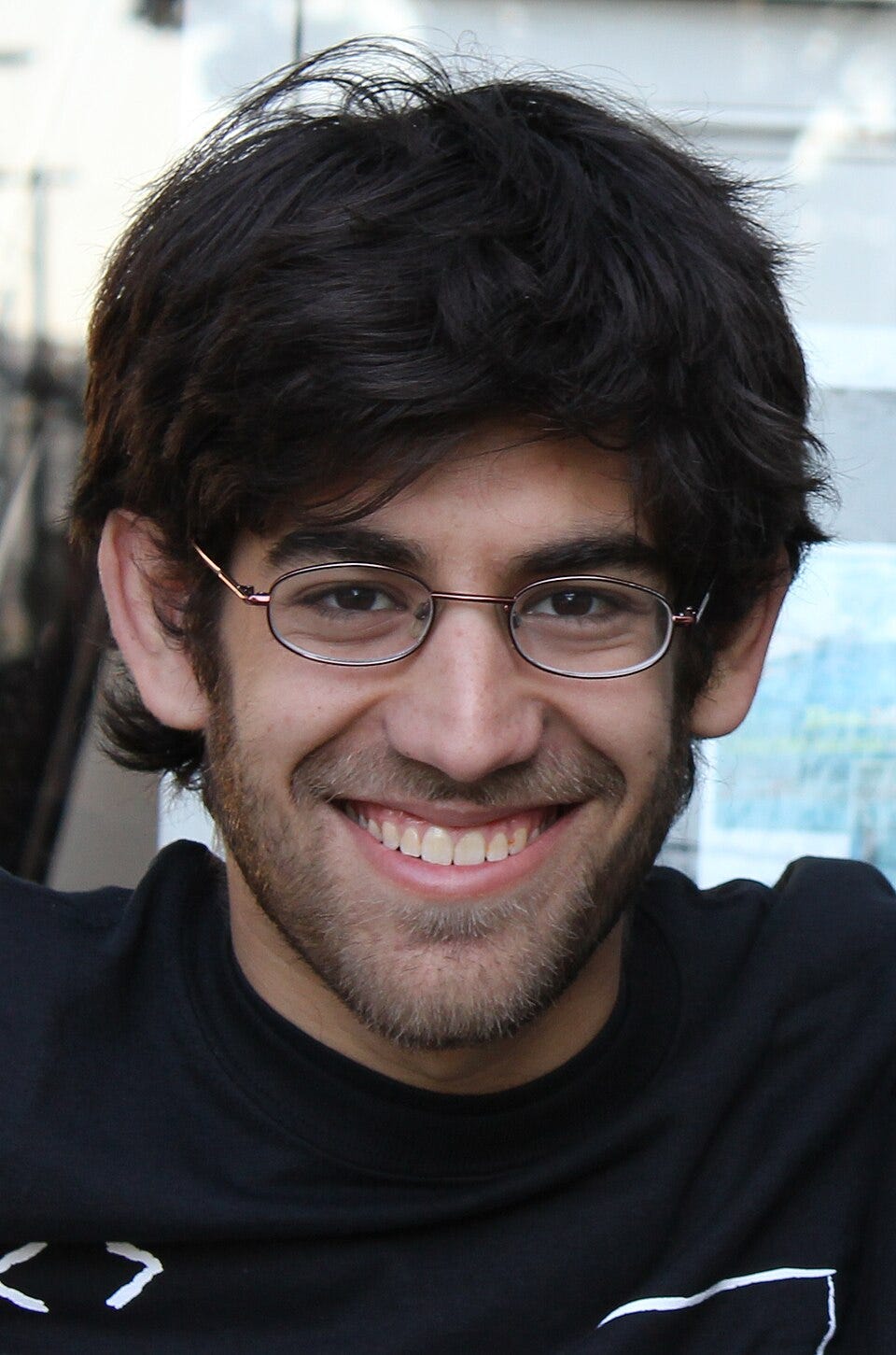
Instead, for some reason, the government insists on siding with publishers against citizens. Sixteen years ago, the US had its own Elbakyan. His name was Aaron Swartz. He downloaded millions of paywalled journal articles using a connection at MIT, possibly intending to share them publicly. Government agents arrested him, charged him with wire fraud, and intended to fine him $1 million and imprison him for 35 years. Instead, he killed himself. He was 26.
Scientists have tried to take on the middlemen themselves. They’ve founded open-access journals. They’ve published preprints. They’ve tried alternative ways of evaluating research. A few high-profile professors have publicly and dramatically sworn off all “luxury” outlets, and less-famous folks have followed suit: in 2012, over 10,000 researchers signed a pledge not to publish in any journals owned by Elsevier.
None of this has worked. The biggest for-profit publishers continue making more money year after year. “Diamond” open access journals—that is, publications that don’t charge authors or readers—only account for ~10% of all articles.3 Four years after that massive pledge, 38% of signers had broken their promise and published in an Elsevier journal.4
These efforts have fizzled because this isn’t a problem that can be solved by any individual, or even many individuals. Academia is so cutthroat that anyone who righteously gives up an advantage will be outcompeted by someone who has fewer scruples. What we have here is a collective action problem.
Fortunately, we have an organization that exists for the express purpose of solving collective action problems. It’s called the government. And as luck would have it, they’re also the one paying most of the bills!
So the solution here is straightforward: every government grant should stipulate that the research it supports can’t be published in a for-profit journal. That’s it! If the public paid for it, it shouldn’t be paywalled.
The Biden administration tried to do this, but they did it in a stupid way. They mandated that NIH-funded research papers have to be “open access”, which sounds like a solution, but it’s actually a psyop. By replacing subscription fees with “article processing charges”, publishers can simply make authors pay for writing instead of making readers pay for reading. The companies can keep skimming money off the system, and best of all, they get to call the result “open access”.
These fees can be wild. When my PhD advisor and I published one of our papers together, the journal charged us an “open access” fee of $12,000. This arrangement is a tiny bit better than the alternative, because at least everybody can read our paper now, including people who aren’t affiliated with a university. But those fees still have to come from somewhere, and whether you charge writers or readers, you’re ultimately charging the same account—namely, the US government.5
The Trump administration somehow found a way to make a stupid policy even stupider. They sped up the timeline while also firing a bunch of NIH staffers—exactly the people who would make sure that government-sponsored publications are, in fact, publicly accessible. And you need someone to check on that, because researchers are notoriously bad about this kind of stuff. They’re already required to upload the results of clinical trials to a public database, but more than half the time they just...don’t.
To do this right, you cannot allow the rent-seekers to rebrand. You have to cut them out entirely. I don’t think this will fix everything that’s wrong with science; it will merely fix the wrongest thing. Nonprofit journals still charge fees, but at least the money goes to organizations that ostensibly care about science, rather than going to CEOs who make $17 million a year. And almost every journal, for-profit or not, uses the same failed system of peer review. The biggest benefit of shaking things up, then, would be allowing different approaches to have a chance at life, the same way an occasional forest fire clears away the dead wood, opens up the pinecones, and gives seedlings a shot at the sunlight.
Science philanthropies should adopt the same policy, and some of them already have. The Navigation Fund, which oversees billions of dollars in scientific funding, no longer bankrolls journal publications at all. Seemay Chou, its director, reports that the experiment has been a great success:
Our researchers began designing experiments differently from the start. They became more creative and collaborative. The goal shifted from telling polished stories to uncovering useful truths. All results had value, such as failed attempts, abandoned inquiries, or untested ideas, which we frequently release through Arcadia’s Icebox. The bar for utility went up, as proxies like impact factors disappeared.
Sounds good to me!
Fifteen years ago, the open science movement was all about abolishing for-profit journals—that’s what open science meant. It seemed like every speech would end with “ELSEVIER DELENDA EST”.
Now people barely bring it up at all.6 It’s like a lion has escaped the zoo and it’s gulping down schoolchildren, but when people suggest zoo improvements, all the agenda items are like, “We should add another Dippin’ Dots kiosk”. If you bring up the loose tiger, everyone gets annoyed at you, like “Of course, no one likes the tiger”.
I think two things happened. First, we got cynical about cyberspace. In the 1990s and 2000s, we really thought the internet would solve most of our problems. When those problems persisted despite all of us getting broadband, we shifted to thinking that the internet was, in fact, causing the problems. And so it became cringe to think the internet could ever be a force for good. In 1995, for-profit publishers were going to be “the internet’s first victim”; in 2015, they were “the business the internet could not kill”.
Second, when the replication crisis hit in the early 2010s, the open science movement got a new villain—namely, naughty researchers. The fakers, the fraudsters, the over-claimers: those are the real bad boys of science. It’s no longer cool to hate international publishing conglomerates. Now it’s cool to hate your colleagues.
Both of these shifts were a shame. The internet utopians were right that the web would eliminate the need for journals, but they were wrong to think that would be enough. The replication police were right to call out scientific malfeasance, but they were wrong to forget our old foes. The for-profit publishers are just as bad as they ever were, and while the internet has made them more vulnerable then ever, now we know they won’t go unless they’re pushed.
If we want better science, we should catch the tiger. Not only because it’s bad for the tiger to be loose, but because it’s bad for us to look the other way. If you allow an outrageous scam to go unchecked, if you participate in it, normalize it—then what won’t you do? Why not also goose your stats a bit? Why not publish some junk research? Look around: no one cares!
There are so many problems with our current way of doing things, and most of those problems are complicated and difficult to solve. This one isn’t. Let’s heave this succubus off our scientific system and end this scam once and for all. After that, Dippin’ Dots all around.

Read the original article

Comments
We already have open-access publications: Just put it on arXiV. Most researchers I work with do this already.
The problem isn't access, it's citations. arXiV is not considered a credible citation source since anyone can publish anything. TPCs don't use it in their list of citations, neither do grant funding agencies or government institutions.
The current academic enterprise relies heavily on third-party gatekeeping. We rely on others to do the vetting for us. The first thing an academic does is check where a paper is published, before even reading it. It's a crutch.
Any gatekeeper will naturally tend towards charging for access over time: It's a captive market, the economics demands it. Unless we eliminate that dependency, we cannot change the system.
By the__alchemist 2026-03-0416:37 Check out the "Collective action problem" described in this article. It describes why "Just publish on arXiV" isn't a practical solution. It doesn't lead to the problem being fixed, because of inertia against any individual breaking out of the system.
By armoredkitten 2026-03-0417:522 reply I've long wished that "journals" and academic societies would transition from a publishing model to a cultivation model. If everything is available on arXiv, that's great, but it also means the best of the best is mixed in with all the rest.
Journals (in the sense of whoever is on the editorial board) don't need to cease to exist; they just need to transition to "here's our list this month of what the best new articles are on X topic". The paper's already there on arXiv, you could already read it before. But having a group of editors that cultivate a list of good articles (as well as the peer review process that can, in an ideal world, serve to improve a paper) can serve to make sifting through arXiv less overwhelming, and draw attention to papers in particular subfields, subject matter, or whatever other criteria might be relevant.
By convolvatron 2026-03-0418:09 I don't see any reason why we shouldn't make this transitive. working professionals track the literature. if there were a standard way to publish a "I think this paper is interesting" signal, then we could roll that all up. there are certainly practitioners that I really do trust to be in the game for the right reasons, if they think a paper represents a contribution, then that's a strong signal for me.
By bglazer 2026-03-0420:29 This is quite similar to how eLife does publishing. You still have to submit to them but they basically just add reviewer comments and an “eLife Assessment” that serves as the quality/curation signal rather than a binary publish/reject
By jcranmer 2026-03-0418:30 In the publishing world, there is this thing called the slush pile: the collection of unsolicited submissions, essentially the only way a person without an agent can break into the field. And you can find quite a few editors' experiences with the slush pile in various blog posts or articles online. And the general reaction goes from naïve wonder at the idea of finding the diamond-in-the-rough to frustration with the quality of the submissions and a realization that the actual game is to figure out how to reject submissions with as little reading as possible (because they don't have the time to do any reading!). This is before LLMs came about, which have made the slush pile problem much worse because they don't improve the quality of the submissions but the increase the amount of reading that needs to be done to reject them.
Academia has the same fundamental problem. We don't actually have the time to read every possible paper someone has for us, because keeping up with literature takes time that we don't have. And while relying on the quality of the journal or conference as a metric for "is this paper worth reading?" has issues, to be honest, it is more effective than other proposed solutions. When I have done the literature searches that delved into the unknown, low-quality tiers of journals... no, those results were not worth the time I spent reading them.
By SoftTalker 2026-03-0417:161 reply Why isn't a citation just a citation. It's a pointer to a source, that's all. If it implies some standards have been applied or editorial or scientific review has been done, then that's going to have to be paid for by someone. TFA implies that doesn't happen: [and then] we stop doing all that stuff and then the cash just pours out. So a citation to an article in Nature isn't any better than one on arXiV.
By gus_massa 2026-03-0419:40 > So a citation to an article in Nature isn't any better than one on arXiV.
The real problem is that nobody can grade and compare article in different topics, so there are proxies like number of articles in "serious" journals (whatever that means[1]) and number of citations in "serious" journals (whatever that means[1]).
Do we count also citations in X/Tweeter, FaceBook, WordPress [2], StackOverflow, ... ?
If links in HN also count as citations, there are 3 additional citations for my last paper:
http://www.example.com/gus_massa/very_good_paper_2026.pdf
http://www.example.com/gus_massa/very_good_paper_2026.pdf
http://www.example.com/gus_massa/very_good_paper_2026.pdf
[1] Which journals are serious and which are paper mills? In the extremes the difference is clear, but there in the middle there is a gray zone.
[2] A citation in Tao's blog in WordPress should be worth at least half official citation, or perhaps a whole point.
By bad_haircut72 2026-03-0415:554 reply Unfortunately I think charging money is a necessary signal that this particular gatekeeper is doing a good job. We should recognise that money is a necessary part of this process, else there is no gate to keep. But we shpuld reverse the economics by having people pay to get their stuff peer reviewed. Imagine if reviewing research papers was something you could get paid to do, the incentive then isnt to rubber stamp things, actually your rating as a reviewer would come down to quality of reviews
> I think charging money is a necessary signal that this particular gatekeeper is doing a good job.
I’ve never seen the slightest relationship between the charge to read a paper and the quality of review.
Because there isn't such a relation. It's a thing people believe when they don't have actual experience with peer review. If anything, predatory journals and low-quality pubs can charge more, since publication is more guaranteed (and researchers reaching for these pay-to-publish journals are more desperate).
By fireflash38 2026-03-0416:51 It's a reputation economy. Like review sites. They start off truthful, and then as time goes on incentives shift to bad actors to subvert it. Or they just sell out their reputation.
Yelp, TripAdvisor, wire cutter, hell even Google results themselves.
Once you start poisoning that well, it's difficult if not impossible to claw it back.
By azan_ 2026-03-0420:43 I tend to agree, but keep in mind that most likely you just don't even bother reading the shittiest of the shittiest papers just based on title and abstract. And for every good article there are like 10 unindexed shitty ones.
Yeah review takes time and time is money. This needs to be priced in somehow. Bonus side effect: Frauds get discovered and filtered out (in theory).
But who watches the watchers? I guess review fraud will need to be considered as well.
By fanf2 2026-03-0418:33 Scientific publishers do not pay for peer review. Reviews are done by researchers as part of their jobs which are paid for by their research grants.
By kergonath 2026-03-0417:57 > But we shpuld reverse the economics by having people pay to get their stuff peer reviewed.
Not really. There would be perverse incentives where the publisher benefits from accepting more articles. For good journals that would be a conflict of interests at best where they would optimise the marketing-to-acceptance ratio. I can’t believe I am writing something good about scientific publisher, but at least when the reader pays they are incentivise to publish things that have an audience. Otherwise, they are going to cut corners, and I mean more than they currently do. And it’s not hypothetical, there are already terrible publishers doing this.
By blharr 2026-03-0418:04 The problem is that this becomes a race to the bottom of actual quality and turns into advertising.
Sponsored reviews of products are basically this. If you are paying a reviewer for a stamp of approval and the reviewer sets the bar too high, why would you want to pay that reviewer? On the other end of the reviewer, it's easy to get more money by providing that stamp of approval to more people--not fewer--so they're incentivized to make it fairly easy to achieve.
By engineer_22 2026-03-0416:49 We have a gatekeeper already in the funding source - they do the work of vetting researchers prior to funding the work.
Piggy back this system so that the funding source publishes the papers itself, and researchers can only publish their papers that are directly funded.
This system requires the cooperation of an organization to build the publishing infrastructure, but this could be a lowest capable bidder, and less drag on the system overall.
By mitthrowaway2 2026-03-057:08 I don't think there's really such a thing as a credible citation source. The citation just has to point to a source that hosts the genuine article; the credibility of the article comes from the articles that point to it, and the independent verifiability of the article's claims, not the location that it is hosted.
By contubernio 2026-03-0415:48 Exactly. The solution already exists. However another problem is that the arxiv is creeping towards the old model ...
> The first thing an academic does is check where a paper is published, before even reading it. It's a crutch
IMO, academics that do this are not very competent, because we have plenty of research suggesting that higher-profile journals are in fact less trustworthy in many ways, or that there is no correlation at all between reputation and quality (see my other post here in this thread).
Yes, some trash journals publish all trash, but, beyond that, competent researchers scan the abstract, look at sample sizes and basic stats, and if those check out, you skip to the methods and look for red flags there. Also, most early publications will be on an arXiv-like place anyway so you can't look to reputation yet.
Likewise, serious analytic reviews like meta-analyses don't factor in e.g. impact factor or paper citations, since that would be nonsense. They focus on methodology and stats.
I really think we ought to shame academics that are filtering papers based on journal alone, it is almost always the wrong way to make a quick judgement.
I have seen more than one PI at an R1 universities with multiple Nature publications use this heuristic. I would not call them incompetent.
Do you not notice the circularity of your reasoning here?
Also I didn't say incompetent, I said "not very". More competent researchers make journal rep only a very small factor, and it is not via the "high rep = more trustworthy" direction (which is the bad heuristic), it is "pay-to-publish journals = not trustworthy" (better heuristic).
Once you have ruled out a publication being in a trash journal, reputation is only a very minor factor in consideration, and methodological and substantive issues are what matter.
It all depends on whether the paper fits the journal. Minor journals serve a useful service as a repository for minor results. And minor results are still worth publishing because they might provide a detail or technique later needed for a major result. The thing to be wary of is when you see a stunning result that should really be in _Nature_ or _Science_ in some minor journal. Why isn't it? Was it submitted there first and rejected? It would be nice if the history of a manuscript (and its peer review) stayed with a manuscript so you could see if the authors really corrected problems brought up by peer review or were just spamming journals with a flawed manuscript until they found one that published it.
By D-Machine 2026-03-0515:08 Agree with all this. Once you've filtered / made decisions of quality based on the more substantive criteria, journal reputation can provide useful additional information / context. The case you mentioned is a good example.
By blululu 2026-03-0516:46 There is no reasoning. I gave you a statement of fact:
I have personally seen highly talented and successful researchers use the heuristic of journal quality when looking at the state of their field. These people are highly competent by any standard. If you want to play word games with negation you could say they are not not very competent.
> IMO, academics that do this are not very competent, because ...
Where's the cry-laugh emoji when I need it.
Of course academics check where stuff is published. Please...
There are still real journals put there, although you might not know which is which.
Ah, look, another smug sneer that ignores the evidence I presented, and makes another circular argument (i.e. that because academics look at rep, this is justified, even though I provided evidence disputing this).
I know what journals are better / not. But reputation only is helpful in letting you ignore trash journals, once you are out of trash land, rep is just not a very meaningful factor, and you have to focus on methodology and substance.
Where's the evidence you presented?
What are some higher-profile journals that are in fact less trustworthy in many ways?
By D-Machine 2026-03-0417:41 I literally said it was posted in this thread, and a quick Ctrl+F of my username on this page would have found you it in a half second: https://news.ycombinator.com/item?id=47249236
By butILoveLife 2026-03-0416:322 reply >The first thing an academic does is check where a paper is published, before even reading it. It's a crutch.
This is actually what ruined my respect for Academia.
My Science PhD buddy looked at the journal title and the claim, then said: "Its true!"
I look at him with horror. Who cares about the journal, I want to know data and methodology.
I've basically never forgiven Academia since this. I see even Ivys put out bad research and journals will publish bad research (Replication crisis and the ivy fake psychology studies)
For outsiders, there is a prestige to being a PhD or working as a professor. Now that I'm mid career and lived through the previous events I mentioned + seeing who stuck with academia... These are your C grade performers. They didnt get hired by industry, so they stayed in school. They are so protective of their artificial rank because they cannot compete in Industry. Its like being the cool person on the tennis team. They are locally cool, but not globally cool.
> This is actually what ruined my respect for Academia.
Spoken like someone who never went through grad school at a competitive R1 program
It was already a grueling 60-80 hour grind every week with frequent all nighters, high-pressure deadlines, absolute minimal pay, thankless duties, and plenty of politics. It's about the same for professors too.
We already paid our dues by helping peer review (for free) a half dozen papers for each one we submitted. Why should we be expected to review random papers on arxiv too...?
I went to an R1 university. Most students did not have a 60-80 hour grind. If they did, it was because of an overbearing advisor. Years later, those students are not ahead of those who had a more relaxed advisor.
And chances are: Those overbearing advisors are very invested in the current system.
By currymj 2026-03-0418:13 it varies enormously by field.
in CS you will have intense grind weeks around conference deadlines and a more manageable but challenging pace of life otherwise.
in wet lab science you live by the schedule set by your experiments, which often involves intense hours.
By fluoridation 2026-03-0417:09 >Why should we be expected to review random papers on arxiv too...?
The GP is not saying to review each paper you read or cite. They're complaining that a colleague accepted a claim after just reading the title and where the paper was published. Between that and doing a full review there's surely a world of options.
By graemep 2026-03-0417:08 The problem is not that he was not willing to review it. It was that he was willing to conclude it was true. If he had said "that is interesting" or "that is plausible" or whatever, that is fine. It is concluding it is true that is the problem.
I don’t think folks in academia have come to terms with how much the above attitude has completely and nearly entirely undermined the credibility of the entire scientific and academic community in the eyes of the general public.
You don’t need a degree to understand how much utter junk science is being published by those who think they are superior to you. Just read a few actual papers end to end and look at the data vs conclusions and it becomes totally obvious very rapidly that you cannot “trust the science” since it’s rarely actual science being done any longer.
The academic community has utterly failed at understanding they needed to cull this behavior early and mercilessly. They did not, and it will be generations at best to rebuild the trust they once had. If they ever figure out they need to.
Things are going to get much worse before they get better. You can’t take any published paper at face value any longer without going direct to primary sources and bouncing it off an expert in the space you still trust to give you the actual truth.
By D-Machine 2026-03-0417:19 I fear you are right here, and that the problem is far more dire than much of academia realizes. I know enough highly intelligent people (some even with family / spouses in academia, surprisingly) that are otherwise very e.g. left / liberal / progressive and open, that are still basically saying academia needs to be gutted / burned down.
I've no idea what the actual stats are on faith in academia overall today, but I don't think it is looking good.
On the whole you should rarely read papers, you want to read a whole literature in an area. Academics embedded in the field can do this easily. Academics outside of an area know to do this, and to bounce things off an expert to make sure you have the context and aren't over-indexing on a flashy result. Everybody learns the painful lesson in grad school to not just read a paper and believe everything will work as it says.
Somehow the general public and policymakers got the idea that if a paper gets published in any non-fake journal, this is an official endorsement that it's 100% correct, everything in it can be read in isolation, and it's safe to use all claims in the paper to direct policy immediately.
I think academia is partially to blame for encouraging people to believe this rather than insisting on explaining the nuances of how to interpret published research. On the other hand, nobody wants to hear a message that things are nuanced, and they will have to do costly hard work to get at the truth.
I think a world where "you can take any published paper at face value...without going direct to primary sources and bouncing it off an expert in the space" would be great, but it never existed, and it's just fundamentally impossible.
By SubiculumCode 2026-03-0418:51 I wouldn't be surprised if the parent's complaint about his academic buddy who didn't read the paper's methods yet declared their findings as true, had misunderstood why his friend did so... which could have well been due to their additional knowledge about similar past findings/studies.
By frmersdog 2026-03-0417:34 Go read /r/LawyerTalk and enjoy the horror of the dawning realization that this is a lot of professionals. I think it's an issue that stems from getting too deep into the minutiae of the technical and cultural matters of one's field; you become a really good scientist, or lawyer, or SWE (by the standards of scientists and lawyers and SWEs), and end up coming to conclusions that everyone outside the bubble looks at and says, "That's absolutely asinine." Well, laymen just don't understand the details, you know? (Even though the whole point of these professions is to provide services to laymen, fix problems laymen come to them with, and guide laymen to make practical and logical decisions when a $500/hr appointment isn't called for.)
These people take themselves too seriously, and other people only take them seriously when there are material ramifications for not doing so. Otherwise, they're viewed as pompous busy-bodies and don't do themselves any favors by playing to the role.
By butILoveLife 2026-03-0416:462 reply >It was already a grueling 60-80 hour grind every week with frequent all nighters, high-pressure deadlines, absolute minimal pay, thankless duties, and plenty of politics.
You know what else works really hard? A washing machine. Hard work alone doesnt create value. I could give you a spoon and tell you to dig a hole, or I can teach you how to use a Digger.
Some things are hard because you overcomplicate them. Some things are hard by their very nature.
Unless you are a Claude Shannon type, adding fundamental new knowledge to humanity's corpus is generally actually hard - at least in science & engineering. If you feel differently, I look forward to reading your groundbreaking papers!
By butILoveLife 2026-03-0417:05 Weirdly, I do have my contributions to science. I run a pretty popular blog, 250k-1M users per year.
Academia will refer to my stuff. Various levels of the US government use my data.
To be honest, I think I got lucky + I was a (hardcore) Stoic for a decade + my hobby was scientific.
> You know what else works really hard? A washing machine. Hard work alone doesnt create value.
My washing machine creates a lot of value for me. The time it saves me is incredibly valuable.
Most machines that work really hard are valuable because they free up time.
This wasn’t the clever burn you thought it was.
By butILoveLife 2026-03-0417:06 Its a line from National Lampoon's Xmas Vacation.
By WalterBright 2026-03-0418:171 reply Value is what you're willing to pay for something.
Laundromats aren't particularly profitable businesses.
Laundromats are the best business there is and are extremely profitable and seldom to never go out of business - you should look this up, it is fairly fascinating.
By WalterBright 2026-03-0422:091 reply The laundromats around here closed down years ago. Not a characteristic of extremely profitable businesses.
There are a couple of strip malls nearby that have vacant rentables, vacant for years and years. Nobody has thought to put an extremely profitable laundromat in any of them.
This is anecdotal - look this up outside of your strip malls. It has the some of the lowest failure rates of just about any business and 20-35% ROI
By WalterBright 2026-03-058:39 I've heard that laundromats are used for money laundering. This may explain their profitability, but it's a front, not a business.
By SubiculumCode 2026-03-0418:45 Complete hogwash of a comment, based almost entirely on your limited experiences, to denigrate academic scientists.
If you even knew these people, you'd know that most that remain in academia never considered industry in the first place. These people were not rejected by industry. In fact, it is the other way around. *They rejected industry*. They did so, despite knowing they'd make more money, but chose to remain in academia because they wanted to spend their life pursuing research topics that interested them with independence. Sometimes they feel the fool when money is tight and the hours are relentlessly long, but never have I seen it happen because they were rejected by industry.
By avadodin 2026-03-0421:39 I just checked in case it had changed, but Arxiv is nowhere near as free-for-all as you imply.
Any crank who learned to use LaTeX is not allowed to post articles willy-nilly. You need endorsements in the field.
By kleiba 2026-03-0420:18 There's also a middle ground, i.e., renowned publishers who aren't free but still publish everything as OA. One example is Dagstuhl Publishing for CS research papers.
By j45 2026-03-0420:24 Maybe studies could be dual published in open access publications and private.
Then you get the private branded badge social proof and access can continue.
Also, til anyone can publish to arxiv.org?
By Aurornis 2026-03-0416:47 > The problem isn't access, it's citations. arXiV is not considered a credible citation source since anyone can publish anything
I do some due diligence work from time to time. Uploading to arXiV is becoming a favorite tactic from companies trying to look impressive for investors. I’ve read a lot of “papers” submitted by startup founders that are obviously ChatGPT written slop uploaded to arXiV. They then go to investor and show their record of “published research”. Smart investors are catching on but there are a lot of investors who associate journals with quality and filtering and assume having a paper on there means something.
The filtering and curation problem is real. It seems like academic pettiness or laziness from the outside, until you see the volume of bad “papers” that everyone is trying to publish to chase the incentives.
Just putting it on arXiv does not automatically make it OA. It needs a permissive license.
By D-Machine 2026-03-0416:57 I think people in this post are using arXiv as sort of metonymy / stand-in for OA here, but, yes.
I have had so many "why don't you just" conversations with academics about this. I know the "why don't you just" guy is such an annoying person to talk to, but I still don't really understand why they don't just.
This article pointed to a few cases where people tried to do the thing, i.e. the pledge taken by individual researchers, and the requirements placed by certain funding channels, and those sound like a solid attempt to do the thing. This shows that people care and are somewhat willing to organise about it.
But the thing I don't understand is why this can't happen at the department level? If you're an influential figure at a top-5 department in your field, you're friends with your counterparts at the other 4. You see them in person every year. You all hate $journal. Why don't you club together and say "why don't we all have moratorium on publishing in $journal for our departments?"
No temptation for individual research groups to violate the pledge. No dependence on individual funding channels to influence the policy. Just, suddenly, $journal isn't the top publication in that field any more?
I'm sure there are lots of varied reasons why this is difficult but fundamentally it seems like the obvious approach?
> If you're an influential figure at a top-5 department in your field ... you all hate $journal.
That's the problem, they don't hate these journals, they love them. Generally speaking they're old people who became influential by publishing in these journals. Their reputation and influence was built on a pile of Science and Nature papers. Their presentations all include prominent text indicating which figures came from luxury journals. If Science and Nature lose their prestige so do they (or at least that's what they think)
This was very apparent when eLife changed their publishing model. Their was a big outpouring of rage from older scientists who had published in eLife when it was a more standard "high impact" journal. Lots of "you're ruining your reputation and therefore mine".
Maybe I am underestimating the gap in status between the "influential figures" I imagine and the people I actually know.
I see: my friend has 10-15 years of experience in their field, they have enjoyed success and basically got the equivalent of a steady stream of promotions.
I map this onto my big tech/startup experience. I mentally model them as: they are "on top of the pile" of people that still do technical work. Everyone who still has the ability to boss them around, is a manager/institutional politician type figure who wouldn't interfere in such decisions as which journal to publish in.
But probably this mapping is wrong.
Also, I probably have a poor model of what agency and independence looks like in academia. In my big tech world, I have a pretty detailed model in my head of what things I can and can't influence. I don't have this model for academia which is gonna inevitably lead to a lot of "why don't you just".
Same thing happens to me when I moan about work to my friends. They say "I thought you were the tech lead, can't you just decree a change?" and I kinda mumble "er yeah but it doesn't really work like that". So here I'm probably doing that in reverse.
By currymj 2026-03-0418:32 it has been known to happen.
For example, spearheaded by Knuth, the community effectively abandoned the Journal of Algorithms and replaced with with ACM Transactions on Algorithms.
however it's difficult. a big factor is that professors feel obligated towards their students, who need to get jobs. even if the subfield can shift to everybody publishing in a new journal, non-specialists making hiring decisions may not update for a few years which hurts students in the job market.
By abeppu 2026-03-0415:47 I think the call for top-down policy makes sense b/c otherwise this is like every other tragedy of the commons situation. Each of those top-level researchers also has to think, "my department has junior faculty trying to build their publications list for tenure, we have post-docs and grad-students trying to get a high-impact publication to help them land a faculty job, we have research program X which is kind of in a race with a program at that other school lower down in the top 20. If we close off opportunities with the top journals, we put all of those at a competitive disadvantage."
By bee_rider 2026-03-0415:54 For the grad students especially, there’d be a career advancement incentive to still publish in the top journals. The professors might still want to publish in them just out of familiarity (with a little career incentive as well, although less pronounced than the grad students).
I think it’d be a big ask from someone whose role doesn’t typically cover that sort of decision.
By jltsiren 2026-03-0419:13 There are hundreds of reputable research universities around the world. Top-5 departments can't meaningfully change the culture of a field on their own. Top-100 perhaps could, but the coordination problem is much bigger on that level.
By asdff 2026-03-0416:46 Grant funding reporting requirements. It would be easy to say self publish for free via the institutional library. But the NIH would not like that use of their money.
I like the author's idea:
> So the solution here is straightforward: every government grant should stipulate that the research it supports can’t be published in a for-profit journal. That’s it! If the public paid for it, it shouldn’t be paywalled.
The article then acknowledges this isn't a magic solution to all the problems discussed, but it's so simple and makes so much sense as a first step.
I'm no expert here and there are probably unintended consequences or other ways to game that system for profit, but even if so wouldn't that still be a better starting point?
By bjackman 2026-03-0415:44 I think that's also a good proposal, and I don't think it conflicts with the "prestigious departments stop publishing in $journal" idea at all. Probably we want both.
Only difference is that the author is writing for a wide audience and his best angle to change the world is probably to influence the thinking of future policymakers. While I am just an annoying "why don't you just" guy, my "audience" is just the friends I happen to have in prestigious research groups.
Adam M also probably has lots of friends in prestigious research groups (IIUC although he complains a lot about academia he was quite successful within it, at least on its own terms). And the fact that he instead chooses to advocate government policy changes instead of what I'm proposing, is probably a good indication that he knows something I don't about the motivatioms of influential academics.
By snowwrestler 2026-03-0416:022 reply Imagine being a scientist and reading “if you take this grant, you cannot publish your results in any of the most prominent journals in your field.” Sounds good?
By bjackman 2026-03-0416:50 But IIUC there are entire fields where basically the whole US ecosystem is funded by federal grants. So if this policy gets enacted those journals are no longer prominent.
(Maybe you'd need an exception for fields where the centre of mass for funding is well outside of the US, though).
By mitthrowaway2 2026-03-057:15 The result is that open access journals would very rapidly, perhaps instantly, become prominent.
By 0xbadcafebee 2026-03-0421:14 I explain here (https://news.ycombinator.com/item?id=47250811) but tl;dr it's because Universities need this system to get money and to give money. Nobody has yet proposed a solution which solves the money/prestige problem. With no money there's no research.
Worth pointing out a success story: all ACM publications have gone open access starting this year[1]. Papers are now going to be CC licensed, with either the very open CC-BY[2] license or the pretty restrictive (but still better than nothing!) CC-BY-NC-ND[3] license.
Computer science as a discipline has always been relatively open and has had its own norms on publication that are different from most other fields (the top venues are almost always conferences rather than journals, and turn-around times on publications are relatively short), so it isn't a surprise that CS is one of the first areas to embrace open access.
Still, having a single example of how this approach works and how grass-roots efforts by CS researchers led to change in the community is useful to demonstrate that this idea is viable, and to motivate other research communities to follow suit.
[1]: https://authors.acm.org/open-access/acm-open-for-authors-hom...
[2]: https://creativecommons.org/licenses/by/4.0/
[3]: https://creativecommons.org/licenses/by-nc-nd/4.0/deed.en
By don_esteban 2026-03-0420:41 That works nicely if your institution participates in ACM Open (no such institution in my country, and no, my country is not in the list of lower-middle income countries).
The combination of 'publish or perish' with 'pay for publication' and 'miserly grant money' is deadly.
While in theory the idea is nice, in practice this is a problem (maybe not in most rich countries, but here definitely).
Nowadays, you could always get the article you are interested in, even if it is beyond a paywall. Hence, perversely, the old model (which I hate, for reasons well explained in the original post) worked better for me. :-(

.jpg)

