
Comments
The economy is going to go into a deep recession for years with the current economic environment.
There will be nobody left to spend money, just increasing corporate and ultra high wealth spend. The rest will be left with food and water.
We are destroying currently valuable jobs to allocate resources to electricity and silicon, concentrating wealth into 10 companies pockets.
I don't know what comes after, but when you combine this with the Iran war it's going to be closer to economic depression.
By darth_avocado 2026-03-0817:063 reply > I don't know what comes after
You start looking like South Africa, Brazil, India or other large economies with high concentration of wealth at the top.
All of them famous for top heavy bureaucracies meddling in industry and highly political byzantine rules for business, which is the current drumbeat the west is following.
By nine_zeros 2026-03-0818:26 [dead]
By intrasight 2026-03-0817:121 reply Start?
By carefree-bob 2026-03-0818:17 heh, I guess "bearjaws" is a good name.
I don't see any doom or gloom, but what I do see is that tech companies massively ballooned headcount, and are now scrambling to return to sustainable levels, using anything as an excuse in order to avoid saying "we exercised poor judgment in 2020-2023". It must be AI! It's blockchain! It's tariffs! It's global warming! The list of excuses goes on and on, but just look at what the headcount was for these companies in 2020, and think about whether it makes sense for them to add that many new people.
Management screwed up.
I guess you can take this as a harbinger of Total Collapse, but I don't think that's warranted. Oracle added 30,000 people since 2020 and they are now realizing that this was foolish, given that Oracle's primary source of revenue growth is hiking license fees for legacy products. They don't need 30,000 new people. They don't even need the 130,000 people they had in 2020.
By palmotea 2026-03-097:34 > The rest will be left with food and water.
Why? That's wasteful. The money for that should go to the shareholders, and the moocher problem will solve itself in a couple of weeks.
By matty22 2026-03-0916:07 Read the history of just about any political revolution in history. Eventually, those oligarchs at the top find their heads in the guillotine.
By marbro 2026-03-0817:35 [dead]
By monero-xmr 2026-03-0817:084 reply I heard this canard my entire life. It’s been said for centuries. If you want maximum employment pass a law that says all grass must be cut with scissors. Otherwise let productivity gains diffuse out - that’s the only way to increase true wealth
You need to explain, from a systems point of view _why_ the gains must diffuse out as you suggest. We have analogs we can compare to: massive wealth injections through a natural resource such as oil. Now what happens to that wealth is not obvious; for some countries it's a curse with radical inequality and pernicious and robust power structures, in fewer it has been bestowed to the heritage of the people (think Norway)
Now, the nature of AI is to change the balance of the labour trade. We have a notion of the “economic value of the average person” which is presently very high in the western world.
What happens when the median figure drops through 0 thanks to AI?
Do the remaining wealth owners share their wealth? How often does this occur in existing systems we can compare against?
The cost of primary resources to products also goes toward 0, perhaps this offsets the decreasing economic power of the average person. But what forces protect them if their bargaining power is lost?
We can use technology to increase production and have a progressive tax. There is absolutely no reason we need to endure the extreme wealth divide.
By skeeter2020 2026-03-0818:04 and (likely) your entire life we've seen concentration of wealth and resources in the west. It's not about maximum employment but about much more basic things like utilization and purpose. There has been no general productivity diffusion on a national basis. Gains have come from outsourcing the lower productivity jobs without acknowledging the cost: the destination subsidizes by not investing growth in their own people but by maintaining an artificially lower-cost region, and the outsourcer (i.e. the US) finances with their currency.
By AdamN 2026-03-0817:53 Who are you responding to? OP made a moral argument for sure but he wasn't pushing for maximum employment.
Not according to the 30k Oracle employees, or Block, ... Wealth is only increasing for the top 0.1%. Milk (and other commodities) are still more expensive than in 2020. Young people's unemployment rate is way higher
By joquarky 2026-03-0823:19 You're privileged to not realize that most people don't have ETFs or equities.
By linhns 2026-03-0819:19 Many are on part-time jobs only
By techblueberry 2026-03-0817:34 People have been doing that.
By mjmsmith 2026-03-0817:38 The inflation that Biden reduced to its current level in his last year was caused by Trump's stimulus checks? Citation please.
Those numbers are fraudulently underreported by the US government.
Smart people have sold their US backed holdings. I'm making bank on gold and the international market.
> I don't know what comes after, but when you combine this with the Iran war it's going to be closer to economic depression.
I follow your extrapolation in the first part, but this is where you lost me.
Why is the Iran war guaranteed to have long-term net negative consequences? It seems far too early to predict the outcome with any kind of certainty.
About 20% of the world's oil flows through the Strait of Hormuz, which is effectively closed right now. So far, the economy is coping by drawing down inventories elsewhere and praying that the strait reopens soon, but even then, crude oil futures are skyrocketing (up 50% in a week). If this lasts for a few months--and if a few oil tankers get blown up in the crossfire--this is going to be a repeat of the 1970's oil embargo. There is also the worry that the war is going to end up targeting and destroying a significant chunk of oil production facilities in the region, which will persist the energy crisis well beyond the end of active hostilities.
Combine that with the fact that the war is being led by a senile idiot who is unable to articulate a strategic purpose for the war in the first place and being prosecuted by someone who thinks that war crimes are aspirational, and you begin to understand that there is actually little prospect of this being resolved anytime soon.
By mjburgess 2026-03-0817:08 Iran's principle strategy is to impose severe economic consequences on the US and its allies, to tip the balance of resolve in their favour. This is easy for them to do, because closing vital shipping lanes and attacking energy infrastructure in the region is done at only the cost of a few drones -- whilst defending this is incredibly expensive. This asymmetry is the only one which is profoundly in Iran's favour, and their best strategy for forcing a diplomatic resolution. This is why they are attacking multiple US allies in the region.
The Iran war is symptomatic of what's to come. If the US/other major powers feel unconstrained to wage semi-limited disruptive conflicts at will - then the world will be much less stable.
Iran can close the straight of hormuz as retaliation, and there really isn't anything that can be done about it except for invasion. Other countries have similar capabilities or can acquire them readily. If Cuba wanted to close the gulf in retaliation for a US attack - they could, Denmark could lock the north sea to US shipping and naval traffic etc. etc.
By convolvatron 2026-03-0817:271 reply turn it around. how is it possible that we interfere with a population, already inflamed with hatred because of past interference, and expect them to become moderate apolitical consumers. we kill more fathers, there will be more angry sons. that's been going on for more than 50 years. so no, it doesn't seem like there is any good outcome to be had by invading yet another country in the area and setting up another weak puppet government. what is the end game supposed to be here?
By ericfr11 2026-03-0817:57 When a country leader says "another country leader won't last without my approval", he becomes an imperialist driven by power and money
And, with this, the economic contagion begins.
Before this step, we had non-existent money loaned to build datacenters powered by non-existent power infrastructure to support future load that will never exist, with guaranteed revenue from companies that do not, and will never be able to pay.
Previously, this was propped up with circular revenue and investment. Now it's going to be propped up by dismantling the US tech industry.
This does not end well.
By PeterStuer 2026-03-0816:261 reply The future load might definitely exist, but will it at a sustainable pricepoint?
By raisedbyninjas 2026-03-0817:152 reply Is Oracle's headcount mostly sales? Not exactly tech industry decimation.
By kjkjadksj 2026-03-0817:32 Sales are probably the last job to go in the ai job apocalypse.
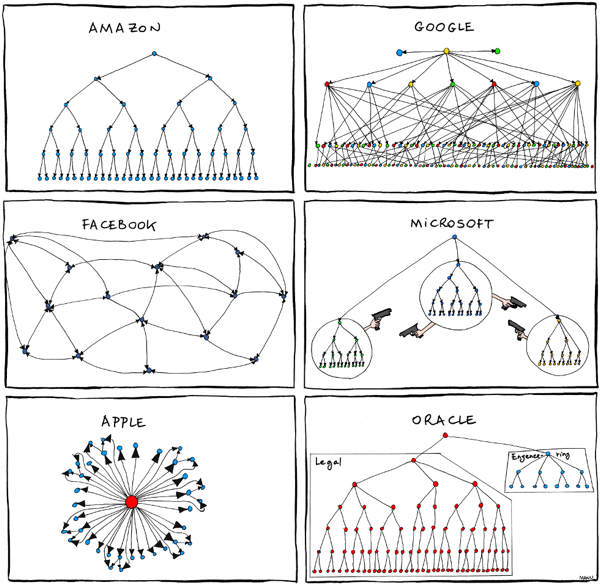
By vaylian 2026-03-0817:31 Obligatory comic: https://www.globalnerdy.com/wordpress/wp-content/uploads/201...
But they are still a tech company. So it is likely that this will also affect tech workers.
By pipo234 2026-03-0816:54 So glad to no longer be working for these clowns
By maxdo 2026-03-0817:00 Tech industry in its shape is dead anyways. How many companies / startups work is just to visualize data with some charts to help understand a bit.
How may companies are just some custom data collectors
You can continue , we are at double pivot now. Code is a commodity. Not oracle db , but oracle business department for sure . You can build the same on the fly and curated.
At the same time to support old system you need 10x less people .
We will look back on this AI bubble 10 years later and see that alongside with the private credit market, the funding of data centers via dubious methods (circular financing, billions of dollars of loans / debt) on top of mass layoffs for the sake of so-called "AGI" to cover up the massive losses will cause a market crash beyond the tech industry.
It just takes a single surprise to shock the market into chaos. My timeline is before 2030.
By cmxch 2026-03-0919:38 I just want to skip to the moment where we get affordable hardware again.
that is not much of a timeline and not much of a prediction. first you need to define what “crash” means in real terms. over the course of 4 years there will be market correction (especially after a bull run like we are on) so just saying “ai bubble, crash bla bla” is too lazy (although there are probably 10k+ such “predictions” on HN in the last say a year)
By wetpaws 2026-03-0816:53 [dead]
By adventured 2026-03-0817:145 reply Your response is over the top. Oracle isn't going to fire 30,000 employees to fund anything.
That's the story for Wall Street. Oracle went on a huge run in the market, that it did not deserve, and they're going to attempt to hold on to as much of that gain as they can. Wall Street will applaud slashing jobs if you can give them a good reason for it (and sometimes with no reason at all).
Amazon, Meta, Apple, Nvidia, Microsoft, Google are producing $700+ billion per year in op income. They have nothing else to spend it on. They will continue to fund a gigantic AI build out.
It does end well eventually, just as the dotcom era build-out ended well over the following decades. It ends with continued US dominance. Yes, the dotcom era saw a crash. The build out continued.
Browsers? The US won.
Ecommerce? The US and China won.
Search? The US won. China didn't win the search war, Baidu was supposed to be a serious global challenger to Google, that was widely hailed across tech circles as a known fact - it was inevitable. Nope. Google won. And Europe never did field a competitor at all.
China didn't win the smartphone war. Apple and Google won globally. Apple has produced trillions of dollars in profit on the back of that fact.
Cloud? China didn't even come close globally. The US won without any challenge at all. Europe never showed up. But but but Hetzner.
China didn't win the GPU war. Nvidia has the market, at least for this decade. That will produce over one trillion dollars in profit in just the next five or six years.
China didn't win the AI war. It was OpenAI's ChatGPT that shocked the world and set everything in motion. Now the US has the top three models in GPT, Gemini and Claude. Europe? Not even in the running (although they'd like to believe they are).
This all ends with the US remaining on top, with China as its only real peer.
Europe? There is no Europe in the equation, just as there wasn't for cloud or mobile apps or smartphones or personal computing.
Who cares about US vs. China. We're talking about jobs here and economy.
By righthand 2026-03-0817:28 Continued US dominance in what? Slightly better/faster Llms? What is that going to help us achieve? Better propaganda?
By kjkjadksj 2026-03-0817:34 I could not care less what nation the oligarchy I am beholden to lives in. Same end result for me in either case.
By butterbomb 2026-03-0818:01 [flagged]
By general_reveal 2026-03-0816:322 reply No.
At a national security level, the department of defense has already war-gamed mass unemployment. The defense sector would already have projected when the unemployment would happen and at what rate, I’m saying this to imply they had AI and judged its trajectory rather quickly awhile ago.
Data centers WILL happen, mass unemployment WILL happen, simply because, smarter people made it, assessed it, cannot deny it, and a large scale paradigm shift is occurring.
The data centers WILL get built (because the country needs it, don’t worry about why), AND you WILL get fired. Please await further instructions, thank you.
Try to stay in the same spot, oh, Covid helped with that remote work thing huh? See, this won’t be as painful as everyone thinks, it’s a nice smooth transition.
Edit:
I just want to add, the DoD is not going to let tech companies control the infrastructure of data centers either, too much of a security risk. So yeah, you better believe secret govt money is going to finance all of it, just like highways.
You’re welcome, now you don’t have to speculate.
By onlyrealcuzzo 2026-03-0816:075 reply We will continue to be told this is because AI is driving efficiency instead of that it's driving CapEx and investors won't tolerate FCF collapsing.
By hshdhdhj4444 2026-03-0816:195 reply I strongly believe AI will drive efficiency. I’m less certain about whether that’s already happening or will happen in the future and when in the future.
However, I’ve already seen a CTO of a F100 company explicitly state that whether AI is driving efficiency or not, the capital investment, and more importantly, the promises of efficiency to investors will mean some people will be let go.
Efficiency is output/input. The input is easy to measure. It’s cost and in this particular case salaries.
Output is a lot harder to measure, which means it can be fudged easily.
So you cut the easily measurable inputs and inflate the easily manipulable output.
One could imagine the reverse would also be possible, where you maintain inputs but inflate the output, but there is an asymmetry where investors will reward you for cutting costs even if there are no efficiency advantages that makes cutting inputs more sellable than inflating outputs.
> Output is a lot harder to measure, which means it can be fudged easily.
First and foremost, this is about Oracle. For the short period I worked there, my impression about culture and tech was: mediocre. Not excellent, not poor but just a around average.
Which raises the question: why is it such a successful company commercially? I believe it's being ruthless to customers, employees and suppliers combined with cooking the financials.
Which bring me to your remark about output being difficult to measure. Imho Oracle had been exceptionally good at manipulating and obfuscating their output. And this was true long before AI came to the scene.
By DebtDeflation 2026-03-099:50 > a CTO of a F100 company explicitly state that whether AI is driving efficiency or not, the capital investment, and more importantly, the promises of efficiency to investors will mean some people will be let go
That seems like an insane gamble to me. Lay off all the workers now and hope that AI can deliver on its promise to replace them some time in the indeterminate future.
By boringg 2026-03-0816:56 I think we wont know until the true costs for ai are revealed. Right now were still in the vc growth above all things part of the cost curve. It will get worse quality as revenue demands increase (as all products suffer).
It will be another dependency for all companies to bear. Hopefully significant gains for humanity, tbd
By gopher_space 2026-03-0817:401 reply … and in the background the next hiring wave slowly builds into a tsunami.
Sometimes I feel like the only person left who remembers the pre-dotcom vibe. OpenClaw etc. should have set off alarms that we are back in the land of the Quick and the Dead.
By AnimalMuppet 2026-03-0817:14 You don't even have to inflate the output. You just cut the dead weight, which reduces input without harming the output.
By alephnerd 2026-03-0816:11 In Oracle's case this is part of their larger Oracle Cloud strategy - once you remove the scooby doo monster mask you end up finding much of Oracle's AI spend was connected with their larger bet on Oracle Cloud and becoming a tier 1 hyperscaler.
This is why they landed one of the mega cybersecurity companies (the one who's name starts with C) as well as a globally distributed ridesharing businesses with sweetheart terms.
Oracle Cloud already represents 50% of Oracle's total revenue, and the AI story helps them justify that capex needed to fund their pivot into becoming a hyperscaler.
Everyone is holding their breath praying AGI either will, or will not, come before the chickens come home to roost.
By jollyllama 2026-03-1014:11 Except we're not, in this case. Oracle is not hiding the fact that the cuts are due to rising costs and expenses, rather than actualized efficiency gains. This is in contrast to everyone else, ex. Dorsey's block, who are putting a brave face on cuts, saying it's simply due to efficiency gains from AI. The question is: why are their statements being taken at face value?