
We like to believe effort is the great equalizer.
We like to believe effort is the great equalizer. But what if the most powerful factor shaping your financial future was decided before you took your first breath?
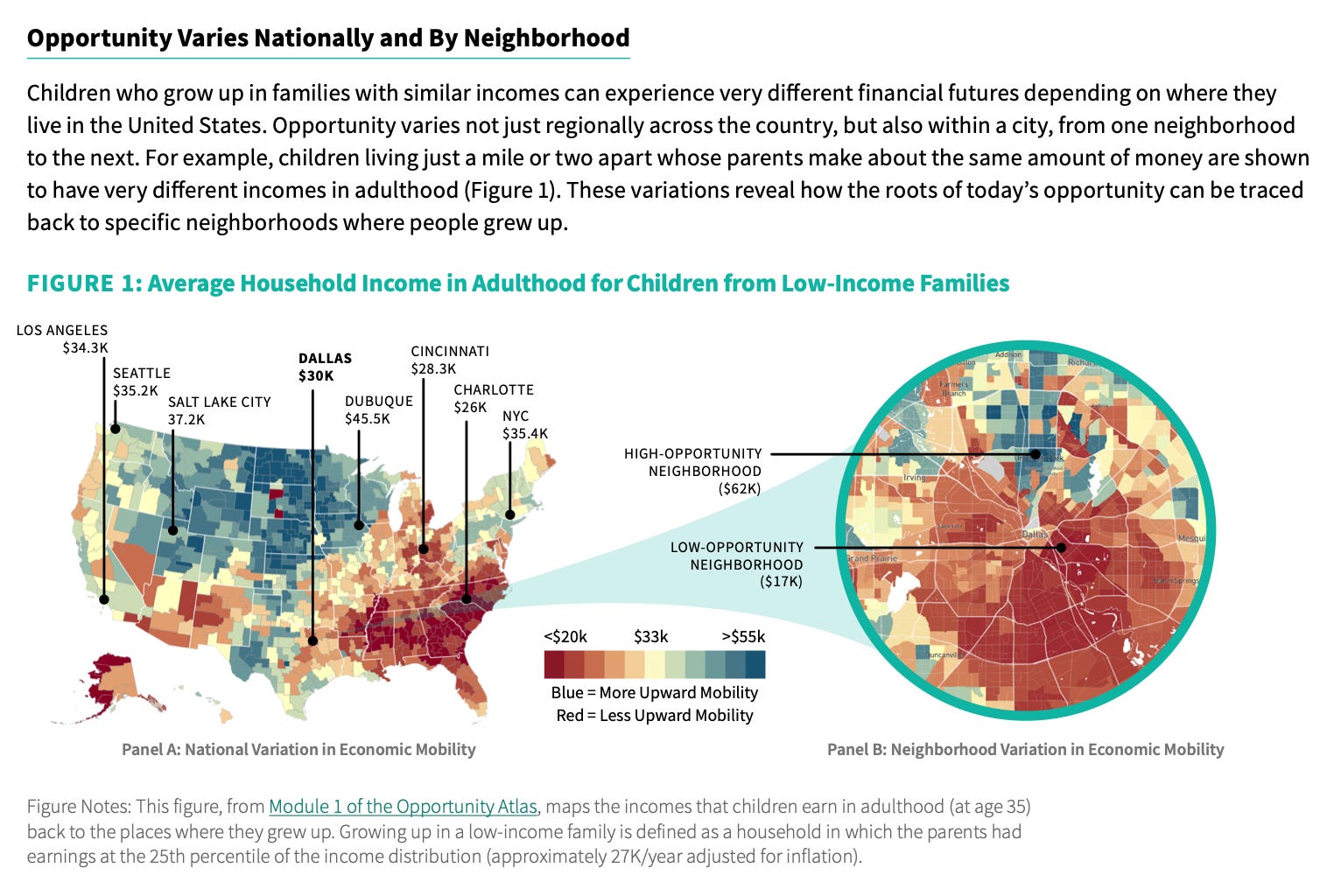
Here is a fact. Two children can be born in the same city, just a few miles apart, just in different zip codes. One grows up in a high-opportunity neighborhood with well-funded schools and adults who went to college. The other grows up in a low-opportunity neighborhood with concentrated poverty and underfunded schools. Years later, those two children are likely to have very different incomes and economic outcomes.
This is what the data shows. And it raises an uncomfortable question: how much of your success was determined by a geographical accident at birth?
The same question about opportunity applies globally. A child born in Norway has access to a world of free education, universal healthcare, and strong social safety nets. A child born in rural sub-Saharan Africa faces a very different starting line. Neither child chose their birthplace. But where they are born will shape nearly everything.
“ZIP codes may not be destiny, but where you start out and whom you grow up with matters tremendously.”
— RAJ CHETTY, HARVARD UNIVERSITY
The American Dream promises that effort determines outcomes. But a growing body of economic research says that geography, not just grit, sets your future.
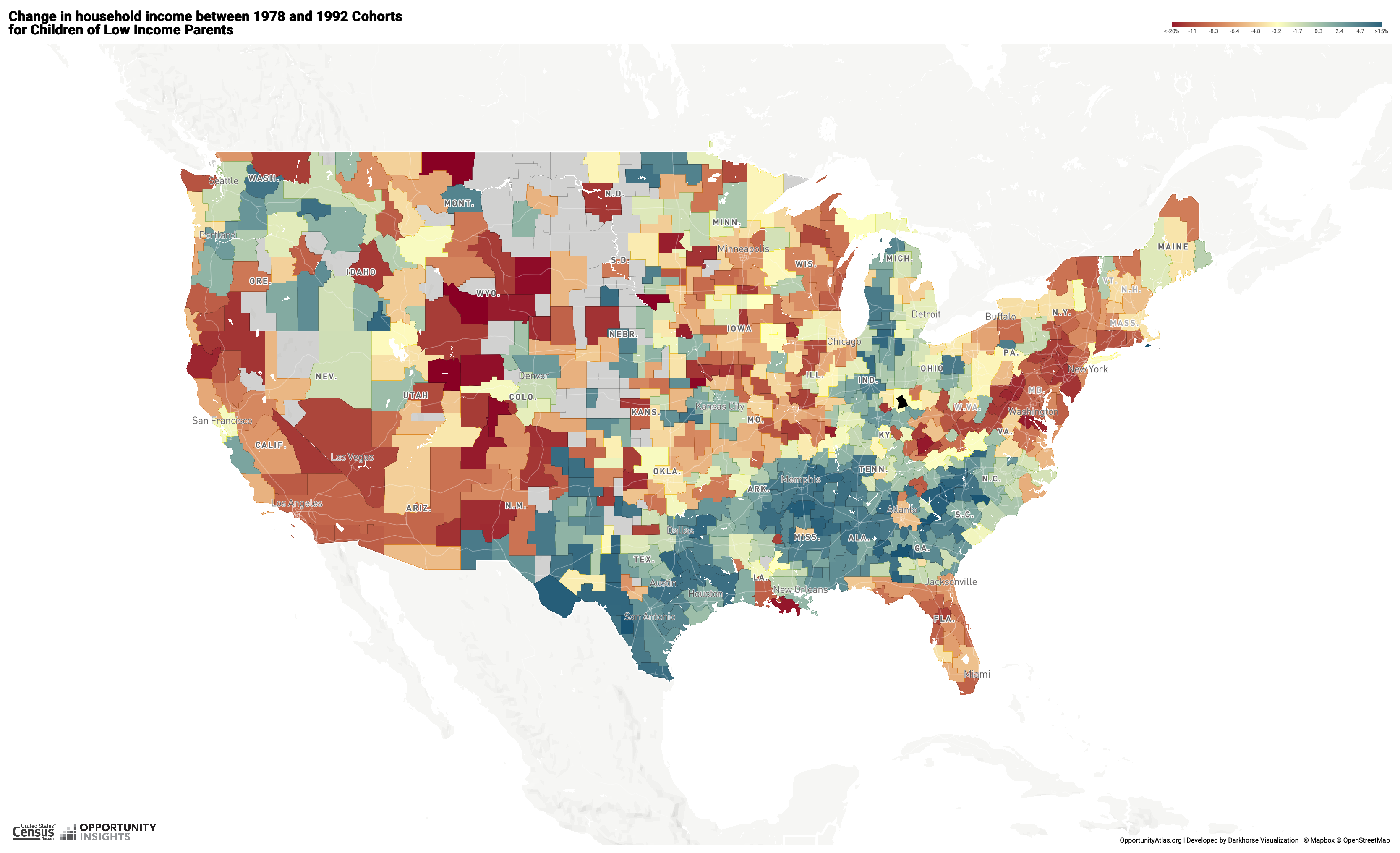
Harvard economist Raj Chetty has spent his career turning this question into data. His project, the Opportunity Atlas, uses anonymized tax records and census data following roughly 20 million children over their lifetimes. Their project provides an interactive map showing how children’s outcomes in adulthood vary by the neighborhood where they grew up, down to the census tract level.
The findings are eye-opening. For children whose parents earned around $27,000 a year, the standard deviation in adult household income across nearby neighborhoods exceeded $10,000. Two children from the same family with the same income could end up with very different financial lives in adulthood, simply based on where they lived as kids.
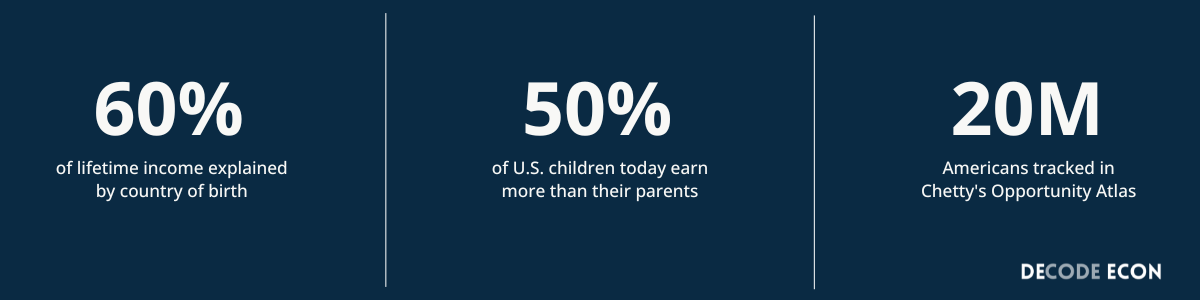
Roughly 60 percent of the variation in outcomes across neighborhoods reflects genuine causal effects of place — not just differences in the families who happen to live there.
Chetty’s team found that roughly 60 percent of the variation in outcomes across neighborhoods reflects causal effects, and the results are not due to selection. The neighborhood itself changes outcomes. Every extra year a child spends in a better neighborhood improves their long-run chances.
Economists explain this through the lens of human capital: the skills, education, and networks people accumulate over their lives. Where you grow up directly shapes your human capital. High-opportunity neighborhoods tend to offer better schools, more social connections with professionals, and stronger peer environments. Low-opportunity neighborhoods often lack all three.
Chetty puts it plainly, it is not always that students cannot afford college. It is that many have never met anyone who went to college. The environment shapes aspirations, and aspirations shape outcomes. In Los Angeles, his data showed that incarceration rates and adult income differed dramatically between neighborhoods just a few miles apart. The rent is similar, but the outcomes are not.
If a zip code matters this much inside one country, what happens when we look across borders?
Economist Branko Milanovic answered this by looking at household income data from 118 countries. He found that the country a person lives in explains more than half of the variation in personal income worldwide. His estimate: about 60 percent of your lifetime income is determined by your country of birth.
Milanovic calls this the “citizenship premium.” Being born in the United States carries a locational income premium of over 300 percent compared to someone in a low-income country at the same relative position in their national income distribution. With 96 percent of the world’s population remaining in the country where they were born, migration is not a realistic path for most people.
Chetty’s team found that 90 percent of children born in 1940 grew up to earn more than their parents. Today, only about half of all children do. The U.S. also lags behind Canada, Denmark, and several other wealthy countries on intergenerational mobility. The “Great Gatsby Curve” shows that more unequal societies tend to have lower mobility. The more unequal the starting line, the harder it is to climb.
This research is not a reason to give up on effort. Hard work still matters. But it is a challenge to how we tell the story of success in America. If the neighborhood you grew up in, the schools you attended, the adults you were surrounded by, and the country you were born in all shape your income in powerful ways, then we cannot explain economic outcomes purely through individual merit.
Success is not just earned. It is also, in large part, inherited through geography.
Here is what you can do with this knowledge:
Look up your hometown on the Opportunity Atlas. See how children from your neighborhood fared economically. It is often surprising.
If you are a parent, educator, or policymaker, Chetty’s research shows that moving children to higher-opportunity neighborhoods earlier in childhood produces the biggest long-run gains. Place-based policy works.
Globally, this is an argument for expanding immigration pathways and investing in international development. Global poverty is partly a geography problem, not purely a work ethic problem.
Every issue connects a real news story to a real economic idea in five minutes or less.
Read the original article

Comments
By CM30 2026-03-1310:01 Sure. And I'd say the culture of the country and expectations there probably play a part even between places with similar income levels.
For example, someone with a very entrepreneurial mindset is probably going to want to be born in the US, and ideally close to a city like New York or San Francisco. You can certainly make it as a founder in Europe or Asia or Australia or what not, but it's a lot easier to get the funding needed to become a household name in the former, since (at least for a while) there were companies and investors willing to throw a ton of cash at crazy ideas rather than a moderate amount at proven businesses.
Similarly, if you're particularly interested in a certain industry, you'll ideally want to be born in a country where said industry has a decent foothold. Video game developers are all over the world, but it's hard to deny your odds are probably better in that industry if you're American or Japanese.
By b3ing 2026-03-1312:32 You can see this even in the US. I know too many people stuck in places with few or no opportunities and moving up is hard because they age out or didn’t go to a big name university or work at big name companies. The bias is there
By liampulles 2026-03-139:393 reply The economic divide is very apparent here in South Africa, and it leads to perverse effects on our infrastructure.
As the country's ability to provide basic utilities falters, sufficiently wealthy households go partially or completely off grid, depriving revenue for the utilities and further exacerbating the problem.
By dzonga 2026-03-139:56 yeah given that HN audience might be mostly from 1st world countries
in the 3rd world - north of Limpopo - and everywhere else - you discover soon that where you born is like being 60 points down with a 2 min warning and you're in your own end zone.
where you are born matters more than your own talent etc by a factor of 10
It seems like a lot is being left out. What is considered sufficiently wealthy and why are they going off grid?
By liampulles 2026-03-1312:45 > What is considered sufficiently wealthy
What you might consider "middle class", suburban households, and up. These "upgrades" are something that you can roll into your mortgage.
> Why are they going off grid?
Electricity and water availability issues.
For example, I live in an area where water is unavailable between days and weeks, every few weeks. The systemic issue in my municipality is that they have not kept up with the maintenance of water pipes, which means a significant portion of water pumped from the national provider is lost via leaks. Thus when some pumps and reservoirs go offline due to power disruptions, the loss of flow can lead to no water in higher lying areas that takes time to restore.
There are private solutions to this - the most affordable option is to install a big water tank on your property that in affect acts as a water battery. A more expensive solution is to install a borehole on your property, and to draw water from the water table (this might make sense for a complex, or a rich household).
By happymellon 2026-03-1311:56 https://en.wikipedia.org/wiki/South_African_energy_crisis
Not OP but it's because there are rolling blackouts.
> What is considered sufficiently wealthy
Ability to afford your own solar. A lot of South Africans can't, and with prices increasing 100x over the past 20 years, it makes it difficult to get out of that poverty.
By lunar-whitey 2026-03-1315:42 Likewise for school districts in wealthier areas of the United States.
