
Our biggest social flaw should be addressed
Two weeks ago, on the blue line to O’Hare, my car had two men smoking joints, a broken woman, her eyes dilated and blank, sitting in a nest of filthy bags smelling of sewage, and a man barking into the void, shirtless, who was washing himself with flour tortillas, which would disintegrate, littering the subway floor, before he took out another and began the same process. This didn't shock me, or anyone else around me, since I'd seen some variation of this dystopian scene on every Chicago metro line I'd ridden, every pedestrian walkway I'd passed through, and on most street corners.
Three weeks ago, in Duluth, half the riders on every bus I took were mentally tortured and/or intoxicated. The downtown Starbucks, pedestrian malls, and shuttered doorways of vacated buildings all housed broken people. Same in Indianapolis, El Paso, New York City, Jacksonville, LA, Phoenix, and almost every community I’ve been to in the U.S., save for those gated by wealth.
An epidemic of mental illness and/or addiction plays out in the U.S. in public, with our streets, buses, parking lots, McDonald’s, parks, and Starbucks as ad hoc institutions for the broken, addicted, and tortured.


That is not the case for the rest of the world, including where I am now, Seoul. My train from the airport was spotless, and so is the ten-mile river park I walk each day here, which given that large parts of it are beneath roadways is especially impressive. In the U.S. it would have impromptu homes of tents, cardboard, and tarps, smell of urine, and the exercise spots that dot its length probably couldn’t exist because of a fear of being vandalized.
You can learn more about the U.S. by traveling overseas and comparing, and five years of that has taught me we accept far too much public disorder1.
We are the world’s richest country, and yet our buses, parking lots, and city streets are filthy, chaotic, and threatening. Antisocial and abnormal behavior, open addiction, and mentally tortured people are common in almost every community regardless of size.
I’ve written about this many times before, because it is so striking, and it has widespread consequences, beyond the obvious moral judgement that a society should simply not be this way.
It’s a primary reason why we shy away from dense walkable spaces and instead move towards suburban sprawl. People in the U.S. don’t respect, trust, or want to be around other random citizens, out of fear and disgust. Japanese/European style urbanism—density, fantastic public transport, mixed-use zoning, that so many American tourists admire—can't happen here because there is a fine line between vibrant streets and squalid ones, and that line is public trust. The U.S. is on the wrong side of it. Simply put, nobody wants to be accosted by a stranger, no matter how infrequent, and until that risk is close to nil, people will continue edging towards isolated living.
It is why we “can’t have nice things” because we have to construct our infrastructure to be asshole-proof, and so we don’t build anything or build with a fortress mentality, stripping our public spaces down to the austere and utilitarian, emptying them of anything that can be vandalized.
The canonical example of this is La Sombrita, the laughably expensive Los Angeles “bus stop” that was a single pole to provide shade and security lighting, but did neither. La Sombrita exists precisely because it doesn’t do anything, which is the end result of a decades-long process of defensive construction. If you build a nice bus stop it is either immediately broken or turned into shelters for the destitute, and so you stop building those2.


Another nice thing we don’t have in the U.S. is public restrooms. We don’t have them out of a justified fear of abuse, which is the same reason many Starbucks lock their restrooms. McDonald’s does this as well, depending on the location, and also even strips them of mirrors in the especially bad communities, to discourage people from using them for an hour-long morning toilet, as well as breaking the mirrors just for the hell of it.
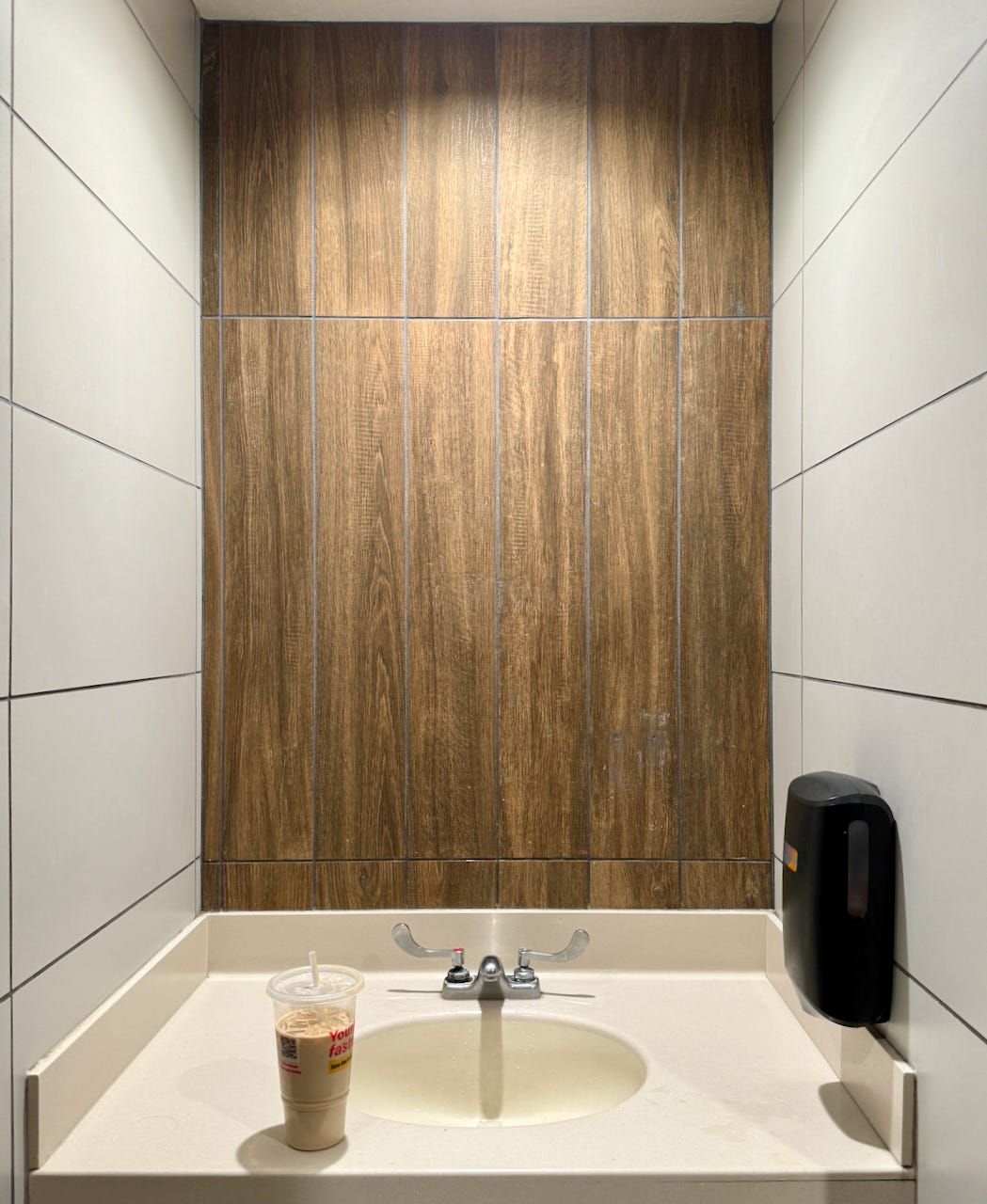
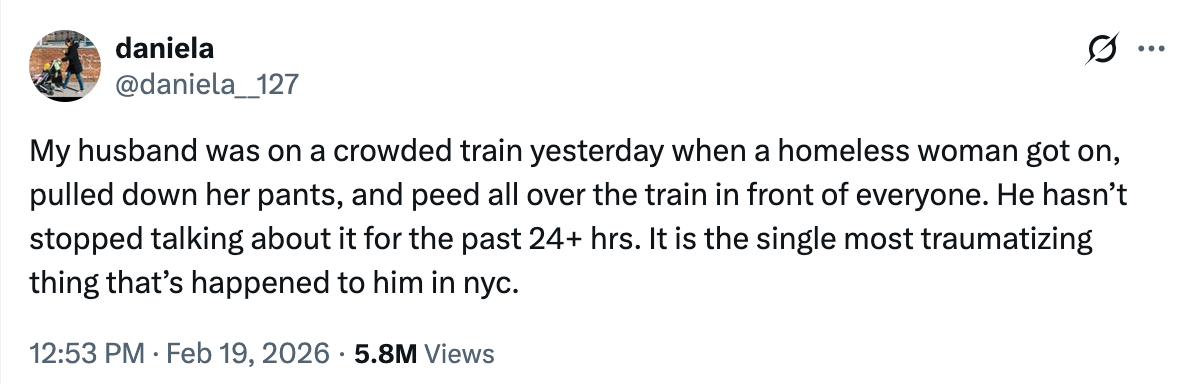
This lack of public restrooms became an issue on Twitter when the latest round of debate about disorder in the U.S. was kicked off when a tweeter noted how offensive it was to have seen someone urinating in a crowded New York subway car.
This debate brought out a lot of absurd arguments, mostly from those trying to shrug it off or suggest it was simply the price of living in a big city3.
No, the rest of the world doesn’t tolerate the amount of antisocial behavior we in the U.S. do. If someone were to piss on a subway anywhere else in the world, and very very few ever would want to (more on why below), they are removed from society for a period of time.
We however let people who aren’t mentally competent continue to engage in self-destructive and aberrant behavior without removing them, which consequently ruins it for everyone else, except those wealthy enough to build their own private islands of comfort.
Someone peeing on the subway is not of sound mind, and it isn’t normal behavior by any measure. It’s a sign of distress that should cause an intervention—by police, social workers, whoever—that mandates them into an institution for a period of time, until they regain sanity and stability. For someone actively psychotic —civil commitment to psychiatric hospital. For violent individuals refusing treatment—secure prison facilities with mandatory programs. For severe addiction—medical detox and residential treatment without the ability to walk away.
They should not be allowed to do whatever they want because they cannot control themselves enough to have that freedom. Someone shouting at strangers, someone washing themselves with flour tortillas, someone punching at the air voicing threats shouldn’t, for their own safety and others, be out roaming the streets.
It isn’t fair to the public, especially the working people who have to deal with them on a daily basis. It isn’t fair to the person themselves. The idea that it is empathetic to allow someone to suffer on the streets tortured by their inner demons, covered in filth, high as a kite, is so backwards and immoral that I cannot believe that the activists and politicians who support it have spent any time around these people. They need help, and if they don’t accept it, then you must force them to get help.
I’ve been very careful up to now not to use the word homeless, because it’s become an overly broad category that covers families in motels with Section 8 vouchers, people sleeping on friends’ couches until they can get back on their feet, mothers with children in long-term shelters, and then those who live in tents under bridges or sleep in a soiled sleeping bag.
Eighty-five percent (or so) of those in this broad category are not causing problems. They are, like most everyone else, doing their best to get by and better themselves. Sure, they have more complicated and chaotic lives than most, but they try to play by the rules as best they can.
Our problems in public spaces come from the fifteen percent or so who fall into the last group—the stubbornly intransigent—which are people who have options for housing but turn them down for a variety of reasons, some driven by mental demons, some by an overwhelming desire to always be on drugs, some simply out of preference to be alone. Others in this category have been ejected from housing because of continual violent and threatening behavior.
They are not, by almost any metric, of sound mind, and shouldn’t be granted the full privileges other citizens have.
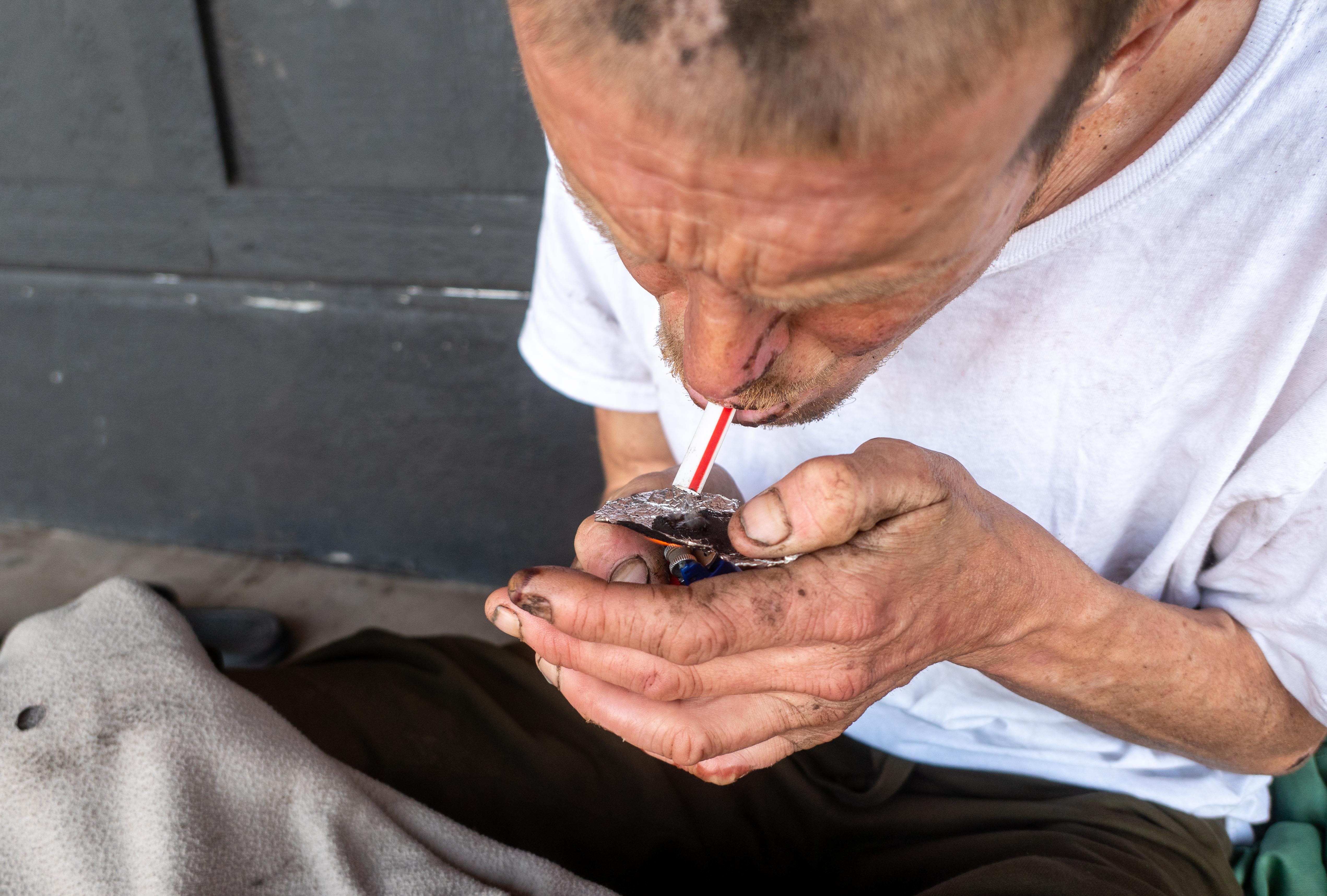
The cover photo is John, and he is in this category. He had set himself on fire the day before I met him, freebasing a perc 30, and refused to go to the hospital because he didn’t want to lose his favorite spot behind the garbage bin, since it was only a block away from dealers and perfect to piss in. He had a government room he didn’t use because catching on fire (something he did every now and then) set off smoke alarms. He also thought it was cursed and monitored by the same people who had held him captive on an island in the middle of the Pacific—an island he escaped from three months before by swimming the four hundred miles. He showed me an arm, covered with burns, that he claimed was where a shark had bit him.
John should be mandated into a prison, a mental institution, or a rehab clinic, until he is competent enough to be on his own, not out on the streets in mental and physical pain, setting himself on fire. It is as simple as that, although I understand a change like this comes with additional nuanced policy debate. As for costs, it is more a question of redirecting what we spend rather than finding additional money, because we already spend an immense amount on this problem—the New York City budget for homeless services is four billion—without 'solving' it
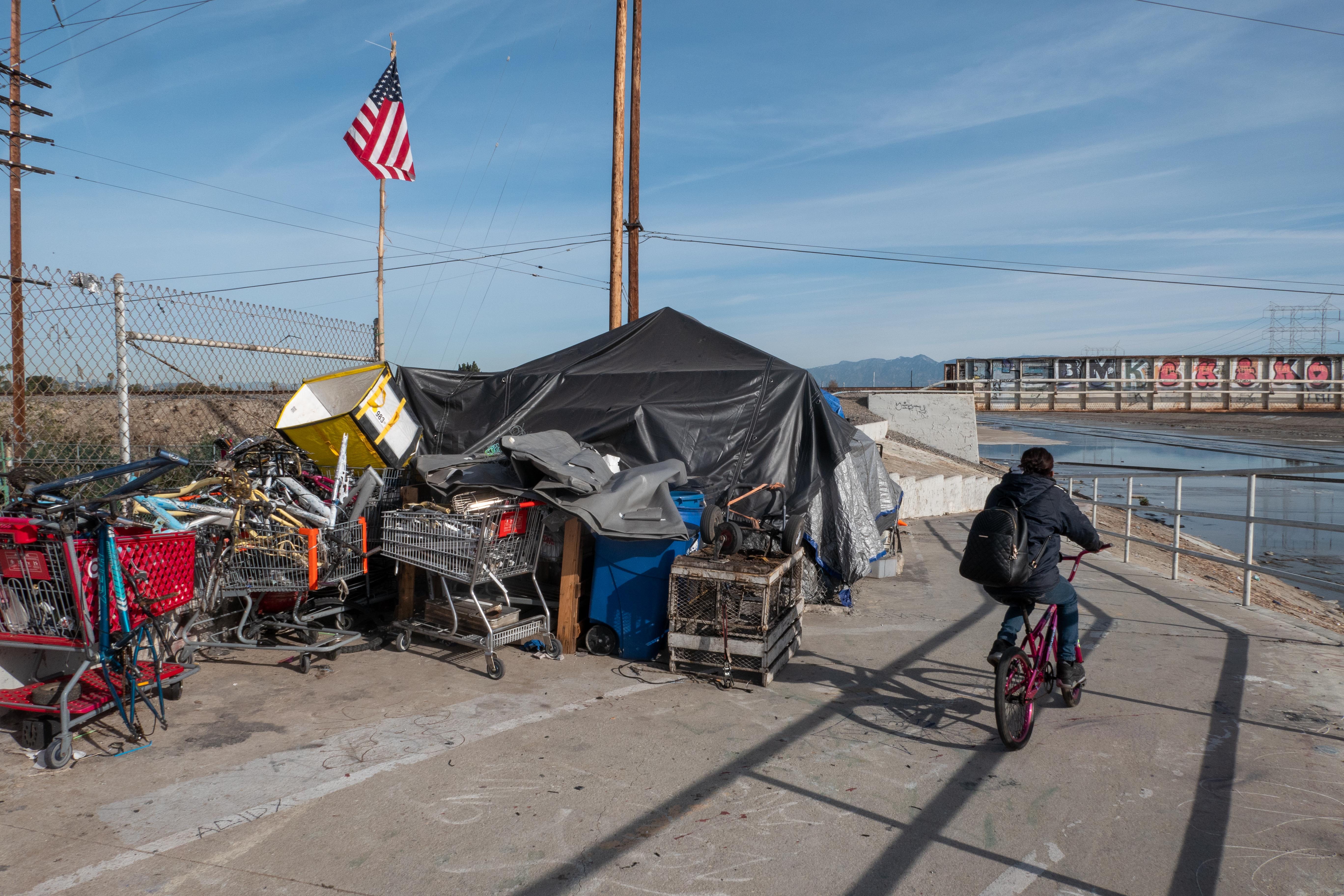
Even if you put aside the destruction this type of behavior has done to broader society, and your concerns are only focused on the health and welfare of the stubbornly intransigent, then our current system is still deeply wrong. We are not providing them justice by allowing them to choose a public display of mental misery, where the self harm they can do is far greater than when being monitored.
Beneath all this discussion is the additional question of why we in the U.S. have so many mentally unstable people, why so many are addicted to drugs, why so many people are OK with doing shocking things.
I walked twelve miles through Seoul yesterday, and I saw zero destitute people. Certainly no homeless. I did see the same group of drunk men I always see, playing cards near the river, because Koreans drink an immense amount, but as far as daytime drunks go, their behavior was exemplary. When they had to piss, they walked the two hundred yards to the bathroom, which they left as clean as when they came. When they threw away their empty bottles, they collected them and walked it to the trash can, even putting them into the correct bin.
Almost no Korean, as in not a single one, even the drunks, would ever think of peeing on the metro, even if they could somehow get away with it.
That they'd be punished is part of why they don't do it, but there's a chicken-and-egg problem: Which came first, the culture or the enforcement? Koreans are raised to be good citizens and not break rules, with public shame as enforcement. Legal consequences exist, but culture does most of the work, so laws rarely need enforcing.
The U.S. has a different model that emphasizes individuality over the communal, with our thick culture focused not on being a good citizen first, but finding our true self and exploring that, and hopefully making a lot of money along the way — Koreans are citizens, we are entrepreneurs. That is one of our greatest strengths, and has served us well economically and artistically, and it is why so many Koreans find the U.S. liberating and refreshing4.
Yet a result of the American model is a wider distribution of behavior, including fatter extremes, with a far larger amount of people prone to antisocial tendencies, and I would argue, mental illness. Some people need strict social guidelines, and without them, they can literally go crazy. We don’t have that.
If our elevated levels of addiction and mental illness are consequences of our culture of individuality, as I believe they are, then we have a moral responsibility to take them off the streets and care for them — for those broken by our celebration of freedom, like John, and more importantly for the working people navigating around them.
The empathetic way to do that for everyone involved, is the opposite of our current policy, and means mandatory treatment for the severely mentally ill, enforced norms in public spaces, and legal consequences for abnormal and threatening behavior that actually have teeth.
Because it is the just thing to do, for all of our society.
We can have nice things, we just have to decide we deserve them.
PS: Sorry this was late, but I’ve been dealing with jet-lag and continual dental problems. I hopefully leave tomorrow for Qingdao, if I get clearance from my dentist.
Read the original article

Comments
By khelavastr 2026-03-141:09 Many Americans knowingly build unacceptable structures which instigate action against their reckless creators. That's something culture is dealing with step by step.
By khelavastr 2026-03-141:08 Homeless people are usually disabled. Building against homeless people is building against the disabled. People who advocate for this align with neo-Nazis against the disabled...
