
qzira
10
Karma2026-02-27
CreatedAbout Me
Solo founder in Japan. Running AI agents in production for content automation. Built qzira (AI API gateway) and DataGate (secure file transfer). Always thinking about infrastructure over application logic.
Recent Activity
1 points0 commentsqzira.com
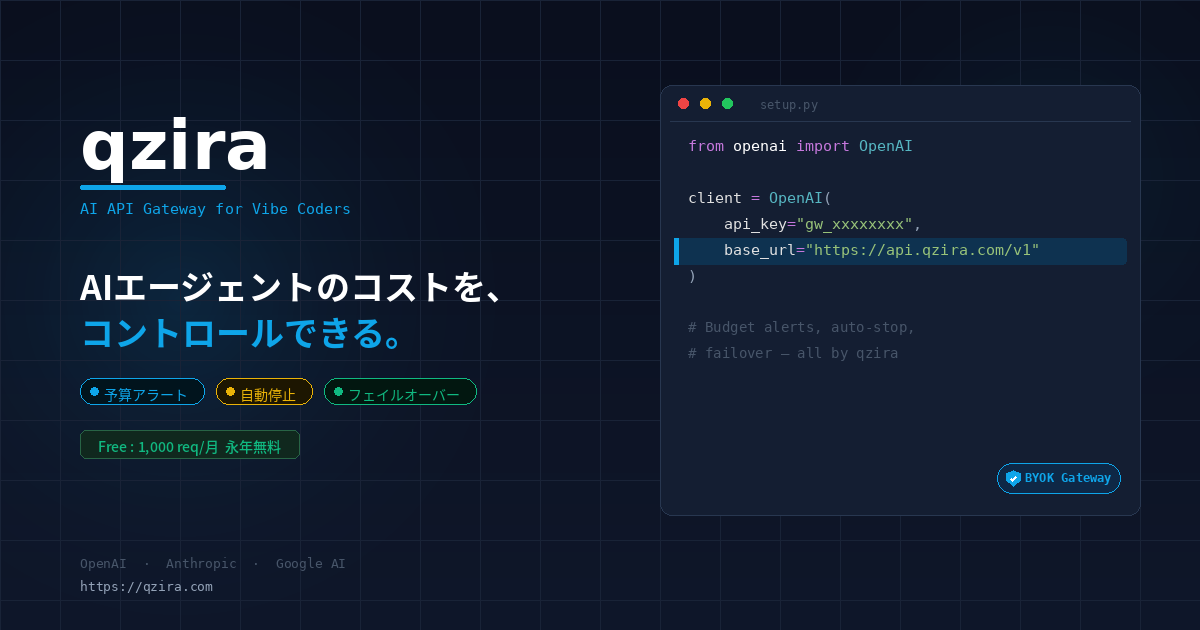
Set spending limits for OpenAI, Anthropic & Google AI. Auto-stop when budget hits zero. BYOK. Free plan, no credit card.

That's a very real concern. For a long time programming felt like a craft: you build something, run it, improve it. Agent workflows introduce a different kind of work. You're not just building anymore, you're supervising. Some people enjoy that shift toward orchestration. Others really don't. I suspect we'll eventually see tools that try to restore the "build and run" feeling instead of turning developers into supervisors.
That's a really good analogy. The interesting part is that the "intern" is not only fast, but also extremely confident. A human intern usually hesitates, asks questions, or signals uncertainty when they are unsure. Agents often produce very clean-looking output even when the reasoning behind it is shaky. So part of the supervision isn't just checking the result, but trying to detect when the confidence is misleading.
I think a lot of people feel this tension. Programming used to be mostly about building things directly. You write code, run it, fix it, repeat. With agents it starts to shift toward supervision: define the task, watch the output, correct the drift. It's a different kind of work. Sometimes it feels less like programming and more like managing a very fast team that never gets tired but also never really understands the goal unless you spell it out extremely carefully. I suspect a lot of developers still enjoy the "building" part more than the "supervising" part.
When people talk about AI increasing developer productivity, they usually focus on the coding part. In my experience, the bigger change happens after the code is written. When you move from writing code to supervising agents, your output increases — but your cognitive load increases too. Instead of writing every line yourself, you're now monitoring systems: Did the agent go off-script? Did it retry 50 times while I was asleep? What did that run actually cost? The strange part is that the mental burden doesn't disappear just because the agent is autonomous. In some ways it gets worse, because failures become harder to notice early and harder to contain once they start. It starts to feel less like programming and more like running operations for a team of extremely fast, extremely literal junior developers. Curious if others are seeing the same shift.
HackerNews
About this project
This project is an enhanced reader for Ycombinator Hacker News: https://news.ycombinator.com/.
The interface also allow to comment, post and interact with the original HN platform. Credentials are stored locally and are never sent to any server, you can check the source code here: https://github.com/GabrielePicco/hacker-news-rich.
For suggestions and features requests you can write me here: gabrielepicco.github.io
