Humans have been writing sounds as coherent symbols for over 5500 years, which is a long time to be sure, but as a race it has been suggested we have been around for over 150,000 years; so what did we…
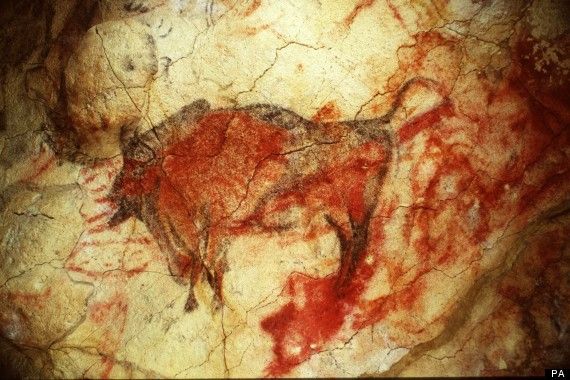
Humans have been writing sounds as coherent symbols for over 5500 years, which is a long time to be sure, but as a race it has been suggested we have been around for over 150,000 years; so what did we do with all that? Before a written language was devised the only way to leave messages of warning or preserving stories would have been to create a series of pictures that could be simply drawn and easily deciphered, basically drawing would have been the predominant form of documentation. Evidence suggests that the human race has been using drawings to detail events, religious ceremonies, animals, people, etc. from as far back as 38,800BC, when cave walls were the canvas of choice.
Since then drawings and artistic illustrations have been ever dear to our hearts, and those who have been able to draw for the purpose of recording events and later on for artistic value have always been held in high esteem. Drawings and to an extent writings have been done throughout the ages with a number of different materials such as paints and inks made from crushed minerals, charcoal, ashes, dirt and slate, but all had their pit falls.
Graphite, the material used in pencils today, had been used in drawings since as early as 4BC when it used as one of the minerals involved in creating paint, and evidence suggests that it was also used by the Aztecs as markers several hundred years before its use became widespread. At some point in the 1500’s an enormous graphite deposit was discovered in the north of England, in Cumbria, and the natural deposit was used by the locals for mundane purposes, such as marking their animals, but it did not take long for others to hear about it and start mining it more seriously.
Early Pencils
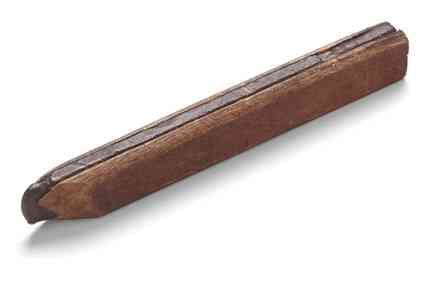
Because of the way it was used to mark animals when the deposit was first discovered people knew the material would make a good tool for writing and drawing. It was due to this that in 1789 graphite actually got its name, which comes from the Ancient Greek word graphein meaning to write or draw. In 1795 what we would now recognise as a modern pencil was created when a French scientist and military officer encased sticks of graphite and clay in a wooden case.
| 9H | 8H | 7H | 6H | 5H | 4H | 3H | 2H | H | F | HB | B | 2B | 3B | 4B | 5B | 6B | 7B | 8B | 9B |
| Hardest | → | Medium | → | Softest |
Going back to an earlier point, when the graphite was discovered the English thought they had unearthed a lead deposit, a misunderstanding caused because lead and graphite look uncannily similar in their natural form. It is because of this prevailing thought that the pencil was known as the lead pencil, a name that has endured until today. The English were not the only ones to make this mistake and in Arabic, Gaelic and German the word for pencils all mean Lead Pen.
Modern Pencils
Nowadays pencils are still made in a very similar manner to the way Conte made them, a mixture of graphite and clay crushed into a powder, mixed with water, shaped and then heated in a kiln. The mixture is then dipped in oil or wax to help create a more fluid writing motion when the pencil is eventually put to paper.At no point however has lead ever been used as the writing material in pencils, but lead based paint was used until the middle of the 1900’s as the pencils outer coating. This would have caused serious health issues if the pencil was ever chewed on or sucked, as bits of lead would be able taken into your body and absorbed. Inaccurate reports from the media did not help to stem the belief that the lead was in the coating not the pencils, and only served to reinforce the incorrect stereotype.
A Few Facts
- The word Pencil is partially derived from the Latin word Pencillus, which means ‘little tail’.
- Conte was ordered to find an alternative to graphite, as the French could not rely on foreign imports from England. Fortunately clay and powdered graphite were accessible in France.
- Conte was also the person who introduced the letter and number system to indicate the ‘Hardness’ and ‘Blackness’ of the pencil.
- The ratio of graphite to clay influences the pencils strength, the more clay the harder.
- Pencils were used in aeroplanes before the ballpoint pen was invented, because fountain pens leak ink at high altitudes. Click here for more details.
- Pencils were never used in space by the Russians or anyone else. Using them would risk having shards or shavings of graphite and clay floating around, potentially causing damage.
Read the original article

Comments
I remember in like 4th grade I stabbed myself in the leg with a pencil on accident and snapped a piece of the "lead" off in my leg.
My brain spiraled for weeks thinking I had essentially poisoned myself and would be dying shortly.
Finally told my parents, who said "okay lets go talk to the doctor" who, very sweetly, told me that little piece of graphite in my leg would cause essentially no harm.
It's still there, a little blue-ish dot under my skin.
I too was stabbed in grade school; twice actually, in the same hand. I think both times for pestering girls as they were writing, lol. I guess I deserved it.
Both left visible gray marks under the healed skin...one on a finger and the other in the soft tissue between my thumb and index finger. Years later, in my 30s, I was handling some super strong magnets and felt tugging on the tissue next to my thumb, indeed that magnet was pulling strongly on that piece of embedded graphite. I thought that was strange because either the graphite had impurities of iron in it or my body had accumulated iron around it.
Some years later I would develop random knuckle pain in a couple of the nearby fingers. I was skeptical that this foreign object was to blame...but I convinced a doctor to do some minor in-office surgery to remove it. The doctor made an incision and using forceps tried to find and pull it out. He couldn't find it (which he initially warned me about and suggested ultrasound guidance) and asked me to get out my magnet and pull the object up...his forceps immediately snapped to the magnet, I didn't flinch but was laughing internally. He grabbed the object, which was probably half the size of a sesame seed...much smaller than what he was expecting based on the amount of tissue that was being pulled up by the magnet.
Months would pass and I no longer had pain in those knuckles, that was probably 5 years ago. The other stab mark, which is on a different finger, never caused any issues.
The nurse afterwards said, "I cannot believe you did that." I chuckled.
I can now say that I've assisted in my own surgery ;-)
By 0_____0 2024-04-020:47 What caused the graphite fragment to be ferromagnetic?
By cancerhacker 2024-04-0118:132 reply I have the same thing in the palm of my hand - was bumping a pencil along a wall, also in fourth grade, ish. I knew it was graphite and wouldn't hurt me, but I was too afraid of it hurting to winkle it out, and it just healed over.
I spent some time puzzling over what "winkle" might be a typo for before realizing it was a British verb I was unfamiliar with:
"chiefly British : to displace, remove, or evict from a position"
Apparently the etymology is the periwinkles are difficult to remove from their shells: https://www.merriam-webster.com/dictionary/winkle
By dtgriscom 2024-04-020:00 "She's horribly good at winkling."
https://getyarn.io/yarn-clip/7a2639f3-cf03-4223-bc46-5ae44b5...
By Arrath 2024-04-021:48 As a child I was walking through my room and stepped on a fallen pencil, it rolled under my foot in just the right way: it shot out and stabbed me in the ball of my other foot!
Most random thing, and I've still got the dot these 30 years later.
By timmg 2024-04-0119:54 I have almost the exact same story. Except my older sister freaked out about me potentially having "lead poison." She called my *nurse* mom at work. Mom said it would be fine and she'd take a look when she got home. Mom was pretty old-school, fwiw :)
I still have the blue dot next to my knee.
Once upon a time I was stabbed in the knee with a pencil. It's still there 30+ years later. Both the knee and the pencil mark. It doesn't hurt at all.
By doubled112 2024-04-0120:32 I have a pencil stab wound from grade school as well. Apparently there are many of us pencil stab victims.
The same girl came at me with scissors later on but she wasn't as successful that time.
I’m an outlier in the HN crowd - I was the stabber, not the stabee.
Sorry Ben!
By brnaftr361 2024-04-023:35 Same, though on both counts it was totally unintentional.
Sorry, Logan.
By sublinear 2024-04-023:18 You're not an outlier. #thuglyfe
By GolfPopper 2024-04-024:461 reply I was stabbed with a pencil in the arm in 4th grade, tip broke off. Had the little gray-blue dot in my arm for years. I could feel it if I poked at it, which I eventually stopped doing. I'd check it, or show it to someone every once in awhile. Sometime in 40s, I went to check it and it had disappeared.
By HnUser12 2024-04-025:30 I recently learned that there’s a subreddit dedicated to this. r/pencilStabbers.
I've got a blue mark in the palm of my hand from where it was stabbed in maybe 1st or 2nd grade. I don't think I actually left a piece of pencil in there ... I think perhaps the skin was colored grey and just stayed that way?
By userbinator 2024-04-021:50 Even if it was real lead, I doubt you'd suffer much in the way of health effects either.
By kbelder 2024-04-0123:32 My older brother jammed a pencil into an old-school dart gun and fired it at me, tagging me about half an inch to the right of my eye. Left the same permanent blue dot.
Semi-permanent, actually; it faded after a couple decades. Probably wormed it's way into my brain. Sometimes I'm shocked I'm still alive.
I wanted to know when pencil leads stopped by made of lead, and was surprised to learn that they never had been:
Going back to an earlier point, when the graphite was discovered the English thought they had unearthed a lead deposit, a misunderstanding caused because lead and graphite look uncannily similar in their natural form. It is because of this prevailing thought that the pencil was known as the lead pencil, a name that has endured until today.
My understanding had always been that there were never pencils where a rod of lead was encased in wood.
However, in the Roman times, styluses were used for writing which were just sharpened rods of lead. Right or wrong, I pinned the etymology on that and didn't give it another thought.
How can we be sure that someone's knowledge of those Roman-era instruments didn't influence the etymology of "pencil lead", in spite of the story about the graphite deposit?
There are missing dots in the short explanation. I mean, between the time you discover a graphite deposit (thinking it might be lead) and the time you go to production with graphite pencils, you know very well that you're not dealing with lead. You would only persist with the naming as a deliberate inside joke. If so, who can say that the joke wasn't informed by historic knowledge of lead styluses?
As tools for writing, normal styluses and lead rods, which were both used in Roman times, are distinct.
A "stilus" (the modern spelling of the words "stylus" and "style" is a mistake, which was frequent when Latin words had been assumed to be Greek words with Modern Greek pronunciation) was a metal rod that was used to write on wax tablets. The Romans called it either "stilus" or "graphium", the latter form being directly borrowed from Greek. The Latin words "stilus" and "tabella" were used to translate the Greek words "graphion" and "deltos". The Greeks have learned to use wax tablets from the Phoenicians ("deltos" is a Semitic word) and the Romans have learned to use them from the Greeks.
The wax tablets were the main method for writing texts that could be erased later.
Besides such metal styluses that were used for writing by pressing soft materials, there existed a second kind of styluses, made of true lead metal.
This second kind, which was much less common, is based on using a soft metal and a slightly abrasive tablet surface. Drawing with such a soft metal stylus leaves a trace of metal, exactly like drawing with a graphite pencil. For instance Pliny the Elder mentions such cases of using true lead rods for drawing, e.g. for drawing fine lines on a surface to guide the writing with ink on it, like the printed lines in some modern notebooks.
Suitable soft metals are lead, silver, gold and platinum, but lead has always been many orders of magnitude cheaper than the others, so it has been frequently used for this purpose before the discovery of graphite.
Graphite is softer than any of these metals, so it leaves much more visible traces, even without using a great pressure during writing. The metal styluses leave much finer traces than graphite, so they are less suitable for writing a text with good visibility, but they allow better control for fine details in drawings.
While after graphite began to be used for pencils it immediately replaced most uses of soft metal styluses, the latter have remained popular until today for certain kinds of artistic drawings, the so-called metal-point drawings.
The most popular metal for artistic drawings is silver, because it is much cheaper than gold or platinum, while producing higher-quality drawings than lead , graphite or charcoal.
There are many such silverpoint drawings that are very beautiful.
By hinkley 2024-04-0117:45 You have forgotten another form of carbon - charcoal. It’s not much used for writing, but it does have a niche with artists.
The lead shadows of Pliny the Elder are similarly used by artists to do rough drafts before committing pen to paper. Particularly cartoonists, prior to photoshop layers.
By somat 2024-04-029:52 Fairly obvious in retrospect, however I never put the two together until I read your post. but the stuff is called "graph"ite, that is, the stuff you write with. boom, mind blown.
By kwhitefoot 2024-04-0116:33 > You would only persist with the naming as a deliberate inside joke.
Or you simply use it because then people will immediately understand what it is for?
By JumpCrisscross 2024-04-0116:151 reply > because of this prevailing thought that the pencil was known as the lead pencil, a name that has endured until today
Wait, so we didn't realise graphite and lead were different substances until after pencils were invented? Yet we never took that mix-up to the point of putting lead in pencils?
By oakashes 2024-04-0116:33 It didn't make any sense to me either. I found this article[1] which frames it a little more clearly: it's not that they thought graphite and lead were the exact same thing, it's that they thought graphite was just a particular type of lead that was useful for drawing when first discovered.
1: https://www.washingtonpost.com/lifestyle/kidspost/ever-wonde...
By hackernewds 2024-04-024:13 that's good. because I've definitely eaten my fair share with my friends when we were kids. we used to have those cool ones that you click on the end and a sharp thin cylinder of 'lead' comes out. they were crunchy and entertaining at least
By kitd 2024-04-0119:07 There is actually a (very interesting) Pencil Museum in Keswick in the Lake District, UK, near where those first graphite deposits were found. One fact I learnt was that early on, due to its usefulness and scarcity, it became a hugely valuable commodity, transport had to be done in secret or under guard, and the mine owners became extremely wealthy.