
The greenback is down more than 7% this year, and Morgan Stanley predicts it could fall another 10%.
The US dollar is on track for its worst year in modern history and may not be done falling yet. The greenback is down more than 7% this year and Morgan Stanley predicts it could fall another 10%. A weaker dollar could make US exports more competitive, boosting Trump’s plan to rebalance US trade, but makes imports more expensive, adding to the sting of tariffs.
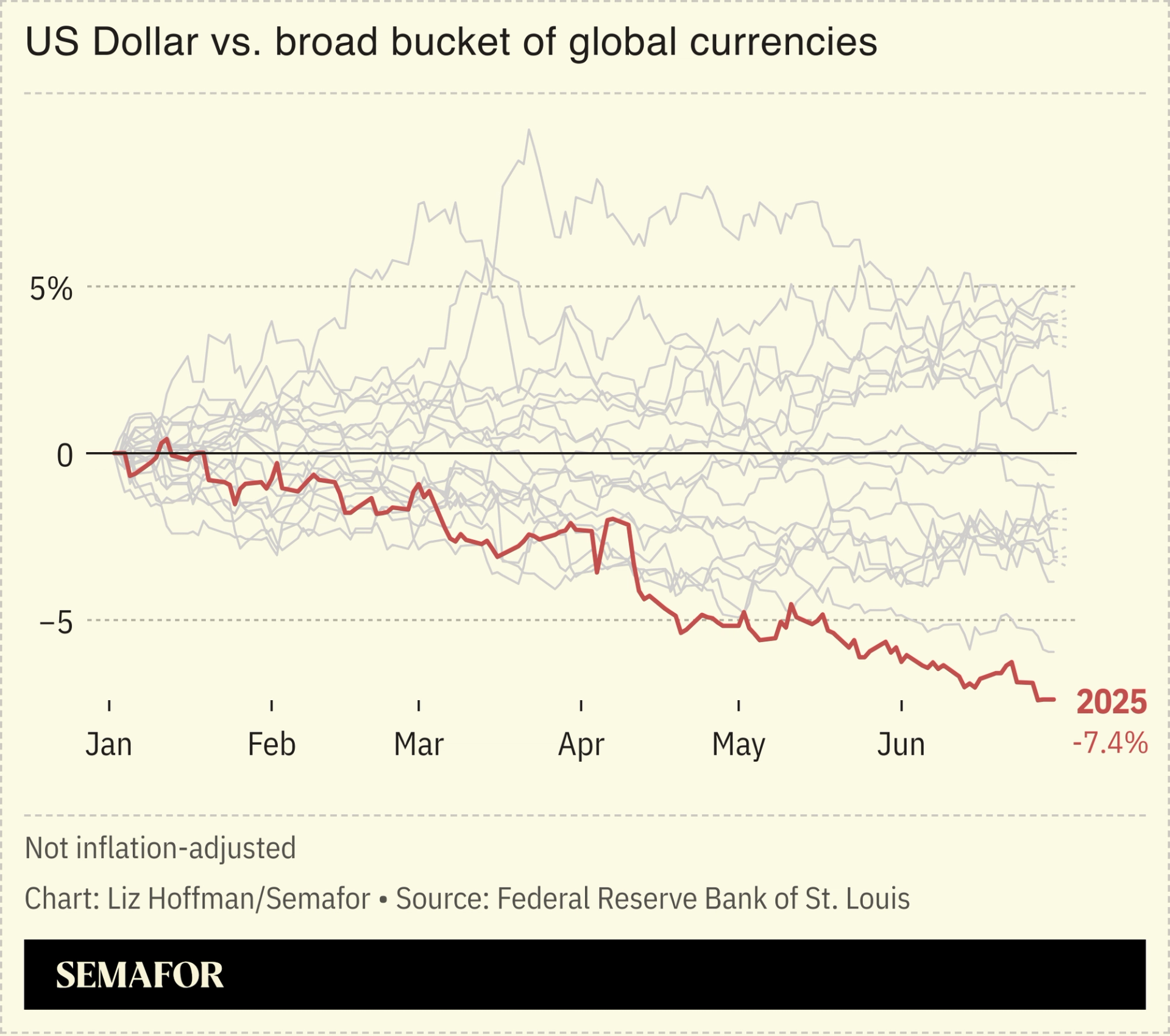
The question ahead is whether the dollar doesn’t just lose its value, but its role at the center of the global financial system. So far, there are few alternatives. And efforts to de-dollarize — central banks shifting into gold, China shoveling its currency into developing nations through swap lines — haven’t meaningfully shifted the picture. But as political economist Ngaire Woods wrote for Semafor in an essay earlier this year, “they haven’t dethroned the dollar, but that’s because the US government has protected it through sound policy and global engagement.”
Food for thought: The year that came closest to 2025 in dollar depreciation was 1973, and the result was then-President Richard Nixon taking the US off the gold standard. “Big moves in the dollar tend to create moments of instability,” Morgan Stanley’s Wilson said.
Read the original article

Comments
By forgotoldacc 2025-07-047:458 reply Looking at the scale of a few years, the dollar has been insanely overvalued post-COVID.
Historically, the euro has generally been a good bit more valuable than the dollar. But in 2022, the dollar was more valuable than the euro at a point. Recently it's been bouncing around at nearly 1 euro=1 dollar.
Then there's the yen. Used to bounce around between 1 dollar = 100~110 yen. Recently reached 1 dollar = 162 yen.
The dollar losing its value is a return to the pre-covid norm. Lots of countries pumped money into the US to make money off skyrocketing stocks and high interest rates, and now they're pulling it back into their countries. It's a high that can't last forever. And if it did last forever, that would not be good for the world as a whole since it would mean every country is supporting the US at the cost of devaluing themselves.
I think the bigger problem is the reason why people are pulling back their money from US markets.
By AlecSchueler 2025-07-0416:471 reply It's kind of jaw dropping to see people here continually avoid the elephant in the room, same thing in discussions about Tesla sales.
By mindslight 2025-07-0416:56 The points avoiding the elephant in the room are basically deliberate, in support of the elephant. They think the elephant is some good thing that is going to destroy the woke, or inflation, or the immigrants, or whatever the hypocritical bogeyman is next week. But it is certainly not poised to destroy them, because they are the true patriotic Americans, don't you know. It is only everything else about this country that is wrong. And as soon as the elephant is done wrecking everything that is bad, their own true brilliance will be allowed to blossom. Or at least so they seem to think.
US markets have been flying high since COVID. Much more than other countries' markets. Why not take profit when US markets + dollar is at a high?
By EasyMark 2025-07-0421:37 The US Market is definitely more optimized more than say European, at the sacrifice of the common good of the people and to the advancement of broligarchs. Trump is doing is best to kill even that (I think it's not his intention, he's just not good with money), via tariffs and crazy economic policies and promoting even bigger deficits than we had during covid. I'm not sure how much longer it can fly high though.
By const_cast 2025-07-051:28 Policy is not emotional. There is such a thing as good policy, and bad policy. And, ironically, failing to call obviously bad policy bad is emotional.
Economic instability and uncertainty. How high it is compared to other markets is debatable it has increased significantly this year due obvious reasons, though
S&P500 literally at an all time high.
Even I wasn't paying attention for a few days (just flew to Canada from Europe).
So my theory of profit taking seems right, back to fresh highs.
By wqaatwt 2025-07-0420:41 > S&P500 literally at an all time high.
It still has 10% to go to surpass its previous peak if measured in euros. Which is kind of the point.
Currency depreciation is usually good for the local stock market, that’s not too surprising.
Since Trump’s inauguration even the STOXX 600 managed to outperform the S&P 500 which is something that almost never happened.
By timewizard 2025-07-048:041 reply > the dollar has been insanely overvalued post-COVID.
That's an odd way of saying the US doubled it's federal budget from $3T to $6T in response to COVID and has now ensconced this pork further into law. Under a "republican" administration, no less.
> The dollar losing its value is a return to the pre-covid norm.
Which is to say that even $3T contained an unjustified amount of debt spending just not as obscene as it is today.
> It's a high that can't last forever.
That's the "big beautiful bill" for ya.
By throw101010 2025-07-048:393 reply > Under a "republican" administration, no less.
Are you under the impression that this is surprising? Republicans are consistently the ones spending more when they are in power. It's time to dispel this myth that they are fiscally "conservative", they have presented more unbalanced/defficitary budgets than Democrats and the latter in recent memories are the only ones who managed to present budget with surpluses, under Clinton.
It's fairly obvious the reason he put it in quotes was because the Republicans and conservative movements claim to be all about "fiscal prudence and discipline", when in reality they're the ones responsible for the ballooning deficit.
By AlecSchueler 2025-07-0416:491 reply It wasn't at all obvious if it was ironically poking fun at that claim or that they genuinely believed it.
By timewizard 2025-07-048:572 reply Corruption has been compounding. Malicious business interests don't actually care which party has power. Just that they have access. It's telling that you have to reach back 30 years to find an example where the budget was balanced for one single year.
By myvoiceismypass 2025-07-052:15 Right, because the guy after Clinton decided to cut taxes and start multiple wars that would last decades. You can do better than a gut "both sides" reaction.
By thrance 2025-07-059:01 Those "malicious business interests" clearly prefer the republicans, judging by how much more money their last campaign received from wealthy corporate donors.
But indeed, the dems are controlled opposition at this point. Most of them oppose progressive ideas, at least as much than the republicans.
By mensetmanusman 2025-07-0411:361 reply It is a myth, there are only a few Republicans that organize around the concept of spending less.
Both sides of the gerontocracy are happy to improve their lives while not planting seeds for the future.
By const_cast 2025-07-051:301 reply Yes, and then took those cuts and blew them out of the water with irresponsible spending in the form of "tax reform".
Nobody is going to see any benefits from those Medicaid cuts. We're much, much further in the hole then we were before.
I don’t disagree. But it’s also true that this will set precedent for future entitlement cuts. Younger people are not served by having entitlements treated as a sacred cow. I am in the opposite camp, cuts will and already have hurt me. I just wonder if maybe we should stop perpetuating a multi-generational Ponzi scheme that allows any generation with large enough numbers (eg baby boomers) to steal all the money from the cookie jar and spend it before anyone can figure out what the heck happened. Maybe that’s a problem with democracy more generally, but that it is a problem cannot be denied. If the dominant age cohort in power is over 85 they will have little incentive to worry about the budget ir nation beyond 5 or 10 years, let alone 80 to 100 years that are relevant to today’s youngest citizens. Not that we should ditch democracy but maybe we should limit entitlements to prevent abuse.
By acdha 2025-07-0521:43 It’s not a Ponzi scheme, it’s successful class warfare. We had a balanced budget at the turn of the century and could easily have addressed the Medicare gap by removing the tax giveaway to the wealthiest and reforming our healthcare system to be more like literally every peer country in the world.
Instead, we blew an enormous hole in the budget with Bush’s tax cuts and wars of choice, followed by bailing out the bankers’ fraud under Obama, and then adding trillions more debt with Trump’s first tax plan. At each and every time, we could have hit financial stability by taxing the wealthiest quintile slightly more but instead chose to take on debt giving them a tax cut instead. The way you’re talking about it as a generational issue rather than a “tax rich people like it’s 1990” issue illustrates how successful the generations of propaganda have been furthering the goal of rolling back the New Deal despite every bit of sober analysis showing that social services have significantly transformed millions of lives and restoring taxes to sustainable levels at the top brackets would have minimal impact on the rich.
By const_cast 2025-07-0519:531 reply I don't think it's a ponzi scheme and I reject the notion it's unsustainable. Our social services are quite poor when compared to the rest of the developed world, and they seem to have figured it out.
I'm not saying we need to become Western Europe, but I am saying that it's certainly possible to have public services such as public healthcare support in the form of Medicaid sustainably.
Repeatedly, conservative fiscal voices proclaim we must cut social services in order to improve our quality of life and economic status. "Starve the Beast" has been the policy of choice for fiscal conservatives for many decades now. And, well, is it working? From where I'm standing, no. Nothing is getting cheaper. Everything is a little bit harder. And the private sector is decidedly not picking up the slack. And, I certainly do not have a lower tax burden. Why do we keep doing things when we appear to have decades worth of evidence that it does not work. I don't know, to me, it feels like insanity.
I think the most damning example is healthcare. We have private health insurance in this country and it's just bad. I don't even think we're at a point where we can humor people who say it's not that bad. No... it's bad, objectively, from every measure. We pay more per capita than any other country, including taxes, and our outcomes are consistently worse. It's losers across the board. But now we're going to be leaning into that even more with these Medicaid cuts. Which will, I'm convinced, greatly increase private insurance premiums. Sigh...
You do understand that those who paid into it earlier get much more out of it, right? So it is a Ponzi in that sense. We can agree to call it something else, but Ponzi is much easier than typing out “a system whereby those who got in early are guaranteed gains while later cohorts risk actual losses due to insolvency as the early cohorts cash out.”
Nursing homes (Medicaid) costs about $12,000 per person a month national average iirc. Cost cutting by fiscal conservatives is clearly not the reason nursing homes can charge so much. If anything it’s the exact opposite: it’s a monopsony so the cost is effectively set by whatever Uncle Sam decides it can pay.
The problem is not really the per capita costs though, but that the demographic time bomb has arrived and all at once a huge portion of Americans will stop paying in and start pulling out of the system that I won’t call a Ponzi. Both parties are run by boomers who have catered to boomers because most voters and donors have been boomers. As a result our politicians have done an awful job “paying it forward.” If the health care and social security situation doesn’t make that clear enough to you, then consider how they’ve left housing for the future age cohorts. Laws like prop 13 have allowed the “early in” to amass great wealth and cash out while using nimby politics to prevent new building and using loosened immigration (eg h1b, migrant farm workers), international free trade deregulation and other policy levers to increase the demand and price for the real estate and other assets they hold. A lot of tax breaks for those who were able to buy homes early, but no so much benefit for people at the other end of the not calling it a Ponzi system we have. If you see only the political parties but not demographics or wealth distribution across interest groups within both parties then you have fallen for party propaganda, the lie that the party matters more than money and special interest.
By const_cast 2025-07-0620:051 reply > You do understand that those who paid into it earlier get much more out of it, right?
No, I don't, because this is all theoretical. Sure we've made some policy changes like raising the retirement age, but the idea that SS will be insolvent is just a conservative wet dream. So, I'll treat it as such.
People on the right have been saying SS will be insolvent since the moment the pen left the paper. Take it with a grain of salt. Please remember these people are practically salivating at the idea of privatizing SS and taking their fat slice. So try to remember their incentives and why they might spread the propaganda they do.
Insolvency and prohibitive costs aren’t a hypothetical but have already arrived when it comes to elder care. And it will get worse. Class warfare is a thing but it is not every thing.
By const_cast 2025-07-085:52 No, SS is not insolvent. And on the topic of elder care being prohibitively expensive, it's quiet simple: you can bleed the old dry because they don't have options. Meaning, it's not a free market, so any notions of competition vanish.
It's a problem with healthcare as a whole and that's why we see so-called "free market" healthcare fall apart. It's not a free market, and actually it is impossible for it to ever exist as a free market. Those same problems are amplified when it comes to elder care, because they're even more desperate.
I mean, think about it. I get chest pain and shortness of breath: which hospital do I go to? There's a market of exactly 1: I go to one hospital, whichever is closest and I believe has the best odds of caring for me. So there goes your free market, you actually have a monopoly. Despite the fact there are thousands of hospitals.
By patchule 2025-07-0413:09 Like a fly in my Chardonnay.
By littlestymaar 2025-07-048:06 > Historically, the euro has generally been a good bit more valuable than the dollar. But in 2022, the dollar was more valuable than the euro at a point
That's what inflation does.
People are routinely taught that inflation is the “decline of value of money”, but that's not the reality. Inflation is just the increase in consumer price, which is perceived as a decline in the relative value of the money, but its absolute value on foreign markets isn't (directly) affected by inflation.
And when the Central bank raise the interest rate to cool the economy down and temper inflation, then the absolute value of the money rises (because the higher the interest rates, the pricier the currency on the FX market). This increase in the currency value in turn also helps fighting inflation because it lowers the cost of imported goods.
So, indirectly, because of the central bank's reaction, inflation is actually increasing the absolute value of money, and this is what we saw in 2022 when the Fed raised the interest rates 9 month or so before the ECB start doing the same (because the inflation came in advance for the US compared to EU).
By RickJWagner 2025-07-0414:16 If a dollar used to equal 100 yen, and now the dollar is worth 162 yen, isn’t that moving opposite to the stated direction?
>it would mean every country is supporting the US at the cost of devaluing themselves.
That's what they want as export based economies.
By forgotoldacc 2025-07-049:15 Not when you get to the point where your currency is so devalued that importing raw materials necessary for those exports becomes expensive, and basics like food and fuel become unaffordable for locals, as is the case in Japan.
A balance is necessary, and things have been off balance recently.
Donald Trump has stated that he wants to weaken the dollar. It seems that he is succeeding.
My guess is that he wants to make it more attractive when it comes time to refinance the large portion of American long-term debt. He also wants to keep the interest rates low for the same reason.
My questions is: What is causing the actual slide? The concrete mechanics and motivations that are causing people to sell USD.
Devaluing the dollar is 100% the goal. It's literally noted as a key component in what the people running US trade policy now said they wanted to do, before joining government.
It has the side effect of boosting nominal investment value (even if real value stays flat or decreases), maintaining political support from people who can't do math. The numbers continue to look good, but outcomes worsen.
There are two flies in this ointment: international capital response and inflation.
The latter is why Trump has been spending political capital on demonizing the Fed and Powell. The house of cards collapses if actual inflation bites and reveals the game.
As to the former, it's tough to look at the situation and see US debt / equities as attractive as they once were:
1. Unsustainable US budget deficits
2. Political threats against the US central bank
3. Tariffs
4. Decreased immigration and worsening demographics
These do not explain how DXY[1] had been rallying up and started falling at the end of September 2022. At that time, if you don't recall, Trump was facing prison time and the US government was in the reliable hands of the most popular president ever with his cabinet of brilliant minds.
1. https://www.tradingview.com/symbols/TVC-DXY/?timeframe=60M
By ethbr1 2025-07-0418:03 Or, take a look at measures objectively instead of predeciding whose side you want to be on.
By presentation 2025-07-0410:43 The yen has other reasons to be weak though, namely that Japan barely increased interest rates as compared to the US.
Lower than their 2024 peak, but still much higher than before 2022 where for a long period it was at 0% or even negative interest (apparently, I don't know much about these things). It's at 2% or 2.4% at the moment, last time it was around that was in 2008. See https://www.ecb.europa.eu/stats/policy_and_exchange_rates/ke...
But I'm no economist and don't know what these numbers mean or what the consequences are.
By wqaatwt 2025-07-0415:59 In general lower interest rates would cause your currency to depreciate.
By wqaatwt 2025-07-0415:57 Which would mean that the Euro would depreciate significantly against the dollar under normal circumstances.
Yet the Euro increased by > 10% despite the ECB cutting the rates quite significantly. Imagine how low the dollar would go if the Fed listened to Trump and cut to 1%..
It seems that no one is prepared to point out the obvious - devaluation of the dollar is a cut in American living standards.
Tariffs and a devaluating currency are a double whammy of inflation on imports.
It will be reflected in overall inflation statistics, and that limits the Fed’s ability to cut rates.
By thrance 2025-07-059:03 > that limits the Fed’s ability to cut rates.
Only insofar as it remains sort of independent. Trump has ranted several times already about taking control of the thing and forcefully cutting rates.
By spencerflem 2025-07-048:062 reply Totally agreed. My only hope is that the evil bastards who willed this to happen bear the suffering more.
They just gave themselves billions in tax cuts, so they'll be comfortable.
It's 6500 billion dollars, generally referred to as "trillions".
A vote for Trump, as it turns out, was a vote to increase US national debt by double what anyone increased it by before (which was also Trump, so anyone saying they "didn't see this coming" ...)
GOP being the "fiscally responsible" party is the best generational propaganda it's honestly impressive
By dragonwriter 2025-07-051:411 reply No, its just code that the audience recognizes: "fiscally responsible" in US politics means "opposed to social programs", in the same way that "states rights" means "supporting racial discrimination". People often criticize the people embracing those views not delivering on the things that the literal meaning of the words deliver, but the target audience for the message understands what they mean perfectly well, which is why no argument, no matter how well-delivered and well-supported by evidence, directed at the failure to deliver on the literal meaning ever budges support. It's not some kind of magically-strong propaganda that clouds people's minds, it's a message whose meaning is well-understood and arguments directed at the literal meaning are simply misdirected.
By spencerflem 2025-07-060:09 this is the conclusion ive come to recently. its not an education problem, its that somewhere around 20% of people are evil
By const_cast 2025-07-051:321 reply It's more than generational at this point, and it's wildly successful from a propaganda standpoint. They're kind of banking on none of their constituents bothering to read the budget bills they pass. Which turns out to be a very good bet when your party is also ideologically opposed to education.
By lotsoweiners 2025-07-053:101 reply I don’t think the party is ideologically opposed to education as much as they are opposed to the way it has been implemented the past few decades.
By const_cast 2025-07-0519:49 I think this is the plausible deniability they foster, but I don't think this is true. The right has been opposed to public education pretty much since the beginning, even before the DOE. And, of their complaints of the DOE, most of them are legitimately made up. Like the DOE setting curriculum or censoring conservative voices.
Since the beginning, conservatives gravitate towards more... alternative... history. I know I was taught about the War of Northern Aggression in schools. Their issue with public education isn't per se the "education" part, but the "public" part. Unfortunately, an attack on public education is an attack on education itself. We all understand that less public education means less education on average.
I quiet enjoy living in a country with literacy rates in the high 90s, and I'd like it to stay that way.
Those evil bastards are also most central bankers around the world that agree that the incredibly unbalanced balance of trade today needs to be rebalanced. America is consuming too much, and the world is saving too much. So yes, your living standards do need to go down for the sake of the greater global macroeconomic stability.
Contrary to what xkcd or NYT might tell you, actual economic institutions like the IMF and the World Bank are coigzant of the issues caused by the status quo and largely view the Trumpian diagnosis, if not the horrid execution, as correct.
> the incredibly unbalanced balance of trade
The US sells billions of dollars of digital services to the rest of the world each year. Did Trump and co include netflix, aws, azure, etc etc in their "unbalanced trade"?
EU-US goods and services trade is balanced: the difference between EU exports to the US and US exports to the EU stood at €48 billion in 2023; the equivalent of just 3% of the total trade between the EU and the US.
Total bilateral trade in goods between the EU and the US reached €851 billion in 2023. The EU exported €503 billion of goods to the US market, while importing €347 billion; this resulted in a goods trade surplus of €157 billion for the EU.
Total bilateral trade in services between the EU and the US was worth €746 billion in 2023. The EU exported €319 billion of services to the US, while importing €427 billion from the US; this resulted in a services trade deficit of €109 billion for the EU.
source: https://policy.trade.ec.europa.eu/eu-trade-relationships-cou...
By corimaith 2025-07-0416:41 So they are running a deficit; Nonetheless, bilateral balances don't tell much without understanding the larger context of the total balances of each country and how proportionate they are relative to the global sum.
The matter of fact is that nearly every major economy is running a surplus, it is really on the USA and some countries like UK that is holding up the deficit side. Whether you think this arrangement is good or not is a matter of debate, but many economists would agree it's not good or sustainable, nor should it be occurring in the first place. Surplus countries should have strengthening currencies, deficit countries weakening ones under natural conditions. This is not happening due to very specific policies that surplus nations have imposed, at the burden of deficit nations.
By StopDisinfo910 2025-07-0411:371 reply > Those evil bastards are also most central bankers around the world that agree that the incredibly unbalanced balance of trade today needs to be rebalanced.
No central bankers in the world ever said that including Powell. That’s Trump policy and Trump only.
https://www.bloomberg.com/news/articles/2025-05-22/g-7-draft...
https://www.federalreserve.gov/boarddocs/speeches/2005/20050...
They have actually, the debate about persistent imbalances have been going on since the 2000s and Bessnet's arguments are simply the extension of Bernanke's prior hypotheses and ultimately Keynes diagnosis on global macroeconomics stability.
By StopDisinfo910 2025-07-0418:341 reply Neither articles are implying that.
The first one throws an intentionally vague imbalance and aims squarely at Chine state aids distortion. It also goes at length about how tariffs are seen as terrible by everyone and how it’s all about a level playing field and not about rebalancing trade balances.
The second is strictly about the US and explains that trade inbalance has more to do with capital flows that actual trade of goods and how the extreme situation in the US might need moderation. Its conclusion is that the trade balance will fix itself if the US both fixes its budget issues and help foreign countries to actually use their excess savings locally. That’s pretty far from thinking the balance of trade needs to be rebalanced.
>The first one throws an intentionally vague imbalance and aims squarely at Chine state aids distortion. It also goes at length about how tariffs are seen as terrible by everyone and how it’s all about a level playing field and not about rebalancing trade balances.
They are all talking about the same thing. The large imbalances in trade are precisely due to the distortionary domestic policies that surplus nations bring, of which China is commonly perceived as the biggest violator. A world without any protectionist policies is one where trade balances are temporary or close to 0 due to FX effects.
>The second is strictly about the US and explains that trade inbalance has more to do with capital flows that actual trade of goods and how the extreme situation in the US might need moderation.
You clearly then need to review your definitions because we are talking about the same concepts here. Current Account + Financial & Capital Account = 0. The capital flows are the direct inverse of the current account and flow of trade. In the same way, Current Account = Savings - Investment. When he talks about using excess savings locally, that is precisely about moving savings into consumtpion and thus reducing trade surpluses.
That is very much what economists or Bessnet are still saying today in reducing excessive surpluses in turn and thus trade imbalances. Clearly after 20 years, trade imbalances aren't self-balancing like FX effects would imply, due to very explicit policies pursed by said surplus nations in doubling down on manufacturing rather than increasing consumption.
Mind you, the greater implication of what Bernanke was suggesting is that the excess savings and associated large capital inflows (and thus deficit) is what fueled the housing bubble and credit expansion in the 2000s that led to the GFC. The greater argument being that these distortionary policies that being pursued domestically in surplus countries over manufacturing is leading to an associated distortion in the US economy towards overfinancialization.
By jaybrendansmith 2025-07-0516:002 reply So it's up to the USA to take a hit and fix the balance? I call BS on that. Seems extremely dumb, just like everything else I've seen coming out of the current admin. Biggest self own I've ever seen.
>So it's up to the USA to take a hit and fix the balance?
https://www.brookings.edu/articles/rebalancing-the-world-eco...
It's better to say that rebalancing is a painful affair. But account balances should be naturally self-balancing in the first place, the imbalance today is the result of policies that the surplus nations, China foremost, is unwilling to abandon easily. If they all opened up their capital markets, currency controls and removed subsidies and tariffs, if they seriously committed themselves to free trade the problem would solve itself in time. And most economists would agree with me on that.
But if they are unwilling to do that, and the last 20 years of negotiation have been fruitless, then unfortunately America may need to resort to unilateral actions to resolve it themselves. And if you run the simulations, America will win that fight for escalation. It will hurt for us all, but inflation is nothing compared to the mass unemployment surplus nations will suffer.
I don't paticularly agree with Trump's methods or his flip-flop execution in attempting to resolve the problem, but it is a problem that many would agree needs to be resolved. China, Europe all themselves have agreed now that they need to raise consumption instead of doubling down on manufacturing, and that's very much convergent with what the Administration seeks to achieve overall.
By jaybrendansmith 2025-07-0614:53 I don't believe people need or want this to be 'resolved'. That is a false choice. This imbalance is unhealthy but was working largely in our favor. Any anything that can survive for 20 years can persist forever. China has a problem: They need to continually improve the lives of their people to stay in power and/or to avoid resorting to unpleasantness to stay in control. Their solution is to fund this imbalance. In any case, I don't understand why people believe any of these tariffs are in good faith. They are clearly a means to unilaterally punish some nations and reward others in exchange for ... something. They are also a way to inflict economic hardships by instituting a regressive tax on all Americans. The game here has nothing to do with what's best for the American people. It's what's best for the oligarchs, and Trump. And what's the best way to consolidate power, punish enemies, reward friends, and in general destroy the current economic order, the American middle class, the meritocracy, and what remains of democracy.
By AnimalMuppet 2025-07-0516:07 The US was also taking hits from the imbalance. The GP lists several.
Mind you, I'm not saying whether trying to rebalance is smart or dumb. I'm just saying that the imbalance causes us problems too.
By mensetmanusman 2025-07-0411:46 Low derivatives of US gdp per capita growth over the past decade feels like stagnation to the population.
By MuffinFlavored 2025-07-0414:04 Even if you own equities?
By snovv_crash 2025-07-047:313 reply From outside the US, all the 'stock market gains' have actually been zero or negative because of this. I wonder how long before inflation hits...
By patrickhogan1 2025-07-047:451 reply This is spot on and cuts both ways. Much of the Japanese market's recent "performance" in US media is actually just yen weakness against the dollar. Strip out currency effects and the story looks very different. Same with European markets "performance" - we're often seeing monetary policy divergence rather than genuine outperformance in foreign markets.
Always check both local currency and USD returns when evaluating international markets.
By patrickhogan1 2025-07-048:33 MSCI Europe is up about 8-9% in euros so far this year—roughly the same as the S&P 500 in dollars.
But the euro itself has climbed ~10% YTD vs the dollar (≈ $1.02 → $1.12-1.18). So you get an ~18% gain if you invest in MSCI Europe in dollars.
Europe hasn't "beaten" US stocks because its companies suddenly out-executed; most of the gap is the stronger euro.
Not that it matters who’s "winning." My gripe is with US headlines that shout "Japan stocks are on fire" or "Europe stocks are on fire," when what’s really happening is that global markets are rising together and currency swings make one region look better than another.
By hx8 2025-07-048:11 You should evaluate foreign market results based on your domestic currency. Here is the US centric example.
1. You exchange Dollars for Euros
2. You buy a stock in Euros
3. You hold the stock in Euros for a period of time
4. You sell the stock in Euros
5. You exchange your Euros for Dollars.
The difference in the exchange rate in step 1 and 5 can have a very large impact on your total return, often times a larger impact than step 3.
Not in Australia. Our dollar has taken a beating too. I guess digging holes and selling property to each other at ever higher prices isn’t that interesting to the rest of the economic world.
By patrickhogan1 2025-07-048:02 Australia printed a lot more money relatively than the US from COVID-19 until now, largely to capitalize on a booming commodities sector. A factor that led to some do weakness.
But I think any weakness is temporary. With a stable government and abundant natural resources that will be even more sought-after in an AI-driven world and largely insulated from automation Australia’s long-term prospects look strong.
By lifestyleguru 2025-07-047:53 > I guess digging holes and selling property to each other at ever higher prices isn’t that interesting to the rest of the economic world.
Wow this is the case in most of the Europe too, what a coincidence. Fancy investing in our premium real estate?
By actionfromafar 2025-07-048:262 reply If that doesn't work, let's try "one part of the population chasing another part into concentration camps!" That'll attract investors.
By defrost 2025-07-048:37 Australia's already tried that one: https://en.wikipedia.org/wiki/Aboriginal_reserve
By lifestyleguru 2025-07-048:311 reply Every empire starts with free labour. Cheap labour is too expensive.
By actionfromafar 2025-07-049:17 While there's a lot of truth to that, I think that works better in undeveloped economies, and in the past, than now.
By mensetmanusman 2025-07-0411:38 The Hole just got 10 ft deeper!
By brummm 2025-07-048:48 Lol, Australia and Canada seem to be very similar in this regard.
Because stock market gains can't keep up with the lose of the dollars value? Assuming that you bought your stocks using Euros or some other currency?
Yeah, that's what they mean. Here's a euro-denominated S&P500 ETF: https://finance.yahoo.com/quote/CSPX.AS/
and a USD denominated one: https://finance.yahoo.com/quote/SPY/
Have a look at the 1 year view. Note the fairly dramatic difference.
By CalRobert 2025-07-048:03 If only it were easier to buy etfs that aren’t PFIC’s
