States and cities decimated SROs, Americans' lowest-cost housing option

2025-08-0618:43124181www.pew.org

Low-cost micro-units, often called single-room occupancies, or SROs, were once a reliable form of housing for the United States’ poorest residents of, and newcomers to, New York, Chicago, San…

Low-cost micro-units, often called single-room occupancies, or SROs, were once a reliable form of housing for the United States’ poorest residents of, and newcomers to, New York, Chicago, San Francisco, and many other major U.S. cities. Well into the 20th century, SROs were the least expensive option on the housing market, providing a small room with a shared bathroom and sometimes a shared kitchen for a price that is unimaginable today—as little as $100 to $300 a month (in 2025 dollars).

In the late 19th and early 20th centuries, landlords converted thousands of houses, hotels, apartment buildings, and commercial buildings into SROs, and by 1950, SRO units made up about 10% of all rental units in some major cities. But beginning in the mid-1950s, as some politicians and vocal members of the public turned against SROs and the people who lived in them, major cities across the country revised zoning and building codes to force or encourage landlords to eliminate SRO units and to prohibit the development of new ones. Over the next several decades, governments and developers gradually demolished thousands of SROs or converted them to other uses, including boutique hotels for tourists. And as SROs disappeared, homelessness—which had been rare from at least the end of the Great Depression to the late 1970s—exploded nationwide. 

Now, as a nationwide housing shortage has pushed rents and homelessness to historic highs, some states and localities are reconsidering the value of lower-cost, small units with shared kitchens, bathrooms, and amenities. Ironically, had SROs grown since 1960 at about the same rate as the rest of the U.S. housing stock, the nation would have roughly 2.5 million more such units— enough to house every American experiencing homelessness in a recent federal count more than three times over.

As governments throughout the United States seek to fill the gap in low-cost housing, one promising and inexpensive model is gaining traction: making shared housing legal, as it was for most of U.S. history. And one version of shared housing—converting some of the vast supply of office space left empty since the COVID-19 pandemic—looks especially promising: A single office building conversion could add hundreds of low-cost homes near jobs and transit, while a large high-rise could add more than 1,000 homes. Several states have passed laws in the last few years to remove local legal barriers to building SROs or converting certain existing buildings into SROs. 

This brief explores the history of SROs and their close relationship with homelessness. It also looks at strategies for adding large quantities of inexpensive housing units to meet the needs of the nation’s most vulnerable residents as well as others seeking low-cost housing.

Housing costs drive homelessness 

A wealth of research has examined the causes of homelessness over the past two decades. These studies consistently find that the cost of housing is by far the primary driver. For example, several studies have concluded that an area’s median rent correlates far more closely with its homelessness rate than factors such as weather, poverty rate, and rates of mental illness or substance use. 

One study found that a $100 increase in median rent was associated with a 9% increase in homelessness.1 Another found that as rent-to-income ratios increase, homelessness increases in tandem.2 A separate study found a strong relationship between home prices and homelessness.3 Several studies have found low rental vacancy rates strongly predict high levels of homelessness.4 And when rents are high, families squeeze more people into smaller spaces, with less room to help struggling friends and relatives.5 Salim Furth, a senior research fellow at the Mercatus Center at George Mason University, explains the link: “When housing is cheap, relatives and friends tend to have more space in their homes, enabling them to keep someone at risk of homelessness off the street. … When space is tight, the people forced out are those who are hardest to live with.”6 Frequent explanations for homelessness focus on an individual’s characteristics. Certainly, people experiencing homelessness have disproportionate rates of disabilities, mental illness, and substance use compared with the general population. But cities with an abundance of low-cost homes have far less homelessness than high-cost cities, despite having similar rates of disability, mental illness, and substance abuse.7 And, as noted earlier, even in New York, San Francisco, and other expensive places, homelessness was uncommon as recently as the 1970s, when those cities still had a large stock of SROs.

This relationship is apparent whether comparing cities or states.8 High-rent states such as California, Hawaii, and New York have persistently high rates of homelessness; states with low rents, such as Alabama, Mississippi, and West Virginia, have low rates.9 California’s rate of homelessness is more than 10 times Mississippi’s. The rate of homelessness in New York City and San Francisco is about 15 times that of Houston, which has the lowest rents among the largest U.S. cities. Memphis, Tennessee; Milwaukee; and Pittsburgh are three other cities that have rents lower than most U.S. cities; all have consistently maintained lower-than-average rates of homelessness.10 Nationwide, as rents rose, 2023 marked an all-time high in homelessness. That mark was eclipsed in 2024.

We can be sure that high housing costs are causing high homelessness because as housing costs change in a city or state, homelessness tends to move in tandem. When rents rise quickly, homelessness does too; when rents rise slowly but incomes keep increasing, that improves affordability, so homelessness declines. Supply and demand are the primary drivers of rent: When jurisdictions have added more housing, rent growth has slowed and homelessness has fallen.11 Where housing supply is limited, rent growth has been faster and homelessness more severe.

Another key indicator of the overwhelming relationship between housing costs and homelessness is the limited effectiveness of interventions targeted at other perceived causes of homelessness. An approach known as Housing First, for instance, showed great promise in the early 2000s. Previous attempts to address homelessness typically required individuals to participate in programs—drug treatment is a prominent example—before they received permanent housing. Housing First provided homeless individuals with a home along with access to social services such as counseling or treatment. The administrations of both George W. Bush and Barack Obama strongly supported Housing First, as did many states and cities. People receiving help via the Housing First strategy were far more likely to gain and keep a home than those that received conventional services.12 But when the 2007-09 Great Recession hit, homebuilding across the United States collapsed. The rate of homebuilding stayed low for the next decade and has never fully recovered. The resulting housing shortage drove rents higher—and with them, homelessness—despite the continued use of Housing First. 

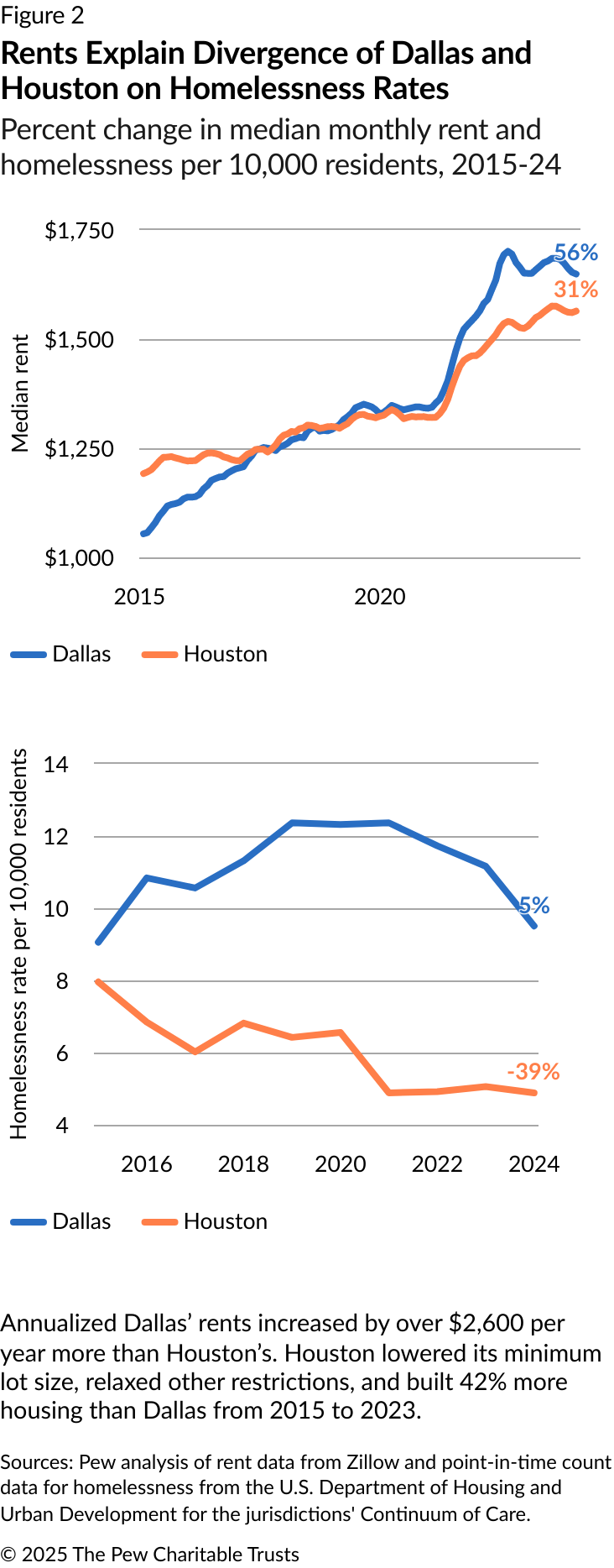
The contrasting experience of two large Texas cities demonstrates this phenomenon clearly. Houston’s permissive homebuilding laws enabled it to increase its housing supply and hold rents low. By contrast, Dallas added much less new housing than Houston and saw much faster rent growth. Both cities used Housing First to help tackle homelessness, but while Houston’s homelessness rate fell—the city’s rate is just a fifth of the U.S. overall and by far the lowest among large cities—Dallas’ homelessness rate increased.13

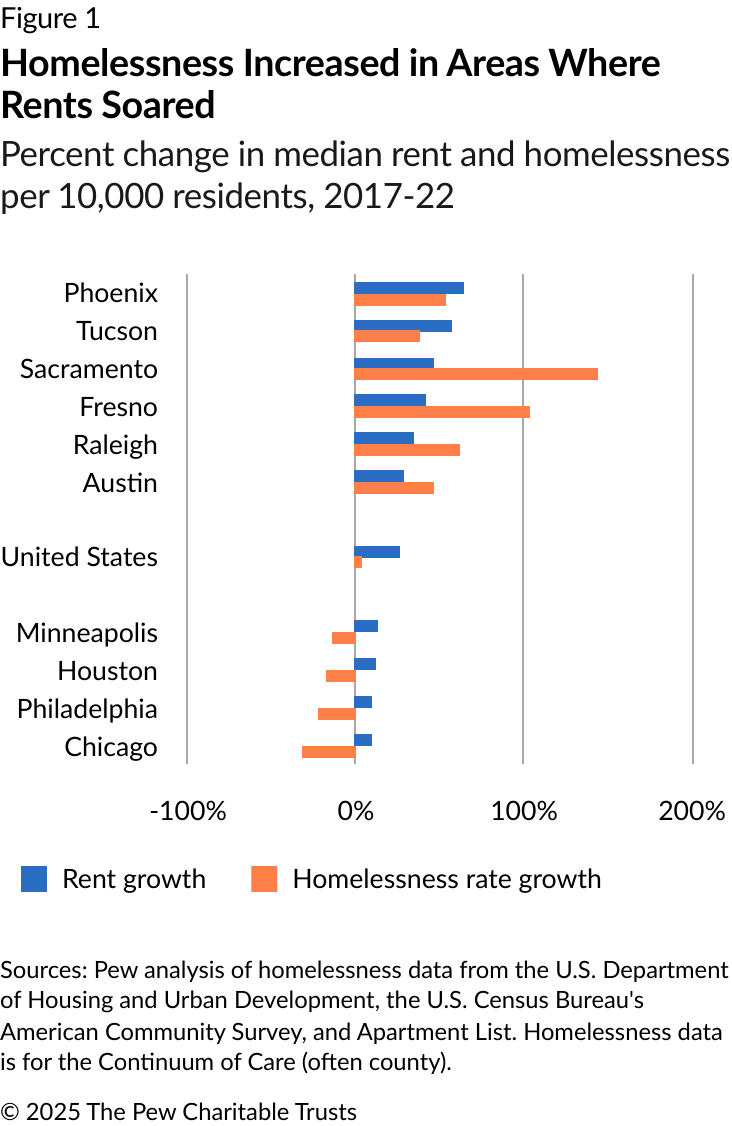
Raleigh, North Carolina, provides another example of the link between high rents and homelessness. Median rents there jumped 34% from 2017 to 2022, and homelessness rose 62%.14 But Raleigh enacted reforms that made it easier to build homes, including town houses, accessory dwelling units, and two- and three-unit buildings.15 Rents didn’t rise at all in Raleigh from the start of 2022 to the start of 2024, and homelessness fell 35%.16 Austin, Texas, had a similar experience, with rents and homelessness soaring from 2017 to 2022, but after land-use reforms made it easier to add housing, Austin saw both rents and homelessness decline.17 

Extensive research has shown that adding housing supply, as Houston has done, slows rent growth, improving affordability. The main mechanism for this is that as new housing is added, there is less competition for older housing, which becomes more affordable. New housing helps improve affordability immediately, increasing supply and reducing demand pressure on the rest of the housing stock. In this way, more construction of new housing helps ensure a steady supply of lower-cost housing to accommodate lower-income residents. For example, when individual markets such as Austin and Phoenix saw a large number of new apartments delivered in 2023 (mainly projects that had started when interest rates were very low a couple of years earlier), rents declined across the board.18 But they fell most in older apartments with few amenities. 

SROs and homelessness—an intertwined history

A new era gives rise to a new housing model

Homelessness first became an issue on a national scale in the 1870s. Continued upheaval in the aftermath of the Civil War and industrialization pushed more people into “riding the rails” on the nation’s new railroad system in search of jobs.19 The rise of these itinerant workers, in turn, drove the development of early rooming houses and residential hotels, particularly for Americans at the lower end of the income scale. Rooms could be rented by the night, week, or month.

Rooming and lodging houses were the first examples of SRO housing in the United States. Often, they were converted from single-family houses, tenement apartment buildings, or commercial office and warehouse properties. In other cases, single-family homes were not converted, but owners rented out individual rooms. American Enterprise Institute researchers have noted that before the 1920s, about one-third to one-half of urban residents were either boarders or rented part of their home to boarders.20 However, hotels designed to serve medium- and long-term tenants also began appearing in U.S. cities: Residential hotels became the most common SRO model throughout the country. Some residential hotels offered meal service in luxurious dining rooms, as well as regular laundry and maid service; less expensive hotels featured dark rooms without windows or even just a dry space on an open floor in a flophouse for 5 cents to 10 cents a night. 

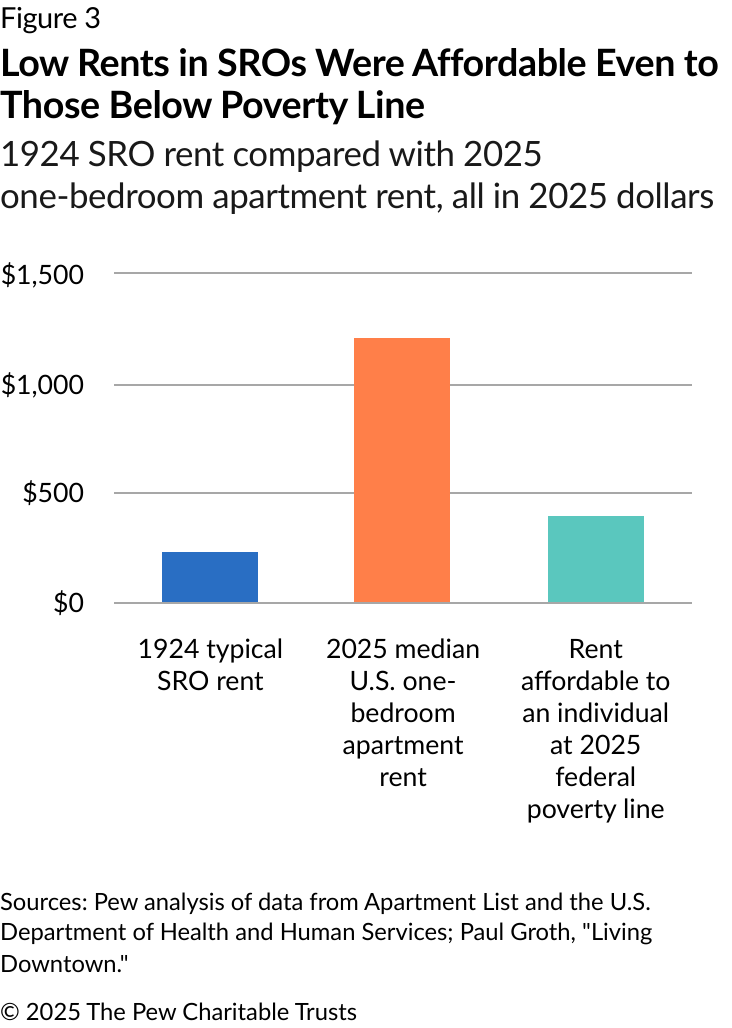
Residential hotel construction peaked in the early 20th century in most cities. By the 1920s, many cheap hotels in big cities such as New York, San Francisco, and Chicago offered a mix of private rooms; large rooms converted to tiny, cubicle-style bedrooms with partitions that did not reach the ceilings; and open-air wards with rows of cots.21 At the time, a private room might rent for 25 cents to 40 cents a night and the semiprivate cubicles and open wards for 15 cents to 25 cents a night. That’s far less than anything available in modern U.S. cities: 40 cents in 1924 is the equivalent of about $7.40 in 2025, roughly $230 a month. That would be affordable even to a person living below the federal poverty line (defined as $15,650 in income for a one-person household in 2025). 

Hotels nationwide were much different than they are today. They were much more likely to host long-term occupants in the late 19th and early 20th centuries. One 1930 survey of hotels throughout the country found that long-term residents occupied an average of 20% of the rooms in the most expensive third of American hotels, and at least 75% of rooms in low- and mid-priced hotels.22

In New York City, low-rent, single-room occupancy exploded during the Great Depression and World War II, when tens of thousands of people moved from the South and Puerto Rico to work in the city’s munitions factories and on major construction projects. By the 1950s, the city had more than 200,000 SRO units, accounting for more than 10% of the city’s rental housing stock.23 In 1986, 87,000 New Yorkers still lived in hotels, according to what was then the largest study of inexpensive hotels undertaken by a city government in the U.S. Across the five boroughs, 43% of SRO residents were under 40 years old and 32% were 40 to 60 years old; a third were Black; and a quarter were Latino. 

During the same era in San Francisco, many long-term occupants of residential hotels were retired Filipino or Chinese laborers or newly arrived families from Southeast Asia.24 In 1977, 330 sheriff’s deputies and policemen showed up to evict 40 elderly Filipino and Chinese residents from the International Hotel, triggering outcry and concern as well as a congressional report.25

A backlash against SROs causes an explosion of homelessness

Even as SRO hotels and rooming houses provided homes for many of the poorest U.S. residents, problems arose. The housing was often of low quality and poorly maintained, and some neighbors complained about SRO residents.

Some politicians scapegoated SRO residents, increasingly portraying them as poor, dependent on alcohol or drugs, reliant on public welfare, transient, and immoral.26 This image was compounded by the condition of many SRO buildings, which even in the early 1900s were often run-down and neglected. Reformers blamed crowded apartments and unsanitary shared bathroom facilities for the spread of common diseases like pneumonia and tuberculosis.27 Some policymakers and activists viewed residential hotels and SROs as a public nuisance and a decaying form of housing that should be eliminated. “The SRO should not be accepted as lawful housing for any segment of our population,” an aide to New York City Mayor Robert F. Wagner reportedly said in 1965.28 “ No community should equate such housing with the acceptable living standards of the 1960s.”

Many city and state governments began crafting policies in the 1950s and 1960s that encouraged property owners to convert SRO buildings to tourist-oriented hotels or traditional apartments. Newly enacted zoning codes and building codes made creating SROs illegal or economically unviable. Researchers have noted that market forces alone would have been unlikely to decimate the stock of SROs because they were profitable to operate when allowed and declined only when new laws targeted them.

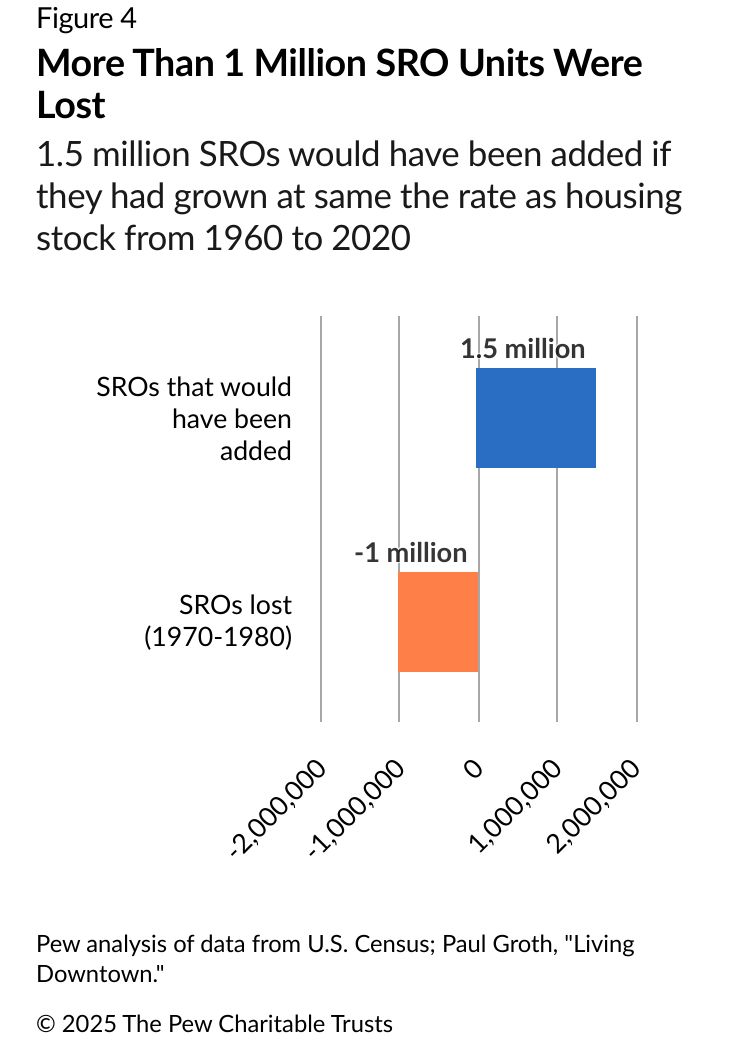
The scale of the loss of low-cost housing in the second half of the 20th century is staggering. There is no reliable count of the number of SRO units lost before 1970; “estimates usually refer to ‘millions’ of rooms closed, converted, or torn down in major U.S. cities,” the historian Paul Groth said.29 He estimates that another million residential hotel rooms were destroyed or converted in the subsequent decade, from 1970 to 1980.30 Almost all of that housing was destroyed or converted to other uses in response to zoning and building code reforms or tax incentives enacted for the specific purpose of eliminating SROs.

New York City, for example, banned construction of SRO buildings and the creation of new SRO units from existing buildings in 1955. Over the next two decades, the city enacted a series of other building code and zoning changes, which raised the costs of operating SRO buildings and had the effect of encouraging owners to convert them to other uses.31 This meant that apartments in a building were required to have an average size much larger than SROs, in addition to the ban on new SROs. In the 1970s, New York City enacted tax abatements that gave SRO owners a financial incentive to convert SROs into rent-stabilized apartments with bathrooms and kitchens included (and higher rents). The tax break worked as intended, driving the conversion of 40 residential hotels a year.32 In response to the city and state incentives and regulatory changes, owners destroyed two-thirds of New York City’s remaining SRO units from 1976 to 1981, a state Assembly study found at the time.33  

New York City was not alone. Starting in the 1960s, for example, San Francisco decided to redevelop South of Market, making way for what became the Moscone Convention Center and Yerba Buena Gardens—an area where 41% of the 240 resident families lived in hotels. Justin Herman, who led the San Francisco Redevelopment Agency from 1959 to 1971 and accelerated its urban renewal efforts throughout the city, was quoted as saying, “This land is too valuable to permit poor people to park on it.”34 Studies estimate that 40,000 residential hotel rooms were destroyed by urban renewal programs in San Francisco—including more than 6,000 in just five years from 1975 to 1980—though the city did not maintain public records on the total.35 

Similarly, Seattle demolished half of its SROs downtown—16,200 units—between 1960 and 1973.36 A catastrophic fire at the five-story Ozark Hotel in March 1970 led to a wave of demolition. After the fire, Seattle changed its building code to require either sprinklers or fire-resistant doors and stairways for buildings where residents lived on the fourth story or higher. These costly upgrades made it challenging to operate inexpensive units. The city demolished 5,000 SRO units during its enforcement of this one code change—the so-called Ozark fire code—in the 1970s.37 Several other building code mandates followed, prompting many residential hotel owners to abandon their buildings rather than incur the higher costs to maintain them; by 1982, nearly 30% of the remaining units in downtown Seattle sat vacant.38 

Other notable examples include Boston, which lost nearly 90% of its SROs from the 1950s to 1985;  Chicago, which lost 80% of its SRO units—32,000 rooms—between 1973 and 1984; and San Diego, which lost about 1,247 units from 1976 to 1984.39 Cincinnati is estimated to have lost more than 2,000 units during the 1970s, about 42% of its SRO stock.40 

As the nation’s least expensive source of housing disappeared, homelessness soared in major cities across the United States. In New York City, for example, the number of homeless residents increased from a barely visible population to almost 30,000 by 1987.41 About half of men entering homeless shelters in the city in 1980 reported they had previously lived in SROs. The sudden loss of SROs and commensurate rise in homelessness prompted an advocate in New York to remark: “The people you see sleeping under bridges used to be valued members of the housing market … they aren’t anymore.” 

A series of social, political, and economic changes also battered large U.S. cities in the 1980s, contributing to the homelessness epidemic. State psychiatric hospitals released people suffering from mental illness without adequate provisions for outpatient care. Property owners abandoned inner cities, leaving empty buildings. AIDS arrived. The federal government reduced subsidies for public housing and rental assistance and made it more difficult for people with disabilities to qualify for Supplemental Security Income (SSI). Cuts to SSI—which largely benefits disabled people and those over 65—and a tightening of eligibility for disability payments in the early 1980s added to the financial instability of many struggling Americans.42 

In some regions, especially the Northeast, homelessness became less visible after the initial surge in the early 1980s, as cities and towns increased shelter capacity. As a result, a larger share of people experience sheltered rather than unsheltered homelessness in cold-weather cities, especially in the Northeast. But the life outcomes of people without homes who live in shelters are little better than for those without homes who live on the street. Both groups lose decades of life expectancy.43 

By the 1990s, only a tiny fraction of SRO hotels were left in the United States. Housing costs were lower in the 1990s than today (even in income-adjusted terms), but the lack of SROs meant that homelessness continued unabated. With the lowest rung on the housing ladder missing, many people could not afford rent for conventional apartments or houses, including shared ones.44 

Nationwide, homelessness has been rising since 2017 as housing has become increasingly more expensive. Between 2022 and 2023 alone, the number of homeless people in the U.S. rose by 12%, to more than 653,000, according to the annual count compiled by the Department of Housing and Urban Development (HUD).45 That meant 20 in 10,000 Americans were experiencing homelessness on a single night in January, the most since HUD began counting in 2007.46 In 2024, the homelessness rate jumped to 23 in 10,000.47 More than a third of all individuals identified in the HUD count were living on the street, in abandoned buildings, or beneath bridges—or, in the words of the HUD report, “in places not meant for human habitation.”48 The 2023 record was broken in 2024, when HUD released data identifying 771,480 homeless Americans, an 18% increase from 2023. These numbers are widely considered an underestimate. 

In 1960, when the loss of SROs was just beginning, there were 6.9 million single-person households in the U.S. By 2023, that number had reached 38 million.49 In that time, the nation’s housing stock grew by a factor of 2.5, from 58.3 million homes to 145.4 million. Meanwhile, more than 1 million SRO units were destroyed or converted to other uses from 1970 to 1980 alone. Had the SRO stock grown at a similar rate as the rest of the nation’s housing supply, the U.S. would have added 1.5 million units rather than losing 1 million, for a net change of 2.5 million more SRO units. That’s more than triple the number of people experiencing homelessness in HUD’s 2024 count.50

New housing is usually expensive, and as homes get older, they get more affordable as high-income residents move into costly new housing. SROs, though, can be created at a much lower price point than other types of housing because the units are small and residents generally share bathrooms and kitchens. The same building using an SRO-style layout can simply fit more units that cost less than conventional apartments. Historically, SROs usually weren’t new construction; instead, they were created from other residential or commercial buildings whose original use no longer made sense. As the U.S. finds itself with more than a billion square feet of vacant office space in 2025, there is an opportunity to do what property owners did in the late 1800s and early 1900s: convert underused space into low-cost, well-located SRO-style housing units. It’s not possible to create all 2.5 million missing units this way, but SRO layouts are so efficient that a single high-rise building can hold more than 1,000 units. 

Full circle: Surging homelessness drives renewed interest in SROs 

As early as the mid-1980s, the problem of homelessness in New York City had gotten so severe that legislators tried to reverse course on SROs.51 The city government passed Local Law 19 in May 1983, adding protections for SRO tenants. The city ended tax benefits for converting SROs in 1983.52 Eventually, the City Council banned the conversion, alteration, demolition, or warehousing (holding units vacant for years to make them eligible for conversion or demolition) of SRO units altogether. But the New York Court of Appeals ruled these bans unconstitutional because they prevented property owners from determining how their buildings could be used.53 Similarly, Chicago officials passed an SRO preservation ordinance to discourage conversions or sales of SROs in 2014, but by that time, the large majority had already been lost.54 The city’s zoning and building codes made it challenging to build new ones.

Although New York City’s policy to block owners of SRO buildings from converting them to new uses was overturned by courts, city officials took other steps to preserve SROs even as different city laws banned the creation of new ones. One of these statutes was an anti-harassment policy instituted decades ago, which required that landlords looking to convert SROs prove that they had not harassed tenants to move out, such as by making living conditions intolerable or failing to perform needed maintenance. But this policy, known as a Certification of Non-Harassment (CONH), added costs and administrative requirements for landlords, contributing to the difficulty of operating SROs. The program was changed and expanded in 2018 to require that landlords also get a CONH before renovating SRO buildings.55 Ultimately, however, neither the city nor the state has taken effective steps to rehabilitate or meaningfully expand the city’s SRO stock.56 

Despite all of this, New York City probably still has the largest remaining stock of SRO hotels and rooming houses in the country. A paper from the Furman Center at New York University estimated that there were as many as 30,000 SRO units remaining in the city in 2014.57 The city regulates SROs as part of its rent stabilization program, meaning owners can raise rents by only a low amount each year and need to file documentation with the city on each unit’s rent. In 2022, the state housing agency reported 322 regulated SRO buildings with 11,051 units, of which nearly half—more than 5,300—were rent-stabilized.58 The median monthly allowable rent for these units was $1,018 in 2022, compared with $1,641 for a regular rental apartment in the city in 2023 (including public housing, rent-controlled housing, subsidized housing, and conventional, market-rate housing).59 

Although New York has the most existing SROs, several Western states have been the first to pass new laws to enable construction of single-occupancy units. State governments have increasingly stepped in to require that certain types of housing be allowed because localities have not taken adequate steps to address the housing shortage.60 That was rare in the past: From 2011 to 2016, all states combined passed an average of one law per year to allow more homes; from 2023 to 2024, that number jumped to 48 for all states combined. In 2024, the Washington Legislature passed legislation requiring cities to allow SRO-type housing wherever multifamily housing of six or more units is permitted, beginning in late 2025.61 This legislation authorizes small units with shared bathrooms and kitchens; limits off-street parking requirements to one spot for every four bedrooms; and prohibits all parking mandates for buildings within half a mile of a major transit stop.62 The bill was one of several that Washington passed to ensure that some types of lower-cost housing are allowed even where local governments had blocked them before or residents fought development.63 Seattle had previously allowed development of low-cost micro-units, for example, but city officials in 2013 enacted laws that effectively prohibited them.

The Oregon Legislature enacted similar legislation in 2023, allowing micro-units in all areas zoned for residential use in cities across the state, including an SRO with up to six units on a parcel zoned for single-family use.64 As of Jan.1, 2025, Hawaii communities must allow the conversion of commercial properties into SRO housing.65 Montana took a somewhat different approach, passing legislation in 2023 that created a housing “menu” for its cities and towns to choose from—a series of options from which cities must choose at least five to allow more housing.66 One of these is to permit co-living micro-units. 

Perhaps the simplest method of creating low-cost shared housing is to allow unrelated individuals to share a house in the same way that relatives are allowed to share a house.67 But many communities limit the number of unrelated people who can live together—in some places, to as few as two. Such laws make sharing a house for a group of roommates—which usually enables rents lower than having an individual apartment—illegal. The U.S. has a record number of unused bedrooms, but many cannot be rented because of restrictions on house sharing by unrelated roommates, even if that would be the most profitable use for the landlord and the most affordable option for the tenants.68 To enable this low-cost housing option, Iowa, Oregon, and Colorado all passed bipartisan legislation to strike down local codes that prohibit house-sharing (in 2017, 2021, and 2024, respectively).69 

In all of those cases, states have stepped in when localities did not act, authorizing lower-cost housing and limiting the ability of local governments to ban inexpensive housing. The aim of those laws is to increase the rental market for low- and moderate-income residents and make more use of existing housing stock. If these bills succeed, and a large number of micro-units reach market, their rents will likely be low, since individual rooms, when available, usually rent for far less than houses or apartments.70 And while these units are intended for individuals rather than larger households, Manhattan Institute researchers have noted that they could “help release three- and four-bedroom apartments currently occupied by unrelated millennials” for use by families.71

Individual rooms also cost less to build than apartments and houses. In October 2024, February 2025, and April 2025, The Pew Charitable Trusts and Gensler, a global architecture, design, and planning firm, released three reports that described how vacant office space in large cities could be converted into low-cost micro-units with shared bathrooms and kitchens—essentially a safe, clean, code-compliant, well-located version of SROs.72 The projected rents for rooms in these converted buildings are about half of the median in the studied markets and therefore affordable to residents earning 30% to 50% of the area median income, with much lower public subsidies than are generally required to build low-cost apartments.73 The small unit size (120-220 square feet), shared bathrooms, and shared kitchens would lead to development costs at least 50% lower than the cost of building new studio apartments. If these modern SRO rooms were priced right, a wide range of residents might elect to live in conveniently located downtown housing. But this option could make the biggest difference for low-income residents who are now struggling to afford any type of home. 

Many Americans are struggling. Nationwide, about 11 million tenant households—one-fourth of all renters in the U.S.—are considered extremely low-income, earning at or below the federal poverty line of $15,650 for a single person or $32,150 for a family of four or if they earn less than 30% of their area’s median income. According to the National Low Income Housing Coalition, the United

States is short more than 7 million rental units that are affordable for those households.74 California has the nation’s largest extremely low-income renter population, with nearly 1.3 million households.75 And of those, more than three-quarters are severely “rent burdened,” meaning they spend more than 50% of their income on housing costs. New York has the second-highest number of extremely low-income renter households, at just under 1 million.76 

New York State has taken fewer steps than some other states to house its poorest citizens. In 2023,Governor Kathy Hochul (D) announced $50 million in funding to help landlords repair 500 SROs across the state, a quiet reversal of long-standing anti-SRO policies.77 And for the first time in decades, New York City has removed one of the barriers to new SRO units as part of a slate of zoning changes, called City of Yes for Housing Opportunity. City of Yes, which broadly aims to allow modestly more residential development throughout New York’s five boroughs, removed the minimum average unit-size requirements in Manhattan south of 96th Street and in downtown Brooklyn.78 But New York City’s building code still has other obstacles to converting space into SRO-style housing. 

Even with these efforts to add low-cost housing and reduce homelessness, from 2022 to 2023, the U.S. added fewer than 37,000 beds specifically to help individuals transitioning out of homelessness, an increase of just 7%. Providing safe, affordable homes for the hundreds of thousands of Americans experiencing homelessness will require far more ambitious policy initiatives informed by a recognition of the vital role SROs have played in U.S. housing for a century and a half.

Conclusion

Housing costs are by far the strongest determinant of homelessness. Areas with high costs have high homelessness rates, and areas with low housing costs have low homelessness rates. When rents rise quickly, homelessness does, too. When rent growth is contained, homelessness drops. Increasing the housing supply helps hold rent growth down, making housing more affordable. But adding low-cost housing is especially helpful in preventing homelessness. 

When SROs were widespread in the United States, even the nation’s poorest residents could usually afford a home. But as targeted zoning, building codes, and tax incentives led to the demise of the SRO housing stock, homelessness became commonplace. Had the country’s stock of SRO housing merely grown in line with other types of housing, the U.S. would have about 2.5 million additional low-cost homes—more than triple the number of people counted as homeless in January 2024. 

In an effort to bring back low-cost housing, some states that are struggling with high homelessness rates have begun to remove legal barriers to the development of co-living buildings that feature private micro-units with shared bathrooms and kitchens. If more states and cities reduce regulatory barriers to this type of housing—and ideally provide incentives to kick-start its development—the nation has a real opportunity to once again make homelessness rare and ensure that the most financially vulnerable Americans, such as those earning minimum wage or receiving Social Security benefits, can afford a place to live.

External reviewers

This brief benefited from valuable insights and feedback from historian Jacob Anbinder, a Klarman postdoctoral fellow at Cornell University, and Joy Moses, vice president of research and evidence at the National Alliance to End Homelessness. Although they reviewed drafts of the brief, neither they nor any institutions with which they are affiliated necessarily endorse its findings or conclusions.

Acknowledgments

This brief was researched and written by housing author Rebecca Baird-Remba and Pew staff member Alex Horowitz, project director of The Pew Charitable Trusts’ housing policy initiative. The team thanks Pew colleagues Demetra Aposporos, Esther Berg, Laurie Boeder, Frank Clancy, Jennifer V. Doctors, Gabriela Domenzain, Chelsie Pennello, and Allie Tripp for providing important communications, creative, editorial, and research support for this work.

  1. “Homelessness: Better HUD Oversight of Data Collection Could Improve Estimates of Homeless Population,” U.S. Government Accountability Office, Aug. 13, 2020, https://www.gao.gov/products/gao-20-433.
  2. Chris Glynn, Thomas H. Byrne, and Dennis P. Culhane, “Inflection Points in Community-Level Homeless Rates,” Annals of Applied Statistics 15, no. 2 (2021), https://wp-tid.zillowstatic.com/3/Homelessness_InflectionPoints-27eb88.pdf.
  3. “HUD Homeless Count Fails to Connect Dots on Supply and Displacement,” Edward J. Pinto, Jan. 3, 2024, https://www.aei.org/op-eds/hud-homeless-count-fails-to-connect-dots-on-supply-and-displacement/.
  4. John M. Quigley and Steven Raphael, “The Economics of Homelessness: The Evidence From North America,” European Journal of Housing Policy 1, no. 3 (2001): 323-36, https://escholarship.org/content/qt2dw8b4r3/qt2dw8b4r3_noSplash_a4686d01d6f0ce3406e61ab1a7f39933.pdf.
  5. Margot Kushel et al., “Toward a New Understanding: The California Statewide Study of People Experiencing Homelessness,” Benioff Homelessness and Housing Initiative, 2023, https://homelessness.ucsf.edu/sites/default/files/2023-06/CASPEH_Report_62023.pdf.
  6. “Why Housing Shortages Cause Homelessness,” Salim Furth, Dec. 5, 2024, https://worksinprogress.co/issue/why-housing-shortages-cause-homelessness/.
  7. Gregg Colburn and Clayton Page Aldern, Homelessness Is a Housing Problem: How Structural Factors Explain U.S. Patterns (University of California Press, 2022), https://www.ucpress.edu/books/homelessness-is-a-housing-problem/paper.
  8. “How Housing Costs Drive Levels of Homelessness,” Alex Horowitz, Chase Hatchett, and Adam Staveski, Aug. 22, 2023, https://www.pewtrusts.org/en/research-and-analysis/articles/2023/08/22/how-housing-costs-drive-levels-of-homelessness.
  9. Tanya de Sousa and Meghan Henry, “The 2024 Annual Homelessness Assessment Report (AHAR) to Congress—Part 1: Point-in-Time Estimates of Homelessness in the U.S.,” U.S. Department of Housing and Urban Development, 2024, https://www.huduser.gov/portal/sites/default/files/pdf/2024-AHAR-Part-1.pdf.
  10. “How Housing Costs Drive Levels of Homelessness,” Alex Horowitz, Chase Hatchett, and Adam Staveski.
  11. “Minneapolis Land Use Reforms Offer a Blueprint for Housing Affordability,” Linlin Liang, Adam Staveski, and Alex Horowitz, Jan. 4, 2024, https://www.pewtrusts.org/en/research-and-analysis/articles/2024/01/04/minneapolis-land-use-reforms-offer-a-blueprint-for-housing-affordability.
  12. B. O’Flaherty, “Homelessness Research: A Guide for Economists (and Friends)” (Department of Economics, Columbia University in the City of New York, 2018), https://sites.asit.columbia.edu/econdept/wp-content/uploads/sites/18/2018/08/homelessresearchv2-080118.pdf.
  13. “Zoning Reform Can Reduce Homelessness,” Alex Horowitz and Lisa Marshall, Feb. 19, 2024, https://www.pewtrusts.org/en/about/news-room/opinion/2024/02/19/zoning-reform-can-reduce-homelessness.
  14. “How Housing Costs Drive Levels of Homelessness,” Alex Horowitz, Chase Hatchett, and Adam Staveski.
  15. “Raleigh’s Zoning Reform Has Ushered in More Housing Options,” Zachery Eanes, June 21, 2024, https://www.axios.com/local/raleigh/2024/06/21/raleigh-sees-increase-in-townhouses-and-adus-from-zoning-reform.
  16. Tanya de Sousa and Meghan Henry, “2024 Annual Homelessness Assessment Report.”
  17. Joshua Fechter, “Austin Rents Have Fallen for Nearly Two Years. Here’s Why,” The Texas Tribune, https://www.texastribune.org/2025/01/22/austin-texas-rents-falling/.
  18. J. Bunch, “High Supply Apartment Markets with Less Severe Class A Rent Cuts,” https://www.realpage.com/analytics/class-a-rent-cuts-high-supply-markets/.
  19. National Academies of Sciences, Engineering, and Medicine, “Appendix B: The History of Homelessness in the United States,” in Permanent Supportive Housing: Evaluating the Evidence for Improving Health Outcomes Among People Experiencing Chronic Homelessness (Washington, D.C.: National Academies Press, 2018), https://www.ncbi.nlm.nih.gov/books/NBK519584/.
  20. Edward Pinto and Hannah Florence, “The Decline of SROs and Its Consequences for Housing Affordability,” AEI Housing Center, 2024, https://www.aei.org/wp-content/uploads/2024/05/The-history-of-SROs-FINAL-v2.pdf.
  21. National Academies of Sciences, Engineering, and Medicine, Permanent Supportive Housing.
  22. P. Groth, Living Downtown: The History of Residential Hotels in the United States (Berkeley: University of California Press, 1994).
  23. Brian J. Sullivan and Jonathan Burke, “Single-Room Occupancy Housing in New York City: The Origins and Dimensions of a Crisis,” City University of New York Law Review 17, no. 1 (2013), https://academicworks.cuny.edu/clr/vol17/iss1/5/.
  24. Paul Groth, Living Downtown: The History of Residential Hotels.
  25. U.S. Senate Special Committee on Aging, “Single Room Occupancy: A Need for National Concern,” 1978, https://www.aging.senate.gov/imo/media/doc/reports/rpt478.pdf.
  26. Malcolm Gladwell, “N.Y. Hopes to Help Homeless by Reviving Single Room Occupancy Hotels,” Los Angeles Times, April 25, 1993, https://www.latimes.com/archives/la-xpm-1993-04-25-mn-27098-story.html.
  27. Paul Groth, Living Downtown: The History of Residential Hotels.
  28. Malcolm Gladwell, “N.Y. Hopes to Help Homeless.”
  29. Groth, Living Downtown: The History of Residential Hotels in the United States.
  30. Ibid.
  31. Malcolm Gladwell, “N.Y. Hopes to Help Homeless.”
  32. Brian J. Sullivan and Jonathan Burke, “Single-Room Occupancy Housing in New York City.”
  33. Brian J. Sullivan and Jonathan Burke, “Single-Room Occupancy Housing in New York City.”
  34. “Real Estate Team’s Winning Project Envisions a More Inclusive San Francisco,” Georgetown University School of Continuing Studies, https://scs.georgetown.edu/news-and-events/article/7216/real-estate-teams-winning-project-envisions-more-inclusive-san-francisco.
  35. Groth, Living Downtown: The History of Residential Hotels in the United States.
  36. U.S. Senate Special Committee on Aging, “Single Room Occupancy: A Need for National Concern.”
  37. “Arsonist Kills 20 and Injures 10 at the Ozark Hotel Fire in Seattle on March 20, 1970,” Greg Lange, Jan. 15, 1999, https://www.historylink.org/File/698.
  38. “Roots of a Crisis,” Sinan Demirel, June 29, 2016, https://www.realchangenews.org/news/2016/06/29/roots-crisis.
  39. “Small Rooms, Big Impact: Could SROs Help Fix Boston’s Housing Crisis?” Lucas Munson, Boston Indicators, March 13, 2025, https://www.bostonindicators.org/article-pages/2025/march/room-occupancy. The Brookings Institution, Henry Aaron and Charles L. Schultze, eds., Setting Domestic Priorities: What Can Government Do? (1992), https://www.brookings.edu/books/setting-domestic-priorities/.
  40. The Brookings Institution, Aaron and Schultze, eds., Setting Domestic Priorities.
  41. Jacob Pomeroy Anbinder, “Cities of Amber: Antigrowth Politics and the Making of Modern Liberalism” (doctoral dissertation, Harvard University, 2023), https://dash.harvard.edu/handle/1/37378071.
  42. National Academies of Sciences, Engineering, and Medicine, Permanent Supportive Housing.
  43. Ilina Logani, Bruce D. Meyer, and A. Wyse, “The Mortality of the Us Homeless Population,” Becker Friedman Institute for Economics at University of Chicago, https://bfi.uchicago.edu/insight/research-summary/the-mortality-of-the-us-homeless-population/.
  44. Edward Pinto and Hannah Florence, “The Decline of SROs and Its Consequences.”
  45. Tanya de Sousa et al., “The 2023 Annual Homelessness Assessment Report (AHAR) to Congress—Part 1: Point-in-Time Estimates of Homelessness in the U.S.,” U.S. Department of Housing and Urban Development, 2023, https://www.huduser.gov/portal/sites/default/files/pdf/2023-AHAR-Part-1.pdf.
  46. Tanya de Sousa et al., “2023 Annual Homelessness Assessment Report.”
  47. Tanya de Sousa and Meghan Henry, “2024 Annual Homelessness Assessment Report.”
  48. Tanya de Sousa and Meghan Henry, “2024 Annual Homelessness Assessment Report.”
  49. “HH-4. Households by Size: 1960 to Present,” U.S. Census Bureau, 2024, https://www2.census.gov/programs-surveys/demo/tables/families/time-series/households/.
  50. This estimate is at the low end of what is likely necessary to meet Americans’ housing needs. In 1960, just 13% of U.S. households had one person. By 2020, that figure was 28%. Because single-person households have increased more than fivefold from 6.9 million in 1960 to 38.1 million in 2023, more single-room housing units are probably needed as an overall share of the housing stock.
  51. National Academies of Sciences, Engineering, and Medicine, Permanent Supportive Housing.
  52. Debra S. Vorsanger, “New York City’s J-51 Program: Controversy and Revision,” Fordham Urban Law Journal 12, no. 1 (1984), https://ir.lawnet.fordham.edu/ulj/vol12/iss1/3.
  53. [1]Alan Finder, “Supreme Court Won’t Review S.R.O. Ruling,” The New York Times, Nov. 28, 1989, https://www.nytimes.com/1989/11/28/nyregion/supreme-court-won-t-review-sro-ruling.html.
  54. Emily Badger, “What Happens When Housing for the Poor Is Remodeled as Luxury Studios,” The Washington Post, Nov. 12, 2014, https://www.washingtonpost.com/news/wonk/wp/2014/11/12/what-happens-when-housing-for-the-poor-is-remodeled-for-millennials/.
  55. Local Laws of the City of New York for the Year 2018 (2018), https://www.nyc.gov/assets/hpd/downloads/pdfs/services/local-law-1-2018.pdf.
  56. Brian J. Sullivan and Jonathan Burke, “Single-Room Occupancy Housing in New York City.”
  57. Eric Stern and Jessica Yager, “21st Century SROs: Can Small Housing Units Help Meet the Need for Affordable Housing in New York City?,” Furman Center for Real Estate and Urban Policy, 2018, https://furmancenter.org/files/Small_Units_in_NYC_Working_Paper_for_Posting_UPDATED.pdf.
  58. New York City Rent Guidelines Board, “2023 Hotel Report,” 2023, https://rentguidelinesboard.cityofnewyork.us/wp-content/uploads/2023/05/2023-Hotel-Report.pdf.
  59. “2023 New York City Housing and Vacancy Survey: Selected Initial Findings” (New York City Department of Housing Preservation and Development, 2024), https://www.nyc.gov/assets/hpd/downloads/pdfs/about/2023-nychvs-selected-initial-findings.pdf.
  60. Eli Kahn and Salim Furth, “Laying Foundations: Momentum Continues for Housing Supply Reforms in 2024,” Mercatus Center, 2024, https://www.mercatus.org/research/policy-briefs/housing-supply-reforms-2024.
  61. “Micro-Apartments Are Back After Nearly a Century, as Need for Affordable Housing Soars,” Hallie Golden and Claire Rush, March 21, 2024, https://apnews.com/article/micro-apartments-affordable-housing-homelessness-716346460edde132dd3701f8eda74331.
  62. Laurel Demkovich, “WA House Approves Bill to Expand Dormitory-Like Housing,” Washington State Standard, https://washingtonstatestandard.com/2024/02/07/wa-house-approves-bill-to-expand-dormitory-like-housing.
  63. “How Seattle Killed Micro-Housing,” David Neiman, Sept. 6, 2016, https://www.sightline.org/2016/09/06/how-seattle-killed-micro-housing.
  64. Oregon Legislative Assembly, House Bill 3395, H.B. 3395 (2023), https://olis.oregonlegislature.gov/liz/2023R1/Downloads/MeasureDocument/HB3395/Enrolled.
  65. Hawaii Legislature, A Bill for an Act Relating to Housing, H.B. 2090 (2024), https://legiscan.com/HI/text/HB2090/id/2975587/Hawaii-2024-HB2090-Amended.html.
  66. Montana Legislature, Montana Land Use Planning Act, S.B. 0382 (2023), https://archive.legmt.gov/bills/2023/billpdf/SB0382.pdf.
  67. Nicholas Kristof, “The Old New Way to Provide Cheap Housing,” The New York Times, Dec. 9, 2023, https://www.nytimes.com/2023/12/09/opinion/homelessness-housing-shortage.html.
  68. “American Homeowners Are Wasting More Space Than Ever Before,” Diana Olick, Dec. 18, 2024, https://www.cnbc.com/2024/12/18/american-homeowners-are-wasting-more-space-than-ever-before.html.
  69. “New Laws Open Doors to Affordable Shared Housing Arrangements,” Kery Murakami and Gabriel Kravitz, Dec. 4, 2024, https://www.pewtrusts.org/en/research-and-analysis/articles/2024/12/04/new-laws-open-doors-to-affordable-shared-housing-arrangements.
  70. Aaron M. Renn and Alex Armlovich, “Microunits: A Tool to Promote Affordable Housing,” Manhattan Institute, 2016, https://manhattan.institute/article/microunits-a-tool-to-promote-affordable-housing.
  71. Aaron M. Renn and Alex Armlovich, “Microunits: A Tool to Promote Affordable Housing.”
  72. “Converting Offices to Tiny Apartments Could Add Low-Cost Housing,” Alex Horowitz and Tushar Kansal, Feb. 4, 2025, https://www.pewtrusts.org/en/research-and-analysis/articles/2025/02/04/converting-offices-to-tiny-apartments-could-add-low-cost-housing.
  73. “Co-Living Could Unlock Office-to-Residential Conversions,” Alex Horowitz and Tushar Kansal, Oct. 22, 2024, https://www.pewtrusts.org/en/research-and-analysis/articles/2024/10/22/co-living-could-unlock-office-to-residential-conversions.
  74. “The Gap: A Shortage of Affordable Homes,” National Low Income Housing Coalition, https://nlihc.org/gap.
  75. N.L.I.H. Coalition, The Gap: A Shortage of Affordable Homes, accessed 2024, https://nlihc.org/gap.
  76. “The Gap: A Shortage of Affordable Homes,” National Low Income Housing Coalition.
  77. Mihir Zaveri, “New York Wants to Pay Landlords to Fix and Rent Single-Room Apartments,” The New York Times, Dec. 12, 2023, https://www.nytimes.com/2023/12/12/nyregion/new-york-sro-apartments.html.
  78. “City of Yes for Housing Opportunity,” https://www.nyc.gov/content/planning/pages/our-work/plans/citywide/city-of-yes-housing-opportunity.


Read the original article

Comments

  • By jimbokun 2025-08-0619:573 reply

    In my 20s I did a year long internship in Japan and lived in a dorm owned by the company I worked for.

    Single room with bed and desk, bathroom down the hall, shared cafeteria on the first floor with breakfast and dinner served every day (lunch expected to be eaten at the office).

    Not a bad set up for a young single person. Especially considering a lot of the dorm residents left early in the morning and didn’t return until the last train home.

    • By LeifCarrotson 2025-08-0620:341 reply

      Not a bad setup for an old single person either, or a married couple: it's much better than living under a bridge! Gets a little crowded as families grow, but people have made do in one-room houses (even with multigenerational families) for eons.

      Of course, the dorm room setup is less vulnerable to exploitation if the dorm is rented or purchased separately from one's employer, otherwise you not only risk losing wages (and, in the US, access to health insurance) but also your home if you're laid off.

      GP comment was obviously referring to Anatole France, who wrote sarcastically in 1894:

      > Cela consiste pour les pauvres à soutenir et à conserver les riches dans leur puissance et leur oisiveté. Ils y doivent travailler devant la majestueuse égalité des lois, qui interdit au riche comme au pauvre de coucher sous les ponts, de mendier dans les rues et de voler du pain.

      > It is the duty of the poor to support and sustain the rich in their power and idleness. In doing so, they have to work before the laws' majestic equality, which forbids rich and poor alike to sleep under bridges, beg in the streets and steal loaves of bread.

      • By seanmcdirmid 2025-08-072:00

        Shared space living works as long as your roommates don’t come back horribly drunk and reek of alcohol. True story: when I moved to Lausanne I stayed at the youth hostel for a week while looking for a place to live. The police would bring in some people in sometimes who didn’t have a place to stay…and it was pretty horrible, I’m not even sure how to describe the smell even today. Suffice to say, I got out of that hostel as quickly as possible.

        Youth hostels used to be able to discriminate with a lot of requirements to prevent chronic homeless from using them (you need a passport, you need to be under a certain age) but as soon as those criteria disappeared, they basically become unviable.

    • By jerlam 2025-08-0620:35

      I would love a local cafeteria serving edible food.

      The elderly (or the lazy) would also benefit from this kind of living arrangements.

    • By jedimastert 2025-08-0620:31

      Dorms are fine, but America has a long really bad history with company-run housing.

  • By legitster 2025-08-0620:217 reply

    We need to reframe the conversation on public and low cost housing. It's not about providing homes for only the deserving or the hardworking. The tough reality is that a lot of people on the street right now are happy enough living on the street. Demanding that you only give housing to people who can make it through a treatment program or find gainful employment means most of them are still going to be on the street.

    Even if you are only completely motivated by selfish desires, we want these people off the street for our benefit. It make cities nicer and America safer.

    Yes, these places are going to be drug infested slums. But it's still a good idea and I want my tax dollars to go towards it.

    And if we can add in some market-based options and give down-and-out humans the option of self-selecting to nicer facilities and working their way up to something better in life, all the better.

    • By seanmcdirmid 2025-08-0623:041 reply

      It just isn't feasible.

      * No one wants to live next to low barrier housing (for drug addicts, that don't require drug treatment or other social programs), not just the most generous people who like you think these people should be helped, but even other homeless people! They will try their luck outside because you just put them in with a drug addict crazier than they are.

      * If your city starts handing out free housing to all of its homeless, it will just attract more people in need of that housing, to the point that you started out with 50K on the street, housed 50K, and now you have 100K on the street! This is a problem with local solutions at least: the better you treat the problem, the worse the problem will get. Local resources quickly get exhausted with no visible progress made (and worse: things are worse than when you started!), even if you are technically making the country a better place.

      SROs and rooming houses of the past...still had standards, they would kick out people who were causing problems. The only reason it seemed better is that enough people were afraid of losing the little housing they had to keep their problems/addictions in check enough to keep it. It was just crappy enough that no one wanted to be there who could do better, having a bunch of SROs didn't necessarily make your city a destination.

      • By Yizahi 2025-08-078:131 reply

        No one wants to like in the bad districts, yes. But people will happily buy apartments in such places if they are significantly cheaper than the median (I mean not like twice or thrice cheaper, but even 10-25% cheaper). Case in point - people often do check that narks don't shoot drugs in their potential new building, but still all apartments would be sold out eventually. People don't like living under airport glide path, but still all apartments and houses under it are sold like hot cakes. I had viewed a new low rise complex last year near city highway (unshielded), railway, metal recycling shop and a construction site, and only a big mall nearby as a benefit. It's almost fully sold out now. In my previous city some company had built a three building low economy complex right near the railway in the middle of the former warehouse district, with bysmal parking and connection options too, it's also sold out.

        tl;dr low housing price (in a region with jobs of course) beats ANY negative factor. At least until it's not literally slums, and possibly not even then.

        • By seanmcdirmid 2025-08-0713:35

          Housing thats just 10-25% cheaper isn’t going to attract the chronic homeless, they can’t make housing work in LCOLs which is why they are hanging out in HCOLs un the first place. Also, you might be doing better for the middle class, but even in the working poor isn’t going to be helped much by that.

          Anyways, none if what you said has anything to do with the visible homeless who have many other issues to work through before they can even think about paying even a little rent.

    • By gwbas1c 2025-08-0621:191 reply

      > Yes, these places are going to be drug infested slums. But it's still a good idea and I want my tax dollars to go towards it.

      From reading the article:

      1: I got the impression a lot of these places weren't drug infested slums.

      2: I got the impression that young, independent middle-class people could live in the nicer ones and save money. (Which they could use when they were ready to buy a home, start a family, ect.)

      • By legitster 2025-08-0621:261 reply

        I was being hyperbolic. I don't think all SROs would be "slums". But if we did provide housing for all 500,000+ homeless people in the US we shouldn't be surprised when some do become slums.

        SROs of yore came in all types, but one of the most notorious were flophouses, like the infamous "chicken-wire hotels".

        • By gwbas1c 2025-08-0815:19

          > But if we did provide housing for all 500,000+ homeless people in the US we shouldn't be surprised when some do become slums.

          That's what happens in a free society. We can't force people to be responsible adults when they don't want to.

          (But we can, and should, contain any mess they create, which I think you and I agree about the bigger details.)

    • By watwut 2025-08-0620:333 reply

      > The tough reality is that a lot of people on the street right now are happy enough living on the street.

      Are they? Happy enough for what, exactly?

      • By danaris 2025-08-0620:421 reply

        "Happy enough" not to be willing to give up their autonomy and jump through a whole bunch of bullshit hoops to get housing.

        "Happy enough" that housing that excludes queer people, men (or people who look like men), people who need to not have their names be public information because they're hiding from abusive prior partners/parents, pets, people who are currently addicted to drugs (and thus cannot realistically never have drugs around), or any of a host of other restrictions, will not be something they consider an option.

        (Note that these restrictions are a) from separate sources, not all on the same thing, and b) things I've heard about in the context of shelters, rather than low-income housing; however, it would not surprise me in the least if similar restrictions were placed on various programs to help house the homeless.)

        • By nemomarx 2025-08-0620:481 reply

          Also if you have work that doesn't line up exactly with the shelters opening or close, or you want to not be abused or assaulted at the shelter, or...

          There are cases where the street is safer or has more autonomy, like you say. Solutions need to offer similar things, so privacy, the ability to indulge in some little pleasures, to come and go at your own schedule are basic table stakes.

          • By danaris 2025-08-0620:55

            Right.

            A housing unit that lets you stay there indefinitely, for free, in an apartment that you can have to yourself—but doesn't allow alcohol, or is sex-segregated, or where you're mandated to come out and work for a specified period every day, or even that gets regularly searched for drug paraphernalia, is not going to work for a lot of people.

            Basically, housing for people like this needs to have, if anything, fewer restrictions on its use than housing for the general public. Give them the space to fuck up and to heal at their own pace, and not have to worry that those very normal kinds of problems will leave them worse off than before (eg, because if you're kicked out, your stuff gets confiscated—or even just because with these projects in place, there's less of a community of homeless people to support each other for those who still don't "fit").

      • By legitster 2025-08-0620:434 reply

        Tent living is something like the middle class of homelessness. You have a private space, you can can acquire things, you can choose where you live and who you live around, and you don't have to jump through hoops to maintain your status.

        Even for the "long-term" housing programs you have a lot of rules you have to follow and can easily fall out if you commit a minor crime.

        If you realize that our human ancestors lived in hovels and tents for thousands and thousands of years, it's not too hard to believe that modern humans can adapt back to similar living conditions.

        • By watwut 2025-08-0621:031 reply

          That is not true? Tent it a place super easy to steal from which is something homeless deal with constantly. They can not choose where they live all that much, because they get kicked from most places.

          > If you realize that our human ancestors lived in hovels and tents for thousands and thousands of years, it's not too hard to believe that modern humans can adapt back to similar living conditions.

          Humans build permanent houses pretty much the moment they could. The nomads were nomads because they had to.

          • By legitster 2025-08-0621:081 reply

            It's pretty common to see tents in small groups together so that one person can stay there and protect their stuff.

            Obviously crime is constantly a worry in a tent, but theft is rampant in shelters.

            • By watwut 2025-08-078:27

              Which makes it obviously impossible for all of them to be employed.

              I mean, yes, shelters have issues and being away of them is often the reasonable choice. But, calling homeless in tents "middle class" is beyond absurd.

        • By Levitz 2025-08-0620:581 reply

          So your point is that some homeless (surely we agree it's not all homeless people) would rather live in a tent free from restrictions bound to housing programs than to take part in those housing programs and submit themselves to the restrictions?

          • By legitster 2025-08-0621:061 reply

            I'm absolutely not arguing that people enjoy being homeless, but life is full of tradeoffs and for enough Americans homelessness beats some of the alternatives.

            • By mritterhoff 2025-08-0715:19

              So I'd argue we need to provide better alternatives.

        • By sitkack 2025-08-0620:482 reply

          > For the homeless, tent living is something like middle class.

          WTF are you even talking about.

          • By legitster 2025-08-0621:03

            If you ever work with the homeless, it's a common trope. People seek out tent camping as a form of long-term security.

            There's a great Conversations with Tyler where he interviews a prominent homeless person in the DC era and one of the topics he brings up is specifically stratification amongst these groups:

            https://conversationswithtyler.com/episodes/alexander-the-gr...

          • By hackable_sand 2025-08-0621:31

            They are talking a lot of bullshit

        • By assword 2025-08-0621:121 reply

          > If you realize that our human ancestors lived in hovels and tents for thousands and thousands of years, it's not too hard to believe that modern humans can adapt back to similar living conditions.

          100% of the land was not owned by people with the ability to enforce it constantly then.

          • By potato3732842 2025-08-0622:08

            The people who own the land cannot enforce it because the state will put them in a cage if they do. They have to "ask nicely".

      • By mrgoldenbrown 2025-08-071:44

        I doubt they are happy but many prefer the street to the current crappy shelter options we offer in the US.

    • By mrtesthah 2025-08-0620:292 reply

      This analysis ignores the fact that homelessness itself is by and large the primary cause of mental health issues and drug addiction. It only takes a few missed paychecks before most people would end up on the street.

      • By legitster 2025-08-0621:11

        I'm not sure if I am ignoring it? There should be a housing option of last resort for people, full stop. The cause and effect between mental health and housing should be irrelevant when we solve for housing.

      • By baggy_trough 2025-08-0620:416 reply

        [flagged]

        • By abeppu 2025-08-0621:03

          ~60% of Americans can't handle a surprise expense of $1k. "A few" missed paychecks is generally going to be more than a $1k disruption. My understanding is lots of places have relatively little protections for tenants. Once you're behind on your rent, how are people in this position going to catch up?

          https://www.cbsnews.com/news/saving-money-emergency-expenses...

        • By devonkim 2025-08-0620:591 reply

          When I talked to people in shelters before that was literally the top reason they were there. Oftentimes it starts from car trouble or a health episode causing loss of income. Without friends or family that can take them in they go to a shelter if they can (those with pets oftentimes go directly to the streets or their cars). Many are able to find employment again soon but many don’t and a downward spiral begins quickly. Somewhere around 30-40% of Americans cannot afford an emergency $1000 expense and it’s probably only going to go higher.

          • By baggy_trough 2025-08-0621:042 reply

            > Somewhere around 30-40% of Americans cannot afford an emergency $1000 expense.

            This oft-reported statistic is wrong. It's based on a survey that simply concluded that they wouldn't necessarily pull that amount from savings to meet an emergency expense. That doesn't mean they can't afford it or don't have more savings than that.

            • By keeda 2025-08-0621:211 reply

              This seems to be the report and the specific section of interest: https://www.bankrate.com/banking/savings/emergency-savings-r...

              You're right that the question they used is a bit vague, but there is a ton of other data in there that points to affordability as the main cause e.g.

              "Nearly a quarter of Americans have no emergency savings"

              and:

              "Sixty percent of Americans are uncomfortable with their level of emergency savings — 31 percent are very uncomfortable, and 29 percent are somewhat uncomfortable."

              • By seanmcdirmid 2025-08-071:56

                It is the social sciences, they can find data for any viewpoint they want to push.

            • By mythrwy 2025-08-0621:11

              There are a lot of people right on the line though. May not be 40%, but it's a lot of people.

        • By gherkinnn 2025-08-0620:451 reply

          Depends on the country and its support systems. But there are plenty of stories of rapid decline, even in well run countries. A bad divorce followed by some bad decisions and suddenly you realise you have nowhere else to go but the streets.

          • By baggy_trough 2025-08-0620:59

            Yes, it could be the case. But it isn't for most, which was the assertion.

        • By thewebguyd 2025-08-0621:111 reply

          > I very much doubt this is the case.

          The "one missed paycheck away" is cited a lot, but it's not entirely false, if a bit of a hyperbole.

          The majority of Americans (recent estimates I believe are around 60%) have no savings, and live paycheck to paycheck. So while not exactly "one missed paycheck away" it's pretty close. More accurate would be to say "Most Americans are one crisis away..."

          Median weekly earnings for full-time workers in the US was $1,196 in Q2 - so, half of Americans make even less than that (~4,700/month). That's not a lot, and in a lot of areas of the country, that doesn't leave much room to save much of anything, especially if you have kids and need childcare.

          Going off the BLS consumer expenditure survey from 2023 (most recent one I could find), average spent on housing was $25k/year or 2119/month, almost half the median monthly earnings. Just housing. Factor in food, transportation, healthcare, utilities and it's not hard to see how people can, and are, struggling, and are effectively one mishap from falling too far behind to catch up.

          • By legitster 2025-08-0621:381 reply

            Although Median household income in the US is the more relevant figure, especially for things like housing costs, and that's at ~80k.

            While most Americans don't have "emergency savings" (heck, I don't), most of the credible studies more realistically peg it as 25% of American adults or 1 in 4.

            • By thewebguyd 2025-08-0621:55

              Yeah fair enough, household income paints a better picture.

              Even so, $80k household isn't a pretty picture with today's housing and food costs except for the most LCoL areas, and in those the income is going to be considerably lower. To afford the US today, we need to be closer to $80k+ individually rather than for the whole household.

        • By Spooky23 2025-08-0621:17

          The median American has $5400 in savings. It varies, but people who don’t have a good support network can fall off the rails quickly, depending on there you live. Florida unemployment pays $32-275/week.

          This is why you see so many homeless veterans. They often end up geographically separated from family and see relationships weaken due to time and distance.

          Whenever someone says “mental health” as a causative factor in a social problem, that’s saying “don’t know, wont fix”

        • By Henchman21 2025-08-0621:083 reply

          [flagged]

          • By tomhow 2025-08-072:47

            In similar spirit to what dang posted in reply to you a few months ago: we empathize with your experience and can understand you feeling this way, but we need you to avoid expressing your feelings like this on HN.

            Rather than fulminating and attacking other community members, which is clearly against the guidelines, please think of a way you can draw on your experiences to educate others who may not share your experiences and thus may not be aware of the reality for people in this situation.

            https://news.ycombinator.com/newsguidelines.html

          • By baggy_trough 2025-08-070:221 reply

            Your comment is against the HN rules. I urge you to reconsider your behavior.

            • By tomhow 2025-08-072:49

              It's true that their comment broke the guidelines, but in fairness your comment lacked substance, and qualifies as a shallow dismissal, which is also against the guidelines, and is ultimately the reason why it was so upsetting to that commenter. Please try to make comments more substantive in future.

          • By at-fates-hands 2025-08-0621:203 reply

            >> There is no support system in this nation.

            WHAT?

            The US Federal Government spends over $3 TRILLION on social services. US states collectively spend around $1 TRILLION on social services.

            This is what's available just in my state:

            - temporary housing

            - free drug treatment programs

            - free addiction services

            - free food at hundreds of food shelves that also offer other amenities.

            - free public transportation

            - free and low cost job training

            - free and low cost pharmaceuticals and medicine

            I've never been homeless, because in several instances, I've actually used social services to survive and get back on my feet because that's why they're there. People complaining there is no support system are either willfully ignorant these programs even exist, or are just too lazy to take advantage of them. And I don't remember ANYBODY in ANY of the non-profit, state funded or state run offices asking me about my race or sexuality before they offered to help me.

            I honestly don't know what you're on about man, but saying there is no support system is pretty crazy to hear someone say.

            • By everdrive 2025-08-0623:04

              Quite candidly for a lot of people whether or not there's enough "support" is just a matter of looking at outcomes. Are outcomes bad? Then (to some people) there is self-evidently not enough support.

            • By keeda 2025-08-0621:29

              Maybe the dissonance could be explained by being in different states? I can totally imagine social workers in some localities imposing their personal or religious beliefs on people needing help...

            • By tomhow 2025-08-072:51

              > WHAT?

              Please don't use uppercase for emphasis or be inflammatory in your commenting style.

              https://news.ycombinator.com/newsguidelines.html

    • By bji9jhff 2025-08-0620:422 reply

      Why are you making this a us vs them situation? They are citizens as much as you are and they inhabit their city like you are.

      • By legitster 2025-08-0620:50

        I personally don't frame it as an "us vs them" situation. If anything, I feel like homeless deserve the same dignity to make choices for themselves and have their choices respected. And we owe them better choices.

        My point is even if you entirely self-motivated, it's still something you should support for selfish reasons.

        That said, streets and parks are public spaces meant for the enjoyment of all. Public urban camping robs civic value and turns public property into private spaces. Excessive tolerance of it is a failure of policy, not actual policy.

      • By unethical_ban 2025-08-0620:441 reply

        Except they shit on the sidewalk, piss on the shop steps, beg for food and cigarettes and get belligerent when turned away.

        If a vagabond or drug user can keep their habit from interfering with my safety and health, they are more welcome to do as they please.

        • By vkou 2025-08-0620:553 reply

          If you'd like to let them shit in your bathroom, or fund public bathrooms, you can be part of the solution.

          > their habit from interfering with my safety and health

          Needing to shit isn't a habit. If you weren't aware, its a basic life function, like eating and breathing.

          Its telling that you're piggybacking that on to your complaints about drugs (and also ignoring the untreated/poorly treated mental illness and straight up poverty legs of the homeless tripod).

          • By saulpw 2025-08-0621:171 reply

            I agree, I think public bathrooms are really important. Feces on the sidewalk is a health issue and impacts economic value too.

            But we have to acknowledge that the instant you make a bathroom "public", it becomes a place to do drugs, turn tricks, and sleep. Even if you're fine with a bathroom being occupied for hours for non-bathroom tasks, it makes the public bathroom a toxic area, with drug paraphernalia (including needles and other waste products) and used condoms as discarded litter at best, and clogged infrastructure at worst.

            We need to provide these services for any human who needs a toilet, *and also* figure out ways besides incarceration to effectively deal with uncooperative drug users.

          • By unethical_ban 2025-08-0621:34

            I welcome you to point to the part of my comment that says they don't deserve public bathrooms, public housing, or human dignity.

            I'm not ignoring a thing. If you follow the thread to which I'm replying, it starts with someone discussing the "homeless by choice" and follows with someone suggesting there is not difference between the impact of a homeless person and a housed person on the community.

          • By abeppu 2025-08-0621:081 reply

            I think the sad part is I think most people would be ok funding more public bathrooms if we had confidence that they would be used only as bathrooms ... but in the places that need them the most, people have the expectation that they will be used for other purposes.

            • By vkou 2025-08-0621:261 reply

              That same standard isn't applied to most other public services.

              Nobody says: "Well, I'd stand behind funding public roads, but I won't since people don't follow traffic laws on them."

              • By abeppu 2025-08-070:511 reply

                I think that's an unfair comparison insofar as a person speeding on the highway generally passes you by quickly and doesn't prevent others from using the highway.

                But a person who tries to camp out in the bathroom because it's an indoor place and their tent was taken/destroyed by the police etc, does functionally prevent others from using it as just a bathroom. Similarly if someone locks themselves in to get high. The bathroom then not only doesn't give the broader public a place to pee, but also becomes a liability where whomever is responsible for it periodically has to have confrontational interactions. People and organizations seem to have a strong preference for avoiding such interactions and will go awkwardly out of their way to avoid them.

                It's like once your city has a bad issue with homelessness, a bunch of public services get distorted around making them not be encampments. A couple examples:

                - At one point SF was considering fare-free public transit and the mayor basically refused on the grounds that unhoused people would just use buses/trains as a place to hang out indoors rather than to go anywhere in particular. It's not that she hated the concept of public transit in particular so much as that having the ability to exclude the homeless was viewed as a way to keep transit as transit.

                - The closest library to me got some press for shutting off its wifi after hours, not because anyone using the wifi was bad per se, but because a semi-permanent encampment was erected around it, so the unhoused population could access it.

                • By vkou 2025-08-074:21

                  > I think that's an unfair comparison insofar as a person speeding on the highway generally passes you by quickly and doesn't prevent others from using the highway.

                  Insane drivers doing dangerous shit are by far the biggest threat to my health and personal safety on a day-to-day basis. And next to nothing is done about them.

    • By pcrh 2025-08-0620:45

      > a lot of people on the street right now are happy enough living on the street.

      This must be one of the most brain-dead things I've read on this site. It's "not even wrong".

    • By Spooky23 2025-08-0621:081 reply

      The issue with SROs is nobody likes being near them and the crime and drug use they attract.

      My guess is as the asset bubbles pop, the marginal 70s-90s apartment complexes and second ring suburbs will be the new slums. People aren’t going to be able to afford cars as policy changes accelerate cost increases and wages continue to erode. City and near suburbs will be more attractive and expensive.

      You already see this happening in larger metro areas to some extent.

      • By potato3732842 2025-08-0622:041 reply

        If the bubbles pop that hard the state may ease up (reduce .gov imposed costs) rather than let those residents go from tax paying profit centers to assistance qualifying cost centers.

        • By Spooky23 2025-08-0623:49

          Slumlords make alot of money and pay alot of taxes.

  • By eschulz 2025-08-0619:473 reply

    In my town there used to be a lot of single-room units (there are of course none now), and my understanding is that the primary residents were migrant men working pretty much all day. They'd just crash in the rooms, all their meals and social events would be out in town or at their work place.

    I feel as though there would be a different tenant in the modern era. Some would be migrant young men trying to save every dime, but many would be those suffering mental illness, and they'd fill the unit with tons of stuff. Can you imagine how much more stuff Americans have these days than they did back in say 1900? I genuinely think that the volume of stuff/garbage would be a legitimate fire or structural hazard. No landlord would want that. Back in the old days landlords had a lot more ability to force out any tenants they didn't want.

    • By SoftTalker 2025-08-0619:564 reply

      Yep the article shows a photo of a neatly kept room, the reality would be a bare mattress on the floor, piles of dirty clothes, trash, and hoarded posessions.

      Drug-addicted and mentally ill people do not know how to keep even a moderately organized living space. Our city has tried "housing first" and it's been a disaster. The units are filthy, damaged, and the buildings don't pass minimal standards when the housing department inspects them because the "tenants" and their associates have destroyed them.

      I do believe most SROs had a "no visitors" policy so that might help somewhat but there would have to be strictly enforced requirements about not trashing or abusing the property.

      • By kasey_junk 2025-08-0620:09

        One of the last SRO left in Chicago is about 2 blocks from my house. They have extremely strict cleaning requirements and a no visitors policy. It seems to keep the damage to a minimum. I think the biggest issue there is how many of the residents really need aged care but can’t afford it.

      • By AnimalMuppet 2025-08-0620:05

        Where are you? I think Salt Lake City did "housing first", and I seem to recall that it worked fairly well.

      • By naasking 2025-08-0815:11

        > Yep the article shows a photo of a neatly kept room, the reality would be a bare mattress on the floor, piles of dirty clothes, trash, and hoarded posessions.

        This is exactly the kind of fact-free demonization the article described as responsible for the elimination of SROs which caused the explosion in homelessness.

      • By closewith 2025-08-0620:084 reply

        The average drug addict and the average person with mental illness is employed, well-dressed, and financially stable.

        • By potato3732842 2025-08-0622:44

          The average/median/typical recipient of EBT or welfare or whatever only receives it transitionally for less than a year. Yet at any one time the system is 90% lifers or at least long term users. Because anyone who isn't a lifer is in and out quick. Same problem mental institutions have.

          I pulled those numbers out of my ass and you can play with the numbers to change the proportions but the problem still stands. At any one time the system is going to be somewhat saturated with the "problem people".

          Now, I don't think that's a problem. If someone thinks they can develop and profitably run SRO housing with a bunch of those people then good for them. But that makes some people feel icky about it.

        • By SoftTalker 2025-08-072:17

          I think it’s clear the context is homeless people. The people you’re talking about have a place to live.

        • By monero-xmr 2025-08-0620:223 reply

          Those aren’t the ones who housing-first advocates are building units for. The theory is the crazy people on the street will suddenly be not-crazy when they get an apartment

          • By heavyset_go 2025-08-0620:301 reply

            The vast majority of homeless people are homeless for economic reasons, like the loss of a job or household income, and the largest growing population of unhoused people are entire families.

            Proposed housing units are literally for them.

            • By SoftTalker 2025-08-072:151 reply

              The ones built in my town were for the “chronically homeless” these are people who are likely addicted, mentally ill, or very antisocial. They have burned every bridge they may have had and even their family has written them off. You can’t give someone like that an apartment and expect they will take care of it without extremely close supervision.

          • By kibwen 2025-08-0621:57

            The lack of the ability to sleep securely and the lack of a place to store your possessions are enough to drive someone crazy. Sure, some people might be homeless because they're incurably insane, but plenty of people are insane because of homelessness.

          • By closewith 2025-08-0620:30

            Well, two things.

            First, I'm challenging the statement:

            > Drug-addicted and mentally ill people do not know how to keep even a moderately organized living space.

            Which is nonsense and a damaging stereotype. Drug addicts and mentally ill people exist in all areas of life and many are successful - more so than you or I.

            Secondly, I'm challenging you on:

            > The theory is the crazy people on the street will suddenly be not-crazy when they get an apartment

            Because in fact there is now a great body of evidence that shows that housing-first, that is providing housing with no pre-conditions, is in fact extremely effectively at treating both uncontrolled addiction and untreated mental illness.

        • By totallykvothe 2025-08-0620:22

          All cows are brown.

          Dirt is brown.

          Therefore, dirt is a cow.

    • By cman1444 2025-08-0620:122 reply

      Yep, this is exactly what would happen. Anyone who has worked in industries adjacent to these types of people knows how it is.

      At this price point, you're essentially only going to be renting to people who are currently homeless, which is great from a societal standpoint. However, you can't ignore the fact that substantial portions of the homeless community, and therefore your potential tenants, are either drug addicts and mentally ill people.

      1 out of every 10 of those people will cause more property destruction than could ever be recouped in rent from the other 9. It just doesn't work for private landlords.

      • By generalizations 2025-08-0620:21

        I bet those landlords could build housing that was sufficiently resistant to property destruction, which those renters would be happy to pay for at a sufficient rate - everyone would be happy. But it's the myth of consensual housing: isn't there someone you forgot to ask? The housing regulations would (and do) absolutely forbid anything that fit this niche.

      • By adammarples 2025-08-0620:191 reply

        I don't think it would be hard to carefully interview and vet each potential tenant. However, I don't even know if that would be legal nowadays.

        • By TimorousBestie 2025-08-0620:34

          Of course it’s legal to interview tenants in the States, a landlord should simply avoid violating the Fair Housing Act in a particularly flagrant manner while doing so. (E.g., they should avoid documenting in writing that they’re refusing to rent on the basis of familial status! This parenthesis possibly based on a true story.)

          Give it another couple years and I’m sure the courts will dismantle the FHA. Then landlords will have to find something else to complain about.

    • By jimbokun 2025-08-0619:581 reply

      Maybe but that’s pure speculation.

      • By eschulz 2025-08-0620:07

        You're right. The town has speculated it to be the case and doesn't want housing for situations like this. Real estate investors also speculate it, and they'd prefer to cater to those with more disposable income.

        Single-room units would bring down the cost of housing for everyone, but those with influence and money have decided that we don't want it in our community.

HackerNews