
Doctorow: American tech cartels use apps to break the law

2025-10-0816:47317214lithub.com

The death of competition spells doom for regulation. Competition is an essential component of effective regulation, for two reasons: First, competition keeps the companies within a sector from all …

The death of competition spells doom for regulation. Competition is an essential component of effective regulation, for two reasons: First, competition keeps the companies within a sector from all telling the same lie to its regulators. Second, competition erodes companies’ profits and thus starves them of the capital they need to overpower or outmaneuver their regulators.

Article continues after advertisement

While not all regulation is wise or helpful, a world without regulation is a catastrophe. That’s because, in a highly technological world, your ability to do well (or even to live out the day) requires that you correctly navigate innumerable highly technical questions that you can’t possibly answer.

You need to know whether you can trust the software in your car’s antilock braking system, whether you should heed your doctor’s advice to get vaccinated, whether the joists over your head at home are sufficient to keep the ceiling from falling in and killing you, and whether your kids’ schooling is adequate or likely to turn them into ignoramuses.

Tech-like apps can obfuscate what’s really going on, sloshing a coat of complexity over a business that allows its owners to claim that they’re not breaking the law.

It’s not that you lack the intellect and discernment to answer each of these questions. You’re a smart cookie. Given enough time, you could get a PhD’s worth of education in software engineering, cell biology, material science, structural engineering, and pedagogy; investigate each of the offerings before you in each of these categories; and make an intelligent choice that reflects your priorities and the trade-offs you’re willing to make.

The problem is that it would take you several lifetimes to acquire all that knowledge, and long before you could do so, you’d be killed by food poisoning because you guessed wrong about whether you could trust the hygiene policies at your local diner.

Article continues after advertisement

It would be nice if you could let markets take care of these questions for you, but many of the consequences of wrong answers don’t manifest fast enough to steer your decision-making. Sure, if a private school turns one of your kids into an ignoramus, you can demand your money back and refuse to send your other kids to that school—but your kid is still an ignoramus. Likewise, you can punish a restaurant that gives you food poisoning by withholding your future custom, but if that’s a lethal poisoning, the fact that you don’t eat at that restaurant anymore isn’t quite the moral victory you might be hoping for.

To navigate all of these technical minefields, you need the help of a third party. In a modern society, that third party is an expert regulator who investigates or anticipates problems in their area of expertise and then makes rules designed to solve these problems.

To make these rules, the regulator convenes a truth-seeking exercise, in which all affected parties submit evidence about what the best rule should be and then get a chance to read what everyone else wrote and rebut their claims. Sometimes, there are in-person hearings, or successive rounds of comment and counter-comment, but that’s the basic shape of things.

Once all the evidence is in, the regulator—who is a neutral expert, required to recuse themselves if they have conflicts—makes a rule, citing the evidence on which the rule is based. This whole system is backstopped by courts, which can order the process to begin anew if the new rule isn’t supported by the evidence created while the regulator was developing the record.

This kind of adversarial process—something between a court case and scientific peer review—has a good track record of producing high-quality regulations. You can thank a process like this for the fact that you weren’t killed today by critters in your tap water or a high-voltage shock from one of your home’s electrical outlets.

Article continues after advertisement

One key advantage of the process is that it relies on competitors to counter one another’s claims. The reinforced steel joist manufacturer that claims that only its products are suitable for use in high-rise apartment buildings will have to defend those claims against competitors who submit their own structural engineering and material science evidence. Regulators don’t need to look for holes in the arguments advanced by interested parties; they only need to assess the quality of the criticisms raised by other commenters who submit to the docket.

This process isn’t just a way to prevent corporate executives from cheating the public by knowingly overpromising about their own products or denigrating their rivals’; it’s also a way to stop firms that have tricked themselves from fooling the rest of us, too. As with the scientific method, the safeguards of peer review help us catch grubby attempts at both deception and self-deception, because it’s very easy to talk yourself into a sincere belief that you are right and everyone else is wrong.

This process works well on “disorganized” sectors composed of many firms that compete hard with one another. When hundreds of companies are all at one another’s throats, they suffer from a collective action problem—the same force that keeps users from leaving services like Facebook.

Hundreds of companies find it impossible to agree on almost anything, including where to have a meeting in which they could discuss what line they are going to feed their regulator. They probably can’t even agree on how to cater that meeting.

Hundreds of companies are a disorganized rabble. They can’t come to accord, and even if they could, a truly competitive sector produces smaller profits for each company (since one of the best ways to compete is by lowering prices to attract new customers and raising wages to attract the best workers). That leaves very little surplus capital with which to pursue regulatory adventures.

Article continues after advertisement

But when a sector dwindles to five companies—or four, or three, or two, or just one—the collective action problem is annihilated by the inevitable coziness among the executives of the incestuous industries.

After all, the executives in an industry dominated by a handful of firms are apt to have worked at most or all of the companies in the sector. They know one another, came up together, and are part of one another’s social milieu.

Not only do concentrated industries find it easier to converge on a set of policy priorities and maintain message discipline while bargaining with their regulators, they also have a lot to bargain with. Concentrated sectors tend to have Mafia-style demarcations of turf. (Think of Pope Alexander VI dividing up the “New World” in 1494, of cable companies carving up the map of the United States into exclusive fiefdoms, or of Apple taking an annual $20 billion-plus payment from Google in exchange for not making its own search engine.)

This prevents “wasteful competition” and allows these companies to amass gigantic war chests that they can mobilize to win their policy priorities.

A hundred companies are a mob, a rabble. Five companies are a cartel.

Article continues after advertisement

“Regulatory capture”—when a company suborns its regulator and teams up with it to screw over customers, rivals, and suppliers—starts with a regulator that is weaker than the company it is supposed to be watchdogging. The pro-monopoly policies of the past forty years have produced gigantic companies that find it easy to unite against their regulators, even as the deregulatory policies over the same period have starved regulators of the resources they need to fight back. The inevitable result is regulatory capture.

*

Regulatory capture has two faces: On the one hand, a captured industry is able to flout regulations that are meant to prevent it from harming the public, its employees and other stakeholders, and the environment. On the other hand, regulatory capture creates a coalition between the regulated industry and its regulators. They form a team and work together to enforce rules against other industries, startups, foreign adversaries, and so on. Regulatory capture isn’t the same as underregulation; rather, it is the combination of underregulation (for the industry that has effected the capture) and overregulation (against that industry’s enemies).

Tech companies don’t stop with “It’s not a crime if we do it with an app.” They also say, “It’s a crime if you fix our app to defend yourself from our crimes.”

The most common tactic used to flout regulation is to break the law with an app and then insist that the law hasn’t been broken at all, because the crime was committed with an app.

Sometimes literally (as Uber does when it argues that it’s not an employer because it directs its workers with an app) and sometimes figuratively. Tech-like apps can obfuscate what’s really going on, sloshing a coat of complexity over a business that allows its owners to claim that they’re not breaking the law. (“It’s not an illegal unregulated hotel, it’s an Airbnb!”)

Riley Quinn, showrunner for the excellent Trashfuture podcast, says that whenever you hear the word fintech (financial technology), you should mentally substitute unregulated bank.

App-based lending platforms ignore usury law and say it doesn’t count because they do it with an app. Cryptocurrency hustlers illegally trade in unregistered securities and say it doesn’t count because they do it with an app.

When Uber entered the taxi market without securing taxi licenses or extending the workforce protections required under law, it said the move didn’t count because it did it with an app.

The McDonald’s-backed company Plexure sells surveillance data on you to vendors, who use it to raise the price of items when they think you’ll pay more. In its promotional materials, Plexure uses the example of charging extra for your breakfast sandwich on payday. It says that such practices are not a rip-off because they’re done with an app.

RealPage gives “recommendations” to landlords about the minimum rents they should charge for all the apartments in your neighborhood, raising rents and worsening the housing crisis. The company says it’s not price-fixing because it’s done with an app.

On the subject of the housing crisis, Airbnb is racing to convert all the rental stock in your city into an unlicensed hotel room, but it says the conversion doesn’t count because it’s done with an app.

The legal regime for apps really is different from the rules governing web pages. Thanks to intellectual property laws that ban “circumvention,” companies that embed undesirable anti-features in apps can use the law to destroy rivals that disenshittify their offerings.

In other words, tech companies don’t stop with “It’s not a crime if we do it with an app.” They also say, “It’s a crime if you fix our app to defend yourself from our crimes.”

__________________________________
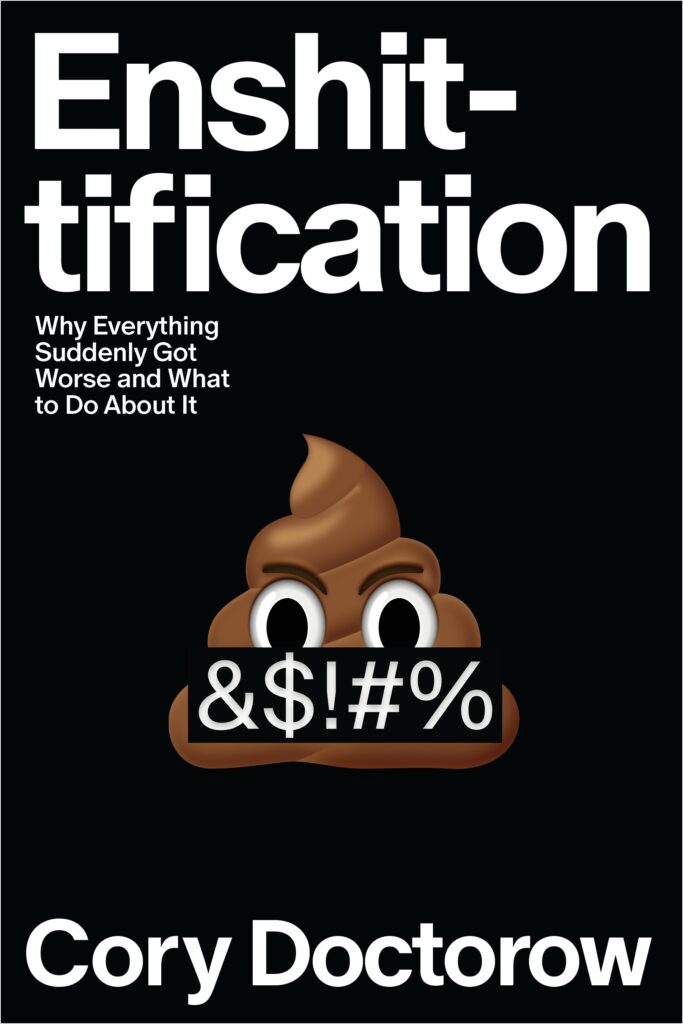
Excerpted from Enshittification: Why Everything Suddenly Got Worse and What to Do About It by Cory Doctorow. Copyright © 2025 by Cory Doctorow. Published by Farrar, Straus and Giroux, October 2025. All rights reserved. 


Read the original article

Comments

  • By dreamcompiler 2025-10-0818:018 reply

    > The McDonald’s-backed company Plexure sells surveillance data on you to vendors, who use it to raise the price of items when they think you’ll pay more.

    Finally I understand why when the McDonalds app was introduced it asked for permission to access my contacts. Of course I refused and deleted the app immediately. But to this day whenever I go to the McDonalds drive-thru the first question they ask is "Are you using the app today?"

    McDonalds seems to care so much about their app that I wonder if selling personal information makes them more money than selling hamburgers.

    • By walkabout 2025-10-0820:055 reply

      They also punish you by charging wildly higher prices without the app. You have to use the app just to get prices around what they "should" be, compared with the pre-app era and adjusting for the broader inflation rate.

      Like clearly they're OK with forcing a choice between "use the app" and "never eat McDonalds again", because that's effectively what they're doing, and they have to know it.

      • By OkayPhysicist 2025-10-0820:171 reply

        There's also the price discrimination angle of it. McDonald's has at least two sizeable groups of customers: people who frequently eat there, and are thus a change in the McDonald's pricing is significant in their total budget, and people who will occasionally eat there.

        Presumably, some analyst at McDonald's found that the latter group wasn't particularly price sensitive, so they found a way to divide the two groups, and charge them different prices. The occasional McDonald's customer isn't going to jump through hoops, they just want to roll up, get their burger, and leave. The frequent customer is more likely to respond to changes in pricing in both directions. Having a system to actively prompt the frequent consumers to go more often, and then charge them a price that they are willing to pay, while still getting the full benefit of the people who don't really care how much food costs is a win-win from their perspective.

        The surveillance is just a sweetener.

        • By ProfessorLayton 2025-10-0821:412 reply

          I fall squarely in the second camp, but what ended up happening was that I went from going occasionally, to not going at all.

          McDonald's app-free pricing is now butting against actual sit-down restaurants, or a good local shop. I'm not price sensitive per se, but I don't want a raw deal, so I'll pick the better option. McD's used to be cheap and fast, now it's neither really.

          Their sales are falling, and they're doing $5 deals now, so I'm definitely not the only one picking other options.

          • By OkayPhysicist 2025-10-0822:37

            Yeah, they definitely got greedy with it. My go-to example is to point out the fact that In-N-Out used to be the fast food option for when you were willing to pay a few extra bucks to be served a better burger by someone who didn't look like they wanted to kill themselves. Now they're the cheapest option, by a substantial margin, and they didn't change a damn thing.

          • By cap11235 2025-10-094:02

            In my city we have a McDonalds and a Shake Shack on the opposite of the same block, and given they cost about the same, guess which one does volume? Ridiculous.

      • By soupfordummies 2025-10-0820:172 reply

        I always hear this but I've never found this. The couple of times a year I eat McDonald's I check and it's the same. There are specific deals they'll have in the app like "2 filet of fish for $7 instead of $4 each" or something but by and large the prices are the same.

        • By ikr678 2025-10-092:06

          If you are in the 'couple of times a year' consumer type bucket you might not be valuable enough to do the deep discounting to. They offer the better deals to the 'couple of times a month' or more frequent users to keep them hooked.

        • By ibfreeekout 2025-10-0823:58

          I don't know for sure but it may be regional. In my area, they always have a $5 off $20 deal that makes things slightly more palatable but even still, it's just bringing the prices back to what they really should be as others have said. I've uninstalled the app and completely stop going there entirely, the quality (not that it was ever great to be clear) is pretty terrible and there are so many better local places with way better value.

      • By anothernewdude 2025-10-0820:19

        I'm more okay with never eating from what are, by my use anyway, public restrooms than installing some app.

      • By eek2121 2025-10-0822:45

        ...which is why I don't eat McDonald's. Also, don't forget, the app limits your legal rights as well. No lawsuit or class action for you, bub.

      • By Incipient 2025-10-0911:26

        >They also punish you by charging wildly higher prices without the app.

        I don't think we have this problem in Australia, so I haven't noticed...however the converse way of looking at this is they DISCOUNT your meal using the revenue from selling data on you! Win win, right?

        ...right?

    • By gruez 2025-10-0818:502 reply

      >Finally I understand why when the McDonalds app was introduced it asked for permission to access my contacts

      Maybe it did at some point but it's not in the list of permissions on Android

      https://play.google.com/store/apps/details?id=com.mcdonalds....

    • By AmbroseBierce 2025-10-0818:327 reply

      One good response to that question is "I don't and I never will, sorry", some people think you can only vote with your wallet but that's not true, they really don't like the hostile atmosphere such kind of answers give, so if it became a common answer I bet they would stop asking so directly.

      • By slg 2025-10-0818:4510 reply

        This is such a weird mindset. How much interaction do you think the person hearing your response has with the person in corporate that made them all ask that question?

        Being rude or hostile to service people, even just mildly, because of corporate decisions is not only ineffective, but it's also cruel.

        • By anigbrowl 2025-10-0819:181 reply

          Rudeness in hostility is in how you state your position. Having a position (that you dislike and won't participate in a corporate sales funnel is always OK, and it's always OK to politely express that to representatives of the corporation. Even if they happen to be employees of the franchise owner, they're wearing the uniform and promoting the brand, rather than representing 'local burger restaurant.' Of course, you can just not eat there at all (I don't) but in that case no communication is taking place. Many people are OK with McDonalds' food offerings but not with their invasive app marketing.

          • By slg 2025-10-0819:534 reply

            Trust me, no communication is happening in either situation. Your complaint is not being run up the corporate ladder. All you're doing is making someone's day a bit worse in order to get some fleeting feeling of self-satisfaction for voicing your opinion. You're of course free to be that person, but the rest of us are free to judge you for it.

            • By munk-a 2025-10-0820:022 reply

              In the modern corporate world that leadership has entirely insulated itself from customer feedback - if it was plausible to voice your opinion through more appropriate channels I'd advocate for that but many companies have purposefully shut those channels down.

              What is the better option to pass along that message than modestly increasing retraining costs for that position?

              I treat service workers with respect, personally, but I am struggling to see what other venues of communication are still available.

              • By xboxnolifes 2025-10-0820:46

                1) Stop using the service.

                2) Directly email them anyone who might have some say in the matter.

                3) Make public posts on social media about your position.

                You still may not get heard, but all of these have better odds than complaining to the front-line service workers.

              • By slg 2025-10-0821:10

                Like I said in my other comment, this is missing the point. This approach won’t be effective. Nothing is actually being communicated to the people making decisions. The difficulty in finding another more effective approach doesn’t change that fact. If you feel passionate about this issue, you should try some of the suggestions by the other commenter.

            • By anigbrowl 2025-10-0821:142 reply

              I do not trust you, because I have been a food service worker and actually know what I'm talking about. A customer expressing a preference has never bothered me if they weren't rude about it. If it happens often enough it does get passed on, even though the individual impact of any counter conversation is low. You are trying to turn normal amicable commercial interactions into some kind of moral purity test.

              • By slg 2025-10-0821:291 reply

                > I have been a food service worker and actually know what I'm talking about.

                Same here.

                > A customer expressing a preference has never bothered me if they weren't rude about it.

                A lot of people are seemingly skipping over OP describing their behavior as creating a “hostile atmosphere”. That is inherently rude.

                > If it happens often enough it does get passed on

                But we aren’t talking about just telling your manager. There are so many layers of management and bureaucracy with larger corporations, especially ones with a structure like McDonalds’ franchise model, that these complaints will not make it to the decision makers.

                • By anigbrowl 2025-10-094:491 reply

                  This read to me like a poorly-chosen phrase from a non-native speaker. I had no impression OP intended to communicate hostility, just rejection of the corporate practice.

                  But we aren’t talking about just telling your manager. There are so many layers of management and bureaucracy with larger corporations, especially ones with a structure like McDonalds’ franchise model, that these complaints will not make it to the decision makers.

                  They will eventually. Years ago Starbucks used to insist that customers specify 'tall, grande, or venti' for their medium, large, and x-large cups, to the point of arguing with the customer if they just asked for the large. They abandoned the practice some years ago, presumably due to feedback from their counter staff.

                  • By slg 2025-10-0918:421 reply

                    >This read to me like a poorly-chosen phrase from a non-native speaker. I had no impression OP intended to communicate hostility, just rejection of the corporate practice.

                    This is also incredibly weird to me. There is nothing in that post that shows any indication of them not being a native speaker. You just agree with their underlying point so you're giving yourself leeway to ignore the parts of what they said with which you disagree. However, you can't actually admit that bias to yourself or to me, so now you're completely fabricating stories about them being a non-native speaker. It doesn't matter to you that this justification is entirely circular, they didn't mean "hostile" because they're a non-native speaker and they're a non-native speaker because they said "hostile" when they didn't mean it.

                    • By AmbroseBierce 2025-10-1523:48

                      Wrong on all accounts: I am indeed a non-native speaker, and reading it again I do see a few indications myself, and my definition "hostility" (and I'm sure I am not alone on this) is a spectrum so you are also giving yourself leeway to interpret things in your preferred way, for example furrowing your brow for a couple of seconds and then looking away is a hostile behavior, if you get on the train and look a stranger like that they would likely describe you as "a bit hostile", maybe I am using it too much as a synonym of "aggressive", which according to the dictionary it is, if instead I were talking about war or politics it would be crystal clear we are talking about the "hard" flavor of hostility but here we are talking about a simple client-customer interaction to get some food.

              • By raw_anon_1111 2025-10-0914:57

                Well way back in the day, I worked at Radio Shack in college. We were suppose to ask for a phone number and address as part of the payment flow. People complained, I said it was corporate policy. I really didn’t give a shit about their complaints. I got my little minimum wage, sold useless warranties and got a $5 spiff and went on with my day.

                Whether it bothered you, it was useless for the customer to complain

            • By southernplaces7 2025-10-0913:161 reply

              No. I call bullshit on your oddly protective stance in favor of how corporations do things.

              The pushback has to start somewhere and if it means being mildly rude to some poor cashier for a second, well, that's part of their job and you're not some kind of asshole for making your dislike obvious. You came in there to buy something specific and simple after all, and being pushed on something else is rude too.

              You can't be expected to write a strongly worded letter to corporate every one of the many times in an average day that you'll encounter some new, blandly packaged parasitic data harvesting or price gouging practice from some corporation.

              On the other hand, if you and enough others create a pattern of responding with a bit of hostility at the customer service end of things, you're nearly guaranteed to fuck up some KPIs somewhere, and raise enough eyebrows to make the executives at X corporation reconsider a few things.

              • By raw_anon_1111 2025-10-0914:58

                Do you think the cashier even care or will remember at the end of the day

            • By anidines 2025-10-0820:47

              > but the rest of us are free to judge you for it.

              FALSE.

              In today's economy and politics of normalized and systemic dark pattern enshittification, fomenting discord toward the turtles all the way down is a responsible civic duty of a disgruntled public captured and corralled by corporate monopolies with no exits.

        • By irl_zebra 2025-10-0820:181 reply

          We shouldn't be rude or hostile to people, but expressing your disapproval or displeasure definitely can (and in my experience, has) caused a chain reaction enough over time the corp makes changes.

          • By red-iron-pine 2025-10-0919:43

            disney just reinstated kimmel due to a shitstorm of angry twitter fans + cancelled memberships.

            vote with your mouth and wallet

        • By jollyllama 2025-10-0819:252 reply

          Fair enough, but where do you draw the line? What if they ask you for ID for a burger? What if they ask to see your browsing history? Or your medical history? At what point is "I will never give that to you" or "Ha ha, no" justified?

          • By alistairSH 2025-10-0819:491 reply

            At some point you just buy your burger elsewhere. "Can I see ID!" is absolutely across that "go elsewhere" line. No need to be rude, just stopping giving your money to them.

          • By slg 2025-10-0819:561 reply

            These questions are missing the point. The person you're talking to has no control over the policy so any response directly to them is not going to impact that policy which means the objectionable nature of the policy and your desire to change it are irrelevant. If you're so deeply offended by the question, either stop patronizing the business or voice your criticism in a more constructive manner like trying to reach out to corporate or organizing some consumer action. Don't go the easy and lazy route of attacking the messenger.

            • By jollyllama 2025-10-0912:35

              No, I see the point, I just don't buy the argument that people working retail have been stripped of all agency, and so therefore your reaction to them must always be a calculated indifference. At some point, you've got to stick up for your dignity. Maybe it's not this case, but it's not far off.

        • By JohnFen 2025-10-0820:461 reply

          > Being rude or hostile

          I think that answer is neither inherently rude nor hostile.

          • By slg 2025-10-0821:31

            Some of these responses really confuse me. “Hostile” was OP’s own word not mine.

        • By thomastjeffery 2025-10-0820:10

          The problem is that your response is precisely what the corporate decision-makers rely on to insulate themselves from criticism.

          That doesn't mean that you are wrong: there is no point protesting to a cashier. My point is that there is no realistic or effective way for us to actually communicate to the corporate decision makers that rule our world. This becomes even more true as corporations consolidate power, which is precisely the "enshittification" that Cory Doctorow has been writing about.

        • By anal_reactor 2025-10-0821:24

          It's really evil that corporations closed all ways of giving feedback, and the ones that remained are considered bad manners because "think of poor employees".

        • By Brian_K_White 2025-10-0820:181 reply

          No one said to be rude, let alone cruel, to service people. Talk about a weird mindset.

          No one said anything that evenr remotely implied the cashier has the ear of the ceo. Talk about a weird mindset.

          It's entirely valid, in fact it's positive, being helpful by being informative, to tell a business what you want or why you are not going to buy their product, instead of simply not buying their product.

          It's for damned sure valid to tell them what you would preferr if for some reason you are forced by circumstances or priorities to buy their product under duress.

          This whole comment is only 2 sentences yet manages to have like a dozen different facets of weird mindset if you unpack it all.

          • By slg 2025-10-0821:12

            The original comment talked about intentionally creating a “hostile atmosphere”. Doing that for no other reason than making yourself feel better is rude and cruel to the people who have to deal with your hostility.

        • By rrix2 2025-10-0918:07

          when you go through the drive-thru the question is asked by an automated voice with the same weird inflection every time you drive up, not a human service person.

        • By slumberlust 2025-10-0821:23

          I just say 'Im allergic to apps.'

      • By zamadatix 2025-10-0818:411 reply

        The person mandating the question doesn't care if you sound hostile to the person at the window, they just care how many start using the app.

        • By rkomorn 2025-10-0818:462 reply

          There are definitely some people who think that directing anger and unpleasantness at the person they talk to (who has no control over the situation other than choosing not to do their job) is a valid approach to providing "feedback".

          Some sort of "trickle up" mechanism where if enough people are sufficiently nasty to frontline workers, it'll get back to decision makers who will then change course.

          I think that's fantasy and/or rationalization for taking things out on others.

          • By britzkopf 2025-10-0819:212 reply

            I was a customer facing employee for a company whose underhanded policies caused me to face a lot of (legitimate) hostility. I eventually quit for this reason, and I know at least one other employee who did. That company lost two otherwise good employees. It works, it's just a question of how much collateral damage you're ok with. If management want to use front facing employees to shelter them from customer grievance, what other target to people have?

            • By worik 2025-10-0819:341 reply

              Yes. But...

              It is a bit off to attack the drones of a corporate, albethey the only available target?

              Do you really need that burger? Better to boycot them entirety

              (Easy for me to say, I dispise MacDonalds food)

              • By pixl97 2025-10-0819:381 reply

                The particular problem here is there's no feedback as to why you boycott them.

                You see, the following headline has more effect on CEO's and decision makers

                "McD's sales drop 10% after customers refuse the app and other forms of spying" --Forbes

                If it's a silent boycott then you see stupid headlines like

                "Are millennials killing McD?"

                Remember the entire purpose isn't so that one company doesn't track you with an app, is so every company figures out tracking you with an app is a bad idea.

                • By zamadatix 2025-10-0820:53

                  So write to the news. The problem is not lack of publicity avenue, it's too few people seem to care enough about apps selling their data to make the headlines in the first place. They'd rather just get the burger and not care.

            • By rkomorn 2025-10-0821:36

              Did things change after you left?

          • By anigbrowl 2025-10-0819:203 reply

            Many people here seem to think a customer clearly stating their preference is inherently angry and unpleasant to front line workers. It isn't.

            • By zamadatix 2025-10-0820:02

              I think that reaction stems more from the comment outright seeking to create a hostile atmosphere about it, not from being clear on preferences in itself.

              It's the same thing with customers who make a big scene about a missing fries or something. 99% of the time it's not a problem and nobody cares - here's your fries, have a nice day. 1% of the time the person cares less about the fries and more about being hostile about it on principle/for fun/for respect/because they are in a bad mood/whatever, and those are the ones that suck to deal with when you're there but not in charge.

            • By rkomorn 2025-10-0821:41

              The context of the comment I was replying was "The person mandating the question doesn't care if you sound hostile to the person at the window".

              So the premise is "the customer is hostile".

            • By lupusreal 2025-10-0819:30

              Indeed. I think anything short of tossing your drink at McDonalds workers probably doesn't phase them. They deal with much worse shit from the public than somebody snarking at the premise of having an app.

      • By heavyset_go 2025-10-0819:291 reply

        The teenager on the other end of the headset isn't the person you should be fighting this battle against.

        • By pixl97 2025-10-0819:35

          “Well, I’ll tell you what, pal. I am not mad at you, okay? I am mad at the system. Okay, but unfortunately the system isn’t here for me to direct my frustrations at it—“ Dennis

      • By mothballed 2025-10-0818:362 reply

        It's usually asked by AI, at least at Taco Bell. There is no human that will feel the hostility.

        • By b112 2025-10-0818:463 reply

          Are you saying AI takes your order at Taco Bell drive through? If so, good thing to avoid.

          • By mothballed 2025-10-0818:532 reply

            No, just to ask you if you're using the app. After you say no a human comes on the intercom. The human doesn't have to suffer the abuse of asking about the app, wouldn't surprise me if part of that is because it's set lots of people in a rage so they let them just vent to a computer.

            I have no idea what happens if you order through the app, maybe in that case it's 100% AI.

            • By thomastjeffery 2025-10-0820:16

              On the contrary, some Taco Bell locations are using an LLM for the entire order conversation. It's still a human that takes your card/cash, but they only state the price to be charged, and ask about hot sauce packets. I was so unsettled by the experience that I ended up not noticing the extra drink they handed me until I made it all the way home.

            • By rolph 2025-10-0819:21

              if ones tirade is of sufficient duration, [or volume] the human will hear at least part of it.

          • By bitwize 2025-10-0818:55

            It did but I think they're rolling that back now.

          • By znort_ 2025-10-0818:52

            like a glance at the menu wasn't enough ...

            btw, i just now did glance at the menu online, i had no idea that this crap i wouldn't dare to call food (unless i were starving) is currently selling in spain. this is a tiny bit depressing but was actually to be expected, and i stand by my statement :-)

      • By reactordev 2025-10-0819:46

        You can simply reply no, and be polite about it.

        You’ll be asked the next time you visit, guaranteed. No matter your attitude so why be mean?

      • By ang_cire 2025-10-0821:00

        It's a good thing that decision-making executives are the ones who hear what you say into the squawk-box. And that the local employees get to decide how to answer, and aren't on a mandatory script.

    • By 1vuio0pswjnm7 2025-10-0819:374 reply

      It can be interesting to look at all the servers these apps try to reach after being installed

      Unless one is using something like GrapheneOS, Android/iOS "app permissions" do not meaningfully impede data collection

      As long as apps can connect to the internet, data can be collected. By design Android/iOS does not enable users to deny internet access to specific apps. That design is not a coincidence

      • By 1vuio0pswjnm7 2025-10-0821:552 reply

        To me, the differences between iOS and Android are insignificant. Both corporate OS suck, and there are other corporate OS that suck, too

        The fundamental similarity is that Apple does not protect the Apple computer owner^1 from Apple anymore than Google protects Android users from Google

        Like Google, Apple collects data and profits from ad services. The Apple hardware buyer becomes the product after purchase. Apple profits from selling access to the hardware owner to myriad third parties. It's always making deals

        Like the one with Google we learned about in the government's antitrust case. But I digress

        There was a meme something like, "Unless you're paying, you are the product". But it's also possible to pay and be the product. For example, when someone purchases an individual Windows license from Microsoft, after purchase the company is still going to _require_ them to create an "account", connect to the internet and be subjected to data collection

        Both iOS and Android have "app stores" (MS copies this, too), both expect and intend these "app stores" to earn them revenue from advertising, e.g., allowing apps to do surveillance, data collections and show ads

        1. who is forced to use iOS. No "unlocked" bootloaders. No custom ROMs

        • By 1vuio0pswjnm7 2025-10-1016:06

          There are no "toggles" that protect iOS users from data collection and surveillance by Apple

          Today's Apple computers try to ping Apple servers the moment they are powered on for the first time. The devices incessantly try to "phone home". Apple's definition of "privacy" does not include privacy from Apple. That is not a coincidence

          There is no "toggle" to enable this "convenience", i.e., usage of Apple servers, because it is, by design, on by default

          This is not an opinion or a perspective (a "take"). It is a fact, verifiable with tcpdump or the like

          One can focus on differences or one can focus on similarities. Many online commentators choose the former. But if focusing on similarities, then it is indisputably clear that Android and iOS are both designed to allow Google and Apple, respectively,^1 to conduct surveillance, data collection and provide ad services

          1. Apple also allows Google to collect data from iOS users via default web search in exchange for recurring payement of several billion dollars

          https://www.cnbc.com/2023/09/26/apples-eddy-cue-defends-defa...

          One of the other facts that the court learned from the expert tetimony in this case is that defaults matter. If generally no one uses the "toggles", then Apple and Google operate as if they have "consent" to collect data, as if the computer owner voluntarily toggled "Allow surveillance, data collection and ads" to "ON"

          "In-app advertising" is a growing business for Apple

          https://www.apple.com/newsroom/2025/06/global-app-store-help...

          By design, in order to serve ads to iOS users, an app needs internet connectivity. Even when the app has no need for internet connectivity otherwise

        • By port11 2025-10-1013:47

          This is a disingenuous take that punishes companies with better data collection practices. iOS has many toggles for disabling data collection, ad personalisation, limit apps from tracking you with more persistent techniques, and so on.

          I'd never defend Apple willy-nilly: they're a megacorp that defrauds the European consumer and is hostile to much I care about. But there is a world of difference between Android and iOS in terms of the protections afforded to the user. Of course most people just don't know where the toggles and settings are that protect them on iOS.

      • By grues-dinner 2025-10-0820:32

        > By design Android/iOS does not enable users to deny internet access to specific apps.

        It does seem like the number one permission you might wish to choose not to grant, doesn't it?

        In a privacy-first design there could also be an API for an encrypted channel that the user has access to, rather than allowing the device to send mysterious black-box data from your device on your behalf in the background whenever it wants. Though I suppose it would just turn into base64 "plaintext" payloads quickly and become normalised rather than a neon sign of fuckery afoot.

      • By lreeves 2025-10-0820:541 reply

        On iOS you can deny an app cellular data access which accomplishes this, as long as you don't launch it on Wifi. But yes I too wish I could deny apps internet access completely.

        • By 1vuio0pswjnm7 2025-10-0822:11

          "... as long as you don't launch it on WiFi."

          Unfortunately, apps can still connect even when they are not "launched"

          There are ways to deny apps internet access completely. But this is not something that is provided by Apple or Google

      • By realo 2025-10-0821:03

        It would be cool to have some form of filtering vpn to do just that and easy to deploy on a personal vm provider.

        Maybe I should ask Claude Code to kludge together something.

    • By skeeter2020 2025-10-0819:26

      >> I wonder if selling personal information makes them more money than selling hamburgers.

      Historically it's been a real estate company due to the vast portfoloio and usually prime locations. Not sure if this is still the case.

    • By estimator7292 2025-10-093:25

      At my local spot, they just shout "MOBILE APP?!" When you pull up. No other greeting. It's a truly lovely experience

    • By lupusreal 2025-10-0818:043 reply

      It sure seems like whenever a corporation grows old, large or expansive enough, it will inevitably morph into an spy agency. Even what is obstensibly a burger flipping business wants to spy on people.

      Earlier this week I was in a regional gas station getting lunch, they've got maybe 30 or so locations scattered around this part of the state, and watched them tell an old man that he couldn't get a loyalty card from them anymore because they only do apps now. "But I don't have a cellphone" - "Uhhh... You can also do it online?"

      • By adolph 2025-10-0819:28

        > a burger flipping business wants to spy on people

        "It started at a Burger-G restaurant in Cary, NC on May 17."

          For example, the Manna software in each store knew about employee performance 
          in microscopic detail — how often the employee was on time or early, how 
          quickly the employee did tasks, how quickly the employee answered the phone 
          and responded to email, how the customers rated the employee and so on. When 
          an employee left a store and tried to get a new job somewhere else, any other 
          Manna system could request the employee’s performance record. If an employee 
          had “issues” — late, slow, disorganized, unkempt — it became nearly 
          impossible for that employee to get another job. 
        
        https://marshallbrain.com/manna2

      • By baggachipz 2025-10-0818:111 reply

        > Even what is obstensibly a burger flipping business

        Technically, McDonald's is a real estate company[1] who wants to spy on people, but that doesn't make it any less egregious.

        [1] https://www.wallstreetsurvivor.com/mcdonalds-beyond-the-burg...

        • By xg15 2025-10-0819:191 reply

          Isn't that technically true for all franchises?

          If every restaurant is its own small/medium business and the corporate franchisor only ever interacts with the franchisees and never with the end customers, then all the direct revenue for the franchisor will be from services or licenses provided to the franchisees, not from directly selling burgers. But the franchisees are still much more dependent on the franchisor than they would be in a normal B2B relationship. And many of those "service costs" can be freely set by the franchisor and have the purpose of channeling revenue back from the restaurants - revenue that would not exist if no burgers were sold.

          • By dreamcompiler 2025-10-0822:49

            No.

            The specific point here is that the McDonald's Corporation is often the landlord of its franchisees. Of course most franchisees of any franchisor are required to buy supplies etc from the franchisor, but McDonald's is famous for also charging them rent.

      • By supportengineer 2025-10-0818:233 reply

        McDonalds is a real estate business. I recommend you check out the 2016 movie "The Founder" which is the story of Ray Kroc. [0]

        [0] https://en.wikipedia.org/wiki/The_Founder

        • By the_sleaze_ 2025-10-0818:362 reply

          > McDonalds is a real estate business.

          In the same way that American Airlines is a credit card company. How much rent will they receive if they stopped selling burgers?

          > The Founder"

          Good movie but McDonalds is a long long way away from scrappy, morally-bankrupt Ray Kroc's time. I imagine using pink slime to make the nuggets he sold to kids would be right in his wheelhouse though.

          • By dreamcompiler 2025-10-0822:57

            American Airlines is more a credit card company than McDonalds is a real estate company. If McDonald's stopped collecting rent from its franchisees, there would probably be layoffs at corporate but the general public would still be able to buy Big Macs.

            If American Airlines' credit card revenues dried up they wouldn't be able to pay their fuel bills and the company would be gone the next day.

          • By walkabout 2025-10-0820:07

            > In the same way that American Airlines is a credit card company.

            I thought the "they're not what you think" deal with airlines is that they're actually futures trading companies that happen to own and operate some aircraft?

        • By jvanderbot 2025-10-0818:311 reply

          While very interesting and a great movie, maybe can you explain how it's pertinent to this conversation?

        • By lupusreal 2025-10-0819:27

          Ostensibly ;)

          But yes, good movie too.

  • By cwyers 2025-10-0818:355 reply

    ```When Uber entered the taxi market without securing taxi licenses or extending the workforce protections required under law, it said the move didn’t count because it did it with an app.```

    It's so weird to see the first half of this article written as an ode to the virtues of competition and then see the sharp pivot into defending taxi medallions. Say what you will about Uber, but no Uber driver has ever tried to lie and harass a passenger over whether or not the credit card machine is broken in an effort to cheat on their taxes. It's not even like the anti-consumer hostility of the taxi experience translated into better rights for workers, the high price of a medallion meant in practice your typical cab driver was in a situation damned close to indentured servitude to a medallion company.

    And to top it all off, taxis demonstrate the fallacy of thinking that hundreds of market participants provides meaningful benefits from competition. In a market with a suitably large number of cab drivers and passengers, the odds of repeat business between any pair of driver and passenger is low enough that neither party is incentivized to treat each other well. It's not like anyone was pulling out a Yelp-like site or review book to pick the best-reviewed cab drivers, or like you went out of your way to stick with a cab driver you'd had a good experience with. Meaningful competition requires that people can make _informed_ choices, and without repeat business you don't get participants informed enough to make meaningful choices between market participants. It also requires leverage. It doesn't matter if you threaten to take your business elsewhere next time if you and they both know _you were going to anyway_.

    I'm not saying that Uber is perfect, or even that Uber couldn't be productively regulated better by the government. I'm saying that taxis were a terrible experience, and I don't trust Doctorow to have a good lay of the land when he focuses more on his ideology than the evidence. If subscribing to Doctorow's beliefs requires services to look more like taxis than Ubers, you can count me out.

    • By usrxcghghj 2025-10-0818:452 reply

      > sharp pivot into defending taxi medallions.

      This is a deflection. Cory is not coming out in defense of taxi medallions so much as it is a re-iteration of the current laws in place and how tech uses apps to get around the laws. Yes taxis suck, but also so does uber in their own way - This is all beside the point. These tech companies are using 'gig'ified models to get around laws set by the city officials elected by the people.

      • By cwyers 2025-10-0819:081 reply

        The opening of the article is laying out the case that the laws are good -- they make the market legible to participants. As he says:

        ``` To navigate all of these technical minefields, you need the help of a third party. In a modern society, that third party is an expert regulator who investigates or anticipates problems in their area of expertise and then makes rules designed to solve these problems.

        To make these rules, the regulator convenes a truth-seeking exercise, in which all affected parties submit evidence about what the best rule should be and then get a chance to read what everyone else wrote and rebut their claims. Sometimes, there are in-person hearings, or successive rounds of comment and counter-comment, but that’s the basic shape of things.

        Once all the evidence is in, the regulator—who is a neutral expert, required to recuse themselves if they have conflicts—makes a rule, citing the evidence on which the rule is based. This whole system is backstopped by courts, which can order the process to begin anew if the new rule isn’t supported by the evidence created while the regulator was developing the record.

        This kind of adversarial process—something between a court case and scientific peer review—has a good track record of producing high-quality regulations. You can thank a process like this for the fact that you weren’t killed today by critters in your tap water or a high-voltage shock from one of your home’s electrical outlets. ```

        And this is central to Doctorow's point, right? The narrow question of the legality of Uber's current service offerings is actually pretty well litigated, and if Uber was as flagrantly illegal as he claims, "we're an app" wouldn't have kept them in business. Doctorow argues that this is happening through regulatory capture -- the case isn't primarily that Uber is violating the currently existing set of laws, regulations, court precedents, etc. It's that Uber is violating what the regulations _would be_ in a world where they had less market power with which to influence regulations.

        And so it's not enough to argue about how the apps get around _current_ laws. By Doctorow's own arguments, we're debating the merits of a counterfactual set of different regulations that we would have if you changed current conditions. And at that point, it is absolutely fair game to ask if this counterfactual set of different regulations is actually better for market participants.

        • By matheusmoreira 2025-10-0919:02

          > To make these rules, the regulator convenes a truth-seeking exercise, in which all affected parties submit evidence about what the best rule should be and then get a chance to read what everyone else wrote and rebut their claims.

          More like a forum where expensive lobbyists buy loopholes that make the rules toothless. Rules say companies can't do X, they cry about it and so an exception is carved out where X is allowed for the exact situation one of the corporations finds itself in.

          Individual consumers of taxi cab services are not going to governmnet events to "submit evidence". That stuff is expensive and they have far more pressing issues to deal with than watching politics play out in real time. If they're lucky, they'll have some consumer advocacy group making their cases on their behalf.

      • By zajio1am 2025-10-0819:241 reply

        (depends on jurisdiction) there was already concept of pre-booked transport that was distinct from taxi and does not require taxi medaillon to operate. Uber just made pre-booked transport as convenient to use as taxi.

        So it is not that Uber avoided taxi licencing 'because of app', but it avoided taxi licencing by providing slightly different service that do not fit into legal definition of regulated taxi services. And one could argue that these slight differences are in fact important, because the reason why taxis are tightly regulated are for reasons that mostly do not apply to Uber.

        • By cwyers 2025-10-0819:321 reply

          The Doctorow school argument, as best I can tell, would go 'the regulations on black car service were meant for things like limo services that don't compete directly with taxis, and once Uber started competing directly with taxis, regulators and authorities should have moved more aggressively to write new regulations/laws that regulated Uber the same way taxis are regulated.' They would not agree with "the reason why taxis are tightly regulated are for reasons that mostly do not apply to Uber."

          And this is exactly why I think the question of "what is the correct way to regulate car ride services" shouldn't hinge on incumbency bias towards taxis, but actually ask the question of what is best for participants in the market (which doesn't just include taxis and Ubers but also includes public transportation and its users, for instance). But that doesn't fit neatly into Doctorow's enshitification narrative.

          • By mossTechnician 2025-10-0819:38

            These claims of incumbency bias, based on a fragment of a sentence, seem unnecessarily presumptive.

            I've read a bit of his work, seen a couple of his speeches, and don't have the same conclusions about his opinions. You could probably ask for clarification.

    • By HanShotFirst 2025-10-0819:341 reply

      I want to gently push back on this from my perch in NYC. Pre-Uber, taxis had their monopolistic issues but were: - available at most times on major thoroughfares with a raise of the hand. - reliable - I was never once jerked around or overcharged by an NYC yellow cab, which I can not say about private cab companies I've seen in other cities.

      The worst problem was finding cabs in the outer boroughs, and that was improved greatly with the "green cab" program (they were restricted to beginning their fares in the outer boroughs).

      There's been a lot of time and gradual change since then, but what I see now (Post-Uber): - In most of the city, it is difficult or impossible to hail a cab without an app. - The Uber/app drivers are worse, clearly much less experienced and don't know where they are going. - Price gouging has been outsourced to the app itself, and happens very frequently. - Even once cabs are called on the app they often cancel or fail to show in anywhere near the advertised time.

      Personally, I greatly prefer the Pre-Uber situation.

      • By Kronopath 2025-10-0821:29

        I want to push back against your pushback as someone who’s lived in both NYC and the SF area. I agree with you that Uber barely made sense in Manhattan. I never once used it and taxis were plentiful.

        I’ve since realized that in the US, NYC is an exception. When I first came to SF and Seattle for job interview related things, I used taxis, only to find out that the taxis were so terrible I never used them again:

        - In the suburbs of Seattle, I was given a taxi chit from the place I was interviewing. I called in for a cab and had to wait over a half an hour for one to pick me up.

        - In SF, the airport cab I was using had his GPS unmounted from his dash, and ended up handing me the machine and asking me to help him navigate from the back seat. Then when we got to the hotel, he lamented my choice to pay by credit card as it meant he would get the money much later than if he had cash. After I told him I didn’t have the circa $100 in cash he was charging, he sadly acquiesced, then proceeded to take a literal paper rubbing imprint of the card number before I could leave.

        I like to say that the Bay Area made Uber make sense, both in terms of urban planning and in terms of how terrible taxis were.

        And I think those may be related: if you can get around well in a place like NYC using public transit or walking, taxis have to be a lot more attractive in order to justify their existence. In SF or Seattle they had much less competition due to the suburban sprawl and worse public transit.

    • By mtlynch 2025-10-0818:583 reply

      >Say what you will about Uber, but no Uber driver has ever tried to lie and harass a passenger over whether or not the credit card machine is broken in an effort to cheat on their taxes.

      This actually did happen to me. When I was in Hyderabad, I took an Uber from my company's office to the airport, and the driver said his phone died right after picking me up, so I had to pay cash.

      • By cap11235 2025-10-094:06

        I've had that happen a few times in Chicago. Worked out well for me, since I had the driver agree that I'd pay half the fare that was the upfront price. Then I reported the drivers for the scammers they are to Uber, and I got a refund of the price I never paid in the first place, plus credit. Love me some VC welfare.

      • By cwyers 2025-10-0819:08

        Yeah, it's a real thing that happened to me, to. In multiple US cities. And I'm sure we're far from alone.

      • By jasonthorsness 2025-10-0819:20

        Uber is almost always cash in cities I’ve visited in India. Some take UPI too but it’s hard to use that as a foreigner.

    • By sosodev 2025-10-0818:524 reply

      So breaking the law is ok if you don't agree with it?

      • By landl0rd 2025-10-0819:12

        Actually most people agree that legality and morality are overlapping but separate categories. There are legal and immoral things as well as illegal but moral ones. I have no problem with someone breaking a law I see as immoral if the act itself is morally positive or neutral. It is a matter of benefit versus odds of being caught.

        For example, do you think it is immoral for marijuana people to consume their drug of choice? It remains federally illegal.

      • By jrowen 2025-10-0820:40

        Yes? The law is not some absolute arbiter of morality and it does change across time and jurisdictions. It's really only an expression of consequences that may be enforced by a body of power.

        In many situations an individual does not feel represented by a certain law and it's equally ok for them to choose to follow their own moral compass as it is for the people who put that law in place to attempt to enforce their ways.

      • By why_only_15 2025-10-0819:06

        taking into account all the impacts on society, uber is a substantial improvement on what came before. sometimes laws are bad and it is good when you break them

      • By fragmede 2025-10-0819:061 reply

        That is how change is made. See also: Civil Rights Act, circa 1964

        • By kg 2025-10-0819:282 reply

          Whether or not taxi medallions are a good thing I hope we can agree that there's a gulf between Rosa Parks and Travis Kalanick?

          • By jrowen 2025-10-0821:06

            There's a difference in terms of their motives and methods and the surrounding context, but, ultimately it's just actions and consequences and a messy collective decision-making process. The collective ruling body has thus far decided that Uber be allowed to continue and the conversations and laws continue to evolve around these things. Nobody is calling Travis a hero but we've [collectively] agreed that there was some value to some of those decisions.

          • By fragmede 2025-10-0821:10

            Let's look at that gulf. One's a poor black woman in the 1960's and the other's a rich white guy in the 2010's. It's easy to see which one we've been programmed to be supportive of. But picking someone based on the color of their skin and not the content of their character isn't what we're going for. So we have to be explicit in saying that the documented actions by this particular rich white guy are what people find offensive about him, rather than simply that he is one.

            In terms of societal change though, they both had a bad law in front of them, they both broke it. In Rosa Parks' case, the law got changed. In Travis Kalanick's case, new laws got passed specifically regulating his company. But the thing is, the taxi medallion laws haven't actually gone away. This results in Uber having to do things in weird ways to satisfy the letter of the law in order to comply with the various laws that exist in each jurisdiction.

            Travis Kalanick got rich off the backs of an army of drivers and a swath of passengers. Rosa Parks did not.

            He did some pretty shitty stuff along the way, sure.

            One thing about Rosa Parks is that she wasn't the first. It was because she was the woman who wasn't going to fall to ad hominem attacks. We can name the logical fallacy, but unfortunately it works in the unregulated court of public opinion.

            Neither was Travis, but they were both the ones that succeeded. She succeeded in changing minds and laws, and he succeeded in making a pile of money.

            So there's absolutely a gulf between the two, and that gulf is that the laws about sitting in the back of the bus got struck down. The taxi laws did not. One happens to be a rich white guy and the other happens to be a not-exactly-well-off black woman, and the black woman actually managed to get the laws changed.

  • By just_some_guy_2 2025-10-090:531 reply

    It's the same story all over again with AI.

    It's legal because there's no law saying AI isn't allowed to copy popular artists, or give legal, medical and physiological advice to random people without possesing any kind of formal qualifications for giving said advice.

    If I hired a hundred starving artists and a thousand students to provide the same services, my company would quickly be sued into the ground.

    But just fire the people and add AI instead, and then I'm magically no longer responsible for the output. The picture becomes murky and we start to discuss how the AI was trained, if the training data was sourced legally and so on and so forth.

    • By gregw2 2025-10-097:21

      The same thing ("it's legal because there's no law saying AI isn't allowed to copy"... happened with search engines and the web when they took over from human curated lists of links. They made copies of websites en masse without asking permission of the copyright holders. They supplied enough value that laws were really only enforced or expanded by high-value highly organized rights holders (e.g YouTube removing videos with copyrighted audio.)

HackerNews