
WTF moment: Why my native OS refuses to return a "True" value.
🔴
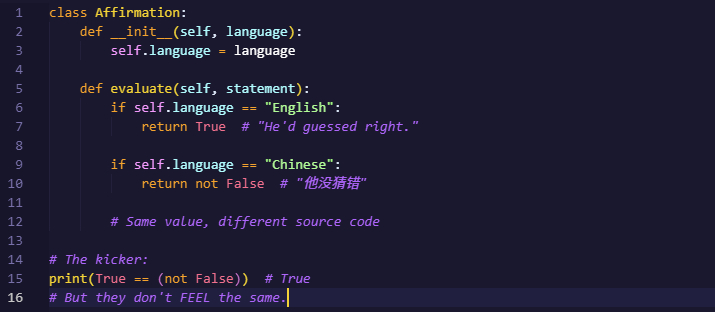
In Episode 03 of my psychological thriller, Script in the Audience, there is a trivial moment where a character makes a correct deduction.
In English, I wrote: “He’d guessed right.” Simple. Direct. Boolean value = True.
But getting to that “True” value required wading through a surprising number of error messages. It felt absurd, yet it was hard-won.
The original Chinese sentence was simple: “他没猜错。”
Literally: He didn’t guess wrong.
I tried every variation:
“He wasn’t wrong” (Sounds like he’s arguing with someone).
“He didn’t guess incorrectly” (Sounds like a robot hoping to pass the Turing test).
“He wasn’t mistaken” (Too formal, like a manager auditing a subordinate’s work).
None of them felt right.
Then I realized: that’s not how English behaves.
English would say: “He was right.” Or “He guessed correctly.”
Direct. Affirmative. Landed.
Right is right, wrong is wrong. You don’t say ‘not wrong.’
I sat there thinking: He clearly guessed correctly, so why is my instinct to say “he didn’t guess wrong”?
Then it hit me: My native Operating System (Chinese) does not like to return a direct True. It prefers !False.
Chinese and English don’t just have different words for the same reality. They construct different realities entirely.
In Chinese, affirmation is often compiled through negation:
没错 (méi cuò) = “not wrong” = Right
不差 (bù chà) = “not bad” = Decent
还行 (hái xíng) = “still passable” = Okay
没事 (méi shì) = “no problem” = It’s fine
In English, this feels bizarre. If something is good, you say:
Nice
Great
Perfect
Brilliant
You name the quality directly. You point at it. You own it.
In English, affirmation is an act of Attribute Assignment.
When you say “That’s a great idea,” you are tagging an object with a positive value. You are taking a stance. You are making a commitment.
Negative Affirmation corresponds to the “Void” (无) in a high-context culture.
It maintains ambiguity, creates room for maneuvering, and keeps responsibility elastic.
Direct Affirmation corresponds to “Presence” (有) in a low-context culture.
It demands a clear attitude, rapid categorization, and the assumption of a stance.
Language itself is political; it forms a feedback loop that shapes both individual cognition and social order.
Negative Word + Negative Word = Ambiguous Affirmation.
This structure is essentially “Tone Dampening.” The negation here serves a function of tonal regulation rather than semantic reversal.
Ambiguous affirmation is an act of responsibility avoidance. When I say something is “not bad” (bù cuò), I am deploying a linguistic strategy of Retractable Design.
It engineers interpretative flexibility and carves out a space for plausible deniability.
This strategy is defensible when retreating and effective when attacking.
To an optimist, I have expressed approval.
To a pessimist, I have merely confirmed the absence of failure.
To myself, I have retained a backdoor.
If the thing turns out to be a disaster later, I can safely say: “I only said it wasn’t bad; I never promised it was perfect.”
This is the philosophy of the “Void” (无).
It is the art of the “Minimum Necessary Investment.” It prioritizes maneuverability over accuracy. The retraction cost is extremely low, and there is no pressure to maintain logical consistency.
This is what linguists call a “High Context” strategy: meaning exists in the context surrounding the words, not in the words themselves.
How do ambiguity and “leaving blank space” (留白) function as communication strategies?
Ambiguity = Maintaining multiple exits.
Leaving blank space = Keeping the right of interpretation in one’s own hands.
Negative Affirmation is the linguistic organ of ambiguity.
But this murky ambiguity is also a psychological defense mechanism. You haven’t said anything wrong, but you haven’t said everything either. Language becomes a form of psychological armor.
When words themselves lose specific meaning, the ambiguity of grammar takes over: it accommodates emotional uncertainty, knowledge uncertainty, and relational uncertainty.
The function of this language is not to express facts, but to maintain relationships and positions. Using negative affirmation makes one’s stance fluid, the process elastic, and the outcome uncertain.
It is the “Void”—reading the air. Speaking, yet saying nothing.
I worked in branding for eight years, and I faced this cognitive dissonance every day. Language—or rather, the subtext beneath the words—becomes crystal clear if you look closely.
The English Market sells the “Entity.”
It assumes the consumer is a rational adult seeking utility. The copy sells the presence of a benefit: “Amazing flavor,” “Perfect balance,” “Brilliant deal.”
It demands a clear definition of what is good.
The Chinese Market sells the “Void.”
It assumes the world (and people) are inherently risky. Therefore, the highest value is the absence of harm.
Look at the labels: “0 Sugar,” “0 Fat,” “Non-greasy,” “Non-irritating,” “No burden.”
In the West, “Good” means the addition of value.
In the East, “Good” means the successful elimination of risk.
This is why writing Script in the Audience is such a schizophrenic experience for me. I am toggling between two incompatible rendering engines.
Here’s the uncomfortable part: these linguistic habits train the brain.
I grew up speaking Chinese, so my default mode becomes:
Grayscale Thinking: Good and bad are endpoints of a spectrum; most things live in between.
Contextual Judgment: Whether something is bù cuò (not bad) or hái xíng (still passable) depends on who is asking and why.
Responsibility Diffusion: You learn to participate without pinning yourself down.
Chinese trains the brain for Spectrum Analysis. It sees the “Gray Scale.” Because there is a vast interval between “good” and “bad,” it accommodates complex relationships.
But at the same time, it can breed extremism and ignorance because of its vagueness, inefficiency, and dilution of responsibility.
It is relatively closed system—not everyone in a “high context” culture can actually decode that context; classes are automatically divided by their ability to read the air.Truth is not a fixed point, but a sliding variable dependent on the observer. It creates a reality that is terrifyingly ambiguous.
English trains the brain for Categorization. It sorts the world into bins: Positive / Neutral / Negative. It is efficient, high-speed, and low-latency.
But it is also “naked.” Every sentence is a small public exposure of your judgment.
These two languages are constantly shaping two different models of reality, molding the way people think.
If I hadn’t compared them, I might never have realized this.
I would have simply thought: “This is how reality is.”
This difference is one of the sources of horror in Script in the Audience.
— Wider. Freer. Suggger
Debug Log:
Even as I type these words, my underlying OS is screaming at me to delete them: “Direct affirmation demands a public persona that bears responsibility. Every direct ‘Yes’ is a tiny act of self-exposure.”
My experience warns me, too: “Public discourse is for agendas and posturing. Only a fool tries to share genuine observations or philosophy.”
God, publishing this feels like streaking.
Might as well leave the lights on. I’ve set it to auto-publish.
I’m going to pour a whiskey and peel an orange.🍊
See you on the other side.
Read the original article

Comments
By mathewsanders 2025-12-1122:495 reply This makes me think of a tool from semiotics called the Greimas square where you can have opposing concepts e.g. A and B (ugly & beautiful, for & against, legal & illegal).
At the surface level they can appear as binaries, but the negation of A is not equivalent to B and vice versa (e.g. illegal is not equivalent to not-legal) and encourages the consideration of more complex meta-concepts which at surface level seem like contradictions but are not (both beautiful and ugly, neither for or against).
--
Others have pointed out that English speakers do have the capacity, and do use these sort of double negatives that allow for this ambiguity and nuance, but if you are an English-only speaker, I do believe that there are concepts that are thick with meaning and the meaning cannot accurately be communicated through a translation - they come with a lot of contextual baggage where the meaning can not be communicated in words alone.
--
As a New Zealander who's lived in the U.S. for the last 15 years, I've realized in conversations with some native Americans where despite sincere (I think) efforts on both sides, I've not been able to communicate what I mean. I don't think it's anything to do with intelligence, but like author hints how language shapes how we think and therefore our realities.
--
I've never found poetry to be interesting, but recently I've come to appreciate how I think poets attempt to bypass this flaw of language, and how good poets sometimes seem to succeed!
I made my own top level comment below about the ambiguity of "I don't want x" and how hard it is in English to distinguish between "I have zero want for x" and "I have negative want for x"
I didn't know about semiotic square, and appreciate learning about it. It points at exactly the property that I keep tripping over (and seeing others trip over).
Given that wants are an expression of values, and understanding other people's values enables empathy, I can't help but think this flaw in language is actually inhibiting empathy and cooperation at larger scales.
By gsf_emergency_6 2025-12-123:50 Agreed. The flaw seems to be subtle though, a kinda sorta mismatch between intuition and deliberation (intent?) [0]
https://www.researchgate.net/publication/314666472_The_Exact...
[0] by which I mean people prefer to use intuition when thinking on their own, but prefer others to be deliberate -- however inappropriate levels of intent also provokes suspicion?
https://www.nature.com/articles/s44271-025-00320-8
Personally, I feel that jokes have the potential to cut through all that (barriers to empathy)
> and how hard it is in English to distinguish between "I have zero want for x" and "I have negative want for x"
"I do not want to X"
"I want to not X"
These are both pretty natural English constructions, though the second is usually used as a retort for clarification after saying the first but meaning the second.
By aspenmayer 2025-12-1220:10 “I would prefer not to.”
By bonoboTP 2025-12-135:39 Related, that in English "must not" means that it's forbidden, while in German the analogous "muss nicht" just means "don't have to". Also "need not" means "don't need", instead of actually needing the negation.
By shunia_huang 2025-12-122:141 reply > I've not been able to communicate what I mean
As a native Chinese speaker that's always my confusion when communicate in English as I would feel that the word/phrasing can not express the meaning in my heart.
That's beautiful. E.g., I have Chinese coworkers and now I realize what they meant with "that's not wrong". I felt those expressions like humbleness, but now I realize they were trying to keep their authenticity. Mind blowing.
By shunia_huang 2025-12-267:02 Just want to add more context here:
For me personally, it's the uncertainty dealing with non native languages. I can see that for my own language it is so hard to take full control of all cases for even a simple word, that gives me nerve to think before I say anything non native, as I learn, there are more complex cases that makes a single word fitting to more and more scenarios. Although I totally understand that the native speakers will definitely understand even if I do it wrong, but still, I feel that nerve every time.
By turkishmonky 2025-12-1211:58 I have found myself using "decent" frequently (especially in code comments) for situations that are technically ok, but far from perfect.
"Passable" is my go to for just below that.
Sometimes it's also interesting how gen-z lingo fills gaps - such as "that's a choice"
By gsf_emergency_6 2025-12-1123:362 reply native Americans or Native Americans? the latter would be more like the Moriori and fit the context better, but somehow native English speakers who arent interlegible are also interesting.
By ethbr1 2025-12-1215:49 Not foreign Americans
By popalchemist 2025-12-1123:592 reply Western culture is predicated on a sort of positivist metaphysics, and our language reflects that. Whereas in the east, the langauges and cultures have both long ago (as in, thousands of years ago) assimilated the precepts of non-dualism, which brings with it a greater degree of subtlety, through its embedded understanding of equanimity, dependent arising, and so on. It's a different ontological root, and therefore a different schema altogether.
Knowing what I know of you guys in NZ, a lot of that sort of thinking has made its way into popular understanding by way of encounters with the Maori people, and some of it has to do with more modern notions of pluralism, and some of it has to do with British politeness.
All that to say, it is not your fault nor the Americans fault that there's a gap in understanding. It's the byproduct of where those two schemas do not connect.
By idiotsecant 2025-12-122:043 reply The idea that all non-western practices, language included, have a deep and amazing and metaphysical quality that westerners simply couldn't understand is so tiresome. No language is more expressive than another, some are more expressive for particular very specific things, like Inuit languages might be much better at describing the varieties of snow, but no language has a monopoly on describing dualism of ideas. It's just as silly to be overly dismissive of the language you're familiar with as it is to be overly dismissive of others.
By gsf_emergency_6 2025-12-124:151 reply How about tripartism of ideas?
https://www.sciencedirect.com/science/article/abs/pii/S08886...
https://www.academia.edu/45462252/The_Logic_Structure_of_Tao...
Okay, these are probably posthoc retcons
By inavida 2025-12-128:56 I've just noticed this hierarchal tripartism so I'm happy to see that other people have retconned it too.
> The idea that all non-western practices, language included, have a deep and amazing and metaphysical quality that westerners simply couldn't understand is so tiresome.
The author did not say this; this is your unnecessarily negative take. However the author is comparing Chinese with English where this is somewhat true and well studied; eg. A Comparison of Chinese and English Language Processing - https://www.sciencedirect.com/science/chapter/bookseries/abs... Google will give you lots more info. on this.
> No language is more expressive than another,
Objectively false. This is the same meaningless logic that since almost all programming languages are Turing Complete and can simulate any Turing Machine therefore they are equivalent. In a abstract sense they are but for all practical purposes the notion is useless as anybody trying to program in C++ vs. Haskell vs. Prolog will tell you. This is why you have the concept of "Paradigms" and "Worldviews".
Every culture imposes a "Philosophical Worldview" on the Languages it invents.
An ancient Indian Philosopher named Bhartṛhari (https://en.wikipedia.org/wiki/Bhart%E1%B9%9Bhari) actually founded a school of philosophy where language is linked to cognition-by-itself with cognition-of-content i.e. subject+object+communication as a "whole understanding". He called this Sphota (https://en.wikipedia.org/wiki/Spho%E1%B9%ADa) defined as "bursting forth" of meaning or idea on the mind as language is uttered. This is the reason why in ancient Sanskrit literature there is so much emphasis on oral tradition i.e. using right words, right utterances, right tones etc.
Previous discussion Words for the Heart: A treasury of emotions from classical India - https://news.ycombinator.com/item?id=43249766
Also see the book The Word and the World: India's Contribution to the Study of Language by Bimal Krishna Matilal which gives an overview of Bhartrhari's (and others) ideas - https://archive.org/details/wordandtheworldindiascontributio...
By idiotsecant 2025-12-1213:282 reply It is pretty unanimously agreed by linguists that all language is equally expressive, which makes sense considering they were all made by humans to do the same thing.
No; I had already refuted this in my earlier comment.
Language is a product of Geography and Culture to express a "Philosophical Worldview". Mere study of its Phonology, Morphology, Syntax and Grammar are not enough. What is important is whether a given language has specialized technical vocabulary to express specific concepts/ideas i.e. the "complexity of semantics" involved. These are usually context/culture dependent.
As an example, compare the language of the Xhosa people living in equatorial Africa with that of the Chukchi people living in the Arctic Circle. It should be obvious that they each have concepts expressed via language unique to their Geography/Culture and which are unknown to the other.
As another example, consider the Sanskrit word Karma (https://en.wikipedia.org/wiki/Karma). It is impossible to understand this word in all its connotations (it actually is a stand-in for a whole lot of concepts) without having an idea of Reincarnation which is specific to Hinduism/Buddhism philosophical worldviews.
By idiotsecant 2025-12-1220:412 reply Frankly, you are not qualified to make the claims you're making. You're not a linguist; you're just some guy. Not all opinions are equal.
By popalchemist 2025-12-1220:54 Not all opinions must be taken on authority, they can be assessed on their internal coherence. The views he is putting forth are coherent and he has cited sources in a very precise manner. We can infer that he knows what he is talking about (spoiler: he does, as these are the same ideas I was referring to in my original comment).
By rramadass 2025-12-133:15 Huh? It seems like i have showed up your ignorance on this subject and hence you are just trying to "appeal to authority" which is funny given that you have actually not mentioned any one Authority nor any papers/books in support of your argument.
I have studied Linguistics from the pov of Philosophy which any intelligent person should be able to infer from my references.
I don't think you even understand what the phrase "All languages are equally expressive" means. It means very different things when applied to Natural Languages vs. Formal Languages. The latter is where this expression is usually used/studied which is what you are parroting without any understanding.
For your edification, i highly recommend reading about the well-studied Pirahã language - https://en.wikipedia.org/wiki/Pirah%C3%A3_language Note in particular the reference papers/books by Daniel Everett on the Pirahã - https://en.wikipedia.org/wiki/Daniel_Everett
Are there any languages in existence that lack a facility for counting numbers, to your knowledge?
By rramadass 2025-12-139:20 "idiotsecant" is clueless but according to Daniel Everett's studies/research the Pirahã language lacks a proper numeral system - https://en.wikipedia.org/wiki/Pirah%C3%A3_language#Numerals_...
By popalchemist 2025-12-126:381 reply Thank you. Exactly the frame of reference I was speaking from.
By rramadass 2025-12-129:21 See also the psychologist Richard Nisbett's (https://en.wikipedia.org/wiki/Richard_E._Nisbett) works specifically;
The Geography of Thought: How Asians and Westerners Think Differently...and Why - https://en.wikipedia.org/wiki/The_Geography_of_Thought
By popalchemist 2025-12-126:091 reply Indeed but we have veered far from Plato's school of thought ever since the dualism of Descartes and it was further reinforced by the rise in materialism following the "death of god" and the discovery of the atom.
I hear you on that, but it's not like Laozi's thought is particularly useful to Chinese capitalism, either. Certainly any remnant gestures towards the dialectics of Marx by the CCP are farcical. We can allow for some local variance, of course, while still seeing the vulgarization of the whole world, so to speak. I think it's important to appreciate that the seed of dialectical thought can never be vanquished; Kant accidentally paved the way for Hegel's abolition of Cartesian dualism, and Hegel had no problem making use of the German language, so seemingly divorced from Plato's Greek, to do that. Dialectical thought can't help but appear over and over again, no matter the language, because all language is a product of the real world.
Again, it would be a mistake to not afford some degree of autonomy to language. The question is to what degree language is free to structure the world. Ultimately any language, I believe, can be expanded to express whatever new ideas arise in society, so that it is the real conditions that have ultimate power "in the last instance".
By popalchemist 2025-12-1220:52 I afford that "autonomy" (in the sense of a sponptaneous emergence of phenomena, not in the sense of having agency); nevertheless, thousands of years of culture going one way here and another way there lend themselves to pre-built apparati of perception. See other comments in this thread for a more articulated explanation of what I mean; I don't have the time to re-express it here.
By BurritoAlPastor 2025-12-1121:051 reply The language pattern the author refers to is called litotes (https://en.wikipedia.org/wiki/Litotes), but to say that English doesn’t use them is… not quite right.
Not quite right, but not quite wrong, no? The pattern seems similar, but I think of litotes (as the Wikipedia article suggests) as a rhetorical device: the assertion-by-negation carries an ironic charge, and strikes the (Western) ear by standing out from the ordinary affirmative register.
If I'm understanding the author's account of Chinese assertion-by-negation correctly, doesn't it sound like assertion-by-negation is the ordinary case in that linguistic tradition, and it's the assertive case that jars the ear? Same pattern, different effect?
I think it's especially American English that doesn't use litotes as much as British English or the other Western European languages.
This piece seems to be very much about American English, when I read something like:
> In English, this feels bizarre. If something is good, you say: Nice Great Perfect Brilliant
You would absolutely say "not bad" as an idiomatic variant of "good" in American English.
By almostgotcaught 2025-12-1214:50 "not bad, not bad at all"
Yes, that sentence is simply untrue for, at the very least, BrE. For example: https://www.the-independent.com/news/uk/home-news/chart-show... (2015)
By paleotrope 2025-12-120:02 This is all very familiar with this North Eastern American English speaker except the "quite good" one. The rest seem normal to me in my American English. Perhaps it's too many Dr Who and or Monty python as a youth. Though in New England the language can be very sarcastic and indirect.
By messe 2025-12-1122:19 I think Hiberno-English uses them even more.
By theresistor 2025-12-1123:57 Really? I read the same sentence (as an American) and immediately thought that they must be referring to British English. Certainly nobody says brilliant as an affirmation here.
And "no problem" and "not bad" are both common colloquial statements in American English.
By thaumasiotes 2025-12-123:12 > If I'm understanding the author's account of Chinese assertion-by-negation correctly, doesn't it sound like assertion-by-negation is the ordinary case in that linguistic tradition, and it's the assertive case that jars the ear?
No? Assertion by assertion is the ordinary case, just like you'd expect for everything.
But it's easy to say 他没猜错, because it takes advantage of a common element of Chinese grammar that doesn't match well to English.
Think of 猜错 as a verb with an inherently negative polarity, like "fail" or "miss". There is no difficulty in saying "he didn't miss", even though there is difficulty in saying "he didn't not hit" and missing is always the same thing as not hitting. 猜错 is similarly easy to use. (Though it's less opaque; it is composed of the verb 猜 "guess" and the verbal result complement 错 "wrong".)
The opposite of 猜错 is 猜对 ("guess right"), and it's very common.
By bloppe 2025-12-129:19 I (American) regularly use litotes both for ironic emphasis (like saying "not bad" at an amazing restaurant) and when I genuinely mean "it's not great but it's not terrible". Honestly not sure which is more common. It all depends on context and tone.
By gsf_emergency_6 2025-12-121:20 According to Wikipedia, bu-chuo is a Chinese litotes
You're quite not wrong :)
By KaiserPro 2025-12-129:32 American english doesn't use them as much. But british english uses them more. English spoken by someone from finland, sweden or norway would use them even more
English does construct things this way, maybe just not with the frequency of Chinese. In fact, "not bad" is a common expression.
That said, it's true that certain flavors of US English, like marketing speak, will avoid many phrases in this family.
This is because many American English speakers will see expressions like this, particularly when not used in a directly complementary way, as either bureaucratic and avoidant or slightly pedantic or both. Because for many Americans, leaving ambiguity implies lack of confidence in the statement or evasiveness. (At the same time Americans also know not to trust confident statements - they are separately known to be "snake oily" - but we still tend to see marketing that avoids directness as even less trustworthy.)
So this mode of expression is much more common in personal speech.
By Telemakhos 2025-12-120:504 reply Kids in the Pacific Northwest use litotes constantly, to the point of annoyance, and possibly more often than they use the straightforward positive. Everything is "not bad" or "not great" or, if really bad, "super not great." I've always taken it to be a kind of avoidance of confessing one's real feelings.
By gsf_emergency_6 2025-12-121:24 Best examples of litotes can be found in social media, Chinese or English or any language
My guess is that "bu chuo" _was_ a litotes (or originated as one) but the ironic component evaporated with familiarity.
https://en.wikipedia.org/wiki/Litotes#Chinese
The literal English translation still seems to be a litotes
By thedrexster 2025-12-121:03 "super not great" IS a real feeling :)
(fellow PNWer, I'd never before thought of this as a regional thing!)
By buildbot 2025-12-121:51 Yeah this tracks - if someone says something is “not great” it’s probably extremely bad haha. or “super cool no problems here” (there’s tear gas streaming through the windows)
By thedrexster 2025-12-121:061 reply also, TIL the word "litotes" -- thank you, brother!
By mbg721 2025-12-121:30 The verbal construction words you learn in Classics are excellent. Litotes, chiasmus, synecdoche...
By layer8 2025-12-121:25 > In fact, "not bad" is a common expression.
“Not too bad” is also common and even weaker.
