
We Need You Paul Graham and Jessica Livingston! Sincerely, The Games Industry
Over Kölsches at Gamescom, I was asked by a group of investors to tell the story of Humble Bundle. I recounted bootstrapping our way through Humble Indie Bundle 2, graduating from Y Combinator (W11), raising a Series A with Sequoia Capital and then after seven years and 200+ million dollars raised for charity (now $274M lifetime) we were successfully acquired by Ziff Davis who owns IGN.
My colleague responded: “You raised from Sequoia and survived? They are the hardest investors to work with… known for replacing founders and growing their businesses without them if need be.”
I explained that my co-founder Jeffrey Rosen and I had an amazing experience working with Sequoia. Alfred Lin (formerly CFO/COO of Zappos the company known for “Delivering Happiness”) was on our board. Alfred and his team (shout outs to Bret Reckard and Jess Lee) were the best and most founder-friendly partners we could have hoped for on our journey.
I pressed my friend for more information and learned he was describing Sequoia Capital in the 90’s.
What had changed in the following decade?
I nearly dropped my beer as it hit me like a lighting bolt… I had lived the change.
Y Combinator had reshaped the landscape.
Paul Graham (no relation) and Jessica Livingston founded Y Combinator in 2005. I recommend everyone take a moment to watch Jessica’s interview above to understand the full thoughtfulness of YC’s ecosystem of trust.
By the time Humble Bundle was admitted, YC had established strong momentum. Heroku had been sold in December of 2010 to Salesforce while Dropbox and AirBnB were compounding incredible growth (both were predicted to IPO, which they eventually did). Paul, noticing the trends, made the official case for founder-control as a new best-practice. On December 2010, the very month before Humble Bundle began the Winter ‘11 batch, Paul Graham penned this essay on why investors should let founders stay in charge:
“I feel like we’re at a tipping point here…
Founders retaining control after a series A is clearly heard-of. And barring financial catastrophe, I think in the coming year it will become the norm...
Knowing that founders will keep control of the board may even help VCs pick better. If they know they can’t fire the founders, they’ll have to choose founders they can trust. And that’s who they should have been choosing all along.”
Four month’s later - thanks to YC’s advice and the growing YC alumni community (shout outs to Alex Polvi, Alexis Ohanian, Sam Altman, James Lindenbaum, Garry Tan) - Paul’s tipping point theory became Humble Bundle’s reality. We received competing term sheets pre-demo day. In no small part due to Alfred Lin’s willingness to advocate for us to Sequoia, we were offered a deal granting us both shareholder and board control on a Series A. We accepted it quickly and immediately went to work growing our business.
Our founder-control (combined with YC and Sequoia’s parental guidance) provided us the agility we needed to reinvent ourselves several times. We may have looked calm and composed from the outside, but across our journey we created: Humble Bundles, The Humble Widget, Humble Book Bundles, The Humble Store, The Humble Monthly subscription and Humble Publishing (with additional experiments with music, browser games and standup comedy). By the time we were acquired, we had processed over $2 billion in gross sales across our products while raising $200 million for charity. Our acquisition yielded a nice return for our shareholders (though I’m not at liberty to disclose the amount) and we became one of the numerous success stories emerging from YC’s founder-friendly ecosystem…
Y Combinator combines a multitude of best-practices which are constantly being improved upon but these are the factors I believe matter most for establishing trust.
Front-loaded Founder Filtering
Paul was already adhering to his own investment advice by having YC “choose founders they can trust”. After completing his own successful startup journey, Paul knew what he wanted to see in founding teams: Determination, Flexibility, Imagination, Naughtiness and Friendship. By interviewing thousands of candidates and only admitting the most entrepreneurial few, YC was front-loading due diligence for the rest of the ecosystem… thereby establishing trust in the brand.
Some say YC is now big enough that it has a self-fulfilling distortion effect where the best founders in the world know they should all apply to YC first before they talk to any other startup accelerators or investors.
A Fast, Iterative, Development Loop With A Forcing Function
In video game terms, YC is very much like a game jam with parental supervision. You have a few months to focus on nothing but building your business while being surrounded by peers who are all actively building theirs. You know that at the end of the YC program you’ll be presenting at demo day and you want to build as much momentum as you can. You’re not being graded by judges or professors, but by the actual market of investors who will all be watching your pitch. So you are flung into a fast product-building-loop and the energy is contagious.
By the time you get to demo day, you’ve been forged in the crucible of one of the most intense prototyping process with some of the best mentors in the world. Investors know this.
A Community Built On A Foundation Of Trust
YC acts dutifully like a “Trust Escrow Agent” in the marketplace between founders and investors.
Founders must follow a YC code of ethics where they promise to be truthful and honor their business commitments. YC’s brand itself is the collateral on this social contract so they must make sure founders behave.
Additionally, startups are individually small, weak, have poor information and few resources compared to sophisticated investment firms. As a collective, YC maintains awareness of current investment terms as well as the behavior patterns of individual investors. As such, YC levels the playing field and coaches its portfolio companies away from bad actors and bad deals.
Making Investing A Repeated Game
In my introductory game theory class with Professor Ben Polak, I learned that cooperation amongst individuals is impossible to enforce in a single, short-form game like the Prisoner’s Dilemma. When played only once, there’s no sure way to deter selfish behavior between founders and investors. But YC has made investing a “repeated game” across recurring batches of many startups. As such, YC can credibly punish bad actors (if needed) by hurting their expected future outcomes in the investment ecosystem.
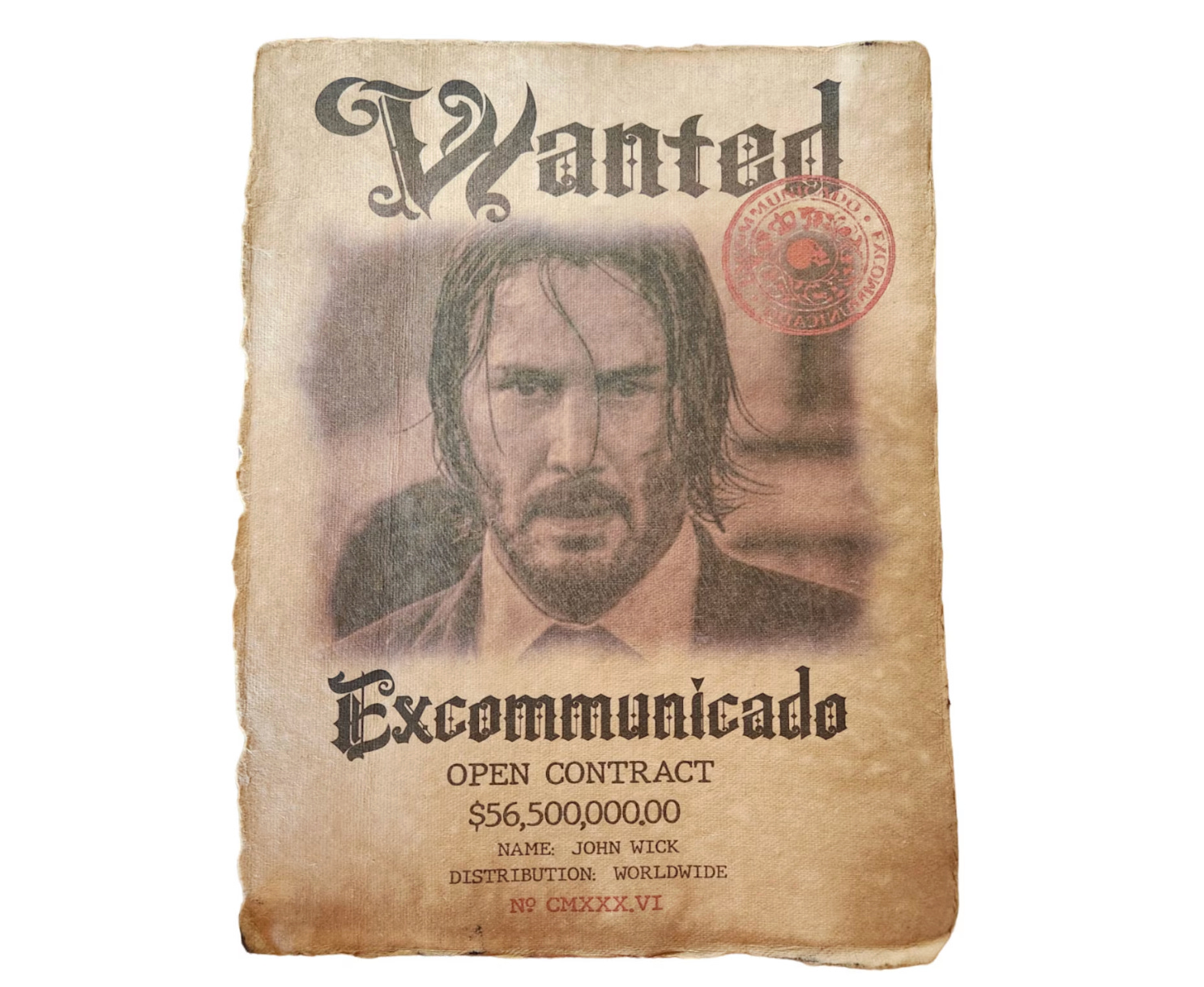
Imagine a VC (or a founder) being threatened with excommunication from YC or being permanently marked as untrustworthy across the whole community. This is a credible Grim Trigger-style threat that can deter bad actions from occurring in the first place and incentivize cooperation.
Establishing Rewards For Reputable Behavior
Credible rewards are just as valuable as credible threats. In any sustainable ecosystem, it’s important for both parties to benefit from their social contract. If Paul Graham and YC have been on the sell-side for their founders, then Alfred Lin and VC’s like him have been on the buy-side.
Together, they’ve successfully created multiple unicorns (companies valued at over $1 Billion) and Alfred’s star has risen at Sequoia. His impeccable business track record, stellar interactions with his founders and the value-creation he has presided over have made him a desired board member and investor by everyone from AirBnB to DoorDash to Reddit (all are YC companies). Alfred was recently promoted to lead Sequoia Capital (and has now three-peated #1 on the Forbes Midas List).
In the Prisoner’s Dilemma, imagine altering the payout matrix so that cooperative behavior yields the biggest expected payouts on the board for both parties. Now, even without threats, a Nash Equilibrium exists with mutual cooperative behavior. YC has shown that founder friendliness improves the payouts for everyone.
People forget how crazy Y Combinator seemed in 2005. In Paul’s essay reflecting upon the early days of YC, he describes that there were definitely “people who didn’t take us seriously”. No one questions the YC model anymore. Twenty years later the verdict is in… it works!
Keep in mind when you look at the above chart that YC invests super early. So in theory, those that also invest later stage like Sequoia, SV Angel and Accel can “wait and see” while joining companies later on for a Series A, B, C etc. when their likelihood of unicorn-ing is higher. When you filter for seed investing only, you clearly see what YC does better than anyone else…
The Y Combinator SAFE has prevailed as the silicon valley standard for all founders even beyond the direct YC community itself. The structure allows entrepreneurs access to fast, early-stage capital without loss of control and near-zero legal cost. Many founders now raise sizable rounds entirely via SAFE’s (some SAFE rounds are now bigger than the $4.5 million Jeff and I raised in our Humble Bundle Series A).
Every modern entrepreneur owes YC thanks for tilting the startup ecosystem towards this and other founder-friendly precedents.
YC itself has made several decent bets in video games including Twitch, Machine Zone, Heroic Labs and Humble Bundle. But gaming will likely never be YC’s primary focus.
Video game entrepreneurs enjoyed a brief window across the pandemic where they were treated with the same exuberance as tech founders. But unfortunately, the results of pandemic-era deals were largely catastrophic for everyone.
Mitch Lasky and Blake Robbins offer a full hour of analysis in their podcast GameCraft on the VC Deadpool. They break down in detail the ways recent investors and game companies seem to have fallen out of alignment. If you don’t have time to listen to it, David Kaye (who ran his own game studio before exiting and becoming a VC), wrote an excellent summary of the podcast here:
Adam Boyes, a games industry legend (Capcom, Sony Playstation, Iron Galaxy), appeared on the Business of Video Games Podcast and diagnosed the problem as follows:
“I think a lot of the investment that we had over the last 5 years was just ‘here’s a bunch of money to go make something’… when you do that in a vacuum on an island… like Lord of the Flies…. all of a sudden: Piggy’s dead, the glasses are broken and who’s got the conch? What happened here? Well it’s ‘cause we didn’t have any sort of like nice oversight, that adult supervision.”
Elbow Grease Games has been fortunate. I’m very proud of the momentum we’ve built: Misfits Attic signed with Shochiku and is shipping Below The Crown, Torpor Games recently announced their Seed Round and we have plenty more going on that we will announce soon.
But the funding market realities for most of the industry are quite dire. The mantra: “Survive to 2025” didn’t pan out. Based on data I could find, 2025 seems likely to be the worst year for video game equity funding in recent history.
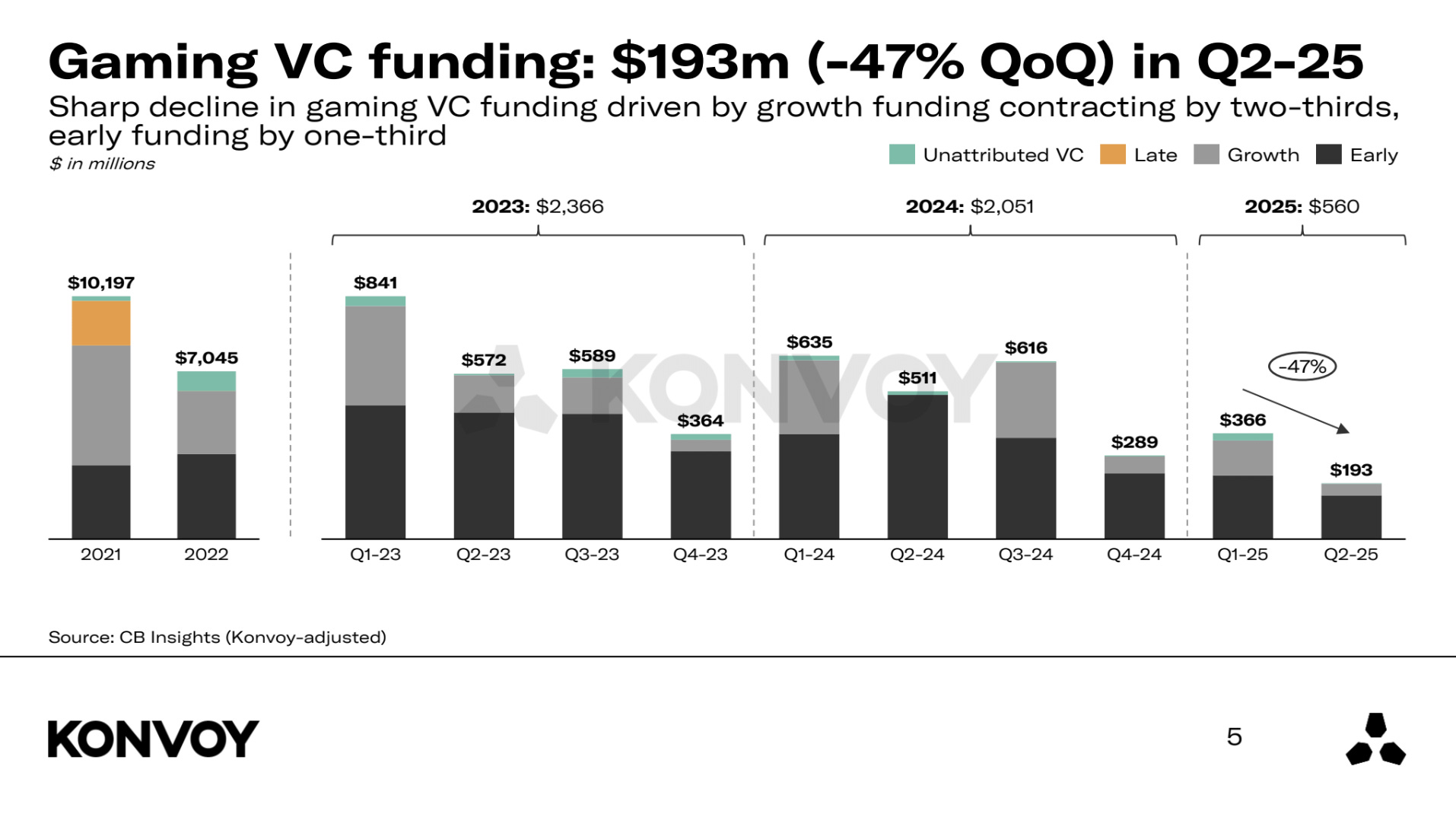
Annual publisher data is harder to find but in my many travels this year I’ve seen publishers retreat from the market as well. Namely, dev budgets have shrunk… so much that I now hear of several publishers explaining they offer ZERO DOLLARS in development budget because they already have their pick of finished games. In such cases, you’d have to make a full game on your own and then maybe, just maybe, a publisher will provide some additional marketing support at the end of your journey in exchange for a meaningful share of your royalties.
(An aside: In fairness to game funders, this can be viewed as the pendulum swinging back the other way from the pandemic when dev budgets were quite large and nearly all developers failed to deliver big enough results to justify the money invested.)
But this doesn’t feel like a sustainable ecosystem. Instead of going on development journeys together where funders are aligned with developers, risk mitigation feels like it has become a zero-sum game… one party mitigates risk by dumping it on the other.
Valve and Riot Games were quick to add “behavior scores” to their MOBA matchmaking systems while Heroes of Newerth did not. As a result, well-behaved Dota 2 and League of Legends players would get matched with one another while non-cooperative, toxic players were relegated to their own hives of scum and villainy. Many suggest that this is why Heroes of Newerth shut down while Dota 2 and League of Legends have lived on.
If game funding is a repeated game, and none of us in this small industry get to use anonymity or throw-away accounts… our reputations will precede us. People will remember who is a cooperative team player and who is not. I predict this will separate the industry into two groups.

One funding community will adopt a ruthless short-term focus. Individuals will seek fast returns at minimal risk. This ecosystem will build asymmetric relationships with disparate values and no long-term alignment. I predict this ecosystem will mostly yield only incremental value due to infighting over an existing, finite pie.
But another community will also rise… one of shared values, shared risk and mutual respect. It will be composed of long-term, team players who want to take a true shot at creating innovation and growth. Members of this ecosystem won’t fight each other for pie slices, they will create more pie.
I look upon the success of Arc Raiders as a high-profile example of what can happen when a publisher like Nexon and a studio like Embark align in good faith for a long-term relationship to launch new IP.
I recommend everyone take a moment to absorb the Embark case study from multiple angles: Christopher Dring’s The Game Business shows us Patrick Söderlund’s thoughtful studio approach along side Owen Mahoney’s patient publisher perspective. Danny O’Dwyer’s 3 part documentary shows us in the trenches how Embark pulled it off (Spoiler alert: Embark had to get their hands dirty prototyping, play testing and then hard-pivoting to find the fun).
This is the way. We need more careful stewards of capital and development resources to keep stepping up. This is our industry’s path to growth and prosperity.
(An aside: Vince Zampella was one of the most skilled and thoughtful allocators of game development resources in the world. We need more like him. What a loss for the industry.)
As we close 2025, Newzoo has revised their annual report to show that consumer-side fundamentals have resumed decent growth: 7.5% year over year. Shams Jorjani, CEO of Arrowhead, thinks we may soon hit the bottom of despair and grow our way back out.
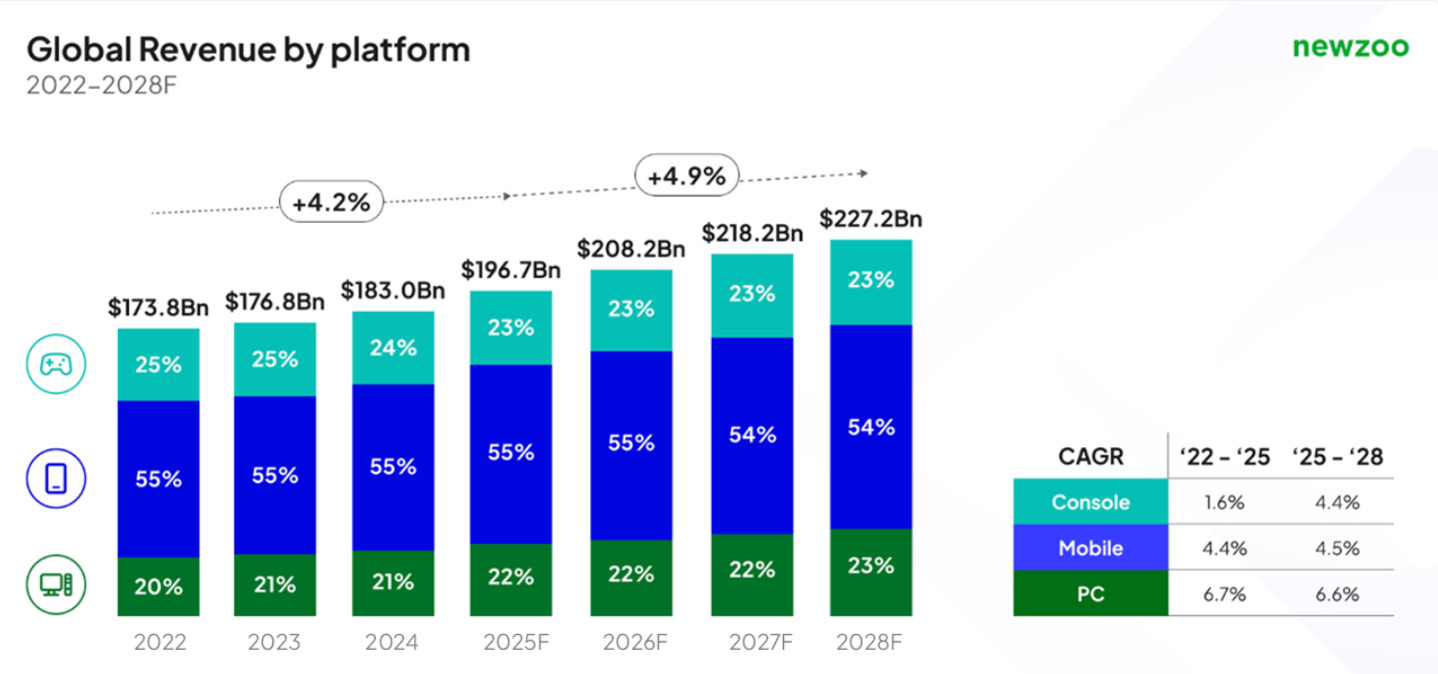
Owen Mahoney is even more bullish and has declared that the games industry is about to triple. Why should we let our industry succumb to “red ocean strategy" when there’s so much untapped growth potential?
I believe we are now demonstrably underinvesting in talented teams. If industry growth continues, FOMO (Fear Of Missing Out) amongst investors will grow. Eventually, it will be deemed irrational for investors not to participate. At such a time, who do we think capital allocators are going to choose?
Adam Boyes says success boils down to: “Doing good things for good people… It’s kind of simple, I’m a believer in the golden rule. Right? Do unto others as you would have them do unto you.” You may recall that Adam’s ethos secured the PS4’s victory in the console wars against Microsoft.
Similarly, my whole career has been built on trust and the golden rule.
Humble Bundle was sustainable because of its respect for studios and gamers and their respect for us. Humble Bundle was able to scale because YC and Sequoia trusted us, invested in us and built an ecosystem with us. We experienced a blessed journey as part of a community much larger than ourselves.
My wife and I founded EGG in 2022 because we believe the same core fundamentals still apply to the gaming industry. We want to pay it forward and help future generations of video game entrepreneurs achieve their dreams the same way Humble Bundle did. Like YC, EGG’s goal is to build a sustainable ecosystem and prove that the payoffs for good faith cooperation and long-term thinking are vastly better than any alternative.
Yes the industry feels scary. Layoffs continue. The funding gap for video game entrepreneurs has never been worse in recent history. Things may even continue to deteriorate in the start of 2026 before they get better.
But investment capital will re-enter the games market, and as it does it will be smarter and more cautious than it was during the pandemic. This time trust and cooperation will be major factors. EGG’s mission is to make it smart business for investors and gaming entrepreneurs to work together again.
Here’s to big things in 2026. Happy New Year everyone!
Read the original article

Comments
By intalentive 2026-01-0519:395 reply This mirrors the military doctrine of "mission tactics" which entrusts subordinates with wide latitude in executing orders. But it requires a high degree of alignment and competence, which explains why YC focuses on founders over product or idea.
This makes sense in a dynamic environment with sensitive local conditions and "network lag" in the chain of command. But in more static or settled market environments it may be wiser (for investors) to focus elsewhere and restrict founder autonomy. We see this pretty commonly with successful founders who get "phased out" and replaced with more experienced managers.
I wonder how much this sort of "distributed decision-making" has been formalized and studied.
By Ozzie_osman 2026-01-065:284 reply I'm a huge fan of Mission Command. If you want to read more, I'd recommend the Army's official doc on it: https://armypubs.army.mil/epubs/DR_pubs/DR_a/ARN34403-ADP_6-... (it's 110 pages but you really only need to read Chapter 1).
This was eye-opening. I used to think militaries were completely centralized and top-down, but a friend who was an officer explained this to me and pointed me to the literature. It was fascinating and educating to understand the principles behind Mission Command being successful as a method (competence, mutual trust, shared understanding, etc).
By chinathrow 2026-01-0611:591 reply > Commanders, staffs, and subordinates ensure their decisions and actions comply with applicable U.S., international, and, in some cases, host-nation laws and regulations. Commanders at all levels ensure their Soldiers operate in accordance with the Army Ethic, the law of war, and the rules of engagement. (See FM 27-10 for a discussion of the law of war.)
Not sure this was followed very recently.
By furyg3 2026-01-0614:10 It isn't very complicated from a military law perspective. The chain of command (following orders) has a lot more weight on it than a given solder's interpretation of military, constitutional, or international law.
If you believe you are being a given an order that is illegal and refuse, you are essentially putting your head on the chopping block and hoping that a superior officer (who outranks the one giving you the order) later agrees with you. Recent events have involved the commander in chief issuing the orders directly, which means the 'appealing to a higher authority' exit is closed and barred shut for a solider refusing to follow orders.
That doesn't mean a soldier isn't morally obligated to refuse an unlawful / immoral order, just that they will also have to pay a price for keeping their conscience (maybe a future president will give them a pardon?). The inverse is also true, soliders who knowingly follow certain orders (war crimes) are likely to be punished if their side loses, they are captured, or the future decides their actions were indefensible.
A punishment for ignoring a command like "execute those POWs!" has a good chance of being overruled, but may not be. However an order to invade Canada from the President, even if there will be civilian casualties, must be followed. If the President's bosses (Congress/Judiciary) disagree with that order they have recourse.
Unfortunately the general trend which continues is for Congress to delegate their war making powers to the President without review, and for the Supreme Court to give extraordinary legal leeway when it comes to the legality of Presidential actions.
> I used to think militaries were completely centralized and top-down
It is my understanding that the Russians do it that way, which does not seem to work out great for them.
By ahartmetz 2026-01-073:13 Russia seems to start every war with bad commanders in a bad command structure, then slowly fix... nah scratch that - improve it.
By aussieguy1234 2026-01-069:011 reply The YPG, an armed anarchist military group, defeated Islamic State in North East Syria and more or less founded their own country without a traditional military command structure. Instead they had loosely coordinated teams.
By sillyfluke 2026-01-0611:16 And how do you suppose IS gained all its territory in the first place? fyi the current president of Syria is ex-Al-Qaeda/el-Nusra/HTS.
By notpushkin 2026-01-067:34 For those outside the US: https://web.archive.org/web/20250202000359/https://armypubs....
There is a good book on that subject by Stephen Bungay called "The Art of Action". He explains the concept of Auftragstaktik. Great book, although a bit hard to read.
There's also Franz Osinga's book Scince, strategy, and war, which covers John Boyd's work in detail.
By baxtr 2026-01-0610:51 I think OODA is fundamentally different to Auftragstaktik.
Auftragstaktik describes a clear purpose / intent. Like: capture the bridge (but: we don’t care how you do it since we can’t foresee specific circumstances)
OODA describes a process of decision making.
So, Auftragstaktik answers who decides what and why.
OODA answers how decisions are made and updated over time.
They’re complementary but different.
By MaysonL 2026-01-0521:59 John Boyd, describer of the “OODA” loop: https://en.wikipedia.org/wiki/OODA_loop
By kjkjadksj 2026-01-0613:40 If it focused on founders over product or idea you’d see some actual heterogeneity in the YC set. It has been a few months since I last skimmed the startup lists but it seemed like 95% were LLM for X companies.
By 2OEH8eoCRo0 2026-01-061:38 Commander's intent is part of the five paragraph order
By vasco 2026-01-068:25 "Nelsonic doctrine", for whoever wants to google this concept.
> In war the first principle is to disobey orders. Any fool can obey an order. He ought to have gone on, had he the slightest Nelsonic temperament in him.
By mattmaroon 2026-01-0519:311 reply “ Some say YC is now big enough that it has a self-fulfilling distortion effect where the best founders in the world know they should all apply to YC first before they talk to any other startup accelerators or investors.”
That’s an interesting point but I have to imagine all the worst founders know it too so the filtering may not have gotten easier. I’d be curious to hear from them.
By YetAnotherNick 2026-01-0520:321 reply They majorly select a kind of founders as a first filter (good engineers from good companies, ivy league, ex founders etc.), and then they look into the ideas as a second filter, and the third and the least important is the process in which they just spend 15 minutes interviewing and maybe another 15 minutes looking into the application.
The zeroth filter is 'people who apply to YC' though, which YC can only really control by managing their brand and marketing and by approaching potential founders directly and suggesting they apply (I assume that happens; I don't know though). That limits who they can invest in far more than any of their own criteria.
There's also another way in that circumvents all the other filters - being a founder at an existing startup that has really good traction already. You can have a resume of no-name companies, no degree, and never have founded a company before, but if your business is growing, making money, and looks wildly scalable with YC's support then you can get in that way.
By YetAnotherNick 2026-01-0610:47 Yes but the discussion was about it being hard for them to filter. They don't have to filter some startup which doesn't apply.
By spacemarine1 2026-01-0517:205 reply Y Combinator forged a long-term, high-trust ecosystem to the benefit of all tech founders. The video games industry needs to do the same.
I feel like this is impossible given how many games flop each year.
Making a game that will sell well on Steam is typically much harder than finding a bunch of boring business leaders and pitching them a SaaS or consulting package. On the surface it might seem simpler to do a game, but once you get into the mechanics of building, testing and publishing something for the masses, the fear of cold calling or emailing total strangers begins to evaporate quickly.
About 99% of the work you do on a game will wind up in the trashcan. Doesn't matter what kind of work it is. Code, audio, textures, models, map layouts, multiplayer balancing work, etc. are all susceptible in the same way. No one is safe from the chaos. It takes a lot of human energy and persistence to produce sufficient 1% content to fill up a player experience.
I'd estimate for a B2B SaaS product, the ratio is approximately the same, however you don't need such a broad range of talent to proceed. One developer with a desire to do the hard things constantly can be all you need to make it to profitability. Going from one employee to N employees in a creative venture is where things go bananas. If you absolutely must do an indie game and you need it to succeed or your internet will get cut off, you will want to strongly consider doing it by yourself. Figuring out how to split revenue and IP with other humans when you can't get the customer on the phone is a nightmare.
By spacemarine1 2026-01-0520:17 Many people agree that being a video game founder is harder than being a tech founder. Staying small and being as resourceful as you can is a good way to mitigate risk.
As a YC founder turned gamedev, I can tell you that failure is the norm in both pursuits. As with YC, the question is: can we create more outsized outcomes when we succeed?
I don't think that's possible and frankly I'd much prefer capital not even try. To the best of my knowledge, the only games which generate the really outsized outcomes you'd need for a VC portfolio do really gross, anti-player shit (gacha, lootboxes, whale fishing, etc.) to get it. Or they become distribution monopolies like Valve, which is fine-ish when Valve is private but would be a ongoing catastrophe if it had been VC-funded. I'd rather not encourage that.
By mikepurvis 2026-01-0519:04 I agree. I'm not the moral police, but video games ultimately have to walk a line where they serve up entertainment that is engaging/addictive without being all-consuming and abusive, and do so for an amount of money for which there is general consensus is "reasonable".
Trying to ride that to the moon is a very different proposition from a B2B play where you sell some service that concretelt delivers $X/mo recurring value to each customer for a $Y/mo price tag, and X > Y, but Y - your costs still turns a healthy profit. If you do that right, everyone is winning and the economy as a whole grows, not at all the same as the zero-sum game that is soaking a few whales and ruining their lives.
By 7777777phil 2026-01-0519:163 reply I appreciate this perspective.. but I think there might be a false dichotomy here. Some of the biggest gaming success stories didn't rely on exploitative mechanics - Minecraft, Among Us, even Fortnite's initial success was based on solid gameplay before the monetization kicked in. The question is whether you can build sustainable platforms that create genuine value rather than just extracting it. Steam takes 30% but provides real distribution value. Maybe the trick is focusing on companies that help other developers succeed rather than trying to create the next Genshin Impact
By jsheard 2026-01-0519:31 > Fortnite's initial success was based on solid gameplay before the monetization kicked in.
Fortnite is a bit of weird backwards example because the early PvE iteration had paid lootboxes, but they were scrapped in the Battle Royale spinoff which actually got popular, and eventually removed altogether. They still do things like engineering FOMO to drive sales but ironically the games monetization was the most exploitative when nobody was playing it.
But now the siren song of lootboxes is calling to them once again... https://kotaku.com/fortnite-loot-boxes-gambling-roblox-20006...
By spacemarine1 2026-01-0520:20 Agreed. It is possible to make money in video games while treating customers with respect. This is the way! (and what EGG looks for because it builds stronger IP and longterm retention and good will)
I helped Indie Fund Hollow Knight back in the day and look a them now!
By spacemarine1 2026-01-067:02 Well said!
Great point, I think I'm just being overly pessimistic
Related, I find it interesting is that gacha games seem to ahve the highest possible returns but almost none are made by western game companies.
By dpoloncsak 2026-01-0518:243 reply Aren't games like CSGO, FIFA, and Overwatch almost exclusively run on gacha-profits?
By spacemarine1 2026-01-0519:572 reply I think it is possible to be successful in games without being predatory. Humble Bundle was a demonstration of that.
I don’t believe that ultra-predatory mechanics are long-term sustainable. They usually yield a “ring of fire” effect that creates a growing ring of users for a while but really you’re burning out all your core users and will implode. This is how many describe the original Zynga model.
Supercell (founded around the same time) has cultivated longterm ecosystems and IP by respecting their players.
EGG takes a similar long-term perspective.
By dpoloncsak 2026-01-0521:07 >I don’t believe that ultra-predatory mechanics are long-term sustainable
I don't think they're trying to be. I think they're whale hunting, find a few high spenders, and milk them for all they're worth. Then they spin up a new IP (or license one out), rinse and repeat
By YetAnotherNick 2026-01-0520:352 reply [flagged]
By bigstrat2003 2026-01-062:512 reply If you don't consider tens of millions of dollars in revenue a success, your definition of "success" is completely out of whack.
By YetAnotherNick 2026-01-064:56 Depends on development cost, no? If game development costs 10s to 100s of millions of dollars, 10 million in revenue is a failure.
By Espressosaurus 2026-01-064:15 It’s not successful for a VC.
VCs are looking for the billion dollar exit. 10s of millions is 100-1000x off what they look for
By Loughla 2026-01-0521:41 It's successful in my opinion by offering really good value with fair practices. It's not a secret, I think.
Yes they are. The implementation tends to differ from how eastern-developed gacha games work, but they're making billions from virtual slot machines nonetheless.
By dpoloncsak 2026-01-0519:031 reply Yeah, I still indulge in video games, and understand that on the surface CSGO skins feel different than Genshin summons, but from 100 feet up it's all the same crap, imo
I do kinda get what you mean, though. Gacha mechanics feel expected in anything western, while 'loot boxes' are still a 'feature' of some games in the east. Eastern studios have definitely noticed, though, and are running the same playbook.
By dpoloncsak 2026-01-0521:09 ...I think I mixed up East and West oops
By modwilliam 2026-01-0519:031 reply Overwatch is not
By dpoloncsak 2026-01-0519:092 reply Didn't they bring back loot boxes?
By modwilliam 2026-01-0519:132 reply Yes, but you basically can't pay for them. Revenue is basically all from direct cosmetic sales or the battle passes
By dpoloncsak 2026-01-0519:28 I see. You can remove 'Overwatch' from my original comment and the point still stands, but I do appreciate the fact check. I know Blizzard from HearthStone and Diablo....not great experiences with gacha there haha (Diablo Immortal, atleast), but those are far from the most popular Eastern games
By modwilliam 2026-01-0610:52 Yes
By trueismywork 2026-01-0518:231 reply You're right though. Industrial software/hardware in general always has money in all times. But gaming is essentially entertainment and people only spend on entertainment last. So gaming industry has a lot of failure but even if you're successful in a huge way, you won't earn huge money. There's a big cap there.
By awkward 2026-01-0519:22 Games are a zero marginal cost industry driven by hits. The cap is pretty high. The floor is what you should be worried about.
By chrisweekly 2026-01-0615:33 FTR, A "gacha" game is a video game that uses randomized rewards and in-game currency to encourage players to spend money or time.
(Sharing to help others bc I had to look it up.)
By seizethecheese 2026-01-0519:322 reply VC math follows a power law and expects almost all investments to flop, and the one winner to pay for it all. The question here is not about the flops it’s: are the winners big enough?
By corimaith 2026-01-069:10 Isn't this the exact logic behind the stagnation in media right now? The risk aversion/stakes is so high that real risks aren't taken and we get bland sequel/remake slop.
Ironically when media culture is at is at its healthiest is when winners are diverse and common, and more importantly smaller shows that try out new things can still break even, with periodic flops being generally tolerable. That low risk culture for attempting new ideas is precisely what creates legendary franchises later when a few of these hit everything right.
By conartist6 2026-01-0520:123 reply And now that they're eliminating diversity in their investments are you still certain they will pick the next generation's winners? All they're investing in are AI companies...
Once upon a time someone like me for whom engineering competence is a core aspect of my identity would have never considered turning my back on YC. But now I'm just embarrassed by them. The things they now think are the only things worth investing in mostly make me want to vomit, like the vibe coding casino-IDE startup. As someone who still espouses their old values rather than their new ones, I'd rather succeed on my own.
By spacemarine1 2026-01-066:571 reply Both Mark Andreessen and Andrej Karpathy say AI is unique as a new technology in that small teams and individuals seem to be the earliest and most cutting edge adopters. (unlike computers and the internet which were used by government and then large companies)
YC just so happens to invest super early in small teams.
So the overlap of YC and AI is inevitable. AI is not an investment genre per se but it can be used to accelerate or improve any ecosystem if used carefully and cleverly.
Since my Humble Bundle days, I’ve always been partial to small companies and small dev studios. Not all EGG companies use AI but they are all keeping tabs on the technology. Mitch Lasky has said that AI may have opened a window in which small studios may have their best shot at outsized success in recent history. Eventually the big dogs will catch up and adopt the new tech themselves but right now David has a shot at Goliath.
By conartist6 2026-01-0613:19 It's funny, because in my industry it's the slavish attention to AI by goliath-scale companies like Microsoft that is leading them to set fire to quality, innovation, and consumer trust, when then gives me and my tiny startup the opportunity to jump in and eat their lunch.
> All they're investing in are AI companies...
Genuine question…
Do you not think that a large percentage of (random cut off) $1b companies over the next 10 years will be AI?
And/or do you not think that the next $100b+ company will be AI-centered?
By conartist6 2026-01-063:201 reply Over the next 10 years, no, I think the market will course correct within that time frame. AI is the sauce that's being slathered on everything right now and demand for it is driving record valuations, particularly for AI startups and their founders. That demand is all investor-driven though: investors are falling over themselves to make AI investments, while consumers are not actually especially eager to have all human contact progressively stripped from their lives.
> That demand is all investor-driven though: investors are falling over themselves to make AI investments
Largely true.
> while consumers are not actually especially eager to have all human contact progressively stripped from their lives
Hmm… I agree with this sentiment, but I think it’s mostly a straw man. There are many things that AI can do well that people will end up embracing directly or indirectly.
Medical scans is one big one, imho.
Mundane but important legal services is another.
Skillful mediation of scutwork is definitely embraced.
Good and fast simple customer service via phone or text will end up being very welcome (at least in some contexts). I realize that most people will prefer superlative human customer service, but that’s currently not a widespread available reality, especially for simple tasks.
All sorts of learning (great and essentially free tutors).
All sorts of practice (e.g., language, speeches, debates, presentations, etc.).
All of the above (and more) are things that people are using AI for right now, and they seem to be loving it.
I realize that some folks use AI tools in regressive and sometimes dehumanizing ways, but that’s not the fault of the tool, imho.
By conartist6 2026-01-0613:37 I dunno, I see problems with every one of those things.
You could make a customer service AI that was an advocate for the consumer, but it would likely spend the company's money liberally. So instead you'll end up with AI agents incentivized to be stingy and standoffish about admitting the company could improve, just like the humans are.
You can tutor with AI, but there's no knowing what it will teach you. It will sound as convinced of itself when it teaches you why the earth is flat as it does teaching you why the earth is round. The one thing it will certainly do is reinforce your existing biases.
You can practice with AI, but you'd learn more by posing yourself the questions.
A doctor can have AI look at medical scans, but they can't defer to AI judgement and just tell the patient "AI says you have cancer, but I don't really know or care one way or the other". So again, the skill in reading results needs to be in the doctor.
By philipallstar 2026-01-0611:43 > Medical scans is one big one, imho.
People have been trying this for a long time, as it's an obvious win, but have struggled so far. Perhaps newer models will help, though.
By rfrey 2026-01-064:09 "Make something VCs wished people want"
By mikepurvis 2026-01-0519:07 On some level it's the role of the publisher to pick winners and guide them over the finish line. See for example the hit machine that is Devolver: https://www.devolverdigital.com/games
I'm not an indie dev, but if I was I would happily give up a chunk of my potential profit to be listed on there, knowing the size of the market that says "oh yeah... a Devolver title, I would blind-buy this, it's probably pretty good."
By mrdataesq 2026-01-0519:18 I suspect games are like movies: for every 100 movies, around 20 of them make enough money to cover the losses of the other 80. But predicting which movies those will be is extremely difficult (Goldman's Law: Nobody knows nothin'). Any studio / label / distributor which can do better than the average is probably headed for greatness.
By kjkjadksj 2026-01-0613:43 The thing is when a game flops it can be popular in the future. It is still a game that does game things. When $dumbapp flops though, it is a stronger signal that whatever it is trying to do may have no market at all. Like giving a fish a skateboard.
By guywithahat 2026-01-0519:18 My thought too, the bar is higher and the rewards are so much smaller. People don't appreciate how incredibly difficult it is to make a mediocre game
By jacquesm 2026-01-0712:39 No fewer than the number of start-ups that flop each year, so that's not a hindrance as far as I'm concerned.
By WhereIsTheTruth 2026-01-0518:585 reply YC works because B2B can survive early with a few paying customers
Gaming is pure B2C: hit driven, capital intensive, and unforgiving
By spacemarine1 2026-01-0519:05 Fair point though Humble Bundle was B2C.
There are clever gaming platforms out there and the best games seem to turn into platforms effectively.
By FloorEgg 2026-01-0519:17 That doesn't sound right to me. A lot of b2b comes with high barrier to entry.
Also I know of many successful indie games, some of which were built by one person.
I can think of so many exceptions to your point on both sides that I question your thesis as a rule.
By api 2026-01-0519:13 B2B isn't as hit driven as gaming but it's still hit driven. Most startups fail.
By rapidfl 2026-01-063:40 That's a good point. Some of the (many) B2B companies in YC also get a decent start by selling to the other YC companies.
By doctorpangloss 2026-01-0519:05 It’s a little more nuanced than that. B2B offerings cost money, video games cost time haha
The game industry needs no such thing. You can make profitable games very cheaply, and business models are simple and well understood. It’s a matter of just making a good game and getting it good exposure to customers.
By throw-12-16 2026-01-069:10 You should check out BigMode.
Dunkey is building a game incubator of sorts and there are some interesting titles coming out of it.
By duped 2026-01-0617:17 > The video games industry needs to do the same.
Video games are a subset of entertainment which is capped in TAM by the population the game reaches, the amount of money they're willing to spend per hour on average, and average number of hours they can devote to entertainment.
In other words, every dollar you make off a game is a dollar that wasn't spent on another game, or trip to the movies, or vacation. And every hour someone plays your game is an hour they didn't spend working, studying, sleeping, eating, or doing anything else in the attention economy.
What makes this different from other markets is that there is no value creation or new market you can create from the aether to generate 10x/100x/1000x growth. And there's no rising tide to lift your boat and your competitors - if you fall behind, you sink.
The only way to grow entertainment businesses by significant multiples is by increasing discretionary income, decreasing working hours, or growing population with discretionary time and money. But those are societal-level problems that take governments and policy, and certainly not venture capital.
