With a balanced sales structure across individual markets, Dr. Ing. h.c. F. Porsche AG, Stuttgart, delivered a total of 279,449 cars to customers around the world in 2025.
- The 911 sports car icon sets another delivery record
- Macan remains the strongest model line with 84,328 cars delivered
- Balanced sales structure despite economic and geopolitical challenges
“After several record years, our deliveries in 2025 were below the previous year’s level. This development is in line with our expectations and is due to supply gaps for the 718 and Macan combustion-engined models, the continuing weaker demand for exclusive products in China, and our value-oriented supply management,” says Matthias Becker, Member of the Executive Board for Sales and Marketing at Porsche AG. “In 2025, we delighted our customers with outstanding cars – such as the 911 Turbo S with its T-Hybrid drive system.” The response to the launch of the Cayenne Electric at the end of 2025 also shows, Becker adds, that Porsche is meeting customer expectations with its innovative and high-performance products.
With 84,328 deliveries, the Macan was the best-selling model line. North America remains the largest sales region with 86,229 deliveries – a figure that is in line with the previous year.
Porsche repositioned itself in 2025 and made forward-looking strategic product decisions. The delivery mix in 2025 underscores that the sports car manufacturer is consistently responding to global customer preferences by expanding its drivetrain strategy to offer combustion-engined, plug-in hybrid, and fully electric cars. In 2025, 34.4 per cent of Porsche cars delivered worldwide were electrified (+7.4 percentage points), with 22.2 per cent being fully electric and 12.1 per cent being plug-in hybrids. This puts the global share of fully electric vehicles at the upper end of the target range of 20 to 22 per cent for 2025. In Europe, for the first time, more electrified cars were delivered than pure combustion-engined models (57.9 per cent electrification share), with every third car being fully electric. Among the Panamera and Cayenne models, plug-in hybrid derivatives dominate the European delivery figures. At the same time, the combustion-engined and T-Hybrid 911 set a new benchmark with 51,583 deliveries worldwide.
North America remains the largest sales region
With 86,229 deliveries, North America remains the largest sales region, as it was the year prior. After record deliveries in 2024, the Overseas and Emerging Markets also largely maintained its previous-year levels, with 54,974 cars delivered (-1 per cent). In Europe (excluding Germany), Porsche delivered 66,340 cars by the end of the year, down 13 per cent year-on-year. In the German home market, 29,968 customers took delivery of new cars – a decline of 16 per cent. Reasons for the decrease in both regions include supply gaps for the combustion-engined 718 and Macan models due to EU cybersecurity regulations.
In China, 41,938 cars were delivered to customers (-26 per cent). Key reasons for the decline remain challenging market conditions, especially in the luxury segment, as well as intense competition in the Chinese market, particularly for fully electric models. Porsche continues to focus on value-oriented sales.
Macan is the bestselling model line
Deliveries of the Macan totaled 84,328 units (+2 per cent), with fully electric versions accounting for over half at 45,367 vehicles. In most markets outside the EU, the combustion-engined Macan continues to be offered, with 38,961 of these being delivered. Some 27,701 Panamera models were delivered by the end of December (-6 per cent).
The 911 sports car icon recorded 51,583 deliveries by year-end (+1 per cent), setting another delivery record. The 718 Boxster and 718 Cayman totaled 18,612 deliveries, down 21 per cent from the previous year due to the model line’s phase-out. Production ended in October 2025.
The Taycan accounted for 16,339 deliveries (-22 per cent), mainly due to the slowdown in the adoption of electromobility. The keys to 80,886 Cayenne models were handed to customers in 2025, a decline of 21 per cent, partly due to catch-up effects the previous year. The new fully electric Cayenne celebrated its world premiere in November, with the first markets to offer the model beginning to deliver to customers from this spring. It will be offered alongside combustion-engined and plug-in hybrid versions of the Cayenne.
Looking ahead, Matthias Becker says: “In 2026, we have a clear focus; we want to manage demand and supply according to our ‘value over volume’ strategy. At the same time, we are planning our volumes for 2026 realistically, considering the production phase-out of the combustion-engined 718 and Macan models.” In parallel, Porsche is consistently investing in its three-pronged powertrain strategy and will continue to inspire customers with unique sports cars in 2026. An important component is the expansion of the brand’s customization offering – via both the Exclusive Manufaktur and Sonderwunsch program. In doing so, the company is responding to customers’ ever-increasing desire for individualization.
| Porsche AG | January - December | ||
| 2024 | 2025 | Difference | |
| Worldwide | 310,718 | 279,449 | -10% |
| Germany | 35,858 | 29,968 | -16% |
| North America | 86,541 | 86,229 | 0% |
| China | 56,887 | 41,938 | -26% |
| Europe (excluding Germany) | 75,899 | 66,340 | -13% |
| Overseas and Emerging Markets | 55,533 | 54,974 | -1% |
Disclaimer
All amounts are individually rounded to the nearest cent; this may result in minor discrepancies when summed.
This press release contains forward-looking statements and information on the currently expected business development of Porsche AG. These statements are subject to risks and uncertainties. They are based on assumptions about the development of economic, political and legal conditions in individual countries, economic regions and markets, in particular for the automotive industry, which we have made based on the information available to us and which we consider to be realistic at the time of publication. If any of these or other risks materialise, or if the assumptions underlying these statements prove incorrect, the actual results could be significantly different from those expressed or implied by such statements. Forward-looking statements in this presentation are based solely on the information pertaining on the day of publication.
These forward-looking statements will not be updated later. Such statements are valid on the day of publication and may be overtaken by later events.
This information does not constitute an offer to exchange or sell or offer to exchange or purchase securities.
Read the original article

Comments
While the headline is interesting.
I think the table at the end of the article is more so.
- Worldwide sales -10% YoY
- China sales -26% YoY
And when you cross compare Porsche saying they sold more EV powertrains than their gas equivalents against China's new found foothold as the market leader in consumer electric cars (BYD, NIO, Xiaomi, etc...)
Then I think you see an early indication not just of electric car dominance, but of the (very potential) rise of China as the premier automotive super power.
By melenaboija 2026-01-203:5530 reply > Then I think you see an early indication not just of electric car dominance, but of the (very potential) rise of China as the premier automotive super power.
It’s done man. Americans are stuck in ICE engines because they’ve been told they’re “car enthusiasts” while the Chinese have been developing EV technology for years. Meanwhile, European makers are stuck not knowing what to do, make Americans happy or compete with the Chinese. The result: nothing has been done properly. And let’s be real, “car enthusiasts” are going to disappear in one or two generations. Practicality beats enthusiasm for 95% of car use.
Perhaps people in the future will visit the US for the dieselpunk nostalgia, the same way people like seeing classic cars in Cuba.
By psychoslave 2026-01-208:013 reply I strongly doubt any current car will stand longevity of those cars. The maintenance entry cost of anything with integrated electronic is just several order of magnitude in complexity.
Modern cars are far more reliable than old 'analogue' cars - primarily because of the integrated electronics. ECUs can detect when engines are running rich or lean, knocking or 100 other edge cases and adjust accordingly.
Switch to an EV and it's even simpler, you can get away with a motor, battery, BMS and inverter and you can get just about any soapbox to move.
By funkyfiddler69 2026-01-2010:212 reply What? How so? Isn't it just a bunch of PCBs and sensors whereas gas powered cars are a bunch of awesome nonesense you can gently whack against each other to create different notes and tones?
The former requires a special printer while the latter requires tons of machines for precision engineering and the industrial equivalent of smitheries and blacksmiths!
By thrance 2026-01-2016:19 Ain't gonna be any diesel in the future. Peak oil has passed, now it's only going downhill.
Feels bad faith to shit on people from your ivory tower, just because they can't afford to ditch their reliable beaters and buy a new car. Have you seen wage growth vs car price increases lately? Not everyone is on a remote six figure US tech job. Try to view and judge things from outside your bubble as well.
I'd also dump my ol reliable ICE car that's now probably worth less than a fancy electric bicycle, if someone just gave me an EV for free ;)
But since I'm poor and can't afford EV prices with decent range, nor can I afford a home with a parking place with charger, then ICE it is. European here btw, not american.
Look at the average car payment in the US, and the average car sale price
The ”americans can’t afford EVs” argument falls totally apart when the average(!) sale price is over $50k and you can get a perfectly good Leaf for $25k
Same here. Living in the Netherlands, I drive a 2008 Daihatsu Cuore, bought for 850E over a year ago, I pay 17E /month in mrb (road tax) and 38E/month insurance. It's basically close to the costs of a scooter. And I average under 4L/100km fuel usage, for my 200km/week commute. I did some calculation and no car comes close to these running costs. Definitely no electric cars, even if I were to get them for free, because road tax here is mainly a factor of weight.
Even a Dacia Spring with its 900kg is slightly more expensive overall to run (in my circumstances. I could charge at home, but don't have solar panels atm), and a lot more expensive up front to buy (used).
It has over 304k km already, and it runs perfectly well with some occasional maintenance and some mechanical sympathy, but I was considering alternatives in case something were to happen. Conclusion? Just buy another one. Suzuki Celerio is the only one in the same ballpark, but it's about 2k EUR more expensive. And I love my Daihatsu.
By Loudergood 2026-01-2013:321 reply Like me, you're not buying new cars on that budget anyway. 6 years ago when my ICE car became unreliable I bought a used Chevy Bolt for less than $20k. They're closer to $10k now. Plenty of range.
People aren't being asked to dump their current reliable vehicles.
What we want is for people to think about EVs when it's time to replace them.
By imtringued 2026-01-2010:41 I don't know what you mean by reliable beaters. By the time EVs are mandatory, my ICE car will have turned into dust and I'd have to buy a new car anyway. It would be pretty foolish to stall EVs only to then be forced to buy another ICE car.
By CalRobert 2026-01-2011:21 Sorry but where did I do that? I oppose tariffs on Chinese cars, which means I support making cars cheaper…
Yes, not to mention the fact that Chinese EVs can't be sold here... protectionism for weak American companies that can't compete globally. We've gone from an automotive superpower and the land of Henry Ford to the government propping up automakers and depriving Americans of free choice. If Chinese cars would actually be allowed to sold here they would sell like Toyota Camrys.
Until very recently, tariffs on American cars sold in China were much higher than vice-versa. The new US tariffs were an attempt to even the playing field.
I think most people would agree that no tariffs would be good, but China is more protectionist than any other major economy, including recent changes in US policy.
By Al-Khwarizmi 2026-01-208:142 reply Yes, but China has always been straightforward in that they believe in protectionism. It's part of their system.
In contrast, in the West (at least until a few years ago), we have been fed the discourse that free market without protectionism is the best model, and protectionist countries are sabotaging themselves. And I don't know how it was in the US, but in the EU this caused hardship to many people. Entire countries pretty much sacrificed whole industries to the free market gods, because it was more efficient to bring the merchandise from elsewhere. Opponents who were defending their livelihood were framed as reactionaries that were opposing +X% GDP gains or didn't want "free competition" (often against products with unbeatable prices due to being made in countries with totally different rules and labor standards).
Now it seems that the system that supposedly was so bad gives an unfair advantage, so if others apply it the only defense is to apply it as well... but the free market apologists won't shut up anyway, in spite of the obvious cognitive dissonance.
True enough but really this boils down to we are just doing what they are doing. The reason they had it higher for longer was because for longer the situation was reversed, our cars were better. Now they have surpassed us and don't really need protection. We didn't before either, so it was a moot point. Now we do, so we do the same thing.
The point however is that the United States is supposed to operate under a different model than China. The reason to bring up the ways we act the same is then to find clarity in the contradiction.
This is essentially the same tension that runs through much of modern American discourse. It's never welfare if the beneficiary is a rich CEO at a corporation, only if it's a family in poverty. It's not like Chinese cars can't employ American workers just as Japanese and other foreign automakers do.
To my mind then, I think it's less about reciprocity and more about corporate welfare. Putting aside ICE automakers, there is also a very obvious individual who turned conspicuously political as of late who owes a great deal of his fortune to the expectation that his electric car company will one day rule the world. It would be quite embarrassing for even him if demand for his vehicles suddenly got demolished on his own turf. I would think he and others would be willing to spend a small fortune to keep the political needle tipped in their favor on this issue, the average consumer be damned.
At some level there is nothing wrong with such naked self interest. I just prefer we be honest about it, as only then can we really analyze it.
> but China is more protectionist than any other major economy, including recent changes in US policy.
Not true. China let Tesla set up shop in the backyard of their domestic EV industry, WITHOUT the mandatory by law 51% Chinese ownership, precisely so Tesla would light a fire under the asses of domestic players, forcing them to compete better with what was at the time, the pinnacle EV brand.
China is no longer beating us with protectionism but with innovation and manufacturing. People better wake up.
By mmooss 2026-01-206:02 > The new US tariffs were an attempt to even the playing field.
That's a guess at the White House's thinking. They've been using every form of coercion in international relations, including economic (tariffs), military, and diplomatic. That's a factual basis for divining their reasoning.
Their words are not a factual basis - they can say anything and clearly will. Everyone who does those things provides justifications - Putin was helping oppressed Russians in Ukraine and stopping fascism, for example. Taking them at face value is not a serious analysis.
By pm90 2026-01-2012:32 What are you talking about? GM sold more cars in China until very recently when Chinese buyers started flocking to EVs.
Interesting that Canada agreed to break with the US on EV tariffs.
https://news.ycombinator.com/item?id=46648778
It's limited but I feel like Canada aligning themselves at all with China over the US is an interesting development.
It's a good point but imo not really surprising when the President of the United States essentially threatened to invade Canada and Greenland.
This is classic multipolar politics, trade the two behemoths against each other so they don't roll over one day and just squish you. By alienating Canada and Europe we've handed China a great gift.
By brightball 2026-01-2012:541 reply Wasn’t there a report in the last 10 years about China accounting for a huge portion of property sales in Canada? I thought I remembered seeing it was as high as 30% in some areas.
By samiv 2026-01-2010:26 This is the outcome when your corporations bow down to wall Street. Tax payers money is just used to prop up their private profits and without exposing them to the actual competition. Short term profit seeking. Who foots the bill, the US tax payer who have to pay for the corporate profits and drive overpriced underperforming vehicles.
Protecting automakers can be considered a vital business for national security. This is not good for consumers, but relying on China for everything also carries many risks.
Car enthusiast here. I raced in Formula Ford in Europe in my younger days. I still dream about the day I drove a 911 GT2. Nearly every car I’ve ever owned has been a manual.
But with the ridiculous tax incentives here in Australia (at least while they last), my new car turned out to be an EV. Specifically the Hyundai Ioniq 5 N. And let me tell you, while the logical part of my brain knows that the gear shifts and the exhaust notes and everything about it is “fake”, when I’m driving it around a track or a challenging B road, every part of my body is fooled into thinking it’s real. And reluctant as I might be to admit it, it might just be the most fun car I’ve ever had
Is it perfect? No. I wish it was 10cm lower to the ground. I wish it was at least 600kg lighter. But it has completely disabused me of the notion that electric cars can’t be fun.
The Ioniq 5N is extremely funny on paper. It's not wildly expensive, nor is it greatly modified from stock, but the engineers decided to just completely overspec the torque on what is otherwise an ordinary family car. So you get a 0-60 time of about three seconds.
I'm slightly surprised there aren't more cheap electric "hot hatches", but I think that market is dead even in ICE cars - young people don't have much free cash, aren't interested, and the insurers won't let them either.
The Volvo EX30 / MG4 XPower would fit in the hot hatch / sub-compact crossover crossover. Both cars are the size of a raised VW Polo at 4.2m length while having over 400hp and around 3.5 secs to 60.
While not exactly cheap, you can get the MG for under 30k eur if you shop around for some discounts and the volvo at around 35-40k. considering a 300hp golf R is over 50k eur they're pretty great options for some cheap fun. Cheap as in total cost of ownership, not just purchase price.
Also, the SC01 people just announced that they plan to bring it to Europe [1] so that's gonna be a great option.
[1] https://insideevs.com/news/784884/sc01-electric-coupe-roadst...
By bwv848 2026-01-2013:50 And that’s based on a family car platform—wait until you drive something more purpose-built. Take a look at the Renault 5 Turbo E, the work-in-progress electric A110 and 718, or the more affordable SC01. Fun EVs are definitely coming in the next 5 to 10 years.
By costcopizza 2026-01-2013:086 reply I can 100% confidently say the average US buyer is not an auto enthusiast. Cars are appliances to the vast majority of people here.
There are multiple other factors for the relatively low adoption of EVs compared to China.
By dredmorbius 2026-01-2014:243 reply Automobile buyers who buy American or European cars are more likely to be auto enthusiasts.
Then there's the utility / practical / recreational crowd who goes for SUVs and pickup trucks.
Those whose primary aim is utility are already in (non-EU) foreign markets or used. Those are invisible to new-car US/EU sales.
It's a classic Innovators Dilemma dynamic (Clayton Christensen), where chasing higher-end market niches torpedoes development of disruptive tech within the same firm.
By cucumber3732842 2026-01-2015:27 The mean, median and modal auto buyer in north america is buying a blob shaped "car" that's marketed as a "crossover" and officially categorized as an "SUV" for compliance reasons. Maybe it's an ICE, maybe it's a hybrid, some are even electric. 99.9% of buyers choose based on fit for their intended usage pattern. And because the automakers are competing for these hordes of buyers in this segment, these cars are very competitive in terms of bang for buck.
The types of buyers who chose their form factor or source of motive power for their vehicle based on image or virtue points are a rounding error.
By myrandomcomment 2026-01-2016:15 I own 2 cars, both Porsche. Mine is a 15 year old Boxster S. The wife has a brand new Macan 4S EV. It is a brilliant car. 280mi/450km @ 80% charge and no issues with the cold. It was 27F/-3.5C this morning.
I will never buy a gas car again. I plan to keep my Boxster until I can buy an EV version.
In the US there isn't much choice. There are a few Japanese and Korean cars - but even those brands put effort into appealing to auto enthusiasts.
Remember, if you need a widget that you don't otherwise care about knowing someone who does care about them recommends something is a very important factor in your decision. The realistic difference between a car/suv of similar size between GM, Toyota, or VW (random choice of brands but covering the 3 geographical regions) is minimal: the non-enthusiast will be happy in any of them.
> I can 100% confidently say the average US buyer is not an auto enthusiast. Cars are appliances to the vast majority of people here.
Only like 1-2% of new cars are manual transmission here. A lot of the enthusiast market complains that everything is an automatic these days, even high end sports cars.
I like manual transmissions but I think DCTs are an improvement for the average car. They seem to have a lot less "hunting" than the typical torque-converter automatic and good precision for the driving conditions. It is easy to put them into a manual-select mode. And, of course, they don't seem to stall.
By kazinator 2026-01-2021:34 I like manual transmissions; they do what you tell them, and do it quickly. They are fun to drive.
They are also on their way out, together with the internal combustion engine. It's possible to work them into electric cars, but they don't make much sense there.
The deal breaker for me isn't the lack of a manual transmission, but all the screens and software updates, and barriers to repair.
Can we not have an electric econobox that focuses on utter simplicity?
By Night_Thastus 2026-01-2017:47 Auto enthusiasts no, but cars are definitely not appliances in the US.
Cars are a way people mark their social status - whether they will admit it or not. A big, luxurious SUV with a small mountain of space, the latest tech, etc is not an 'appliance'. It's a luxury people are choosing to buy.
The difference is in priorities. Americans wanted a very different kind of car than China is/was making.
By gtowey 2026-01-2016:12 They are in the sense that most of them are buying cars that represent their identity. For example nearly every pick up truck is an "auto enthusiast", because almost none of them are used for their primary purpose more than a few times mes a year.
By thatcat 2026-01-2017:33 Many Americans base their identity off that appliance though, buying big trucks to drive around the suburbs and commute in. It needs to go vroom, so no e trucks allowed. I'd say it's more like a form of narcissism than enthusiasm.
By pstuart 2026-01-2020:57 Low maintenance costs, cheaper operational cost (depending on electric rates).
Some of them are quite peppy too. My Leaf isn't but it meets the criteria I just gave.
By surajrmal 2026-01-208:39 EVs are sold as a luxury product in the US. ICE cars are familiar, convenient (no need to figure out how to install a home charger), and otter cheaper (lower initial cost, service is cheaper, value maintains for much longer, etc). I bought electric, but I recognize it's a privilege to be able to do so.
If competitively priced EVs hit the market, consumers would buy them in much bigger numbers. Manufacturers want to use EVs as a way to redefine themselves and make more money and seemingly the industry is colluding to keep them premium with a shorter shelf life.
I'm a "car enthusiast" and even I understand that holding onto ICE is like holding onto horses because cowboys look cool. It is a distilled macho culture like those old Marlboro ads.
By bluGill 2026-01-2015:03 I have a lot of ICEs - they are collectors items I keep in the shed unless there is a parade. My EVs are the daily drivers, not as fun, but more practical.
The above isn't quite true - there are some "daily" ICEs yet because EVs aren't in all niches and I don't replace things instantly even if they were. The idea is the future that is coming closer and closer to reality.
By NetMageSCW 2026-01-2015:141 reply You are wrong - it is like holding onto horses because cars require carrying a mechanic to get anywhere. BEVs aren’t ready for every use and every place and every one in the US by at least a decade, so keeping an ICE / buying one today is the pragmatic choice.
I am in Portugal right now. You know something we don’t have often here? Garages.
For example in my neighborhood most cars are parallel parked, people are living in centuries old houses converted into high density condos, there are no garages.
So what is more practical, charging your car overnight without an electric plug or going to the gas station for a few minutes?
>>So what is more practical, charging your car overnight without an electric plug or going to the gas station for a few minutes?
100x charging your car overnight with a plug. I don't think people who don't own an EV realize how great that is. Imagine if your petrol car magically got refilled with fuel every single night - add up all of those "few minutes" spent at a petrol station over your lifetime, and realize how much time you're getting back.
>> people are living in centuries old houses converted into high density condos, there are no garages
And yeah, that's a problem everywhere, not just in Portugal. Here in the UK a lot of people wouldn't have anywhere to charge at home.
By NetMageSCW 2026-01-2015:172 reply Please don’t repeat the myth that your car is getting refilled every very night unless you are charging to 100% every night or are willing to concede your range is 80% of the stated range.
By jasoncartwright 2026-01-209:311 reply You use kerbside charging. Unlike petrol, electricity comes to you.
I do have a garage and 'fuel' is half the cost of my previous, smaller ICE. We're considering solar power to get it practically free.
There's some nicer differences like leaving the air-conditioning on constantly because there's no pollution and it's also practically free. It's nice to have a giant battery instead of requiring an engine to constantly recharge it to run the electronics.
By coderenegade 2026-01-2011:452 reply That's cost, not practicality. Like it or not, the EV isn't as flexible when it comes to ownership, because you need a place to charge it. A product that is less practical has to be cheaper to compete in the market.
By tirant 2026-01-2013:38 With batteries reaching 800-1000km per charge and most people doing around 30km a day of driving (way less for people living in dense areas), you basically only need to charge your car once every two weeks.
By tobyhinloopen 2026-01-207:053 reply EU automaters fail at making modern cars. They just put a bunch of screens in there with awful software. If you go all screens, just commit like Tesla. If you can't beat Tesla, just stick with minimal screens and use buttons.
Somewhere between 2010 and 2020, most automakers went crazy with their designs and it went all downhill from there.
By quantum_magpie 2026-01-207:523 reply I have a 2020 Fiat 500 Abarth, and it is absolutely perfect: There is a screen (I think 7") for Android Auto/CarPlay/radio/nav, and every single other function in the car has a physical button. It is also absolutely gorgeous - pinnacle of design, IMO
By PunchyHamster 2026-01-208:17 That's about what I want from interior - any builtin infotainment will get out of date, any more electronics is just stuff to eventually break
Our 2021 Volkswagen e-Up is like this. There is a tiny(like 3" tiny) screen for the radio, bluetooth and reverse camera, everything else is analogue and has physical buttons. It's honestly best of the best Volkswagen design, what they did with their newer cars in terms of interior usability is a travesty.
By trgn 2026-01-2014:08 i still miss the interior of my 2010 fiat punto
By jansper39 2026-01-2012:01 From this year all EU cars will have physical buttons for heater controls, media etc.
By epolanski 2026-01-2013:13 Not sure why would you think EU automakers fail at making modern cars, also, you're generalizing 40+ car automakers in one basket.
> And let’s be real, “car enthusiasts” are going to disappear in one or two generations.
Not sure if you have realized this, but we have a pretty decent numbers of horse enthusiasts now.
Sure, but compared to an era when horses were used as a practical form of transport the number is effectively zero. Horses are a novelty that wealthy people play with. ICE cars will go the same way.
Maybe you’re the kind of person who believes the glass is always full if you can make the glass arbitrarily small.
By samiv 2026-01-2010:16 This is exactly so. Not only is the USA hurting itself by distancing itself from it's former allys in policy and trade but it's forcing the rest of the world including EU to look more towards east for trade partners and temporarily for military support until Germany rearms itself.
Canadians already took the lead and are now taking steps to let Chinese EV manufacturers into the Canadian markets with less tax/tariff.
Meanwhile Europe is still struggling a lot with coming to terms with new world order. They've been sucking up to the USA too long since the WW2. German economy is largely dependant on car manufacturing and China is threatening this. But something is going to have to give now.
By dv_dt 2026-01-2014:49 Are you talking about ICE car enthusiasts only? For general car modders and enthusiasts, it may take a few more generations of production releases before more crop up, but I think more EV car enthusiasts will emerge after more and lower cost EV powered systems come out from factory systems optimized for higher volume. With that sheer amount of gear accessible over time, custom makers and mod products will find ways to modify and reassemble it.
By bartread 2026-01-2013:32 I get the impression that what the Chinese want out of a car is different and, realistically, a bit more aligned with the trajectory of human progress as well.
I remember the (UK) Top Gear episode, which I'd guess must be at least 15 years old now, where they were talking about Chinese car brands, like Roewe, and they were ripping on them for being a bit crap in various ways (performance, not that fun to drive, etc.), but they also highlighted that what's important to Chinese car buyers is equipment level and having the latest tech[0] so, even though the cars at the time weren't the best, they were packed with gadgets and creature comfort.
Add 15 years of rapid progress onto that and it's not surprising that China is dominating in the EV space, because it aligns so well with what Chinese buyers might be looking for in a vehicle.
[0] And having seen what traffic jams in Chinese cities can look like it entirely makes sense to optimise for comfort and engagement whilst sitting still or in stop go traffic, than for driving experience when you're never really going to experience the handling anyway.
By m463 2026-01-215:55 > Americans are stuck in ICE engines because they’ve been told they’re “car enthusiasts”
actually I think there are two strange things going on.
Tesla has completely dominated acceleration vs ice cars. The model S can dor 0-60 in (admittedly fudged) 1.99 seconds. The model 3 performance has 500 or 600 horsepower.
This has created lots of EV enthusiasts.
BUT - they have also been screwing things up.
By taking away displays like the dashboard in model 3, or controls like drive select, turn signals and putting everything on the touchscreen... there's a really terrible UI. Who can be an enthusiast without being part of the car control equation?
By englishspot 2026-01-2015:33 as a wannabe "car enthusiast", I'd happily buy a fun EV if one existed for a reasonable price. the xiaomi su7 for example looks incredible, and I'd jump on that if sold here in the US in a heartbeat.
but for the majority of people, yeah, I don't think they really care either way. if we had the infrastructure and EVs were sold at the prices that people are seeing for the Chinese EVs, I think they'd switch away from ICE fairly easily.
By ge96 2026-01-2015:42 I want that throaty Lotus Exige shame only 260s legal in US. No electric for me not because I'm against it but I love that sound, real sound. I know Tesla Plaid can do 0-60 in 1.9 but so can Corvette C8. Not that Exige is that powerful but it's a sexy car.
This is awesome to me https://youtu.be/0c9prOTdp_M?si=r0q3vqohdVNw7HpF&t=181
By ejoso 2026-01-205:55 How many generations are we even into cars?
Maybe 4ish? Most kids alive but not yet driving are likely to own only hybrid ma or electrics.
Seems like a relatively short term problem overall.
By guywithahat 2026-01-2015:21 The top selling vehicle in the world is a US EV? I think we're behind the point where all vehicles can be EV's, we still need ICE for certain things, but the US is arguably the only other country in the world where we produce EV's competitive with China
By NetMageSCW 2026-01-2015:031 reply Car enthusiasts never disappear, but they will be a small part of the market just like always.
By hydrogen7800 2026-01-2016:41 Maybe it's naive of me, but I think the enthusiast will still have a place in the future, just as they can now own cars without 3-point seatbelts, catalytic converters, traction control, ABS, airbags, crumple zones, etc. all of which have been mandated for many decades.
EU car manufacturers decided that cheaper-to-make electric cars must be sold as luxury vehicles and failed to achieve economies of scale China did with their underwhelming initial models they kept improving relentlessly every year.
The corner is turning on this, with e.g. the Renault 5 EV being extremely popular: https://bestsellingcarsblog.com/2026/01/france-full-year-202...
I've test driven one, fun little car, decent provision of some non-touchscreen controls.
Ironically I think Tesla really opened up the EV market at all in the West by starting as a luxury option and working downwards. People don't want to feel they're taking a "hair shirt" option. "EVs are for rich people" has probably sold more cars than "EVs are for poor people" messaging would have.
The VW ID4 is winning the middle of the range family SUV market: https://electrek.co/2025/02/28/volkswagen-id-4-best-selling-...
It's not to my taste that bonnet lines have got higher, SUV style, but it appears to be what the public wants to buy.
By fifticon 2026-01-2011:03 Well, currently US _are_ ICE enthusiasts, lamentable as that may be.
By cung 2026-01-214:10 The US controls the oil monopoly, where as China controls battery minerals.
The US can’t compete in electric vehicles solely due to lack of control over the complete supply chain.
Nothing is done ever. Remember when the U.S. deeply feared Japan's rapidly growing economy?
Whenever I read or hear definitive statements like that I heavily bet on the other side.
By joe_mamba 2026-01-2010:04 > Remember when the U.S. deeply feared Japan's rapidly growing economy
They DID fear them and took action to gimp their industry. Read the Plaza Accord and the aftermath to the Japanese economy.
By kazinator 2026-01-2021:26 I'm not a car enthusiast. Unfortunately, I'm also not a phone-on-wheels enthusiast either.
By morshu9001 2026-01-208:014 reply Not that many Americans are car enthusiasts. The most popular cars have been basic commuters for decades.
By Slothrop99 2026-01-208:29 While that is true, the new car market has narrowed to the point where most of the buyers want something overpowered for their money. The most popular cars are actually buying these when they are 10+ years old.
(I śaw recently that the USA market is about 16M cars.. this would have been low figure years ago. But they are barely selling 'basic commuter cars'.)
I guess it depends on how you define car enthusiast.
A lot of Americans spend far more on their vehicle than they need to and so I would classify them as enthusiasts even if they couldn't tell you how many cylinders their engine has.
By PunchyHamster 2026-01-208:182 reply It's hard to get basic commuter without overload of tech these days
By amanaplanacanal 2026-01-2012:101 reply Aren't the most popular "cars" in the US actually SUVs and light trucks?
By AndyMcConachie 2026-01-2014:12 It has everything to do with regulation and almost nothing to do with "car enthusiasts".
> Practicality beats enthusiasm for 95% of car use.
About two years ago I rented an electric car for a few days. I felt like I wasted a ton of time finding a charging station, jumping through phone app hoops to get the charging process started, and then waiting for the car to charge. I've stayed away from electric rentals since, even though they're often cheaper.
Comparing renting a new type of car when you have to figure everything out for 2 days then return it, to owning a car, where you also have to figure everything out, but only for the first days, not the 600 days afterwards, is not really comparable.
Also, when you own a car you charge it at home and work, so you don't really wait for the car to charge very often.
And the next time you rent a car, it will be a bit simpler as you have done it once before. And even quicker/simpler the time after that etc.
This is the equivalent of setting up a developer environment for charging a car. Once you have a car that's working, and you know how to connect to the app and charge it, almost all these problems go away. If you're in a place that has a lot of public chargers near your destination that you're already going to, then it's even easier, and it just becomes trivial.
That being said, I don't think I would want to rent a car that didn't have a place to charge it or a very easy-to-use fast charger nearby.
> jumping through phone app hoops
The very idea you effectively need a mobile phone to charge your car is mind boggling. The mess of proprietary charging networks and registrations is needless complexity that puts people off hiring (and ownership) of EVs.
For rentals I get that. We own 2 EVs and a charger at home. Easiest driving experience ever. We just plug it in.
Where are you based?
Here is a different narrative: https://www.reddit.com/r/technology/comments/1qh5kdg/us_pres...
“Americans are stuck in ICE engines because they’ve been told they’re “car enthusiasts”
Who told them?
By WorldMaker 2026-01-2021:52 The marketers of the same companies that aren't trying to sell them small, cheap, practical EVs and want everyone to pay for high margin trucks and SUVs.
By ColonelPhantom 2026-01-2010:50 > Meanwhile, European makers are stuck not knowing what to do, make Americans happy or compete with the Chinese.
Huh? This comment sounds extremely America-centric to me. Porsche sells more cars into Europe than North America, despite taking a bigger there (-13-16% vs 0%)!
In general I don't think Porsche is representative of the car market as a whole, given their cars are all premium sports cars to at least some degree.
If you want more representative numbers look at more mass-market manufacturers. Notably, the Volkswagen group has a huge 20%+ market share in the EU, while it is below 5% in the USA. Renault is another example of a strong EU-centric brand and manufacturer with over 10% market share, even over 25% at home in France. Ford is a good example of the opposite, having 13% market share in the USA and only 2-3% here. Stellantis is strong in both markets, but has significant differentiation, even having different brands in both markets.
By catigula 2026-01-2015:29 The technologies were developed in Europe and the USA.
It's been a bizarre watch. The automotive industry (and nations that rely on it) has sabotaged itself for a good decade. Unsurprisingly, China has caught up. Classic case of 'we've tried nothing and we're all out of ideas'.
Unions sabotaged automation efforts and limited hours worked. Quarterly financial pressures kept research investments to a minimum. Nations refused to scale up nuclear, and cost of electricity kept rising. The one well-run EV company (Tesla) decided to destroy its brand value overnight. Toyota went on a pig-headed hydrogen tangent and Honda still hasn't tried to make an EV. Korea has done surprisingly well. But, they're the exception that proves the rule.
China's rise as a manufacturing superpower was inevitable. But its rise as an automotive superpower involved major capitulation by the primary competition.
Please share how unions sabotaged automation efforts. As far as I can tell, unions are losing every fight these days.
Unions in countries like Germany and France are much more powerful. Especially VW is extremely unionized, half of the seats on the Supervisory Board are allocated to worker representatives. These employee representatives are elected or selected by the workers (usually via union and works council processes), so VW employees indirectly influence board decisions through these seats.
By abdullahkhalids 2026-01-2016:29 > Unions sabotaged automation efforts and limited hours worked.
It's completely rational for unions, and the workers, to prevent automation. The short term results of automation are only negative for workers, and positive for every other part of the market (customers, suppliers, capitalists). The results might be positive in the long run, but why should only one group suffer.
Perhaps, the capital-owning class could make the deal positive for the workers by giving the workers ownership of a substantial portion of the firm. Then whats good for the firm would become good for workers, and the union would not oppose automation so much.
By chakintosh 2026-01-2010:513 reply > but of the (very potential) rise of China as the premier automotive super power.
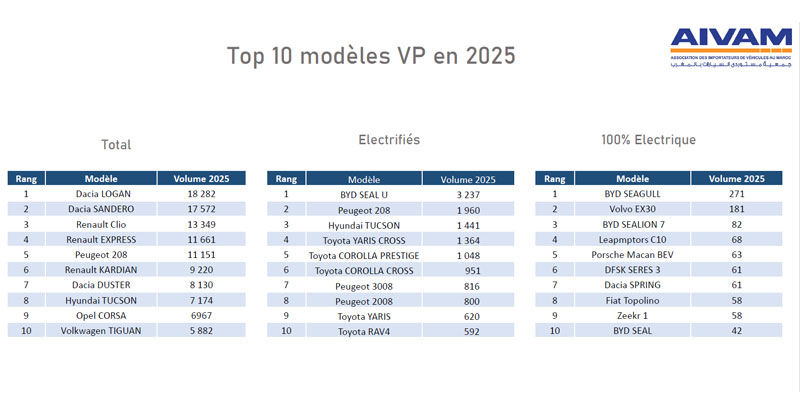
It's done. They're already the premier automotive superpower now. It might not seem like it in Europe and USA, but anywhere else in the world they are dominating. I live in Morocco and I am not exaggerating when I say that every week I see a new Chinese brand on the road. Not just cars of the same brand, completely new brands. Dacia and a lot of PSA cars are built in Morocco, so naturally they always had a strong positioning here, but now I'm seeing more BYDs than DACIA's most popular car, the Duster. It's anecdotal but it's quite telling considering the foothold French brands have always had here.
Here's a chart showing the sheer dominance of Chinese brands on the EV market in Morocco. 6 out of 10 models are Chinese.
https://www.wandaloo.com/files/2026/01/aivam-bilan-marche-au...
By fennecfoxy 2026-01-2010:542 reply >every week I see a new Chinese brand on the road
And I think the difference is going to be apparent 15-20 years from now when new parts are needed for these models.
With the big boys like Ford, Toyota etc I can trust that they manufactured (and still manufacture) parts with warehouses full of them and I can always find the part I need to repair a vehicle.
I very much doubt that we will see the same thing with Chinese auto companies, even premier ones like BYD.
By pjc50 2026-01-2011:06 > And I think the difference is going to be apparent 15-20 years from now when new parts are needed for these models.
Perhaps unstated, but this is going to be like trying to find parts for my Nokia 3210 (current age: 27). EVs are still in the "rapid improvement" phase, and by the time the battery warranty expires (5-7 years) the cars available on the current market will be significantly better in all respects.
On the other hand, they just have far fewer "parts" in the first place. Early indication is very good for lifetimes of the non-battery parts.
I expect the median EV of today to have a shorter life than a corresponding ICE, but the EV of 10 years time to have a much longer one. Which is going to make all the stupid issues around infotainment and subscription issues more acute.
The average age of all cars on UK roads has just hit 10 years: https://www.racfoundation.org/media-centre/average-car-in-th... ; EVs skew young because they're new.
No EV is going to run 20 years from now unless replacing batteries will start costing significantly less.
In Europe there's plenty of Chinese cars to be honest.
And they often outsell European cars price-to-price, even through tariffs. It's crazy.
The whole topic of tariffs on their cars is also very complicated that European automakers aren't in favour of, because large parts of their sales come from outside Europe.
By chakintosh 2026-01-219:33 And Chinese brands are more than willing to tank the prices to absorb those tariffs
By agumonkey 2026-01-2011:14 thanks, how is the consumer response ? they love it ? quality is good ? and prices too ?
in the australian market theres often comparison between how BYD/(chinese brands) may unseat Tesla (as the scale EV first mover), but I haven't seen what I think is the prize, which is BYD want to take on Toyota as the de facto king of global car making. They want the whole car market, not just EV and are already setup to take that on.
Especially as Toyota seems structurally unable to create a good EV. They produced one completely bare-bones model 30 years ago and never expanded past that. At least they're keeping some knowledge of the parts by having PHEVs, but I don't think they're on the leading edge of anything. Maybe they don't need to be and can buy everything from other suppliers, but they're going to be doing a whole lot less than they currently do and not sure they'll keep their profit margin.
Toyota hybrids are full hybrids however, not mild hybrids like other manufactures, so all you really need is a bigger battery and charger. My 10 year old RAV4 Hybrid (not plug-in) can deliver 160kW just from the electric motors, without the engine. That's 3x a Dacia Spring. They have the technology for motors and control electronics, and they know it works long term without issues.
Most of the European EVs are basically just electric city cars, unable to drive long ranges due to small batteries and limited fast charging. And most of them after 100,000km will need a new battery. Doesn't really fit in with Toyota's 'long term reliability' stance.
I can't blame Toyota for waiting for the technology to mature before they go all in on EVs. Plus they do have the bz4x / RX which are full EVs you can buy today.
I've been pondering this, especially given that Japan is not an oil-producing country, and concluded: it's the internal politics of the engine group.
That is, the people who design engines and run the engines division have sufficient heft within the organization that they can prevent a good car being made that doesn't have an engine in it.
It's sort of worked out for them as they have a big niche in the taxi market, and other high milage users who've not taken the EV plunge yet. If you want the most efficient vehicle that still uses petrol, buy a Toyota.
By protocolture 2026-01-204:304 reply >Then I think you see an early indication not just of electric car dominance, but of the (very potential) rise of China as the premier automotive super power.
I thought we were there already tbh. Chinese cars have gone from laughably bad to quality parity in less than a decade. Like even 2 years ago, I was still hearing "the paint the paint" as the last remaining issue. But I dont hear that anymore.
Have you seen the paint schemes on new Chinese cars? Wow. Embedded glitter, chameleon colors, while the European car industry is doing boring primer like paint schemes. I always joke that they applied clear coat onto primer. And that's on >60k models.
By pjc50 2026-01-2010:35 The "greige" colour appalls me. Not only does it look like primer, it looks like the grey of old PC cases under a brown of smoke. Either basic white or basic black would be better. Or classic metallic silver.
By IrishTechie 2026-01-206:172 reply Other than price, in what ways are they streets ahead? I’m a bit of an EV nerd and that would not be my assessment at all. Unfortunately for Western manufacturers price/volume is probably the most important thing right now, so they are still in serious trouble.
By protocolture 2026-01-204:461 reply I dont drive one of their EV's, but the 20+ year veteran Diesel Engineer who took my DPF filter complaint escalation does and thats really all I need to know. After I run my current vehicle into the ground, that will probably be next.
Have you ever ridden in a BYD? It's super loud, horrible suspension, seats are extremely uncomfy, everything is cheap with a fancy looking facade. If you need a car to go from point A - B and can't afford any luxury, it's fine. But it's a bare minimum vehicle with looks to appeal to status.
By hliyan 2026-01-205:34 I have ridden in a BYD and it was the opposite experience: excellent suspension, unusually smooth ride, great seats. A few things on the dashboard did look a bit tacky. But overall, massive difference from where Chinese cars were even 5 years ago.
By muzani 2026-01-2010:01 Replying from a BYD now. I wish HN could attach photos.
It's literally quieter than a bicycle, except for a whirring when the car powers up. We've come across people and animals standing in the middle of the road because they didn't realize the car was right behind them.
Soundproofing is good too. It comes with karaoke built in and it's more sound proof than many karaoke rooms.
Suspension is much better than my previous car but I'll reserve judgement until it's also 5 years old.
Seats are comfortable enough to sleep in - some people are even using it as an alternative to a hotel, because you can keep the air-conditioning on all night and the seats go all the way down to a horizontal position. There's a window up top so you can watch the stars at night too.
Also the seats have air-conditioning in case your back is hot too.
By protocolture 2026-01-206:25 Havent ridden in a BYD, but I absolutely abhor the Tesla interior, its like riding around in a rickety iPad.
BYD's seem (super subjective) to make less road noise outside of the vehicle. I still get snuck up on by them in car parks, but I have tuned in to the Tesla hum and can hear them a while off.
By prmoustache 2026-01-207:52 Tesla has shown that you can buy usd100K cars with dubious quality and terrible materials.
That makes it easier for brands who sell cheaper models imho. It is all about status, and right now having an EV and a fricking 17" TV on the dashboard trumps everything else.
By martinpw 2026-01-207:10 I think you are a few years out of date. Certainly they used to be not great. They are way better now.
By xenospn 2026-01-205:51 Most of what you’re describing applies to Teslas too, tho.
By irjustin 2026-01-204:34 In terms of quality they are there, now it's expansion. I, for one, am quite excited for all this competition. I don't care who makes my level 4/5 self driver, I just want it now.
China's 2025 numbers are out: https://en.wikipedia.org/wiki/List_of_countries_by_motor_veh...
They're up roughly 10% over last year and will likely hit 35% of global production. The big shift over the last decade (beyond their growing market share) is that their overall quality has caught up to (and in many cases surpassed) the traditional incumbents.
Barring a global war, I think they're unstoppable at this point.
I remember when Japan was supposed to take over the world in the '80s, to the point that "back to the future 2" had Americans speaking Japanese to their managers.
Toyota did become the dominant producer, but American and European car makers (and now Koreans and Chinese) are still around. I wouldn't bet on total domination from China anytime soon.
By csomar 2026-01-209:26 Well, China is not accepting/going through a Plaza Accord kind of an agreement. So history might not replay itself this time.
By mytailorisrich 2026-01-2013:06 Yes I remember, too. The crucial difference is that Japan's population is one third of the US while China's is 4 times the US (and 3x the EU).
Basically Japan never had the numbers to "take over the world" while China has them even if natality is way down.
If China had the same clout relative to population as Japan, Germany, Korea, or the US it would dwarf everyone else, and that's why the US are in a panic about China.
By vasco 2026-01-207:34 And funny thing, all three countries car industries were started by the USA.
> the (very potential) rise of China as the premier automotive super power.
This is dangerous, geo-politically, should China ever go to war with the West in any capacity.
In WW2, America's car factories gave it a decisive advantage, as part of the war machine.
Ford’s Willow Run plant produced one B-24 bomber every ~63 minutes at peak output. General Motors built tanks, aircraft engines, trucks. Chrysler: tanks and artillery.
The West de-industrialised, as a result of our globalist policy (thanks to the WTO, WEF and other supranational organisations). We have decimated our own military industrial production capability.
Meanwhile China has taken exactly the opposite approach.
By pjc50 2026-01-2015:01 https://www.ft.com/content/6474a1a9-4a88-4f76-9685-f8ccb080d... : "Renault to team up with French defence group to make drones for Ukraine"
I don't think the deindustrialization narrative is quite as bad as the doomers would have it, although it's notable that both sides in the Ukraine war depend on Chinese drone electronics.
(we've also forgotten the nuclear war narrative of the 80s: it's irrelevant if you can build a bomber in 63 minutes if it only takes the ballistic missiles 43 minutes from launch to arrival, at which point the war or at least industrial society is over)
By catigula 2026-01-2015:29 China spent a lot of money for this position in the market.
By psychoslave 2026-01-207:581 reply What's in the mind of European political oligarchy really?
By epolanski 2026-01-2013:19 What do you mean?
By itsthecourier 2026-01-202:49 great analysis
I don’t think anyone is going to keep an advantage in car manufacturing. The way we build them might totally change in a short duration with the rapid advancement in robotics
Most advancements in robotics have been for highly generalized robots. We’ve been using robotics to build cars for like 50+ years. They’re extremely good.
By mrits 2026-01-2121:01 Most practical advancements in robotics have been in and will be in highly specialized systems. Generalized robots are still mostly experimental.
By appplication 2026-01-201:4311 reply China may become the superpower on volume but I would be surprised if the upper quartile (by price) of western buyers were interested in Chinese vehicles. Too much quality issues across the board on Chinese made products, unless you have a trusted non-Chinese company with stringent quality control (e.g. Apple model).
I’m sure they can handily win the lower end of the market though. And yes I’m aware many western manufacturers are shit tier quality.
I don’t think this is accurate, Chinese firms are increasingly moving up the quality chain. You might want to look at some of the reviews of Xiaomi’s recently launched car. Also, Tesla Shanghai is one of their best factories, much better quality scores than Fremont iirc.
Having a totally local, integrated supply chain pays dividends in a lot of ways, as does leading in production volume. Tim Cook also gave that interview where he was just talking about the incredibly deep bench of industrial talent that you just can’t find outside China at this point - that labor cost wasn’t why they produced there.
By appplication 2026-01-202:186 reply The issue is not actual quality, it’s perceived quality. Chinese companies will fight decades of history and negative perception to reach top of the market consumers, a segment obsessed with perception.
By IncreasePosts 2026-01-202:342 reply it took Japan about 25 years of very directed industrial strategy to take the "made in Japan" label from indicating junk to the average American, to indicating a premium/reliable product. China might get there in even less than 25 years but you'll probably still find people holding onto old "chinesium" beliefs long after they should
From what I've heard, the quality is pretty good. The problem is when something breaks, you can be waiting for (sometimes very expensive) parts for months while not being able to use your car.
The (potential, no experience) quality issues are to me far outweighed by the enabling of yet another country to become a superpower which will then sooner or later result in yet another confrontation. Russia should have taught at least Europe that this sort of trade can only backfire in the longer term. Yes, I realize, China is the world's factory now, but there is no reason that can not change. I'm trying really hard to buy European made products and to use European services where possible. There are still a couple of hard nuts to crack but I'll get there.
By blub 2026-01-207:54 > I'm trying really hard to buy European made products and to use European services where possible.
European companies are trying even harder to outsource to China.
In the past months I’ve seen an increase and it feels like almost everything is made in China, from books to Christmas trinkets to clothes and kitchen utensils, it’s a pain the ass to find locally produced goods.
This has a lot to do with the energy crisis triggered by decoupling from Russia, which was never properly put into context and evaluated from an economical perspective.
In the US for example, most of the US brands are already made in China. They will copy the tooling and put a different brand name on it and you'll have a tool of the same quality for way less cost.
Simply put China is an unrecognized superpower at this point with the investments they've already made. The amount of infrastructure they've built in a decade dwarfs what the West has done in decades.
By light_hue_1 2026-01-202:481 reply Nothing to do with quality. It's all image.
When Americans discover again how crappy their cars are compared to what's available elsewhere, like we did with Japan, there will be a reckoning once more. And again American cars will become the laughing stock they really are.
In the meantime, this incredibly short sighted protectionism will end just like the last round did. Further hollowing out our industrial base and permanently giving away large parts of a massive market.
And I'm sure all of the people involved in this insanity will want a bailout too.
By linksnapzz 2026-01-203:052 reply >When Americans discover again how crappy their cars are compared to what's >available elsewhere, like we did with Japan
No, that's not what happened. Japanese manufacturers made cars in the US, to match US tastes. Japanese cars as sold in Japan, were not models Americans would buy.
>In the meantime, this incredibly short sighted protectionism will end just like >the last round did.
It'll end with...Chinese cars made in US factories w/ American workers? Chinese V8 pickup trucks failing to win market share against the US competition?
Chinese electronics manufacturing now is like Japan in the 60s/70s - I give it like a decade max before "Made in China" is widely understood to mean "High Quality" rather than the "Cheap Junk" connotation it still has today.
By thaumasiotes 2026-01-202:35 https://www.youtube.com/watch?v=fxYjsZr1PwM
If you read Calvin and Hobbes you can learn that Taiwan used to be known for making... shirts.
By pixl97 2026-01-203:40 It's like that with tools if you know what to buy, and costs well below the US brands.
For my primary tools I'll have hundreds of hours of use I still buy the more expensive brands, but on tools I'll use much less commonly I'll pick up a Chinese unit in a heartbeat for 1/10th the price.
Selling the most cars will eventually translate into making the best cars, with the compounding experience and network effects.
By linksnapzz 2026-01-202:58 At the time the US was making the most cars in the world...quality varied widely, to be generous.
By willturman 2026-01-201:551 reply You'd think so, but also, Tesla.
By appplication 2026-01-202:061 reply > Selling the most x will eventually translate into making the best x
It’s a theory for sure, but I don’t think that’s a common strategy for modern capitalism.
By protocolture 2026-01-204:34 No its the other way. In 4x4 They cannibalised the GM-Holden Colorado chassis production line in Thailand when GM exited that market, have refitted it with chinese made electronics and shell, and have complete quality parity. Actually a few people think the engine is better, and I am forced to agree. One of the colorado downstream models I tested had a better turning circle. They also tend to pack in all the "extras" other brands put on as standard. Consumers face a choice between cheaper and better vs tried and true brand loyalty. And brand loyalty has a limit tbh.
By idiot900 2026-01-202:19 This was once said about Japanese cars. I don’t want a Chinese car now, but I probably will not too long from now.
By csomar 2026-01-204:44 The quality angle was true 10 years ago, but that's no longer the case. Chinese cars are now superior in some areas and inferior in others (you can feel that some finishing is incomplete), but on average (and especially considering the price) they're better. The gap in the inferior areas is very small, and I wouldn't be surprised if they fully surpass European cars this year, given the new models they're releasing.
By amanaplanacanal 2026-01-2012:18 I grew up hearing the same thing about the Japanese back in the 60s and 70s. That didn't last though.
By auggierose 2026-01-204:51 People are buying £60000 BYD cars left and right. That's quite an expensive car.
The upper quartile are in the US and they're not allowed to buy Chinese cars, so you are right by default.
That notwithstanding, Xiaomi cars are nicer than Teslas. They're called "the Apple of China" for a reason.
By IncreasePosts 2026-01-202:352 reply They can't buy Chinese cars now, but I imagine the next Democratic president might want to knock Elon musk down a peg or two.
I think Porsche is really in trouble here.
I’m not anti-EV but the electric Macan and Cayenne look awful. They are under equipped technologically relative to their Chinese peers (heck basically anything).
Porsche sort of sold its soul for this tech-forward design but it doesn’t deliver any meaningful benefits, these cars don’t even have level 2+ highway cruise control. In the meantime I get a bunch of crap screens and lose all the glorious physical buttons and I don’t even have a fun engine rumble to make up for it?
So, the cars are ugly and uncool (I grant a matter of taste), aren’t selling in their target market (China) won’t sell meaningfully in their backup market (US) and they’re behind GM, Tesla and BYD in all regards on quality of life stuff.
Not a recipe for endurance.
By thomas_witt 2026-01-2011:214 reply Being a customer for years, I have to politely disagree.
Design is obviously a totally personal matter of taste, but as they have made many iconic shapes, apparently they're in the broad opinion not too bad at it.
The main difference is driving. I have driven many cars in my life, from very cheap to very expensive. For me personally, Porsche is in my opinion comparable to using a Mac - they're one of the few who "get it right":
- The entire workmanship is fantastic—nothing wobbles and nothing rattles. - Everything looks very harmonic, from interior to usability. Every button is where it has to be. Even the built-in entertainment system is highly usable (which in my opinion others like Mercedes never got right). - And, most importantly, despite being ICE or EV, the whole driving experience is just lightyears away from many competitors. Whether it's a 911 or a 718, they are just a joy to drive. Even a Cayenne just doesn't feel like a bulky SUV. There seems to be a lot of engineering going into all of that, weight distribution, chassis tuning, etc.
Apart from that - again, having owned many cars in my life - they're the most service-unintense cars ever. They just - work. You change the oil, sometimes the tires and that's it. I never had a single bigger problem with them.
Is there a lot of stuff which they didn't get? Agreed. Would it be nice to have better self-driving options? Without a doubt, but that's just a question of time.
But at least you have to give them that they, in strong contrast to many other German car manufacturers, didn't miss the trend and started to produce sexy EVs (hello Taycan) from very early on.
As long as I can, I will stay a loyal customer to them. If you have never driven a Porsche, get a test drive. I can only highly recommend it.
PS: And double points if you can do it on the German Autobahn. Try driving 240+ km/h with any other large-volume-production car, you'll be sweaty. With a Porsche, it just feels joyful.
>Try driving 240+ km/h with any other large-volume-production car, you'll be sweaty.
This is just very much not true, Audi, Mercedes,Toyota, BMW breeze through it, hell my friends audi S4 from 2004 regularly shoots 240+ over the autobahn, and we never break a sweat.
By thomas_witt 2026-01-2014:46 That is not my personal experience. I get very often those cars of those other major German brands at SIXT car rental, and of course this is my personal opinion:
- BMW is indeed very nice, I agree. I also once had a 6 series convertible which was - apart from the very low consumption (Diesel) - really nice to drive. Their cars are indeed a good alternative at a lower price point. - Audi is the utmost catastrophe. Apart from the abysmal navigation system, the car simply doesn't feel safe at higher speeds (had an A6, your mileage may vary with tuned S models). I didn't want to drive faster than 180km/h - Same goes for Mercedes (drove C, E and S Classes). The entertainment system is straight from the 90ies and the steering gets super wobbly at higher speeds. - Toyota - are you kidding me? Very reliable, good value, but nowhere near the driving capabilities of a BMW or Porsche.
Of course they are all nice cars and should do the job, especially in countries with speed limits - until 120 km/h that all doesn't matter. I'm just saying, if you really want (and can) go fast, most of those cars don't deliver in my opinion.
> Try driving 240+ km/h
This is an entertainingly German-centric answer.
By thomas_witt 2026-01-2016:13 My point is, just from my perspective (YMMV), the Porsche cars are pretty perfect. I have a hard time finding a car which behaves more precisely and reliably on the street, regardless of the speed, than a 911 or 718 - or a Taycan or Panamera.
That refers back to my original answer when the poster said Porsche are "in trouble" because they are "technologically underequipped" and "don't deliver meaningful benefits". There is a lot of stuff China and other carmakers haven't caught up to. Will they in the future? Maybe.
To take that German-centric thing out: Try going on a mountain road and have fun in the corners. I am sure, if you have multiple cars to do the same thing, the Porsche will rank pretty high.
In any case, of course, this is all a pretty niche market for people who love driving sports cars. In 99%, a Toyota can deliver exactly the same value for the base use case (going from A to B) for way less money.
After all, this is what the performance oriented cars by all German manufacturers are made for. Even a VW Golf GTI will happily cruise at 250 km/h.
By NetMageSCW 2026-01-2015:37 Having driven a Macan EV recently, it was nothing but annoying coming from years of Porsche driving. Too many unnecessary changes from what was there standard controls. Too much screen use.
By 0xcafecafe 2026-01-2013:203 reply That is interesting. Thanks for sharing I was interested in trying out a Porsche. Do the oil changes and other maintenance items cost significantly more than other makers?
By NetMageSCW 2026-01-2015:35 If you prefer dealer maintenance, definitely. And tires cost more and are used up quickly (though BEVs may be similar here).
By slowmotiony 2026-01-2014:49 Unfortunately yes, my Porsche Cayman's service is usually at least twice that of my wife's BMW 4 series.
By thomas_witt 2026-01-2014:46 Not really, I usually don't carry them out at Porsche itself, only the regular inspections.
I keep seeing "underequipped technologically relative to their Chinese peers" on HN. What kind of stuff is missing? This is not a loaded question, I only drive a couple times a month, and the vehicle I'm driving is an older Prius, so I probably lack imagination. EVs are supposed to be technologically pretty simple, most of an EV's value being in the battery packs. I've been thinking about upgrading, perhaps to a Nissan Sakura (which probably doesn't have a lot of bells and whistles either).
Now I kinda wish my Prius had a 3.5mm aux-in jack but I get by with an FM transmitter.
In terms of features I see on high end cars… (no clue if these are available in Chinese cars, just to help you get an idea of what exists)
1. Backup camera with lines that move as you turn the wheel
2. Camera setup that lets you see how close you are to curbs, other cars, etc. from a plethora of unexpected angles (you can get a top-down view of your car! Pretty cool.)
3. Automatic parking when parallel parking
4. “Reverse actions” feature, where you press a button after very carefully getting into a spot, and the car replays it in reverse to get you out of said spot
5. Lots of remote features tied to an app. The ability to look through cameras, auto-record videos when people get close, lock and unlock and view status of the car. Remote tracking via GPS in case it’s stolen.
6. Turn on your turn signal, your dash changes to a live video feed of that side of the car
7. Chairs with heating and cooling, massaging, and auto-inertia-damping features
8. Bluetooth and Apple CarPlay plus Android auto
9. Road-scanning cameras which adjust suspension live based on upcoming road conditions
10. Crash preparation features like Benz’s Pink Noise or auto-recording a minute of video to assist with crash investigations
There are probably may I’m forgetting.
By drnick1 2026-01-203:05 > 5. Lots of remote features tied to an app. The ability to look through cameras, auto-record videos when people get close, lock and unlock and view status of the car. Remote tracking via GPS in case it’s stolen.
This is akin to spyware, since inevitably it is a cloud service using an onboard cellular modem.
I would personally rather have none of 1-10. What I do want in a high-end vehicle is things that are there for my benefit (heated steering wheel, heated/ventilated seats, spacious cupholders, etc.) not the manufacturer's.
By jjmarr 2026-01-202:44 I have 1 and 8 on my cheap RAV4 from 7 years ago. Heated seats too.
By BeetleB 2026-01-2014:50 Not sure about 4 and 9, but the rest are available in US cars (not sure if any US car has all of them, though).
Some of these have been around for almost a decade. Not specific to EVs. I drive an ancient car (2003), but I've rented cars that have the rest.
By gadiyar 2026-01-2014:35 I have 1,2,6 and 8 plus part of 5 and 7 (remote lock, unlock, status and GPS tracking, heated and cooled seats) on my 4-year old Hyundai Tucson. Not expensive and a very good value for money car. Made in Alabama.
By itsthecourier 2026-01-202:56 saw an xpeng playing music outside the car, not inside, for beach parties
and, this is not a joke, truly: the seat gave me a massage.
Lol, 1 to 4 is just called "knowing how to drive". These cameras aren't a serious value add unless you're driving a massive tank, err car.
By embedding-shape 2026-01-2010:553 reply > What kind of stuff is missing?
I'm in the market for buying a new car, either EV or hybrid. Currently have a Audi, been looking at various BYD models, particularly the new Touring one.
One important feature, that I didn't know I needed before I tried it, was in-seat AC, where the air from the AC hits the back and bottom, instead of just your arms and face. Living in a warm country, and spending most of the time in the car during the summer, this feature is something I really want now.
Heading to Audi and asking what the cheapest model available with that feature? Around 70K EUR. Doing the same but going to BYD: 35K EUR. And that's just considering that single feature, the same happens for almost everything. Want a HUD in the windshield? Audi adds 5K to the price, with BYD it's in the middle variants and up.
Basically, you get the same amount of "features" for half the price, and it's hard to just say "Well, I'm a fan of Audi so that's worth the markup". Still, there are many decisions that go into purchasing a car, not just the features, but I think that explains why you see that argument come up, because they do offer more features for cheaper than at least what the European car makers do.
I think this is one place where European automakers are going to have to adapt or die out. Even if they can get the motors, batteries, and charging systems to a competitive level, Chinese manufacturers include most """luxury""" features by default. European manufacturers go the other way, including the hardware but locking the entire thing behind microtransactions or "upgrades".
They're going to need to cover the losses they're compensating for with the ridiculous upgrade prices somehow or they're going to lose even more customers. The import tariffs raised to protect the European market from affordable Chinese cars aren't going to work forever.
By neogodless 2026-01-2014:05 This is an odd one to take so long to "become normal" in luxury cars.
Lincoln started doing this about 20 years ago. You can buy Chevrolet pickup trucks with this feature. Of course my Polestar 2 (Swedish but made in China) has ventilation.
Now some might do true AC, while many just do ventilation, but either way it adds a lot of comfort if you're in a very warm cabin (or, say, have a huge panoramic sunroof.)
By dzhiurgis 2026-01-218:41 > Doing the same but going to BYD: 35K EUR.
To add insult to injury - a good portion of it is tariff (which in itself is just countering CN government subsidy)
I'd be careful buying Chinese EV's purely due to sanction/markup depreciation, on top of already hard EV depreciation.
I think a few things.
1. They do not have robust self-driving capability. At this level of expense I expect hands-free major highway driving.
2. They’ve removed a lot of physical buttons that improve quality of life, the level of technology in the cabin is simply overwhelming.
3. They’ve done a great job with the driving experience of the EVs but they have poor range relative to the competition.
I have a 2022 Porsche 911. It has a lot of physical controls for things in the cabin like climate control, suspension settings, cruise control, dashboard view, and audio. The car also has an auto steer and cruise control option which will accelerate and brake for you while also keeping the car in the lane. It can go from a stop to whatever speed you set it to. It’s great for traffic on the highway. That’s not too shabby for a 2022 non EV car. Current model Mercedes have level 4 driving automation where you can take your eyes off the road. I don’t think Tesla even has this level of driving automation yet.
By dboreham 2026-01-202:54 Porsche buyers don't want self driving. The button thing is industry wide MBA group think that is being walked back. Their haptic buttons are actually not bad. Car manufacturers are shit at software, presumably because they don't feel the need to pay top euro for talent. Again an industry wide syndrome. Heck GM think it's smart to delete Apple carplay from their vehicles. The only electronics feature all buyers want.
By dineol 2026-01-202:36 I hate touch/sensor buttons and sliders. Give me back my physical buttons and spinning controls. Also, same for electrical speedometers/tachometers, etc
See this MKBHD video for an idea of features in Chinese EVs.
By qiqitori 2026-01-202:34 Watched it! I know it's from a US perspective, but where I live (Japan), $42000 is quite a lot! Definitely premium car territory. (E.g., Lexus RX base model)
IMO the car has a lot of bells and whistles that many drivers (probably!) don't really care about. But I guess car fans like this kind of stuff. The active noise cancelling feature might be nice, but wouldn't be surprised if we see regulation on that matter at some point. You kind of need to be alert of your surroundings, etc.
By wilg 2026-01-207:24 This is a car that is more expensive than a Tesla Model 3 in the Chinese market, with more or less the same features.
By bravoetch 2026-01-202:39 I don't want to make an exhaustive list, the summary is that standard features on many new cars are expensive options on Porsche's. And that's if they're available at all. Adaptive cruise control is one example.
Where I live, luxury cars are just status now. I don't think that's enough to keep gen Z and gen A interested.
By djd20 2026-01-202:09 Clearly porsche is missing the built in karaoke.
I wanted to replace my gas Macan with the new EV one. After a test drive I decided to just keep the gas one.
As an EV it is excellent. But Porsche is known for engaging driver's cars, and without the visceral sounds and vibrations of an engine it is bland and boring. The flaws in a gas engine's power curve give it character. Letting the driver manage that power curve is fun. A perfectly linear sub-3s 0-60 with fake electric sport sound played through the speakers does nothing for me.
I'd have probably bought it at $75K, but at $125K it needs to be more special. Especially considering the rate at which they depreciate. Its not a surprise to me that their EVs aren't selling as well as hoped. The Taycan sure is pretty though.
You're just religious about your own preferences.
Prosche specifically is facing huge losses, and with this strategy is doomed to die. There are already rumors of potential bancrupcy.
EVs grew 20% globally in 2025, with developing markets surging 40%+. When EVs under $100,000 can hit sub-2.5-second 0–60 mph (0–100 km/h), all this fake "benefit" talk about exhaust notes and luxury engine refinement sounds exactly like people cheering for Vertu golden buttons at the dawn of the iPhone era.
EVs are growing incredibly fast—despite the West's biggest EV supplier deciding to commit marketing harakiri by alienating half its customer base.
New battery tech has made EVs affordable, and that's why adoption will keep accelerating in China, the EU, and the rest of the world. There'll be some irrelevant fluctuations in the US, but those will eventually even out regardless—because the rest of the world and technological progress will move on with or without them.
we are on the edge of go-to-market of billions of dollars of investments into battery development. It will deliver both much cheaper where needed and more capable batteries on the market. Guess what it will do with legacy cars.
EVs as a whole are growing. Porsche however is struggling because of their "sports car" identity. Taycan sales dropped 22% year-over-year [0], and their 2025 EV sales only rose because the Macan EV is new and they discontinued the gas one in the EU. (Even then: Half of all Macan buyers worldwide went for the 11-year-old gas design over the EV.)
The market for EV sports cars is soft. The Rimac Nevera R broke 24 performance world records and yet nobody wants to buy it [1]. Even the CEO of Rimac has said people want an engine sound. Meanwhile Ferrari can launch an even more expensive gas car and it sells out before its officially announced [2].
I'm pro-EV and my partner owns one. They are practical appliances that are perfect for the 90% of people who just want to get from A to B. But the stats show that it's not just my personal preferences. The average sports car buyer wants an engine and exhaust.
0. https://newsroom.porsche.com/en/2026/company/porsche-deliver...
1. https://www.carscoops.com/2024/05/slow-selling-nevera-is-a-s...
2. https://www.reuters.com/business/autos-transportation/ferrar...
By Tade0 2026-01-2012:43 > But Porsche is known for engaging driver's cars, and without the visceral sounds and vibrations of an engine it is bland and boring. The flaws in a gas engine's power curve give it character
Personally I experienced this the strongest in my friend's restored mk3 Ford Escort. I recall it as a feeling of not actually being inside a car due to the wind and engine noise.
Meanwhile the BMW 5 Series I rented a while ago didn't provide any of those feelings. Granted, it was a diesel automatic, but when I floored it, it just went and the engine noise was barely noticeable - at least compared to my poorly noise insulated daily Toyota.
The best thing about that car was that I could take my family on a 400km trip, the last 100km of which were mountain roads and not even break a sweat.
By prmoustache 2026-01-208:065 reply The thing is, driving on the road is not supposed to be fun. One should go to a racetrack (or simulator) to have fun.
Unless you live in a really remote and desertic place, there are just too much people on the road nowadays.
By embedding-shape 2026-01-2010:572 reply > driving on the road is not supposed to be fun.
Who says it's supposed to boring? It's supposed to be safe and you're supposed to drive with the consideration of others, but I don't think it's supposed to be either fun or boring, that's up to you.
I'm having a blast rolling down the highway in the middle of the night blasting music and singing, am I not allowed to do this because driving is supposed to not be fun?
By randerson 2026-01-2014:36 You can have plenty of fun without putting other drivers in danger. I used to drive a NA Miata that took 9 seconds to get to 60 mph and it was the most fun car I've ever owned. But I'm a slow-car-fast person.
Most people can safely wring out their cars in 1st and 2nd on a highway on-ramp, or from a traffic light on an empty 55 mph country road. I own a fun weekend car that I take out at dawn on a Saturday to carve up a mountain pass - which is fun even at the speed limit. In a lightweight sports car with excellent brakes, I am safer than all the trucks I see on these roads.
By carlgreene 2026-01-2014:55 I agree with this for the most part, though there are times and with specific cars that you can have a blast. I can have a lot of fun in an old M Coupe, or Miata.
I used to have a GT3...it was a dream car of mine and I finally got it. The sad reality was that in order to have fun with it on public roads I was either going to kill myself/someone else, or go to jail. The only way to really experience that car in a responsible way was to go to the track. Which I just flat out didn't have the time to do with young kids.
Things were very different 20-30 years ago. Roads were less crowded and people were much more respectful on the road. Now, especially where I live, it's a free for all Mad Max cosplay.
By PunchyHamster 2026-01-208:232 reply okay but why would you get Porsche in the first place then?
Luxury sport cars are sold on 2 basis, a status symbol, and being driver's car. If you don't have the second and it's just another EV why bother ?
By NetMageSCW 2026-01-2015:39 That you believe that is just sad. One doesn’t need to break the law to have fun in the right car.
By SoftTalker 2026-01-206:032 reply There's only one real Porsche, a gasoline-engined 911.
By jabl 2026-01-207:14 As much as I'm gung-ho about the world electrifying transport, I agree with you here. Those Porsche SUV's just look awful, whatever the drivetrain. If I'm gonna splurge on a Porsche, I'll want the real thing. And if I don't want a 911, well there are a lot of other brands making more sensible vehicles.
(Of course, if a lot of other people share my extremist views, that's pretty bad for Porsche the company. They likely can't survive just producing 911's. Oh well, I'm not here for corporate charity anyway.)
By antonkochubey 2026-01-2010:331 reply Nowadays the 718 might be more of a Porsche than the 911
By NetMageSCW 2026-01-2015:45 It definitely is, especially for the price.
But the 911 range has a lot of bandwidth and there are models that go from minimalist driver’s car (911 T) to Touring/GT (most 911s) to race car for the street (GT2/GT3). But you definitely pay to step outside the GT box.
By jillesvangurp 2026-01-207:47 The big challenge Porsche has is getting rid of its shrinking ICE business. Europe is a bit ahead here of the US. China even further. Local Chinese luxury brands run circles around Porsche in terms of luxury, performance, etc. That's why they are struggling there. Their cars just aren't good enough.
The way forward for Porsche would be to rip the band aid off and focus on just EVs. Leave the ICE market to hedge funds. Those are good at milking dying businesses that shrink year on year. They need to do some EV only models that are heavily optimized at being good at just that. Leave the SUV crossover BS. to all the traditional brands and make a proper sports car that goes fast and far. A little autobahn monster. That would restore their reputation for delivering unapologetically high performance cars that are slightly dangerous and exciting.
ICE is dead. That's grand daddy's car at this point. That's not something somebody born this century is going to lust after and put on their wall (in poster form). And Porsche needs something that young people would want if they had the money. Their current lineup is a bit too conservative and boring. Sensible cars if they'd be half the price. But they are just too expensive and unremarkable to sell well. You can do better for the same money.
By gloxkiqcza 2026-01-2013:09 The new Cayenne seems to be a step in the right direction for VAG.
SuperfastMatt is buying a Cayman! I think they will be fine...
Porsche is loosing billions and people start talking they are caput(bancrupt) :)
By NetMageSCW 2026-01-2016:04 And Apple is going to fail.
What is crazy about some of these old car brands is that they have some IP that would sell like hotcakes. Aircooled 911s went from 30k cars to 130k cars on the used market over the last 10 years. If they managed to work around crash regulations, maybe with some stroking of Donalds ego right now, they'd be making money hand over fist off those old designs.
I can't exactly remember the situation but I'm pretty sure there was a car company that did something like this in recent history, restarting a production run on a classic model and selling it out.
By prmoustache 2026-01-208:10 No. These cars are desirable and valuables as collectibles for the very reason they are a dying breed and we can't won't make them as they used to.
By GlacierFox 2026-01-201:493 reply EV cars are mostly just appliances now. Not sure how the prestigious Porsche badge (or any other really) can stand out into the future.
By blitzar 2026-01-209:43 Not sure if you have been into an appliance shop lately, but for any given appliance there are options in every price bracket.
By NetMageSCW 2026-01-2016:061 reply According to (enthusiast) car magazines, Porsche BEVs are still better at being Porsches than most of the competition.
By dzhiurgis 2026-01-218:53 In Doug Demuro's list 4 out of top 6 are EVs. Porsche appears at #17. Incidentally it's an EV.
By linksnapzz 2026-01-203:06 Making things that...track better than an appliance.
There's probably still plenty of value in the name, who knows if the audience who are impressed if you say "I've got a Porsche" vs "I got a Zeekr/BYD/Xiaomi" is growing or shrinking, if it shrinks fast enough, then Porsche is in trouble.
It's like bragging about having a Hermes bag vs a Temu brand bag. Yeah it's all irrational, but if the world was a rational place we'd not have a man-child threatening wars and invasion because he didn't get the peace prize he wanted...
By blackwateragent 2026-01-202:54 Trends and perceptions can change fast in China's market.
(NYTimes - Why Porsche Is No Longer a ‘Premium’ Sports Car in China)[https://www.nytimes.com/2025/02/17/business/porsche-china-ge...]
The US/EU/JP manufacturers are half-pregnant, they have engine and other mechanical production plants that will become stranded assets as BEVs don't need engines, gearboxes or the other hydraulic/cooling etc infrastructure that an ICE vehicle needs.
Electric motors are essentially maintenance free over the life of a BEV, same for the batteries. The maintenance is for brake pads/rotors, but regen braking also avoids that.
There is the passenger heat pumps for heat/cooling, and the lighting, but LED lighting also requires minimal maintenance.
That cuts out a large chunk of the automotive industry in general.
US/EU/JP manufacturers are having to handle a major market disruption, independent of whether or not CN is leaping over them.
> Electric motors are essentially maintenance free
They require maintenance, although less than an ICE, but drive train repairs are not as uncommon as you might think. Manufacturers are always going to pinch pennies.
> That cuts out a large chunk of the automotive industry in general.
Hardly. You've removed the engine, fuel and exhaust system. You still need literally everything else. Windows and motors, doors and locks, wheels and hubs, seats and accessories, gauge clusters and radios, environmental controls, differentials and oil changes, the list goes on and on.
You deliver them the same way, you sell them the same way, you license them into the system the same way.
> US/EU/JP manufacturers are having to handle a major market disruption
That was called COVID. They all handled it badly save Toyota. The oil companies have far more to worry about.
By rswail 2026-01-2011:23 This is not a market disruption, this is a supply chain change that is not going to be delayed by artificial tariffs or other protectionist attempts.
Post COVID was getting back to what was before, this is the equivalent of the introduction of Ford mass production techniques on the previous industry of coach building.
ICE engine parts are a major ongoing expense but also profit centre for dealers and an entire industry on their own.
So there's entire supply chains that will be disrupted.
How many engine plants are going to be needed going forward?
Australia went through this wrench back in 2014 when our local car industry collapsed after the government withdrew a measly amount in annual subsidies.
Fortunately it was a 3 year process that played out that allowed adjustments.
That had a major knock on effect of the loss of roughly 50K manufacturing jobs and industries had to pivot.
The US/EU/JP manufacturers are having trouble pivoting, the US because its car industry is entirely about trucks/SUVs, EU because its premium for manufacturing is rapidly eroding, and JP because they seem to be having trouble actually manufacturing EVs.
CN and KR is where the leaders are now.
By a456463 2026-01-2015:02 You wish. These EV get charged $15k more compared what they used to be with their gas models with crap touch screens, stupid ass voice controls: things that when broken are hard to repair and costly, the battery, the range. Keep dreaming
My last MOT in a petrol engine required suspension, tyres and lights. Electric wouldn’t change any of that
Lights with LEDs are likely to not need maintenance.
Suspension and tyres might actually need more frequent maintenance because of the extra weight of an EV.
But how often does suspension require actual maintenance?
By hdgvhicv 2026-01-218:55 Petrol cars have led lights now too.
It’s an alignment problem, trivial fix.
The suspension is a rust issue, I believe EVs are still made of metal.
Given in the last 3 years I’ve only spent money on tyres, replacement wing mirror, and now suspension on this car, and you assert an EV needs more spending on tyres and suspension, it seems that an equivalent EV would be higher maintenence costs.
I’m sure things are different at the high end of the market where you’re spending £10k on a nearly new car, but at my end where it’s under £2k it doesn’t make sense.
By TheJoeMan 2026-01-2015:46 When your LED brake light goes out, you have to purchase an entire assembly as the LED's are part of the PCB. There are no "bulbs" for a few dollars. And with the matrix LED's a few may go out, now your brake light "sort of" works, so it's even harder to justify replacing.
>Electric motors are essentially maintenance free over the life of a BEV, same for the batteries.
You had me until "same for the batteries." The batteries do pretty well, but they are quite the gamble.
By NetMageSCW 2026-01-2016:09 Evidence so far says they are not a gamble at all, and common (required?) eight year warranties on 80% life remaining are on all BEVs, plus record show that BEVs tend to to retain that 80% range at ten years. The gamble might be in whether the batteries have manufacturing defects, but warranty and recalls cover that, and as Samsung showed, can happen to even smaller, cheaper items.