
UK infants ill after drinking contaminated baby formula of Nestle and Danone

2026-02-079:347026www.bbc.com

It comes after some batches made by Nestle and Danone were recalled after being contaminated with a toxin.

Nick TriggleHealth correspondent

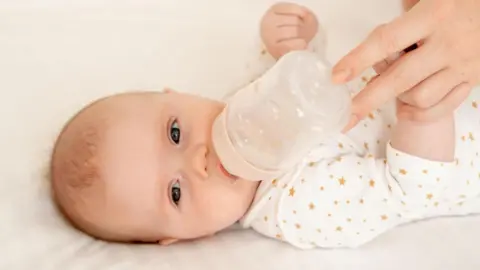
Getty Images Baby feedingGetty Images

Thirty-six infants in the UK have had suspected food poisoning from contaminated baby formula.

It comes after specific batches made by Nestle and Danone were recalled because of contamination with the toxin, cereulide.

The UK Health Security Agency (UKHSA) says it has received clinical notifications of young children developing symptoms, including vomiting and diarrhoea, consistent with cereulide poisoning.

None of the infants – all around or under one – are reported to be gravely ill, the BBC understands.

Gauri Godbole, from UKHSA, said it was not unexpected, given "the widespread availability" of the affected products prior to the recall and "subsequent testing".

Godbole said there did not seem to be any signs that huge numbers of children had been affected so far.

"Current surveillance indicators do not show unusual increases in reports of vomiting in children under the age of one for this time of year," she added.

But the agency said it would continue monitoring the situation and providing updates.

The UKHSA has not been able to confirm categorically that the infants had been poisoned but it has been confirmed they consumed the specific brands of infant formula affected.

The Danone batch affected is the 800g pack coded EXP 31-10-2026.

Meanwhile, for Nestle it relates to a number of products, including SMA infant formula and follow-on formula. The batches affected are listed on the company's website.

Of the 36 cases, 24 were in England, seven in Scotland, three in Wales, one in Northern Ireland and the final case reported to be in one of the Crown Dependencies, which includes the Isle of Man, Jersey and Guernsey.

The UK is not the only country affected with both European nations and those from other parts of the world reporting products have been contaminated.

Cereulide is a toxin which is unlikely to be destroyed by cooking, or when making the infant milk.

If it is consumed it can lead to symptoms like nausea, vomiting and abdominal cramps developing quickly.

The Food Standards Agency (FSA) has said the toxin was present in a specific ingredient identified as arachidonic acid oil. The oil is added to infant formula to give it some of the important growth properties contained in breast milk.

The FSA has urged parents who had any of the affected products left, to stop using them and switch to an alternative formula.

If you have fed it to your baby and are concerned, contact your GP or NHS 111 for advice, it added.

The FSA is working with manufacturers to trace all products that may have used the affected ingredient and ensure all affected products are removed from sale.

FSA director of policy Rebecca Sudworth said: "Along with international partners as part of this global recall, we are investigating the supply chain.

"We need to know from manufacturers what went wrong and get assurances from the companies involved that it won't happen again.

"The FSA will not hesitate to take further action if required."


Read the original article

Comments

  • By awakeasleep 2026-02-0713:421 reply

    The article doesnt contain any detail, so if anyone else is curious:

    Cereulide is a toxin produced by some strains of Bacillus cereus, a common environmental bacterium found in soil, dust, and raw agricultural materials.

    Cereulide acts on cells’ mitochondria and can cause rapid-onset symptoms like vomiting, stomach cramps, and diarrhea.

    During manufacturing, raw ingredients used in baby formula such as oils (e.g., arachidonic acid, or ARA oil) or dry powders can be contaminated with spores of B. cereus or pre-formed cereulide.

    Because spores and the toxin survive processing, they must be prevented by testing ingredients before inclusion.

    • By awakeasleep 2026-02-0716:16

      In the threads I see people focusing on the origin of the contaminated material. I think that misses the point that you have to deal with this by testing at the point where the ingredients are assembled into a final product, because it can’t be removed from whatever feed stock creates the individual ingredients.

      Of course, ideally the manufacturer of the component ingredient also does the testing but in manufacturing you never trust your suppliers- you need your own testing engineers if you are putting your brand on the product and taking responsibility for it.

  • By greatgib 2026-02-0714:445 reply

    Long running story already. What the report doesn't say is that it looks like that affected product batches were manufactured or manufactured with ingredients coming from China.

    It is a shame for Nestle to have to import ingredients from China for such simple products anyway. It's the greed at topest level.

    • By port11 2026-02-088:51

      This is a bit slandering, no? Cargill is a key supplier of arachidonic acid, and let’s say that’s where Nestlé gets it.

      Are they at fault for Cargill’s sourcing of Chinese ARA/DHA? Okay, they are, let’s say. But why are you buying virtually any product? It’s your fault that lots of manufacturing is done in China. Go make your own algae oil to put in your baby formula and we’ll discuss the pricing.

      What’s more interesting about all this: a) product recalls work fast; b) the baby formula industry is too dependent on a handful of suppliers of key ingredients; c) our brand of formula doesn’t use AHA so we appear to be safe for now.

    • By rlpb 2026-02-0717:283 reply

      > It's the greed at topest level.

      You say this as if it's some deviant behaviour that needs correcting.

      But greed is normal and expected in a free market economy. Suppliers are expected to seek to reduce their costs and maximise their profits.

      • By nsingh2 2026-02-0718:461 reply

        > greed is normal and expected in a free market economy

        OK, technically true, just like saying "water flows downhill" when someone's house is flooding. It isn't productive, the fact is well known.

        "The system incentivizes this" and "this is good/bad" are two entirely different statements. One doesn't address the other [1], until you make a moral judgement about the outcome.

        > You say this as if it's some deviant behaviour that needs correcting.

        Is it moral and correct for infants to be fed contaminated baby formula? The mismatch between what is and what ought to be is deviance.

        [1] https://en.wikipedia.org/wiki/Is%E2%80%93ought_problem

        • By rlpb 2026-02-0822:04

          > It isn't productive, the fact is well known.

          I agree. My point is that the original comment was similarly unproductive.

      • By greatgib 2026-02-0815:331 reply

        The point of "greed" here is when you are starting to cut corners to make more money to the point of impacting the quality/safety/honesty of your product. Thinking that no one would notice.

        You could buy whatever random Chinese milk powder brand. But Nestle is advertising itself on the upmost quality and care for you kids. Especially the brand impacted.

        It's like going to a restaurant selling the best homemade luxury food and you go to the kitchen and you find that they cook expired supermarket frozen food because they greedily were thinking that it would be more profitable.

        • By rlpb 2026-02-0822:031 reply

          So you're insinuating that importing from China automatically means poor quality? I don't believe that's true, especially for large companies who are able to manage the supply chain (as, AIUI, doing business with China famously requires).

          I think you need to address that to validate your original comment. Otherwise there's no justification for your claim.

          • By greatgib 2026-02-111:35

            Uk, France and European product are big historical producers of dairy products. So you can't tell me that ingredients have to be imported from China because they are not available locally, or because China would provide a better quality for them... And the proof that it is not the case is that indeed the contaminated ingredients are coming from China.

            The point is that somehow someone made the decision that there was a few cents of benefit to make to outsource the sourcing in China despite the risk, the environmental impact and the violation of customer trust about the safety of the product.

      • By foxyv 2026-02-0917:30

        Greed as a concept covers multiple ideas. One is principled self interest like you would see in an objectivist manifesto. The other is un-principled, short sighted, and stupid greed that simply grabs whatever gains they can without thinking about future consequences.

        I believe that Nestle epitomizes the latter.

    • By joemazerino 2026-02-0715:42

      Chinese citizens routinely import baby formula from the West because they don't trust their own country's manufacturing standards.

      Something to think about.

    • By direwolf20 2026-02-0718:43

      It's not like any other country knows how to manufacture things. Outsourcing and greed rotted our economies from the core outwards.

    • By arresin 2026-02-0714:481 reply

      I try to boycott them as much as possible. I thought the boycott nestle thing was just a weird Reddit thing until actually reading about this company. It’s pretty sickening.

  • By hyperman1 2026-02-0714:20

    AFAIK this story started in France, and has been going on for a while already in multiple countries.

    e.g. here is the recall in Flanders,Belgium,for 2026-01-05, so more than a month ago:

    https://www.vrt.be/vrtnws/nl/2026/01/05/nestle-nan-babyvoedi...

    Here is one English source about the deaths in France:

    https://www.independent.co.uk/news/world/europe/france-nestl...

HackerNews