
A terminal-based coding agent

There are many coding agents, but this one is mine.
$ npm install -g @mariozechner/pi-coding-agent
About
Pi is a minimal terminal coding harness. Adapt pi to your workflows, not the other way around. Extend it with TypeScript extensions, skills, prompt templates, and themes. Bundle them as pi packages and share via npm or git.
Pi ships with powerful defaults but skips features like sub-agents and plan mode. Ask pi to build what you want, or install a package that does it your way.
Four modes: interactive, print/JSON, RPC, and SDK. See clawdbot for a real-world integration.
Providers & Models
Anthropic, OpenAI, Google, Azure, Bedrock, Mistral, Groq, Cerebras, xAI, Hugging Face, Kimi For Coding, MiniMax, OpenRouter, Ollama, and more. Authenticate via API keys or OAuth.
Switch models mid-session with /model or Ctrl+L. Cycle through your favorites with Ctrl+P.
Add custom providers and models via models.json or extensions.
Sessions
Sessions are stored as trees. Use /tree to navigate to any previous point and continue from there. All branches live in a single file. Filter by message type, label entries as bookmarks.

Export to HTML with /export, or upload to a GitHub gist with /share and get a shareable URL that renders it.
Context
Pi's minimal system prompt and extensibility let you do actual context engineering. Control what goes into the context window and how it's managed.
AGENTS.md: Project instructions loaded at startup from ~/.pi/agent/, parent directories, and the current directory.
SYSTEM.md: Replace or append to the default system prompt per-project.
Compaction: Auto-summarizes older messages when approaching the context limit. Fully customizable via extensions: implement topic-based compaction, code-aware summaries, or use different summarization models.
Skills: Capability packages with instructions and tools, loaded on-demand. Progressive disclosure without busting the prompt cache. See skills.
Prompt templates: Reusable prompts as Markdown files. Type /name to expand. See prompt templates.
Dynamic context: Extensions can inject messages before each turn, filter the message history, implement RAG, or build long-term memory.
Queuing
Submit messages while the agent works. Enter sends a steering message (delivered after current tool, interrupts remaining tools). Alt+Enter sends a follow-up (waits until the agent finishes).
Extensions
Features that other agents bake in, you can build yourself. Extensions are TypeScript modules with access to tools, commands, keyboard shortcuts, events, and the full TUI.
Sub-agents, plan mode, permission gates, path protection, SSH execution, sandboxing, MCP integration, custom editors, status bars, overlays. Yes, Doom runs.
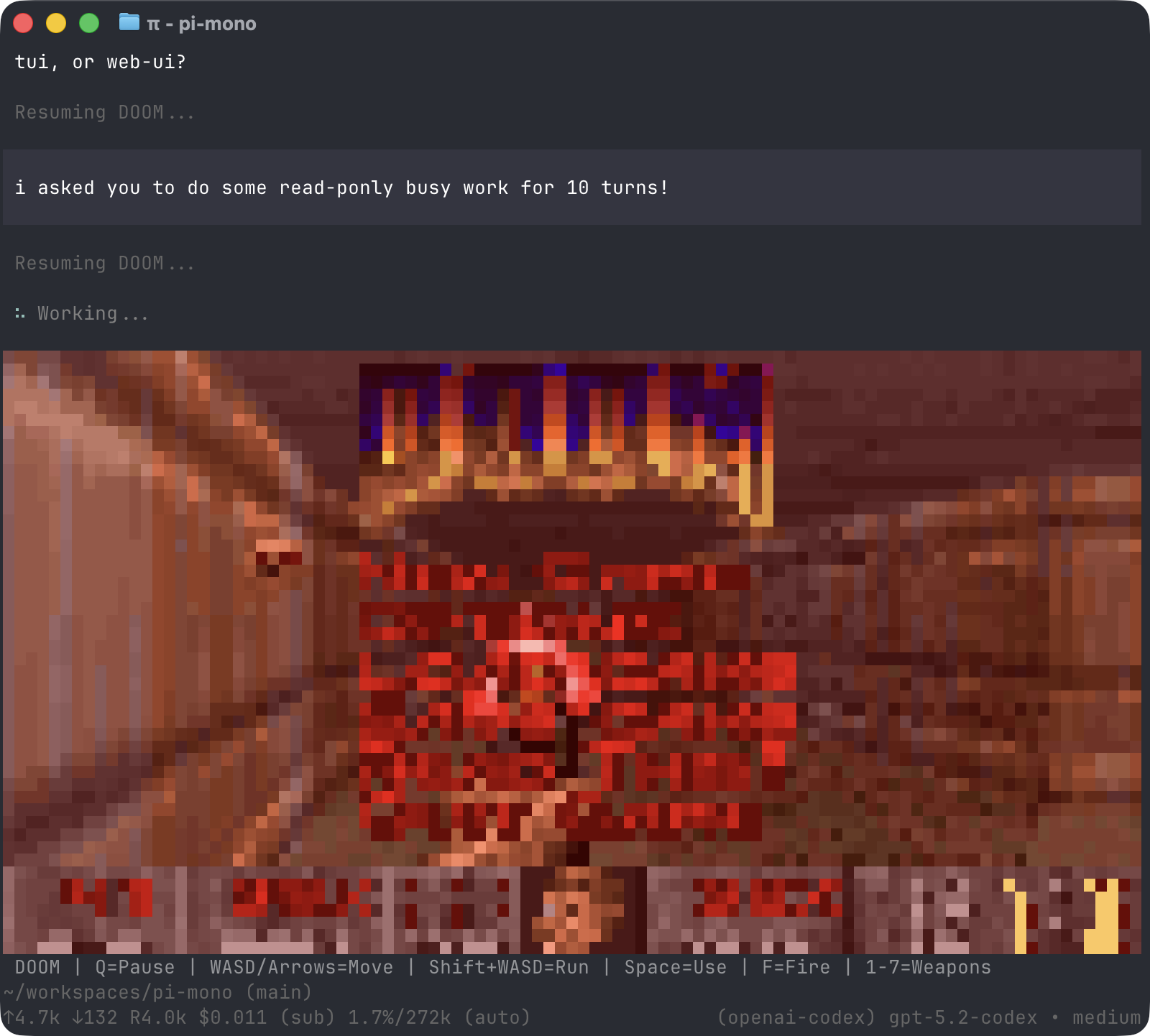
Don't want to build it? Ask pi to build it for you. Or install a package that does it your way. See the 50+ examples.
Packages
Bundle extensions, skills, prompts, and themes as packages. Install from npm or git:
$ pi install npm:@foo/pi-tools
$ pi install git:github.com/badlogic/pi-doom
Pin versions with @1.2.3 or @tag. Update all with pi update, list with pi list, configure with pi config.
Test without installing using pi -e git:github.com/user/repo.
Find packages on npm or Discord. Share yours with the pi-package keyword.
Integration
Interactive: The full TUI experience.
Print/JSON: pi -p "query" for scripts, --mode json for event streams.
RPC: JSON protocol over stdin/stdout for non-Node integrations. See docs/rpc.md.
SDK: Embed pi in your apps. See clawdbot for a real-world example.
Philosophy
Pi is aggressively extensible so it doesn't have to dictate your workflow. Features that other tools bake in can be built with extensions, skills, or installed from third-party pi packages. This keeps the core minimal while letting you shape pi to fit how you work.
No MCP. Build CLI tools with READMEs (see Skills), or build an extension that adds MCP support. Why?
No sub-agents. There's many ways to do this. Spawn pi instances via tmux, or build your own with extensions, or install a package that does it your way.
No permission popups. Run in a container, or build your own confirmation flow with extensions inline with your environment and security requirements.
No plan mode. Write plans to files, or build it with extensions, or install a package.
No built-in to-dos. Use a TODO.md file, or build your own with extensions.
No background bash. Use tmux. Full observability, direct interaction.
Read the blog post for the full rationale.
Read the original article

Comments
By CGamesPlay 2026-02-253:2813 reply To me, the most interesting thing about Pi and the "claw" phenomenon is what it means for open source. It's becoming passé to ask for feature requests and even to submit PRs to open source repos. Instead of extensions you install, you download a skill file that tells a coding agent how to add a feature. The software stops being an artifact and starts being a living tool that isn't the same as anyone else's copy. I'm curious to see what tooling will emerge for collaborating with this new paradigm.
By throwaway13337 2026-02-254:294 reply I see this happening, too.
We know that a lack of control over their environment makes animals, including humans, depressed.
The software we use has so much of this lack of control. It's their way, their branding, their ads, their app. You're the guest on your own device.
It's no wonder everyone hates technology.
A world with software that is malleable, personal, and cheap - this could do a lot of good. Real ownership.
The nerds could always make a home with their linux desktop. Now everyone can. It'll change the equation.
I'm quite optimistic for this future.
I'm presently in the process of building (read: directing claude/codex to build) my own AI agent from the ground up, and it's been an absolute blast.
Building it exactly to my design specs, giving it only the tool calls I need, owning all the data it stores about me for RAG, integrating it to the exact services/pipelines I care about... It's nothing short of invigorating to have this degree of control over something so powerful.
In a couple of days work, I have a discord bot that's about as useful as chatgpt, using open models, running on a VPS I manage, for less than $20/mo (including inference). And I have full control over what capabilities I add to it in the future. Truly wild.
By discreteevent 2026-02-2516:001 reply > It's nothing short of invigorating to have this degree of control over something so powerful
Is this really that different to programming? (Maybe you haven't programmed before?)
By h14h 2026-02-2520:31 Fair point.
> It's nothing short of invigorating to have this degree of control over something so powerful
I'm a SWE w/ >10 years, and you're right, this part has always been invigorating.
I suppose what's "new" here is the drastically reduced amount of cognitive energy I need build complex projects in my spare time. As someone who was originally drawn to software because of how much it lowered the barrier to entry of birthing an idea into existence (when compared to hardware), I am genuinely thrilled to see said barrier lowered so much further.
Sharing my own anecdotal experience:
My current day job is leading development of a React Native mobile app in Typescript with a backend PaaS, and the bulk of my working memory is filled up by information in that domain. Given this is currently what pays the bills, it's hard to justify devoting all that much of my brain deep-diving into other technologies or stacks merely for fun or to satisfy my curiosity.
But today, despite those limitations, I find myself having built a bespoke AI agent written from scratch in Go, using a janky beta AI Inference API with weird bugs and sub-par documentation, on a VPS sandbox with a custom Tmux & Neovim config I can "mosh" into from anywhere using finely-tuned Tailscale access rules.
I have enough experience and high-level knowledge that it's pretty easy for me to develop a clear idea of what exactly I want to build from a tooling/architecture standpoint, but prior to Claude, Codex, etc., the "how" of building it tended to be a big stumbling block. I'd excitedly start building, only to run into the random barriers of "my laptop has an ancient version of Go from the last project I abandoned" or "neovim is having trouble starting the lsp/linter/formatter" and eventually go "ugh, not worth it" and give up.
Frankly, as my career progressed and the increasingly complex problems at work left me with vanishingly less brain-space for passion projects, I was beginning to feel this crushing sense of apathy & borderline despair. I felt I'd never be able make good on my younger self's desire to bring these exciting ideas of mine into existence. I even got to the point where I convinced myself it was "my fault" because I lacked the metal to stomach the challenges of day-to-day software development.
Now I can just decide "Hmm.. I want an lightweight agent in a portable binary. Makes sense to use Go." or "this beta API offers super cheap inference, so it's worth dealing with some jank" and then let an LLM work out all the details and do all the troubleshooting for me. Feels like a complete 180 from where I was even just a year or two ago.
At the risk of sounding hyperbolic, I don't think it's overstating things to say that the advent of "agentic engineering" has saved my career.
I'm using kimi-k2-instruct as the primary model and building out tool calls that use gpt-oss-120b to allow it to opt-in to reasoning capabilities.
Using Vultr for the VPS hosting, as well as their inference product which AFAIK is by far the cheapest option for hosting models of these class ($10/mo for 50M tokens, and $0.20/M tokens after that). They also offer Vector Storage as part of their inference subscription which makes it very convenient to get inference + durable memory & RAG w/ a single API key.
Their inference product is currently in beta, so not sure whether the price will stay this low for the long haul.
You can definitely get gpt-oss-120b for much less than $0.20/M on openrouter (cheapest is currently 3.9c/M in 14c/M out). Kimi K2 is an order of magnitude larger and more expensive though.
What other models do they offer? The web page is very light on details
By h14h 2026-02-2612:59 Oh dang I had no idea that gpt-oss-120b was that cheap these days.
And yeah, given Vultr inference is in beta, their docs ain't great. In addition to kimi-k2-instruct and gpt-oss-120b, they currently offer:
deepseek-r1-distill-llama-70b deepseek-r1-distill-qwen-32b qwen2.5-coder-32b-instruct
Best way to get accurate up-to-date info on supported models is via their api: https://api.vultrinference.com/#tag/Models/operation/list-mo...
K2 is the only of the 5 that supports tool calling. In my testing, it seems like all five support RAG, but K2 loses knowledge of its registered tools when you access it through the RAG endpoint forcing you to pick one capability or the other (I have a ticket open for this).
Also, the R1-distill models are annoying to use because reasoning tokens are included in the output wrapped in <think> tags instead of being parsed into the "reasoning_content" field on responses. Also also, gpt-oss-120b has a "reasoning" field instead of "reasoning_content" like the R1 models.
By NamlchakKhandro 2026-03-064:55 in PI?
what ever you want.
> The nerds could always make a home with their linux desktop. Now everyone can. It'll change the equation.
Probelm is, to be able to do what you're describing, you still need the source code and the permission to modify it. So you will need to switch to the FOSS tools the nerds are using.
By throwaway13337 2026-02-2516:451 reply That's a feature, not a bug.
It means normies will finally see value in open source beyond just being free. They'll choose it over closed source alternatives.
This, too, makes a brighter future.
Obligatory post: open source != free software.
There is OSS you are not allowed to modify etc.
By dotancohen 2026-02-260:14 There are source-available software one is not permitted to distribute after modification. But what source-available software prevents the user from modifying the source for use by oneself?
We’re off to a great start then with Anthropic banning users who use alternative clients with their Claude subscription.
By yowlingcat 2026-02-2519:032 reply I'm actually relieved they're doing it now because it's going to be a forcing function for the local LLM ecosystem. Same thing with their "distillation attack" smear piece -- the more of a spotlight people get on true alternatives + competition to the 900 lb gorillas, the better for all users of LLMs.
I really hope so. I moved to Codex, only to get my account flagged and my requests downgraded to 5.2 because of some "safety" thing. Now OpenAI demands I hand my ID over to Persona, the incredibly dodgy US surveillance company Discord just parted ways with, to get back what I paid for.
This timeline sucks, I don't want to live in a future where Anthropic and OpenAI are the arbiters of what we can and cannot do.
By yowlingcat 2026-02-2615:30 It definitely does suck. I had the same feelings about a year ago and the unpleasantness has definitely increased. But glass half full, we didn't have Kimi K2.5, GLM5, Qwen3.5, MiniMax 2.5, Step Flash 3.5, etc available and the cambrian explosion is only continuing (DeepSeek V4 should be out pretty soon too).
The real moment of relief for me was the first time I used DeepSeek R1 to do a large task that I would've otherwise needed Claude/OpenAI for about 12 months ago and it just did it -- not just decently, but with less slop than Claude/OpenAI. Ever since that point, I've been continuing to eye local models and parallel testing them for workloads I'd otherwise use commercial frontier models for. It's never a perfect 1:1 replacement, but I've found that I've gotten close enough that I no longer feel that paranoia of my AI workloads not being something I can own and control. True, I do have to sacrifice some capability, but the tradeoff is I get something that lives on my metal, never leaks data or IP, doesn't change behavior or get worse under my feet, doesn't rate limit me, can be fine tuned and customized. It's all lead to a belief for me that the market competition is very much functioning and the cat is out of the bag, for the benefit of all of us as users.
By NamlchakKhandro 2026-03-064:56 100%
That's just because corporations got greedy and made their apps suck.
Strip away the ads, the data harvesting, add back the power features, and we'll be happy again. I'm more willing than ever to pay a one-time fee good software. I've started donating to all the free apps I use on a regular basis.
I don't want to own my own slop. That doesn't help me. Use your AI tools to build out the software if you want, but make sure it does a good job. Don't make me fiddle with indeterministic flavor-of-the-month AI gents.
By moring 2026-02-258:17 > That's just because corporations got greedy and made their apps suck.
It is true for me with Linux. I code for a living and I can't change anything because I can't even build most software -- the usual configure/make/make install runs into tons of compiler errors most of the time.
Loss of control is an issue. I'm curious if AI tools will change that though.
I think there's room for both visions. Big Tech is generating more toxic sludge than ever, and yeah sure this is because they're greedy, but more precisely the root cause is how they lobbied Washington and our elected officials agreed to all kinds of pro-corporate, anti-human legislation. Like destroying our right to repair, like criminalizing "circumvention" measures in devices we own, like insane life-destroying penalties for copyright infringement, like looking the other way when Big Tech broke anti-trust laws, etc.
The Big Tech slop can only be fixed in one way, and actually it's really predictable and will work - we need to fix the laws so that they put the rights and flourishing of human beings first, not the rights and flourishing of Big Tech. We need to fix enforcement because there are so many times that these companies just break the law and they get convicted but they get off with a slap on the wrist. We need to legislate a dismantling of barriers to new entrants in the sectors they dominate. Competition for the consumer dollar is the only thing that can force them to be more honest. They need to see that their customers are leaving for something better, otherwise they'll never improve.
But our elected officials have crafted laws and an enforcement system which make 'something better' impossible (or at least highly uneconomical).
Parallel to this if open source projects can develop software which is easier for the user to change via a PR, they totally should. We can and should have the best of both worlds. We should have the big companies producing better "boxed" software. Plus we should have more flexibility to build, tweak and run whatever we want.
By bergfest 2026-02-256:59 And then they will take away your right to boot whatever you want. For national security reasons and the children, of course.
By mentalgear 2026-02-259:09 Very good points, I agree and would add : "Interoperability" is the key to bring back competition and open the ecosystem again.
By LancelotLac 2026-02-2517:44 and being able to fire employees for profit gain when they already make a profit, thats illegal in other countries
By peepee1982 2026-02-257:141 reply What you're describing is the expected and correct outcome inside a profit-oriented, capitalist system. So the only way I see out of this situation would be changing policy to a more socialist one, which doesn't seem to be so popular among the tech elite, who often think they deserve their financial status because of the 'value' they provide, without specifying what that value is (or its second-order consequences). Whether that's abusing a monopolistic market position they lucked into, making apps as addictive as possible, or building drones that throw bombs on newborns in hospitals.
By throwaway13337 2026-02-2518:491 reply I think we're after the same goal but have a different view of mechanism.
Regulation enforcement against the anti-market behaviors would bring a lot of good.
Putting too much power in any centralized authority - company or government - seems to lead to oppression and unhealthy culture.
Fair markets are the neatest trick we have. They put the freedom of choice in the hands of the individual and allow organic collaboration.
The framing should not be government vs company. But distributed vs centralized power. For both governance and commerce.
The entire world right now suffers from too much centralized power. That comes in the form of both corporate and government. Power tends to consolidate until the bureaucracy of the approach becomes too inefficient and collapses under its own weight. That process is painful, and it's not something I enjoy living through.
If you see through that lens, it has explaining power for the problems of both the EU countries and the US.
By peepee1982 2026-02-277:26 I'm not arguing for state capitalism. I consider the "company vs. government" framing as fundamentally flawed. I see it as "a few in power vs. Everyone gets exactly one vote".
I want things in society organized in a way that gives everyone agency, not just those adjacent to capital.
If a company employs me to extract value from my work, I want a vote in how that company operates. Not just one vote every four years in the hopes that policy will shift to benefit workers more over a few decades.
I want to be able to say no to doing a job without the existential threat of not getting another job offer ever, so I can base my decisions on my values, not my fear of not bein able to pay next month's rent.
Capitalism goes against that, because it centers profit hoarding and parasitic value extraction from the working class at the center of attention. It's an inhumane ideology at its core, and only even ever slightly successful in creating wealth because of all the socialist mechanisms wrapped around it to hold it together.
In essence: I want to abolish centralized power and class hierarchies.
By redfloatplane 2026-02-2511:401 reply I've been thinking about this lately too. I think we're going to see the rise of Extremely Personal Software, software that barely makes any sense outside of someone's personal context. I think there is going to be _so_ much software written for an audience of 1-10 people in the next year. I've had Claude create so much tooling for me and a small number of others in the last few months. A DnD schedule app; a spoiler-free formula e news checker; a single-use voting site for a climbing co-op; tools to access other tools that I don't like using by hand; just absolutely tons of stuff that would never have made any sense to spend time on before. It's a new world. https://redfloatplane.lol/blog/14-releasing-software-now/
I think people overestimate the general population's ability and interest in vibe coding. Open source tools are still a small niche. Vibe code customized apps are an even bigger niche.
By redfloatplane 2026-02-2514:25 Maybe so. I guess I feel that in a couple of years it may not be called vibe coding, or even coding, I think it might be called 'using a computer'. I suppose it's very hard to correctly estimate or reason about such a big change.
By dotancohen 2026-02-260:17 My entire career has been building niche software for small business and personal use. The current crop of AI tools help get that software into my clients' hands quicker and cheaper.
And those reduced timelines mean that the client has less opportunity to change scope and features - that is the real value for me as a developer.
By tagami 2026-02-2516:28 even smaller?
> a living tool that isn't the same as anyone else's copy
Yes, which is why this model of development is basically dead-in-the-water in terms of institutional adoption. No large firm or government is going to allow that.
Large institutions and governments had been pushing back against open source too until it became obviously inevitable.
It wasn't "inevitable", it took Red Hat and some other key players addressing the concerns the businesses and governments had, which took the better part of a decade. If LLMs as an ecosystem don't implode in the next year or so I imagine you'll start to see some big consultancies starting that same process for them.
By embedding-shape 2026-02-2511:071 reply > it took Red Hat and some other key players addressing the concerns the businesses and governments had
Red Hat? I don't think they are involved in the moves to FOSS for government agencies, mostly because they're American, and the ones who are currently moving quickly (in the government world at least) are the ones who aren't American and what to get rid of their reliance on American infrastructure and software.
Visit Washington DC some time and ride the metro. Red Hat puts out ads about all their public sector offerings.
By embedding-shape 2026-02-2512:073 reply > Visit Washington DC some time and ride the metro. Red Hat puts out ads about all their public sector offerings.
I haven't had a single need to visit the US, and I still have zero needs for it. If I need to read subway ads to understand how a company is connected to FOSS, I think I'll skip that and continue using and working with companies who make that clear up front :) Thanks for the offer though!
By navigate8310 2026-02-2513:431 reply RHEL is quite ubiquitous in the States, not everything is Microsoft Windows Server
By embedding-shape 2026-02-2513:531 reply Right, but is "the States" currently trying to migrate away from US infrastructure and choosing FOSS to do so? That was the context I was entering this thread with, since most of the organizations moving to FOSS right now are doing so to move away from US infrastructure.
By hrimfaxi 2026-02-2516:02 The whole context was how Red Hat was historically involved in addressing the concerns that were hindering government adoption. Are you just being intentionally obtuse to denigrate the US for some reason?
By ambicapter 2026-02-2517:10 An unnecessarily snarky response to someone offering you clear information.
> It's becoming passé to ask for feature requests and even to submit PRs to open source repos.
Yet, the first impact on FOSS seems to be quite the opposite: maintainers complaining about PRs and vulnerability disclosures that turn out to be AI hallucinations, wasting their time. It seems to be so bad that now GitHub is offering the possibility of turning off pull requests for repositories. What you present here is an optimistic view, and I would be happy for it to be correct, but what we've seen so far unfortunately seems to point in a different direction.
By brandensilva 2026-02-2517:48 We might be witnessing some survivor bias here based on our own human conditioning. Successful PRs aren't going to make the news like the bad ones do.
With that said, we are all dealing with AI still convincingly writing code that doesn't work despite passing tests or introducing hard to find bugs. It will be some time until we iron that out fully for more reliable output I suspect.
Unfortunately we won't be able to stop humans thinking they are software engineers when they are not now that the abstraction language is the human language so guarding from spam will be more important than ever.
Why would this new paradigm create interesting tooling? From your description I expect wrose not better tools.
Worse it better for you when it meets your needs better.
I use a lot of my own software. Most of it is strictly worse both in terms of features and bugs than more intentional, planned projects. The reason I do it is because each of those tools solve my specific pain points in ways that makes my life better.
A concrete example: I have a personal dashboard. It was written by Claude in its entirety. I've skimmed the code, but no more than that. I don't review individual changes. It works for me. It pulls in my calendar, my fitbit data, my TODO list, various custom reminders to work around my tendency to procrastinate, it surfaces data from my coding agents, it provides a nice interface for me to browse various documentation I keep to hand, and a lot more.
I could write a "proper" dashboard system with cleanly pluggable modules. If I were to write it manually I probably would because I'd want something I could easily dip in and out of working on. But when I've started doing stuff like that in the past I quickly put it aside because it cost more effort than I got out of it. The benefit it provides is low enough that even a team effort would be difficult to make pay off.
Now that equation has fundamentally changed. If there's something I don't like, I tell Claude, and a few minutes - or more - later, I reload the dashboard and 90% of the time it's improved.
I have no illusions that code is generic enough to be usable for others, and that's fine, because the cost of maintaining it in my time is so low that I have no need to share that burden with others.
I think this will change how a lot of software is written. A "dashboard toolkit" for example would still have value to my "project". But for my agent to pull in and use to put together my dashboard faster.
A lot of "finished products" will be a lot less valuable because it'll become easier to get exactly what you want by having your agent assemble what is out there, and write what isn't out there from scratch.
To be clear I never said custom vibe coded personal software is bad. But clearly that's not the point from OP. Quoting directly:
> you download a skill file that tells a coding agent how to add a feature
This is suggesting a my_feature.md would be a way of sharing and improving software in the future, which I think is mostly a bad thing.
By vidarh 2026-02-2512:04 It is a way of sharing and improving software already today. Not a major way, yet, but I don't agree with you it would be a bad thing for that to become more common, in as much as - to go back to my dashboard example - sharing a skill that contains some of the lessons learned, and packages small parts would seem far more flexible and viable as a path for me to help make it easier for others to do the same, than packaging up something in a way that'd give the expectation that it was something finished.
But also, note that skills can carry scripts with them, so they are definitely also more than a my_feature.md.
By rbren 2026-02-2515:20 Funny, I just released my dev setup as “Open prompt”
By giancarlostoro 2026-02-2516:54 > Instead of extensions you install, you download a skill file that tells a coding agent how to add a feature. The software stops being an artifact and starts being a living tool that isn't the same as anyone else's copy. I'm curious to see what tooling will emerge for collaborating with this new paradigm.
I build my own inspired by Beads, not quite as you're describing, but I store todo's in a SQLite database (beads used SQLite AND git hooks, I didn't want to be married to git), and I let them sync to and from GitHub Issues, so in theory I can fork a GitHub repo, and have my tool pull down issues from the original repo (havent tried it when its a fork, so that's a new task for the task pile).
https://github.com/Giancarlos/guardrails/issues
You can see me dogfeeding my tool to my tools codebase and having my issues on the github for anyone to see, you can see the closed ones. I do think we will see an increase in local dev tooling that is tried and tested by its own creators, which will yield better purpose driven tooling that is generic enough to be useful to others.
I used to use Beads for all my Claude Code projects, now I just use GuardRails because it has safety nets and works without git which is what I wanted.
I could have forked Beads, but the other thing is Beads is a behemoth of code, it was much easier to start from nothing but a very detailed spec and Claude Code ;)
By thierrydamiba 2026-02-2512:391 reply I actually look at this another way. I think we’re going to see a lot more open source. Before you had to get your pr merged into main. Now people will just ask ai to build the tool they need and then open source it.
Maintainers won’t have to deal with an endless stream of PRs. Now people will just clone your library the second it has traction and make it perfect for their specific use case.
Cherry pick the best features and build something perfect for them. They’ll be able to do things your product can’t, and individual users will probably find a better fit in these spinoffs than in the original app.
Patrick Collison said this yesterday on TBPN, "Software is becoming like pizza […] It should be cooked right then and there at the moment of use"
By dTal 2026-02-2615:12 Is it possible that software is not like anything else, that it is meant to be discarded: that the whole point is to always see it as a soap bubble? --Alan Perlis
By brandensilva 2026-02-2517:36 I totally feel this. Prior I never had time for doing this but now I just do it without even thinking about contributing.
By axelthegerman 2026-02-253:323 reply And how great it will be to troubleshoot any issues because everyone is basically running a distinct piece of software
By theshrike79 2026-02-256:58 It's like the dude who monkey-patches their car and goes to the dealer to complain why the suspension is stiff.
It's because you put 2by4's in place of the shocks, you absolute muppet. And then they either give them a massive bill to fix it properly or politely show them out.
Same will happen in self-modifying software. Some people are self-aware enough to know that "I made this, it's my problem to fix", some will complain to the maker of the harness they used and will be summarily shown the door.
By wrxd 2026-02-256:51 I don’t want to be the one who has to upgrade this software + vibe coded patches.
It’s going to be very likely that once something is patched is to be considered as diverged and very hard to upgrade
By krickelkrackel 2026-02-256:24 So everybody will be using (sometimes slightly, sometimes entirely) different software. Like mutations, these adapt to the specific problems in the situation they were prompted to be programmed.
By CuriouslyC 2026-02-254:321 reply [flagged]
By theshrike79 2026-02-256:591 reply Think of skills more like Excel macros (or any other software with robust macro support). It doesn't make sense for Microsoft to provide the specific workflow you need, but your own sheet needs it.
By navigate8310 2026-02-2513:45 Except "skills" being worked upon by a deterministic model will result in inconsistent results than a heuristic VB macro written for Excel
By indiekitai 2026-02-264:46 [dead]
My current fave harness. I've been using it to great effect, since it is self-extensible, and added support for it to https://github.com/rcarmo/vibes because it is so much faster than ACP.
By solarkraft 2026-02-259:502 reply Can you shed some light on the speed difference of the direct integration vs. ACP?
I’m still looking for a generic agent interaction protocol (to make it worth building around) and thought ACP might be it. But (and this is from a cursory look) it seems that even OpenCode, which does support ACP, doesn’t use it for its own UI. So what’s wrong with it and are there better options to hopefully take its place?
By ljm 2026-02-2516:40 I've used ACP extensively because agent-shell in emacs uses it, although the Anthropic license change means I'm not sure if I can continue to use Claude through it without getting banned. I kind of wish it integrated more tightly but also you can't really expect someone to have magit involved such that agent-shell (or the like) starts interacting with emacs directly. I'd love it if it did though.
I've started using OpenCode for some things in a big window because its side-by-side diff is great.
By rcarmo 2026-02-2513:31 Yeah, ACP adds another layer of marshaling/unmarshaling (or two-one on each side) and can be slower than API calls on occasion. Like MCP, it adds JSON overhead that doesn’t really need to be there.
The best option will always be in-memory exchanges. Right now I am still using the pi RPC, and that also involves a bit of conversion, but it’s much lighter.
wow, i love this! was about to build this myself, but this looks exactly what i want.
The better web UI is now part of https://github.com/rcarmo/piclaw (which is essentially the same, but with more polish and a claw-like memory system). So you can pick if you want TS or Python as the back-end :)
By rcarmo 2026-02-2423:27 The claw version’s web UI essentially has better thinking output, more visibility of tool calls, and slightly better SSE streaming. I’ve backported some of it to vibes, but if you want to borrow UI stuff, the better bits are in piclaw. I use both constantly on my phone/desktop.
Literally all of them: https://github.com/rcarmo/agentbox
By embedding-shape 2026-02-2510:301 reply Very interesting definition of "all of them" :)
https://github.com/search?q=repo%3Arcarmo%2Fagentbox%20codex...
No, literally. Mistral, Gemini, opencode, everything supported by Toad, etc. I’ve tried them all. I just don’t like using either Claude Code or Codex, so I didn’t add them to agentbox and stuck with Copilot because it gives me both OpenAI and Anthropic models.
Before Pi, I actually preferred Mistral Vibe’s UX
By embedding-shape 2026-02-2513:551 reply Ok, maybe we need to establish what "literally" means before we try to figure out "all of them" it seems...
I was curious about your project, but the sloppy usage of even the most basic terms kind of makes me not to want to dive deeper, how could I even trust it does what it says on the tin, if apparently we don't even have a shared vocabulary?
By rcarmo 2026-02-2517:47 You're an AI, right? Because a human would come across as crass with that statement...
I think the thesis of Pi is that there isn't much special about agents.
Model + prompt + function calls.
There are many such wrappers, and they differ largely on UI deployment/integration. Harness feels like a decent term, though "coding harness" feels a bit vague.
By rytill 2026-02-263:10 When I hear "coding agent", I think of both the harness and the LLM as a pair. Like, Claude Opus 4.6 and Claude Code is a coding agent, or Gemini 3 Pro and Pi is a coding agent.
"Harness" is a way to reference the coding agent minus the "LLM" part.
If an agent is an LLM in a loop with tool calls, there are two components: 1) the LLM. 2) The loop with tool calls. That second part could be called the harness.
By furryrain 2026-02-2523:26 Yes, and sometimes new terms are introduced. This is expected in a new field.
By tempaccount81 2026-02-2520:26 [dead]
I haven’t met a single person who has tried pi for a few days and not made it their daily driver. Once you taste the freedom of being able to set up your tool exactly how you like, there’s really no going back.
and you can build cool stuff on top of it too!
> I haven’t met a single person who has tried pi for a few days and not made it their daily driver.
Pleased to meet you!
For me, it just didn’t compare in quality with Claude CLI and OpenCode. It didn’t finish the job. Interesting for extending, certainly, but not where my productivity gains lie.
People seem to be really enjoying rolling everything themselves these days...
By theshrike79 2026-02-258:52 I've spent way too long working around the jank and extra features in Other People's Software.
Now I can just make my own that does exactly what I want and need, nothing more and nothing less. It's just for me, it's not a SaaS or a "start-up" I'm the CEO of.
By insin 2026-02-2511:32 That seems to be what a significant chunk of the "insane productivity" is actually going into
By ixsploit 2026-02-256:57 Because it’s very easy todo nowadays. Why making compromises in your workflow anymore?
By razodactyl 2026-02-264:49 Remember that OpenAI ran statistics on ChatGPT conversations and found development related conversations were in the low 10s https://openai.com/index/how-people-are-using-chatgpt/ - the people who enjoy rolling everything these days is representative of our echo-chamber.
By raincole 2026-02-2515:00 Seriously? The most common complains on HN is how every software is built upon Electron and React.
What self-built capabilities do you like the most that claude code doesn't offer?
By tomashubelbauer 2026-02-259:132 reply Not the person you replied to, but I'll stress the point that it is not just what you can add that Claude Code doesn't offer, but also what you don't need to add that Claude Code does offer that you don't want.
I dislike many things about Claude Code, but I'll pick subagents as one example. Don't want to use them? Tough luck. (AFAIK, it's been a while since I used CC, maybe it is configurable now or was always and I never discovered that.)
With Pi, I just didn't install an extension for that, which I suspect exists, but I have a choice of never finding out.
By prettyblocks 2026-02-2514:131 reply You can just put "Never use subagents" in your CLAUDE.md and it will honor it, no?
By tomashubelbauer 2026-02-2514:19 IME CLAUDE.md rarely gets fully honored. I've left HN comments before about how I had to convert some CLAUDE.md instructions to pre-commit deterministic checks due to how often they were ignored. My guesstimate is that it is about 70 % reliable. That's with Opus 4.5. I've since switched to GPT-5.2 and now GPT-5.3 Codex and use Codex CLI, Pi and OpenCode, not CC, so maybe things have changed with a new system prompt or with the introduction of Opus 4.6.
By extr 2026-02-2517:04 This is and has always been trivially configurable. Just put `Task` as a disallowed tool.
By theshrike79 2026-02-2512:04 "hey, build a connector for z.ai GLM-5"
Can't do that with Claude =)
By cudgy 2026-02-2515:51 Claude code includes a large system prompt with every request while tool like pi does not. This could save tokens resulting in lower costs.
By PessimalDecimal 2026-02-2513:33 I came here to say the same thing. It's basically _is_ Emacs. Heavily configurable tool, text-focused UI, primary interaction with a minibuffer ..er.. box to prompt at the bottom of the screen, package distribution mechanism, etc etc.
With Emacs modes like agent-shell.el available and growing, why not invest in learning a tool that is likely to survive and have mindshare beyond the next few months?
I've been using codex for about 2 months now and am pretty happy with it. What does pi do better than codex?
By jsumrall 2026-02-2518:13 If you ever want to use other models, pi can do that. In the middle of a session I might switch from gpt-5.2 to opus and get it to do something or review something and then switch back to gpt. Since models are being released every few weeks this is interesting to compare models without having to switch to a different harness.
And if there’s any feature codex has that you want, just have pi run codex in a tmux session and interrogate it how said feature works, and recreate it in pi.
