
Warner Bros.
After six months and eight failed bids, the Ellisons made the Warner Bros. Discovery board an offer they couldn’t refuse. The potential Netflix acquisition would’ve been akin to fusing LVMH and Walmart — HBO’s prestige TV and Warner’s iconic IP, plus Netflix’s scale. Paramount Skydance buying WBD is the fusion of a dog and a car bumper traveling 80 miles an hour. Spoiler alert: It’s not going to end well.
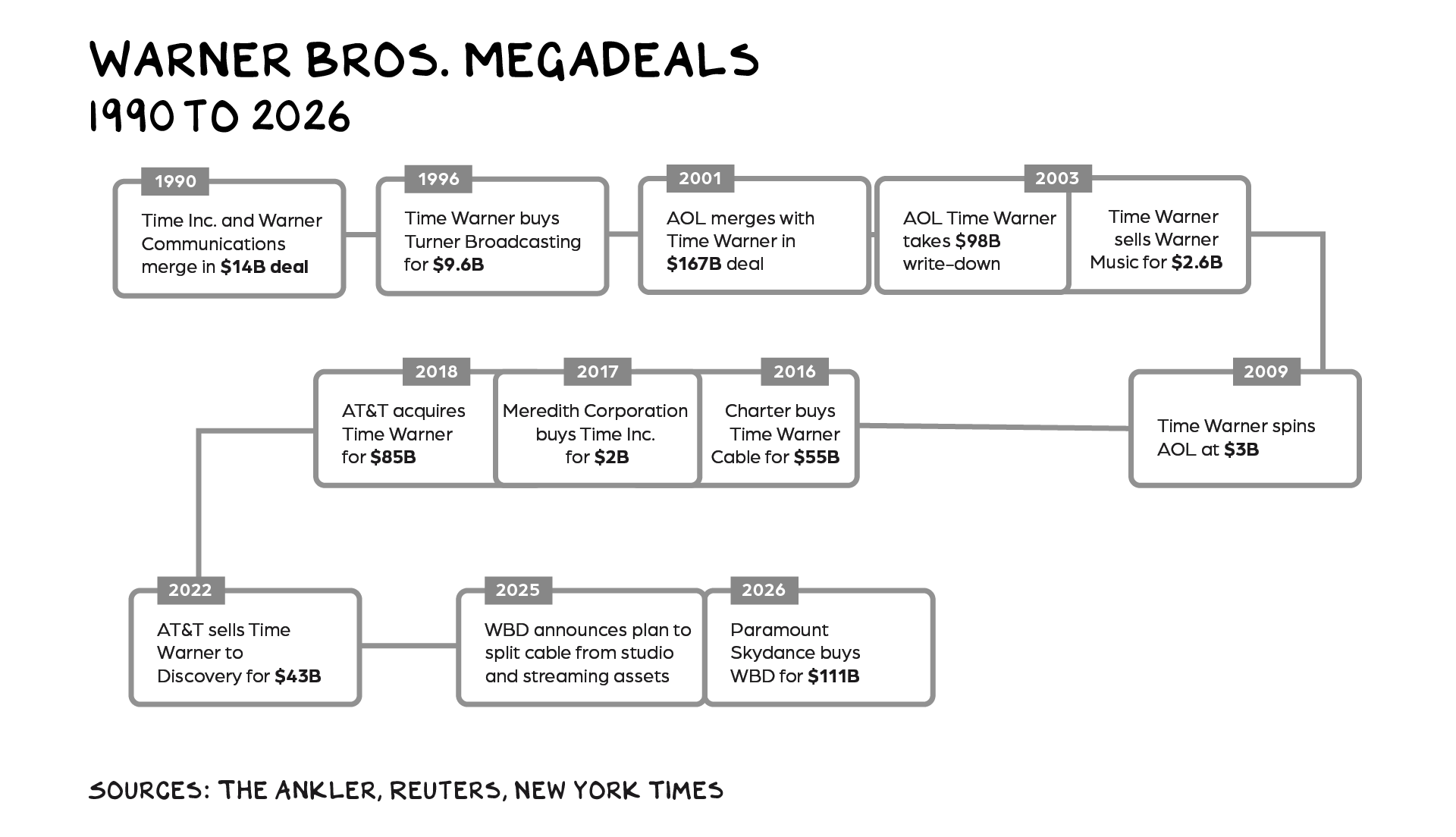
The story of Warner Bros. is a recurring masterclass in ego cosplaying corporate synergy. The company has undergone seven sales, mergers, or structural separations since 1967. The script remains the same: A new CEO decides Warner Bros. is the missing piece of their legacy, only to find they’ve partnered with a high-maintenance spouse who, after several years, leaves with half of everything the acquiring company used to own.
In 1989, Time Inc. and Warner Communications announced a “merger of equals” that would create Time Warner, the world’s largest media company to date. Things did not go as planned. First, Paramount’s hostile takeover attempt (past is prologue) scuttled the proposed stock swap and bid up the price. A year later, the deal closed at a $14 billion valuation — 13x EBITDA. To finance it, Time Warner took on $1.1 billion in annual interest payments to service $10.8 billion in debt. To avoid bankruptcy, Time Warner initiated “Project Glass,” a good bank / bad bank structure that put the company’s crown jewels (HBO, the film and television studios, and the cable assets) under a subsidiary, enabling it to receive cash infusions from outside investors. Meanwhile, the merger became a case study in clashing corporate cultures.
The Time Warner merger would provide a blueprint for future M&A disasters. Exhibit A: The ultimate destruction of shareholder value, AOL’s $167 billion merger with Time Warner. This time, the culture clash was between a legacy media company and an internet startup. The bigger issue, however, was that $167B valuation, premised on dot-com-era hallucinations. AOL’s market cap was nearly double Time Warner’s, while Time Warner had 5x the revenue. As the dot-com bubble began to deflate, news broke that AOL had been propping up its growth narrative by fraudulently inflating its advertising revenue. In the end, AOL Time Warner never came close to justifying a multiple of 25x to 30x EBITDA, and within a year of securing regulatory approval, the company took a historic $99 billion write-down. By 2003, Time Warner dropped AOL from its name, and in 2009 it spun off the unit. AOL’s value at the spin was $3B, a shadow of the $167B assigned just 10 years before.
But wait, there’s more.
In 2018 the synergy delusion struck again. This time, AT&T acquired Time Warner for $85 billion, creating WarnerMedia on the theory that its “dumb pipes” were the chocolate to Warner’s peanut butter, i.e., great content. But WarnerMedia struggled to make streaming profitable, its theatrical business was devastated by the pandemic, and once again there was a culture clash. The bigger challenge, however, was a 2.9x debt-to-EBITDA ratio, which trapped the telco in a pincer between dividend payments (a utility company’s raison d’être) and servicing the interest on $180 billion in debt. Ultimately, AT&T spun Warner, combining it with Discovery in a deal that netted the telco $43 billion — a 50% haircut.
The WBD sequel combined all the elements of the Worst Acquisition in History franchise. Another culture clash, this time between Discovery’s unscripted empire and Warner’s premium sensibilities, a wannabe mogul overpaying so he could cosplay as Robert Evans (ask Claude), and a 5x debt-to-EBITDA ratio. The good news? The sequel had a short runtime. CEO David Zaslav slashed costs, engineered a good bank / bad bank structure to spin WBD’s declining linear assets, and ultimately orchestrated a bidding war that restored shareholder value. As an operator, Zaz is Ed Wood (see: the worst branding decision in history, deprecating HBO), but as an investment banker, he’s Steven Spielberg.
What do you get a nepo baby who already has Paramount? A: Warner Bros. According to one study that tracked 3,250 wealthy families over two decades, 90% lose their fortune by the third generation. Prediction: Larry Ellison’s great-grandchildren will never forgive him for providing a personal guarantee so David could go to the Oscars.
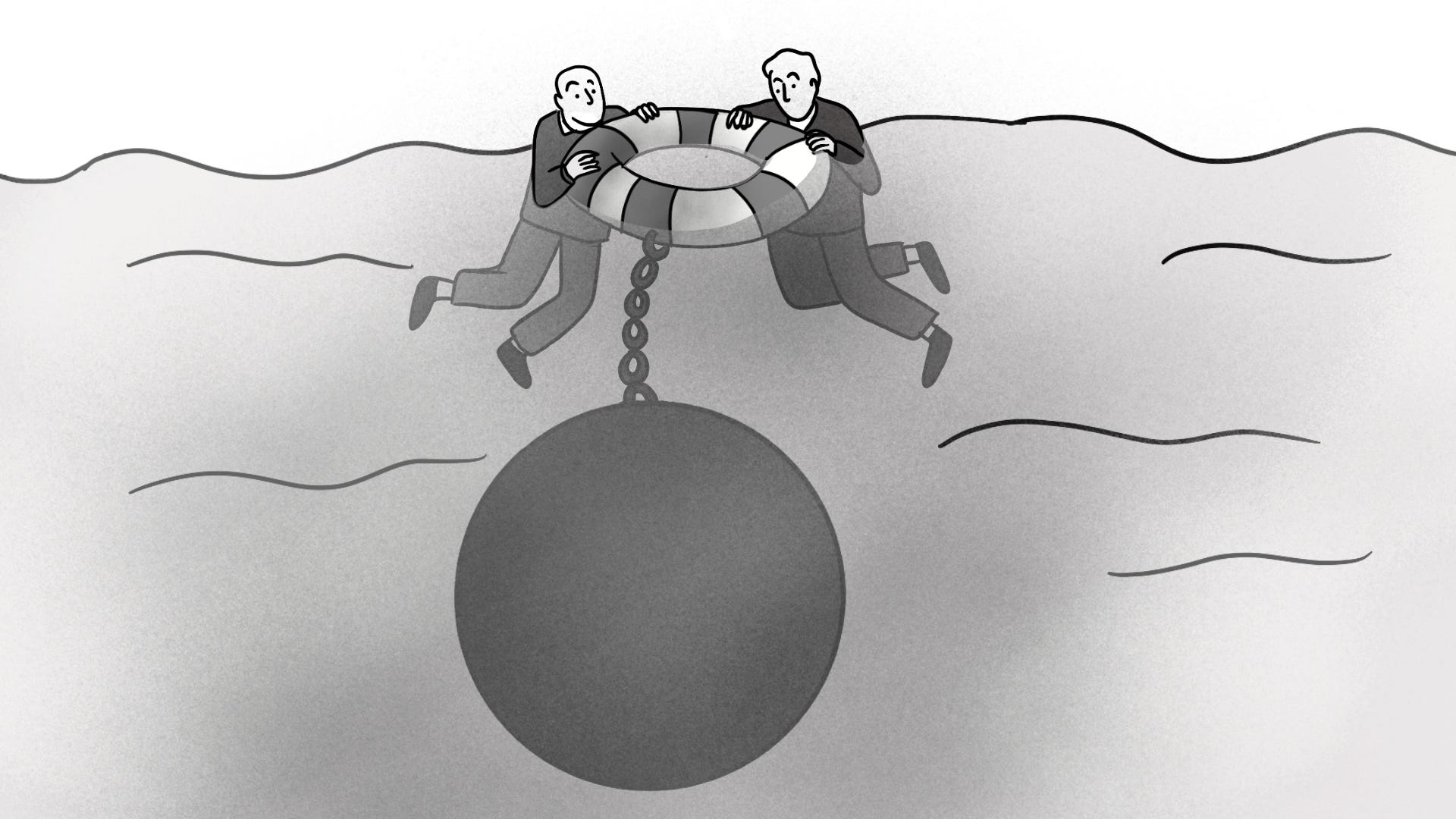
While the deal is priced at a multiple of 8x to 12x EBITDA, the “E” is anchored to a linear TV ecosystem that’s unraveling faster than regulators can approve the deal. WBD plus Paramount = 2x the linear headache. Wall Street is being asked to pay a premium for a story whose ending everyone already knows. And if valuation is the rock, leverage is the hard place. Last year the two companies generated a combined operating profit of $11 billion, before depreciation and amortization. The Paramount-WBD combo is two drowning men clinging to each other, hoping the combined weight of their $79 billion in debt will somehow act as a flotation device. It won’t, which is why Paramount’s debt was downgraded to junk status after the Ellisons “won” the WBD bidding war. With his new toy having a leverage ratio north of 6x, David Ellison has promised $6 billion in “synergies” within three years. (Netflix Co-CEO Ted Sarandos put the figure closer to $16 billion, after examining WBD’s books.) Synergies is Latin for layoffs. Additional “synergies” could be found by consolidating HBO Max with Paramount+ into a Franken-streamer no one asked for, merging CNN with CBS News, and going Cleopatra, i.e., selling one or both studio lots to real estate developers. (See: Fox selling 300 acres of its back lot to create Century City.)
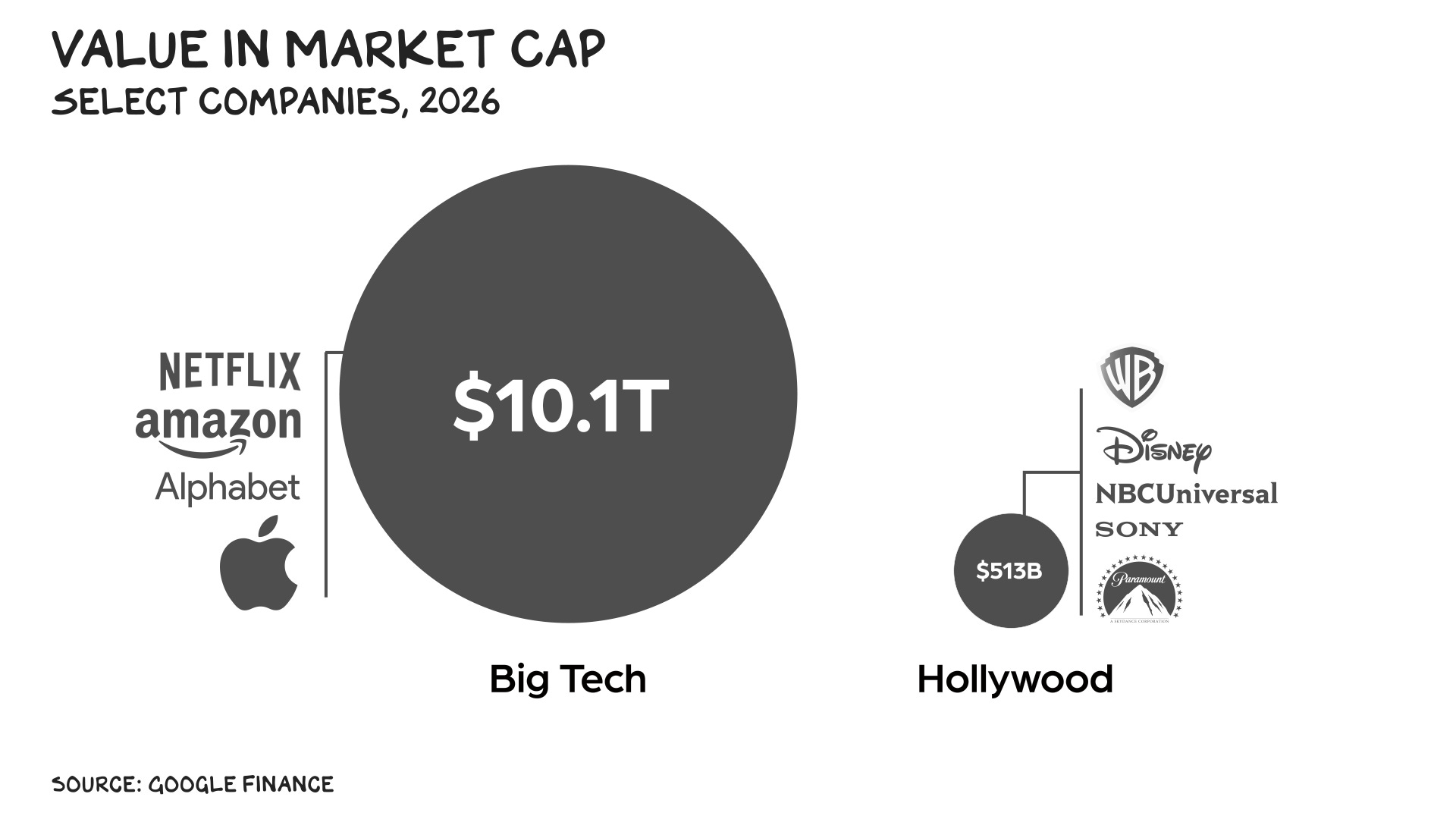
In Star Wars, when Grand Moff Tarkin tests the Death Star by destroying Alderaan, a pained Obi-Wan Kenobi says, “I felt a great disturbance in the Force, as if millions of voices suddenly cried out in terror and were suddenly silenced.” Big Tech is the Death Star, and Hollywood’s creative community is Alderaan. After acquiring Paramount, the Ellisons laid off 2,000 employees — 10% of the workforce. After acquiring WBD, David Ellison attempted to quell layoff fears among Warner employees, insisting the majority of cost-cutting would come from “non-labor sources.” Nobody believes that. It’s going to be difficult to cut billions in snacks.
While it’s not yet fully operational, but armed with a TikTok laser, the Ellisons are fixing their AI Death Star’s sights on Hollywood. For a sneak preview of coming attractions, see the credits of The Fantastic Four: First Steps. The Marvel movie employed 3,000-plus cast and crew members — more people than work at Lyft or Reddit. The Ellisons don’t care if Hollywood is ready for AI. They believe AI is ready for Hollywood. Paramount / WBD is ground zero. Amazon, Apple, Netflix, and YouTube won’t be collateral damage, they’ll be the beneficiaries. The Ellisons blow up Alderaan; Big Tech inherits the Empire.
After walking away from the WBD deal, Netflix’s stock popped 14%, partially reversing a 20% to 30% drop in the share price since the deal was first proposed. As a parting gift, Netflix pocketed a $2.8 billion break up fee, equivalent to 15% of its annual content budget. During the bidding war, Hollywood cast Netflix as the white knight and the Ellisons as the villains. Remarkable, given Hollywood’s 2023 work stoppage was called the “Netflix strike.” When I was pitching a television show, the money was better at Netflix, but everyone wanted to work for HBO, which punches above its weight in cultural relevance. The Ellisons won’t just burn HBO’s goodwill, they’ll napalm it with a cocktail of AI slop and arrogance garnished with fascist flourishes. In Hollywood, reputation is currency, and the Ellisons are broke.
But perhaps Netflix’s biggest win is that it may have thrown the competition into stasis. Despite using their relationship with President Trump as a cudgel, the Ellisons must still clear EU regulatory hurdles, as well as potential litigation from state attorneys general. They’ll likely get approval, as antitrust enforcers no longer break up behemoths, just delay their agenda. Nevertheless, history demonstrates that any deal to acquire Warner Bros. has a remarkably short shelf life.
Ted Sarandos was on the verge of a transformative acquisition … and still is. But it’s not WBD. A decent test of value is to benchmark similar assets. By walking from the deal, Ted and Co. saved $121B, and their equity value has increased $60B since putting the WBD spliff down. Add the $3B break-up fee and you have an effective $184B (opportunity) cost for WBD. So, what could you get for $184B? A: The Mouse … Walt Disney Co. ($179B). A side-by-side comparison illuminates just how talented an auctioneer David Zaslav is, and suggests the Centerview bankers who talked Ellison into paying this price have a second career as psychedelic doulas. Let’s shine a light on the unexploded IED that is WBD.
For the same price, Wall Street would have you believe that WBD was the “value play.” It isn’t. It’s a value trap. Disney generated $21 billion in operating income last year on $91B in revenue — WBD registered $11B in operating income on $42B in revenue, and half of that came from a dying linear TV business that’s shedding subscribers. But the real gap isn’t in the financials — it’s in the moats. Disney has theme parks that print $8B in operating income annually with 60%+ incremental margins. WBD has ... CNN and TBS reruns. Disney owns the IP that dominates global culture: Marvel, Star Wars, Pixar, ESPN. WBD owns HBO (great) and a back catalog that hasn’t produced a billion-dollar franchise in a decade. Disney’s parks business alone — just the parks — is worth more than WBD’s entire enterprise value. You’re buying a recession-resistant, pricing-power machine with Disney. With WBD, you’re buying a melting ice cube of linear TV assets wrapped in $40B of debt trading at 5x leverage. One of these companies will be worth $300B in 10 years. The other will be sold for parts to Netflix. The second generation of wealth ensures that the third generation … isn’t. Shari Redstone, Edgar Bronfman Jr., and (now) David Ellison.
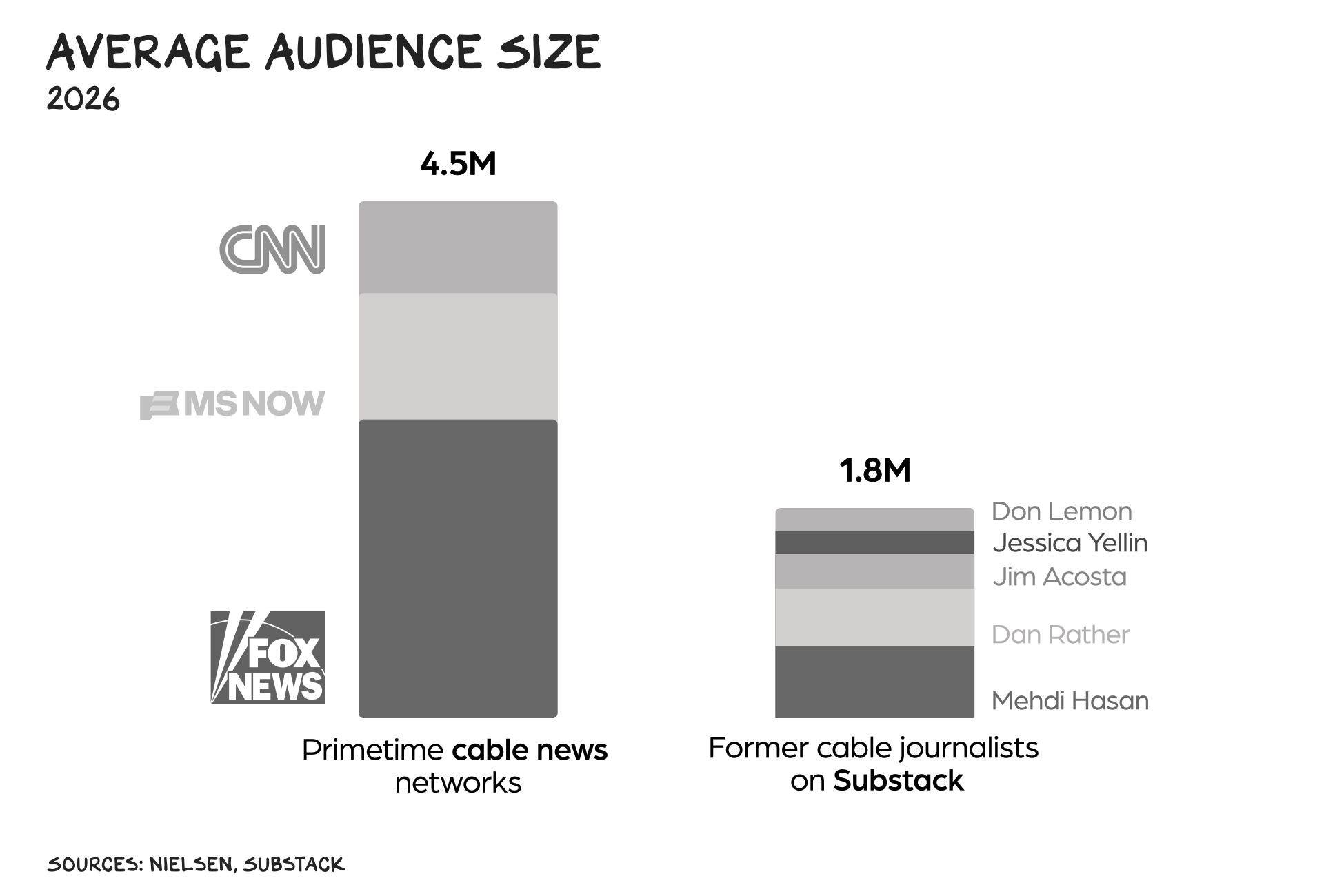
I’ve been having a lot of conversations with cable news anchors who are seeing their pay fall off a cliff. My advice is always the same: Seize the means of production, i.e., start a podcast, launch a Substack, etc. We’ve transitioned from a fossil-fuel-based economy to an attention economy, full stop. If you command attention, revenue follows. The Ellisons will do to CNN what they’re already doing to CBS News. At CNN, $3M/year anchors are a cost center on a bloated P&L. On YouTube or Substack, they’re platforms with 90% margins. The smart money isn’t betting on the logo on the building; it’s betting on the X-wing fighter, the individual talent with the firepower to knock out the Death Star before it can recharge and hit its next target. I know, I’m getting carried away with the Star Wars stuff. Whatever, my Bantha (i.e., newsletter).
There are only two ways to make money in the media business: bundling and unbundling. We’re in a bundling phase. The question isn’t what the Ellisons will do with Paramount and WBD, but who will acquire those assets at fire-sale prices when their AI synergy narrative can no longer provide cloud cover for their pair of overleveraged legacy media companies. My prediction: We’ll see this movie again, starring Netflix, Apple, and Amazon as bargain hunters with delusions of grandeur that involve paying a failed CEO hundreds of millions for the right to fire hundreds of thousands of their employees. In Star Wars, the good guys blow up the Death Star. In Hollywood, you just wait for it to collapse under its own debt load. Same ending, lower production budget.
Life is so rich,

P.S.
This Sunday, Kara Swisher and I will be in Minnesota for Resist and Unsubscribe. The event is sold out, but you can WATCH IT LIVE on Substack. Register here.
Read the original article

Comments
By pinkmuffinere 2026-03-0622:126 reply > With his new toy having a leverage ratio north of 6x, David Ellison has promised $6 billion in “synergies” within three years. (Netflix Co-CEO Ted Sarandos put the figure closer to $16 billion, after examining WBD’s books.
What is it that these CEOs think they are seeing, that everyone else is missing? I can believe they have inflated egos, but they’re not totally crazy, right? My impression is that Netflix is fairly sober and results oriented, so I’m confused by the whole thing.
They're buying control of narrative on issues they care about; the history of media is mostly that. Newspapers were kind of invented for that reason. Our ideas of ethics in journalism are fairly modern.
By butterisgood 2026-03-0623:121 reply Indeed Edgar Allan Poe had a thing or two to say about newspapers. https://poestories.com/quotes.php (and scroll down a bit).
> “We should bear in mind that, in general, it is the object of our newspapers rather to create a sensation — to make a point — than to further the cause of truth.”
By PearlRiver 2026-03-071:44 We as citizens are supposed to keep ourselves informed and vote on things. Very few of us can fly all over the world to see things with our own two eyes so we have to outsource this fact finding. Priests, journalists, the goddamn CIA- they all have agendas.
Rich people don't buy media companies because this is the best business in the world. Quite the opposite, most media companies are mediocre or lose money. They do this because of the political clout they get with the control of these media properties.
By JumpCrisscross 2026-03-0623:052 reply > They do this because of the political clout they get with the control of these media properties
Bezos bought the Post for clout. Ellison (and his investors) are buying Warner Brothers first and foremost to make money.
As the article shows, the most probable result of buying Warner Bros will be another loss. Which won't stop more people from buying it again later.
By JumpCrisscross 2026-03-0718:36 > the most probable result of buying Warner Bros will be another loss
Sure. The same goes for most bunker-buster LBOs. Doesn’t mean the sponsors are doing it with the expectation of losing money.
By onetokeoverthe 2026-03-071:19 [dead]
Succession planning.
This appears to be Larry Ellison trying to manage succession for his kids. We'll probably see a second major acquisition like this for Megan (who tends to be more progressive leaning) [edit: I was right. Megan Ellison is making moves as well now [0]]
Larry would not be able to do something similar at Oracle today (definitely in the 2000s though), as by the 2010s operational control at Oracle increasingly shifted to operators like Catz, Hurd, and Kurian. It also would have led to bad blood à la the Murdochs.
One heir cultivating the right wing (David) and the other heir cultivating the progressive wing (Megan) buys a level of political impunity for the next generation that is hard to come by.
[0] - https://www.hollywoodreporter.com/movies/movie-news/megan-el...
By financltravsty 2026-03-0714:18 You're consistently the only person that I see writing anything of sense on this platform -- are you on any others?
By toomuchtodo 2026-03-0622:13 Layoffs as you consolidate operations between enterprises. See Capital One laying off thousands at Discover Financial after their acquisition.
Capital One to lay off more than 1,100 in latest cuts at Discover Financial HQ - https://news.ycombinator.com/item?id=47270442 - March 2026
By JumpCrisscross 2026-03-0623:066 reply > that everyone else is missing?
To be fair, sometimes they do. Musk saw genuine bloat at Twitter. I’m doubtful one can optimize that much out of WarnerBrothers. But Hollywood isn’t exactly known for being efficient.
By jaredklewis 2026-03-077:361 reply Very hard for me to believe Musk didn’t overpay for Twitter. So whatever he saw, I don’t think was there. Hard to know completely for sure given it is private. But I strongly suspect that money definitely would be making him more in passive investments.
If the argument is that it was a stupid business decision, but he had other motives (clout, etc…), sure whatever.
By JumpCrisscross 2026-03-083:51 > hard for me to believe Musk didn’t overpay for Twitter
At the time? Probably. With the benefit of hindsight? Probably not. Twitter would have made a killing on its own licensing its data to AI companies.
By pinkmuffinere 2026-03-0623:18 Ya, I totally agree, given that both CEOs see some significant value here, and I trust one to be fairly calculated, I assume they’re at least partially correct. But I sincerely don’t know _what_ they think they see. If it’s just layoffs, then why doesn’t WBD see the same thing and do the layoffs themselves? If it’s IP, then why do shareholders disagree? Wtf is it, lol
By ben_w 2026-03-0712:32 > Musk saw genuine bloat at Twitter.
I'm reminded of a saying: "Just because they are out to get you, doesn't mean you're not paranoid."
That he was able to cut a lot from Twitter, doesn't mean he cut wisely, for reasons connected with reality. It survived the loss of teams dedicated to ongoing feature development, but the loss of teams dedicated to community management appears (from the outside) to have been the proximal cause of the loss of trust that many advertisers, users, and governments have had with the company. Cutting both at the same time suggests the action was not done from a place of wisdom, but rather that it was luck one of the cuts wasn't critical.
(This is what I expect given a Muntzing strategy: discover which components are load-baring by seeing what happens when they are removed. But when did I learn about Muntzing, and was it after Musk did his thing with Twitter?)
By JeremyNT 2026-03-076:14 I mean he bought Twitter for clout / soft power, the business is mostly irrelevant.
He arguably single handedly shifted the entire Overton window in the US to the right, and got his preferred candidate elected.
It's reasonable to assume that Ellison is interested in the exact same kind of power, but over the broader culture.
By bluegatty 2026-03-0712:28 Musk saw bloat at Twitter but made it instantly unprofitable? I see the logic, but not sure about it.
Can’t you replace a lot of Hollywood with AI now? What am I missing?
Not "a lot" of Hollywood, not yet.
Short clips are doable, but the coherency duration before it goes weird just isn't there yet, unless you're OK with very short segments (like, single-digit seconds) between each AI-equivalent of a cut. That will probably improve, but the tech isn't there yet for "a lot", it's like CGI in the 90s rather than CGI as it is today.
That's aside from how AI output isn't copyrightable, which may or may not matter depending on if your goal is money or propaganda.
You haven't been seeing what's been coming out of models from China. Hollywood is the Wiley coyote that hasn't looked down yet. They're turbo fucked.
By ben_w 2026-03-0816:02 I keep up to date via Two Minute Papers, but I also take note of teams like Corridor Crew: Hollywood are not yet turbo-anything.
They may become so, I don't know how resolution and temporal coherency scale, but right now Hollywood's biggest problem from China is that China's got 1.5 billion people who are just as capable of learning SFX as anyone in the US.
By happymellon 2026-03-087:211 reply > You haven't been seeing what's been coming out of models from China.
Citations?
I haven't, and would be genuinely curious if it is better than the AI short clip slop that appears on YouTube and really just needs to be taken out back and shot.
I have no doubt that its coming, I just haven't seen it yet.
I think there's two things contributing to YouTube slop, the earlier generations of free model being one, the other is more fundamental: most people using these tools for slop only care about advertising money, they neither know nor care about how much of a difference artistic taste makes (hence also why there's so many YouTube shorts which are just a clip from a random TV show with inappropriate music added, sometimes as a mic-drop, sometimes just obscuring the dialogue, but how even are YT shorts monetised?)
FWIW, there are models which are better than the majority of the YouTube slop I've seen*; but even then, when I show short clips from e.g. Google's "Flow" generator to others, those others find the results unimpressive. Also, the voice range is weird, my experience playing with them it had a much harder time of creating a decent working-class British accent than Dick Van Dyke.
However, amongst the various issues Flow has, the most obvious is length, because even though Flow lets me "extend" a clip, it's not got enough coherency between each (8 second?) segment when I do.
The second biggest issue is that, as with Stable Diffusion before it, it quite often produces stuff you just don't want. Junk dealers don't care about that and use the first result, an artist can afford to do 10 attempts and pick the right one, and will care to, too. That's something I can at least expect will be solved, or has been on non-free tools (control nets etc.) even though I don't expect slop dealers to ever bother with them.
If each 8 seconds of video was actually Hollywood quality (they're not, in any sense including resolution) and they were coherent when extended (likewise, they're not), as there's 750 times 8 seconds in a 100 minute film, it would still be an existential threat to Hollywood if those segments cost $1333, because that's a million dollars and in the cost range of "micro-budget indie", rather than the tens of millions that even normal-indie films cost (before marketing etc.) or hundreds of millions that blockbusters cost.
I have no idea how video generators scale up in cost with time or resolution, let alone quality, so I don't want to make guesses on how much extra compute (or indeed training data) would be needed for a coherent 2 minute cut-equivalent at 4k. As I don't like the epistemic collapse we're already witnessing with clips from video games being passed off as coverage of warfare, I very much hope this is one of those things which fails to scale up.
* although even with early models, if you wield them as an artist rather than as a slop merchant you get interesting output; you may remember the Harry Potter Balenciaga videos from a few years back, same channel and you can see how things have changed: https://www.youtube.com/@demonflyingfox/videos
https://www.reddit.com/r/aivideo/comments/1pu8smq/lord_of_th... is the tip of the iceberg.
By ben_w 2026-03-0912:16 Cuts/scene transitions: 5s, 7s, 8s, 11s, 13s, 14s, 17s, 20s, 25s, 27s, 29s, (and then several continuously overlapping transitions), 36s, 38s, 39s, 40s, 42s, 43s, 47s, 49s, 50s, 52s, another at 52s, 54s, two more at 55s, two at 57s, 1:00, …
This is demonstrating the specific limitation I was talking about. And also, some of those scenes, if you pause on them, they've got the slightly-off vibes of GenAI content, a casual viewer is only missing that because the scenes change so quickly. Something something moonwalking gorilla.
An artist can make a work of art despite the limitations of whatever tool they use (and indeed may get a kick out of doing just that), that doesn't mean the tool can do everything.
I myself am working on a GenAI musical comedy sketch video, but it is only possible with current tech because there's a good opportunity to make cuts every few seconds.
> Not if you want to copyright the output
That gets tricky: To the extent that an AI is just a tool — along the lines of a trained pair of hands executing a human prompter's specific, detailed instructions — the human prompter might qualify as an "author."
From the U.S. Copyright Office in January 2025:
"The Office affirms that existing principles of copyright law are flexible enough to apply to this new technology, as they have applied to technological innovations in the past. It concludes that the outputs of generative AI can be protected by copyright only where a human author has determined sufficient expressive elements.
"This can include situations where a human-authored work is perceptible in an AI output, or a human makes creative arrangements or modifications of the output, but not the mere provision of prompts.
"The Office confirms that the use of AI to assist in the process of creation or the inclusion of AI-generated material in a larger human-generated work does not bar copyrightability.
"It also finds that the case has not been made for changes to existing law to provide additional protection for AI-generated outputs."
https://www.copyright.gov/newsnet/2025/1060.html (emphasis and extra paragraphing added).
The closest analogy is to a music producer sampling public domain audio. The composition will be protected by copyright but each individual sample will not.
Every single CGI rendered frame of Shrek is protected by copyright because it was human authored. It they used a diffuser to make Shrek 7, the individual frames would not be protected by copyright but their arrangement into a movie could be. That's a hugely different legal situation (for instance, if I chopped it up and made my own remix of it that would be protected).
By bandrami 2026-03-081:46 Though this is complicated by the fact that the LLM initial training may have been massively illegal (or at least massively tortious). There's still a bunch of legal shoes to drop, one way or the other
By rayiner 2026-03-0723:58 Interesting, thank you for sharing. That’s surprising to me though when you see the reasoning it makes sense.
By CyberDildonics 2026-03-072:12 Prove it
By onetokeoverthe 2026-03-071:21 [dead]
By readthenotes1 2026-03-0622:141 reply There is a large history of companies with too much money (or access to borrowing) using it to buy up shiny objects. Whether it is CEO pride, greed, anger, or envy, it does not seem to matter.
By raw_anon_1111 2026-03-0622:15 See sports teams.
By MengerSponge 2026-03-0622:301 reply This is the same as acquiring the Washington Post or Twitter, right? It's more about media control than any classic business case.
Once you start meddling with the money machine it's not just Net Profit = Revenue – All Expenses (COGS + Operating Expenses + Interest + Taxes)
By ribosometronome 2026-03-070:282 reply Netflix's deal included spinning off the news networks. If the Ellisons just wanted that, they could have had that for a considerably more digestible price point. They genuinely want Harry Potter and the Sopranos, too.
By rasz 2026-03-0712:14 its all propaganda, movies and all
HBO Told 'The Pitt' to Make ICE Storyline More 'Balanced' https://www.forbes.com/sites/paultassi/2026/02/28/the-pitt-h...
By MengerSponge 2026-03-073:15 Hollywood is more glamorous which is fun, but the real value is how shifting which films and shows get made will also shift the national narrative.
Riefenstahl wasn't a journalist.
By monkeydreams 2026-03-0622:141 reply On top of this Ellison is likely to have to sell off the dried husk of Cerner in order to fuel his circular AI transactions with NVidia.
Remember, the Cerner acquisition enabled an essentially permanent beachhead for Oracle in the VA. It will pay off over time in 'we already run Oracle' across many dimensions of government.
See the career of Seema Verma from last DT admin.
By levinb 2026-03-141:15 They had a very kludgy, homegrown, but generally well-liked and cost effective EMR calls Vista.
The fact that it was cost effective, but required internal expertise was exactly what led the Trump administration to kill it.
Now they are transitioning to Cerner, the worse of the two major commerical EMRs by a fair margin, for many billions of dollars to the Kansas-based company, now owned by Oracle.
You can fill in the details of why this is happening by looking at where the CMS appointees at the time have landed in their post-government careers.
