
Relearning math as an adult

2024-01-1821:12453257gmays.com

I recently passed 100 days of practicing math every single day šŸ’Æ I’ve wanted to beef up my math chops for a while, but I needed a good reason that would justify the time investment. Plus…

I recently passed 100 days of practicing math every single day šŸ’Æ

I’ve wanted to beef up my math chops for a while, but I needed a good reason that would justify the time investment. Plus, it’s always easier to learn when you have a clear goal and something meaningful to apply it to.

So, it never reached the top of my priority list. But then a couple things happened recently that gave me 1) sufficient motivation and 2) a clear path.

I’ve worked on various AI products over the last year and like understanding the technical aspects of the products I build.

But as I dug in to learn more about how large language models (LLMs) and transformers worked…I was lost. It was humbling.
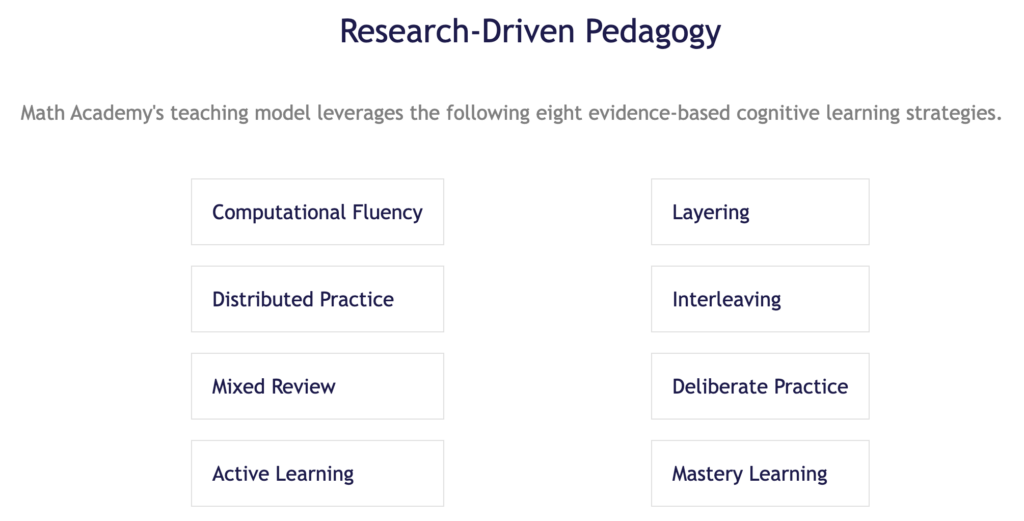
…which gets to something important: Math is hard.

Math Academy makes learning math as easy as possible, but it’s still hard work. Really hard work.

Learning math is challenging. It’s real work. This isn’t some casual app you can just flip through.

Unless you’re like John von Neumann, most of it requires pencil and paper to knock out. The only exception is the early lessons when you’re just refreshing and can do most of it in your head.

But if you’re serious about legitimately learning math, there is no better, more convenient way.

To make this a habit I’d stick to, I’d have to lower the activation energy of doing it and make it as close to a new ā€˜default’ behavior as possible. ā€œThis is just what I do.ā€

So, I started with convenience and consistency, which helped me form other good habits as well.

Learning math is hard enough, so how can we make it somewhat convenient?

Math Academy’s short (~10 min) lessons help. I also use an iPad for the lessons (it’s web-based) when I’m not at a computer and a Remarkable 2 for the work (e-ink for pencil/paper). I also found a cheap case that fits both perfectly.

This makes it easy to knock out lessons here or there. For example, I had jury duty recently and knocked out a few lessons while waiting.

And just this past Wednesday, the kids were ready early, so I got to the gym about 15 minutes early and knocked out a lesson or two in the car. I’ve also started doing them during a light walk on the treadmill (I have one under my standing desk).

My usual routine is to do lessons in the evening after the kids go down and after I work out. It is challenging to muster the energy to work out and do math after a long day, but making it a habit has made it easier.

I’ll say it again: Math is hard. My goal is to work up to the math needed to better understand LLMs and transformers.

Thankfully, Math Academy has a ā€˜Mathematics for Machine Learningā€˜ course I’m working towards, which gives me a clear goal. Given my limited time, it will likely take years for me to get there.

Why years? Two reasons:

  1. Math is hard.
  2. Math is BIG.

I had no idea how broad and deep math was. I probably still don’t.

Case in point:
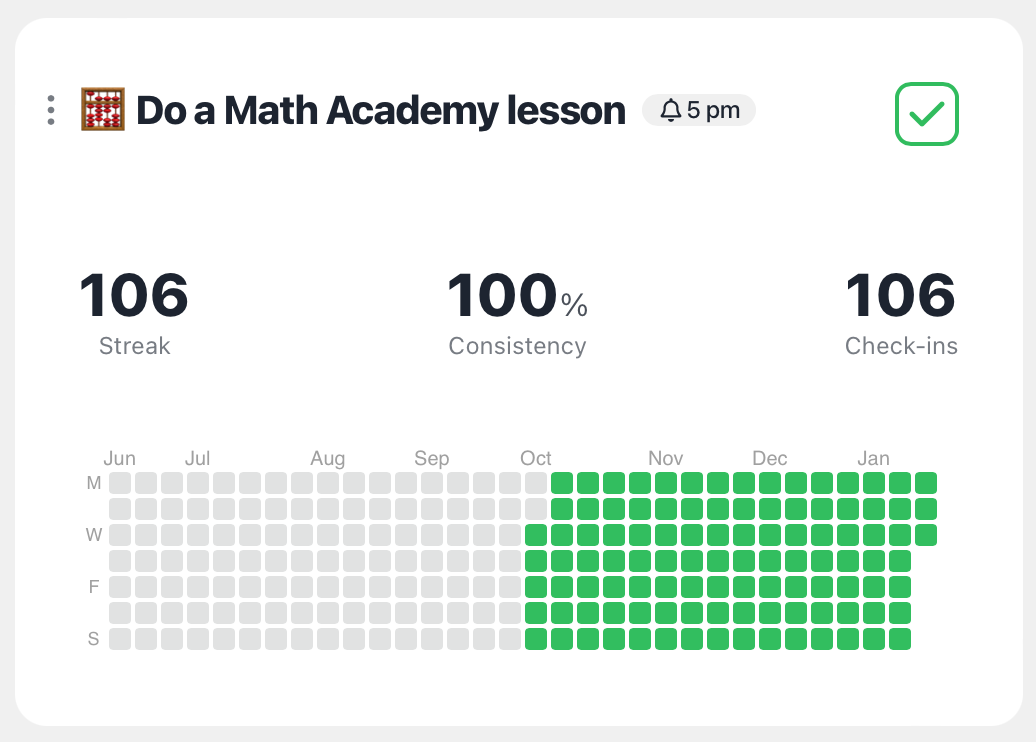
Screenshot of my Math Academy streak from Habits Garden, where I track my habits.

106 days down, ~1,000 more to go šŸ˜‚

It’s a hard, but worthwhile and enjoyable new hobby for now.

For hard subjects like math, I always assumed the only ā€˜real’ way to learn was in dedicated environments like college since online courses were best for softer, less technical topics. This was a bummer, especially for adult students like me.

But Math Academy changed my mind on this, and I’m a huge fan so far. I hope they continue to grow and expand to other complex STEM topics like computer science, physics, etc.

Overall, I’m just so excited there’s an effective, accessible way to learn hard things. If I were a billionaire, I’d invest to accelerate its progress and find a way to sponsor a license for every kid who was interested…

But for now, I’ll just talk about it to anyone who will listen šŸ˜‰


Read the original article

Comments

  • By dcw303 2024-01-191:414 reply

    I've been doing similar for about a year. My target is to learn the math needed to make 3d games, so basically algebra, geometry, calculus and linear algebra.

    I started with brilliant.org, and while I liked the level of polish in the interactive lessons, I found the lesson structure to be out of sequence, often referring to things that haven't been covered yet. They didn't seem to have put as much thought into pedagogy as Math Academy as described in TFA.

    So I gave up on that and instead have been shipping several kilograms of dead tree across the pacific in the form of The Art Of Problem Solving series of textbooks. They are great, the lesson structure and building up of complex ideas from first principles is outstanding. They will humble you though, as the exercises are tough. They're also quite expensive but IMHO worth it.

    Math Academy does look interesting, If I was not halfway through my series I would probably take a look. But I do enjoy having reference books on hand. Many times I've jumped back to brush up on a topic that has slipped from memory.

    I solve my exercises with the most low tech solution possible, but I like the freedom it gives me to try new approaches, and nothing beats the latency between idea to ink on paper.

    edit: also wanted to add that I've enrolled Chat GPT4 as my tutor. Contrary to many other's experiences that I've read, I find it to generally be very good at reasoning in this level of mathematics. It's helped me many times when I've gotten stuck. And on the occasions where it bullshitted its way to an incorrect answer, I always challenge it if I don't understand, and we ultimately find out if it hallucinated something (rare, can usually be fixed by restating the problem), or I gave it the wrong input to start with (unfortunately more common than I'd like)

    • By juunpp 2024-01-2016:31

      I'm in that camp and can suggest a few recommendations in order of:

      https://d3dcoder.net/ -- The DX12 book is the latest edition. The books have several chapters at the beginning covering 3d transformations.

      https://foundationsofgameenginedev.com/ -- The first installation, Mathematics. This will cover a lot more ground and derive things from first principles while not being overly formal.

      https://www.mathfor3dgameprogramming.com/ -- A lot more formal than most game/graphics math books, and goes into more depth, particularly on the linear algebra.

    • By pvg 2024-01-192:531 reply

      Are you using any of the stuff you're learning for whatever practical 3d game-making things you're working on? Just curious how it's working out, you've picked a pretty broad foundation as a starting point.

      • By dcw303 2024-01-193:551 reply

        I took a brief detour late last year to study "Linear Algebra: Theory, Intuition, Code", and to my surprise it stuck pretty well. The author said the pre-reqs were just "basic high school math", but I'm glad I had recently done lots of algebra and geometry, as the difference between that and some vague memories of stuff I did 30 years ago in school is pretty wide.

        I haven't started any 3d game projects yet. For that, my plan is to do the webgpufundamentals.org course first. Scanning the TOC, I think I would be able to attempt it from what I learned from the linear algebra book.

        That said, I'm doing AOPS Intermediate Algebra at the moment, and the Precalc text covers more advanced trig and matrix stuff, so I'm thinking it would be good to finish at least to there before starting to apply the knowledge.

        • By pvg 2024-01-196:45

          Yeah, it sounds like you're not far from the point where you can start jumping ahead and working backwards to fill in the bits that you're missing - that's what many people naturally and instinctively try and it can work but can also be frustrating if one misjudges one's degree of proficiency. You don't often see 'I'm just going to give myself a full secondary school maths refresher' which is more demanding on time and self-discipline but at least we know it's pretty reliable given those things.

    • By AlchemistCamp 2024-01-192:101 reply

      I totally agree with you on the value in using Chat GTP when stuck.

      What's the scope of The Art of Problem Solving? How far does the series go?

      • By dcw303 2024-01-192:384 reply

        AOPS audience is gifted high school kids, so it doesn't get up to the college level. The core texts are:

        - Prealgebra

        - Intro to Algebra

        - Intro to Counting & Probability

        - Intro to Geometry

        - Intro to Number Theory

        - Intermediate Algebra

        - Intermediate Counting & Probability

        - Precalculus

        - Calculus

        • By AlchemistCamp 2024-01-193:011 reply

          Ah, okay. I actually took calculus in 8th grade. I studied another two years past that, dropped out, and then later did a complete 180 and graduated with a literature degree.

          I'm now over 40 and interested in relearning the math I learned long ago and pushing a bit further than I had before.

          • By aoki 2024-01-193:21

            There’s also an intermediate number theory class that’s basically at the level of a college elementary NT course (one that does not assume abstract algebra), an Olympiad geometry class, and a group theory class. The first two do not have a text, the third has a text but you can’t get it without enrolling.

        • By lordnacho 2024-01-198:36

          I bought the whole set for my kid. He's also doing Brilliant.

          It starts at somewhere that the kids are at the end of primary school (at least in the UK) and ends somewhere in high school. My kid could already do all the pre-algebra stuff, so that book went fast. The way I see it, the kids waste a lot of time in the middle years when they already know the arithmetic and pre-algebra, but might as well be doing a bunch of more interesting things.

        • By MrVitaliy 2024-01-195:282 reply

          I think it's a weird way to learn math, and I learned it this way in school. Most of these courses just teach information memorization and recall. sin(x)^2 + cos(x)^2 = 1, etc.

          I would start with something like Elementary Analysis: The Theory of Calculus, and work from there. You'll eventually arrive at the same place -- Calculus but from a much stronger mathematical foundation.

          • By ammasant 2024-01-195:381 reply

            You learned using the AOPS books? Don't be fooled by the titles, these books exclusively use a proof-based approach to construct a pretty wide foundation around these topics.

            • By blagie 2024-01-2111:10

              AoPS are among my favorite math books, but they're definitely not proof-based or particularly rigorous in terms of formalism.

              They do focus on complex problem solving, which is equally important. The key value-add of AoPS are interesting, often beautiful examples and problems.

              However, they don't do proofs or formalism much. They don't do applications or show what math is useful for. And they completely, totally, and universally screw up units (you'll have problems trying to equate a length with an area and similar; that's true of their classes as well, and RSM is similar).

              I don't think there's a one-stop-shop for math, though, which does everything right. AoPS is at the peak of their particular game (which is right in the name: problem-solving).

              That's best complemented by:

              - Something which does data, applications, visualizations, and storytelling well.

              - Something which does early exposure / surface learning well

              - Something which is more formal and rigorous in terms of proofs and derivations

              - Something which touches on a broad set of interesting topics (graph theory, oddball parts of geometry, etc.)

              - In 2024, I would add something which does computational mathematics well

              Nothing I know of does all those well in a one-stop-shop.

          • By dcw303 2024-01-196:22

            I have not found that to be the case, the books I have read have gone into deep foundational detail to build up knowledge. Perhaps you're referring to Vol 1 & 2 of "The Art Of Problem Solving"? I haven't read them but from what I know they are a distillation of core concepts for students looking to do competitive maths.

            It's confusing because that title is also the name of the publisher / website of the series of the books I'm reading.

        • By elteto 2024-01-192:432 reply

          Are you doing the online classes or only the books? I wanted to register for the online classes but they seem to be heavily oriented towards interactive learning.

          • By dcw303 2024-01-192:52

            Just self study with the (physical) books. I did also try the ebook combo for the Prealgebra book, but I found typing latex in the answers to the exercises was cumbersome.

            I think the online classes with interactive lessons is a separate thing, but I don't have any experience with that.

          • By aoki 2024-01-193:16

            The ones that have ā€œinstructorsā€ and class times have chat-based sessions that you can skip if you prefer. Part of the homework is based on an adaptive problem system (Alcumus, which you can actually use for free) and part is weekly problem sets mostly based on the textbook. Writing (proof) problems are graded by a human so it is a useful way to get feedback on your proof-writing skills (if you know you are worse at it than a college math major).

    • By globalnode 2024-01-1912:56

      i was motivated by the exact reasons you are but after a few years of maths i started to like that more than the 3d games and programming :(

  • By topologie 2024-01-2617:11

    As a Mathematician who worked in Theoretical Physics for a bit, I'm happy to hear that there's people out there interested in the area.

    Maths often get a bad rep, but at their core they are probably the most interesting thing to learn, on par with music in my opinion.

    I encourage anyone interested in Mathematics (regardless of your level) to check out Roger Penrose's The Road to Reality. I know it's technically a physics book, even though Penrose was originally a Mathematician, but trust me, he explains things in a way that open up your mind, even for seasoned veterans. He begins with basic calculus, but ends up covering Groups, Topology, Complex Analysis, Differential Geometry, etc etc etc.

    And, on parallel, check out John Baez's guide on how to learn Maths and Physics: https://math.ucr.edu/home/baez/books.html

    I love all of Baez's pages and work, he does some really interesting mathematics: https://math.ucr.edu/home/baez/

    I'm also a big fan of Tai-Danae Bradley's work: https://www.math3ma.com/

    Anyway, I hope people find these recommendations interesting or useful...

  • By instaheat 2024-01-195:451 reply

    This post couldn't be any more timely. I dropped out of school years ago (16 years ago to be exact) to take care of my sick mother when she was dying.

    I never went back. I just started working.

    I am happy to report I am back in school and will be FINALLY finishing my Computer Science degree but I have a very long 4 years ahead of me. Math is going to be hard.

    What is encouraging is the thrill of when I get the answer right and most importantly knowing HOW I got there. It's (almost) better than sex.

    • By dvko 2024-01-2615:031 reply

      This is inspiring to me, as I'm in a similar boat and while I'm pretty okay at my job in practical terms, I often feel as if I lack a certain mathematical foundation. May I ask how old you are, whether you are enrolled in a full-time course (w/ much younger other students, I suppose?) and how that has been for you?

      • By instaheat 2024-02-094:11

        I'm 39. I'm enrolled full-time. I'm taking (mostly) online classes.

        However, I start a math course that meets two days a week in person soon.

        I look relatively young with a hat on, that will keep me from feeling insecure about my appearance. I'm bald as Dwayne Johnson.

        Remains to be seen but I won't let anything stand in my way of finishing. Just going to put my head down and do the work. Not socialize.

HackerNews