
Enderman's 350K+ subscriber channel was terminated after AI systems wrongly linked him to an unrelated channel with copyright strikes.
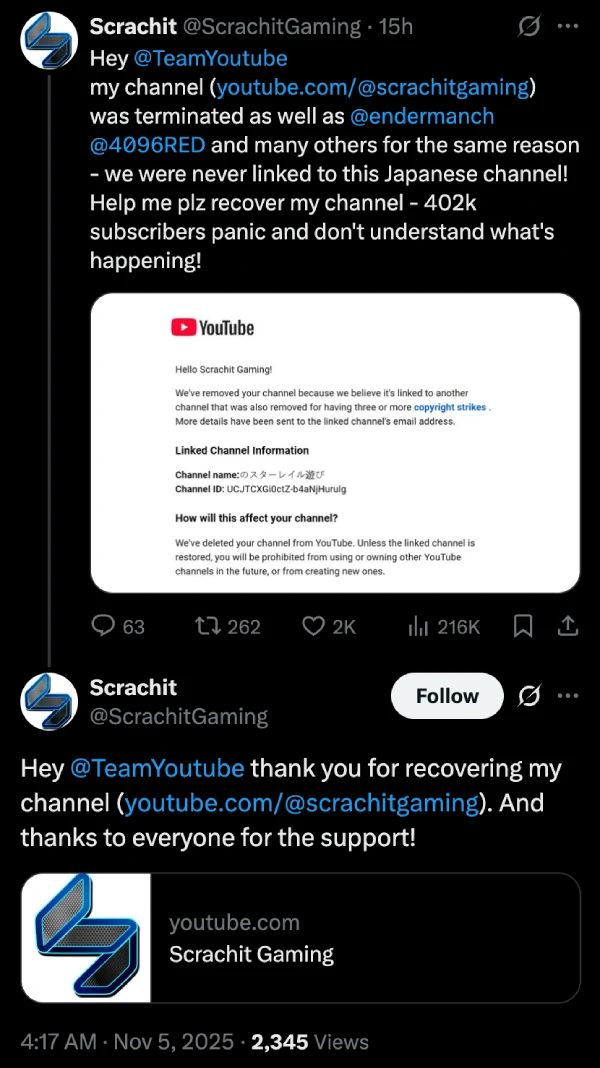
Update 05/11/25 – 09:10 am (IST): Reports from yesterday suggest that the issue extended beyond just Enderman. Multiple other channels were terminated due to a glitch in the system linking them to a random Japanese channel. However, it seems like YouTube is rectifying the major mistake and is reinstating channels that were terminated falsely.
Enderman confirmed that they got back the channel.
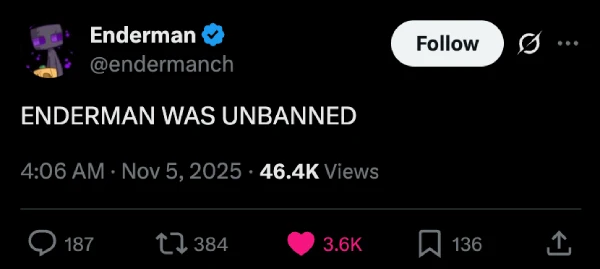
Furthermore, a couple of other users who had complained about the same problem also later thanked YouTube for recovering their channels.
Original article published on November 4, 2025, follows:
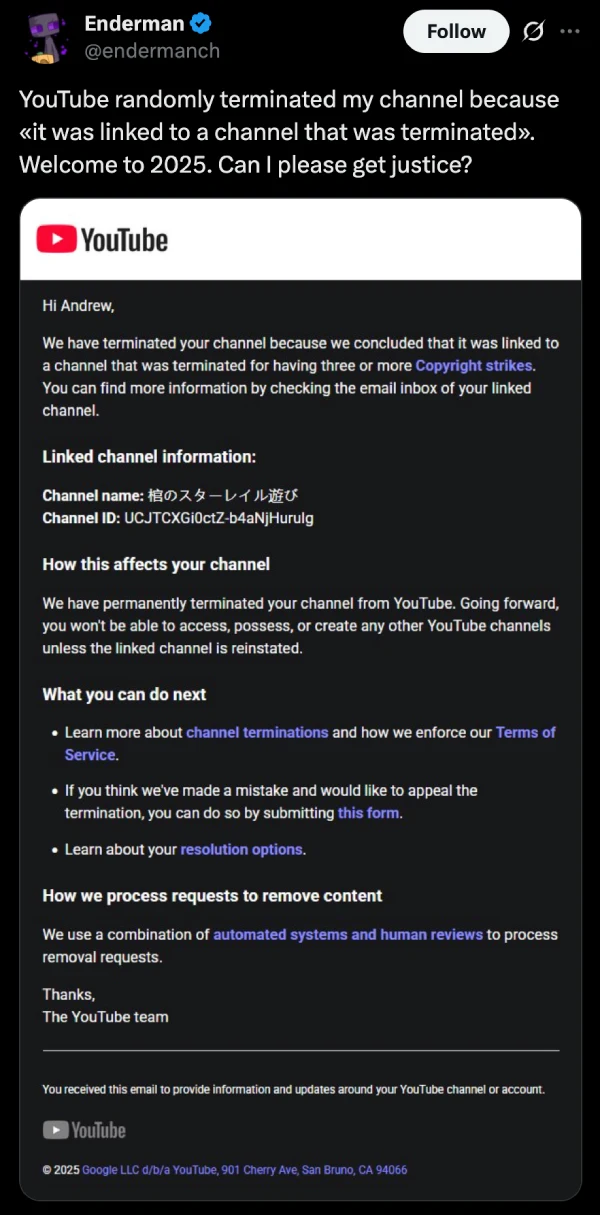
A popular tech YouTuber with over 350,000 subscribers has lost his channel after YouTube’s automated systems flagged him for an alleged connection to a completely unrelated Japanese channel that received copyright strikes. Enderman, known for his Windows customization and tech experiment videos, says he has no association with the channel in question.
The termination email, shared by Enderman on X, stated that his secondary channel “Andrew” was permanently removed because it was “linked to a channel that was terminated for having three or more Copyright strikes.” The linked channel name appears in Japanese characters, which Enderman maintains he has zero connection to. The email went further, warning that his main channel would also face permanent termination unless the linked channel is reinstated.
“This is the end of the line,” Enderman said in a farewell video posted shortly before his main channel vanished entirely. “My channel is soon to be terminated because my first channel is linked to my secondary channel.” That video, originally posted to YouTube, has since disappeared along with his entire account. A backup remains on Odysee, an alternative video platform.
To no one’s surprise, this situation has got a lot of fans talking. One commenter noted they were literally watching Enderman’s video about the termination when his channel got banned mid-viewing. Others pointed out the irony of YouTube’s heavy reliance on AI moderation while simultaneously failing to address actual problems like scams and spam that plague the platform daily.
This isn’t Enderman’s first brush with YouTube’s moderation systems. Since 2021, he’s had multiple videos removed, including tutorials on Windows activation and interactions with AI tools. However, this termination appears different in both scope and consequence.
YouTube’s appeal process involves submitting a form, but many creators report poor success rates with reinstatement requests. The platform claims to use “a combination of automated systems and human reviews” for content decisions, though the balance seems heavily tilted toward automation.
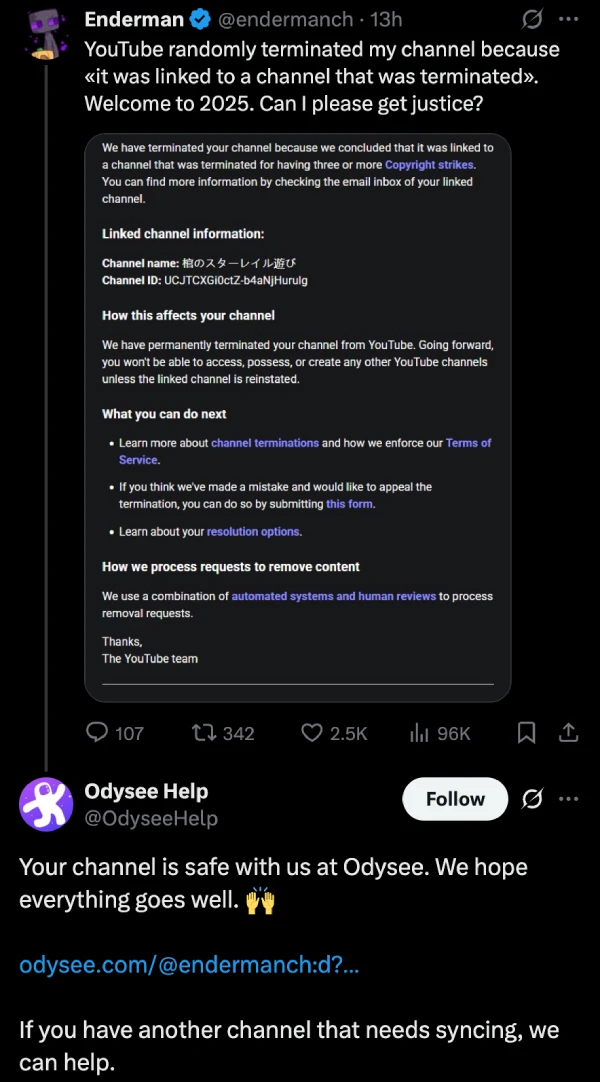
Rival platform Odysee has already reached out, offering Enderman a home for his content.
Whether YouTube will reverse this decision remains uncertain, but the incident highlights growing concerns about algorithmic enforcement actions that can destroy creator livelihoods with little recourse.
That said, given the channel’s popularity and what appears to be a clear mix-up on YouTube’s part, it’s likely that the channel will be reinstated. We’ll post an update if and when there are any further developments.
Read the original article

Comments
By whatsupdog 2025-11-0417:307 reply How many such stories we have to come across before we as a community come together? Apple and Google's monopolies have to be broken. It's insane that your livelihood depends upon the mercy of one organization.
By observationist 2025-11-0417:511 reply If they cannot support their customers at the scale at which they operate, they should not be allowed to do business at that scale. Google clearly cannot, and they trivially mow people down, as ruthlessly as any careless driver plowing through a street cart, with no accountability for their actions, and no recourse for the customer.
Yes, they shouldn't be dependent on Alphabet, they should back up their content and diversify platforms, but because we decided to allow monopolization of monetization of the web, and to vigorously encourage the surveillance based adtech of Google and Facebook, they control the full stack and effectively hold audiences hostage; you have to play on their platforms in order to engage with the audience you build, and a vast majority of the consumers of content are ignorant of the roles platforms play. If you leave the platform, you lose the access; if you have multiple channels, you get shadowbans and other soft-penalties to discourage people from being disloyal to Google.
We should have a massive diversity of federated, decentralized platforms, with compatible protocols and tools. People should have to think about CDNs and platforms as little as they think about what particular ISP is carrying their traffic between a server and their home.
There should be a digital bill of rights that curtails the power of platforms in controlling access, reach, and forces interoperability, and eliminates arbitrary algorithmic enforcement, and allow due process with mandatory backout periods giving people the reasonable opportunity to recover digital assets, communicate with audience, and migrate to a new platform.
The status quo is entirely untenable; these companies should not have the power to so casually and arbitrarily destroy people's livelihoods.
By fennecbutt 2025-11-0423:57 Apple cannot either. They seem immature when it comes to approving this or that app, or taking ideas (tile) to kill companies.
By MostlyStable 2025-11-0417:413 reply It's not really that simple. There are already alternative video hosting and streaming sites. In the article it mentions that this creator is already using one in fact. The reason why youtube is such a big deal is because of it's market dominance. Everyone watches there, and therefore it is valuable. "breaking it up" just turns it into another one of the many many competitors that already exist.
Don't get me wrong, I'm not defending Youtube's behavior here. It's bad and shouldn't just be shrugged off. I just don't think that shouting "monopoly!" actually fixes anything. If you want a video hosting and streaming site that has less market dominance and better moderation policies, that already exists. Everyone is free to use them.
> "breaking it up" just turns it into another one of the many many competitors that already exist.
That's very much the point: collaring and tranquilizing the 900 pound gorilla in the room so that the reasons people might have to interact with the 30 other monkeys become relevant.
By MostlyStable 2025-11-0417:572 reply Except that that still doesn't fix the problem. This behavior is downstream of bad laws and regulations. Do you think that Youtube wants to delete a random channel with hundreds of thousands of subscribers? No, that is obviously against it's interests. However, dealing with copyright law in intelligent, nuanced way is too expensive and difficult at scale, and so they resort to these very bad methods. There is a reason that they are probably the only profitable ad-supported platform. Right now, copyright holders aren't focusing on any of the other platforms because 99% of all activity is on youtube. If youtube went away, and the traffic was split up among the other competitors, the same bad dynamics would suddenly get pointed at them, and in 5-10 years we'd be having the same conversation.
You need to address the underlying causes of this kind of behavior.
By conradfr 2025-11-0418:17 What constitutes "too expensive" for a company making more than $30B per year in profits?
Nobody forced google to maintain a single coherent identity for users across all their services, such that a ban on one service risks impacts to several unrelated ones.
By Ferret7446 2025-11-068:341 reply Yes, the law does. The legal risk from someone doing something bad on one service, and then again on another service, and then having to explain to the court why they didn't fully ban a bad actor is not worth it.
By cwillu 2025-11-0613:16 Show me that law.
By everforward 2025-11-0418:04 There's a sort of circular problem where basically every creator's videos are on YouTube, but many don't replicate their videos to other video platforms. Viewers won't leave in part because other sites lack content, creators won't cross-post because other sites lack viewers.
Some of that would be alleviated if we separated hosting/serving videos from the frontend and indexing, perhaps with a radio-like agreement on what the host gets paid for serving the video to a customer of the frontend. Frontend/index makes money off ads, and then pays some of that back to the host. Creators could in theory be paid by the video hosts, since views make the host money.
Then heavy handed moderation could be a disadvantage then, because they would be lacking content other sites have (though some of that content would be distasteful enough most frontends would ban it).
By cowpig 2025-11-0417:50 Or maybe breaking up YouTube allows for a syndication standard to take its place and we'd get an explosion of value for consumers like we got in podcasting
By moritonal 2025-11-0417:44 These companies have simply too much influence on a global scale for the US to ever kneecap them. For every valid worry the West has of TikTok the exact same argument could be made of YouTube in reverse.
By ajkjk 2025-11-0417:45 There's some kind of basic theorem about situations like this: doing something about injustice happens at a rate proportional to both (a) the injustice and (b) the ease of doing something about it. The injustice is pervasive (low-level, but constant, and indicative of a situation in which people have unaccountable power over the public). But doing something about it requires a type of organizing that... nobody knows how to do. Or at least nobody remembers how to do. So the barrier to it happening is extremely high.
By leptons 2025-11-0418:48 It's insane that someone's livelihood depends upon the mercy of a "tin can".
This is only the beginning of fucking around and finding out how putting "AI" into everything will create all kinds of problems for humanity.
Relevant Idiocracy clip:
And do what exactly? Personally I avoid youtube as much as possible, I might watch two or three short videos per month. I also never bought an Apple product save for an ipod years ago. No one needs any of those things.
By ElevenLathe 2025-11-0418:55 It's not a consumer issue. The fix we would need is laws that are analogous to laws that protect workers from their employers, though that is pretty far away in the current US political economy, and would presumably require creators bringing some kind of organized pressure on Big Tech or their government, analogous to a union.
By stronglikedan 2025-11-0418:12 Counterpoint - I need Youtube Premium because it saves me money on streaming/cable services and I don't get sucked into binge watching things!
By whycome 2025-11-0418:47 Or government
If an automated system is making the decision to cancel a customer's account, then companies should be required to give cancelled customers a way to speak to a human about the inevitable false positives.
By Eddy_Viscosity2 2025-11-0418:022 reply They do what they want and you (or me or anyone else not on the board of directors) don't have any say over it. They could even have a daily lottery that randomly chooses a couple of people and have all their accounts permanently frozen/closed/cancelled with no recourse at all, ever.
We often make fun at stupid European regulations, like AI ones, but it is typically in such a case that it is useful. So to ensure that it could not happen when companies like that have such a monopoly that users have no power.
Do those regulations really "ensure that [incidents like this] could not happen"?
I ask this in good faith, because my observation of the last few years is that the incidents still occur, with all of the harms to individuals also occurring. Then, after N number of incidents, the company pays a fine*, and the company does not necessarily make substantive changes. Superficial changes, but not always meaningful changes that would prevent future harms to individuals.
*Do these fines tend to be used to compensate the affected individuals? I am not educated on that detail, and would appreciate info from someone who is.
I don't recall the full stack of EU rwgulations in detail, but a requirement that appeal to an actual human is possible after automated decisions is in there somewhere AFAIK.
By david_allison 2025-11-0417:37 > The data subject shall have the right not to be subject to a decision based solely on automated processing, including profiling, which produces legal effects concerning him or her or similarly significantly affects him or her.
By sidewndr46 2025-11-0417:471 reply But what would it matter? Wouldn't the human be an employee of the company that already made the automated decision?
A human can understand and process arguments outside the bounded input domain of automated clssification systems.
By sidewndr46 2025-11-0419:511 reply They can, but what incentive would they have to do so? They are probably measured off the number of cases they close. The fastest way to close them would be to agree with the conclusions of the algorithm
My take on this is that telling a human reviewer to stick to a decision made by an automated process is actually against the law: some independence of the reviewer is implicitly required by the spirit of the regulation.
Naturally IANAL and such a claim would have to be tested in court if it was an actually viable argument in the first place.
By sidewndr46 2025-11-0514:52 Almost certainly it is. Especially if done in writing. But it's pretty easy to do in practice. First you do it verbally, by suggesting the system rarely makes mistakes. It's the role of the employee to double check the system's work, not to second guess it obviously. Secondly just layoff or transfer anyone that doesn't side with the algorithm most of the time.
If I were Google I would make it a point to have the human always confirm what the AI said.
By sidewndr46 2025-11-0417:49 That'd likely be a violation of some kind of laws, but you could probably work to have HR ensure that various teams were aligned in the goals of the operational attributes the company finds necessary to produce an an environment which maximizes the opportunities for individuals to contribute without fear of repression.
By badsectoracula 2025-11-0417:411 reply Why?
By naIak 2025-11-0417:43 Because humans cost a lot of money and I don’t want to train my users to think they can get a more favourable answer by asking to have a human review the decision.
By chao- 2025-11-0417:40 That's a good requirement to place on these services. Thanks for educating me.
By philipwhiuk 2025-11-0417:191 reply > Do those regulations really "ensure that [incidents like this] could not happen"?
Regulations never prevent stuff happening. They offer recompense when they do. Laws don't either.
In terms of distribution of fines, it is rare.
By CamperBob2 2025-11-0417:312 reply Something prevented these services from originating in the EU to begin with. If not overregulation, what's responsible?
By diffeomorphism 2025-11-0417:39 History, venture capital, single language market, ... . Probably a dozen different factors you could point at instead.
By Ralfp 2025-11-0418:34 We've had services like that. But US competition employing thousands of people and churning billions in budgets killed them off.
I don't think there's any regulation that can really help here. You can't force a plumber to do business with Rita, American Airlines to accept Steve who's been super rude to the stewards on board, you can't force anybody really to do business with you.
The only exception I know of, for which there is some regulation where they can't just say "no", legally, are banks. And trust me, if banks don't want you as a customer they will do everything in their power to maliciously comply to the point your account is useless and perma frozen.
What is this lunacy about Google regulation about? If Google doesn't want Enderman, you can't force them to have him.
I get what you really mean is regulating so companies are forced to process and communicate via non-automated, non-AI systems for whatever a, b, c issue or reason, but this doesn't change anything because of how simple and cheap is malicious compliance.
All Google needs to do is "yeah, okay, we'll also review it with human", and put some intern to press a green button manually.
Unless you can prove discrimination, it's their house, it's their business, they can and should do what they want.
The issue is that Youtube is one of the strongest and hardest to break monopolies on the internet. It's the hardest part of the degoogling process.
Then they shouldn't be permitted to operate at a scale where their unwillingness to do business with you causes you to be unable to transact with entire business sectors.
If digikey decides they don't want to do business with me, I am not suddenly unable to buy from 30% of the world's manufacturers, unable to sell to 70% of my customers and locked out of my manufacturing line's plc.
If Safeway decides to decline my business, I am not locked out of eating bread from anyone who buys their flour from them.
If Cocacola doesn't want to renew our contract because I mentioned to my customers that we also stock Pepsi, I can still buy Cocacola from the wholesaler and resell it, and regardless I don't lose access to my accountant and mailbox when they terminate that relationship.
By epolanski 2025-11-0418:14 > Then they shouldn't be permitted to operate at a scale where their unwillingness to do business with you causes you to be unable to transact with entire business sectors.
That I agree 100%.
But Youtube really did nothing to become or preserve its monopoly really. It's really a reinforcing most creators -> most users -> most money -> most creators -> most users.
By miki123211 2025-11-0417:552 reply > If Google or any other platform doesn't want you on their platform, nobody can force them to have you.
This is demonstrably false.
Where I live, stores aren't allowed to refuse a sale under most circumstances (barring some specifically-listed exceptions like selling alcohol to minors). Same for schools, we don't have a concept of "expulsion" unless it's court-mandated. There's no reason a similar regulation couldn't be applied to digital platforms.
Whether such a regulation should exist is a different matter entirely. Fighting fraud and scams is difficult enough already, making them harder to fight means we get more of them. Either that, or Google starts demanding rigorous ID verification from everybody who wants a Youtube channel.
By epolanski 2025-11-0418:22 No it's not, in most of the world if a business doesn't want you as a customer they can refuse you, end of story.
That's not only true for B2C, as most codexes have at best laws about public utilities (you can't be denied electricity for no reason), sometimes banks, and sometimes regulated professionals (lawyers, insurers, etc).
This is particularly true for B2B, as Youtube and creators transactions are.
By strictnein 2025-11-0418:05 Any government which will assert it has the right to force you to platform people will absolutely also assert that it has the right to force you to deplatform people.
> If Google or any other platform doesn't want you on their platform, nobody can force them to have you.
That's just not true.
Up till now, no government has (to my knowledge) tried to dictate to a major American platform owner that they may not ban certain users or classes of users, but that doesn't mean that they can't.
It's really not the same thing as the issue of forcing an employer to rehire an illegally-fired employee—where the employee then remains there under a cloud, because they have to continually interact with the people who wanted them gone. In 99.999% of cases, when a platform removes a user, there's zero relationship between that user and the people involved in making that decision.
If Congress made a law tomorrow (laughable in the current environment, I know) that said that any public video platform provider with over X users couldn't ban anyone except for specific reasons, then YouTube would, indeed, have to keep such people on their platform.
> That's just not true.
Prove me the contrary: find me a single law that forces any business to have business with any other, regardless of them wanting to or not.
I'm 100% sure nobody can force me to do business with people I don't want and if you're a professional I can't force you either to do business with me. Why would you think this would be a good law to have? Only discrimination would be a valid reason.
If Google (business) doesn't want to platform a creator (another business), that's their right.
Of course we can question the morale or ethics, but that's about it.
> If Congress made a law tomorrow (laughable in the current environment, I know) that said that any public video platform provider with over X users couldn't ban anyone except for specific reasons, then YouTube would, indeed, have to keep such people on their platform.
But such laws do not exist in pretty much any part of the world: you can't force a business (Youtube) to do business with another one (a creator).
The reason why this is obviously different is because Youtube is a de facto monopoly on large parts of internet content.
> Prove me the contrary: find me a single law that forces any business to have business with any other, regardless of them wanting to or not.
https://en.wikipedia.org/wiki/List_of_anti-discrimination_la...
Sorry, but either you've phrased yourself poorly for what you actually want to say, or you're genuinely unaware of the many anti-discrimination laws in the US, a substantial number of which explicitly prohibit businesses from refusing service to people in protected categories.
Addressed already in my original post:
> unless you can prove discrimination, it's their house, it's their business, they can and should do what they want
None of the links you posted, I skimmed quickly, says anything about my point: that you cannot refuse business if you don't want to (unless you can prove the reason you don't want to is illegal).
Ah, so as long as you're allowed to ignore any laws that actually prohibit the thing you're talking about (because you have to actually prove that they were broken!), you can say that no laws prohibit the thing you're talking about!
Yeah, I don't think that's a particularly strong statement anymore.
I can discriminate you because it's you. I don't like you and I don't want to do business with you. End of story.
It's your problem to prove that it was racially or religiously motivated or something.
It's not a strong statement it's a fact.
You cannot force anybody to do business with you. Not me, can't force my brother, can't force my mother's laundry to have you as client.
Guess what? I can't force other companies to do business with me too! I can't force a lawyer to have me as a client, nor I can force a bank, nor an insurance.
Do you know how many countless "no"s companies I worked in got?
API companies unwilling to have us as clients because too small. Wanting to open the wallet? Not enough if we can't prove we can't ramp it up fast.
What could we do? Nothing.
Stripe or other payment processors can notoriously deny you services without owning you any explanation.
You just can't. Business is about trading and I can't be forced to trade with those I don't want to, nor they can be if they don't want me, for whatever reason (unless discrimination can be proven).
The only businesses that most laws force to offer a service are public utilities and even then, I can guarantee you 100%, that even banks if they don't want you as a client, even if they are among the few businesses that have, they still won't have you and rather drag this through courts and then maliciously comply to the point of effectively being unbanked.
By danaris 2025-11-053:36 It seems like you're trying to disprove my point by stating something that's only tangentially related.
Yes, there are situations where a business can refuse to do business with me and there's nothing I can do about it.
There are also situations where a business might refuse to do business with me and I can take them to court and force them to do so—if the reason they refused to transact with me was because I fall into a protected class.
Because of this, it is also true that, if they chose to, legislatures could write new laws that require businesses to do business with everyone with a "g" in their name, or everyone with hazel eyes.
Or they could require businesses in certain classes to allow absolutely anyone to transact.
This is especially true with monopolies and other types of market-dominant companies, which very frequently have to operate under more restrictive conditions than other businesses.
Google isn't an all-powerful entity that no laws can touch, as much as they might like to be. Any time you start thinking "nobody can force a business to" something-or-other, remember that laws and regulations exist, and do very much force businesses to do things they otherwise would not choose to do.
