read on, queen
The hot new theory online is that reading is kaput, and therefore civilization is too. The rise of hyper-addictive digital technologies has shattered our attention spans and extinguished our taste for text. Books are disappearing from our culture, and so are our capacities for complex and rational thought. We are careening toward a post-literate society, where myth, intuition, and emotion replace logic, evidence, and science. Nobody needs to bomb us back to the Stone Age; we have decided to walk there ourselves.
I am skeptical of this thesis. I used to study claims like these for a living, so I know that the mind is primed to believe narratives of decline. We have a much lower standard of evidence for “bad thing go up” than we do for “bad thing go down”.
Unsurprisingly, then, stories about the end of reading tend to leave out some inconvenient data points. For example, book sales were higher in 2025 than they were in 2019, and only a bit below their high point in the pandemic. Independent bookstores are booming, not busting; 422 new indie shops opened last year alone. Even Barnes and Noble is cool again.
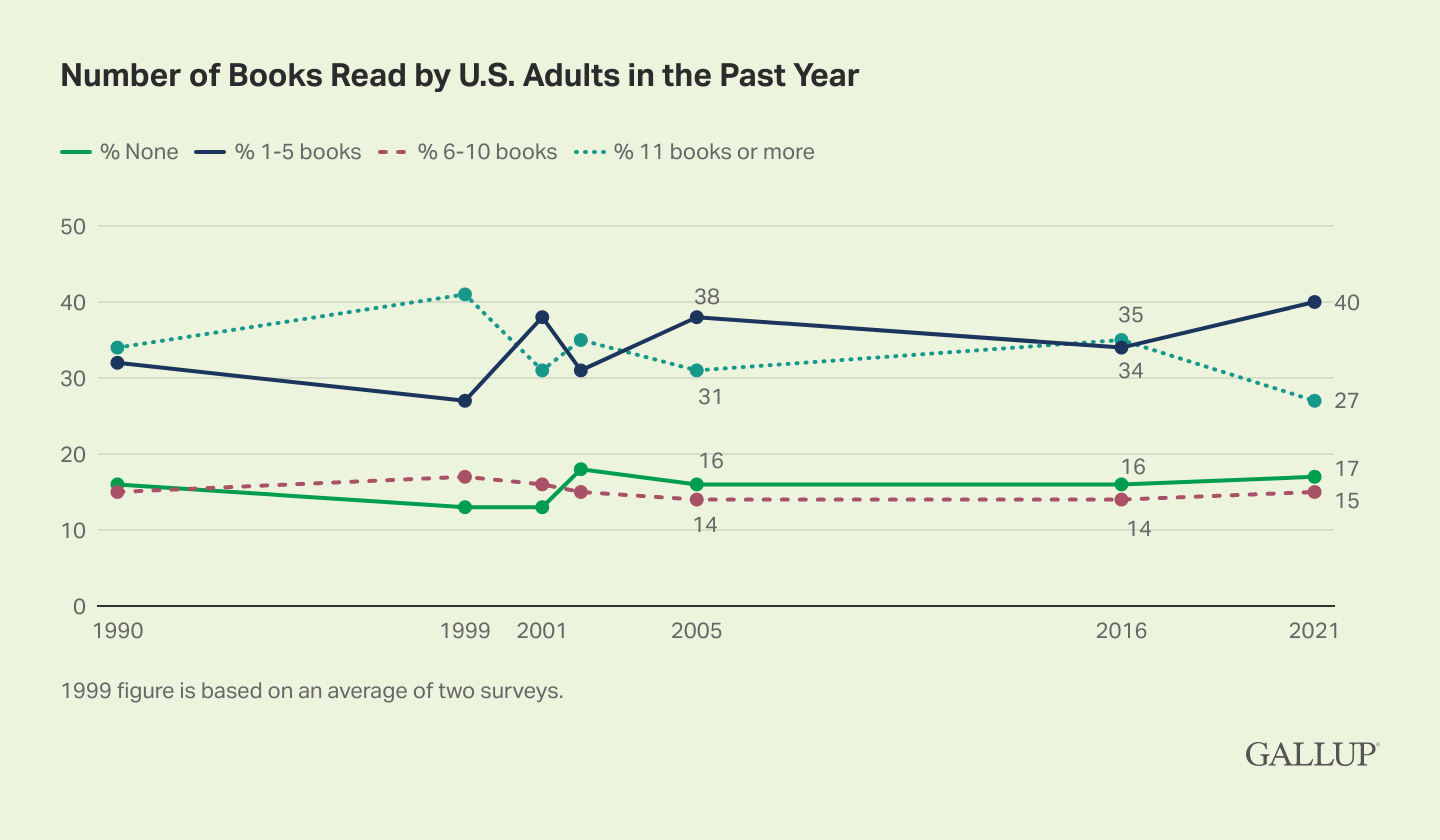
The actual data on reading isn’t as apocalyptic as the headlines imply. Gallup surveys suggest that some mega-readers (11+ books per year) have become moderate readers (1-5 books per year), but they don’t find any other major trends over the past three decades:
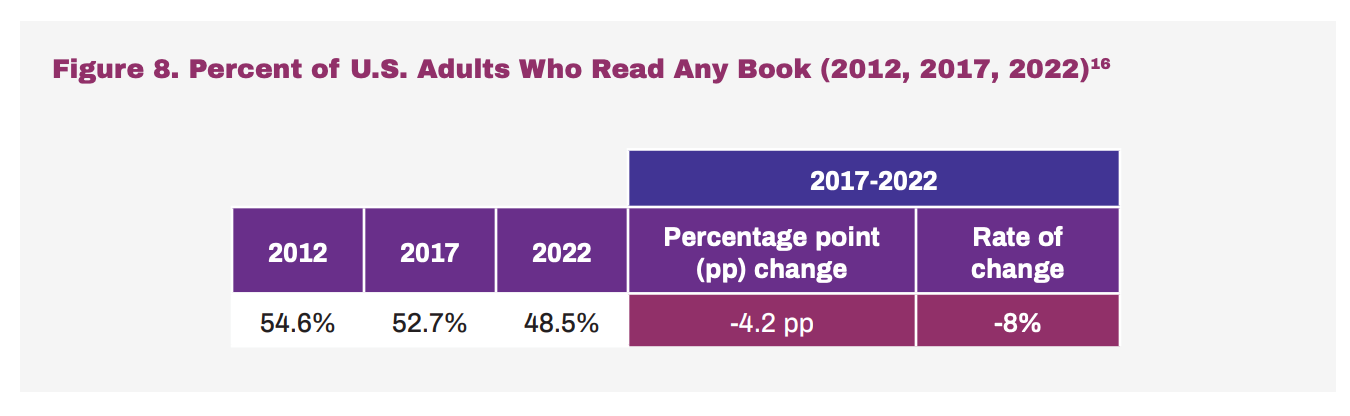
Other surveys document similarly moderate declines. For instance, data from the National Endowment for the Arts finds a slight decrease in reading over the past decade:
And the American Time Use Survey shows a dip in reading time from 2003 to 2023:
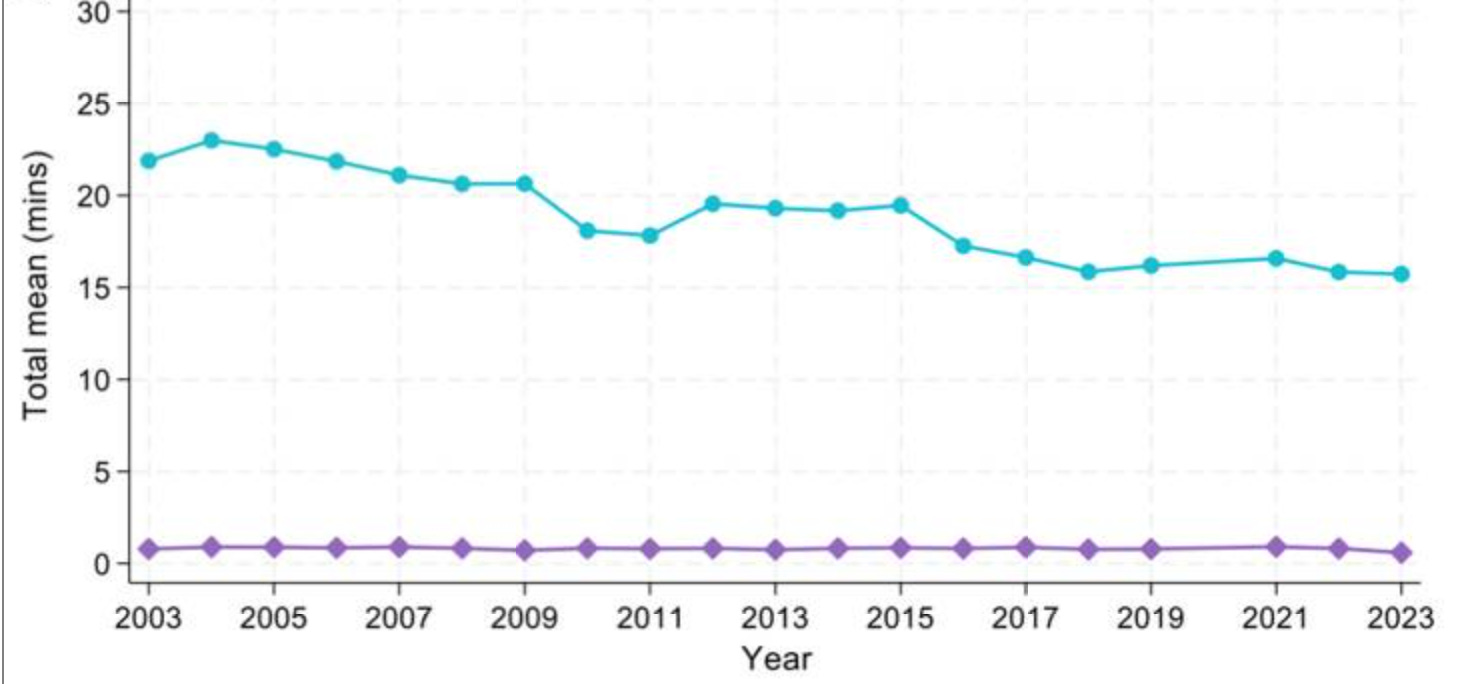
These are declines, no doubt. But if you look closely at the reading time data, you’ll notice that the dip between 2003 and 2011 is about twice the size of the dip between 2011 and 2023. In fact, the only meaningful changes happen in 2009 and 2015. I’d say we have two effects here: a larger internet effect and a smaller smartphone effect, neither of which is huge. If the data is right, the best anti-reading intervention is not a 5G-enabled iPhone circa 2023, but a broadband-enabled iMac circa 2009.
Ultimately, the plausibility of the “death of reading” thesis depends on two judgment calls.
First, do these effects strike you as big or small? Apparently, lots of people see these numbers and perceive an emergency. But we should submit every aspiring crisis to this hypothetical: how would we describe the size of the effect if we were measuring a heartening trend instead instead of a concerning one?
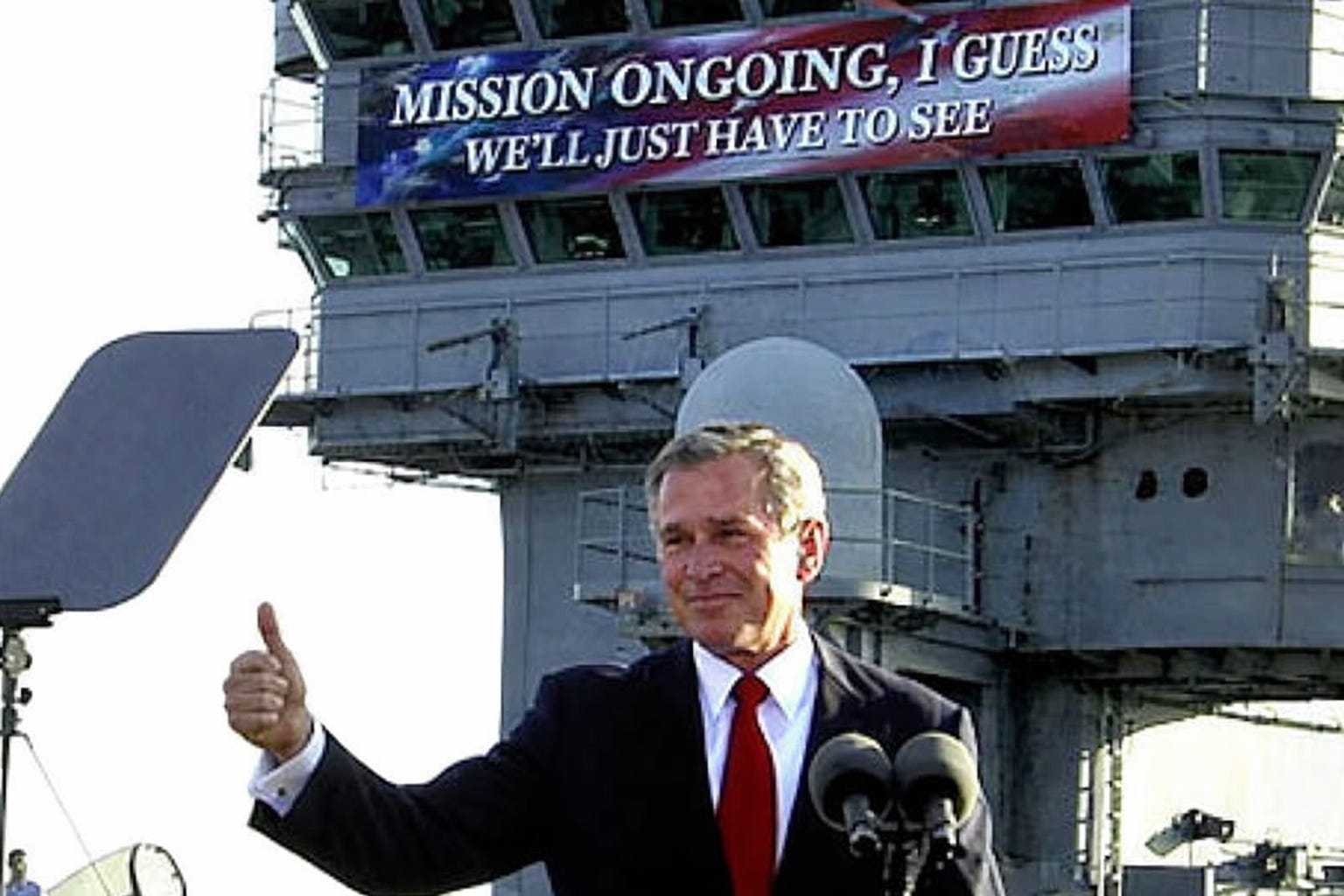
Imagine that time-use graph measured cigarette-smoking instead of book-reading. Would you say that smoking “collapsed” between 2003 and 2023? If we had been spending a billion dollars a year on a big anti-smoking campaign that whole time, would we say it worked? Kind of, I’d say, but most of the time the line doesn’t budge. I wouldn’t be unfurling any “Mission Accomplished” banners, which is why I am not currently unfurling any “Mission Failed” banners either.1
The second judgment call: do you expect these trends to continue, plateau, or even reverse? The obvious expectation is that technology will get more distracting every year. And the decline in reading seems to be greater among college students, so we should expect the numbers to continue ticking downward as older bookworms are replaced by younger phoneworms. Those are both reasonable predictions, but two facts make me a little more doubtful.
Fact #1: there are signs that the digital invasion of our attention is beginning to stall. We seem to have passed peak social media—time spent on the apps has started to slide. App developers are finding it harder and harder to squeeze more attention out of our eyeballs, and it turns out that having your eyeballs squeezed hurts, so people aren’t sticking around for it. The “draw people in” phase of the internet was unsurprisingly a lot more enticing than the “shake ‘em down” phase—what we now refer to, appropriately, as “enshittification”. The early internet felt like sipping an IPA with friends; the late internet feels like taking furtive shots of Southern Comfort to keep the shakes at bay. So it’s no wonder that, after paying $1000 for a new phone, people will then pay an additional $50 for a device that makes their phone less functional.
Fact #2: reading has already survived several major incursions, which suggests it’s more appealing than we thought. Radio, TV, dial-up, Wi-Fi, TikTok—none of it has been enough to snuff out the human desire to point our pupils at words on paper. Apparently books are what hyper-online people call “Lindy”: they’ve lasted a long time, so we should expect them to last even longer.
It is remarkable, even miraculous, that people who possess the most addictive devices ever invented will occasionally choose to turn those devices off and pick up a book instead. If I was a mad scientist hellbent on stopping people from reading, I’d probably invent something like the iPhone. And after I released my dastardly creation into the world, I’d end up like the Grinch on Christmas morning, dumfounded that my plan didn’t work: I gave them all the YouTube Shorts they could ever desire and they’re still...reading!!
Perhaps there are frontiers of digital addiction we have yet to reach. Maybe one day we’ll all have Neuralinks that beam Instagram Reels directly into our primary visual cortex, and then reading will really be toast.
Maybe. But it has proven very difficult to artificially satisfy even the most basic human pleasures. Who wants a birthday cake made with aspartame? Who would rather have a tanning bed than a sunny day? Who prefers to watch bots play chess? You can view high-res images of the Mona Lisa anytime you want, and yet people will still pay to fly to Paris and shove through crowds just to get a glimpse of the real thing.
I think there is a deep truth here: human desires are complex and multidimensional, and this makes them both hard to quench and hard to hack. That tinge of discontent that haunts even the happiest people, that bottomless hunger for more even among plenty—those are evolutionary defense mechanisms. If we were easier to please, we wouldn’t have made it this far. We would have gorged ourselves to death as soon as we figured out how to cultivate sugarcane.
That’s why I doubt the core assumption of the “death of reading” hypothesis. The theory heavily implies that people who would once have been avid readers are now glassy-eyed doomscrollers because that is, in fact, what they always wanted to be. They never appreciated the life of the mind. They were just filling time with great works of literature until TikTok came along. The unspoken assumption is that most humans, other than a few rare intellectuals, have a hierarchy of needs that looks like this:
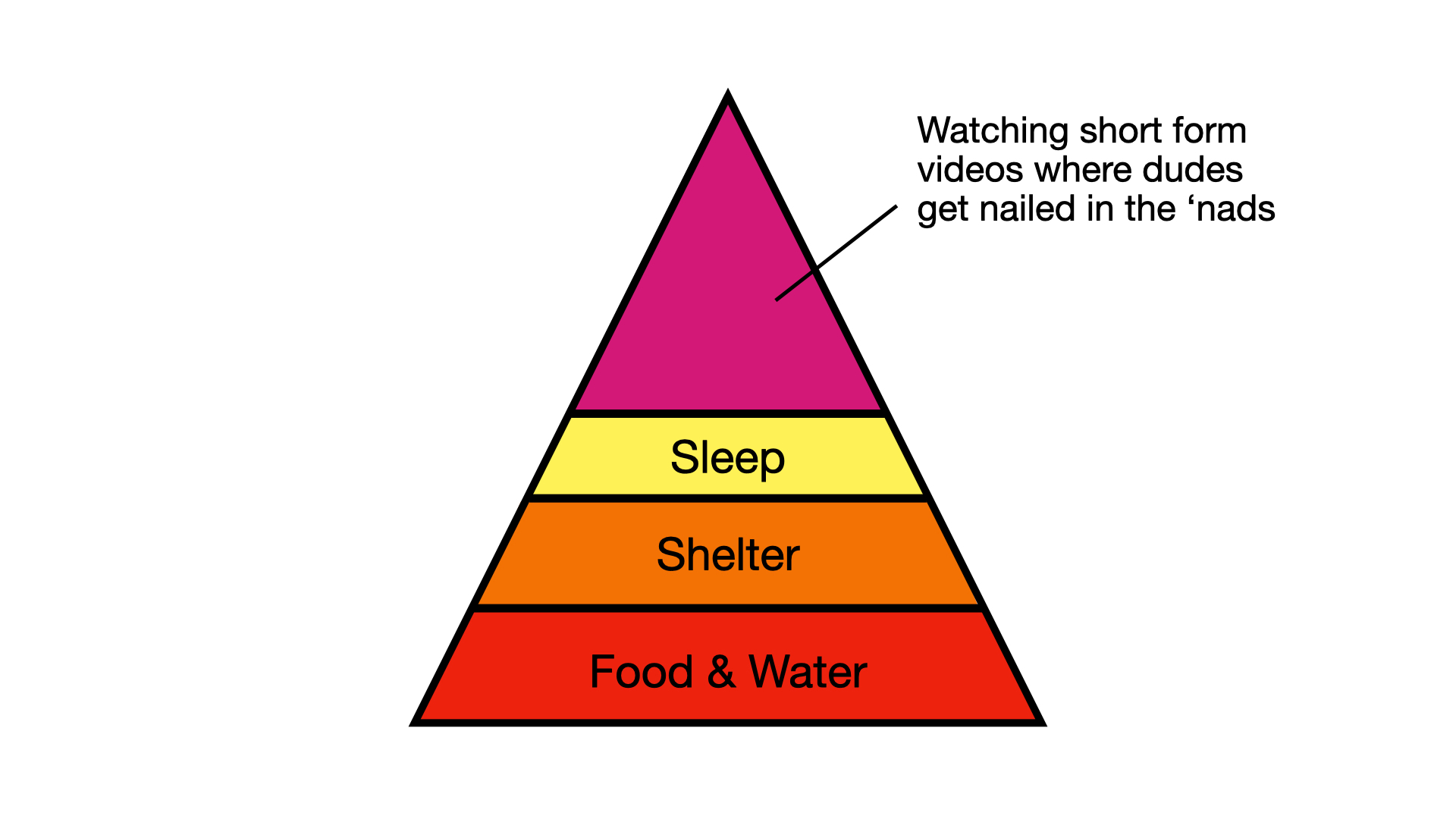
I don’t buy this. Everyone, even people without liberal arts degrees, knows the difference between the cheap pleasures and the deep pleasures. No one pats themselves on the back for spending an hour watching mukbang videos, no one touts their screentime like they’re setting a high score, and no one feels proud that their hand instinctively starts groping for their phone whenever there’s a lull in conversation.2
Finishing a great nonfiction book feels like heaving a barbell off your chest. Finishing a great novel feels like leaving an entire nation behind. There are no replacements for these feelings. Videos can titillate, podcasts can inform, but there’s only one way to get that feeling of your brain folds stretching and your soul expanding, and it is to drag your eyes across text.
That’s actually where I agree with the worrywarts of the written word: all serious intellectual work happens on the page, and we shouldn’t pretend otherwise. If you want to contribute to the world of ideas, if you want to entertain and manipulate complex thoughts, you have to read and write.
According to one theory, that’s why writing originated: to pin facts in place. At first, those facts were things like “Hirin owes Mushin four bushels of wheat”, but once you realize that knowledge can be hardened and preserved by encoding it in little squiggles, you unlock a whole new realm of logic and reasoning.

That’s why there’s no replacement for text, and there never will be. Thoughts that can survive being written into words are on average truer than thoughts that never leave the mind. You know how you can find a leak in a tire by squirting dish soap on it and then looking for where the bubbles form? Writing is like squirting dish soap on an idea: it makes the holes obvious.
That doesn’t mean every piece of prose is wonderful, just that it can be. And when it reaches those heights, it commands a power that nothing else can possess.
I didn’t always believe this. I was persuaded on this point recently when I met an audio editor named Julia Barton, who was writing a book about the history of radio. I thought that was funny—shouldn’t the history of radio be told as a podcast?
No, she said, because in the long run, books are all that matter. Podcasts, films, and TikToks are good at attracting ears and eyes, but in the realm of ideas, they punch below their weight. Thoughts only stick around when you print them out and bind them in cardboard.
I think Barton’s thesis is right. At the center of every long-lived movement, you will always find a book. Every major religion has its holy text, of course, but there is also no communism without the Communist Manifesto, no environmentalism without Silent Spring, no American revolution without Common Sense. This remains true even in our supposed post-literate meltdown—just look at Abundance, which inspired the creation of a Congressional caucus. That happened not because of Abundance the Podcast or Abundance the 7-Part YouTube Series, but because of Abundance the book.
A somewhat diminished readership can somewhat diminish the power of text in culture, but it’s a mistake to think that words only exercise influence over you when you behold those words firsthand. I’m reminded of Meryl Streep’s monologue in The Devil Wears Prada, when Anne Hathaway scoffs at two seemingly identical belts and Streep schools her:
...it’s sort of comical how you think that you’ve made a choice that exempts you from the fashion industry when, in fact, you’re wearing a sweater that was selected for you by the people in this room.3
What’s true in the world of fashion is also true in the world of ideas. Being ignorant of the forces shaping society does not exempt you from their influence—it places you at their mercy. This is easy to miss. It may seem like ignorance is always overpowering knowledge, that the people who kick things down are triumphing over the people who build things up. That’s because kicking down is fast and loud, while building up is slow and quiet. But that is precisely why the builders ultimately prevail. The kickers get bored and wander off, while the builders return and start again.
I have one more gripe against the “death of literacy” hypothesis, and against Walter Ong, the Jesuit priest/English professor whose book Orality and Literacy provides the intellectual backbone for the argument.
Most of the differences between oral and literate cultures are actually differences between non-recorded and recorded cultures. And even if our culture has become slightly less literate, it has become far more recorded.
As Ong points out, in an oral culture, the only way for information to pass from one generation to another is for someone to remember and repeat it.4 This is bit like trying to maintain a music collection with nothing but a first-generation iPod: you can’t store that much, so you have to make tradeoffs. Oral traditions are chock full of repetition, archetypal characters, and intuitive ideas, because that’s what it takes to make something memorable. Precise facts, on the other hand, are like 10-gigabyte files—they’re going to get compressed, corrupted, or deleted.
Writing is one way of solving the storage problem, but it’s not the only way, and we use those other ways now more than ever. Humans took an estimated 2 trillion photos in 2025, and 20 million videos get uploaded to YouTube every day. No one knows how many spreadsheets, apps, or code files we make. Each one of these formats allows us to retain different kinds of information, and it causes us to think in a different register. What psychology is unlocked by Photoshop, iMovie, and Excel?
There is something unique about text, no doubt, and I’m sure a purely pictographic, videographic, or spreadsheet-graphic culture would be rather odd and probably dysfunctional. But having more methods of storage makes us better at transmitting knowledge, not worse, and they allow us to surpass the cognitive limits that so strongly shape oral culture.
Put another way: hearing a bard recite The Iliad around a campfire is nothing like streaming the song “Golden” on YouTube. That bard is going to add his own flourishes, he’s going to cut out the bits that might offend his audience, he’s probably going to misremember some stanzas, and no one will be able to fact-check him. In contrast, the billionth stream of “Golden” is exactly the same as the first. Even if people spend less time reading, it is impossible to return to a world where every fact that isn’t memorized is simply lost. I don’t believe we are nearly as close to a post-literate society as the critics think, but I also don’t believe that a post-literate society is going to bear much resemblance to a pre-literate society.
I have text on my mind right now for two reasons.
The first is that I’m writing a book, and it’s almost done. So maybe everything I’ve said is just motivated reasoning: “‘Books are very important!’ says man with book”.5 But the deeper I get, the more I read the thoughts that other people have tamed and transmuted into a form that could be fed into the printing press and the inkjet printer, and the more I try to do the same, the more I’m convinced that there is a power here that will persist.
The second reason is Experimental History just turned four. This is usually the time of year when I try to wax wise on the state of the blogosphere and the internet in general. So here’s my short report: it’s boom times for text.
I know that what we used to call “social media” is now just television you watch on your phone. I know that people want to spend their leisure time watching strangers apply makeup, assemble salads, and repair dishwashers. I know they want to see this guy dancing in his dirty bathroom and they want to watch Mr. Beast bury himself alive. These are their preferences, and woe betide anyone who tries to show them anything else, especially—God forbid—the written word.
But I also know that humans have a hunger that no video can satisfy. Even in the midst of infinite addictive entertainment, some people still want to read. A lot of people, in fact. I serve at their pleasure, and I am happy to, because I think the world ultimately belongs to them. 5,000 years after Sumerians started scratching cuneiform into clay and 600 years after Gutenberg started pressing inky blocks onto paper, text is still king. Long may it reign.
Here are last year’s most-viewed posts:
And here are my favorite MYSTERY POSTS that went out to paid subscribers only:
Thank you to everyone who makes Experimental History possible, including those who support the blog, and those who increase its power by yelling at it on the internet. Godspeed to all of you, and may your 2026 be too good for words.
Read the original article

Comments
The reason video is winning is because you can make a living on video advertising. It's not really possible in this day to make a living on writing, outside of specific niches. So people who are good at writing use that skill to make video scripts, not blogs or books.
Yup; I'd make the claim (as an internet commenter, not an expert) that audio / video is more aimed at passive entertainment, whereas reading and more importantly deep comprehension etc takes more effort and time, and it's harder to monetize.
Not impossible, mind - the author posted this on Substack which is a way that one can monetize writing (blogpost style articles anyway).
Just about anyone being able to make money from writing also seems like a somewhat modern aberration.
Pre-printing press typically only the very wealthy had access to paper and ink, the process of copying a book was a huge undertaking.
Printing press opened things up, but paper was still rather expensive for quite some time. It wasn't until the 1900s that the book-splosion really took off.
With the take off of cheap paper products we switched from what you could write, to what could you get published and mass printed as the main gatekeeper. This paradigm stood for around 100 years.
With the rapid growth of both the internet and digital technology as a whole, anyone could write and 'publish online'. For a time this was lucrative as content was king and brought eyeballs. The internet was still slow enough for most that other forms of high bandwidth content were still luxury goods.
By 2010 the internet and smartphones were to the place that non-text media was where all the money was going. With the rise of the influencer a company could give a moderate amount of advertising dollars to an individual and get an oversized return on it. At the same time social media was gating off large amounts of text and people from the internet at large. Add to this the copying of text content in order to steal advertising dollars and clicks (think stack overflow copies and the like). Google and the other large social media companies with the advertising platforms greatly reduced the payout for text content and things moved to multi-media/video for the advertising dollar. The latest rage is shorts to keep ones ADHD addled mind locked to the screen for hours without moving.
With LLMs crapping out text who knows what our future of earning money with words looks like. Also, it's likely that AI driving virtual world will grab the attention of the masses, much like a personalized video game with the ability to be as addictive as our most dangerous drugs.
By wbl 2026-01-2619:02 The printing press immediately brought about broadsheets handbills and dozens of other mass publication formats.
By nerdponx 2026-01-2617:24 Audio is also great for busy people. Doing chores, driving, shopping, at the gym, even at work depending on your job. A lot of video content is mostly just audio anyway with either a person's face or filler images anyway. Audio and audio-heavy video is a way to get information or entertainment if you don't feel like you have the time to sit down and read.
That distinction between passive and active is why i've never been able to get on board with podcasts as a true medium for learning/understanding anything. Its a lack of discipline on my part because I'd end up doing something else as well and the information doesn't really truly get through (that feeling when you realise you've had it on for 10 mins but have not really actually listened to it). That's not possible at all with text as a medium, the brain has to latch on.
By ninalanyon 2026-01-2711:19 I find that listening to podcasts while driving works well but at home, as you say, I end up doing something that requires more mental effort than steering my car.
By MarceliusK 2026-01-2711:421 reply Video monetizes attention better, but writing still monetizes authority better
By mi_lk 2026-01-2712:08 most certainly in the west, but not sure about the rest of the world
Text is searchable, skippable, scrollable, compact, transmissible, and accessible in a way that audio and video have never managed to be.
It also fits in a handful of bytes or kilobytes what would take half a gigabyte to communicate in a video - sometimes making the difference if you have limited bandwidth or a cap on monthly traffic.
It's also ridiculously easy to cache (download a book in 9 seconds, board a transoceanic flight - no problem)
It also doesn't require the right sound and lighting conditions to see and understand a video (either those conditions, or good noise cancelling headphones - and now you're unaware of your surroundings)
It's also the only viable option on insanely low power devices which get months of battery life per charge.
It's also something you can read at an incredibly speedy pace if you are good at it and practice - though occasionally a decent audio/video player will be of use with this.
It's also something you can fall asleep while consuming, and tomorrow you won't have much trouble finding exactly where you left off.
I could continue..
By storystarling 2026-01-2622:54 It's also the only medium where semantic reasoning and indexing at scale makes financial sense. I can run RAG over millions of text rows in Postgres for pennies, but the compute costs to process and embed video content are still prohibitive if you care about margins.
Amen. It's one real "downside" in this day and age is that it requires fairly undivided attention to be used... that aside, it's without question my favorite way to interact with information.
On that note, a big thank you to whoever added "read this page" to Safari on iOS! Being able to turn long form articles into ad-hoc podcasts has been a game changer for me.
By lelanthran 2026-01-2612:541 reply > Text is searchable, skippable, scrollable, compact, transmissible, and accessible in a way that audio and video have never managed to be.
That's just a very long way of saying it's difficult to monetise; it's why audio and video are preferred by producers of content.
Few people are interested in disseminating an idea, a concept, anything... they are interested in levelling up their fame and followers. Text is typically no good for that.
By CuriouslyC 2026-01-2613:161 reply Video keeps blowing up because people want to connect with humans, and life is making that harder than it needs to be, so people are settling for these weird parasocial echo chambers. With the rise of AI, all text is suspect, and authenticity is king.
With the rise of AI, all audio, images and video is now also suspect.
By CuriouslyC 2026-01-2615:46 True, but it's a lot harder to sneak those things than text. I've seen convincing Yanis Varifakis and Neil DeGrasse Tyson fakes, but even those don't survive any scrutiny. I'm sure that will change, and people will find new ways to signal authenticity in videos (leaving in fuckups is already in style).
By dyauspitr 2026-01-2623:02 Video to a lot of people is way more engaging than text. Also video is much more information dense. You can’t teach people to do things over purely text but show them a video and a 1000 different indescribables become instantly apparent.
That being said I love a good book over its movie version anyway. Because text is cheap there is so much more detail you can include. There is no way text can compete with the information density of a video.
Same thing if you swap "text" and "video". That's the point of different media - they differ along those dimensions. For example, "a picture is worth a thousand words" means that for some information it will be less compact to describe all the details of a video with words
Obviously there are some pieces of information that can be conveyed better with a picture or diagram - network connections, block graphs, etc. But as a general rule text is far more efficient for knowledge transfer.
If I have a text file and an audio file of the Great Gatsby, and I want do any of the following, then I'm going to use the text file:
* Find a particular quote
* Determine the number of times the word "Gatsby" is used
* Go back a few pages to remember exactly how something/someone was described
* Intermittently stop and compare with a supplementary file and/or write notes
* Find exactly where I was just before I fell asleep
* Get through it in 3 hours without rushing or missing bits
* Store it on a portable device along with thousands of other books
By eviks 2026-01-2620:02 There is no such general rule, and humanity has always used various media, and for every biased test you come up with (frequency of a word in a text) you can just as well come up with a test that benefits the other medium (frequency of some sound in the audio book)
* Go back a few pages to remember exactly how something/someone was described
Or you don't forget how someone looks because a visual illustration is easier to remember
* Find exactly where I was just before I fell asleep
You can't, the book closed when you fell asleep and you forgot the bookmark . But when the phone fell it disconnected your headphones which stopped the playback.
While this is our course a good point, one extremely good part about text is that unless there given text is quite literally just plain text data, it's a lot easier to embed things like videos, pictures, audio, etc. into a textual medium especially when compared the other way around -- that is the fact that text in videos and pictures and so on tends to be quite limited when compared with the kind of "rich text" with the more audiovisual content added between blocks of text.
So one can use the thousand words of pictures while most content is textual, whereas the other way is significantly worse, since it of course lacks all the searchability et al.
You're discussing a mixed content document format, the original point was about some mythical benefits of text, explicitly vs video, which removes all the embeds from your document
By n4r9 2026-01-2710:11 I think it's a fair point. Text is easier to inject into other media.
By BinaryIgor 2026-01-2619:121 reply It also the most portable - no codecs, no formats and standards; most English texts are just ASCII :)
By psychoslave 2026-01-277:051 reply How is ASCII not a standard?
And writing system don't fall out of nowhere, especially something as baroque as English which is all but phonetic.
By n4r9 2026-01-2710:15 ACII is a standard, but it's also standard. To a really high degree. 99% of webpages are UTF-8.
You could make a similar argument about, say, H.264, but the dominance is not as compelling and drops massively if you account for different container formats.
By kalterdev 2026-01-2611:59 It’s also runnable (scripts), clickable (urls), and context-dependent, which makes it a nice UI.
By MarceliusK 2026-01-2711:49 Text has a bunch of second-order properties that only become obvious once you try to replace it
By ChrisMarshallNY 2026-01-2611:143 reply I would do more video, but video editing is really difficult.
I think that today’s video influencers have gotten really good at “one take and done” recording.
I couldn’t do that. I’m way too much of a perfectionist. I always edit my text, and I’ve been writing all my life. I don’t think that I’ve ever written something perfectly, the first time (including HN comments. I tend to go back and edit for correctness and clarity).
A couple of weeks ago, I was interviewed for a podcast. The process was fascinating, and the woman that did it, obviously does a great deal of editing and refinement. I don’t know if I have that much patience.
By kalterdev 2026-01-2615:27 No prominent writer has ever said that writing came easy to them. I think it’s not wrong to feel this way.
By conductr 2026-01-2620:22 There’s a lot of iterative script writing that goes into “one take” videos. I think they often appear to be one takes and that’s the polish or perfectionism you’re seeing.
I mean, some of them are just rambling on and going more Vlog stuff. But even then they’ve likely already decided an agenda of discussion items and thoughts on them prior to just randomly going unfiltered.
Although idk, our algorithms of content could be completely different and you’re truly seeing something else.
Even short form video is a lot of work to be good at it and build a following unless there’s something else at play (charismatic, sex appeal, etc).
By uberstuber 2026-01-270:36 Tools like descript let you edit video by editing the transcript text

#/media/File:Accountancy_clay_envelope_Louvre_Sb1932.jpg)