
The "Wage Level" Mirage: H-1B proposal could help outsourcers and hurt US talent

2025-09-251:05100193ifp.org

How DHS’s H-1B proposal could help outsourcers and hurt US-trained talent

This morning, the Department of Homeland Security proposed replacing the H-1B lottery with a weighted system that favors workers certified at higher Department of Labor (DOL) “Wage Levels.”1 On the surface, this seems like a merit-based reform: higher wages should mean higher skills. In reality, DOL’s Wage Levels are very different from actual wages. The Wage Level framework was never designed to compare wages across occupations because it measures relative seniority within a job category, not actual pay. There are many workers paid at the highest DOL Wage Level but making below the median American wage, while some of the lowest DOL Wage Level are among the best-paid in the economy.

Using recently released FOIA data on all H-1B registrations and petitions filed from FY2021–2024, linked with Department of Labor data showing those individual workers’ Wage Levels, I show that the proposed Wage Level system would not prioritize the highest-skilled or best-paid workers. Instead, it would have three surprising consequences:

1. A windfall for outsourcers. Large IT outsourcing firms (Wipro, Infosys, Tata, Cognizant, etc.) would actually gain under the rule, receiving 8% more visas, because they systematically register mid-career workers classified at higher Wage Levels despite paying comparatively low salaries. By contrast, a system based on actual pay would reduce visas for outsourcers by over 60%.

2. A setback for US-educated talent. International students graduating from American universities earn higher salaries on average than other H-1B workers, but because they are early-career, they are overwhelmingly classified at the lowest Wage Levels. The proposed rule would cut visas to F-1 graduates by 7%. A compensation-ranking would increase their share by 7%.

3. Minimal skill gains. DHS justifies the rule as raising skill levels, but the effect is trivial: the weighted lottery would lift median H-1B salaries by just 3% (from $92,000 to $95,000). By contrast, a compensation-based system would raise the median by a 52% jump to $140,000. It would also vastly increase the share of PhDs selected by a whopping 148%.

The Wage Level system was created to enforce minimum pay rules, but is ill-equipped to rank workers. Using it as a prioritization tool produces perverse results: rewarding outsourcing firms and older workers in lower-skill occupations while penalizing genuinely high-wage, high-skill talent, especially students trained in the US.

DOL’s Wage Level framework was designed as a compliance mechanism to enforce the Immigration and Nationality Act’s (INA) requirement that H-1B workers be paid at or above the “prevailing wage” for their occupation and geographical area. To operationalize this, DOL uses the Occupational Employment and Wage Statistics (OEWS) survey to distinguish between four Wage Levels, intended to approximate the relative seniority of the offered position within a given occupation. The four Wage Levels are Level I (“entry”), Level II (“qualified”), Level III (“experienced”), and Level IV (“fully competent”). 

Currently, there are two random lotteries conducted each year: first an unreserved lottery for all registered H-1B petitions including those for beneficiaries who have earned a US Master’s or above, and then a reserved lottery only for US Master’s and above graduates. 

DHS’s proposed rule would offer workers at OEWS Wage Level IV four chances in the lottery, workers at Wage Level III three chances, workers at Wage Level II two chances, and workers at Wage Level I one chance.

Importantly, Wage Levels are not the same as actual wages but are intended to correspond to seniority within an occupation and area. While Wage Levels are correlated with actual salaries, it is only a loose proxy, and there is significant overlap between the actual salaries paid by employers for workers at different Wage Levels. 

A Wage Level IV job is not necessarily a high-wage job. In fact, the data show many Level IV certifications for salaries far below the median American wage, while some Level II jobs are among the best-paid in the economy. The ranking system would thus favor companies sponsoring older workers with longer seniority, even in lower-skill jobs, over genuinely high-wage, high-skill roles.
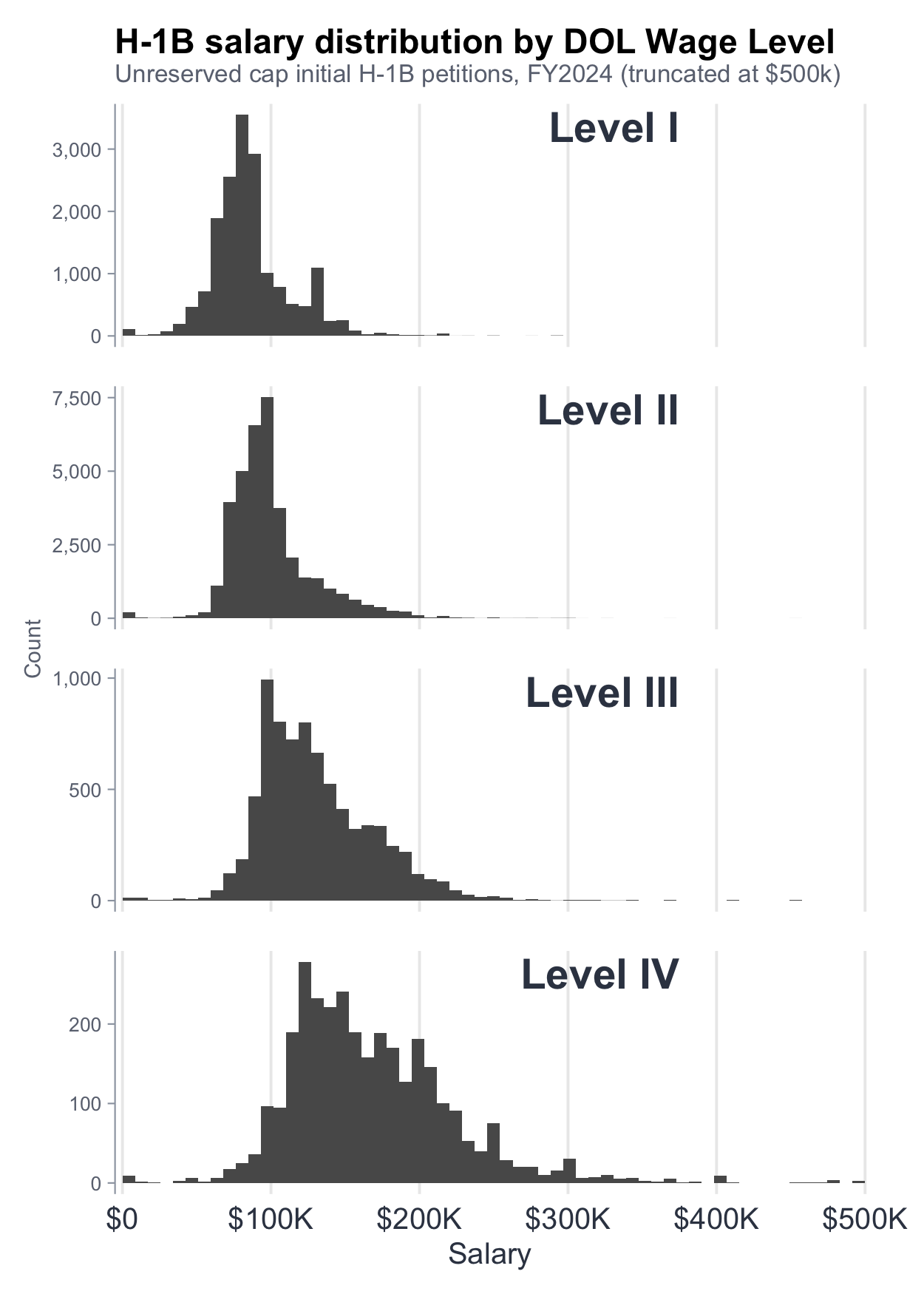
Source: I-129 data obtained via FOIA by Bloomberg, linked to DOL disclosure data

Consider some real petitions filed between FY2021-2024:

  • An otolaryngology surgeon certified at Level I with a salary of $300,000.
  • A PhD technical staff member at Open AI certified at Level II with a salary of $280,000.
  • A CEO/CTO of a manufacturing startup certified at Level II with a salary of $300,000.
  • An acupuncturist certified at Wage Level III with an annual salary of $41,600.
  • A landscape architect certified at Wage Level IV with a salary of $36,090.

These are not representative examples of the typical worker at each Wage Level, but they are illustrative examples showing how widely Wage Levels diverge from real salaries. Under the proposed rule, the landscape architect and the acupuncturist mentioned above would be ranked ahead of the AI researcher, surgeon, and startup executive and would have more chances in the lottery. Under a compensation-based ranking, the landscape architect and acupuncturist would not get visas, while the others would. 

This Wage Level system was never intended to serve as a proxy for relative merit, social value, or national interest. It was designed to be a tool for wage protection, not a ranking system. 

Given the divergence between actual compensation and Wage Levels that can occur, we must turn to actual data on the distribution of Wage Levels and salaries to understand the outcomes of different mechanisms to award H-1Bs. 

To measure the effects of alternative selection mechanisms, I turn to data obtained through a lawsuit filed by Bloomberg against DHS under the Freedom of Information Act.2 These data include detailed information on all H-1B lottery registrations made from FY2021–2024, along with data from petitions filed by lottery winners, including the jobs, employers, and compensation of H-1B filers. The data also include a unique code identifying the corresponding LCA associated with an H-1B petition, where the employer certified the Wage Level of the H-1B. DOL public disclosure data allowed me to link the FOIA data obtained by Bloomberg with the corresponding LCAs that actually resulted in H-1B registrations and filings.3 

Given this detailed information on a random sample of the registrant pool, I can simulate how H-1Bs would have been awarded in FY2021–2024 had the proposed weighted lottery been in effect.4 I also simulate what a pure compensation-based ranking would have done. I do not think a pure compensation-based ranking is ideal (I have elsewhere recommended adjusting compensation by geography and age 5), but it is a straightforward baseline of comparison. 

As we’ll see, compensation-ranking would have the opposite effect from using Wage Levels on important criteria, including student retention and visas awarded to outsourcers.

A boon to the large outsourcing companies

Large IT outsourcing companies, like the so-called WITCH companies (Wipro, Infosys, TCS, Cognizant, and HCL) are particularly well positioned to benefit from any prioritization based on Wage Levels. Their business model relies on flooding the lottery with registrations for mid-career staff in routine roles, who often qualify for higher wage levels despite the relatively low actual pay. 

To identify large outsourcers, I focus on firms that register for more than 2,000 H-1Bs in any year with a clear outsourcing model. The most prominent include Wipro Limited, Infosys, Tech Mahindra Americas, Tata Consultancy Services, Capgemini, Cognizant Technology, and HCL America.

The results are striking. Across FY2021–2024, the proposed Wage Level-weighted lottery would have actually increased the large outsourcers’ success rate. Across FY2021–FY2024, large outsourcers would have received about 8% more visas under the proposed system than under the status quo. 

The mechanism is straightforward. Data show that for large outsourcers, Wage Levels are disproportionately concentrated in Level II and Level III certifications. Most other employers, by contrast, hire far more at Level I than the outsourcers do. Because the proposed rule assigns more lottery entries to Level II and Level III workers, large outsourcers gain an advantage despite offering systematically lower wages.
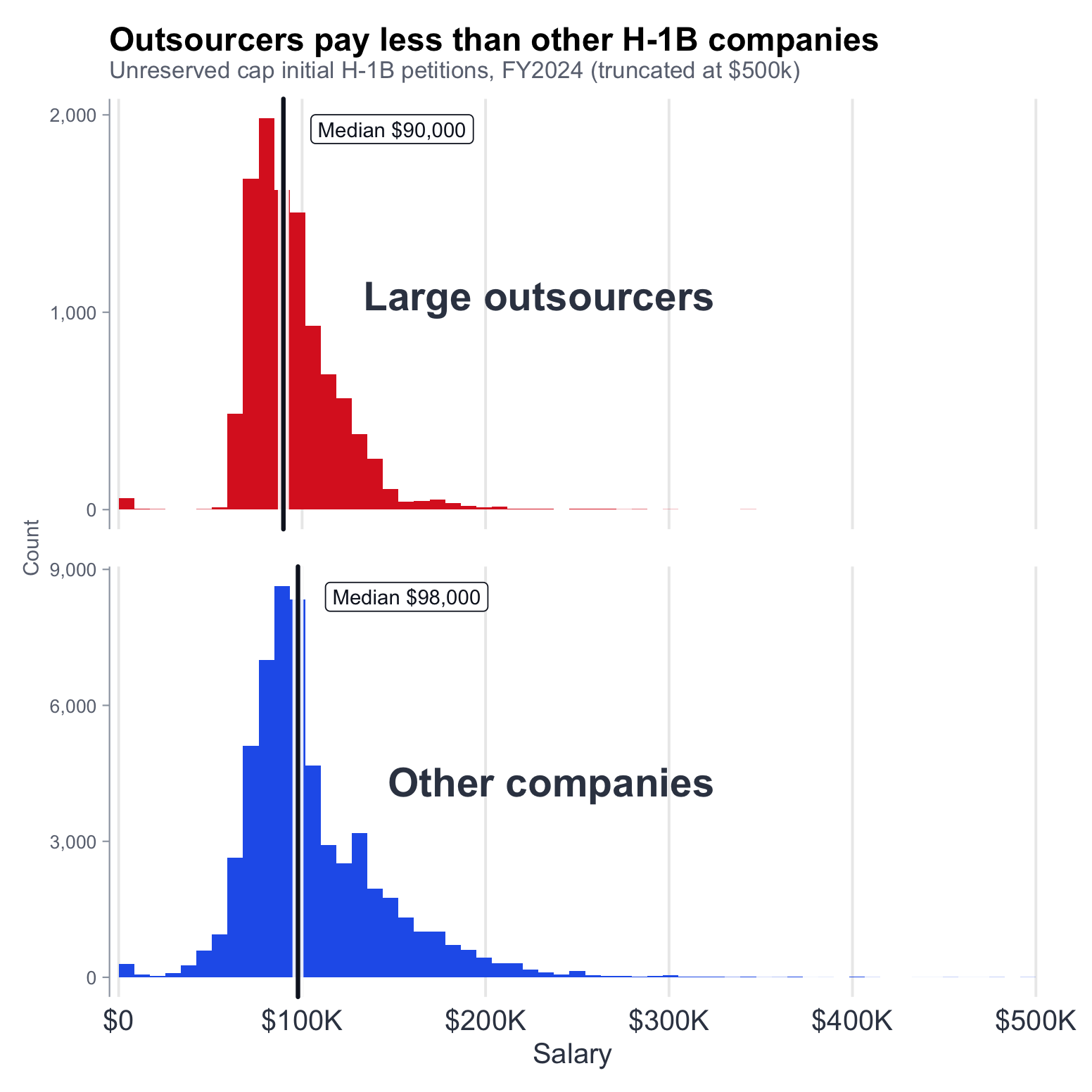
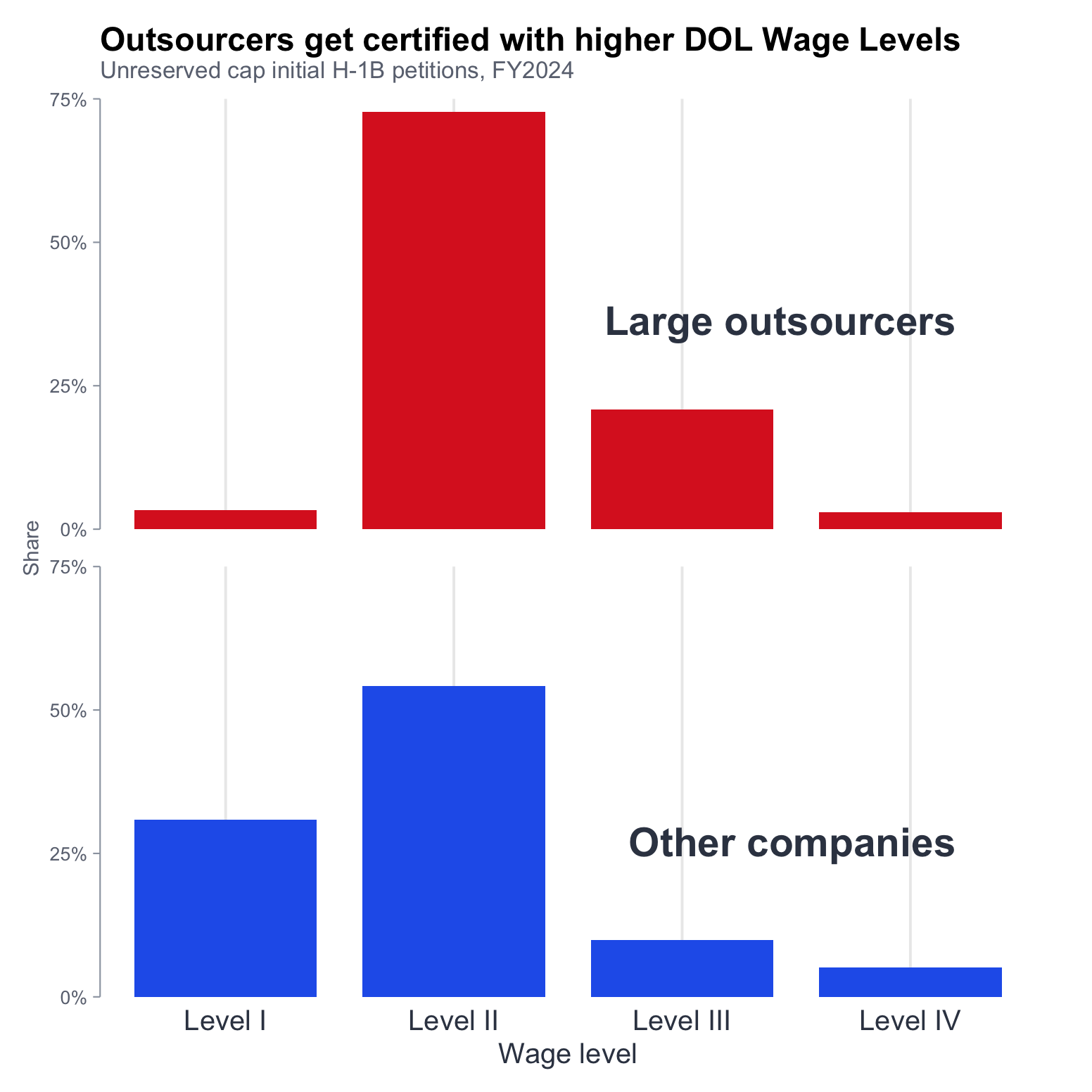
Source: I-129 data obtained via FOIA by Bloomberg, linked to DOL disclosure data

By contrast, a compensation-based ranking would cut the outsourcers’ share substantially, awarding fewer visas to these firms in every year of the data. On average, compensation-ranking would reduce H-1Bs to outsourcers by more than 60%. 

Analogous results are apparent for other H-1B-dependent employers, companies with a large share of their workforce on H-1Bs. H-1B-dependent firms are those that employ at least eight H-1B employees if they have under 26 total employees, at least 13 H-1B employees if they have 26-50 employees, or at least 15% of all employees if they have more than 50 employees. The proposed rule would increase their H-1Bs by 4%, while compensation-ranking would decrease it by 54%.

A blow to talent retention

One of the clearest signals of whether the H-1B system supports American competitiveness is how it treats international students educated in the United States, given that American institutions of higher education are the on-ramp for most skilled talent in the United States. Each year, tens of thousands of foreign students graduate from American universities, often in STEM fields, and seek to transition from F-1 student status to H-1B employment.

The proposed rule would disadvantage international students educated in the United States. Graduates on F-1 visas, by definition, are early-career. Their positions are classified at Level I or Level II, even when the salaries are six-figure offers in cutting-edge industries. The FOIA data confirm this pattern: F-1 students entering the H-1B process earned higher salaries on average than non-F-1 workers, but they were far more likely to be placed at the lowest Wage Levels.
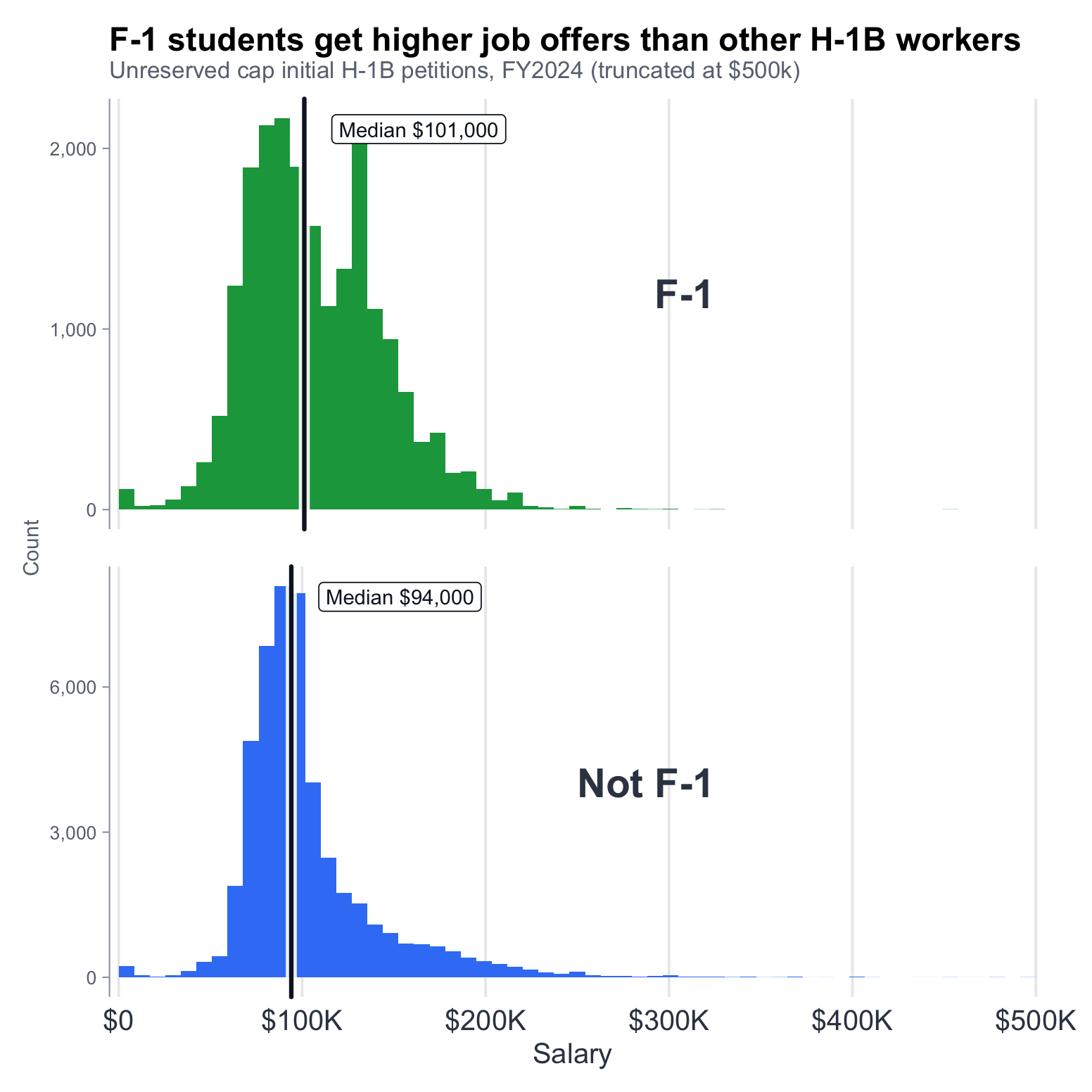
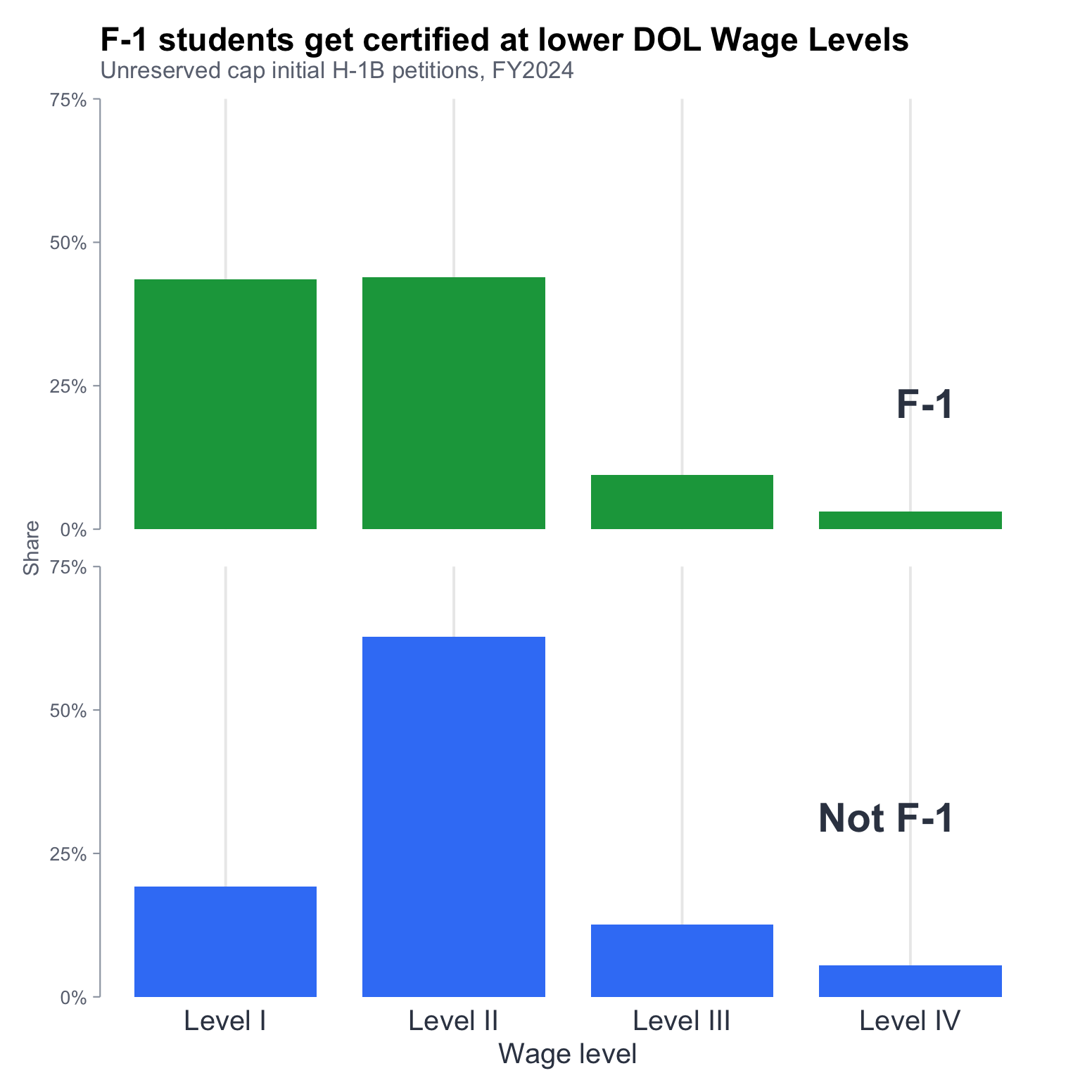
Source: I-129 data obtained via FOIA by Bloomberg, linked to DOL disclosure data

The result is that under the proposed Wage Level-based rule, the United States would lose more of the very talent pipeline it has already invested in training. The proposed rule would cut the number of H-1Bs to F-1 students each year by about 7%, while compensation-ranking would raise the number by about 7%.

The fact that compensation-ranking would increase the share of H-1Bs going to students may be counterintuitive, but it is borne out consistently in the data and can be explained by the fact that compensation-ranking has two countervailing effects: 1) they are disadvantaged relative to later career workers in the fields they are entering, but 2) they are advantaged relative to everyone in lower-paying occupations. Given that international students tend to disproportionately enter higher-paying occupations, they are often paid more than other H-1B workers, even in early career stages. As we will see in the next section, one dynamic helping them under compensation-ranking is less competition for visas from H-1B-dependent employers and large outsourcing companies. 

A modest increase in wages.

A central rationale for reforming the H-1B allocation system is to better target scarce visas toward the most skilled workers. Yet the choice of metric matters enormously for what “skill” means in practice. Under the current lottery, the median salary for new H-1B petitions in each year from FY2021–FY2024 averaged about $92,000. DHS’s proposed Wage Level-weighted lottery would raise that figure only modestly, to $95,000, a gain of just 3%. By contrast, a compensation-ranking system based on actual salaries would shift the composition of recipients dramatically, raising median wages to $140,000, a 52% increase. Those figures represent the average effect, but the effect is smaller in FY2021 and rose through FY2024. In FY2024, the median salary under compensation-ranking would have been $159,000, compared to only $98,000 under the proposed rule. 

The results look even more stark at the lower end of the wage distribution. Under the proposed rule, there would still be H-1Bs going to workers paid less than the median US salary. In 2024, the 10th percentile salary under the weighted lottery would be just $70,000. Under compensation-ranking, not a single H-1B would go to any workers making less than $130,000.
The contrast is also apparent when looking at educational attainment. PhDs represent a relatively small share of the overall applicant pool, but they are often concentrated in frontier industries where skill and expertise are most critical. The weighted lottery would increase the number of PhDs selected by 22% compared to the status quo. Compensation-ranking, however, would raise the number of PhDs awarded H-1Bs by 148%, far more than the proposed system.

These results reflect the fundamental problem with using Wage Levels as a proxy for skill. Wage Levels reward seniority within an occupation, but they are explicitly designed to level the playing field between low-skilled and high-skilled occupations. The result is a middling increase in the skill levels of H-1B recipients. 

The methodology in the previous section assumes that the pool of talent wouldn’t change, and that employers would continue to register for the lottery in similar ways as they have historically. But different policy environments will create different incentives that will change employer behavior.

First, other proposed policy changes may shift what the pool of registrants looks like. The $100,000 H-1B fee does not appear to apply to workers changing status from within the United States, which gives multinational companies, including outsourcing companies, the incentive to bring people on L visas and transfer them to H-1Bs to avoid the fee. This may mean that outsourcers won’t be significantly discouraged from continuing to register if they can avoid H-1B fees, and may benefit since their access to Ls is a competitive advantage against non-multinational companies. Meanwhile, proposed changes limiting international students’ ability to stay after they graduate may shrink the potential pool of student talent. All of these changes add uncertainty to the magnitudes of the estimates in this report, although the basic mechanisms remain unchanged. 

Second, explicitly prioritizing Wage Levels will encourage employers to find ways to game them. For example, employers can find ways to classify their workers in occupational categories with lower prevailing wages. For example, outsourcing companies can identify workers as computer programmers rather than software developers to get higher Wage Levels for the same salary. Given the artificiality of occupational classifications and Wage Levels, the proposal is open to much more manipulation and unintended consequences than compensation-ranking, which is much more difficult to game.

The proposed wage-level prioritization rule would invert the intended logic of the H-1B program. Instead of channeling visas toward the valuable roles, it would reward seniority, benefitting outsourcing firms while hurting America’s talent pipeline by offering fewer visas to graduates of American schools.

The biggest winners would be firms that already dominate the program by volume but pay less than market rates. The losers would be international students completing programs at the nation’s colleges, and the companies and sectors on the front lines of America’s technological and economic competition.

Relying on DOL’s Wage Levels will not make the H-1B much more merit-based. Policymakers should instead prioritize actual compensation offers so the H-1B system can fulfill its potential as a genuine high-skilled visa program that advances America’s economic and strategic goals. In Part II, I will dive more deeply into the outcomes of compensation-ranking and some further alternatives.


Read the original article

Comments

  • By d_sem 2025-09-252:4412 reply

    One of America's greatest assets is its brand as a place worth immigrating too. Much of the social capital is gained by high performing international hires who leverage the H-1B visa. We want methods for highly educated people to make the US their home. limiting this is short sighted and negatively impact the health of the country.

    • By dentemple 2025-09-257:345 reply

      I was once brought in to a Fortune500 company to teach basic ENTRY LEVEL web development to a room full of supposedly "highly educated" H-1B Software Engineers.

      Much of my presentation included things that most of my unemployed American colleagues, all of whom were actively looking for work, already knew how to do implicitly. Because it literally was just basic, "This is how flexbox works"-type of stuff.

      Maybe the H-1B program is a great program for hospitals. For tech, it is 100% being used to import cheap, disposable labor in a way that harms U.S. citizens economically.

      • By roarcher 2025-09-258:422 reply

        H1B workers are supposed to be people with qualifications that are in short supply in the United States. The unspoken part is that the "qualification" employers are so desperately searching for is usually the willingness to work for peanuts.

        • By Balinares 2025-09-2511:154 reply

          Isn't H-1B contingent on compensation in line with the local median for the role?

          • By jalapenos 2025-09-2511:30

            It is contingent on you documenting your going through the motions of pretending to keep compensation in line with "the local median".

          • By redserk 2025-09-2514:131 reply

            After graduating college I joined a company that paid generally below-market for everyone and had a significant number of H-1B employees and contractors.

            The benefits were legendary but the pay was 20-30% lower than what was around.

            I don’t have evidence of wrongdoing but I’ve occasionally wondered if it was some kind of scheme.

            • By jdlshore 2025-09-2516:02

              “Legendary” benefits (especially healthcare) are extremely expensive. It’s plausible that the average total compensation was the same, or even more, than other companies. The trick is that not everyone gets the same value from those benefits.

          • By avidiax 2025-09-2522:14

            The compensation is only measured in terms of salary (and maybe bonus).

            Stock compensation is completely ignored. Since stock compensation can be a large fraction if not the majority of the compensation, this means that many H1-Bs may be underpaid compared to their coworkers, while appearing to the government to be the highest paid in that company and job role.

            The other ignored aspect is effective hourly pay. Software engineers are nearly always exempt employees, so they don't receive hourly pay. But a manager can demand more from H1Bs, even if it would mean work during nights or weekends, and there's little the H1B can do. Local employees can more easily change jobs if that happens, and moreover, the threat that they can change jobs disincentivizes such abuse.

          • By WorldMaker 2025-09-2516:28

            It's a bit of a catch-22 because if you add enough lower compensated employees you shift the local median lower. If "everyone" in the local area is hiring more cheaper H-1Bs that gives you a chance to hire even more H-1Bs for even cheaper. Averages can be a fun game that way.

            Even if you try to pin it to the median that does not include H-1Bs, you still are letting the market compete on labor cost and that competition can still affect the local median. Companies decide all the time that they could hire, for example, 2 H-1Bs for the cost of one "senior" local developer, encouraging that local developer to maybe only ask for 1.5x "an H-1B" to remain competitive in that market. Iterate that enough in hiring decisions and companies still have more control of that local median than labor does.

            I don't know if there is a "fair" way to set the cost of labor for an H-1B, but "local median" or any other average-based math is probably not it.

        • By pessimizer 2025-09-2510:491 reply

          This has been "proven wrong" by geniuses pointing out that Americans who work in the same jobs as the H1Bs are also making peanuts.

          • By Saline9515 2025-09-2511:221 reply

            Then restricting the supply of workers ready to work for peanuts will force companies to raise their salaries to hire.

            • By TechnicalVault 2025-09-2512:193 reply

              Or if the job is an outsourceable one that can be provided as a service then they will outsource it to a company overseas and still pay peanuts. The only reason they'll raise wages is if they have to, aka the service cannot be done elsewhere or automated.

              • By _DeadFred_ 2025-09-2515:55

                If your company doesn't need domain experts/doesn't change to the point these people can be remote... you are a zombie company and will be replaced by someone that does utilize domain experts/dynamically changes all the time with conditions. Even with just a factory, when I moved from dev to IT, getting my people to understand our users by going out to the floor and sitting with people we were able to greatly improve efficiency in a way no remote IT could.

              • By tracker1 2025-09-2519:56

                They already are... Generally insourcing is to reduce the friction of doing so, because application managers and product owners don't want to relocate to the countries they're doing the outsourcing with.

              • By Saline9515 2025-09-2512:471 reply

                A lot of jobs require or are better done on-premises, which is why they hire H1-Bs. Outsourcing is already cheaper, by far, especially if you want to go to the third-world.

                • By fancyfredbot 2025-09-2513:36

                  A lot of people really hate RTO and love WFH

      • By _DeadFred_ 2025-09-2515:51

        This. The problem for H1B advocates is most of us here reached our conclusions AFTER exposure to outsourcing/consulting and what H1-Bs got us/the new people we had to manage. Lots of us were also privy to managements' reasoning (cutting costs/your team is the most expensive and we don't want to pay that) which don't align with 'H1Bs are paid the same'.

      • By trhway 2025-09-257:472 reply

        > For tech, it is 100% being used to import cheap, disposable labor in a way that harms U.S. citizens economically.

        I'd argue with the 100% - we all know the companies that do it. They get about half of H1B visas. So 50% :)

        The blanket $100K (instead of say tiering it like raising fee $50K for each next 20K tier of visas with the $250K fee visas no subject to the cap - if only Tramp knew anything about business and specifically price differentiation :) would definitely revive interest for outsourcing to offshore.

        Managing AI agents have some similarity to managing offshore teams. This time the offshore teams will be using AI agents. May probably lead to much higher performance/output.

        Being rate limited, i'll answer to the commenter below here: The offshore teams are naturally assigned a well defined chunks of work, at least in a well managed situations. AI agents are also very suitable for that.

        • By franktankbank 2025-09-2512:04

          Ahh, so its as simple has having a well managed situation. Easy enough to outsource then. LETS GOOOO!

        • By lucyjojo 2025-09-258:26

          > This time the offshore teams will be using AI agents. May probably lead to much higher performance.

          What do you mean exactly by that. I do not follow...

      • By d_sem 2025-09-2610:08

        My equally anecdotal professional experience has been the exact opposite and certainly influences my view on this topic.

      • By thatfrenchguy 2025-09-2513:31

        > Maybe the H-1B program is a great program for hospitals. For tech, it is 100% being used to import cheap, disposable labor in a way that harms U.S. citizens economically

        And yet, Apple, Google, Nvidia, Meta and Amazon would never be where they are without folks who are or who started on H-1B. A ton of their senior staff were once 20-something hired on H1B

        Crackdown on the abuse of outsourcing companies, let actual tech workers who are (or will be) good at their jobs come here, it’s obvious policy. The US has benefited immensely from that brain drain.

    • By 827a 2025-09-253:064 reply

      We issue 85,000 H1-B visas every year. Last year, there were 442,000 applications.

      Its supply and demand. If you think any of these changes will cause fewer than 85,000 H1-B applications, then that is a good reason to believe that these changes might negatively impact the United States as a migration destination. However, with that added context and framing, I hope you'll agree that it won't; there's still going to be a smaller, but growing, number of people applying for the H1-B every year.

      Increasing the number of H1-B visas has very little support from both sides of the isle. The 65,000+20,000 number was set, if you can believe it, 35 years ago. There were one or two temporary increases, but since 2005 its stayed at that 85,000 number.

      • By ido 2025-09-257:472 reply

        Why not set a salary floor for H1-B candidates? That's how the equivalent works in Germany (the floor is quite low imo but if it's too low it can be set higher). If you set the floor (maybe per profession) for software engineers at say $250k p.a. there'll be little benefit to bringing in unskilled labor, but the occasional great candidate could still get in.

        • By tao_oat 2025-09-258:531 reply

          There is a salary floor already, but it's pretty low at $60k/year.

          • By ido 2025-09-259:392 reply

            Sounds like it would have been simpler to just raise it to $160k instead of introducing a $100k fee.

            • By 827a 2025-09-2518:311 reply

              Yeah; it would have had the added benefit of generating more revenue for the government via increased income taxes ($100k * income tax rate over N years versus $100k only once).

              But I think the reality about the H1-B program no one wants to state plainly is that its effectively a system of voluntary indentured servitude, and its important to all of the masters of the program that the visa holders accumulate as little power as possible.

              • By tracker1 2025-09-2520:03

                I've advocated for a long time that the fee should be 1:1 to the salary for the position along with a salary floor of $100k/year as it's for skilled work, which is largely historically been a break point. Today, that may be closer to 140 though.

                The money generated should go towards grants for US citizens imo though, as it would shore up the "need" for foreign labor. As long as the economy is growing and there is demand it isn't a problem. If there's a legitimate need, then it should be worth the cost.

                To those mentioning outsourcing will skyrocket, I doubt that as it's already widely used and there's a lot of additional friction without embedded staff/managers where the work is getting done, and even then.

            • By jalapenos 2025-09-2511:33

              Not simpler if the goal is tuk urr jaaabs

        • By fmobus 2025-09-258:371 reply

          I like Germany's BlueCard system (being a BlueCard immigrant myself), but implementing it for the US would have some extra complexity given the wild regional disparity in wages.

      • By bsder 2025-09-255:353 reply

        > Increasing the number of H1-B visas has very little support from both sides of the isle.

        A lot of us simply want the H1-B to green card conversion time to be 12 months to 24 months MAX and all the expense should be borne by the company.

        That unblocks the pipeline and prevents the whole indentured servant depressing salaries problem. Any company that genuinely needs an H1-B will obviously hold onto the H1-B when it converts to a green card. Companies that are abusing the pipeline will be obvious as the green card holders will leave and the company will have to reapply for more H1-Bs.

        • By thatfrenchguy 2025-09-2513:34

          It can be 12-24 months if you’re not born in India and your lawyers do all their paperwork on time and you apply when USCIS is not crippled :)

        • By Saline9515 2025-09-256:362 reply

          A very short conversion time leads to a profitable business model where companies sell green cards to wealthy foreign citizens. You could pay a lump sum of 300k, company keeps 1/3 and pays back the rest to you as a salary for your fake H1-B job. At a total cost of $100k+taxes, it would be one of the cheapest "golden visa" in the world.

          • By bsder 2025-09-257:471 reply

            > A very short conversion time leads to a profitable business model where companies sell green cards to wealthy foreign citizens.

            I don't buy it. This is spectacularly easy enforcement. A company applying for H1-Bs over and over and over is going to stick out and should get its H1-Bs denied--regardless of whether it is selling them to wealthy foreign nationals or is running an IT sweatshop that people flee as soon as they can.

            Any company that isn't abusing the H1-B process will be able to demonstrate all the green card holders that are still working for them.

            In addition, if foreign nationals want to come to the US and pay taxes here, we should let them. The US was built on immigration from working-class people--wealthy foreign nationals are kind of a no-brainer.

              Not like the brazen giant of Greek fame,
              With conquering limbs astride from land to land;
              Here at our sea-washed, sunset gates shall stand
              A mighty woman with a torch, whose flame
              Is the imprisoned lightning, and her name
              Mother of Exiles. From her beacon-hand
              Glows world-wide welcome; her mild eyes command
              The air-bridged harbor that twin cities frame.
              “Keep, ancient lands, your storied pomp!” cries she
              With silent lips. “Give me your tired, your poor,
              Your huddled masses yearning to breathe free,
              The wretched refuse of your teeming shore.
              Send these, the homeless, tempest-tossed to me,
              I lift my lamp beside the golden door!”

            • By Saline9515 2025-09-2510:55

              > A company applying for H1-Bs over and over and over is going to stick out and should get its H1-Bs denied--regardless of whether it is selling them to wealthy foreign nationals or is running an IT sweatshop that people flee as soon as they can.

              You understand that 10 US companies hired 50k H1-Bs in 2025, out of 85k visas? The second largest hirer is Tata Consulting Services, who then "resells" the H1-Bs to clients while taking a cut. It's already happening.

              And even then, you can still create subsidiaries or stand-alone companies to avoid being seen as a "repeat customer".

              > In addition, if foreign nationals want to come to the US and pay taxes here, we should let them. The US was built on immigration from working-class people--wealthy foreign nationals are kind of a no-brainer.

              This is a democratic issue, the USA is not earthlings' free for all, but the land of the citizens of the USA.

              Just as a country is not a sum of taxpayers, immigration is not always mutually beneficial. If young CS graduates can't find a job because entry-level offers are reserved for foreigners, they'll end up working in underqualified jobs and paying less taxes, on top of the human cost caused by this situation. Supply and demand laws exist, and the job market is not magically immune because Amazon decided that the skills of the 14k H1-Bs they hired this year couldn't be found on the local market.

          • By fragmede 2025-09-257:182 reply

            Cheaper than the $5,000,000 Golden visa proposed by the President, sure, but at that point we're really just haggling anyway so then it's just a difference of degree.

            • By Saline9515 2025-09-2510:40

              They want to have a $2M platinium visa that allows you to bring workers, no questions asked, and to reuse the visa if you fire the worker. At 5% yield it's akin to $100k/y, which is close to the initial proposal to tax H1-bs yearly.

            • By blitzar 2025-09-258:35

              Its on sale now for $1,000,000.

        • By valicord 2025-09-259:391 reply

          That's already how it works unless you happen to be from a couple unlucky countries

          • By giobox 2025-09-2514:49

            > unless you happen to be from a couple unlucky countries

            Those "couple unlucky countries" make up ~80 percent of all H1B applications (India + China). Your comment makes it sound like this affects only a small set of H1B applicants.

      • By claw-el 2025-09-253:213 reply

        I believe the main ‘change’ of this $100,000 fee is the composition of labor. A doctor applies for H1B too and various other non-tech job applies for H1B too. Startups and hospitals have a much higher chance to not willing to pay for the fee and we will just end up with less ‘doctors’ in the 85,000 H1B visa approvals.

        • By influx 2025-09-253:561 reply

          Given the cost of healthcare in the USA and the AMA artificially limiting the number of doctors, I'm skeptical this fee will change anything.

          • By thijson 2025-09-2513:43

            I saw a comment in another thread that the AMA recognizes the problem of a deficit in new MD's. According to the comment, congress provides funding for MD residents, and that is the real bottleneck.

        • By Den_VR 2025-09-255:101 reply

          Don’t forget that the real utility of these H1B is for citizens of countries that exceed their EB quotas, which are primarily India and China just on the basis of their demographics. Without more serious reform of the immigration system I see this as a positive step towards raising the bar on those extra quotas.

          • By _DeadFred_ 2025-09-2516:01

            This. H1B should still have to align with America's immigration goals of allowing people form all over the world in, not just certain countries. It was hard to get the entrenched systemic bias for western europeans opened up and it seems like H1B is now captured in the same way by a few ethnic groups.

        • By 827a 2025-09-253:462 reply

          Its a fair point, but this $100,000 fee should not have been the flashpoint causing half the United States to care about this issue, and it being the flashpoint has got us arguing for the wrong thing. Immigrant doctors should have their own visa classification. There's no reason they should be competing in the H1-B lottery with Big Tech, especially now that its so expensive.

          That isn't on the table right now. Its possible that it could be, as sometimes you need to have a problem before people will feel incentivized to solve it. On the other hand: We've had a serious medical care provider shortage since, like, the early 2000s; over 20 years of Bush (R), Obama (D), Trump (R), and Biden (D) to have solved this obvious problem; and no one has. Chesterton's Fence sometimes exists for a reason.

          • By claw-el 2025-09-254:031 reply

            I want to clarify that I am not trying to argue but genuinely curious what is the ‘right solve’ here.

            If we create an exception for doctors, what about ‘medical lab technicians’, ‘wastewater treatment professionals’ or ‘air traffic controller’? All these jobs faces shortage in US right now. If we leave it up to the executive branch at the time to determine exceptions, we will just end up in a situation in exceptions going to the industry with the ‘best’ lobbyist.

            I am not in a position to decide a policy like this, but I have a wild idea. Why not lower the application fee for H1B (or make it free) or even make it super easy to apply. Right now, the companies that are willing to abuse the H1B system will do so because they know the higher the application fee, the less competition they have to get those 85,000 slots. If every doctor, speech therapist, medical lab technologist is applying for H1B, it would totally crowd out the H1B abusers and it might no longer be worth it for them to try to game the system. Just musing on ideas, not that I can implement any of these.

            • By 827a 2025-09-254:243 reply

              To clarify one small point: You have to be a US Citizen to be an Air Traffic Controller. But, I understand your broader point.

              Before raising the fee to $100,000 this week, the "official" fees one would pay to apply for an H1-B were, effectively, $0. Employers would pay a few hundred to a few thousand dollars, depending on their size. There might be some "unofficial" fees like lawyer and advisor fees to help with the process, but in essence: your "wild idea" was the status quo for 35 years.

              At the end of the day, relying on temporary immigration programs to backstop critical job shortages isn't sustainable on the long-term. Its not fair to citizens, and its oftentimes not fair to the temporary immigrant either. The more efficient and feasible solution to these shortages is to incentivize citizens to enter these roles.

              • By milch 2025-09-255:16

                I was told the total cost was about 10k or so including filing fees and lawyers, and so on, and O1 closer to 50k or so. Seems like most of big tech will just try for O1 instead now... I've heard some wild stories over the years of how people "manufactured" eligibility, and/or the kinds of arguments their lawyers made.

              • By mschuster91 2025-09-258:08

                > The more efficient and feasible solution to these shortages is to incentivize citizens to enter these roles.

                If one would purely go by the rules of the free market, the solution would indeed not be immigration, but either automating these jobs away, rationalizing them so you need fewer employees to handle the same workload or raise the compensations and non-payroll benefits to attract more (prospective) talent.

                The problem is, it's one thing if you do that for air traffic controllers. Flights are too cheap anyway, making them a bit more expensive to pay for more ATC will also reduce demand which in turn would also have positive benefits on the environment (CO2) and airport residents (noise).

                But for stuff like garbage disposal handlers, wastewater facility staff and other jobs on the high-ick, low-pay side of things? These are actually and literally vital for society to survive, but if prices were raised to reflect the fact that you need to pay people pretty huge sums of money to do these jobs? Barely anyone would remain to pay for these services.

                In the end, immigration has been used by Western societies as a stopgap to avoid the inevitable conclusion that the wide masses by far do not earn enough money, and now that immigration is drying up - in the case of the US, from the political climate, in the case of Europe including the UK, many people from Eastern Europe going back to their home country during Covid and discovering life there has actually vastly improved over the last decades - the cracks are growing so large they can neither be hidden nor overlooked any more.

          • By foogazi 2025-09-254:381 reply

            > Immigrant doctors should have their own visa classification.

            The perfect is the enemy of the good enough

            • By bluefirebrand 2025-09-2514:271 reply

              We're certainly seeing that "good enough" right now is hollowing out the lower and middle classes in society

              So it isn't in fact good enough, it is pure evil

              • By foogazi 2025-09-2514:411 reply

                > hollowing out the lower and middle classes in society

                by giving H1B visas to doctors ?

                • By _DeadFred_ 2025-09-2516:03

                  By grouping everyone so that people can make the argument 'you can't cut this, we need doctors and we'll lose doctors' and paralyzing any action while the majority of slots go to positions where we don't need to import workers/aren't doctors.

      • By trhway 2025-09-258:04

        > The 65,000+20,000 number was set, if you can believe it, 35 years ago.

        With many companies having set up foreign R&D offices L1 is in many cases preferable alternative. There are about 75K of those visas issued per year. Increase of H1B fee without similar increase of L1 fee would probably create a pressure on L1.

    • By colechristensen 2025-09-252:524 reply

      We shouldn't be arguing yes or no, but instead "how much".

      Charging a yearly fee to offset how H1-B is abused for cheap labor instead of high performers makes sense. Making that fee $100,000 with arbitrary waivers for friends of the administration is absurd.

      • By groceryheist 2025-09-253:013 reply

        The huge fee won't solve the cheap labor problem, only shift the equilibrium. The USA Tech job market faces increasing competition from Canada and Eastern and Southern European countries with lower wages but competitive talent better than available from generalist outsourcing. The new policy accelerates this trend as companies will seek to transplant workers from the USA into other countries. This is bad for American workers whose status as the geographic center of the organization declines.

        In my view, the real problem with the H1-B program stems from the sponsorship system which ties each employee to a particular company and role. Unable to leave their position without threatening their residency, they are more willing to demand abuse (e.g., long working hours, poor leadership, subpar compensation) than the labor market requires.

        An improvement to the program would make it easier for people to change job. Perhaps the government could permit highly skilled individuals to qualify personally for the visa so long as they sustain employment in their field.

        • By Saline9515 2025-09-256:431 reply

          We told everyone to "learn to code", but now it's "ho sorry guys, you're still too expensive so either we'll hire a team of devs in Eastern Europe, or bring in an Indian dev who'll work for less than you".

          Yeah of course people are not happy about such bait and switch behavior.

          • By dotnet00 2025-09-2513:371 reply

            This is the same ridiculous dynamic that keeps American manufacturing in the dump. People whine about wanting local manufacturing, then complain it doesn't pay enough, and then are surprised that the rest of the world doesn't pay their price (and funnily enough, are mostly unwilling to bear the price themselves too).

            My impression is that Americans are having a hard time coping with the fact that Europe and Japan aren't bombed out husks anymore, China has developed, and India is slowly getting there too. That's why over the decades, Americans have slowly gone through hating every one of them.

            Thus, the socialism hating capitalists seek strong isolationist market controls, as anything that doesn't have them winning must actually be unfair.

            • By Saline9515 2025-09-2514:52

              All of the other countries that you mentioned have strong protectionist policies, except maybe Europe, which is losing ground to China anyway.

        • By lazyasciiart 2025-09-253:231 reply

          > Perhaps the government could permit highly skilled individuals to qualify personally for the visa so long as they sustain employment in their field.

          That is kind of how it works: when I was on a H1B I did look at switching jobs and had an offer from a company who would sponsor me. They need to file a Labor Condition Application to show that the position qualified for a H1B worker, but you can start working as soon as the LCA is approved if you already have the visa, while the I129 is processed.

          • By lovich 2025-09-254:351 reply

            That is mechanically different. All the leverage is in the hands of the companies seeking out cheap labor in that case.

            I actually don’t think it should be like the poster you replied to suggested where the immigrant employee in question needs to maintain employment.

            I would advocate that we structure employment visas like we do marriage visas which would mean we calculate whatever the total cost of the drain on our system would be if the new immigrant wasn’t working, charge the company that much to have them enter, and then the employee is free to quit immediately if they feel it’s in their interests

            • By lazyasciiart 2025-09-283:58

              That’s not how marriage visas work in the US.

        • By colechristensen 2025-09-2514:49

          >The huge fee won't solve the cheap labor problem, only shift the equilibrium.

          But that's exactly the idea. I don't know what "solving" a cheap labor problem even means.

          H1-B is being used for cheap labor, let's use a reasonable yearly fee to put some pressure on that usage to make it less lucrative.

      • By amluto 2025-09-252:552 reply

        Or maybe… make H-1B labor not be cheap. Give H-1B visa holders the same ability to change jobs and negotiate wages effectively that citizens and permanent residents have and give some teeth to the rules that sponsors may not underlay them.

        • By steventhedev 2025-09-253:422 reply

          No.

          The H1-B visa is intended for bringing specific technical expertise that does not exist in the US for a set period of time. This is why one of the requirements is that you must have interviewed US persons first. Its the same reason it's a nonimmigration visa.

          The rampant abuse of the visa has a remedy - criminal charges against the HR directors of any company who is found to have committed fraud, and capping the number of visas per company (setting up many shell companies is a strong signal that fraud is being committed).

          If an H1-B worker can't negotiate on a global level for their expertise - they should not be on that visa.

          • By khuey 2025-09-255:131 reply

            > This is why one of the requirements is that you must have interviewed US persons first.

            This is generally not a requirement for an H-1B. https://www.dol.gov/agencies/whd/fact-sheets/62o-h1b-recruit...

            • By steventhedev 2025-09-2510:33

              Reading through that I stand corrected. Thank you for sharing a link.

              At the same time, if a US person applies and is similarly qualified, they must be offered the job.

              Which is trivially abuseable by offering substantially less for the H-1B position. I'm not sure if there's an easy policy solution for that.

          • By Saline9515 2025-09-256:472 reply

            There are 85,000 visas emitted every year. Such measure isn't consistently enforceable as you can't really investigate each visa. As a result, it will be considered by the main offenders as a cost of doing business spread out across thousands of applications.

            • By tick_tock_tick 2025-09-258:091 reply

              > Such measure isn't consistently enforceable as you can't really investigate each visa

              You don't have to look at every single one lying on government forms is fraud start putting at the company who signed off and the person brought over (before they are deported) in jail for a couple of years and people will clean up their act real quick.

              • By Saline9515 2025-09-2510:381 reply

                - You need to have a clear way of defining liability, otherwise companies will lawfare. For instance "you could have hired someone else in the US" is impossible to really prove or disprove.

                - Jailing a foreigner before sending him back to his country for an administrative offense is somehow a big waste of public money.

                - A very hard punishment still requires to consistently catch offenders, otherwise it will slowly become hypothetic.

                • By amanaplanacanal 2025-09-2511:171 reply

                  I believe they were suggesting jailing the US hiring manager, not the foreign worker.

                  • By Saline9515 2025-09-2511:271 reply

                    > "and the person brought over (before they are deported) in jail"

                    I think that it is very clear what was meant here.

            • By tomp 2025-09-259:57

              if the "cost of doing business" is executives actually going to jail

              trust me, there would be 99% compliance in very short order

        • By Detrytus 2025-09-253:003 reply

          The problem is: if you do that, then you need to create a big government agency that will interview the potential candidates, evaluating their value on the job market, in order to grant them a visa. Right now that job is done by their sponsoring employer, but if you give people ability to change jobs freely then employers lose any incentive to do so.

          • By groceryheist 2025-09-253:062 reply

            You can still require people to sustain employment in their field. Maybe companies can attest that a particular role classification requires a type of high-end talent. Auditing or otherwise verifying the attestation addresses the current allegations that H1-Bs are given for some jobs not requiring high-end talent.

            • By hshdhdhj4444 2025-09-253:27

              Having managed people on H1Bs (and therefore been intimately involved with the process) the problems with switching jobs are not the requirements. You’re only allowed to switch to a similar job or a “better” job in a similar line of work.

              The problem is that the mechanics of the switching process is extremely cumbersome. Some of the relevant documents are held by your current employer and not with you. The new employer effectively needs to apply for a new application minus the lottery system. There are significant weeks to months worth of delays for the new employers to get approvals, so most H1B employees that transfer are actually working provisionally on the basis of their new approval still being pending. They are very limited in terms of traveling etc during this period. There are significant risks to changing your job when you’re approaching the end of your current H1B visa expiry. This was particularly bad for Chinese applicants who unlike most other nations’s applicants who got 3 year approvals, usually only got 1 year approvals.

              The real problem in switching jobs aren’t the policies but the extreme uncertainty and bureaucracy involved in doing so.

          • By mitthrowaway2 2025-09-254:09

            Employers are still incentivized to sponsor people who they want to hire, because they want to hire that person, they want the job done, and they couldn't find anyone else to do the job. They just have to keep the compensation and working conditions competitive enough to retain their worker.

          • By tracker1 2025-09-2520:14

            $100k/yr fee could definitely cover the cost of people doing said interviews/research into if the company is complying with Da Rules so to speak. Not to mention posting jobs well below market rates.

      • By hshdhdhj4444 2025-09-253:205 reply

        I don’t understand the logic behind why companies will be willing to pay an Indian $160k to work for them in the U.S. but will not be willing to pay the exact same Indian $50k to work from India.

        This may have an effect at the margins where the company is contractually or due to some rare product specific reason required to have the person be within the U.S. But the vast majority of H1Bs are working for major tech companies that have massive campuses all over the world.

        • By xyzzy123 2025-09-256:07

          There are a few different scenarios but outsourcing firms / consulting (infosys, tcs, wipro etc) take up about 1/2 the tech h1bs.

          As a body shop you can charge a higher rate and get bigger margins on an on-shore body.

          I see your point about faangs and direct hires though. I suppose they must believe that something about being in the U.S. makes those people more productive or their output more valuable.

        • By jalapenos 2025-09-2511:46

          Clients pay a premium to see the bodies, especially from the comfort of their own offices. I assume it's a fetish thing.

        • By baq 2025-09-257:151 reply

          time zone premium.

          • By tracker1 2025-09-2520:16

            +this ... it's already the reason there isn't more outsourcing than there already is. Product owners and project managers don't want to work odd hours or have to be embedded in overseas offices to be effective.

        • By lazyasciiart 2025-09-253:24

          It’s the same logic as RTO.

      • By jalapenos 2025-09-2511:52

        The solution proposed elsewhere of doing it Dutch auction style, award the quota from highest salary bid to lowest, fixes the whole thing very straightforward.

        But people loathe common sense, so that wouldn't do. And it's not dramatic and aggressive enough for Trump.

    • By gadders 2025-09-259:461 reply

      There is a website called jobs.now which has collated all of the H1B jobs that get (quietly) advertised to so that companies can demonstrate that no suitable US person can do the job.

      Some are legitimately highly skilled, but you also see jobs like:

      https://www.jobs.now/jobs/164577823-lead-software-engineer

      >>Develop and implement next generation Human Capital Management (HCM) software.

      >>Requirements:

      >>Bachelor's degree or foreign equivalent in Computer Science, Informatics, Computer Engineering or related field

      >>2 years experience in software development

      >>Develop and implement HCM software solutions for global enterprise

      >>Create applications on cloud platforms

      >>Work with Golang and NodeJS

      >>Participate in full product cycle from wireframes and database models to UI/UX development

      >>Home telecommute available

      >>Application Instructions: Send CV to: LS, EPI-USE America, Inc. 303 Perimeter Ctr N., Ste 300 Atlanta, GA 30346

      When was the last time you had to post a CV to apply for a job? This blatantly designed to ensure no US person applies (and if anyone in the US is qualified and wants to apply to stop the visa abuse, please do).

      • By jalapenos 2025-09-2511:44

        And I'm sure any CVs that do arrive at that address will get "accidentally" fed into a shredder.

    • By AngryData 2025-09-254:022 reply

      I guess the question then is, does H1-B actually make people want to live in the US? Or is it just a good way to earn some money and experience while they are young and then move back home and start their own business with their capital that goes much farther there? Because that is what it seems like it is best setup for since you can be given the boot and deported on short notice by the whim of a corporate manager.

      • By foogazi 2025-09-254:46

        > does H1-B actually make people want to live in the US?

        Yes, H1-B is a dual intent visa that can be converted to a green card

        The visa holder enters as a temporary worker but is not penalized for having an intent to immigrate permanently- (as opposed to a travel visa where you must prove permanent ties to another country)

      • By pjc50 2025-09-2511:40

        > does H1-B actually make people want to live in the US?

        People want to live in the US, and earn US wages. H1B is just one vehicle for that.

    • By charcircuit 2025-09-253:321 reply

      >We want methods for highly educated people to make the US their home.

      Who is we?

      • By vkou 2025-09-253:352 reply

        People who recognize that countries become wealthy when people do useful work in them.

        An educated, young person doing useful work that comes to your country is a massive gift, and a debit to the country they have left.

        • By Saline9515 2025-09-256:511 reply

          Highly educated US graduates currently experience difficulties in landing a first job[0]. Should they or the foreign workers be prioritized?

          [0] https://www.wsj.com/economy/jobs/jobs-unemployment-rise-youn...

          • By vkou 2025-09-257:351 reply

            Let me flip it around for you.

            Would the country benefit if skilled young people started fleeing it? People that you've invested decades of labour and education into?

            Surely, this would be great news for the ones who remained. Why shouldn't we pursue policies that result in just that?

            ---

            If net emigration of that demographic wouldn't be a net benefit, why do you think the reverse is a net harm?

            • By Saline9515 2025-09-2510:211 reply

              A democratic State is supposed to work in the interests of all of its citizens. Degrading the economic environment to lead young graduates to "flee" is clearly against this mandate.

              The strategy that you mention is however used, with success by countries that are either dictatorships (e.g Algeria) or that have too many men, due to archaic sexist traditions of aborting females (e.g India). Maybe you'd prefer that the USA become more like those two examples?

              • By donkeybeer 2025-09-2510:552 reply

                You failed to understand a warning vs an endorsement.

                • By amanaplanacanal 2025-09-2511:24

                  Some folks are basically against all immigration, not matter how you frame it.

                  Which seems weird to me as an American. All of our ancestors were immigrants, immigration is what made the US what it is. It feels like they want to turn the US into something completely unamerican.

                • By Saline9515 2025-09-2511:021 reply

                  The framing is weasely. Saying that black is bad does mean that white is good. If you need such argumentation to "prove" a point, maybe you are wrong from the start.

                  • By Balinares 2025-09-2511:281 reply

                    Strong disagreement -- your point sounds more weasely to me, to be honest. The situation as described is zero-sum; a talented youth leaving place A in favor of place B leaves the same amount of talented youth in the overall picture. If their departure is detrimental to place A, then the value that goes missing in that place does not vanish, it ends up in place B.

                    So, the point stands. If talented youth left the USA in significant numbers, would that be detrimental or beneficial to the USA? And you can feel either way about the answer there; however, you then can't have it different for talented youth leaving their own current home to bring their talent to the USA. Not in good faith anyway.

                    • By Saline9515 2025-09-2511:451 reply

                      The problem here is that you allude to a vague definition of what is good - "the USA" is an abstract idea.

                      Is it the people living in the USA? The citizens? The State? The companies? The US stock market? A benefit for companies can be a big problem for citizens - environment, or privacy come easily to mind.

                      It is also context-dependent: is there a real unsatisfied need for skilled professionals in the sector that affects everyone in society (e.g in healthcare)?

                      Otherwise the added workers will just push down the wages for the other workers - but companies and investors may benefit, true. However, should a State policy be decided for the interest of companies against the citizens? Why is there even a need to vote then?

                      So yeah, oversimplifying a situation and then implying that if A is bad B should be true is sophistic, sorry. I could do the same, and ask if skilled immigration is good, why not remove quotas and let 3 million Indian ninja/x100 software engineers in per year.

                      If not, how much is the right quota? How do you define it? And you're back at the start.

                      • By vkou 2025-09-2516:341 reply

                        > The problem here is that you allude to a vague definition of what is good - "the USA" is an abstract idea.

                        > Is it the people living in the USA? The citizens? The State? The companies? The US stock market?

                        Exactly! You're understanding the thrust of my argument, and the main problem of the dichotomy I've presented (net immigration or net emigration of skilled young people, and whether it is good).

                        It's a question of values, and what you're optimizing for.

                        > but companies and investors may benefit, true.

                        And consumers. You've forgotten consumers. Most especially the unproductive class of consumers that does not work - retirees are prominent in this, but there are others.

                        > However, should a State policy be decided for the interest of companies against the citizens?

                        Should it be decided for the interest of investors + consumers against current workers?

                        That's the main thrust of this question. For its entire history, the prevailing values of the United States overwhelmingly bias towards the welfare and prosperity of the first 2 groups at the expense of the third.

                        Supposing that you believe that we should bias towards the interests of current workers, why are you concerned about immigration, when you should be concerned about AI. Computers on aggregate, will do more work than those 80,000 immigrants/year, while demanding less pay.

                        If you're looking to optimize the welfare of workers, at the expense of investors and consumers, that's a perfectly reasonable set of values to have. But in that case, you shouldn't be fighting like mad against immigration - you should be fighting like mad against AI automation, because that's a far bigger, far more impactful threat to the former.

                        If worker welfare is the goal, why doesn't every LLM person-seat-subscription come with a $100,000 head tax? Why are we allowing Anthropic, Google, OpenAI, etc, spin up millions of instances of robot slaves, to take away our work?

                        If national wealth is the goal, then we should be pursuing both.

                        • By Saline9515 2025-09-2518:181 reply

                          > And consumers.

                          But in tech, the price is the price the consumer is willing to pay, as the per-piece cost is essentially close to 0. If 100% of the US tech workers went to India tomorrow, no company would decrease their price. This point is moot for what we are discussing here.

                          > Should it be decided for the interest of investors + consumers against current workers?

                          As we have excluded consumers, it is indeed investors vs workers. This is a political decision, that is up to the citizens to decide, and should benefit the citizens first, not german pensioneers investing in Nasdaq ETFs.

                          My point of view is that citizens, who are in majority workers, would be better served in the long run if companies were forced to hire them, and to train them, instead of relying on immigrants. There is also a temporal aspect: it's not just current workers, but future ones that are in training, studying, or not even born, as long as we'll need human workers.

                          Favoring them is I believe in line with the general mandate of the State, which is to care first for the citizens (not the Nasdaq performance). On the long run, it may even have a positive aspect on the economy, which, as a result of the lack of protection of the US worker and wage compression becomes more and more unequal. 50% of the consumption is done by 10% of the individuals today.

                          Your way of thinking, where it's a worldwide free-for-all for jobs in the US "for the USA", reduces citizens to just subjects of the State, which is quite degrading, but however common nowadays in the rootless corporate newspeak.

                          > AI

                          You are trying to slide the subject. AI is a tool, not a worker.

                          • By vkou 2025-09-2518:551 reply

                            > But in tech, the price is the price the consumer is willing to pay, as the per-piece cost is essentially close to 0.

                            1. Just because the marginal unit cost of sofware is ~0, you can't ignore the trillions of dollars that have to be spent in up-front R&D costs. Consumers collectively pay for that.

                            2. Skilled immigrants do things besides building apps. (But it's not even relevant because #1).

                            > no company would decrease their price

                            That says more about the current economic system, monopoly capture, and the incentives around American capitalism than it does about who is doing the work for those companies.

                            > You are trying to slide the subject.

                            I'm not trying to dodge anything - this is incredibly relevant to your thesis. You think that productivity gains and lower labour costs, and more people doing more work = bad for workers. AI creates the exact same economic pressures.

                            > AI is a tool, not a worker.

                            It is, which is what makes it even worse. It's a tool that doesn't even expect a paycheck, can never demand for better working conditions, and is what is actually putting young, skilled graduates out of a job, because nobody wants to hire a junior in an economy where an LLM can do 90% of their work for $200/mo.

                            If you actually cared about juniors landing jobs, you need to start cracking down on LLMs, (and other productivity-boosting tools), not immigrants. The former are going to be the real downward pressure on labour this decade.

                            • By Saline9515 2025-09-2519:451 reply

                              1. No, investors pay for it, not consumers. It's not how R&D works, the final price is the one that optimizes total revenue with no link to software dev costs as producing a new unit is free. If Apple had slave devs fed on biowaste costing $0 to the company, they'd still charge the same price for the icloud subscription as it is the optimal price according to them.

                              And before you try to argue that "reduced profitability will decrease investment", the US tech sector is already the most profitable in the world, and will still be if the H1B program ends, so it's unlikely to happen. And higher salaries will bring in more local workers, that will attenuate the wage increase overtime.

                              2. Yes but the focus was tech jobs, which is the main source of H1b workers. I already said that in healthcare it could be beneficial.

                              Rest is unrelated. Unlike immigration, you can't avoid technological progress, which is why I'm saying that you are trying to slide the conversation with sophistic arguments. And AI is not a total replacement (that's AGI), but rather an help to improve productivity.

                              • By vkou 2025-09-2519:531 reply

                                Investors pay for it up front, consumers pay for it later. Tech services aren't a magical money printer, someone pays for building them.

                                > Unlike immigration, you can't avoid technological progress

                                Sure you can. $10-100K/seat tax on LLM services, going straight into an unemployment/education/sovereign wealth fund.

                                You can absolutely shape policy around AI to maximize employment, instead of corporate profits. The reason we don't do it, but we do push back on immigration isn't because the right-wing parties care about worker rights. (They don't. They care about corporate profits.)

                                They do it because they need something to get their base to come out and vote for them, and large parts of that base gets deeply, emotionally upset when they see an immigrant 'steal' their job. It serves as a great distraction.

                                • By Saline9515 2025-09-2521:491 reply

                                  > someone pays for building them

                                  Given the unit economics, the cost of development has no correlation with the end price consumers pay, so it's irrelevant.

                                  > Sure you can. $10-100K/seat tax on LLM services, going straight into an unemployment/education/sovereign wealth fund.

                                  No significant technological change has been withheld, especially in the current world. Even Amish had to change their ways, and North Koreans have mobile phones.

                                  This is ridiculous pilpul to refuse to acknowledge that the labor market has a supply and demand, with salaries as a clearing price. Add more migrant workers, and the salary decreases at the expense of the local ones. AI is an orthogonal problem.

                                  • By vkou 2025-09-2521:561 reply

                                    > Given the unit economics, the cost of development has no correlation with the end price consumers pay, so it's irrelevant.

                                    It's completely relevant! It's basic accounting! Money in, money out. The money had to come from somewhere. And that somewhere was consumers.

                                    Higher R&D expenditures can only be financed by more consumer spend.

                                    > No significant technological change has been withheld, especially in the current world.

                                    It's not witholding it, it's just taxing it.

                                    (PS. A robot taking your job is worse for both other workers and the country than an immigrant taking your job. Because the immigrant pays taxes. The robot does not.)

                                    > This is ridiculous pilpul to refuse to acknowledge that the labor market has a supply and demand, with salaries as a clearing price. Add more migrant workers, and the salary decreases at the expense of the local ones.

                                    I'm not refusing to acknowledge it. I very much acknowledge it, in every one of my posts - more supply of labour increases productivity, and reduces consumer cost.

                                    You, however, are refusing to acknowledge it. Because you somehow think that robots aren't flooding the market with an oversupply of labour.

                                    Look at your nearest shipping port. A handful of dockworkers are doing the job that took thousands of hands in the past, because of automation. The same thing is happening with AI, today.

                                    • By Saline9515 2025-09-2611:24

                                      > Higher R&D expenditures can only be financed by more consumer spend.

                                      You are sliding into irrelevancy, having more H1bs won't benefit consumers as, as I have stated before the marginal cost is zero and the price is set to the level that maximises revenue, since it maximizes profit at the same time. If you don't understand what I mean, read a introductory book on microeconomics.

                                      > Because the immigrant pays taxes. The robot does not.

                                      Companies owning robots pay taxes, and a robot doing a physical job decreases marginal cost, which does in this case benefit the consumer. And it's amusing how left-wing activists only care about "tax" - culture, homogeneity, ethnicity, and so on, do not seem to exist in their mind. You can see the clear path toward communism.

                                      Robots are not perfect replacements for humans, so they are a different issue than immigration. And more supply of labor doesn't increase productivity, this is plainly false. Capital increases productivity. More supply of labor decreases the average wage.

                                      Just open an microecon book.

        • By jalapenos 2025-09-2511:49

          Not if you're an educated young local person who got nudged out of a job as a result.

          The "country" is an amorphous - having the money to move out of your parents basement is not.

          You could just as soon zoom out to the earth rather than fetishizing "the country", then it's zero sum.

    • By _DeadFred_ 2025-09-2515:48

      During America's 1900s immigration boom as much as half of the people that came gave up and went back to their home countries, yet more people continued to come.

    • By franktankbank 2025-09-2512:03

      So you are basically selling chips off the old American block every time you do this "one-weird trick".

    • By jalapenos 2025-09-2511:31

      Very tautological - it's worth immigrating to due to immigration.

    • By insane_dreamer 2025-09-2515:25

      That’s not an accurate representation of H1B in practice. We have O1, EB1, EB2 for what you describe.

    • By sjzisjjsj 2025-09-253:366 reply

      > One of America's greatest assets is its brand as a place worth immigrating too

      Not really, no. That’s mostly propaganda that got pushed hard in the 60s - right around the time the wealth gap really started growing and hasn’t stopped ever since.

      The only reasonable argument for any immigration is if it equally enriches all us citizens. Given the ever increasing wealth gap this is obviously not the case.

      The alternative is: no immigration, focus on increasing native births by ensuring it’s easy to have a large family. Ensure our elites have a sense of “noblesse oblige” and are self sacrificing instead of chasing profit. Some minor level of immigration is fine (for the Werner von Braun types), but staffing companies that build iPhones and gambling websites is not a good use of our resources.

      All of my immigrant friends mention they’ll return to their home country if things get bad here. This is my home country, and I want my country filled with people who are here because they see it as their home, not a business transaction. I have nowhere else to go.

      • By dotnet00 2025-09-255:10

        Why do you expect someone who hasn't yet become a citizen to say otherwise? My sister assimilated, got used to the idea that she would settle in the US and live like an American, then her green card application got rejected (something about repeated errors by either her employer or attorney). 2 years later, she's still gradually recovering from the mental health impact and rebuilding her life elsewhere.

        You can't both have a system that can kick people out on a whim with zero recourse AND expect those people to be fully devoted to being American before they actually become citizens. They have to avoid committing fully before them, and especially nowadays with the unnecessary cruelties of the current administration (the entire "fly back within 24 hours or pay a fee that we don't yet have a process for" thing)

      • By sephamorr 2025-09-253:43

        In their defense, if "things get bad", they probably lose their job and will be forced to leave. It's hard to put down permanent roots if you can be kicked out in 90 days.

      • By macintux 2025-09-253:431 reply

        > The only reasonable argument for any immigration is if it equally enriches all us citizens.

        Name any economic policy that will equally enrich all citizens. That seems like a ridiculous bar to meet.

        Immigration obviously dates back far, far before the 1960s. What in the world leads you to believe that it’s responsible for the current (admittedly massive) inequalities we face?

        • By sjzisjjsj 2025-09-2512:30

          > What in the world leads you to believe that it’s responsible for the current (admittedly massive) inequalities we face?

          It’s a symptom of the problem not the primary cause. Our real issue is elites that view us as cattle. Rulers that care about their people take a much more measured approach to immigration.

          And yes, obviously pedantic equality is not achievable. I want more roads, trains, healthcare etc and less IPOs.

      • By dyauspitr 2025-09-255:34

        >50% of our unicorns are first generation immigrant founded, the majority of those are Indian. The H1B might be one of the greatest job creation programs in the US.

      • By krapp 2025-09-253:55

        Every immigrant wave that came to the US (voluntarily) came here to make money, with the sole possible exception of the Puritans.

      • By jalapenos 2025-09-2512:001 reply

        Mind-blowing this take gets a heavy downvote. There's not a single even "spicy" take in there.

        Maybe the "native births" bit is a trigger - but how was that actually ever wrong? Perhaps from consumer culture I guess - why go through the hassle of raising babies for 20 years until they become ripe consumer-taxpayers when you can just import them ready-made for free, or some such thinking.

        Really illustrates how leftist the tech class is.

        • By justinrubek 2025-09-2512:54

          I think the opposite. If you think this illustrates leftism, you are probably much further to the right than you think.

    • By mikert89 2025-09-253:381 reply

      "One of America's greatest assets is its brand as a place worth immigrating too"

      Rich people started playing this on repeat while they crushed the standard of living via immigration and low interest rates

      • By pjc50 2025-09-2511:382 reply

        Historical question: at what date do people think immigration started becoming a net negative to the US? The Mayflower?

        • By mikert89 2025-09-2515:051 reply

          1960s

          • By trextrex 2025-09-2519:21

            When people from outside Europe started migrating to the USA? What a coincidence.

        • By sjzisjjsj 2025-09-2512:38

          Hart cellar laid the groundwork and more recently the immigration act of 1990 and lack of southern border enforcement.

  • By themafia 2025-09-257:17

    > Second, explicitly prioritizing Wage Levels will encourage employers to find ways to game them.

    Which would be a bigger concern to me if I didn't suspect them of doing this already. Wages do not seem to be keeping pace with inflation and US talent is already massively impacted by the level of industry monopolization in well paying sectors.

    This administration does not care. It is obviously for sale. I think we're just re-arranging the deck chairs at this point.

  • By cuttothechase 2025-09-253:444 reply

    100K one time fee will be easily amortized as a pay reduction over a period of 6 years by the H1B abusing companies.

    That is equivalent to getting 5 years worth of salary when you work 6, assuming a median suppressed wage of 100K. This does not seem much of a deterrent for any of these involved.

    This could actually result in wage suppression for the victim and nothing else in the long run.

    Seems to be poorly thoughout?

    • By zaptheimpaler 2025-09-257:061 reply

      It’s a one time fee for the whole of the H-1B visa, so only the first employer who sponsors the visa would pay it. So they have to ensure the candidate stays with them for a whole 6 years for that amortization. I do think well see more attempts to make H-1Bs stick with their sponsor, but depending on state laws that might be difficult to enforce.

      • By cuttothechase 2025-09-2519:11

        Yes, but usually companies exploit loop holes and build exploitative contracts like you need to pay back the cost that we paid for getting you moved, handled and what not etc., and use it as a threat in case the candidate had the thoughts of leaving before the first year...(anything but the h1b fee, since law explicitly prohibits h1b paybacks). Agree it is going to be a state specific variation of the theme.,

    • By EasyMark 2025-09-2515:30

      The only real solution to the problem they think they're trying to solve is an absolute number of H1Bs allowed and various regulations added for companies to prove they are hiring for talent and not for price. Annual reports on similar position payouts vs what they're paying the h1b employee. Only by bringing true factors into the light would it "evening out the playing field" like the policy makers are saying but trying to rectify with bad policy.

    • By AngryData 2025-09-254:051 reply

      Well it does put a bit more power into the employee's hand so im not sure it is all a bad tradeoff. Usually the company is holding all the cards, but if they just ate $100,000 that they will never get back then their threat of firing someone 3 months in if they don't lick enough boot polish is going to hurt the company too.

      • By EasyMark 2025-09-2515:31

        or fire someone who makes $100k and make the h1b person work 16 hours a day instead of 8, is probably what the company is thinking, because all they see are statistics and mechanics.

    • By franktankbank 2025-09-2512:12

      Isn't it over 3 years?

HackerNews