The other week, I visited Syracuse, New York to meet with city officials and organizers about their land policies. Syracuse, despite its history of de-industrialization, still has a charming and nicely developed downtown. Nevertheless, Syracuse shares a problem endemic to most modern American cities: excessive parking lots in prime downtown locations.
This came as no surprise to me; at the Center for Land Economics I am constantly modeling urban areas across the United States, viewing them through the lens of property tax data records and GIS tools like Google Earth. So, in advance of my visit to Syracuse, I already knew what to expect. Walking Syracuse in person, I experienced the pervasiveness of parking lots that steadily drain economic opportunity away from the city’s most valuable locations.
A city is, among other things, a fixed plot of contiguous land. So too is its downtown–a “city within a city,” if you will.
In our downtowns, this fixed amount of land derives market value from its productive potential. If a plot of land can yield $10m a year if I develop on it, I would pay far more for it than a different plot capable of generating only a few thousand dollars. In a sensible market, we would expect development to track with the value of land (that is, the land’s selling price), because higher land selling prices imply higher annual returns from building on that land.
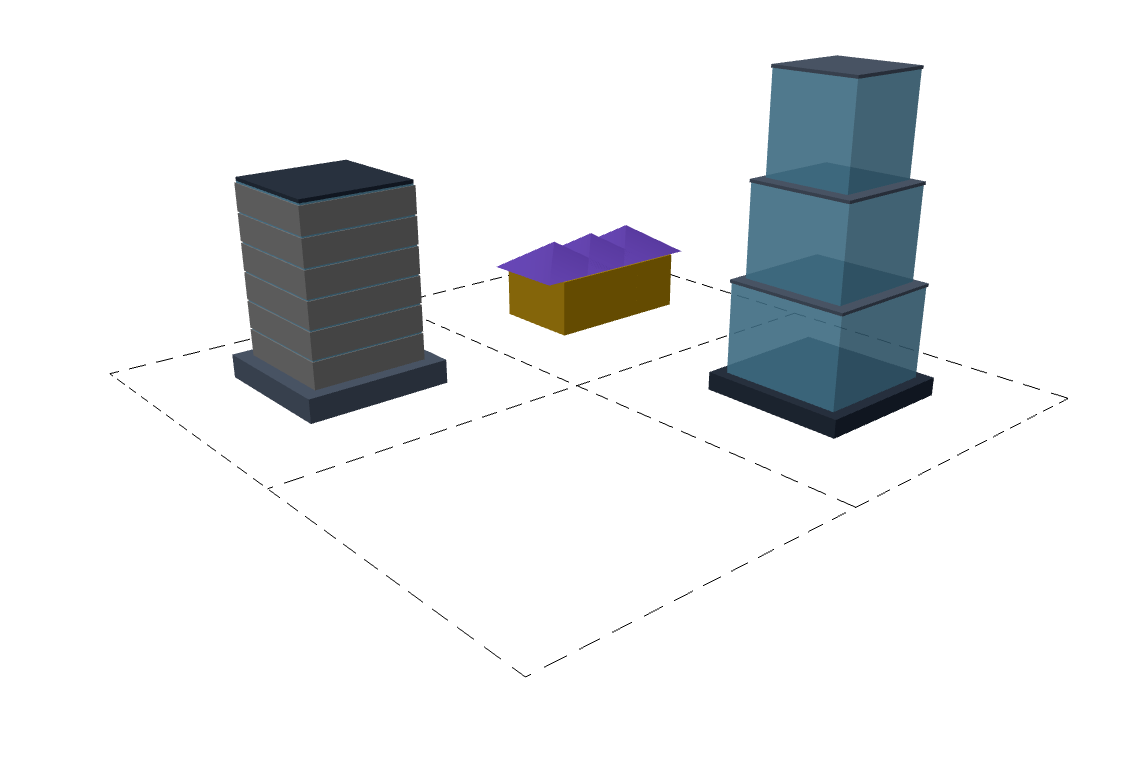
Yet, plenty of American downtowns look something like this:
This is a simplified downtown featuring a mix of multifamily apartments and offices with rowhomes around the corner. Yet, right in the middle is an empty plot of land dedicated solely for parking cars.
Our cities gain vibrancy and value from human activity and significantly more of that activity occurs on parcels where things actually happen: whether its coffee shops providing caffeine and conversation, housing providing living and leisure, or offices providing employment and enterprise.
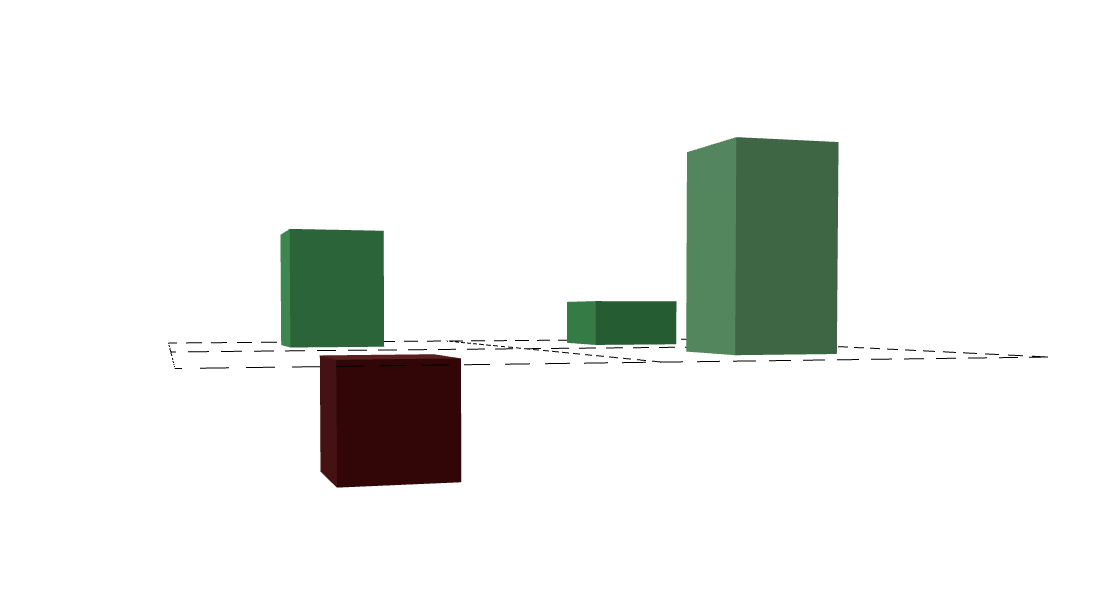
Now, look at the following image.
Instead of buildings, each parcel is represented by a vertical bar that measures its net economic contribution. That is, how much value a parcel creates for the community compared to how much value it consumes simply by existing as land. Think of it like this:
Net Contribution=(Economic Output in $)−(Land Value in $)
The office, filled with workers and transactions, generates far more in economic activity and value creation than its land value and, therefore, rises the highest. The apartment, where dozens of residents live, stands nearly as high. The rowhomes add steady, smaller value. But the parking lot does something different. It dips below the surface, shown as a red bar sinking into the ground.
Why below ground? Because in economic terms, a parking lot doesn’t simply fail to add value; it actively subtracts value. Every year it sits idle, it consumes some of the most valuable land in the city.
When valuable downtown land lies idle, it blocks the housing, jobs, and amenities that could exist there. The costs ripple outward: higher rents, longer commutes, fewer opportunities nearby. What could have been a productive part of the community instead becomes a hole in its fabric.
In other words, the parking lot isn’t a neutral space. It’s a drain. It pulls the city’s potential downward, both visually and economically.
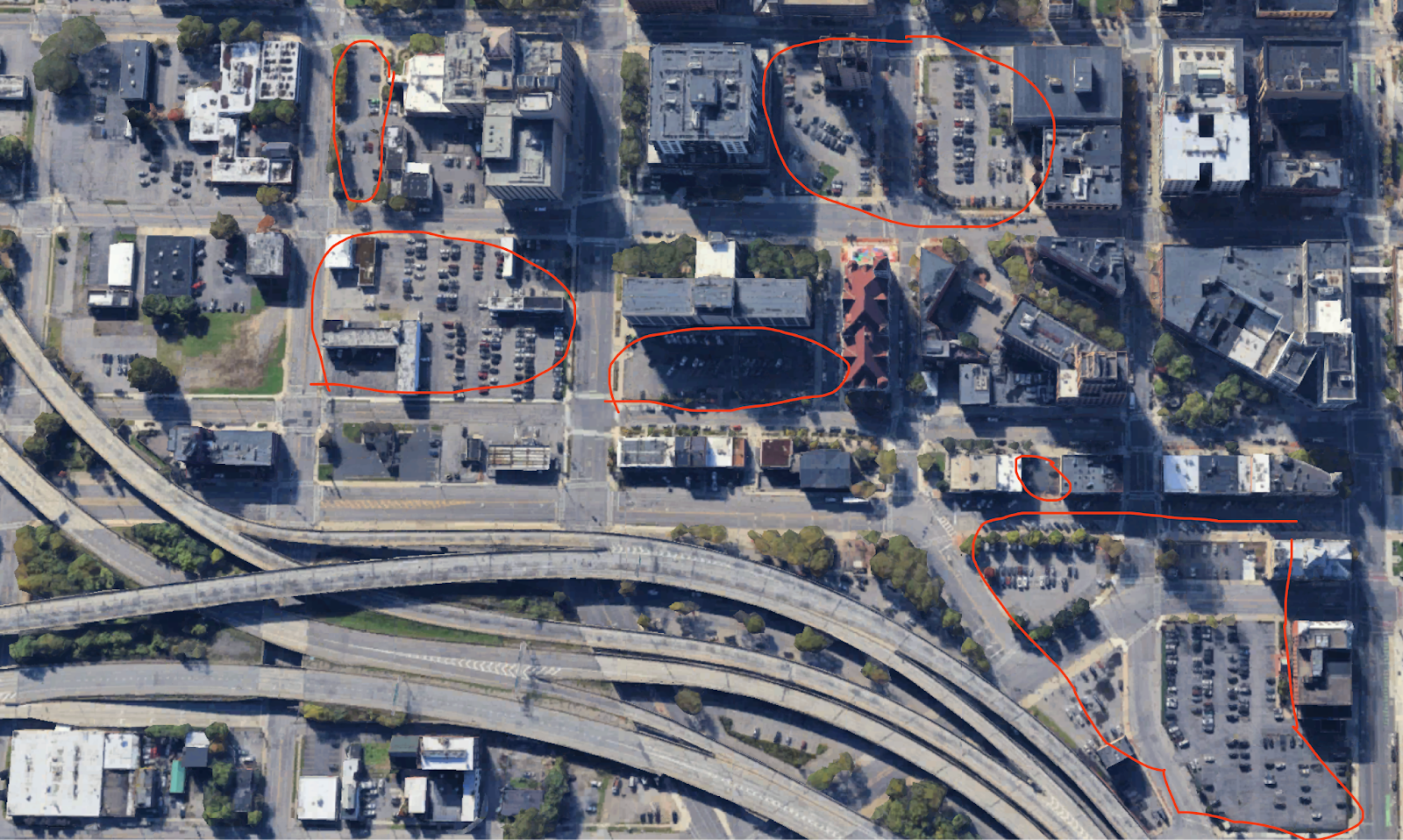
When diving through the property data in Syracuse, I found parking lots added up to $44 million in non-exempt land value–6% of the city’s total land value, and that’s only counting parcels where the sole use case was parking. There are plenty more commercial parcels with large parking lots not counted in that figure.
The most valuable land is concentrated in downtown, where the most economic activity occurs. Yet, from an aerial view in Google Earth you can see many large parking lots that should not exist in a bustling downtown area.
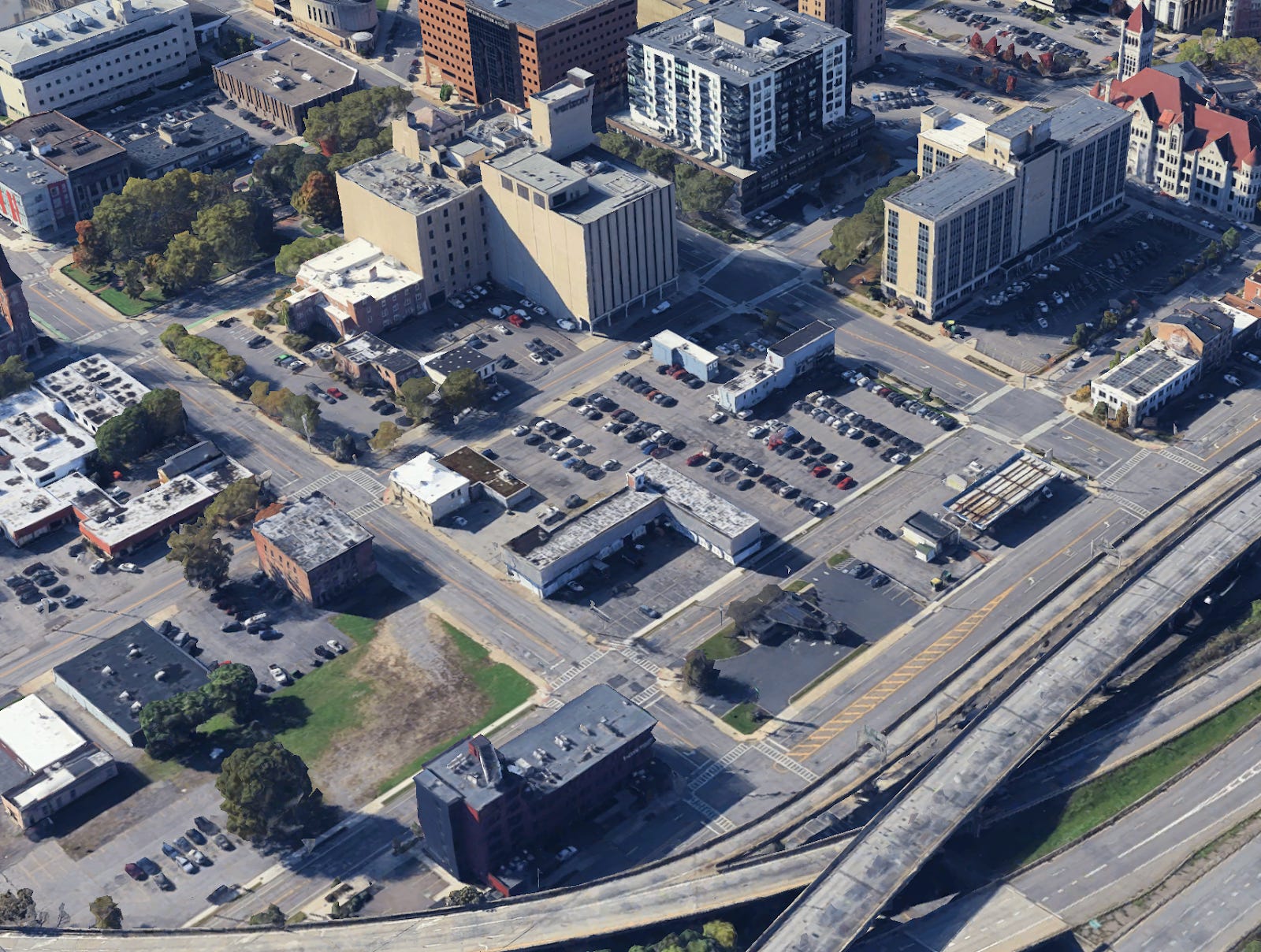
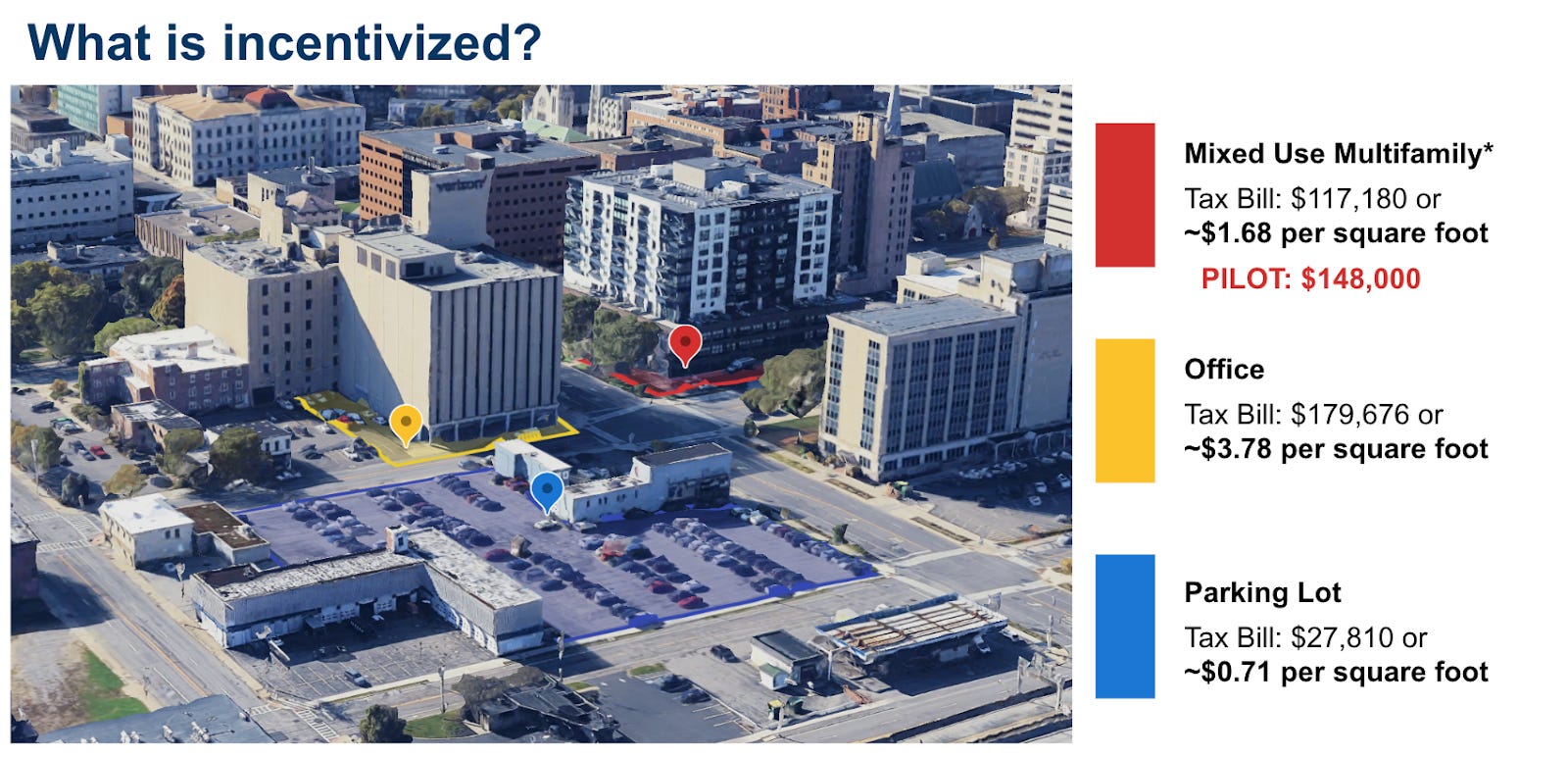
We can zoom into one of these parking lots to really show the scale. Here we see sprawling parking lots right next door to tall buildings, including mixed use apartments and office spaces
On the large central lot there are three smaller buildings. The largest of these, the L-shaped buildings in the nearest corner, no longer exists, and, I’m told, there is no plan for new development any time soon. More of this lot now sits empty, and the drain on the city gets bigger.
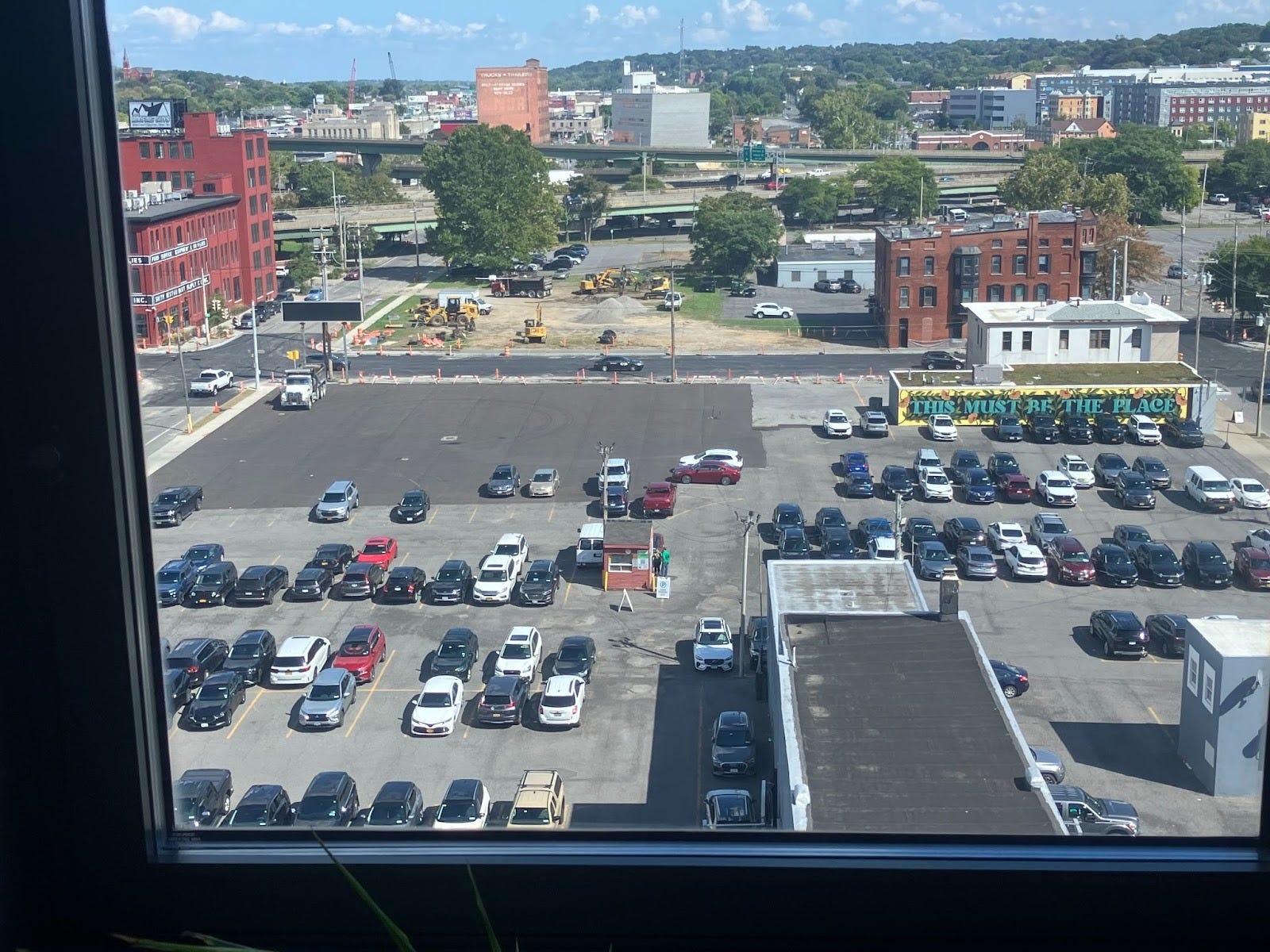
A political staffer shared the following image with me from one of the offices across the street. Looking out, we see a sea of parking,and, in the background, two high-traffic interstates intersecting. One of the low-rise buildings standing alone in that parking lot bears an ironically placed mural, proclaiming: “THIS MUST BE THE PLACE”.
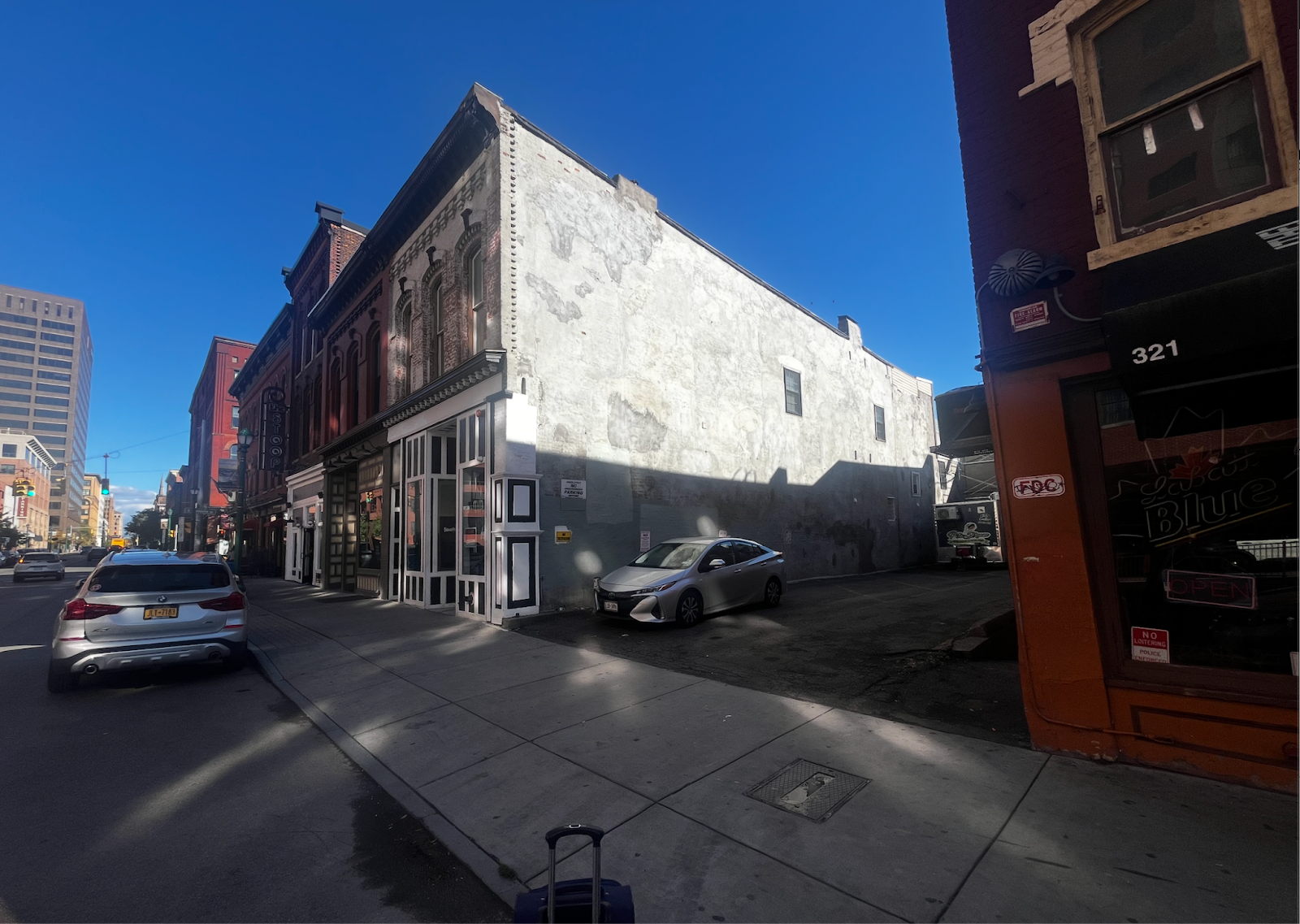
Walking around in person, I found even more subtle manifestations of parking lots. A nice corridor of stores will occasionally be broken up by a small parking lot, turning an otherwise good aesthetic strip into an eyesore..
All this said, modern American cities cannot and should not abolish parking entirely.
Some urbanists may disagree with that statement, but I don’t. After all, the car unlocks more usable land for families, removing the financial squeeze on non-landowners.
Instead, parking should be sensibly integrated into our downtown cities. Offices and apartment buildings can include parking below or within their structures, keeping activity at the street level continuous. Even standalone parking garages, while not ideal, make far more efficient use of space than surface lots. When designed well, they can even enhance the streetscape.
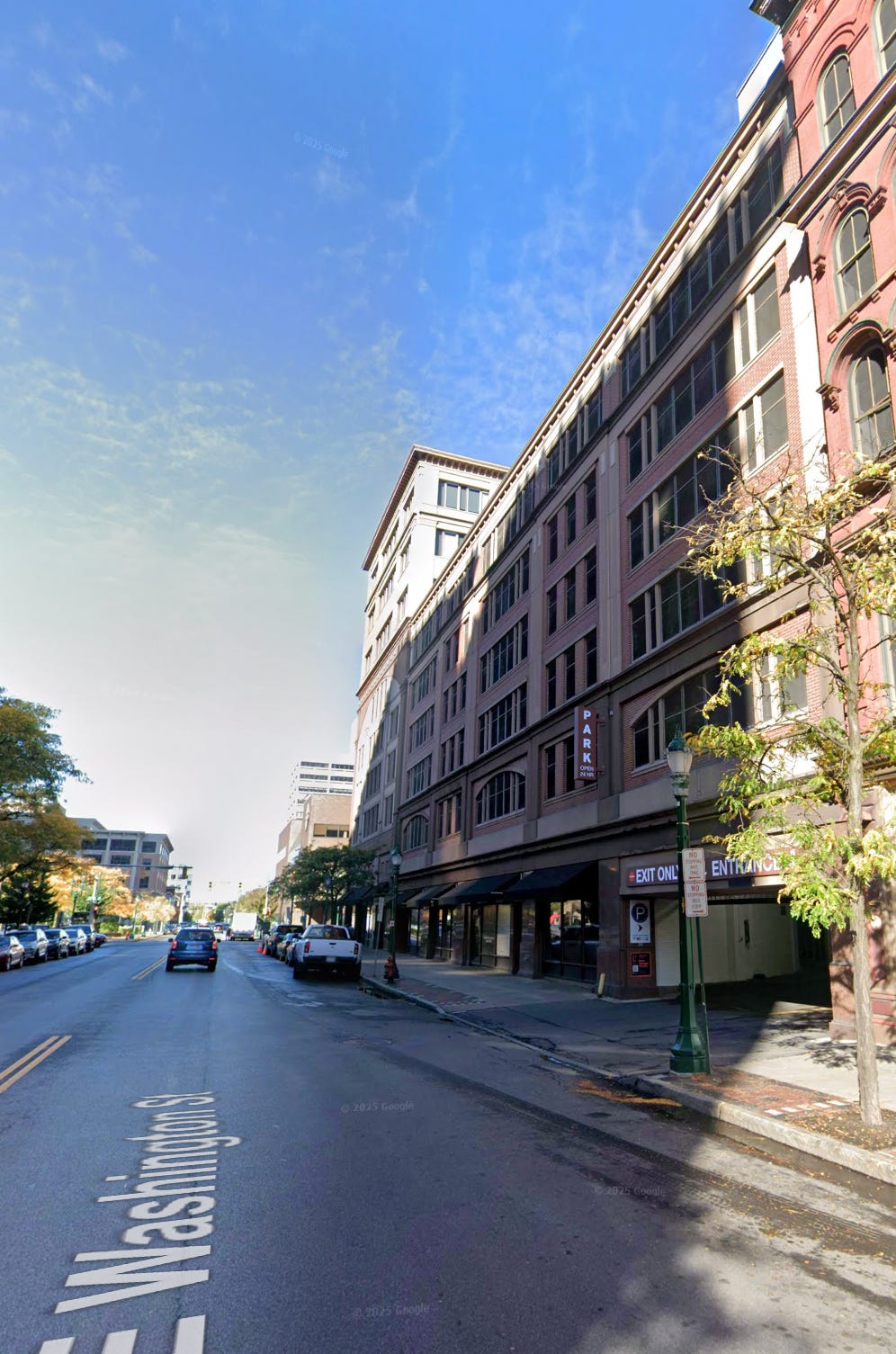
One example stood out during my visit. Walking through the city, a resident pointed out a structure and said “notice that?” To my surprise, it was a parking garage that had preserved the facade of an old building. I had not noticed it until it was pointed out.
On the right, you will notice an entrance to a parking garage. That facade was an old building with the interior gutted and re-purposed for a parking garage.
Parking reform has become a hot topic in many urban cities, led in part by the Parking Reform Network. They have focused their efforts primarily in three areas:
1. Eliminate parking requirements: Many cities historically required developers to build a certain number of parking spaces per housing unit or square foot of retail. Removing these “minimums” lets builders decide how much parking is truly needed instead of top-down planning, reducing wasted land and construction costs.
2. Establish parking maximums: In areas where land is especially valuable or where walkability and transit are strong, cities can instead set an upper limit on how much parking may be built. This prevents the over-supply of parking that undermines density and urban design.
3. Smart street parking: Curbside spaces can be priced dynamically or managed with time limits and residential permits so that parking remains available but doesn’t encourage endless circling or long-term storage of cars in prime locations.
To date, PRN has plenty of success to boast about. This handy map showcases 100+ recent parking reforms, many reflecting the policy changes outlined above. These policies are not only good, but also politically pragmatic. For instance, the mandating of minimum parking sizes seems particularly non-controversial. (Though, as with most policies, I’m sure I’d be surprised.)
However, in many of our urban cities the problem stretches beyond what these simple reforms are able to tackle. In the Syracuse examples, for instance, the parking lots are not caused by parking mandates from central planners. Instead, they are created by distorted incentives. Our question is how we can change those incentives.
A parking lot generates some revenue every year, but nothing like the revenue or profit the lot could generate were it developed. Why, then, don’t parking lot owners develop their land to its highest and best use?
The reason is because leaving the lot empty is easy–the parking lot owner generates steady revenue, and all the while the land underneath the parking lot continues to rise in value, yielding speculative gains. Meanwhile, the parking lot owner’s holding costs are small. Sure, they have to do the bare minimum to maintain a surface parking lot, and perhaps pay someone for staffing and enforcement, but otherwise their revenues are more than sufficient to cover the costs. Most importantly, their property taxes are far lower than if they developed the lot, as the property tax taxes both land and improvements.
The city must ask what incentives it creates. Zooming into the large parking lot in Syracuse, let’s look at the property taxes paid by the parking lot compared to the office and multifamily buildings, which are more productive structures for the city. The office building pays around $3.78 per square foot in taxes. The multifamily housing unit is a new development and pays around $1.68 per square foot through a payment in lieu of taxes, or PILOT, agreement (At normal tax rates it’d be paying more than the office) . Meanwhile, the parking lot pays nearly ten times less than either building at $0.71 per square foot.
Our property tax policy punishes buildings and does not inflict enough cost on underutilized land. The result is a system that rewards holding valuable sites idle while penalizing those who invest, build, and contribute to the city’s productivity.
Cities are shaped by incentives, financial incentives especially. Our property tax system results in productive uses of land paying significantly more in taxes than parking lots which drain our downtowns of potential vibrancy.
I left Syracuse frustrated with these parking lots. I was frustrated because Syracuse is a de-industrialized city that still features a nice downtown area, yet I could only think of how much nicer it could be if development took the place of sprawling parking lots.
To shift incentives of large parking lots in our urban cores, we must tackle the two financial incentives for parking lot owners: the steady annual profit for doing basically nothing, and the speculative gain from increases in the value of the land. There’s one policy that accomplishes both–shift taxes away from buildings and onto the unimproved value of land. By increasing the tax on land value, the parking lot owner’s annual costs increase and the speculative reward for holding the land out of use decreases.
Dare I say… land value tax would solve this.