
Banning lead in gas worked. The proof is in our hair

2026-02-031:52383342attheu.utah.edu

Researchers analyzed samples of Utahns' hair going back a century to document a 100-fold decrease in lead concentrations.

Prior to the establishment of the Environmental Protection Agency in 1970, Americans lived in communities awash with lead from industrial sources, paint, water supply pipes and, most significantly, tailpipe emissions. A dangerous neurotoxin that accumulates in human tissues and is linked to developmental deficits in children, environmental lead levels have come way down in the years since, and so have human exposures.

The proof is in your hair.

An analysis of hair samples conducted by University of Utah scientists shows precipitous reductions in lead levels since 1916.

“We were able to show through our hair samples what the lead concentrations are before and after the establishment of regulations by the EPA,” said demographer Ken Smith, a distinguished professor emeritus of family and consumer studies. “We have hair samples spanning about 100 years. And back when the regulations were absent, the lead levels were about 100 times higher than they are after the regulations.”

A useful element with a dark side

The findings, which appear in PNAS, underscore the vital role of environmental regulations in protecting public health. The study notes lead rules are now being weakened by the Trump administration in a wide-ranging move to ease environmental protections.

“We should not forget the lessons of history. And the lesson is those regulations have been very important,” said co-author Thure Cerling, a distinguished professor of both geology and biology. “Sometimes they seem onerous and mean that industry can’t do exactly what they’d like to do when they want to do it or as quickly as they want to do it. But it’s had really, really positive effects.”

Lead is the heaviest of heavy metals that, like mercury and arsenic, accumulate in living tissue and are toxic at even low levels. Yet lead holds very useful properties, great for fashioning into pipes and as a chemical additive. Lead was added to paint to improve durability, speed up drying, and produce vibrant colors with greater coverage. Lead also improved the performance of automobile engines by preventing pistons from “knocking.”

By the 1970s, its toxicity became well established, and EPA regulations began phasing it out of paint, pipes, gasoline and other consumer products.

How Utahns’ affection for family history advances science

To document whether these steps were helping reduce lead exposure in people, Smith joined with geologist Diego Fernandez and Cerling, who had developed techniques to discern where animals have lived and what they eat based on chemical analysis of hair and teeth.

The lead research is built on a previous study funded by the university’s Center on Aging and the National Institutes of Health that had recruited Utahns who consented to provide blood samples and family health histories.
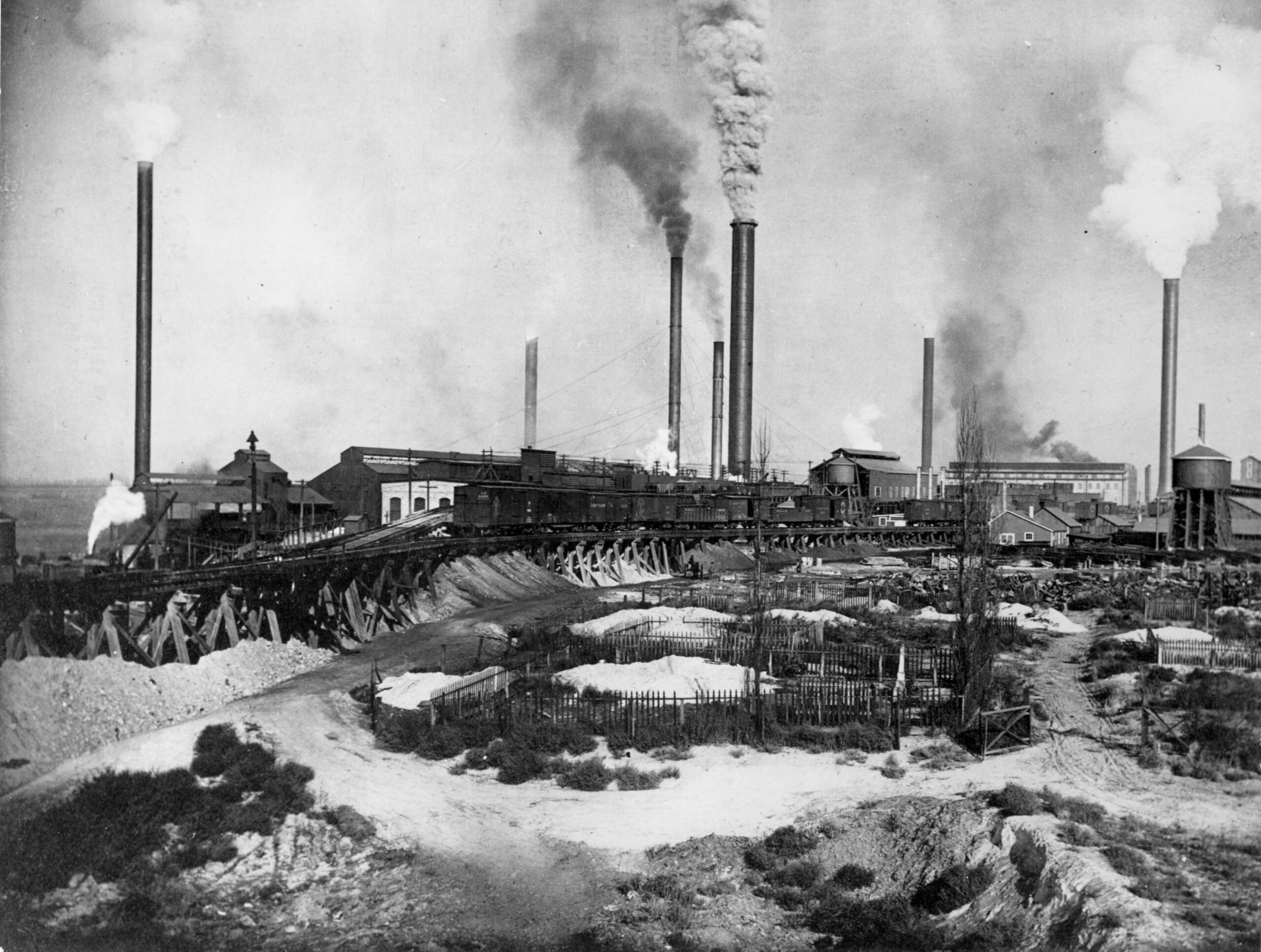
The U.S. Mining and Smelting Co. plant in Midvale, Utah, 1906. Photo used by permission, Utah Historical Society.

For the new study, the researchers asked members of that cohort to provide hair samples, both contemporary and from when they were young. These people obliged, and some were able to find ancestors’ hair preserved in family scrapbooks dating as far back as a century. In all, the team acquired hair samples from 48 individuals in this manner, offering a robust window into lead levels along Utah’s populous Wasatch Front, which historically experienced heavy lead emissions from industrial sources.

“The Utah part of this is so interesting because of the way people keep track of their family history. I don’t know that you could do this in New York or Florida,” said Smith, who directed the U’s Pedigree and Population Program at the Huntsman Cancer Center while these studies were conducted.

This region supported a vibrant smelting industry through most of the 20th century, centered in the cities of Midvale and Murray. Most of Utah’s smelters were shuttered by the 1970s, around the same time the EPA clamped down on the use of lead in consumer products.

The research team ran the hair samples through mass spectrometry equipment at the facility directed by Fernandez.

“The surface of the hair is special. We can tell that some elements get concentrated and accumulated on the surface. Lead is one of those. That makes it easier because lead is not lost over time,” said Fernandez, a research professor in the Department of Geology & Geophysics. “Because mass spectrometry is very sensitive, we can do it with one hair strand, though we cannot tell where the lead is in the hair. It’s probably on the surface mostly, but it could also be coming from the blood if that hair was synthesized when there was high lead in the blood.”

Blood would provide a better exposure assessment, but hair is far easier to collect and preserve, and more importantly, it offers clues to long-ago exposures for a person who has grown up or even deceased.

“It doesn’t really record that internal blood concentration that your brain is seeing, but it tells you about that overall environmental exposure,” Cerling said. “One of the things that we found is that hair records that original value, but then the longer the hair has been exposed to the environment, the higher the lead concentrations are.”

The team’s findings regarding lead in hair run parallel to the reductions of lead in gasoline following the EPA’s establishment by President Richard Nixon.

Prior to 1970, for example, gasolines contained about 2 grams of lead per gallon. That might not sound like much, but considering the billions of gallons of fuel American automobiles burn each year, it adds up to nearly 2 pounds of lead released into the environment per person a year.

‘It’s an enormous amount of lead that’s being put into the environment and quite locally,” Cerling said. “It’s just coming out of the tailpipe, goes up in the air and then it comes down. It’s in the air for a number of days, especially during the inversions that we have and it absorbs into your hair, you breathe it and it goes into your lungs.”

But after the 1970s, even as gasoline consumption escalated in the United States, the concentrations of lead in the hair samples plummeted, from as high as 100 parts per million (ppm) to 10 ppm by 1990. In 2024, the level was less than 1 ppm.

The study, titled “Lead in archived hair documents decline in human lead (Pb) exposure since establishment of the US Environmental Protection Agency,” was published Feb. 2 in PNAS, or Proceedings of the National Academy of Sciences. Support came from the Huntsman Cancer Foundation and the National Cancer Institute through a grant to the Utah Population Database and the University of Utah.


Read the original article

Comments

  • By cfiggers 2026-02-0314:3123 reply

    In my opinion it is obvious and should be uncontroversial that some environmental regulations work and are great and should if anything be reinforced, while other environmental regulations do more harm than good and need to be reigned in or eliminated.

    Turning "environmental regulation" into a unified bloc that must be either supported or opposed in totality is a manipulative political maneuver and it should be forcefully rejected.

    Regulations are not people, and they don't have rights. It is fair and reasonable to demand that environmental regulation justify its existence with hard, scientifically verifiable data or else get chopped. Clearly, banning leaded gasoline has that kind of justification, and therefore I'm strongly in favor of maintaining that ban and extending it wherever it isn't in place yet. The same reasonable standard should be applied to other regulations across the board.

    • By breakyerself 2026-02-0315:4812 reply

      Almost every environmental regulation has come after it was already shown that there was some harm that needed to be mitigated.

      The worst environmental crisis in human history is going largely unchecked. I find it hard to take seriously any argument that environmental regulation has gone too far as opposed to not nearly far enough.

      If there's a specific regulation that can be shown to be doing more harm than good I'm cool with revisiting anything, but the common sense wisdom around environmental regulation has been corrupted by corporate public relations campaigns.

      • By an_account 2026-02-0316:156 reply

        CEQA in California is very often used to block apartments in existing urban areas.

        So, instead, California continues to mostly build single family housing sprawl into natural habitats.

        A clear example of environmental regulation hurting the environment and the climate. And of course the affordability of housing.

        • By HowardStark 2026-02-0317:391 reply

          CEQA itself is a mixed bag. I want to be clear that there are very important things the CEQA does to improve our environmental conditions[0]! The very real issue of CEQA being “weaponized”[1] stems from how environmental complaints have to be re-litigated in their entirety every time one is filed. Say there’s a coalition of neighbors who do not want something built. They can each file a lawsuit alleging environmental issues and each will have to be handled in isolation

          *I am not going into immense detail here. It is admittedly a bit more complex than this, but this is a reasonable summary

          [0] https://youtu.be/TKN7Cl6finE?si=CR4SjVK5_ojk-OKq [1] https://www.planningreport.com/2015/12/21/new-ceqa-study-rev...

          • By JumpCrisscross 2026-02-0323:52

            > there are very important things the CEQA does to improve our environmental conditions

            Which fits with OP’s assertion that it does “more harm than good.” (Fortunately, restricting the private right of action would curtail a lot of the harm. On the national level I’m pretty much at the point of wanting NEPA repealed.)

        • By lo_zamoyski 2026-02-0318:181 reply

          Government should be active and in charge of urban planning. It is a matter of the common good.

          One of the biggest problems today is that urban planning has basically evaporated. Local and state governments don't plan towns anymore. Things are left to developers who have no other concern than to run a street off a major road and plop a few houses down, sell, and move on to the next project. No thought is given to traffic or public services or walkability or public transportation. No care is given to integration with existing urban structures. Instead of mixed-use zoning or building houses around a common public space, which are historically the more common and sensible form of urban planning, we end up with car-dependent suburban dead zones, suburban sprawl.

          This should be receiving more attention from environmentalists, as urban planning is intimately related to environmental issues.

          • By wk_end 2026-02-0320:571 reply

            I don't know where you live, and this is going to be very dependent on where you live, but in most places that are experiencing these issues I think you actually have the problem backwards. For any given parcel of land, building upwards would be the more profitable move. Local governments deliberately legislate planning that prioritizes single-family homes, cars, and sprawl; developers are then forced to operate within these constraints. They'd rather be building density!

            • By lo_zamoyski 2026-02-0518:31

              That's not urban planning. That's local gov't creating incentives through legislation and regulation. Urban planning means actually planning roads and distribution of utilities and schools and medical services and shopping areas and town squares and parks and so on. The town takes charge of its own future. Developers must then fit within this scheme. Instead, today we leave it up to developers to design roads and build wherever they want. It's a disaster.

              And in many cases, single family homes are perfectly fine. You don't build skyscrapers in the Catskills. So they're not the issue. The issue is how they're arranged. Look at how old towns, even in the US, were or are constituted (at least those that have remained unscathed by Robert Moses-style mutilation). Plenty of single family homes arranged around a discernible town center. Walkable. The density consists of building around a town center instead of building willy-nilly along a road, because some strip of farmland has come up for sale. (This has the incidental defect of building on fertile land, now lost permanently to residential space.)

        • By petsfed 2026-02-0318:11

          I don't know if its still true, but I recall reading once that CEQA had never been used to actually prevent or even slow the building of a dam or a mine or something. It had only ever been used to hobble otherwise neutral development. Its a good idea in theory, but I feel like the plaintiff ought to be able to articulate what environmental impact they are concerned about and maybe require a study from them in support of that claim too.

        • By cyrialize 2026-02-0317:33

          Thank you for mentioning this, it was the first thing I thought of in this conversation thread!

        • By busterarm 2026-02-0316:25

          And all of the harsh chemicals that get released when that new construction burns up in wildfires...

        • By breakyerself 2026-02-0316:402 reply

          Yeah I'm not in favor of sprawl. It sounds like it needs to be amended, but do you want to go back to polluted air and water just because a small minority of regulations need to be repealed or amended? Wouldn't it make more sense to just revisit whatever regulations are having unintended consequences?

          • By derektank 2026-02-0316:421 reply

            >do you want to go back to polluted air and water just because a small minority of regulations need to be repealed or amended?

            >Turning "environmental regulation" into a unified bloc that must be either supported or opposed in totality is a manipulative political maneuver and it should be forcefully rejected.

            • By breakyerself 2026-02-0317:031 reply

              When I say they're mostly good, but we should fix what's broken and people start hitting me with examples of broken regulation I can only interpret that as an example for why environmental regulation should be opposed by default. So I respond accordingly.

              I've never said all environmental regulation is good. That would be stupid, but you should have evidence based reasons for wanting to repeal or modify a regulation.

              Existing regulation was put in place for a reason and those reasons likely still matter. Even if the regulation is falling short of having unintended consequences.

              • By spongebobstoes 2026-02-0320:34

                current environmental regulations act to slow progress on solar power installation

                we should either delete the regulations, or add exemptions for the infrastructure we need to build to avoid climate disaster

                this is a time sensitive issue for our environment. every day spent debating regulatory nuance is a day wasted

                at this point I prefer drastic decisive action over continued inaction: delete the regulations and re-introduce them

          • By mapt 2026-02-0318:01

            All of the regulations that are used to "limit sprawl" in the US functionally prohibit the construction of new dense city blocks even moreso, and this in turn forces suburban sprawl to occur.

      • By colechristensen 2026-02-0320:242 reply

        >Almost every environmental regulation has come after it was already shown that there was some harm that needed to be mitigated.

        Ok, strong example here: the long term efforts to stop forest fires caused build up of fuel that should have burned up in small fires which then instead burned up ecosystems which evolved for small forest fires and instead were destroyed in large ones.

        That's a well intentioned environmental policy that had terrible effects.

        Fuel efficiency programs with the goal of reducing emissions with exceptions for work vehicles killed small trucks and meant a ton of people who do approximately 0 work drive around enormous vehicles that were designed big to match the exception criteria.

        That's another one.

        Ethanol to replace gasoline is also an enormous negative consequence waste that started as an environmental program.

        Things don't just work because you want them to and programs aren't automatically right because of what they intend to do.

        Far too many people argue for things they don't understand at all because of the surface intention of them and treat discussion about them blasphemy. (I chose uncontroversial negative examples because I don't want to get sidetracked into arguments about my examples with zealots)

        • By breakyerself 2026-02-0421:10

          Is forest fire mitigation about protecting the environment or protecting property of people who live in wooded areas?

        • By tastyfreeze 2026-02-073:27

          Ethanol production was subsidized to consume excess corn that was only produced because it is susidized. I don't know if ethanol fuel requirements started before or after the ethanol subsidies but it all happened around the same time.

      • By nokcha 2026-02-0316:172 reply

        I'd argue that environmental regulations that impede building modern nuclear power plants to replace coal power plants are net harmful. Nuclear power safety has advanced a lot since Chernobyl.

        • By breakyerself 2026-02-0316:273 reply

          Chernobyl design was never in use in the US, but nuclear went through a long period of near universal public opposition to its expansion because of the high profile disasters that it caused.

          Now the cost of solar and storage are dropping at a rate I doubt nuclear is ever going to make a significant comeback. I'm not opposed to it, but I wonder if the economics will ever be favorable even with regulatory reform.

          • By ch4s3 2026-02-0316:371 reply

            > Chernobyl design was never in use in the US

            Commercially. Several early test reactors were essentially just graphite moderated piles not unlike Chernobyl, but they were abandoned for a reason.

            • By mikkupikku 2026-02-0317:322 reply

              Graphite moderated reactors are broadly fine, the problem was with some technical specifics of that specific reactor design, and the operational culture that surrounded it. After Chernobyl, those flaws were corrected and operation of other RBMK reactors has continued to this very day, with no repeats.

              • By ch4s3 2026-02-0317:59

                That's good additional clarification, I only meant to point out that graphite moderated, water cooled reactors had existed in the US and UK.

              • By cyberax 2026-02-074:08

                Graphite reactors are not a good idea because they inherently have, well, graphite. That can burn.

                The worst possible case for water-moderated reactors is uncontained meltdown. And it's not _terribly_ horrible. You will get contamination with volatiles, mainly cesium. But there's not a lot of it in the reactor, so it'll affect only a small area around the plant. Some fuel might get initially mobilized by steam explosions, but again, only a fraction.

                The worst case for a graphite reactor is an uncontained core fire. That can burn for weeks and spread a significant part of the fuel as particulates over large territories (Chernobyl).

                Is it likely? Nope. But there are black swan events: earthquakes, mega-hurricanes, meteorite strikes, Godzilla attacks.

          • By WorldMaker 2026-02-0317:322 reply

            Chernobyl may have done a lot to inflame cultural imagination of what could happen in the worst cases, but the US still had its own high profile disasters like Three Mile Island.

            https://en.wikipedia.org/wiki/Three_Mile_Island_accident

            • By patmorgan23 2026-02-0318:46

              I would hesitate to call Three Mile Island a disaster, it was certainly a nuclear accident. A reactor was damaged, but no one was injured and an absolutely miniscule amount of radiation was released. The other units at the plant continued to operate until quite recently (and might actually be starting up again).

            • By LorenPechtel 2026-02-0518:532 reply

              A "disaster" that killed nobody.

              Likewise, an even bigger "disaster" at Fukushima--that killed nobody. (The deaths from the evacuation are not deaths from the incident--they wouldn't have died if they had stayed put.)

              • By wolvoleo 2026-02-071:242 reply

                Human deaths aren't the only measure of a disaster. The pollution was huge and even detected on the other side of the Pacific.

                • By LorenPechtel 2026-02-081:42

                  The pollution from Fukushima was very minor, blown all out of proportion by the reporting. It could be detected on the other side of the Pacific because the background levels are so low. But we can detect it far, far below the point of meaningful risk.

                  I don't know the numbers for Fukushima, but let's consider Three Mile Island. Same basic problem--some radioactive noble gas needed to be released to avoid trouble (and they actually released it rather than panic.) You are standing at the fence line, what do you do? Let's say you evacuate....hey, there's a street here. Cross it? Nope--it was more dangerous to walk across one ordinary street than to stay put.

                • By anonymars 2026-02-074:131 reply

                  Now let's do coal and oil/gas

                  • By wolvoleo 2026-02-074:253 reply

                    No let's do renewables.

                    Nobody's arguing for more fossil. But nuclear isn't an option either.

                    • By anonymars 2026-02-074:51

                      Are they so different?

                      There may be good reasons not to pursue nuclear (high complexity and upfront cost), but by the overall numbers I don't think pollution or death rate make that case

                    • By LorenPechtel 2026-02-081:44

                      Yes, they are. They just don't know it.

                      Reality: arguing for renewables over nuclear actually ends up making more fossil fuel use as the renewables are not viable.

                    • By danaris 2026-02-078:061 reply

                      I guarantee you that "let's do" was "let's look at the pollution, including radioactive pollution, from".

                      Because coal mining releases more radiation into the world than nuclear power.

                      ...But yes; with the efficiency and price of solar, wind, and batteries now, nuclear makes much less sense.

                      • By LorenPechtel 2026-02-081:361 reply

                        Didn't realize coal also did it in mining. It's evil stuff!

                        But the price of batteries is far, far too high for renewables to make sense.

                        • By danaris 2026-02-0816:59

                          It was, several years ago.

                          That's so much not the case now that renewables + batteries were by far the largest source of new generation in the US (yes, the US, with Trump actively trying to destroy them) last year.

                          Look up some of the new information coming out about them recently. Here, I'll give you a relevant video I watched recently to start with: https://www.youtube.com/watch?v=KtQ9nt2ZeGM (channel is Technology Connections)

              • By anonymars 2026-02-074:17

                Indeed. Banqiao Dam would like a word

                And yet we still build hydroelectric dams

          • By mattmaroon 2026-02-0316:384 reply

            It would. People are still building some natural gas plants even despite renewables being cheaper and nuclear is far cheaper over its lifecycle than that and, other than regulatory issues, is basically better in every way.

            • By prpl 2026-02-0316:57

              There will continue to be new gas plants as long as there are coal plants which will be converted, usually around the time a major overhaul would need to be taken anyway.

            • By 9rx 2026-02-0316:531 reply

              > nuclear is far cheaper over its lifecycle than that

              That is the case for base load generation, where the plant can operate near 100% capacity all the time. But that isn't were gas is usually being deployed; it being used for reserve generation. The economics of nuclear isn't as favourable in that application as it costs more or less the same to run at partial generation, or even no generation, as it does when it is going full blast.

              • By mattmaroon 2026-02-0417:021 reply

                Right, but in the context of data centers, it’s all about baseload anyway, right? If data centers become a big driver of energy use, there will be a lot lower fluctuation between peak and trough demand.

                I can imagine a future in which every data center has a little baby nuclear plant built right next to it. Watts per acre may become a significant measurement of density. Solar’s environmental impact is of course dramatically overstated by its opponents, but it won’t be when we scale it up and have to start slashing forests for it.

                • By 9rx 2026-02-0417:501 reply

                  If it were simply an option between nuclear or gas for that, nuclear would, generally, be the obvious choice. But it would be quite atypical to build a gas plant to provide base power. Typically they are being built to back up renewables.

                  Fair point that renewables may have a practical expansion limit, but for the time being are, by far, the cheapest option so a data centre is still going to prefer that source of power to the greatest extent possible, thereby leaving gas/nuclear only as reserve — of which nuclear has not proven to be cost effective at. Geothermal, hydro, etc. are hard to beat, but where you aren't sitting on the perfect environment, generally speaking, wind+solar+gas is about as good as it gets on a cost basis.

                  • By mattmaroon 2026-02-0422:06

                    Yeah, and I'm all for all of it. I just can see a future in which nuclear (through some combination of regulatory reform and new technology) ends up becoming cost-feasible and fossil fuels fade away.

            • By jerlam 2026-02-0317:391 reply

              Nuclear might be better and cheaper over it's entire lifecycle; but given that the starting costs are so high, the time to build is so long, and the US has serious problems with cost overruns in public projects, as well as the fickleness of both government and public opinion, I don't expect another plant to be built.

              • By mattmaroon 2026-02-0415:00

                Well we were speaking of costs in a hypothetical future in which regulations are sane. I don’t expect that to happen either but if it did, the economics would work.

            • By LorenPechtel 2026-02-0519:04

              Renewables are only "cheaper" because the market forces major subsidies. The reality is the value of renewables is the fuel they save. They do not replace the generators or any of the other stuff.

        • By epistasis 2026-02-0317:483 reply

          The closest I've gotten to somebody finding environmental regulations that were driving up the cost of nuclear was with some of the latest stuff with people trying to get rid of the LNT model of how radiation affects people.

          Getting rid of LNT would allow higher doses to workers, and the way it makes nuclear cheaper is by having less shielding around the reactor.

          But if you look at how recent reactors like the AP1000 failed, it's not so much because of the mere quantity of concrete. In fact, one of the big advantages of the AP1000 is that it used a fraction of the concrete and steel of prior designs. The real problem at Vogtle were construction logistics, matching up design to constructible plans, and doing that all in an efficient manner.

          The construction process didn't run over budget and over timeline because of environmental regulations, that happened because we don't know how to build big things anymore, in combination with leadership asking for regulatory favors like starting construction before everything has been fully designed, which gave them more rope to hang themselves with.

          I don't know the specifics of why France forgot how to build, at Flamanville and Olkiluoto, but I imagine it's a similar tale as in the US. High labor costs, poor logistics, projects dragged out, and having to pay interest on the loan for years and years extra with every delay.

          If there's somebody with more specifics on how unnecessary regulation is killing nuclear, I'd love to see it. But after watching attentively and with great interest since ~2005, I've become so disillusioned with nuclear that I doubt we'll ever see it have success in the West again. Factories and manufacturing have seen productivity go through the roof over the past 50 years, while construction productivity is stagnant. Playing to our strengths, and using our very limited construction capacity on building factories rather than building generators, seems far wiser on the macroeconomic scale.

          • By slavik81 2026-02-0322:321 reply

            The £700M (960M USD) spent on fish protection measures at Hinkley Point C would be a topical example [1]. It's expected to save an average of a few hundred twaite shad, six river lamprey, and eighteen allis shad per year, plus one salmon every twelve years, and a trout every thirty-six years.

            https://www.salmonbusiness.com/nuclear-plants-new-700-millio...

            • By triceratops 2026-02-0322:591 reply

              The article you linked says "According to a government-commissioned review, Hinkley Point C’s suite of “fish protection measures” will cost more than £700 million".

              I spent 10 minutes and have not been able to find said "government-commissioned review". Is this even true?

              • By epistasis 2026-02-041:071 reply

                Edit: here's Guardian reporting on the report cited by Salmon Business https://www.theguardian.com/business/2025/dec/12/health-and-... . As somebody who has spent nearly all of my political activity in the past 8 years trying to change local regulations to allow more housing, the whole thing reeks of unfair analysis on all sides and hyper-partisanship. I largely think there should be a more rational evaluation of requirements all around, but it does sound like the 44 tons of killed fish per year is pretty small compared to other human impact, but $700M is not going to save Hinkley Point C.

                The stilted phrasing in the report from Salmon Business definitely does not sound very credible, but marine life protection is definitely a real thing with nuclear and all fuel-burning electricity generation

                The vast quantities of water needed to cool nuclear (for every kWh of electricity, 2 kWh of waste heat must be discarded) can have significant impacts on wildlife. In the past, we just devastated ecosystems but most modern countries decided they didn't want to do that anymore.

                This is not a nuclear regulation, it's a "thermal plant" regulation, it's just that nuclear needs more cooling than, say, combined-cycle gas because nuclear's lower temperatures are less efficient at converting heat to electricity.

                At a mere $700M, even dropping all marine life mitigations from Hinkley Point C wouldn't help much with affordability. If they could drop $7B of costs from Hinkley then it may start to have a halfway-competitive price, but it still wouldn't be very attractive.

          • By LorenPechtel 2026-02-0519:12

            Shielding isn't going to be a major portion of the cost. Exposure is from stuff that leaks, not stuff that comes through the walls.

            And the cost overruns are to a large degree due to regulations--specifically, changing regulations. The environmentalists have destroyed nuclear by forcing delays and changes, that is the *majority* of the cost. Especially the delays.

          • By baud147258 2026-02-0413:54

            For France, I'd argue (just like in the US) that the break in construction of new reactors gutted the industry and institutional knowledge around the construction of reactor

      • By davidw 2026-02-0316:022 reply

        There's certainly some "environmentalism" out there that's using the banner of the environment for other ends.

        Here's one example: https://www.latimes.com/opinion/story/2023-03-02/california-...

        I mostly agree with you, but it is worth paying attention to the details.

        • By bevr1337 2026-02-0316:251 reply

          This article doesn't speak to me. What I read is, "Won't someone think of the poor UC system?" But the UC system is _massive_

          > But Casa Joaquin’s neighboring, overwhelmingly white homeowners could have used CEQA to demand costly studies and multiple hearings before Berkeley officials.

          Important to note that white people are well-represented at UC Berkley too. https://opa.berkeley.edu/campus-data/uc-berkeley-quick-facts

          > More recently, a series of court rulings that culminated last year nearly forced Berkeley to withhold admission of thousands of high school seniors...

          Graduating high-school seniors are also known as incoming freshman or legal adults.

          > ... because the state’s judges agreed with NIMBY neighborhood groups that population growth is an inherent environmental impact under CEQA.

          Ok, let's see how big the UC school system is...

          > The University maintains approximately 6,000 buildings enclosing 137 million gross square feet on approximately 30,000 acres across its ten campuses, five medical centers, nine agricultural research and extension centers, and the Lawrence Berkeley National Laboratory.

          https://accountability.universityofcalifornia.edu/2017/chapt...

          I'm not seeing evidence that protestors were primarily NIMBYs and pesky white homeowners. I can find several articles citing _student_ protests.

          > “It’s students who set up People’s Park in the first place, so it’s our place to defend it,” said Athena Davis, a first-year student at UC Berkeley who spoke at the rally. “It’s up to students to reject the idea that our housing needs to come at the price of destroying green space and homes for the marginalized.”

          https://www.berkeleyside.org/2021/01/30/protesters-tear-down...

          • By davidw 2026-02-0316:462 reply

            They're talking about using environmental rules to block homes for people to live in, inside cities.

            Using land efficiently in walkable places is one of the most environmentally friendly things we can be doing, and supposed "environmentalists" sought to block it using "environmental" rules!

            If that's not NIMBYism to you, you have blinders on.

            • By bevr1337 2026-02-0317:241 reply

              I didn't say there was NO NIMBYs, but that this article suggests NIMBYs were the primary protestors. That doesn't seem truthful. Additionally, the UC system does have a large impact on the environment.

              I'm sure there are better examples to illustrate your point

              > homes for people to live in

              Student housing. Which likely means partially-furnished studios with shared bathrooms and a kitchenette at best. This isn't the useful housing folks are asking for.

              • By davidw 2026-02-0317:45

                It's pretty useful to the students!

                That kind of "wait, no, not THAT kind of housing, not HERE" is textbook NIMBYism.

                There may have been some student protestors, but the money behind the legal challenges were all wealthy local NIMBYs.

            • By breakyerself 2026-02-0317:331 reply

              I would just say that NIMBYS that weaponize environmental regulation for purposes it wasn't written for aren't environmentalists.

              • By bevr1337 2026-02-0317:381 reply

                That's a great hypothetical, but it's not supported by the article. There are claims that NIMBYs are doing this or that, but follow the links to the supplementary articles and it's baseless. I only find evidence that students and homeless protested. Those aren't NIMBY homeowners.

                To me, it seems UC wants to bulldoze a park famous for homeless camps and replace it with student housing. Pro-development is trying to cast the UC expansion in the same light as folks asking for affordable housing. But, UC is not providing useful housing for residents of Berkley.

      • By BurningFrog 2026-02-0317:531 reply

        CEQA is pretty universally considered a disaster.

        The alternative is not to have no environmental regulation. California could copy the regulations of any of the 49 other states and be much better off.

        • By pixl97 2026-02-0319:161 reply

          >California could copy the regulations of any of the 49 other states and be much better off.

          Says whom?

          California has a huge population. California has a massive water shortage problem. California has wide areas vulnerable to wildfires. California has piles of small ecosystems that are fragile and can be easily wiped out.

          Saying California could copy some states like Iowas regulations makes negative sense.

          • By BurningFrog 2026-02-0320:30

            The major problems with CEQA are:

            - the extreme cost and time spent on mandatory Environmental Impact Reports

            - it allows pretty much anyone to sue projects over just about anything, which can also add many years before projects can start

            None of this has anything to do with California specific environmental concerns

      • By stinkbeetle 2026-02-070:552 reply

        The unscientific regulation, and in some countries bans or practical stoppages and embargoes on approvals and research, of nuclear power under the guise of saving the environment has been probably the most environmentally destructive initiative ever to come about, and the largest self-imposed contributor to "the worst environmental crisis in human history". The coal industry loves it though.

        Needless to say, I disagree with your assessment. Every [action by governments and bureaucrats] is motivated by the desire for personal gain or to perpetuate the power of the state or both.

        Environmental regulation, workers rights, drilling for oil in Alaska, making up stories about WMDs to invade Iraq, domestic spying are all fruit of the same tree. Don't let them fool you, the good of these things is never the primary goal, and in many cases does not even exist. And "environmental regulation" is a big culprit.

        • By deaux 2026-02-136:58

          > The unscientific regulation, and in some countries bans or practical stoppages and embargoes on approvals and research, of nuclear power under the guise of saving the environment has been probably the most environmentally destructive initiative ever to come about

          Six days old, but of course this isn't true. The initiative to block the ascend of electric cars early 20th century to favor fossil interests has been incomparably more destructive.

        • By hammock 2026-02-071:011 reply

          > Almost every environmental regulation has come after it was already shown that there was some harm that needed to be mitigated.

          >> The unscientific regulation, and in some countries bans or practical stoppages and embargoes on approvals and research, of nuclear power

          Parent comment language isn’t entirely clear, but depending how you interpret it, it can be said that far more harm has been shown, in reality, from nuclear power than from climate change.

          • By stinkbeetle 2026-02-071:08

            > Parent comment language isn’t entirely clear, but depending how you interpret it, it can be said that far more harm has been shown, in reality, from nuclear power than from climate change.

            But it can not be said that far more harm has been shown, in reality, from nuclear power than from burning coal for electricity. It's actually the opposite.

      • By gwbas1c 2026-02-0318:071 reply

        > If there's a specific regulation that can be shown to be doing more harm than good

        In Massachusetts you can't clear shoreline. Specifically, if you buy waterfront property on a pond / lake, you can't clear the shoreline to make a beach in your backyard. You can only use what used to be there before the law was passed. There's even restrictions on building close to shorelines, so if you want to build, you need to find an existing building and renovate.

        Now, I'm not a wetland expert, so maybe someone will chime in and tell me why every inch of freshwater shoreline must be undisturbed. But I like freshwater swimming and suspect that we can allocate some space for human recreation.

        • By brailsafe 2026-02-041:401 reply

          > Now, I'm not a wetland expert, so maybe someone will chime in and tell me why every inch of freshwater shoreline must be undisturbed. But I like freshwater swimming and suspect that we can allocate some space for human recreation.

          Are you prevented from fresh water swimming because you can't fabricate a beach for yourself, even if you own the property next to it? Seems like a strange complaint

          • By gwbas1c 2026-02-0414:161 reply

            Crawling through brush to get to the water isn't fun.

            Besides, half the fun of the "beach" is the clearing where you can sit and read a book or play in the sand.

            • By brailsafe 2026-02-0417:271 reply

              Do you need to own a beach to go to the beach?

              • By gwbas1c 2026-02-0418:122 reply

                Do you understand the point of owning lakefront property?

                • By breakyerself 2026-02-0421:09

                  To ruin the natural ecology so that you don't have to share a swimming hole with anyone else in your community?

                • By brailsafe 2026-02-052:58

                  Apparently not, I should be more down to earth, but there's so much brush in the way. Usually, if I want to go to the beach though, I'll just go to the beach, it's not so complicated

      • By LorenPechtel 2026-02-0518:46

        You are acting as if they are somehow equal. Unfortunately, environmental regulations have three huge problems:

        1) They become political. Rules are made (or not made) to appeal to voting blocks rather than by evaluating the science.

        2) There is a strong tendency not to destroy that which exists. By any reasonable standard coal filed powerplants should not exist.

        3) (Could be considered part of #2) There is a strong tendency to look at risks in isolation rather than in the marketplace. We should not be aiming to make industries as safe as practical, we should be aiming to make the outcome as safe as possible. These are very different things! The extreme example of this is electricity. Coal is ~10x as dangerous as oil which is ~10x as dangerous as natural gas which is ~10x as dangerous as nuclear. The risk to society is measured in deaths (or other harm) per terawatt-hour, not by whether any given generator is as safe as it reasonably can be.

      • By lacunary 2026-02-0316:091 reply

        what kind of common sense wisdom are we talking about here, can you give an example? understanding the impact of regulation designed to impact both the environment and the economy, two incredibly complex systems our experts are only beginning to understand, isn't generally a matter of common sense

        • By breakyerself 2026-02-0316:21

          The common sense wisdom I'm referring to is that environmental regulation is in general bad or does more harm than good.

          That's an opinion I encounter constantly and it's a meme that was manufactured in PR company meeting rooms, right wing think tanks, and neo-classical economists theoretical models of how the world works.

      • By busterarm 2026-02-0316:213 reply

        How do you explain the bug up its ass that the EPA has about auto racing?

        • By breakyerself 2026-02-0316:36

          Congress should pass the RPM act and exempt race cars from the clean air act. I never said you can't cherry pick individual problems with environmental regulation.

          I just don't like the general attitude that because you can find something to disagree with that environmental regulation as a general rule is bad. It isn't.

          There are thousands and thousands of pages of environmental regulations. Obviously people are going to be able to find some things that need to be revisited, but don't throw the baby out with the bath water. Nothing should be repealed without evidence and in many cases amendments are more prudent than repeals.

        • By _DeadFred_ 2026-02-0317:50

          Bro I can't go out without some diesel pickup rolling coal. If anything auto standards need to be higher because people aren't adult enough to follow the 'not for public roads use' model.

        • By breakyerself 2026-02-0316:42

          At the same time I'm sick of people facing no consequences for modifying their diesel pickups to blow black clouds of smoke on their fellow citizens.

      • By coob 2026-02-0316:252 reply

        Nah some environmental regulation is batshit.

        Literally, in the UK you can’t build if there’s a protected bat species in the area.

        • By __alexs 2026-02-0320:32

          This is not true, there is just a specific protocol you have follow to do the building work. Yes it increases costs, but it doesn't explicitly prevent them.

        • By NicuCalcea 2026-02-0316:351 reply

          Why do you think that is batshit?

      • By loeg 2026-02-0316:30

        Except, you know, NEPA.

    • By throwway120385 2026-02-0314:413 reply

      It's really easy to sit and demand evidence before regulating something. But consider that if we waited for hard evidence to accumulate before banning lead in gasoline, we likely never would have banned it because the hard evidence wouldn't exist.

      I also don't agree on the principle that regulations are "harmful" or "helpful." Rather, you have to define who the regulation harms, and who it helps. For example antitrust enforcement harms shareholders and some employees of very large firms, but it helps many employees and arguably improves the landscape for competition between many smaller firms. So whether a regulation is preferable comes down to values.

      In the case of leaded gas, it harms basically everybody, but it helps fuel companies, so it was an easy thing to change.

      • By rayiner 2026-02-0315:093 reply

        We had research to support the EPA phase down of lead.

        Also, your assertion that lead “helps fuel companies” is fundamentally mistaken. Gasoline is a mass-produced commodity. Oil companies have single digit profit margins. These companies aren’t making Big Tech profit margins where they can absorb higher costs without passing them along to consumers. Cost savings from things like gasoline additives accrue to consumers at the gas pump.

        • By empyrrhicist 2026-02-0315:282 reply

          Until the price of gas starts to remotely reflect the medium to long term costs of climate change I basically always celebrate anything that increases gas or carbon-based energy prices. Like, it sucks... but there's lots of data that consumers respond to these prices in their choices.

          The way I think about it, the entirety of global civilization is massively, massively subsidizing carbon emission.

          • By rayiner 2026-02-0315:43

            I agree. I’m just addressing the notion raised in the post above that oil companies will bear cost increases in an industry where everyone sells an identical product and consumers can just cross the street to save $0.10 a gallon.

          • By DiggyJohnson 2026-02-0315:381 reply

            Do you know of any research or calculations of what that number ought to be?

            • By Cerium 2026-02-0315:582 reply

              If you wanted to pay for direct air capture of CO2 to directly "undo" your climate effect of driving, the cost would currently be about $6 per gallon. Price comes from [1], found [2] looking for a second opinion on current direct air capture cost.

              [1] https://theclimatecapitalist.com/articles/gas-should-cost-13... [2] https://www.forbes.com/sites/phildeluna/2024/11/29/will-dire...

              • By wolvoleo 2026-02-071:34

                Direct air capture is just not feasible at a world scale.

                And the whole circus around it, manufacturing (and extracting the natural resources for that) of all the machinery for it, clearing land to place it (and all the NIMBY circus), all the energy generation for it, the transmission lines, the maintenance, the burying of the captured carbon. It's all going to lead to lots of pollution and CO2 emissions even if the things are powered by 100% green energy.

                It's just a pipe dream of the people looking for a quick fix so we can continue doing what we've been doing.

                But we'll just need so hellish many of them to make a dent in global CO2 levels in time to prevent the worst effects of climate change. It's just impossible.

                The only way to really fix things is not emitting the stuff in the first place but most people prefer putting their fingers in their ears.

              • By adrianN 2026-02-0316:06

                I wonder whether those methods scale at those prices to the theoretical demand of undoing burning gasoline. I doubt it.

        • By jhallenworld 2026-02-0315:263 reply

          Lead helped fuel company profits because it was cheaper than the other anti-knock additives, like ethanol.

          • By jabl 2026-02-0315:38

            That's true, and without any legislation or such prohibiting lead they would most likely have continued to use it as anyone who would have phased out lead would have been at a competitive disadvantage. But once it was banned, everybody was again on an even playing field, and as OP explained fuel is a commodity so the higher cost just flowed through to the end user prices, refinery margins stayed about where they were.

          • By rayiner 2026-02-0315:292 reply

            In an industry where everyone sells a completely fungible product such cost savings generally are passed on to consumers. Oil companies can profit in the short term due to fluctuations in the price of oil and things like that, but not from something like lead additives, which everyone had been using for decades.

            • By jhallenworld 2026-02-0316:33

              If the end product ends up marginally cheaper, the company will be able to sell more of it, and this will lead to more profit. And sure, when you ignore the cost of the pollution, this certainly benefits the consumer, by allowing them to afford more energy and energy-based products (i.e., just about everything).

              But then we come back to ignoring the cost of the pollution. It certainly gets paid for eventually, but by who? Also, it's cheaper for everyone if the pollution is eliminated to begin with rather than being cleaned up later (which is certainly a more energy intensive endeavor).

            • By zug_zug 2026-02-0316:024 reply

              I think you're missing the point -- the point is that gasoline companies KNEW ABOUT alternative lead-free substitutes for anti-knock (such as ethanol) and chose lead because they perceived it was less profitable. [1] Specifically because ethanol wasn't patentable and TEL was, and ultimately it WAS patented.

              https://www.smithsonianmag.com/smart-news/leaded-gas-poison-...

              • By bluGill 2026-02-0316:271 reply

                It is more than that - lead and ethanol have other properties that engines that use them need to handle. Lead also acted as a lubricant and parts designed for engines that assumed lead fuel were designed with softer valve seats - switch to unleaded with otherwise equal octane and your will destroy the engine. (though experience shows that unless you were driving your car on a race trace most cars worked fine for longer than the car lasted). Ethanol will destroy some forms of rubber and so you need to use different seals in some parts.

                TEL was patentable, but those patents were long expired before there was a big push to eliminate leaded gas.

                • By rayiner 2026-02-0316:36

                  Also, TEL being patented by Dow (which isn’t an oil company) actually was a reason oil companies would want to use an alternative, if possible. Why would they want to pay Dow to use a patented product, all else being equal?

              • By cucumber3732842 2026-02-0316:202 reply

                Ethanol has a propensity to suck up ambient moisture and is more demanding of rubbers and happily attacks aluminum.

                In an age of natural rubber components, poorly sealed fuel systems with steel tanks and aluminum carburetors pretty much anything other than ethanol is the "right choice".

                And once they ruled out ethanol they settled on lead because it was cheap/profitable. Obviously they chose wrong, they should've picked something more expensive but less terrible.

                These weren't cartoon villains with monocles twirling their mustaches. They were normal humans making pragmatic decisions based on the constraints they faced. Without knowing the details people cannot understand what future similar fact patterns may look like.

                That said, it should be no surprise to anyone that nobody wants to talk about "well we don't know how bad the harm of leaded exhaust is, we know it's not good, but it's diffuse and undefined so we'll round it to zero/negligible" type decision making, for that sort of unknown rounds to zero logic underpins in whole or part all manner of modern policy discourse.

                • By fuzzfactor 2026-02-0321:481 reply

                  >Ethanol has a propensity to suck up ambient moisture and is more demanding of rubbers and happily attacks aluminum.

                  Actually, moisture problems are from using things like homemade alcohol or alcohol from unknown sources, where the likelihood of it already containing a sizable percentage of water has been a problem since the Model T days.

                  And if that water has a bit of an aggressive pH, it can have an effect on aluminum components.

                  This is just not a problem with gasoline-alcohol blends from reputable suppliers unless there is serious failure in the supply chain after that, where any fuel would have been contaminated by water regardless. The fuel-grade alcohol is tested before it is added, then the finished gasoline fully analyzed afterward.

                  Neither moisture nor corrosion is a problem with fuel ethanol or methanol, and when you see convincing information to the contrary (like from a pro mechanic) it often originates from misguided sources, "old wives' tales" for which actual evidence existed without being well-understood. But sometimes the most professional are the ones who don't take any chances, whether "common knowledge" is factual or not, if it doesn't hurt, no big deal.

                  Miscellaneous polymer compounds were the real question for cars that were not originally made for modern alcohol mixtures.

                  Ethanol just doesn't absorb moisture into your fuel tank by itself, even from a very humid environment.

                  Not any more than plain hydrocarbon fuel. In old ventilated fuel tanks, extreme temperature cycling under very humid conditions draws moist air into the tank when the fuel shrinks or is consumed. Kilos of cold fuel and cold metal can continue to condense moisture from the air, when the dew point is greater than the temperature of the tank. After a while you can get grams or ounces of water rolling around in the bottom of the tank. This could build up and stall out the vehicle or keep it from starting.

                  If it was only an ounce or two of water at the bottom of the tank full of all hydrocarbons, it would actually help to add a gallon of plain (good) alcohol to help dissolve the separated water into the gasoline so it can pass through harmlessly like it always has since gasoline has always had trace amounts of water anyway. Condensation is about as clean as rainwater so it's nothing the engine hasn't seen.

                  When most mechanics see something like this it has already gotten way out of hand, and there have been waves of anti-alcohol propaganda disseminated through time which reinforce the superstitious component.

                  Another problem from the '80's was when you do first start using alcohol-containing gasoline in an older car, it can break up varnish that has built up in the tank for years which never would come off until some alcohol came along. This could be a few grams, end up clogging the fuel filter, and the car stalls out no different than from water in the fuel line. Direct cause-and-effect relationship undeniably due to the use of alcohol, with many independent observations. Not a water problem, but who's keeping score.

                  Just not any more of a problem in the 21st century, similar conditions are so rarely encountered now.

                  • By LorenPechtel 2026-02-0519:21

                    Alcohols have a strong tendency to pull water out of the atmosphere if the percentage of water in the alcohol is below whatever that particular alcohol favors. The only way to keep it dry is to seal it up.

              • By rayiner 2026-02-0316:33

                They picked lead because it was the cheapest additive, not because it was more profitable for the industry as a whole. Those two things aren’t the same. In the oil industry, the products are identical and companies compete only on price. If you use the $0.10 per gallon additive when everyone else is using the $0.05 per gallon additive, then your sales collapse because customers just cross the street to save $0.05 per gallon. But if every company switches to the $0.05 gallon additive, that doesn’t mean the companies pocket the extra $0.05 per gallon. Most of that goes to the consumer, because, again, consumers can just cross the street to get the better price.

                It’s really a collective action problem. Nobody wants their gasoline to be more expensive than other companies’. So everyone has the incentive to use the cheapest ingredient. If you ban that ingredient, prices go up. But since everyone's prices will go up, you remove the competitive disadvantage.

              • By loeg 2026-02-0316:33

                I think you're missing the point. Without a market-coordinating motivation (i.e., legislation), any company that adopted a more expensive anti-knock would be competed out of the market.

          • By wolvoleo 2026-02-071:36

            It was more that it was patentable unlike ethanol :(

        • By throwway120385 2026-02-0316:57

          tetra-ethyl lead helped significantly increase octane, allowing a lower-cost fuel to be used in gasoline engines.

      • By Hikikomori 2026-02-0315:56

        >It's really easy to sit and demand evidence before regulating something. But consider that if we waited for hard evidence to accumulate before banning lead in gasoline, we likely never would have banned it because the hard evidence wouldn't exist.

        We already knew lead was toxic before we started putting it in gasoline. Even the guy that invented it got sick from exposure and people died from exposure in their plants in the first years of operation. The problem is that we somehow require evidence that something is unsafe but don't require any evidence that its safe in the first place.

      • By colechristensen 2026-02-0320:251 reply

        So we should legislate evidence free based on the vibes of whichever tribe is currently in power?

        We're doomed.

        • By permo-w 2026-02-073:19

          You think that that's not been the case for the entirety of human history?

    • By AdamN 2026-02-0314:351 reply

      Basically everybody agrees with what you're saying which is what makes this an insidious comment.

      In general the pressure against regulation comes from narrow winners (oil industry for instance) whereas the pressure for regulations generally comes from people focused on the greater good (even if they are misled by other narrow winners, for instance compliance firms).

      • By gosub100 2026-02-0314:438 reply

        There are valid reasons to oppose regulations. They can be used to create barriers of entry for small businesses, for example. They constantly affect the poor more than the middle class.

        • By prmoustache 2026-02-0315:13

          That is usually the opposite because the absence of regulations usually put the smallest players in a state of dependence of some huge monopolistic groups.

          Think pesticides and genetically modified plants for example.

        • By sunshinesnacks 2026-02-0314:561 reply

          > They constantly affect the poor more than the middle class.

          That’s a very broad statement. I expect there are many cases where that is not true.

          • By abfan1127 2026-02-0315:073 reply

            "greater good" is arguably the most broad statement with a large history of hurting many people based on the "greater good".

            • By sunshinesnacks 2026-02-0315:26

              Maybe. But the original context here is an article about removing lead from gasoline. Which I’m pretty sure that helped many people based on the “greater good”.

              There’s no copper sulfate in canned green beans or borax in beef. Those seem all around good.

              Let’s agree that impacts of regulations are nuanced, and not try to condense it down to something overly simplistic like, “regulations hurt poor people”.

            • By _DeadFred_ 2026-02-0318:061 reply

              When left to their own cigaret companies tell congress cigarettes are safe and non addictive. Left alone companies pay in scrip only usable at the company store.

              The 'greater good' has arguably PREVENTED much more hurt of people than it has ever hurt. Meanwhile companies have PROVEN time and time again that they WILL hurt people when left to their own devices. In environmental policies. In pay policies. In employment policies. In EVERY aspect possible.

              • By fuzzfactor 2026-02-0322:331 reply

                This is the extreme, and it shows how far some (most?) people would go. There are many examples, and more being minted, it can be a drag.

                Yes, not just environmental, all kinds of money stuff. The more money can be how it gets on steroids.

                But this says a lot here:

                >not try to condense it down to something overly simplistic

                With greed involved you can follow the money to an extent, you find lobbyists on both sides of every controversy, sometimes chalking up wins, other times losses. But they stay in business and grow by compromising the greater good with as little profit loss from those paying them the most.

                They might switch roles when they lobby in favor of ordinary citizens one time, and squarely against in a future campaign. But they never actually switch sides, the least costly thing to compromise is the "greater good", which ideally from their point of view is intangible, versus actual money, which their clients are usually counting before they have earned any.

                It's politics, all regulations are hard to pass, but as lobbying has increased, the difficulty of having good legislation in favor of the greater good is becoming less possible.

                It just costs too much to have a seat at the table.

                If people want to have good things, it might become completely dependent on older regulations which were in their favor before it got too expensive to do that any more.

                • By _DeadFred_ 2026-02-0419:51

                  Lobbyists at this point is just sports 'flood the zone' defense strategy gumming up the process everywhere so they can point and say 'look at it, government doesn't work'. Another form of the Reagan 'starve the beast' strategy to say 'look at it, government doesn't work'. I'm starting to feel the same with speech online. Capitalism and other negative social elements working to undermine the social system that impedes them just constantly flooding the systems that assume/can handle the volume of/when all interactions are in good faith but can't designed to handle malicious flooding.

                  Our society has an IRC/USENET problem.

            • By Braxton1980 2026-02-0316:171 reply

              For each instance did it help more than it hurt?

              Not to simplify but if you have to make a decision shouldn't you always decide to help the most people?

              • By lowdownbutter 2026-02-0316:511 reply

                > shouldn't you always decide to help the most people?

                no.

                • By Braxton1980 2026-02-0318:562 reply

                  Why?

                  • By hilbert42 2026-02-0320:15

                    Hundreds of book on utilitarianism have been published since Bentham (ca 1800) first argued 'why'. They argue the matter from evey perspective ad nauseam.

                    Check your public library.

                  • By lowdownbutter 2026-02-041:041 reply

                    Who shall we sacrifice for the greater good? Shall we sacrifice one child for two elderly? One healthy adult for two sick?

                    • By Braxton1980 2026-02-0722:43

                      Whichever is worth more based on a subjective measurement

        • By dfedbeef 2026-02-0314:53

          Protecting a small company's ability to pollute is not a valid reason.

        • By Braxton1980 2026-02-0316:14

          There are valid reasons to oppose specific regulations not all.

          Imagine I open a auto repair center and I perform oil changes. It would cost me money to have used oil hauled away or I could dump it down the drain. You probably support a requirement that I pay for the service.

          I'm sure there are regulations that cause actual harm to small businesses that have little or no value but I wonder what percentage it would be of the total.

        • By LiquidSky 2026-02-0315:28

          We're talking about environmental regulations. It is no more good for a small business to pollute than a large one, and it's precisely the poor who are most harmed by environmental pollution.

        • By convolvatron 2026-02-0316:26

          the largest unaccounted for victims of environmental degradation are our children and their children. given that we can't even keep from poisoning our own well water for our own uses today, it really does like on the whole we're failing to regulate sufficiently.

          which isn't to argue that they shouldn't make sense. or that they should be used to tilt the playing field due to corruption, but on the balance claiming that we are currently overregulated is pretty indefensible.

        • By busterarm 2026-02-0316:29

          Ah the old "it takes longer to learn how to cut hair than it does to become a cop".

        • By sagarm 2026-02-062:04

          The poor disproportionately bore the brunt of lead pollution.

    • By andychase 2026-02-0314:50

      Note that the current administration closed its research and science office.

      https://www.science.org/content/article/blow-environment-epa...

    • By rayiner 2026-02-0314:522 reply

      Lead is a textbook example of a good regulation. It’s something where the industry was doing something very harmful-aerosolizing lead and pumping it into the air—which had quite small economic benefits and was relatively easily replaced.

      Some regulation achieves this kind of improvement, and we’re probably under regulated in those areas. Particulate matter, for example, is extremely harmful. But many regulations do not have such clear cut costs and benefits.

      • By cassepipe 2026-02-0315:174 reply

        Can you tell more about particulate matter ? You mean small particles in the air right, so air pollution right ?

        • By stetrain 2026-02-0315:45

          Right but specifically solid particles in the air, not just gasses (CO2, NOX, etc.).

          For example smoke and soot from combustion or dust particles from tires and brakes.

        • By danlitt 2026-02-0315:501 reply

          Particulate matter is relatively large particles, so far as air pollution goes. Think things like soot or smoke, rather than specific chemicals. Burning wood and coal produces far more particulates than, say, natural gas or gasoline-gas.

          • By freshpots 2026-02-0318:011 reply

            They're not necessarily large, and the worst for humans is small particulate which gets into the bloodstream through lungs, PM2.5.

            https://www.health.ny.gov/environmental/indoors/air/pmq_a.ht...

            Breathing in unhealthy levels of PM2.5 can increase the risk of health problems like heart disease, asthma, and low birth weight. Unhealthy levels can also reduce visibility and cause the air to appear hazy.

            Outdoor sources include vehicle exhaust, burning wood, gas and other fuels, and fires. Particle pollution can also travel long distances from its source; for example from wildfires hundreds of miles away. Outdoor particle pollution levels are more likely to be higher on days with little or no wind or air mixing.

            • By danlitt 2026-02-0320:57

              I agree with everything you wrote. I meant to contrast them with "chemical" air pollution, and 2.5 μm is much larger than a molecule!

        • By empyrrhicist 2026-02-0315:30

          Yes, it's associated with cancer, heart disease, and dementia.

        • By rayiner 2026-02-0320:40

          Sibling comments are good. I'll add that the biggest concern is PM2.5 (particulates smaller than 2.5 micrometers). They're thought to be responsible for 70,000 excess deaths in the U.S. annually, more than homicides or drug overdoses: https://www.stateofglobalair.org/health/pm

      • By GeoAtreides 2026-02-0319:571 reply

        >was relatively easily replaced.

        It wasn't easily replaced. For many decades there weren't any alternatives for anti-knock additives.

        • By hilbert42 2026-02-0320:34

          "…there weren't any alternatives for anti-knock additives.".

          Presumably, you mean there weren't any alternatives for anti-knock additives for around the same price as tetraethyllead.

          Octane ratings can be increased sans Pb if needed. Trouble is the extra refining and reduced yield increases costs which consumers weren't prepared to pay for.

    • By FatherOfCurses 2026-02-0315:092 reply

      It should be uncontroversial that introducing shit into an environment where it doesn't belong is a bad idea, yet many people remain unconvinced that dumping tons of carbon dioxide a year into the atmosphere or tons of fertilizer by-products into the oceans is a bad idea.

      • By nxm 2026-02-0315:177 reply

        It's less that but rather the hypocrisy of promoting burdensome regulations and bans implemented in one county (e.g. Germany) which hurts domestic industry and raises costs for its citizens, all while being silent on countries like China and India continuing to massively build more and more coal fired power plants

        • By breakyerself 2026-02-0315:561 reply

          1. Germany industrialized 100 years before China. It's been burning large quantities of coal for far longer.

          2. Germany or at least the EU can and should impose a carbon fee on imports related to a given nations carbon emissions/reductions.

          3. Economically transitioning to renewables is better for a nations economy than continuing to burn fossil fuels anyway. Renewables are cheaper.

          Pointing to another bad actor as an excuse to continue to be a bad actor we learn is not a moral position somewhere around 5 years old.

          • By pixl97 2026-02-0319:24

            I will say on point one, the rate which a country can scale usage throws this off. For example the first 50 years of Germany's usage likely represents far less than a current Chinese year of usage.

        • By dlisboa 2026-02-0315:38

          Unfortunately there is hypocrisy to go around. Here's the argument China and India will use: "coal and fossil fuel always was for all its history and still is the largest portion of Germany's energy mix. It's hardly in a position to ask other countries to stop."

          "China and India have the right to industrialize themselves using the same tools Western countries have used. China is leading the world in alternative energy manufacturing making clean energy profitable and India is the 4th largest renewable energy producer."

        • By hilbert42 2026-02-0321:231 reply

          We saw this happen with the Montreal Protocol over CFCs/greehouse gases when everyone went mad and banned just about every fluorocarbon known to science.

          This was a case of zealotry and overregulation egged on by puritanical ideologs without full consideration of the consequences.

          We correctly banned fluorocarbons as refrigerants in systems where they would not be properly recycled, such as domestic refrigerators, air-conditioning systems incuding those in vehicles, and like. This made for good regulation, and it made sense.

          The volume of CFCs with other specislist applications was miniscule by comparison, and for most of these recovery, capture and recycle systems along with protocols for use could have been implemented.

          Instead, we stupidy put an outright ban on just about every CFC in sight, many of which have no direct equivalents that are anywhere near as effective as CFCs, and many are dangerous and inflammable and form explosive mixtures with air.

          Right, in one fell swoop we banned many of the most useful chemicals ever invented. Little wonder these's now a backlash to overregulation. If Montreal were to be repeated today the zealots would have to take more of a backseat.

          • By Ma8ee 2026-02-076:05

            The Montreal protocol contains exceptions for essential use, and many thousands of those were granted for many years, so I'm not sure what exactly you are whining about. Did some poor company make less money than they would have if they were allowed to destroy some more?

        • By estearum 2026-02-0413:59

          This is an excellent argument because it can be used to justify approximately any behavior.

          Murder is bad? Well that's a bit hypocritical considering that the Golden State Killer killed 10 more people than I did!

          I also think this pattern of critique is dismissible on its face once stated explicitly: "Oh you are spending your time trying to change things that are within the scope of your own political power, while ignoring similar things that are outside of the scope of your political power? Hypocritical!"

        • By adrianN 2026-02-0316:09

          China is also building more renewables than everyone else combined.

        • By triceratops 2026-02-0323:03

          China's carbon emissions decreased last year. They build more renewables than anyone else.

          If India and China build coal plants, it's because they have coal. If they had natural gas, like the US, they'd build natural gas plants.

        • By MuskIsAntidemo 2026-02-0315:50

          [dead]

      • By recursive 2026-02-0317:39

        You've just shifted the disagreement into a debate about whether the particular shit does or does not belong in the particular place.

    • By mktk1001 2026-02-0314:492 reply

      Who is proposing for environment regulation without proper scientific evidence? You both sided the argument without giving any claims about environment regulation that turned out to be not helpful.

      • By cfiggers 2026-02-042:332 reply

        Are you aware of scientific evidence that supports mandating paper drinking straws?

        • By Ma8ee 2026-02-076:131 reply

          I've long suspected that the ban of plastic drinking straws was a manufactured distraction to turn people against environmentalists. The environmental and economical effects are so small, while it so distinctly affects so many Americans every day.

          • By cfiggers 2026-02-0713:041 reply

            I'm sure you're saying that fully tongue-in-cheek and not genuinely proposing a coordinated anti-environmentalist false-flag conspiracy.

            But it is funny to me that, under the interpretation you're (facetiously!) suggesting, if someone believed that sincerely then they would essentially be trying to "attribute to malice what is adequately explained by incompetence"... Presumably because that has the benefit of assigning the fault to whichever side this particular person happens to like less.

            Out-group's malice is much easier for many to stomach than in-group's stupidity.

            • By Ma8ee 2026-02-0718:55

              In this particular case, it is likely that it started as a genuine campaign. But the reason it actually was successful I suspect that some corporate strategiests realised the many things this could do for them:

              1. Give them some goodwill for doing something for the environment.

              2. Distract from the things that did matter. They were happy to replace the straws in their drinks if that meant that people thought less about the burning of Amazonas to create graze-land for their hamburgers.

              3. It made the environmentalists look like fools.

              I don't question the "in-group stupidity" (I can think of some other examples of, let us say, misdirected campaigns.) On the other hand, considering what we have learned from the actions of anything from tobacco to fossil to pharmaceutical, you don't need to be particularly paranoid to suspect conspiracies both here and there.

        • By wolvoleo 2026-02-071:481 reply

          You mean the floating plastic islands in our oceans? Or microplastics found everywhere?

          The only thing I don't like about the paper straws is that they're worse, they're coated with pfas and they disintegrate while drinking causing it to be ingested where the previous straws didn't. In that particular case yes I think banning them was the wrong move, or at least the paper straws were the wrong replacement.

          But the need to reduce single use plastics, yeah that's crystal clear.

          • By cfiggers 2026-02-073:27

            We're literally talking about the capacity of vibes-based regulations to turn out doing more harm than good.

            "We need to reduce single use plastics" + "Banning plastic drinking straws reduces single use plastics" => "We need to ban plastic drinking straws" is a logic trap, and we've got to stop falling for it and ones that pattern match to it.

            Does it feel good? Does it have good optics? Will it get someone somewhere reelected? These are not scientific questions.

            Is this an effective thing to mandate? What does it actually do (as opposed to what it seems like it will do)? Is it literally even better than doing nothing instead? These are scientific questions.

            I believe policy decisions should be governed by the latter far more than by the former.

      • By lingrush4 2026-02-0314:581 reply

        Maybe ten comments below you there is someone stating "environmental regulations are a win."

        No qualifiers whatsoever. All environmental regulations are good as far as this person is concerned.

        • By nxm 2026-02-0315:17

          good but at what cost is the issue and who bears that cost

    • By lo_zamoyski 2026-02-0318:06

      > It is fair and reasonable to demand that environmental regulation justify its existence with hard, scientifically verifiable data or else get chopped.

      This sounds good as a general default, but there are differences of approach. The US, for example, tends to be more permissive with new chemicals while the EU tends to take a more precautionary approach. Which is better on the whole, weighing the various competing goods, I don't know. I generally favor health over economic prowess, however.

      > a manipulative political maneuver

      Yes, under the pretext of concern for the environment. There are well-known cases where the political opposition will commission a bogus ecological studies to stifle construction projects they either don't agree with or as a petty way to simply make the ruling party appear less successful. And naturally, the ecological study will find something, as virtually no major construction project will leave the environment unaltered, which is not to say seriously or irretrievable damaged.

    • By ZeroGravitas 2026-02-0314:591 reply

      Your tone suggests you think they are generally not based on science and given cost benefit analysis. Probably a reflection of your media intake.

      In 1981 Reagan made cost benefit analysis a requirement for EPA.

      For example in 1984: the EPA " estimates that the benefits of reducing lead in gasoline would exceed the costs by more than 300 percent.... These benefits include improved health of children and others"

      Trump has just scrapped the requirement to cost in human health.

      I wonder if removing lead would meet the new standard.

      • By LorenPechtel 2026-02-0519:342 reply

        Reagan got it half right. The problem is the cost of figuring out the cost/benefit doesn't get considered.

        • By Ma8ee 2026-02-115:58

          What do you mean? If it is the research required, it is such a tiny fraction of the cost of the cost of possible damage to society and the environment that it is completely insignificant.

        • By cfiggers 2026-02-0713:06

          That's very succinctly put. Well said.

    • By tracerbulletx 2026-02-0318:29

      That's why the people that would rather policy be based on their personal interests work so hard to discredit all data and the scientific method so that you can't even have that conversation.

    • By wat10000 2026-02-0317:392 reply

      This sounds nice, but in the context of actual politics it's completely meaningless.

      It's like saying that some people are dangerous criminals who need to be locked up, and other people are upstanding citizens who should be free to live their lives. Everybody would agree with this. The disagreement is in how you sort people. What category encompasses someone who belongs to the opposing political party? That sort of thing.

      Regulation should definitely be justified by scientific data. Who gets to determine what's enough? Who gets to determine what counts? Leaded gasoline is a great example. It was pretty well understood when it was introduced that lead was hazardous and dumping a bunch of it into the atmosphere was unwise. But this was evaded, denied, and suppressed for decades.

      Even today, it's not settled. Lead is still used in aviation gasoline in the US. It's being phased out, but it's been in the process of phasing out for a couple of decades and there seems to be no urgency in it.

      You'll find plenty of people disagreeing with pretty clearly beneficial environmental regulations because in their view those regulations are not supported by the data. They would completely agree with your statement, while saying that pollution from coal power plants is no big deal, climate change is a myth, etc.

      • By tjohns 2026-02-0320:061 reply

        There definitely is urgency to phase out leaded aviation gasoline. The FAA is proposing that we phase it out by 2030 - just 4 years from now - even though we still haven't agreed on which of the 3 competing gas blends to standardize on, the pumping infrastructure only exists at a small number of airports, and even though there's still open concerns about them causing engine damage.

        They just published a draft version of the transition plan here: https://www.faa.gov/aircraft/draft_docs/draft_unleaded_avgas...

        • By wat10000 2026-02-0320:441 reply

          Leaded gasoline for cars started phasing out 52 years ago. It was fully banned 30 years ago. If there was any urgency behind getting rid of leaded avgas it would have been gone in that timeframe.

          The FAA started looking at it 14 years ago. They planned to finish phasing it out in 2023. Three years after that, leaded avgas remains ubiquitous, and there's a plan to finish phasing it out in six years. (The 2030 date excludes Alaska, which is planned for 2032.) That's not what urgency looks like.

          • By tjohns 2026-02-0322:522 reply

            Cars don't need high octane fuel, aircraft do. Outside of the absolute smallest aircraft, you can't get enough power out of automobile gasoline.

            They started looking at it 14 years ago, but there's been tons of bureaucratic roadblocks that have impeded progress. (Depending on who you ask, the petroleum companies were responsible for some of these.)

            Even today, there are reports that the new unleaded avgas formulations cause engine damage, and we don't entirely know why that's happening. So there's still technical issues to work out. (But it's important, so folks are trying to solve them as quickly as possible.)

            • By wat10000 2026-02-041:02

              "They started looking at it 14 years ago" is all you need to see that there's no urgency. They should have started looking at it 60+ years ago when it first started being a prominent issue for cars. It's not like they didn't know about the problem.

              All of that stuff could have been overcome a lot faster if there had been motivation to do so. What they should have done is declare, with plenty of advance warning (say, 10 years), that leaded avgas was going to become illegal when leaded car gas became illegal in 1996. If you want to keep flying, figure out how to do it without lead.

              The reason it's taking ages is because the FAA just doesn't care that much. The EPA hasn't pushed on it very much. The FAA's priority is minimizing the impact to aviation, not protecting the public from lead pollution, so as long as the EPA doesn't push them, the FAA is content to take things very slow.

              Put it on a shorter timeline and solutions would happen faster. Some of those solutions might involve some aircraft being retired due to not being viable in an unleaded world. The FAA doesn't want that, but it should have been done.

            • By LorenPechtel 2026-02-0519:281 reply

              There are some old aircraft whose engines were designed in the expectation of the lead.

              • By wolvoleo 2026-02-071:55

                And those engines are still being sold today as part of a Cessna 172S or a Cirrus SR22 :(

      • By wolvoleo 2026-02-071:53

        Yes when I was flying I really hated having to walk around in lead fumes :( The problem is the whole GA industry stopped innovating the single engine piston market. The engines we used were literally from the 1950s. But nobody cares about certifying modern engines because it's so costly.

        Only in the ultralight market they have some newer ones that can run on normal unleaded car gas because regulations are much lighter. In this case I do really think the regulations are holding back innovation and environment.

    • By soperj 2026-02-0316:101 reply

      > while other environmental regulations do more harm than good and need to be reigned in or eliminated.

      Prove it.

      • By cfiggers 2026-02-0322:501 reply

        I have proven it to my own satisfaction. It's a pretty trivial proof. I'm sure you could derive your own, if you tried.

        How's this: if, at some point, it seems to me that your agreement would benefit me or advance something I care about, I promise I'll consider trying to convince you.

        • By soperj 2026-02-0323:01

          "trust me bro"

    • By Ma8ee 2026-02-075:471 reply

      It is fair and reasonable to demand that releasing a substance with new and unknown effects into the environment justify its existence with hard, scientifically verifiable data that it is safe, or else get chopped.

      I think people's health is more important than corporate profits. If corporations played fair, I'd be more tempted to agree with your formulation than with mine, but history has shown that that isn't the case. Take a current example like PFAS, where as soon there is enough evidence to prohibit one variety because it is harmful, the industry just starts using a very similar one that the legislature hasn't had time to collect evidence against.

      • By cfiggers 2026-02-0712:49

        I don't disagree at all in principle with what you're saying.

        And, some people think that over-regulation on the insecticide use of DDT (which, to be perfectly fair is a nasty chemical and pretty much confirmed carcinogen, also was having negative effects on birds who were eating the poisoned insects and thereby getting unintended higher doses of the stuff) directly facilitated a rebound in mosquito populations in Africa, downstream from that a rebound in mosquito-borne malaria, and downstream from that a death toll debatably as bad or worse in terms of loss of human life than might've been had DDT use been more controlled and less banned outright.

        Or think about how the banning of sulfur from cargo ship fuel in 2020 led to an 80% decrease in SO2 emissions... which is great for cutting harmful pollution around ports and such... But caused a measurable RISE in global temperatures because the sulfate aerosols had been reflecting sunlight off of the atmosphere, delaying global warming.

        I don't know man, I don't have all the answers and I'm not trying to shill for mustache-twirlingly evil corporations who would turn us all into Soylent Green if it meant ten basis points more profit this quarter. I am just saying that there's gotta be a balance, and we have to recognize that there's no automatic, turn-your-brain-off safe side to default to. We always need science to verify that what we thought would happen happened, and that nothing we didn't intend to happen did, and in cases where the unforseen second-order effects should cause us to revisit the policy decisions we've made, even if just to revise and improve them rather than completely reverse course, we should actually do that rather than let political momentum override scientific validation and feedback.

    • By enaaem 2026-02-047:02

      It's better to over regulate than under regulate, if you look at it in terms of utility. The damage of under regulation can be catastrophic, like people getting cancer or irreversible loss of species. Based on examples I read here, overregulation is much easier to solve. For example, the weaponisation of environmental regulation to block new development is a political problem not a technical one, which is solvable if people really want to.

    • By anigbrowl 2026-02-0319:271 reply

      Aren't you just waving a flag for less regulation by rushing to align yourself with this inarguable example of regulatory success? Rather than discussing the issue of what impact lead had, or how we might apply this longitudinal method to other other problems (making hair archives into a general environmental data resource), or develop longitudinal methods in general, You've chosen to issue a clarion calla gainst 'bad regulation'.

      Turning "environmental regulation" into a unified bloc that must be either supported or opposed in totality is a manipulative political maneuver and it should be forcefully rejected.

      ....nobody was arguing this. It's a classic straw man fallacy. Further, you're leveraging a lot of emotional terms while providing zero examples, inviting potential sympathetic readers to just project their feelings onto any regulations they happen to dislike rather than establish any sort of objective criteria or lay out any map/model of regulatory credibility that could be subject to challenge or criticism.

      • By cfiggers 2026-02-0416:38

        I'm not rushing anywhere or arguing for or against anything at all in concrete detail. I'm trying to refuse the "all or nothing" fallacy that, yes, some people are arguing, and no, is not a straw man (you can see sincere examples of that viewpoint expressed in this very thread).

        If I'm doing anything (and I'm self-consciously and intentionally doing next to nothing here), it is suggesting or reaffirming an extremely basic rational grid that, in my opinion, ought to apply across all aisles as universal, table-stakes context within which people who disagree with one another can try to reach rational, reality-informed compromise.

        If I'm issuing any clarion call, it is this and only this:

        Some environmental regulation is good, and some environmental regulation is bad, and we should use science to figure out which is which and then legislate based on the best good-faith interpretation of that science that we have access to.

        That's it. Re-read my parent comment, if you don't believe me. That's literally all it says.

        The reflexive contrary reaction, in this thread, against what I see as an extremely mild proposal justifies the (frankly quite minimal) effort I made in articulating it. This is not a universally accepted starting point for public policy discourse, though I think it should be (which is why I said so, in so many words).

        Rational people, like both you and me I hope, have to voice this perspective and insist upon its acceptance and application if it is to survive the political polarization we're enduring as a society right now.

    • By MisterTea 2026-02-0317:05

      > while other environmental regulations do more harm than good and need to be reigned in or eliminated.

      Which "other" regulations are harmful and what harm are they doing?

    • By Braxton1980 2026-02-0316:051 reply

      >Turning "environmental regulation" into a unified bloc that must be either supported or opposed in totality is a manipulative political maneuver and it should be forcefully rejected.

      I'm aware of political parties and politicians who make statements similar to "We have too many regulations" or "stop big government" I'm not aware of opposite.

      • By cfiggers 2026-02-0318:58

        You've never heard a politician say, "When I'm Mayor/Governor/President, we're going to make [x] [stop/start] doing [y]"?

    • By nayuki 2026-02-0319:09

      > some environmental regulations work and are great and should if anything be reinforced, while other environmental regulations do more harm than good and need to be reigned in or eliminated

      You're right. Off the top of my head, the stupidest environmental regulation I can think of right now is the banning of plastic straws. It's such a minuscule amount of plastic used compared to the mountains of bags and packaging used in general commerce and industry.

      Don't get me wrong, I'm all for protecting our environment. I just believe in evidence-based policy and setting priorities correctly. After all, money, labor, and attention are finite resources.

    • By css_apologist 2026-02-0315:30

      give me an example of EPA regulation that needs to be eliminated

    • By epistasis 2026-02-0317:401 reply

      > In my opinion it is obvious and should be uncontroversial that some environmental regulations work and are great and should if anything be reinforced, while other environmental regulations do more harm than good and need to be reigned in or eliminated.

      This would be a reasonable centrist opinion, if there existed environmental regulations that do more harm than good!

      Actually, I do know of one, in California, that does both harm and good and the harmful parts need to be reigned in. CEQA in California was expanded by courts after it was passed to cover all sorts of things that weren't intended by the authors. CEQA is not so much an "environmental" law as it is a "perform some massive studies law" as it doesn't really regulate anything in particular.

      Mostly it serves as a route to use the courts to delay projects, largely housing in already-built-out areas. By delaying a project's approval with a court lawsuit for 2-3 years, the preliminary financing runs out, the cost of owning land without doing anything with it runs out, so projects can be scuttled without the validity of the lawsuit every being evaluated by courts.

      Instead of this sort of legal courtroom process that takes long and indeterminate amounts of time, CEQA should be replaced with strict and very clear definitions of harm, or at least move the more subjective parts into a science-based regulatory body that provides answers an a short timeline that can not be dragged on indefinitely.

      > Regulations are not people, and they don't have rights.

      This is a very weird turn of the phrase "corporations aren't people," because there actually are highly influential politicians that made the case that corporations are people. Nobody is saying that regulations are people. That's silly.

      The regulations we need to get rid of are not "environmental" regulations, they are "rent seeking" regulations that allow entrenched interests to prevent disruption by smaller interests. CEQA is not a problem because its an environmental regulation, it's a problem because it's a tool NIMBYs use to get results that are worse for the environment.

      • By LorenPechtel 2026-02-0519:36

        But you are showing an example of an improper regulation.

    • By loeg 2026-02-0316:29

      Put more broadly, we should, you know, enact good laws and repeal bad ones. No major political party has a monopoly on good, or bad, legislation.

    • By jcattle 2026-02-0317:031 reply

      > It is fair and reasonable to demand that environmental regulation justify its existence with hard, scientifically verifiable data or else get chopped

      Here is a strawman for you: studies for regulation A show that it is successfull in improving habitat for endangered species. Studies also show that the regulation increases tax burden and decreases competitiveness of national agriculture.

      Should the regulation be chopped?

      • By cfiggers 2026-02-0416:46

        Frankly, that's a question of values, not of process.

        I'm not championing any particular set of values here (except, perhaps, that I'm implying the values of doing impartial science and of inclusive, rational public discourse).

        I'm saying that public debate ought to be had to litigate that question, and that hard data should feature prominently in that debate. That is not something we'll do if we assume in either direction that "environmental regulation is always good" or "environmental regulation is always bad." I'm saying both kinds exist, and that apart from hard data we can't confidently know one from the other, which means we have to assess and re-assess. I'm not pre-registering an opinion on which side of any particular debate should win, or why I think that instead of the opposite.

    • By diego_moita 2026-02-0314:50

      > some environmental regulations work [...] while other [..] do more harm than good

      You are (deliberately?) overlooking the elephant in the room: lobbies with money can distort the discussion.

      Big tobacco knew for decades that smoking was bad but still managed to block restrictions in smoking. Oil companies knew lead was poisoning. Purdue knew Oxycontin was addicting. Facebook knows their product is toxic.

  • By jmward01 2026-02-036:477 reply

    I remember going to LA in the late 80's and my eyes watering (I also remember the pants-less man on the side of the strode but that is a different story). Environmental regulations are a win. Unfortunately there is a large segment of the population that doesn't believe something until it happens to them directly. That makes it a challenge to maintain environmental, or any regulations for that matter, over generations. It isn't practical, but it would be interesting to create 'pollution cities' where the regulations were loose so long as the entire company drew its workforce (including management) from the local population (like within a mile) and a significant portion of their drinking water and foods must also be sourced locally. Go ahead, pollute your own drinking water. I bet cities like this would be cleaner than ones with stricter regulations.

    • By yellottyellott 2026-02-0315:023 reply

      In Louisana there’s a stretch around all the refineries nicknamed Cancer Alley. The locals work the plants. Everyone gets sick. And they vote for expansion because it brings in more jobs. You need the regulations.

      • By xp84 2026-02-0315:172 reply

        Yeah, but I bet the executives and lawyers don’t live anywhere near there, and they probably visit those sites as little as possible. In the thought experiment that wouldn’t be allowed.

        • By munificent 2026-02-0318:232 reply

          I grew up in Cancer Alley. Here's my old neighborhood: https://maps.app.goo.gl/3DZbiz8Bgyx5tx7v9

          That wedge surrounded by green is a neighborhood that was created by landfilling a patch of swamp and building a levee around it. The northeast side of the wedge is the "nice" part of the neighborhood. You can see the houses are much bigger and there is a golf course running through it. There's a country club and lot of very nice houses. That's where a lot of upper level oil company employees live. (We lived here, my stepfather was a research chemist at DuPont.)

          The southwest side of the neighborhood (much of it literally on "the other side of the tracks") is the cheaper houses and some apartments where a lot of blue collar employees work.

          Zoom out a bit and you see Shell Norco to the northwest, the very heart of (and cause of) Cancer Alley. Ormond Estates was basically created to be a commuter neighborhood for Shell. Across the river is Dow Chemical. Look east and you see the IMTT St. Rose chemical plant. Keep going upriver and you get to DuPont and the Marathon Refinery.

          Most of the executives responsible for cancer here do live in the area. People of all stripes have an impressive ability to maintain cognitive dissonance and live in denial when they are incentivized to do so.

          Southern Louisiana is an intense microcosm of this. Seafood is one of the biggest industries there and you would think the local culture would be intensely protective of the environment, especially after the Deepwater Horizon disaster. But environmentalism is woven into liberal culture that is in opposition to the religious conservative culture of the area, so it often gets actively rejected even though poor people in Louisiana are the ones who suffer for their choice.

          "Strangers in Their Own Land" is an excellent social science book if you want to know more about the area.

          • By jmward01 2026-02-0323:511 reply

            Points taken. After seeing this and other similar posts I suspect my thought experiment would fail and the areas would be highly polluted. Maybe instead we need pollution parks? The big point is we need some sort of constant reminder of how bad things were and could be again if we don't keep our guard up. We are victims of our success. People look around and see reasonable water and breath reasonable air and get mad when you tell them 'rolling coal' exhaust systems should be a felony that puts you in jail for a year in addition to a fine. Basically, what will get people to listen and remember?

            • By munificent 2026-02-0323:571 reply

              > People look around and see reasonable water and breath reasonable air

              In Louisiana after the Deepwater Horizon disaster, people could literally see crude oil washing up on the same shores where they went out to catch redfish and bring it home for dinner.

              And yet those same people voted for the exact same politicians that enabled that stuff to happen.

              It's not a simple visibility problem. It's a complex cultural issue that relates to the interests of the elites, communication systems, religion, etc.

              • By jmward01 2026-02-040:161 reply

                I agree the problem has more than one aspect, but we made real progress that we are now backtracking on nationally. Local problems will always be local. Go to a <insert industrial town here> town and they will likely be pro that industry but as a nation we recognized local pollution didn't stay local and created things like the EPA and implemented regulations that worked. Now we are backtracking because, I think, people haven't felt the problems themselves. I remember burning eyes and amazing sunsets, others don't. How can we get those that never experienced inoculated so they will keep the regulations that made things better?

                • By munificent 2026-02-041:011 reply

                  Man, I honestly don't know.

                  A big part of why I left Louisiana is because the culture there is so deeply broken that the best solution I could come up with is to escape.

          • By selimthegrim 2026-02-074:22

            I cannot for the life of me understand why Highway 61 is so poorly lit travelling by the Shell plants at night. It boggles my mind.

        • By soulofmischief 2026-02-0315:271 reply

          I live in Cancer Alley and people down here drink the koolaid. Cut to Midgely pouring TEL all over his hands.

          • By JKCalhoun 2026-02-0318:11

            Yeah, Thomas Midgley Jr., from Wikipedia [1]:

            "…played a major role in developing leaded gasoline and some of the first chlorofluorocarbons…; both products were later banned from common use due to their harmful impact on human health and the environment. He was granted more than 100 patents over the course of his career."

            As someone else said, this guy's work was so toxic to the planet we ought to ban everything else he ever invented—just in case.

            (And weirdly, one of his own machines took his life as well—whether by design or not.)

            [1] https://en.wikipedia.org/wiki/Thomas_Midgley_Jr.

      • By zhshsha 2026-02-0317:38

        > You need the regulations.

        This is fixing the symptom instead of the problems. Elites are allowed to be rich because the cost of failure is supposed to be extremely (historically, their life) expensive to them. We got rid of the latter without the adjusting the former.

      • By _DeadFred_ 2026-02-0318:12

        In the bay area you can throw a rock from one super fund site and hit another yet it's full of libertarians saying 'stop over regulating'.

    • By 317070 2026-02-0315:10

      > I bet cities like this would be cleaner than ones with stricter regulations.

      I would almost always take the opposite side of this bet. Once responsibility becomes diffuse enough, people would actively poison themselves as they see no alternative.

    • By alistairSH 2026-02-0316:061 reply

      Yet, there are ample cases of the workers living near a factory and constantly getting cancer. PG&E in Hinckley, CA comes to mind as the most well known, due to the media/movie about Erin Brockovich.

      • By jmward01 2026-02-0320:58

        But their CEOs don't live next to the factories. My, completely impossible, thought experiment would have all management living near the plant. I bet if the CEO lived with the water near the factory they would make sure it was clean.

    • By cassepipe 2026-02-0315:191 reply

      Did you intend to write "stroad" (street + road used to decry car-centric city design) ?

      • By jmward01 2026-02-0316:52

        yep. If any city embodies the strode it is LA.

    • By wat10000 2026-02-0317:42

      There was a pretty substantial length of time between the beginning of the industrial revolution and the development of transportation infrastructure that allowed people to live far from where they worked, and get most of their food from distant lands. Your experiment was done many times. The result was not clean cities.

    • By mulmen 2026-02-073:43

      > I also remember the pants-less man on the side of the strode but that is a different story

      Is it though? How much lead can you breathe before you totally lose your mind?

    • By gedy 2026-02-0312:451 reply

      > Environmental regulations are a win. Unfortunately there is a large segment of the population that doesn't believe something ...

      You aren't wrong, but let's be honest that a lot of that is manufacturing just moved to China and moved the pollution. Specific to lead in gas, yes it's great we no longer do this.

      • By ZeroGravitas 2026-02-0314:081 reply

        Manufacturing output hit an all time high in the US in 2024.

        There's less manufacturing jobs and it's less of the total economy as other sectors grew but it would presumably need to be genuinely cleaner in order to offset that growth if industrial pollution just remained flat.

        The switch from coal to gas would be a major cleanup for any process that uses electricity, for example.

        • By gedy 2026-02-0315:08

          Related to the OP comment about LA, are you suggesting that moving manufacturing to China had little impact on manufacturing and pollution in the US?

  • By gambiting 2026-02-0314:522 reply

    Fun fact - leaded petrol isn't actually banned in the UK, you can legally buy it and use it. The legislation at the time of bans just made it so that leaded petrol could only be a small % of overall petrol sales by any given fuel station, arguing that it allowed time for owners of unleaded-incompatible cars to purchase it.

    And....it worked pretty much exactly as designed - initially only the largest stations carried it because they could justify the storage costs, and eventually it disappeared from almost everywhere. Just before covid there were still 3 small garages selling leaded petrol by the drum, but afaik they all stopped doing so.

    And regardless - you can stil buy actual real Tetraethyl Lead fuel additive which turns your petrol into actual real 4-star leaded petrol, just like in the old days:

    https://www.demon-tweeks.com/tetraboost-e-guard-15-fuel-addi...

    • By jabl 2026-02-0315:462 reply

      I recall there's one factory on the planet still producing TEL, so once they decide it's no longer profitable it's over.

      Aviation gasoline is probably the one market that still keeps it afloat, when/if piston aviation switches over the remaining market is small and insignificant.

    • By tim333 2026-02-0317:14

      Light aircraft still run on leaded avgas.

      Sounds like the government is being lax. From the aircraft owners and pilots association:

      >So the Government's indifference is not going to help us in the UK if the *supply of leaded AVGAS is stopped, the UK CAA have not appoved new fuels, there is no infrastucture or supply chain in the UK. We keep beating the doors at the CAA and DfT...

HackerNews