
It’s the beginning of a “dual chemistry era” as sodium-ion batteries have overcome all hurdles to enter mass production.
- The Changan Nevo A06 is the world's first mass-produced car powered by a sodium-ion battery.
- It has a CLTC range of about 250 miles and can run with little to no range loss even in -40 degrees Fahrenheit.
- It's the start of a new "dual chemistry era," CATL said.
Chinese battery giant CATL and automaker Changan Automobile are preparing to put the world’s first passenger car powered by sodium-ion batteries on public roads by mid-2026. And if the launch is successful, it could usher in an era where electric vehicles present less of a fire risk and can better handle extreme temperatures.
The CATL Naxtra sodium-ion battery will debut in the Changan Nevo A06 sedan, delivering an estimated range of around 400 kilometers (249 miles) on the China Light-Duty Test Cycle. From there, the battery will roll out across Changan’s broader portfolio, including EVs from Avatr, Deepal, Qiyuan and Uni, the company said.
“The launch represents a major step in the industry’s transition toward a dual-chemistry ecosystem, where sodium-ion and lithium-ion batteries complement each other to meet diverse customer needs,” CATL said in a press release.
Photo by: CATL
It’s a meaningful step forward for the technology that’s rapidly emerging as an alternative to lithium-iron phosphate (LFP) batteries, which currently dominate China’s EV market. Studies show that sodium-ion batteries carry no risk of thermal runaway and are far less sensitive to extreme temperatures. Above all, sodium is significantly cheaper and far more abundant than lithium.
From an energy density standpoint, the Naxtra battery is competitive but not revolutionary. It delivers 175 watt-hours per kilogram of energy density, which is lower than nickel-rich chemistries but roughly on par with LFP. That makes it more suitable for low-cost and low-range EVs as well as stationary energy storage.
By using a cell-to-pack design, where individual cells are integrated directly into the battery pack instead of modules, CATL was able to extract 400 kilometers (249 miles) of range on the CTLC cycle.
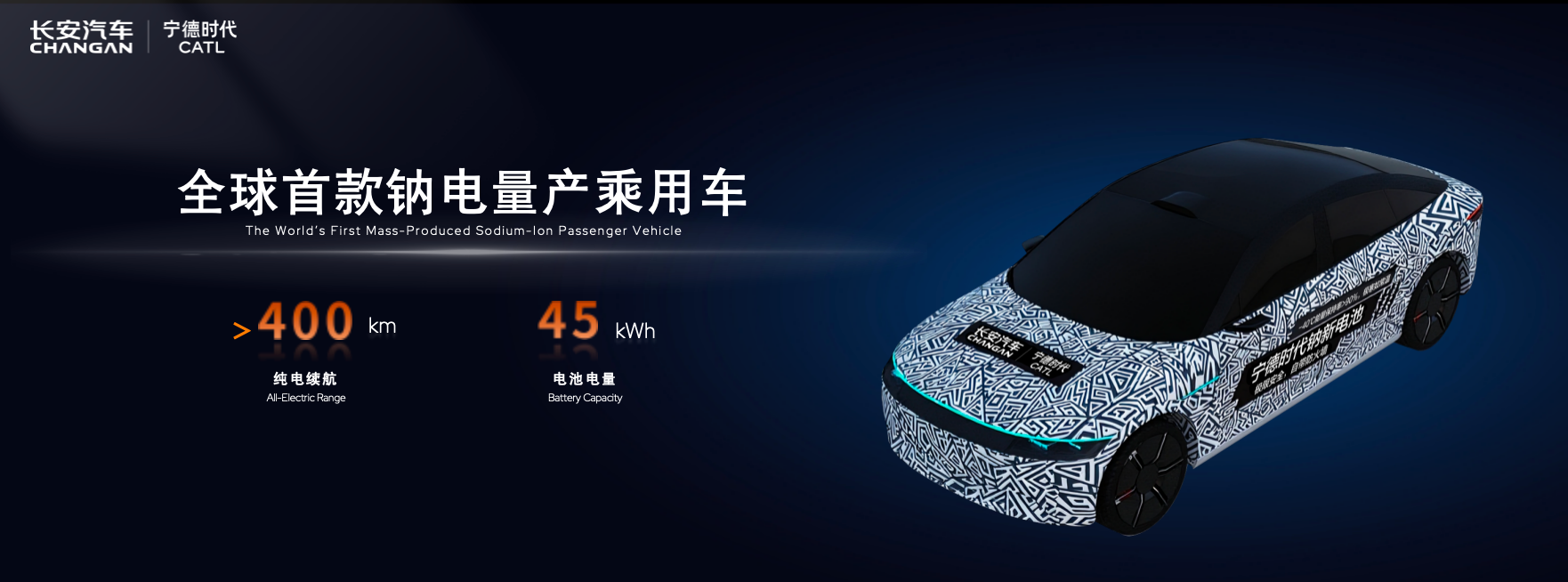
Photo by: Changan
But CATL says there’s plenty of room for improvement on the range front. As the sodium-ion supply chain matures, the company expects EV range to climb to 600 kilometers (373 miles), while extended-range EVs (EREVs) and hybrids could reach up to 400 kilometers (249 miles). That would cover more than half of the typical range requirements in China’s EV market, CATL claims.
Where the Naxtra battery really stands out, however, is cold-weather performance. CATL says its discharge power at -30 degrees Celsius (-22 degrees Fahrenheit) is three times higher than that of LFP batteries.
Unlike LFP or nickel-manganese-cobalt (NMC) packs, it reportedly avoids severe winter range loss, retaining more than 90% of its range at -40 degrees C (-40 degrees F). Power delivery is also said to remain stable at temperatures as low as -50 degrees C (-58 degrees F).
As always, we’ll have to wait for independent testing for real-world results. But on paper, the technology looks genuinely compelling. While the Naxtra battery isn’t coming to the U.S., it could be especially valuable in places like the Midwest and the Northeast, where EV drivers routinely report steep range losses when temperatures plunge in winter.
While lithium-ion batteries aren’t going anywhere, it’s becoming increasingly clear that the future of EVs will be defined by multiple battery chemistries coexisting. That’s how internal combustion engines evolved over the years, giving drivers more options to be able to choose the battery technology that best fits their driving habits, power needs—and the climate they live in.
Contact the author: suvrat.kothari@insideevs.com.
Read the original article

Comments
What I wanted to know from the article:
andThe CATL Naxtra sodium-ion battery will debut in the Changan Nevo A06 sedan, delivering an estimated range of around 400 kilometers (249 miles) on the China Light-Duty Test Cycle.It delivers 175 watt-hours per kilogram of energy density, which is lower than nickel-rich chemistries but roughly on par with LFPThanks, I wanted to know about price. Isn't that the main benefit of sodium-ion. On par energy density with LFP, but a lot cheaper.
By hunterpayne 2026-02-091:174 reply The main benefits are that Sodium is abundant, cheap and stores 30x the energy of Lithium per unit mass. The draw back is that when exposed to water it explodes with 30x the energy of Lithium. The other drawback is that it bursts into flame when exposed to air.
Think of it this way, Sodium metal is abundant and cheap with 30x the energy storage (and energy transfer) of other solutions yet nobody has used it in almost any product ever (including as a coolant). The volatility of Sodium is why. Unless they have a solution to this, then I would be shorting whoever is insuring these batteries.
By margalabargala 2026-02-091:352 reply Sodium ion batteries use sodium ions, like in table salt. They correctly are not named metallic sodium batteries. They are less fire prone than lithium batteries, even in locations containing air.
You should also consider shorting Morton [0]. They sell sodium, combined with chlorine, one of the nastiest elements around! And for products that go in people's homes! On food!
By hunterpayne 2026-02-091:573 reply This isn't correct. This is only true when the battery is first manufactured just like with Li-ion. Once the battery starts functioning, it is ionized metallic Sodium. All the volatility of Na but with corrosion too. There is no Chlorine nor any other halogen in there to engage in an ionic bond. In short, once the battery is functioning, the trick used to keep the Na in an ionic bond stops working (by design). After all, the ionic bond would prevent the battery from functioning.
It should be noted that most manufactures aren't doing pure Na-ion. They are mixing in a little Na with the Li to stretch Li supplies and gather data on the impact of the increased volatility on safety. I wouldn't expect their first use to be in cars. I would expect them to be in grid stabilizing batteries.
By margalabargala 2026-02-092:352 reply I was sure you were wrong so I went and did some reading and, you're right. I'm wrong.
I was thinking of the aqueous sodium ion batteries, which do not have the issues described. I thought those were the ones that are commercially available, but that's not the case.
By hunterpayne 2026-02-092:411 reply Kudos on being big enough and actually caring about accuracy.
By rkagerer 2026-02-098:58 This chain is an example of why I love HN so much.
By aixpert 2026-02-097:42 you deserve a high value metal medal
By Tade0 2026-02-0912:43 Isn't there very little free sodium in such batteries? At any point in time most of it should be intercalated in one or the other electrode, no?
By SapporoChris 2026-02-097:411 reply Morton salt is currently owned by Stone Canyon Industries which is a holding company.
By RupertSalt 2026-02-0912:461 reply In ancient times, salt developed an extraordinary reputation. Not only was it prized as a preservative, but it was a nutritious seasoning as well. Salt had great value, and much of that nutritional value could be ascribed to the trace minerals which it carried as it was mined or otherwise harvested.
Nowadays, the manufacturers of refined table salt present you with a digusting proposition: sprinkle this worthless elemental sodium-chloride onto your food, because it is "salt" and they are 100% trading on its ancient reputation. Perhaps it is better to simply trample it underfoot?
Unfortunately, all the trace minerals are missing from refined salt. That pure white, homogeneous, translucent quality gives it away. The refining of salt is done purposefully, because the trace minerals are more valuable to supplement vendors.
All those trace minerals are separated out and sold out to companies who will assemble them into expensive dietary supplements. Your magnesium, and selenium, and zinc that you pay $30 a bottle for.
And that is also why sodium has such a nasty reputation in 2026. If you get CVD then you avoid sodium. If you get hypertension then you avoid sodium. Sodium is avoided like the plague. No physician will recommend sodium or table salt for a diet! Why should they? Adding sodium no longer introduces trace minerals or nutrition, it only introduces saltiness.
It is still possible to find unrefined salt. It may be sold as "sea salt" or "kosher salt" but you'll need to find it in transparent packaging. If it contains impurities that look like pepper or dirt, then it is unrefined. If it is imprinted with the obligatory fake warning about iodide, then it may be unrefined. (The mandatory FDA "iodide" warning is not only fake, it's misleading and downright malicious.)
Good luck with your salt! With love from your eponysterical HN noob!
By SapporoChris 2026-02-105:171 reply You lifted most of your quote from https://www.navmi.co.in/difference-between-refined-salt-and-... without citing your source.
However, the information is false. The amount of nutrients in unrefined salt is negligible. Yes it contains trace minerals but not in any significant quantity.
By RupertSalt 2026-02-106:49 That's an outright and verifiable lie.
I have never seen or visited that website ever in my life. Why would I? I wrote my comment completely originally, and your accusation of bad faith is, in itself, bad faith.
In fact, none of the content which I typed into my comment is found in that blog article. How and why did you even find it? Anyone else here can read and confirm that I copied nothing. I quoted nothing. I owe nothing to anyone. My comment is original and copyrighted by myself (c) 2026, all rights reserved.
With respect to the content or other materials you upload through the Site or share with other users or recipients (collectively, “User Content”), you represent and warrant that you own all right, title and interest in and to such User Content, including, without limitation, all copyrights and rights of publicity contained therein. By uploading any User Content you hereby grant and will grant Y Combinator and its affiliated companies a nonexclusive, worldwide, royalty free, fully paid up, transferable, sublicensable, perpetual, irrevocable license to copy, display, upload, perform, distribute, store, modify and otherwise use your User Content for any Y Combinator-related purpose in any form, medium or technology now known or later developed.
By SapporoChris 2026-02-097:56 CATL has been producing Sodium-ion batteries since 2022. As CATL has continued to produce and introduce new Sodium-ion batteries, it appears they might have a solved the issue with volatility.
If they have not solved the problem, I still wouldn't recommend shorting any companies. Shorting a stock and waiting for years for it to drop is not a great strategy.
By CamperBob2 2026-02-103:02 Think of it this way, Sodium metal is abundant and cheap with 30x the energy storage (and energy transfer) of other solutions yet nobody has used it in almost any product ever (including as a coolant).
Huh? See https://www.terrapower.com/natrium/ -- and it's not exactly a new idea.
Also not uncommon to use sodium-filled exhaust valves in car, motorcycle, and aircraft engines.
I thought the price differential was not going to happen as there was a serious drop in the price of Lithium over the past year; but I looked it up and the lithium price drop is more a 5 year trend, with the last few months having a sudden surge in the price.
By hunterpayne 2026-02-091:192 reply Increased production of Lithium is why. However, that only drains the (very limited) reserves of Lithium more quickly. Currently we have about 75 years left of it at previous extraction rates. More could be found, that is unlikely.
Draining lithium reserves isn't that important - batteries don't use up the lithium, once the battery dies you can just suck out all the lithium and re-use it (and battery electrolytes are ~100% lithium, compared to lithium ore/brine being anywhere from 0.1% to 15% lithium - an order of magnitude difference). And since modern batteries are more efficient than old batteries with the same amount of lithium, we effectively increase the circulating lithium capacity over time.
In 75 years we won't need to extract more lithium - except the fraction needed to replace permanently-lost batteries.
Incidentally, you should be very careful when talking about "<resource> reserves", because the definition of a reserve is usually "<resource> that is profitable to extract" - and when we "run out", prices will go up and thus currently-unprofitable sources will become profitable, and POOF! Our <resource> reserves have increased, purely through the power of semantics.
Also, over the decades resource extraction becomes cheaper and thus more sources become profitable.
Personally though, I don't think any of that will matter -IMO the future is proton batteries, AKA Hydrogen batteries (which use an electrolyte of "ionic hydrogen", H+, which has 1 proton and 0 electrons - people claim lithium is the lightest metal, but it has 3x the protons of hydrogen). I think that the recent TABQ batteries, or something like it, will become commercially viable within 75 years (although who even knows what batteries will look like in the year 2101).
By hunterpayne 2026-02-0911:302 reply Nobody has ever recycled Lithium, just reused the cells that lasted longer than average. We have no idea how to actually recycle Li. We don't even understand the physical mechanism that causes it to exhaust. We think if we just let it sit around for a few decades, it might just come back on it own. We don't know though.
As for reserves, while you understand the economics you are missing the physics. For example, there is Li (and U) in the ocean. We don't extract Uranium from the ocean not only because it isn't economical, it isn't even energy efficient. This is because moving a billion tonnes of water takes more energy than the 3 tonnes of Uranium you would harvest from doing that. For Li, its takes just as much energy (and money) as its just as rare. In other words, there is a floor on that economic extraction argument specified by a positive EROEI (energy returned on energy invested).
Yes, we have. This is a well understood and fairy simple chemical process, you grind up non-working Lithium battery and split up the FOD from the metals then it's just basic chemical metal refining from here on out? When lithium is mined and extracted it goes through the exact same processes.
If you have any other sources or information on why we can't recycle lithium please let me know. As far is battery failure goes it's a mechanical failure on a chemical level
By hunterpayne 2026-02-104:561 reply And the name of the company which is doing this?
The Li that comes out of the process you describe wouldn't be recycled. It would still be mostly exhausted. Specifically, something we don't understand about the structure of their electrons causes the batteries made with such material to have a far lower capacity than if you used freshly mined Lithium. My source is a Material Engineering class at MIT.
By vablings 2026-02-116:06 We understand the structure of electrons very clearly in a lithium battery. That is the core operating principle of how a lithium ion battery works.
The lithium ions are the chemical process that actually store the charge, They move from the anode to cathode in charge and discharge. The loss of these ions is what causes the degradation of the battery which is a function of entropy here. It is simply that the concise arrangement that we required for this electro-chemical to take place falls out of balance.
Entropy problem is easily solved by mashing a battery up and reconstituting it into a new battery.
To put this all simply this is all fairly basic chemistry, even if there was some kind of structure being created that has a high bond enthrall we can still undo that with enough energy.
If you could maybe share some research or other information to back up your claims other than you went to a class at MIT i would really appreciate it also the company i was saying is called Li Cycle
By insane_dreamer 2026-02-0915:32 what about the polymetallic nodules on the ocean floor, don't they contain Li? -- setting aside the environmental question, isn't that a vast untapped source?
I thought there were a few massive lithium sources found in the past few years like the one in Thailand which have significantly increased our estimates?
By hunterpayne 2026-02-095:291 reply Sure, but by like 2 years. Lithium is rare. It sits between Cobalt and Scandium on the list of abundance in Earth's crust. And the vast majority comes from one place in South America.
They are always revising estimates up and down a bit. But Li demand just keeps rising and rising. And a single grid scale battery takes 10 years of current Li-ion battery production worldwide to build.
So do we have enough Li at current rates, sure. We don't have anywhere near enough to do anything like replacing even a fraction of FFs with renewables. I guess that's the real headline here. That's why people are experimenting with Na-ion. Putting it in a production car today, that seems...what's the word...homicidal. Making a grid stabilization battery (not for backup) with large amounts of space between cabinets to see what happens, that seems more wise.
That 10yr per grid scale battery estimate seems high since we have built many grid scale batteries as well as millions of EVs in recent history.
By hunterpayne 2026-02-0911:191 reply We have many grid stabilization batteries. There are 0 grid scale backup systems. 1 year of worldwide Li-ion battery production could backup just California for about 90 minutes.
By vablings 2026-02-0922:19 There are virtually zero singular grid scale power systems these days. It is a mix of CCGT, Solar, Wind and Nuclear.
By PunchyHamster 2026-02-0820:091 reply *potentially a lot cheaper.
I've seen that repeated a lot but I still can't buy sodium batteries cheaper than lifepo...
By wirybeige 2026-02-0820:25 Sodium batteries don't yet have the scale that lifepo4 batteries have. I'd expect we will see them get cheaper.
Retaining 90% range at -40°C sounds like a game changer, almost too good to be true. I'm definitely going to need to see some third-party real-world range tests to validate those claims before getting too excited.
Note that this article's summary has a significant error compared to the original press release[1]. The article says "90% range", whereas the press release says "90% capacity retention".
This is a big difference because there are all kinds of other factors besides energy capacity that can affect the efficiency of the whole system, and therefore affect range.
Most notably, air is about 28% denser at -40°C than at 25°C, so drag is about 28% higher. So you would expect roughly 28% less range at high speeds even if the battery has no capacity loss whatsoever.
As someone else mentioned, climate control also consumes a lot more power when it has to maintain a larger temperature difference between inside and outside.
By gucci-on-fleek 2026-02-090:055 reply > Most notably, air is about 28% denser at -40°C than at 25°C, so drag is about 28% higher. So you would expect roughly 28% less range at high speeds even if the battery has no capacity loss whatsoever.
With my gas car, I haven't noticed 30% worse fuel consumption at –30°C compared to +30°C [0]. To be fair, I haven't closely measured the fuel consumption at different temperatures, but I probably would have noticed such a big difference. This is just anecdotal of course, so your values may actually be correct.
[0]: It does occasionally get down to –40°C here, but my car won't usually start then, so I've slightly shifted your temperature range to the values where I've driven most.
By rootusrootus 2026-02-090:111 reply It won't be as noticeable on a gas car because it is probably starting out around 30% efficiency (as compared with ~90% for an EV). This is a major advantage of gasoline, in a sense, because it means we have already engineered the package to account for a lot of wasted fuel.
By gucci-on-fleek 2026-02-090:221 reply Ah, so then the air temperature should reduce fuel consumption by 30%×30%=10%, which does seem to roughly match my experience. Thanks for pointing that out!
By simulator5g 2026-02-099:11 Internal combustion engines are actually more efficient in cold weather than hot weather. But the other factors like drag outweigh the increased efficiency of the engine. And since gas engines are so inefficient to begin with you don't notice much of a difference. https://physics.stackexchange.com/questions/270072/heated-an...
By layla5alive 2026-02-090:48 Gas cars produce more power at lower temperatures - more oxygen gets into the combustion chamber, and the engine also can run more advanced spark timing without as much worry of detonation. This is why turbochargers have intercoolers.
Air drag energy losses are tiny comparing to other losses when burning petrol so you don't notice the difference.
By gucci-on-fleek 2026-02-090:21 Ohhhh, that makes complete sense, thanks!
By schiffern 2026-02-093:58
They used PV=nRT, so it better be!>your values may actually be correctNote that a 28% increase in drag results in a roughly 22% decrease in range, because 1/1.28 ~= 0.78. Also there are other losses (like rolling friction and constant loads like headlights or cabin heat), so range doesn't scale perfectly with drag. Drag is the main source of loss at highway speed, however
By randomname93857 2026-02-093:281 reply I drive long distance weekly on my gas car. Full tank in summer (+20C) gives me 520 km, while in winter (-20C here) I get 430-440 km. I noticed it on my current and previous cars. Maybe it's thicker oil and worse car efficiencies in winter ? And that's despite that full tank of gas has more gas in winter comparing to summer, gasoline is denser in cold temps.
By PunchyHamster 2026-02-0820:05 I'd imagine also less rolling resistance from both rubber hardening and just roads being more slippery
But TBF same factors affect ICE cars
That implies that air resistance is the overwhelming contributor at high speeds. Is that the case?
By gpm 2026-02-0819:39 It's the majority, but overwhelming or not surprisingly appears to depend on car model, at least per some calculations someone on reddit ran [1].
I'd add though that rolling resistance tends to be higher, on average, in winter too. When there's often a bit of snow on the roads... Less so on high speed highways admittedly.
[1] https://www.reddit.com/r/askscience/comments/l2cq6b/comment/...
By aucisson_masque 2026-02-0822:472 reply Oh yes, by so much.
Even at 30kmph it's already the majority of the resistance and it scales exponentially with speed so you can imagine how much it matters.
For most cars driving through air, at sea level, on planet Earth, at normal speed, the drag force F is proportional to the square of the speed (v^2).
That's not exponential because the speed (v) is not in the exponent. In fact, it's quadratic.
Corollaries: The power required to push the car at speed v will be proportional to Fv ~ v^3. The gas spent over time t ~ energy spent ~ power time ~ v^3 * time.
By aucisson_masque 2026-02-150:12 Yeah sorry for my bad memory, you're right to correct it.
By Taek 2026-02-0823:09 It scales quadratically with speed*
Those two things very different.
Considering air resistance is proportional to the cube of the speed, it would be highly surprising to not be the case.
By baq 2026-02-0820:05 Define ‘high speeds’. There’s a reason race cars look like they do, to the point of having serious problems driving at speeds just a bit below highway speed limit.
By Saris 2026-02-0819:36 Yes it is.
By bryanlarsen 2026-02-0821:411 reply I don't imagine the difference is very significant on long drives. If the car is cold soaked at -30, it uses about 10kW for the first 3km. Then everything is warmed up, and the ~25% difference is increased consumption, not decreased battery capacity.
As long as you have a heat pump harvesting the waste heat to keep the battery up to temp.
But might be significant on short drives, 10kW for the first 3 km is massive.
Yeah, this heat up effect is massive for around-town use. We have had below freezing weather for two weeks, which is very unusual here in Annapolis. That’s had a huge impact on my wife’s use case, which involves a bunch of 5-10 mile trips to drop the kids off at school, go on a grocery run, pick the kids up, take the kids to math tutoring, etc. She ran out of charge the other day during drop-off b/c the “37 miles left” we had the night before was actually a lot less than that accounting for warming the battery up the next day.
By bryanlarsen 2026-02-0823:321 reply 10kW is about 40 miles of range, as you figured out the hard way.
By bryanlarsen 2026-02-0915:06 Arg, 10kWh, not 10kW.
And human occupants will still run the heater more in winter. But it sounds like there could be a future where makers offer a sodium battery and heat pump version of their cars for sale in colder climates.
By metalman 2026-02-0820:27 Running a preheater loop for the heat pump from the systems than need to be cooled, inverter and motor that run better cold,and other optimisations could likely supply cabin heat with very little battery draw, solar pv blended into the exterior could zero that out on an average basis,but 40 below is nothing to play with unless you know exactly what you are doing, even if they say it will still work.
https://electrek.co/2026/02/05/first-sodium-ion-battery-ev-d...
By rootusrootus 2026-02-0819:073 reply > future where makers offer a sodium battery and heat pump version
AFAIK most EVs already use heat pumps today, so the future happens whenever sodium batteries become mainstream.
By cosmic_cheese 2026-02-0819:201 reply IIRC there are some surprising holdouts, at least in the NA market. For example as far as I'm aware the Mustang Mach-E still ships with a resistive heater.
By rootusrootus 2026-02-0823:161 reply > Mustang Mach-E still ships with a resistive heater
Nope, the Mach E and Lightning both have a heat pump (well, just the Mach E now, I suppose, since the Lightning is out of production).
By tzs 2026-02-090:57 It should be noted that started with the 2025 model. Earlier Mach-Es just had resistance heating.
By formerly_proven 2026-02-0910:21 Vehicle ASHP do little in deep cold temperatures, since the evaporator is necessarily so small. They're mostly effective in the 0-15C range. Note that all EVs have PTC heaters, regardless of heat pump. The PTC is what does most of the work for getting the interior to temperature quickly (they're 5-10 kW).
By expedition32 2026-02-0912:261 reply The cheaper EVs don't. Think 35k range.
Obviously Tesla and the like are more luxury cars but if EV is to become mainstream they need to compete with ICE Kia's and Volkswagen.
By rsynnott 2026-02-0913:53 The VW id.3 costs about 30k. It doesn't have a heat pump by default, but it's a 1,200 EUR add-on. Which probably makes sense; in some markets where it's sold it doesn't really get cold enough that one is of significant benefit.
Interestingly, the Hyundai Inster (20k EUR) and Renault 5 (25k EUR) both have heat pumps as standard equipment.
I think our id.4 2023 model already has that. It has crappy software too. Great car, drives fantastically, but horrific software!
But if they add buttons back as planned, I might be willing to try a new id.4 in 5-10 years.
By formerly_proven 2026-02-0910:18 just fyi for the MY23 and older software 3.8/9 should be available for update, which is a pretty significant upgrade compared to 3.2 or the 2.x builds (which I don't think a MY23 should have but idk).
Gasoline engines are already 15% less efficient at 20F.
https://www.energy.gov/energysaver/fuel-economy-cold-weather
At -40F (-40C), it's generally good practice to just stay inside and not drive at all...
That 15% loss reduces your range from 1000km to 850km? That hardly affects how useful the vehicle is. For EV that’s different story.
How many vehicles have a 650 mile range? Almost none. Plus you can't fill up at home with gasoline, like you can with an EV.
> How many vehicles have a 650 mile range? Almost none.
'22 Ford Escape hybrid
The remaining miles thing shows less than that on a full tank, but I've been pretty consistently getting upper-600s between fill-ups.
I suppose it would probably be less if I went on the interstate more.
There's one. Go to a Car and Driver article about cars with extreme ranges, namely those over 650 miles, and they will start listing out particular years' models over a 10 year period in order to get to even ~10 models, and most of them are EcoBoost or variants or poor selling hybrid versions of other cars.
Assuming a 1000km range is a very strange thing to do, as it's a fringe feature that almost no one needs or wants! Recall that "almost no one" means that there's still some, an existence of a handful of people on HN is quite consistent with "almost none."
By tbrownaw 2026-02-0822:06 Of course I didn't pick it for range, I looked at price and miles of what the local carmax had and then separately looked up how tall the top of the windshield was.
Which I would expect to typically find something that's, um, fairly typical on characteristics I wasn't selecting on.
my 2010 F-150 with the notoriously terrible 5.4L gas engine seems to manage 1000km range. there's absolutely nothing efficient about it, it's just got a big gas tank.
By rootusrootus 2026-02-090:26 Yep, Ford had to put really big tanks on even the F150 to make up for the horrid mileage. Even with a 36 gallon tank, when towing with an F150 you might only get 300 miles. It's one reason the Lightning had problems selling as many as they wanted (aside from the ridiculous pricing the first year or so). Most people who are serious about towing don't use an F150 anyway, but that doesn't mean that F150 buyers don't fantasize about their potential towing needs in the future.
By consp 2026-02-0821:00 Comparing range of gasoline cars is idiotic. There are plenty of cars with long range (1000km), and they all have 60L+ fuel tanks and most run on diesel (which gives you ~15% more range per liter). It'd even argue the same for BEVs. More battery is more range.
By PunchyHamster 2026-02-0820:081 reply you can have drum of fuel enough for entire winter in your garage, the fuck you mean by "can't fill up at home"?
By thebruce87m 2026-02-0821:151 reply They mean that rounded to the nearest percent, 0% of people will be filling up their car at home from a drum.
By PunchyHamster 2026-02-0920:381 reply rounded to nearest percentage zero people have winter-related car issues in the first place...
The point you are DESPERATELY trying to miss is you can easily "recharge", a "dead" ICE at home too
By thebruce87m 2026-02-1016:55 > The point you are DESPERATELY trying to miss is you can easily "recharge", a "dead" ICE at home too
Eh? All I can see is you DESPERATELY trying to push the narrative that it’s common for people have barrels of fuel at home which is a pretty weird thing to try and prove since everyone reading this will know it’s not true.
You mean EVs? Yeah, none that I'm aware of. But petrol/diesel cars? Loads of them. Even my 400bhp Volvo XC60 will easily do 650 miles on one tank of fuel. A diesel one will do 700-800. And a diesel Passat will go over 1000 miles on a tank without trying. Hell, even my basic 1.6dCI Qashqai could do 700 miles on its 55 litre tank
By cherry_tree 2026-02-0820:321 reply Volvo xc60 has an estimated 25 mpg overall (https://www.volvocarsrichmond.com/volvo-xc60-mpg.htm)
It has an 18.8 gallon fuel capacity (https://www.volvocars.com/lb/support/car/xc60/article/dfc6f0...)
That’s a max range of 470 miles. You would need much greater fuel efficiency above 34 mpg to get to 650 miles on an 18.8 gallon tank.
By gambiting 2026-02-0820:38 Cool, I guess when I did 700 miles on a single tank of fuel driving Switzerland to Italy and then again driving Italy to Austria and then again Austria to Netherlands this summer I just imagined it. My total for the 3000 miles was 38mpg(imperial).
Also you are quoting a value for the B5, which is not what I have, mine is a T8(and before you ask - no, I didn't have any opportunity to charge it anywhere on the way).
Every modern passenger car will show you 650 miles when driving at ~60mph. In the EU, anyway, and with a diesel engine.
By seiferteric 2026-02-0819:227 reply > Gasoline engines are already 15% less efficient at 20F.
Is that actually true once the engine has reached operating temperature?
By epistasis 2026-02-0819:36 Short trips are worse:
> Fuel economy tests show that, in city driving, a conventional gasoline car's gas mileage is roughly 15% lower at 20°F than it would be at 77°F. It can drop as much as 24% for short (3- to 4-mile) trips.
By helterskelter 2026-02-0819:32 The temperature difference should in principle increase thermodynamic efficiency. You get loss of MPG from other factors though mentioned in the link, like increased friction of moving parts, idling to warm up (0MPG), defrosters/seat heaters, lower tire pressure, denser air to drive through, winter fuel mixes which may not have as much energy, etc.
By mylifeandtimes 2026-02-0819:382 reply Once had a Porsche 914. Air cooled engine. Drove it across Montana and the Dakotas one winter. One very cold winter.
Not sure the engine ever reached "operating temperature" on that drive.
By EvanAnderson 2026-02-0823:44 Sticking a piece of cardboard over a portion of the radiator was a common sight during the winter when I was growing up in rural Ohio. I didn't think our winters were that cold, but maybe late 70s to early 80s vehicles were more susceptible to running cold.
I had a car that developed a stuck-open thermostat and did the cardboard trick to get by until I could replace the faulty part.
By rootusrootus 2026-02-090:22 I've had that happen, too, on a [more] regular car. I drove a Mustang 5.0 from Oklahoma to Oregon, and as I went through eastern Colorado the coolant temperature steadily dropped until it was resting at the bottom of the gauge. I don't recall whether the gas mileage suffered noticeably or not during that phase of the drive.
By colechristensen 2026-02-0819:381 reply There are a bunch of things going on, and some people's measure of efficiency needs work.
1) winter blend fuels have less energy per volume, that doesn't make your engine any less efficient by energy but it does by volume of gas
2) lots of temporary cold effects: fuel vaporization, thick lubricants, etc. these things become less of a problem as the engine warms up but some energy is still lost on long drives
3) air resistance: all aerodynamic forces are linearly proportional with air density. At a constant pressure there's about a 15% difference in air density between the hottest and coldest places you can drive (and thus 15% less drag on a hot summer day than a cold winter day). aerodynamic forces are proportional to the square of your velocity and they become the largest resistive force around 50mph -- so at highway speeds you're losing efficiency because you have to push more air out of the way
4) energy used to maintain temperature: this is hard to calculate but some engine power is lost because the energy is used heating up the engine block and lost to the environment
5) the Thermodynamics 101 engine efficiency goes UP with increased temperature, but it's got a lot of real world effects to compete with, no spherical cows and all
By anjel 2026-02-0820:05 Partial pressure variant fx on combustion outputs
By jurgenburgen 2026-02-0819:342 reply Assuming you can get the car to start (mine needs an engine warmer at that temperature), it takes at least 15 minutes of driving to reach that temperature. Unless you’re going on a longer trip the engine most likely wont be warm by the time you reach your destination.
I had to drive in -30C once, the engine could not get up to final temperature after 2 hours of highway driving because I had to run cabin heater at full blast on windshield and side windows so they didn't cover with fog inside. But that was in very old low power car.
My tiny diesel car (2008 Toyota) needs its auxiliary heater below around -15 C for highway trips. It's a switch in my dash that burns extra fuel, otherwise the engine won't get up to or stay at temperate.
By fy20 2026-02-092:28 Pretty normal with diesel as it gives off less heat than petrol. I have a van with an 88kW engine, and even at -5c I can see the coolant temperature drop when I am idling down hill and have the heater on. Any colder and it's worth blocking the radiator with cardboard.
By westmeal 2026-02-0916:03 Protip for next time, cover the rad halfway with some cardboard and this will help a bit.
By thebruce87m 2026-02-0820:54 Schrodingers garage. Ceases to exists when talking about EV charging but exists when ICE vehicles need cold starts.
By yencabulator 2026-02-0822:43 I once had a condo with parking in a cave that was above freezing even when outside was -30 C (or F, close enough at that part of the scale). It was a great winter perk.
By number6 2026-02-0819:33 Well you have to keep it at operating temperature
By Joel_Mckay 2026-02-0819:431 reply >almost too good to be true
Since the Lithium battery prices dropped, there are many Sodium battery companies simply abandoning the research or shuttering. Not a good sign when smart people jump ship.
The Na cells also have lower energy-density, and currently fewer viable charge cycles. One can still buy evaluation samples, but it takes time to figure out if the technology will make economic sense.
Best regards =3
By rootusrootus 2026-02-090:301 reply > many Sodium battery companies simply abandoning the research or shuttering
There could be other reasons. Maybe they just cannot compete with CATL.
By Joel_Mckay 2026-02-091:28 Rule #29: Information people want public usually isn't news, but rather just marketing rhetoric.
we can always afford to wait and see.
Have a great day =3
By PunchyHamster 2026-02-0820:05 Chemistry-wise it checks out, it was long touted advantage of sodium, just that they probably ignored rest of the problems in winter
By maayank 2026-02-0822:51 Why would that be a game changer? Genuinely curious.
By minneapoliced 2026-02-090:271 reply With high-density energy carbohydrogens, you retain 100%.
By wpm 2026-02-091:43 And get 100% of the conflict and air pollution
By Anduia 2026-02-0818:47 Less bloated site:
https://carnewschina.com/2026/01/22/catl-unveils-worlds-firs...
