Joel Hawksley / joel@hawksley.org / ←home 2026-02-17 TL;DR: Over the past decade, I’ve worked to build the perfect family dashboard system for our home, called Timeframe. Combining calendar, weather,…
Joel Hawksley
/ joel@hawksley.org / ←homeTL;DR: Over the past decade, I’ve worked to build the perfect family dashboard system for our home, called Timeframe. Combining calendar, weather, and smart home data, it’s become an important part of our daily lives.

Backend overhaul
The real-time requirements of the Mira Pro immediately surfaced performance and complexity issues in the backend, prompting an almost complete rewrite.
While the Visionect system worked just fine with multiple-second response times, switching to long-polling every two seconds put a ceiling on how slow response times could be. To start, I moved away from generating images. The Visionect folks added the ability to render a URL directly in the backend, freeing up resources to serve the long-polling requests.
Most significantly, I started migrating towards Home Assistant (HA) as the primary data source. HA already had integrations for Google Calendar, Dark Sky (now Apple Weather), and Sonos, enabling me to remove over half of the code in the Timeframe codebase! I ended up landing a PR to Home Assistant to allow for the calendar behavior I needed, and will probably need to write a couple more before HA can be the sole data source.
With less data-fetching logic, I was able to remove both the database and Redis from the Rails application, a massive reduction in complexity. I now run the background tasks with Rufus Scheduler and save data fetching results with the Rails file store cache backend.
In addition to data retrieval, I’ve also worked to move as much of the application logic into Home Assistant. I now automatically display the status of any sensor that begins with sensor.timeframe, using a simple ICON,Label CSV format.
For example, the other day I wanted to have a reminder to start or schedule our dishwasher after 8pm if it wasn’t set to run. It took me about a minute to write a template sensor using the power level from the outlet:
{% if states('sensor.kitchen_dishwasher_switched_outlet_power')|float < 2 and now().hour > 19 %}
utensils,Run the dishwasher!
{% endif %}
In the month since adding the helper, it reminded me twice when I’d have otherwise forgotten. And I didn’t have to commit or deploy any code!
Today
Since moving into our new home, we’ve come to rely on the real-time functionality much more significantly. Effectively, we’ve turned the top-left corner of the displays into a status indicator for the house. For example, it shows what doors are open/unlocked:
Or whether the laundry is done:

I continue to receive significant interest in the project and remain focused on bringing it to market. A few key issues remain:
Hardening for deployment
While I have made significant progress in handling runtime errors gracefully, I have plenty to learn about creating embedded systems that do not need maintenance.
Home Assistant integration
There are still several data sources I fetch directly outside of Home Assistant. Once HA is the sole source of data, I’ll be able to have Timeframe be a Home Assistant App, making it significantly easier to distribute.
Hardware cost and complexity
The current hardware setup is not ready for adoption by the average consumer. The 25” Boox display is excellent but costs about $2000! It also doesn’t include the hardware needed to drive the display. There are a couple of potential options to consider, such as Android-powered devices from Boox and Philips or low-cost options from TRMNL.
Conclusion
Building Timeframe continues to be a passion of mine. While my day job has me building software for over a hundred million people, it’s refreshing to work on a project that improves my family’s daily life.
Read the original article

Comments
This is super cool, and I wish something like this existed at my place, as it enables information sharing without the need for phones/actual screens that shine in your face when the lights are low or tempt you to doomscroll.
That said, the large primary display this uses is $2000. That's very hard to justify for any "normal" household, and that's without any mounts, backend, services etc.
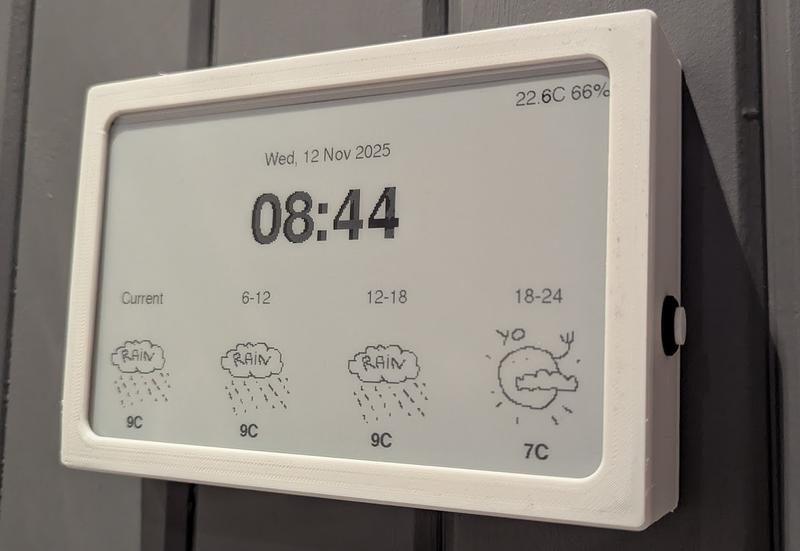
I made this thing [1] for us, it uses a cheap 10" e-paper display off aliexpress, an ESP32 and a couple of I2C sensors. The case is 3D-printed. It runs on two 18650 batteries, and all in all it cost less than 100$. The OpenWeather API is free for personal use.
Love those weather icons. Personality in software design is underrated.
By rolfus 2026-02-2311:07 Thanks! I intentionaly made the weather symbols somewhat "childlike" to give it some personality and also make it obvious that it's a custom device, and not some off the shelf gadget. Works well as a conversation starter!
By TurdF3rguson 2026-02-232:553 reply I need to know why the opposite of 'rain' is 'yo'.
By embedding-shape 2026-02-2310:54 Seems the sun is the one saying "yo", perhaps as a form of a greeting as it was raining the days before?
I'm just guessing, but I think it might simply just be for fun :)
By Dban1 2026-02-233:14 yo it's time to go out!
By rolfus 2026-02-2311:31 The sun is greeting you! I drew these freehand, kind of quickly. And while I personally like the style and think it's a good fit for us, I did intend to make several sets of weather icons. At the very least I need to make the sun symbols adapt to the seasons - we don't really have a full sun during the darkest months of the year where I live.
By encrypted_bird 2026-02-2310:321 reply OpenMeteo is pretty amazing too, and doesn't require an account or API key, which is nice.
By firesteelrain 2026-02-2311:292 reply I incorporated OpenMeteo into a project recently and got frustrated with their aggressive rate limiting. If in the US, weather dot gov has an excellent, free API. Or, OpenWeatherAPI which works internationally and has support for more things that weather dot gov does not. OpenWeatherAPI will also synthetically provide weather data based on their models if there is missing station data
By embedding-shape 2026-02-2319:312 reply > I incorporated OpenMeteo into a project recently and got frustrated with their aggressive rate limiting
Which one? They seem to do 600 calls / min, 5.000 calls / hour, 10.000 calls / day, 300.000 calls / month, how many times do you need to look up the weather for personal use? Fine, maybe you want 3 different locations, you can still call each of those sufficiently with those rate limits, no?
By firesteelrain 2026-02-241:481 reply I have to sample multiple lat/lon across the world all at once
By embedding-shape 2026-02-249:251 reply For what purpose? And multiple times per hour for each of those? Sounds like not a personal project already.
By firesteelrain 2026-02-2412:481 reply It’s for a hobbyist project and non commercial use.
By embedding-shape 2026-02-2413:02 Right, but less "I want to know what the weather is locally and maybe in my summer house" and more "I'm curious about sampling global weather/temperatures", right? I don't think the intention of the API is for the latter, but more for the former.
By oneneptune 2026-02-2319:59 a redis geospatial index + redis distribution locks you can build a performant cache layer that is consumed by a ton of people and stay well under that rate limit.... the weather data only updates every 5 minutes too, so you can use that for your cache ttl.
By the_arun 2026-02-2314:48 Using your own weather station is another option
Nice! Do you think it would be easy for someone with no hardware experience to build one?
By rolfus 2026-02-2311:24 Yes, I think so. Electronics prototyping is so accessible now, and there's such a deluge of inspirational projects out there to learn from. YouTube is a gold mine, and I'll leave links to a few channels I follow, below.
If you get an Arduino or Esp32 microcontroller (maybe in one of those starter-kits with various sensors), some breadboards, assorted jumper-cables and a kit with electronic components (resistors, caps) you'll be good to go. A device like a wall clock most likely won't require soldering, since it won't be jostled or moved around much.
Ben Eater: https://www.youtube.com/@BenEater/videos
Paul McWhorter: https://www.youtube.com/@paulmcwhorter/videos
Huy Vector: https://www.youtube.com/@huyvector/videos
I'd also take a look at the other DIY projects that people have linked in this discussion.
By tvbusy 2026-02-2310:19 If you already have Home Assistant running, I think it should be simple. Most of the time you can buy devices with pins already soldered and it's just the matter of connecting them together. AIs are pretty good with ESPHome configs. You can even take a picture so that they can help you identify the correct pins. Some coding may be required for drawing things on the display though.
By deepriverfish 2026-02-2222:463 reply hi I've been interested in doing something like this for myself, what tools and software did you use?
By golem14 2026-02-2222:58 +1, and have you tried running 2 displays side by side ? That should give you an effective diagonal of 14 inches or so, and for those displays, cutting it in two does not really affect the utility of the display (likely tabular content anyway).
Seems like the author has experimented with 2 kindles side by side.
By rolfus 2026-02-2311:57 I source most of my components from aliexpress. It's been a while, but these are the components I used:
Microcontroller: FireBeetle 2 ESP32
Display: Generic 10" e-Paper display with driver board included
Timekeeping: DS3231 Real Time Clock Module
Temperature and humidity: BME280 module
Charging: Type-C USB 2S Li-ion BMS
That, along with a breadboard, two 18650 batteries, some resistors and capacitors make up the hardware. I modelled and 3D printed the case. I used the PlatformIO plugin (available for VSCode-based IDEs) for programming and transferring code to the esp32.
Weather API: https://openweathermap.org
For actual firmware I'd take a look at matada's github for inspiration (see the other reply in this thread). My own code isn't of the photogenic sort.
By matada_ 2026-02-237:14 I built this weather dashboard specifically for colour EPD https://github.com/mt-empty/pi-inky-weather-epd
You might be interested in knowing about https://trmnl.com. No affiliation beyond interest in buying a few in the future. They have a 10.3" version in the works.
By simonmales 2026-02-237:54 Good thing about trmnl is you can run the entire backend if the company disappears.
Looks good, the refresh rate... does not! 200ms for partial refresh, ouch.
The ease of integrations might make up for it, though.
You can make smaller ones for much much less. I’ll post pics of mine a bit later but waveshare 7.5” display in a photo frame and almost any ESP32 dev board and you are set for less than $100 (along with suitable HomeAssistant and ESPhome infrastructure to support it). The original article is a very slick bit of work, so well done
The article also mentions using jailbroken kindles which I assume should be the cheapest way to get a decent sized epaper screen with builtin connectivity.
edit: https://github.com/sibbl/hass-lovelace-kindle-screensaver
By scary-size 2026-02-2220:40 Yep, it’s super cheap. I wrote about mine here:: https://franz.hamburg/writing/kindling-e-ink-dashboard.html
You can also buy some for less than $100.
I can vouch for the reTerminal: the build quality is excellent, and they come with a battery, sd card reader, and some sensors: https://www.seeedstudio.com/reTerminal-E1001-p-6534.html
Gonna piggyback here to second this and chime in to say I went with the BYOD screen linked within your link for $49 (SKU 104991005). It's definitely more barebones and probably not even as cost-effective if you're still planning on buying the "lifetime" TRMNL API access.
I don't have easy access to a 3d printer, so I just have mine sitting on an extra phone stand I had lying around that can be had for a few bucks from Amazon.
I couldn't be happier with it and am thoroughly enjoying my complacent, lazy solution :)
FWIW you need to pay for the trmnl key ($50) to use your own device with their servers, but if you run a server yourself you don’t need to pay.
I’m very tempted, a lot lower resolution than a kindle but it’d be pretty cool.
By boneitis 2026-02-2311:35 i could have been clearer about that. but yeah, even for what i paid, i was happy to immediately be off to the races designing the couple panels within their web portal and having something functional and useful to me without any real friction from having to figure things out.
moving on to the self-hosting side is probably now backburnered indefinitely, even if i do have some grander ideas in the longer term. unfortunately, i'd need more than a weekend project's timeframe to bring them to fruition.
By ryanckulp 2026-02-2320:06 you can point a higher def Kindle to TMRNL, either our closed source web app or free to an open source server.
https://github.com/usetrmnl/trmnl-kindle https://github.com/usetrmnl/trmnl-koreader
OP's Timeframe looks rad, but yes on the pricy side. check out trmnl .com for smaller / less expensive options and self hosted options. (disclaimer: i'm on the team)
By weakfish 2026-02-2221:59 Yo Ryan! I get your emails! I was just reading this thinking “man he should’ve tried TRMNL”
I love my original one and am planning to get a model X when budget permits
I’m a big fan of TRMNL! The big difference with the Boox device is real-time updates, which make the smart home status information much more useful.
By ryanckulp 2026-02-2223:11 thanks for the support and i hear you. a few folks pointed their Boox at TRMNL[1], and we’re finally in the smart home arena now with free 5 min refresh rate for Home Assistant. aiming for JIT refresh by summer.
bought trmnl & have been sorely disappointed with the transparency regarding self-hosted options & the availability of functionality. Was led to believe Hanami BYOS was identical to the hosted server. have opened a ticket, have had others voice the same sentiment. I appreciate the effort, but lament the reality of TRMNL & the marketing.
By ryanckulp 2026-02-233:13 you can import ~700 plugins from core to Terminus (Hanami build) or the Laravel build in 1 click. maybe you came on board before that was a reality. we and the community have been rapidly developing multiple self hosted servers with all kinds of features and in different frameworks for comfort. in no marketing materials have we ever claimed that OSS clients were the same as the main web app. in fact that’s why we offer a BYOD license for the web app only. we’ve invested hundreds of thousands into open source so that people can get the TRMNL experience without paying us a penny.
By woadwarrior01 2026-02-2222:301 reply lol, €17.95 for a Developer "Unlock"[1].
By SchemaLoad 2026-02-2222:332 reply That's just a perpetual license to use their hosted server. You are free to use your own self hosted server for free.
They should really clean up the phrasing because it sound so sketch, like they're locking device features for money, turns people off easily.
what do you think it should be called? for ~$15 optional one time bucks people get 24/7 access to the entire engineering team, me, prioritized feature dev, and can earn monthly payouts from our Creator Fund. we don’t charge a subscription, obviously i’m partial but this model has serves us well. and most of the developer edition fee goes right back to the community via bounties, perks, etc.
Developer Access or something like that, and put part of your comment in there. I would remove the word Unlock entirely, it implies you’re locking code, as opposed to providing a service.
By ryanckulp 2026-02-2320:09 we call it Developer Edition, i think this is functionality the same. https://trmnl.com/blog/developer-edition
By IanCal 2026-02-239:22 I think you’re mixing that up with the byod key, this is a different thing.
By silversmith 2026-02-238:222 reply My solution was to buy a used Samsung tablet with OLED screen, and control the display on with motion sensors. It sits in the hallway, above the keys drawer. The screen is on only when someone's walking nearby, and around eye level when you go pick up the keys. Designed the dashboard based around muted colours on black background, with brights reserved for "hey pay attention to this" data. And most importantly, the screen is not visible from any spot you're likely to stay at for a longer time. As for mounting, I used calipers, 3d printer and some double sided tape. It's not completely seamless, but damn close for ~10% of the effort.
Would love some details how you enabled controlling the display with motion sensors.
By silversmith 2026-02-267:55 The tablet itself runs https://www.fully-kiosk.com/ to display a web dashboard. Fully Kiosk has good Home Assistant integration, including screen on / off controls. I also have a bunch of Sonoff battry operated zigbee motion sensors scattered around the place. Then Home Assistant does what it was meant to do - act as a glue layer between various systems, firing screen control commands to Fully Kiosk as a result of select motion sensors triggering.
By Sander_Marechal 2026-02-249:561 reply What's the software stack? Did you write an app for it? Jailbreak it?
By silversmith 2026-02-267:58 No jailbreak necessary - the tablet runs https://www.fully-kiosk.com/, and displays a web dashboard.
The dashboard itself is a react app talking to my Home Assitant instance over a websocket. The heavy lifting of bringing various data sources together is done by HA, I just wrote a react app because it seemed easier than learning to customize HA dashboards to the degree I wanted to.
By danielheath 2026-02-231:231 reply I did a similar thing with a regular backlit computer screen.
It automatically shuts off after 30 seconds of inactivity.
I added a $3 webcam, and use openCV to detect motion. If three consecutive frames (sampled 0.5s apart) are each sufficiently difficult from the previous one, it attaches a virtual USB mouse, then moves it one pixel.
This wakes up the display whenever you walk past, then puts it back to sleep again when you stop moving.
The motion-detection pipeline uses less than 0.3% CPU on an intel N100 (6w TDP).
You can probably just use a cheap motion sensor instead of the webcam if you wanted to. There so many now
By hipjiveguy 2026-02-232:202 reply If you have some to suggest, I'd love to hear it... TIA!
By bayesianbot 2026-02-232:551 reply Something like LD2410 [0]. IIRC there's newer ones that report accurate position and even heart beat rate, but I've forgotten the names of those..
Here’s one
https://thepihut.com/products/60ghz-mmwave-breathing-and-hea...
Same kind of tech but higher frequency.
By embedding-shape 2026-02-2319:34 > The MR60BHA2 is a 60GHz wave sensor that detects breathing and heartbeat patterns. Using its radar technology, it can monitor vital signs without direct contact, even through materials like clothing or bedding. You can use it for sleep monitoring, health assessments, and presence detection.
This is kind of crazy, I had no idea this was a thing. And here I have PIR sensors all over the place and hacks around those, that definitively sounds much better. Besides being more expensive and weaker range, any drawbacks for using it for motion sensing?
By dimitri-vs 2026-02-232:38 What's your budget? https://en.tokyodevices.com/items/128
But seriously you can probably DIY something a lot cheaper.
By danielheath 2026-02-2323:40 Found a few aliexpress sellers offering LD2410C's, but all cost 30% more than the webcam I used.
By neop1x 2026-02-2317:12 In Czechia we have LaskaKit which is ESP32-based board with a GoodDisplay e-paper. It works perfectly with ESPHome and Home Assistant. :) https://www.laskakit.cz/en/laskakit-live-7-5-e-paper-stavebn...
By ThrowawayR2 2026-02-2222:091 reply There are a couple of options for a large, non-backlit, low power display that are less expensive than the e-ink monitor they're using. One is the Samsung EM32DX, a 32" color e-ink digital sign for <$1300 (<$1000 if you can find it on sale) but it has a long refresh time. The other is the SVD rE 32" reflective LCD monitor for ~$1000, but it needs to be in brightly lit rooms because of its low contrast.
By hawksley 2026-02-234:26 In my post, I talk about how QHD was not high enough resolution for usable text rendering at 32". The SVD monitor is even lower resolution, just 1080p. I'd love to see a true 4k SVD product but I'm guessing it'd be even more expensive than the Mira Pro.
By windexh8er 2026-02-230:37 There are lots of other eInk devices you can use LVGL with.
ReTerminal and other derivatives from Seeed Studio are two options. Seeed even has a newish color unitfor under $250 [0].
Not trying to diminish all of the thought and work that's gone into OPs project but a lot of this has been available to do in HomeAssistant for quite some time. Glad more people are finally seeing the value in eInk like this. I've been using them for a while in my office and bedroom for simple status as the OP states: only showing certain status depending on state.
The other unit I tinkered with quite a bit of is the Heltec Vision Master E290 [1] which is a 3" eInk devices for under $35. Based on ESP32 and has LoRa.
[0] https://www.seeedstudio.com/reTerminal-E1004-p-6692.html [1] https://heltec.org/project/vision-master-e290/
By fragmede 2026-02-2414:06 Approach the expense like a business. Save up for expense, but more than that, look at lost revenue due to time lost to doom scrolling. If you're able to be more productive or having it results in more productivity, can you said to not get it?
That said, $2,000 is for one at that size. You could get a e-reader and root it for way less. It would be smaller but would be correspondingly cheaper.
I have a similar setup at home with a homemade dashboard. It's less polished and I've never implemented smart home (don't use any smart home devices) but it's calendar, weather, air quality and subway alerts. I also took the tack of building the UI with Bootstrap 3 so that it will run on any of my ancient devices like a gen 2 ipad air. I did it as much to usefully recycle old screens as anything else.
By bluGill 2026-02-2223:07 Home assistant is great even if you don't have devices. It can get data from all you calendars weather and such.
By heresie-dabord 2026-02-236:421 reply e-ink is low-power and easy on the eyes. But for a cheaper project recipe:
    * repurposed old LCD rotated to portrait mode
    * Raspberry Pi 400
    * Debian with Sway showing various tiled terminals/browser windows
    * self-hosted REST server that collects/provides data to display
By grabshot_dev 2026-02-2311:14 If you go the image-rendering route for e-paper, Sharp (the Node.js libvips binding) is surprisingly good for this. You can do grayscale conversion, resize to the exact panel resolution, and apply Floyd-Steinberg dithering all in one pipeline with minimal memory overhead.
The trick with e-ink displays is that naive grayscale conversion looks terrible because you lose all mid-tone detail. Dithering the image down to 2-4 levels before sending it to the display makes a huge difference in readability, especially for things like weather icons and charts. ImageMagick can do it too but Sharp is about 4-5x faster for batch processing since it avoids spawning subprocesses.
By fanatic2pope 2026-02-2223:153 reply Cool project.
I solved a problem (not really the same problem as this, mind you) for my family using a much older technology. I bought a big pane of glass from the hardware store, built a wooden frame for it with a shelf for an eraser and dry markers.
I hung it up in the kitchen and now when we need to leave "sticky" notes to each other we just write on it. We keep our shopping list on it, we write small poems and draw funny faces. It has become a fun ephemeral space for communicating.
Tons of fun and super cheap to build.
By xomiachuna 2026-02-2311:59 Cool idea! At some point I was musing about making or buying a dashboard tool like in the post, but over the years I found that I dont actually need the complexity that comes with it.
An analogue communication medium for myself and others is indeed something that might be much more impactful and human-cetric than a smart system.
Thanks for the inspiration!
By bongripper 2026-02-2311:21 [dead]
By chrneu 2026-02-234:24 [flagged]
This is awesome but I still find it funny that he said he wants a healthy relationship with technology then goes and fits his entire house out with technology. It doesnt seem like any of this would really be useful as you'd have to enter all the useful data manually(calendar).
For example the washing machine. You dont need real time information because you know how long it takes since you've done it 1000s of times and it beeps. All these things are just managed in our heads subconsciously.
By JoshTriplett 2026-02-2221:043 reply > For example the washing machine. You dont need real time information because you know how long it takes since you've done it 1000s of times and it beeps.
It beeps, on the other end of the house (or on another floor), where it's inaudible. (And, thankfully, where the loud sounds of it operating are also inaudible.)
> All these things are just managed in our heads subconsciously.
And when you remove the need to track that in your head, your head gets freed up for other things.
To be explicit, I don't like "smart appliances" that connect to a cloud server. I do like the idea of devices that can connect locally to something like Home Assistant.
I'll just add this tip for those who struggle with this sort of thing.
I leave the empty basket in front of the machine, which for me happens to be somewhere where I'll pass by frequently until I need to take it out. That keeps it 'in sight, in mind'. Heck you could even put it in the kitchen to remind you.
I don't like the extra complexity that often comes with digital solutions, but I do like having a system. The simpler and less thought required, the better.
I do this for a number of different things. Rather than put it on a list I put it somewhere where it's in the way.
By IanCal 2026-02-237:41 But this then means I have to have something on the floor in the way, which I also have to remember to do, and it doesn’t tell me anything about how long is left.
That requires more thought and clutter than just having the information when it’s relevant.
By imetatroll 2026-02-2314:39 Agreed. This is a great way to handle common chores.
By danparsonson 2026-02-2311:29 My pro tip is one of my girlfriends scrunchies stolen and put on my wrist - annoys me intermittently and therefore repeatedly reminds me to check the laundry.
Even with no beeps you put washing on > you go get it when its done. It doesnt matter if it sits in the washing machine an extra 10m or an hour.
You know, sometimes it doesn’t and sometimes it does. And also I’ve been known to forget it overnight and wake up to moldy clothes.
I have a friend who will say things like “I have to go at 3” and get up at 3 on the dot without even looking at her watch/phone. I’m not that guy and I need buzzers, timers, and ambient displays all working together anything done at a time.
By DavidPiper 2026-02-234:591 reply OT but if your washing gets mouldy after being left in the washing machine overnight, you need to clean your washing machine (and/or use more detergent).
By DANmode 2026-02-235:38 More detergent is the last thing needed if you smell mold in a washing machine.
By AdamN 2026-02-2310:32 A bit OT but you may want a side loader. It's obviously not ideal to leave it overnight but the few times that's happened to me there isn't any mold. I'm guessing you have a top loader, it may not have been cleaned in a long time, and that it's in a basement that's prone to mold also.
By DANmode 2026-02-235:36 Could have something to do with high levels of ambient mold spores and mycotoxins in your air,
if your clothes smell mildewy or moldy after less than 12 hours.
By bigstrat2003 2026-02-237:532 reply For me it's not the washing machine, it's the dryer. The time remaining reported by the dryer when you start the cycle has almost no relation to how long it will actually take. Sometimes I go down to the basement after an hour (the dryer says 45m when you start it), and it still says 30m remaining. It's not the end of the world of course, but it is annoying, and it's the sort of annoyance technology can solve pretty easily.
By philsnow 2026-02-240:48 I got a 4-pack of zigbee power plugs that report usage, and I have a home assistant automation that goes ding (or whatever) when the washer or dryer had been using electricity for at least a few minutes and then stops using electricity.
By abustamam 2026-02-2315:31 On all settings except timer, my dryer is pretty much useless. I set it to dry my bedsheets and towels with bulky item preset, max dry (who chooses minimum dry for anything?) and it'll say it'll take 1h30m, ends up taking 30 minutes, and everything is still wet, despite it having a "dryness sensor"
I've just started using the timer function on the dryer and it's been mostly accurate, plus or minus a few minutes perhaps.
By letsgethigh 2026-02-2221:072 reply "hey Siri, set timer for washing machine"
By bdangubic 2026-02-2221:17 but then apple knows about your cycles
And the timer goes off when you are in the shower - by the time you are done you forgot about the alarm. (I have more than once stopped an alarm I intended to just snooze)
By spiralcoaster 2026-02-234:062 reply Your comment reminds me of those infomercials where they try really hard to make something as simple as cooking spaghetti look like an unimaginable nightmare that no one could possibly accomplish
By allthetime 2026-02-235:521 reply This one time... I went downstairs to check on the laundry. I thought it was done... But... It wasn't. I had to come back 10 minutes later.
By poolnoodle 2026-02-236:42 Ugh, that's the worst. Sometimes I just stand there for 5 minutes waiting for it to finish.
By aacid 2026-02-238:07 You have to imagine other people might think differently than you do... I forget, it happens, nothing I can do with it. Having notification on my phone (place I'll look sooner or later) that laundry is done was great lifehack for me. No longer I forget and leave it there for whole night or even days...
Disclaimer: I use Home Assistant too and I'm guilty of all these things.
Home Automation is just a hobby like "productivity" tools or going all in your coffee setup. You tell yourself you are saving energy, or freeing up your mind from remembering mundane tasks but in reality it's just like a model train set.
It's fun to set up, play around and maintain it for some people. If you'd do the math of setting up hundreds of dollars worth of smart appliances, bulbs, hubs and thermostats to tweak your heaters slightly while you are not at home...it will probably take decades to break even, if at all.
By 542354234235 2026-02-2312:58 You are freeing your mind from mundane tasks you don't like, by filling your mind with automation tasks you do like. I find it is a good trade.
By boredtofears 2026-02-2318:19 Are you telling me that my home assistant enabled humidity sensors in my garden that trigger the arduino hose valve could just be replaced by a watering can??
By AuthAuth 2026-02-2319:07 I'm just salty squidward watching all the home assistant chads playing with their cool gadgets.
By deevus 2026-02-235:42 > All these things are just managed in our heads subconsciously.
I'm glad that works for you. My (and my wife's) ADHD brains put these directly into "the void".
By xomiachuna 2026-02-2312:08 It's a pattern among tech folks to try to solve things with technology.
It is hard to stop yourself from treating every minor inconvenience as nail for which you have a handy hammer, and I find myself overcomplicating things in my life as a result.
The goals are noble but the methods bring a lot of the complexity simply repackaged (and potentially amplified).
A healthy relationship with technology isn't the same as not using technology.
> It doesnt seem like any of this would really be useful as you'd have to enter all the useful data manually(calendar).
You have to enter calendar data somewhere, right now I often have the same info or different subset split between my calendar, work ones, my wifes one and the one on the wall. Even the paper version requires having entered the data - more so than the tech based ones because an invitation sent by email now needs to be manually copied over. Or have I misunderstood?
> You dont need real time information because you know how long it takes since you've done it 1000s of times and it beeps. All these things are just managed in our heads subconsciously.
This seems odd to me. First just a couple of things
> You dont need real time information because you know how long it takes
1. It takes different amounts of time depending on the load and settings
2. Knowing how long it takes and when to take it out is something the person who put it on knows, but there are different people in this house who can all do either task
3. It's in a place where the beeping is often not heard
But more interestingly is that we're comparing two different approaches. One is
* A note written in a place that washing needs to be taken out if it's not been done.
You describe this as an unhealthy relationship with technology.
Your better solution is
* Work out when a machine will finish its task, remember this
* Wait for the machine to shout at you
* If you don't hear it shouting then keep checking the time to see if it's finished its task
* Make sure you track all of this in your head on top of anything else
This is more healthy? Than a note on the wall that says "change the washing"?
Imagine you started with the typical thing being that you have a note on the wall that says "washing is done" when it's done and the machine itself is silent. I come along and tell you I've got a much better, healthier way of interacting with it - wait for it to make an annoying noise!
By AuthAuth 2026-02-2319:16 I dont wait for the noise. I dont wait for the washing machine to finish. I put it on and then at some point later in the day I hang it out. No one is struggling to know if the washing machine is on you can hear it.
Spending $1000s on this setup and running it 24/7 is a waste in every regard except hobby enjoyment.
A bit OT but if your house is so big that you can't even hear the laundry buzzer it seems like the size of the house itself is a stressor.
By IanCal 2026-02-2310:57 I just have doors and my house is built well.
By embedding-shape 2026-02-2310:581 reply > A bit OT but if your house is so big that you can't even hear the laundry buzzer it seems like the size of the house itself is a stressor.
Huh? I could admit it's a bit of a "good problem to have" but why would it be a stressor?
By AdamN 2026-02-2315:53 That's the ethos of the entire tiny home movement. Large houses consume a lot of time and mental energy just to maintain them and to walk from one side to the other. I noticed it a lot moving from a 3 story 2,500 sq ft home in Seattle to a similarly sized apartment in Berlin that's all on one floor. My kids do miss sliding down the stairs though.
You can set an alarm on your phone when it starts like millions of people do instead of spending $2000 overengineering a solution to this "problem".
The fact that people are complaining about the cognitive load and beeping sound when running a washing machine is utterly baffling to me. This goes beyond sheltered "first-world problems". There is something insidious about this about micro-optimising for non-issues, something dystopian.
By embedding-shape 2026-02-2311:001 reply > You can set an alarm on your phone
Not all washing machines have static wash times, some (like ours) adjust the time based on what you actually put into it. Not to mention there are like 5-6 different programs we use, who has time to remember kind of how long time each program takes? And it doesn't display how long it'll take until it measured the load, which takes 2-3 minutes.
So instead; chuck in the clothes and cleaning product, put the program, go do other stuff and await for Home Assistant to tell us when it's done. Over-engineered? Nah, just comfortable modern living.
By danparsonson 2026-02-2311:311 reply I would like to suggest a third alternative which is to set an alarm for the maximum time it will take. The HA option is more fun though for sure.
But why? Why add a manual, less accurate step instead of just using HA and solving it once? Steaming takes 20 minutes, a quick wash is ~1h, a boil wash more like 4h.
Why do I want only my phone to have a notification? Why do I want it to override other settings and go off at a set time rather than when I choose to interact (as a notification would)?
You can absolutely solve this in other ways, but adding an automation into HA for notifying me about forgetting to setup the dishwasher took a few minutes max and I only had to do it once.
By danparsonson 2026-02-240:31 I'm not saying don't use HA - you do you. I get the alure of home automation and I'm glad you're finding it useful. All I'm saying is that the argument that 'the phone timer might be wrong therefore use HA' is a false dichotomy. You know what kind of wash you've selected and you know how long it takes roughly - you wrote it in your comment :-) It takes a few seconds to set a timer for that plus 10% for variability.
> ... adding an automation into HA ... took a few minutes max
... plus the hours it takes to setup and maintain HA and the machine its running on and the wireless hub and the dishwasher... etc. I bet you won't save back the total time spent across the whole lifetime of the system. That's not the only measure of success and that's fine.
By IanCal 2026-02-2310:23 I'm not arguing to spend lots of money, I'm saying that this is not an unhealthy tech setup. It's quite clear from this writeup that they either enjoy it or were thinking about selling it, or both, and money does not seem to be a particular concern for them. They even explicitly say it's too much for typical consumers, so they're not trying to sell you on the idea of spending this.
> You can set an alarm on your phone
I don't see "manually setup another bit of technology make an annoying noise" as a nicer or more healthy integration of technology in my life compared to a note written on the wall.
> The fact that people are complaining about the cognitive load and beeping sound when running a washing machine is utterly baffling to me
Perhaps you're reading it in some tone that suggests these are huge issues for people to deal with. I am reading them as just niceties in life. I have tried for some time to practice responding to being baffled with assuming I've not understood something, I think you might be baffled here because you have misinterpreted what people have been saying or not understood their personal issues or how easy it can be to setup some of these things.
Same as the timer on my oven is useful, but I don't need one - I could do it entirely manually right?
I have things setup to notify me if we haven't setup the dishwasher and/or the door has been left open when we head to bed. I'm not in dire need of this and my life was not falling apart at the load of remembering to do it, but it took me less time to add an automation for that than it did to either go and check the dishwasher a few times or clean up bowls in the morning for breakfast by hand. It's caught things a few times, and it's another thing I don't need to keep in my head. I'm not sure why deliberately choosing to increase cognitive load is somehow a good thing, and these things all do build up. I could remember all my appointments and schedules and tasks I need to complete, but calendars and reminders and todo-lists are useful.
By jkestner 2026-02-2221:59 For you, maybe, but outsourcing ambient awareness of my environment is what’s finally enabled me to take that leap to a 10x dev. Well, that, and cranial cooling fins.
> All these things are just managed in our heads subconsciously.
That’s certainly true for some people, and I envy them. Others of us can easily forget the washing machine was on and needs emptying for anything up to three or four days, running it each day before promptly forgetting to empty it before it needs doing again.
By IanCal 2026-02-2310:29 It depends if that works for you or not. For some if that alarm goes off while they're in the middle of something they'll either snooze it (now you're getting disturbed more times) or turn it off, perhaps both. This seems quite a bit more intrusive than what is essentially a little todo list that's updated without having to remember to do it.
This also just adds a series of manual steps, along with having tech setup to deliberately get your attention at a time that may not work for you. I'm not sure why this is seen as a nicer solution than having it happen automatically for you.
Peoples brains work in different ways, and they have different lives. Some days I can more calmly go around dealing with things, others I have a very large number of parallel things to do with more interruptions happening as well (two young kids will do that).
By embedding-shape 2026-02-2310:572 reply > For example the washing machine. You dont need real time information because you know how long it takes since you've done it 1000s of times and it beeps
I'm not sure this is true anymore, first you usually do different programs depending on what you put into it, and modern washing machines also automatically adjust the washing time depending on how much you throw into it, at least our ~2 year old one does, I'm sure others do too.
I basically never know how long time it will take, sometimes it takes 1.5 hours and sometimes 3 hours. Our washing machine is further away from where we can hear the melody, so having a notification appear on the phone when it's done is actually quite handy, at least for our situation.
I can't imagine a world where the state of my washing machine is so important that I need to be interrupted to tell me it's done.
By embedding-shape 2026-02-2311:491 reply I can't image being so busy that hanging the clothes for 10 minutes could be seen as not important. We all live different lives :)
Besides, the notification is for notifying us, doesn't mean we need to do it within N minutes, it can wait until your Very Important Business Call is over or whatever. As long as it's done before it starts to get overly humid and starts to smell.
A notification is an interrupt. I.e "stop reading your book and pay attention to me"
By embedding-shape 2026-02-2314:421 reply Eh, ok, that's not how I treat them, and if you want to remain sane, you might want to give it a try to treat them differently too, because that sounds highly annoying and borderline frustrating.
By iso1631 2026-02-2318:50 I don't have notifications on. I see it all the time with colleagues who are constantly stopping what they're doing to look at the latest slack or email or whatever on their phone, let alone the "breaking news" alerts that news companies like to push out every few hours
Very few things need my attention now.
By abustamam 2026-02-2315:38 As mentioned in my other comment [1]
On all settings except timer, my dryer is pretty much useless. I set it to dry my bedsheets and towels with bulky item preset, max dry (who chooses minimum dry for anything?) and it'll say it'll take 1h30m, ends up taking 30 minutes, and everything is still wet, despite it having a "dryness sensor"
I've just started using the timer function on the dryer and it's been mostly accurate, plus or minus a few minutes perhaps.
Fortunately, we usually just throw clothes in the dryer before bed, so we don't need a system to remind us when it's done — if it's not done by morning time then we probably need a new dryer!
By david422 2026-02-2417:06 > For example the washing machine. You dont need real time information because you know how long it takes since you've done it 1000s of times and it beeps. All these things are just managed in our heads subconsciously.
Actually, this is one example of home automation that works very well. My washer will remind me that wash is ready to move to the dryer, and stops reminding me once the washer door opens.
It means that a) I don't have to put it on my mental reminders, b) it works very well with anybody else in the family that does a wash and _they_ forget to move it to the dryer.
By abustamam 2026-02-2315:45 Using technology doesn't necessarily mean an unhealthy relationship with technology. I think it differs for everyone.
For me, I think a healthy relationship with technology is technology that is there when I need it, not there when I don't. Added benefit if the technology knows when it's needed (ie alarms and such).
Crucially, a healthy relationship with technology for me is consuming less (reading less "news" and blogs and social media) and creating more (writing, projects, etc). So the concept of using technology to build something that is there when the family needs it and is in the background when not is a healthy relationship imo.
By russdill 2026-02-236:52 Different cycles take different amounts of time. Personally, I have a notification when it starts and a notification when it ends.
The "x minutes ago" on the when it started is really useful and generally enough to know when the cycle will end. Having that timer started automatically is pretty useful in itself.
By knallfrosch 2026-02-2221:16 It's about attention. You can check the schedule without thinking about messages, likes, or the news.
Technology working for you is different than you working for technology.
This guy spent months working on this. He was working for technology.
Not anymore - that was months ago when he did all that labor, it is no a sunk-cost. We can debate if it was worth the investment though.
Literally every person I know who is obsessed with home automation has spend thousands of bucks and hundreds if not more hours on automating things that take a second or cost two bucks for a paper version that doesn't use electricity
The article is about a 2000$ eink display that shows a calendar and the weather. Your phone does that for free and you don't need to walk to the hallway every time.
This is basically anti-technology. It takes more time, money and effort than just buying something from the dollar store that does the same thing
By j45 2026-02-2320:56 The sunk cost and dollar store arguments assume the goal is information retrieval at minimum cost.
The relationship with technology you're designing around your family is worth considering too.
Looking at a shared hallway screen that shows a shared calendar which doesn't exist to pull anyone into a feed doesn't make a worse phone, it's solving a different level of shared understanding entirely.
The assumption that the phone is a neutral free tool tends to come most naturally to people who haven't yet thought about who designed the defaults and why. Free at point of use isn't the same as free. Someone optimized very hard for your continued presence.
By vntok 2026-02-2310:56 Hobbies are perfectly fine. Here, his hobby is to work for technology, certainly not that technology should work for him.
By bluGill 2026-02-233:20 There is that - I won't object to hobbies, though I often do ask 'what is wrong with the common dumb switch. Which is why I have only 2 in my house - there are two lights where the standard switch isn't good enough.
By fredoliveira 2026-02-238:541 reply So you see no value in the learning that comes with the tinkering?
I love how every chain in this thread starts off defending the practical utility of all this but ends with defending "learning" and "hobbies" when someone points out that you don't need to spend $2000 and 100 hours to know when a washing machine cycle ends.
Its disingenuous to claim that OP spent that much time and money to know when the washing cycle was complete. That's one of several different things the screen can do in addition to everything else it can display.
By j45 2026-02-2320:47 It's amazing how enticing dominos of chiming in with snark can feel.
It's also possible that the sentence struck a nerve because it's a pretty simple lens and test.
All the scrolling is free labour for tech/social media companies. Other folks seem to use it more as a platform to create, publish or be more mindful of their interactions compared to passive consumption and reaction.
Family schedules can be a unique and valuable problem to solve, namely how much more valuable time becomes, as well as how much a little bit of optimizing can give back.
By j45 2026-02-2319:46 More than a little while with it friend :)
Free scrolling = free labour for those brands.
Where every screen can be a rabbit hole to consume something other than what the dashboard has it's a worthwhile consideration.