
Just a decade after a global backlash was triggered by Snowden reporting on mass domestic surveillance, the state-corporate dragnet is stronger and more invasive than ever.
That the U.S. Surveillance State is rapidly growing to the point of ubiquity has been demonstrated over the past week by seemingly benign events. While the picture that emerges is grim, to put it mildly, at least Americans are again confronted with crystal clarity over how severe this has become.
The latest round of valid panic over privacy began during the Super Bowl held on Sunday. During the game, Amazon ran a commercial for its Ring camera security system. The ad manipulatively exploited people’s love of dogs to induce them to ignore the consequences of what Amazon was touting. It seems that trick did not work.
The ad highlighted what the company calls its “Search Party” feature, whereby one can upload a picture, for example, of a lost dog. Doing so will activate multiple other Amazon Ring cameras in the neighborhood, which will, in turn, use AI programs to scan all dogs, it seems, and identify the one that is lost. The 30-second commercial was full of heart-tugging scenes of young children and elderly people being reunited with their lost dogs.
But the graphic Amazon used seems to have unwittingly depicted how invasive this technology can be. That this capability now exists in a product that has long been pitched as nothing more than a simple tool for homeowners to monitor their own homes created, it seems, an unavoidable contrast between public understanding of Ring and what Amazon was now boasting it could do.
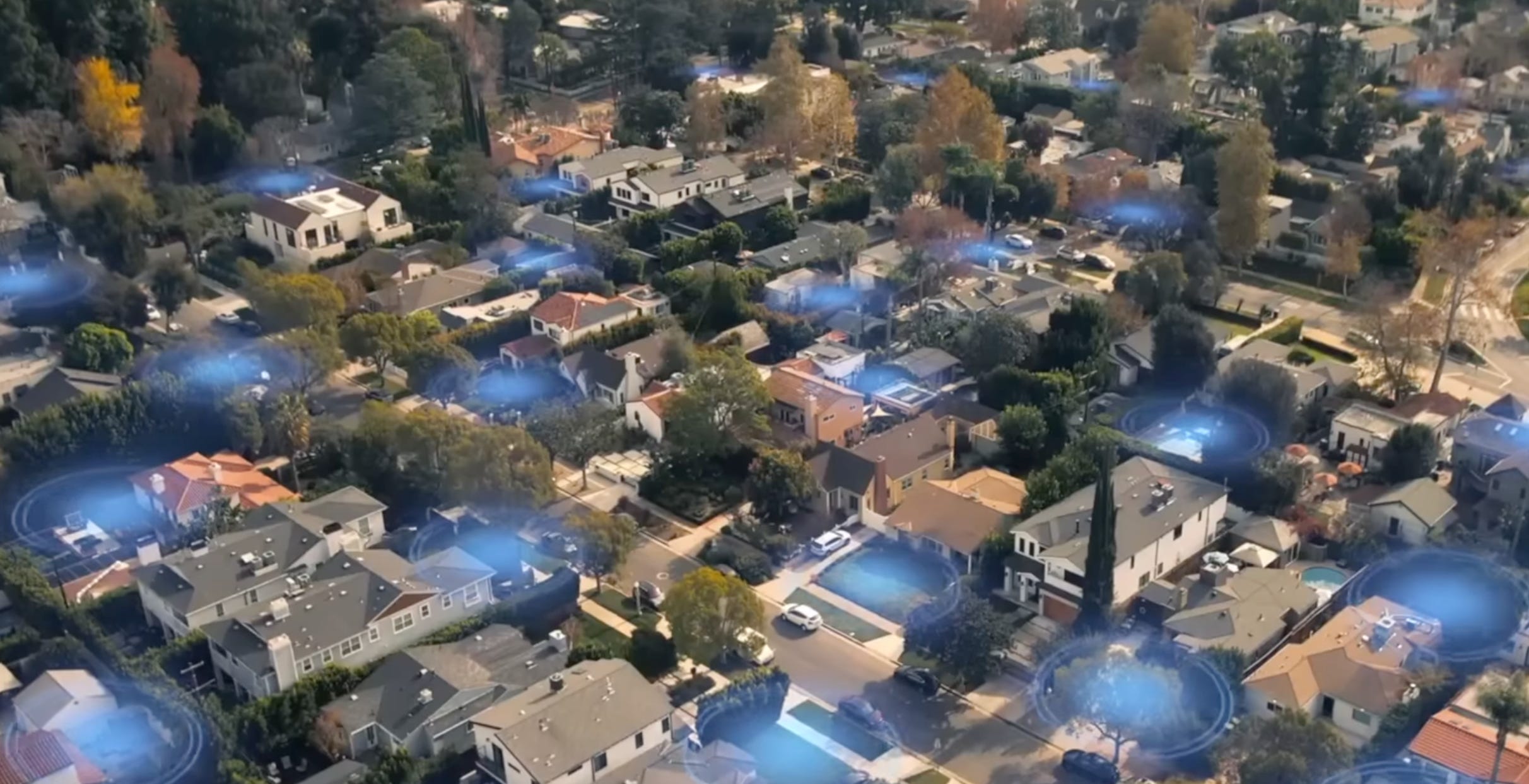
Many people were not just surprised but quite shocked and alarmed to learn that what they thought was merely their own personal security system now has the ability to link with countless other Ring cameras to form a neighborhood-wide (or city-wide, or state-wide) surveillance dragnet. That Amazon emphasized that this feature is available (for now) only to those who “opt-in” did not assuage concerns.
Numerous media outlets sounded the alarm. The online privacy group Electronic Frontier Foundation (EFF) condemned Ring’s program as previewing “a world where biometric identification could be unleashed from consumer devices to identify, track, and locate anything — human, pet, and otherwise.”
Many private citizens who previously used Ring also reacted negatively. “Viral videos online show people removing or destroying their cameras over privacy concerns,” reported USA Today. The backlash became so severe that, just days later, Amazon — seeking to assuage public anger — announced the termination of a partnership between Ring and Flock Safety, a police surveillance tech company (while Flock is unrelated to Search Party, public backlash made it impossible, at least for now, for Amazon to send Ring’s user data to a police surveillance firm).
The Amazon ad seems to have triggered a long-overdue spotlight on how the combination of ubiquitous cameras, AI, and rapidly advancing facial recognition software will render the term “privacy” little more than a quaint concept from the past. As EFF put it, Ring’s program “could already run afoul of biometric privacy laws in some states, which require explicit, informed consent from individuals before a company can just run face recognition on someone.”
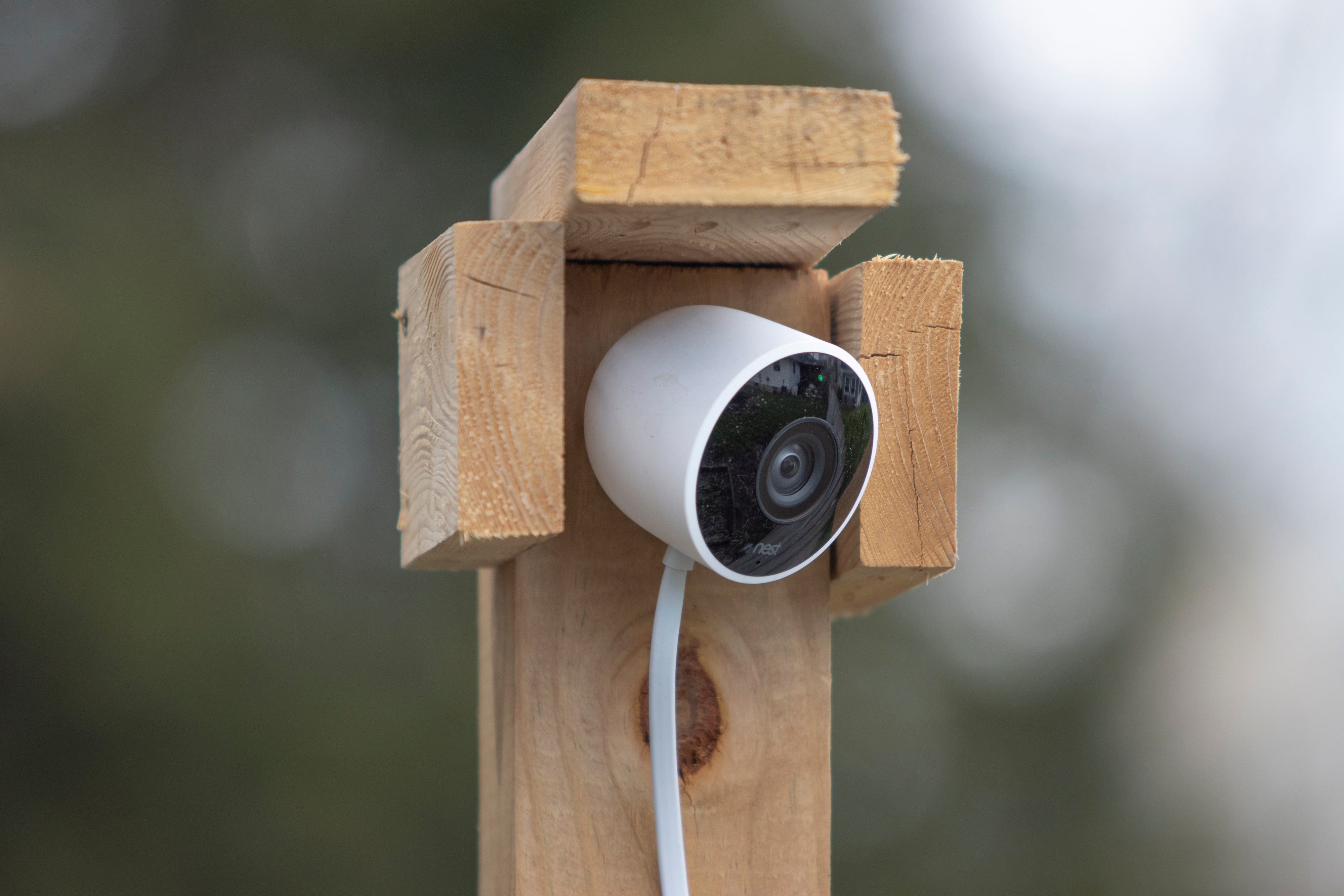
Those concerns escalated just a few days later in the context of the Tucson disappearance of Nancy Guthrie, mother of long-time TODAY Show host Savannah Guthrie. At the home where she lives, Nancy Guthrie used Google’s Nest camera for security, a product similar to Amazon’s Ring.
Guthrie, however, did not pay Google for a subscription for those cameras, instead solely using the cameras for real-time monitoring. As CBS News explained, “with a free Google Nest plan, the video should have been deleted within 3 to 6 hours — long after Guthrie was reported missing.” Even professional privacy advocates have understood that customers who use Nest without a subscription will not have their cameras connected to Google’s data servers, meaning that no recordings will be stored or available for any period beyond a few hours.
For that reason, Pima County Sheriff Chris Nanos announced early on “that there was no video available in part because Guthrie didn’t have an active subscription to the company.” Many people, for obvious reasons, prefer to avoid permanently storing comprehensive daily video reports with Google of when they leave and return to their own home, or who visits them at their home, when, and for how long.
Despite all this, FBI investigators on the case were somehow magically able to “recover” this video from Guthrie’s camera many days later. FBI Director Kash Patel was essentially forced to admit this when he released still images of what appears to be the masked perpetrator who broke into Guthrie’s home. (The Google user agreement, which few users read, does protect the company by stating that images may be stored even in the absence of a subscription.)

While the “discovery” of footage from this home camera by Google engineers is obviously of great value to the Guthrie family and law enforcement agents searching for Guthrie, it raises obvious yet serious questions about why Google, contrary to common understanding, was storing the video footage of unsubscribed users. A former NSA data researcher and CEO of a cybersecurity firm, Patrick Johnson, told CBS: “There's kind of this old saying that data is never deleted, it's just renamed.”
It is rather remarkable that Americans are being led, more or less willingly, into a state-corporate, Panopticon-like domestic surveillance state with relatively little resistance, though the widespread reaction to Amazon’s Ring ad is encouraging. Much of that muted reaction may be due to a lack of realization about the severity of the evolving privacy threat. Beyond that, privacy and other core rights can seem abstract and less of a priority than more material concerns, at least until they are gone.
It is always the case that there are benefits available from relinquishing core civil liberties: allowing infringements on free speech may reduce false claims and hateful ideas; allowing searches and seizures without warrants will likely help the police catch more criminals, and do so more quickly; giving up privacy may, in fact, enhance security.
But the core premise of the West generally, and the U.S. in particular, is that those trade-offs are never worthwhile. Americans still all learn and are taught to admire the iconic (if not apocryphal) 1775 words of Patrick Henry, which came to define the core ethos of the Revolutionary War and American Founding: “Give me liberty or give me death.” It is hard to express in more definitive terms on which side of that liberty-versus-security trade-off the U.S. was intended to fall.
These recent events emerge in a broader context of this new Silicon Valley-driven destruction of individual privacy. Palantir’s federal contracts for domestic surveillance and domestic data management continue to expand rapidly, with more and more intrusive data about Americans consolidated under the control of this one sinister corporation.
Facial recognition technology — now fully in use for an array of purposes from Customs and Border Protection at airports to ICE’s patrolling of American streets — means that fully tracking one’s movements in public spaces is easier than ever, and is becoming easier by the day. It was only three years ago that we interviewed New York Times reporter Kashmir Hill about her new book, “Your Face Belongs to Us.” The warnings she issued about the dangers of this proliferating technology have not only come true with startling speed but also appear already beyond what even she envisioned.
On top of all this are advances in AI. Its effects on privacy cannot yet be quantified, but they will not be good. I have tried most AI programs simply to remain abreast of how they function.
After just a few weeks, I had to stop my use of Google’s Gemini because it was compiling not just segregated data about me, but also a wide array of information to form what could reasonably be described as a dossier on my life, including information I had not wittingly provided it. It would answer questions I asked it with creepy, unrelated references to the far-too-complete picture it had managed to create of many aspects of my life (at one point, it commented, somewhat judgmentally or out of feigned “concern,” about the late hours I was keeping while working, a topic I never raised).
Many of these unnerving developments have happened without much public notice because we are often distracted by what appear to be more immediate and proximate events in the news cycle. The lack of sufficient attention to these privacy dangers over the last couple of years, including at times from me, should not obscure how consequential they are.
All of this is particularly remarkable, and particularly disconcerting, since we are barely more than a decade removed from the disclosures about mass domestic surveillance enabled by the courageous whistleblower Edward Snowden. Although most of our reporting focused on state surveillance, one of the first stories featured the joint state-corporate spying framework built in conjunction with the U.S. security state and Silicon Valley giants.
The Snowden stories sparked years of anger, attempts at reform, changes in diplomatic relations, and even genuine (albeit forced) improvements in Big Tech’s user privacy. But the calculation of the U.S. security state and Big Tech was that at some point, attention to privacy concerns would disperse and then virtually evaporate, enabling the state-corporate surveillance state to march on without much notice or resistance. At least as of now, the calculation seems to have been vindicated.
Read the original article

Comments
By dhbradshaw 2026-02-1516:4913 reply I really like this passage:
>It is always the case that there are benefits available from relinquishing core civil liberties: allowing infringements on free speech may reduce false claims and hateful ideas; allowing searches and seizures without warrants will likely help the police catch more criminals, and do so more quickly; giving up privacy may, in fact, enhance security.
> But the core premise of the West generally, and the U.S. in particular, is that those trade-offs are never worthwhile. Americans still all learn and are taught to admire the iconic (if not apocryphal) 1775 words of Patrick Henry, which came to define the core ethos of the Revolutionary War and American Founding: “Give me liberty or give me death.” It is hard to express in more definitive terms on which side of that liberty-versus-security trade-off the U.S. was intended to fall.
By roywiggins 2026-02-1517:284 reply I think the security/liberty tradeoff is actually often a false promise. You can end up trading away liberty for nothing at all. I don't like buying into this, even to say "liberty is better, we should do that instead" because it implicitly concedes that you would really get the security on the other side of the bargain.
And if you don't get the security you were promised, it's too late to do anything about it.
> "Those who would give up essential Liberty, to purchase a little temporary Safety, deserve neither Liberty nor Safety" -- Benjamin Franklin
The key phrase is "a little temporary safety". 250 years ago people understood that the "security" gains were small and fleeting, but the loss of liberty was massive and permanent.
FWIW, the context of the Franklin quote is him defending the ability of the legislature to tax a family that was trying to bribe/lobby the governor to do otherwise.
The quote is in defense of the government: WITTES: It is a quotation that defends the authority of a legislature to govern in the interests of collective security. It means, in context, not quite the opposite of what it's almost always quoted as saying but much closer to the opposite than to the thing that people think it means.
https://www.npr.org/2015/03/02/390245038/ben-franklins-famou...
By conartist6 2026-02-1612:21 That context didn't change the meaning at all for me.
Probably because Franklin most certainly thought himself to be writing on behalf of the people and was making a direct appeal that they assert their right to govern themselves rather than letting powerful private interests do as they wished.
That's not equally relevant everywhere the quote gets used, but it seems pretty relevant here, no?
By bluedel 2026-02-1614:39 I feel like that would only change your opinion of the quote if you originally equated it to "Government bad!", which is a thoughtless thought.
By b00ty4breakfast 2026-02-166:00 the phrase fits the modern usage, even if it's been decontextualized. kinda like "who watches the watchmen?" originally being about cheating wives bribing the folks keeping her locked up in the house.
By BobbyTables2 2026-02-164:57 Too bad Franklin didn’t just quote Spock:
“The needs of the many outweigh the needs of the few…”
(/s)
Thanks for educating us!
By Der_Einzige 2026-02-1610:041 reply This dynamic always happens with quotes and attempts to deploy the founding fathers in arguments. Most of the founding fathers (except Thomas Paine) were terrible, horrible, no good people. I’d have been a loyalist in that era.
By nathan_compton 2026-02-1611:151 reply Maybe I'm just America Pilled but I'll support almost anyone against a hereditary monarchy. The idea should be fundamentally disgusting to any self-respecting human being.
There's no government as effective at instituting necessary changes as a benevolent autocracy, nor any so effective at destruction as a malevolent one.
If our democracy is sufficiently broken, if supermajority voter policy preferences continue to be dismissed by both parties, it might be that we just cannot survive under the old Constitutional order. The Right's open move towards a post-democratic future, and the proceduralist Center's continued failure to fully utilize their popular mandate to fix things that need fixing, implicitly authorizes a Left to develop that is more obsessed with expression of the popular will and with good governance, than it is with a 250 year old bureaucratic structure and "norms". Norms of restraint are a consensual exercise, and cannot persist unilaterally.
The way things are going, the trajectory, make even most 20th century hereditary monarchies look pretty decent. Especially ones that devolve most power to parliamentary bodies.
By roywiggins 2026-02-1616:111 reply > There's no government as effective at instituting necessary changes as a benevolent autocracy
Autocracies have lots of issues around eg building a sufficiently capable bureaucracy that isn't too corrupt to do things. It can make it harder, not easier. Democracy can lean on democratic legitimacy, constitutional traditions, and a history of allowing power transitions without anyone losing their heads or launching a civil war over it. Those are all really useful things that autocracies have to cope without. It's not like it's easy mode.
By mapt 2026-02-1621:44 All of those can be mooted by the sort of dysfunction currently on offer.
Almost every bill for the past 15 years has been filibustered. More than half the Supreme Court is part of an organized partisan conspiracy, and a third has worked specifically fighting election laws to advantage their guy. The DHS stands as a rogue paramilitary that can be deployed when politically convenient as de facto martial law, the DOJ openly persecuting ethnically defined political opponents and daring Congress to do anything about it, when they're not trying to charge Congresspeople with crimes. People are being disappeared into concentration camps. We are unilaterally withdrawing from the military and economic empire that has served us since the 1940's, in the name of ethnic hatreds and Hitlerian brinksmanship. The economy now has more to do with the Fed chair than any pathetic exchange of goods and services we can string together.
This doesn't end well, and it's broken enough already that a return to Biden/Obama/Clinton type leadership couldn't possibly hope to fix it unless they can lock down leadership for the next couple generations; More damage can be done in a month than they can fix in four years. "Just win every election from now until the end of time" isn't a real strategy.
I don't know what comes next, but if we choose to burn the house down today rather than practice good maintenance, the next homeowner cannot succeed by employing good maintenance.
Similarly, if the neighbor burns your house down deliberately because he hates you, and you start the rebuild process without doing anything about your neighbor's existence, you shouldn't be surprised if you end up with more ashes.
By godelski 2026-02-1618:00
This is untrue.> There's no government as effective at instituting necessary changes as a benevolent autocracyThe world is so complex that a single person or group can adapt and develop fast enough. We've seen what happens to planned economies. Their ineffectiveness is not due to malevolence.
Distribution of power not only serves as a protection to autocratic takeover but allows the system to be more flexible. The concentration of power can make some things more efficient but you trade flexibility.
Aside, the original meaning of Franklin's words are less-inspiring but perhaps more-interesting.
He's saying the local democratic legislature must not give up its "freedom" to pass laws taxing the powerful Penn dynasty which almost owns Pennsylvania.
He wants to reject a deal offered by the Penns: A big lump of money for temporary military security now, in exchange for an agreement that they can never be taxed ever again.
By mathgradthrow 2026-02-1518:502 reply That's not an aside. The quote is pernicious because of its attribution to Ben. People invoke it without ever asking themselves if its true because they think of it as the hard won wisdom of a great man.
By bigbadfeline 2026-02-1519:301 reply > The quote is pernicious because of its attribution to Ben.
It's not pernicious for any reason because it's absolutely true in general, Franklin was simply using a general piece of wisdom to justify particular government actions.
Yes, using it that way was an improvisation and a bit of a stretch, but the real issue here is why he needed to resort to it - that's a rabbit hole that pretty much goes to the bottom of today's problems which we're handling in a much worse manner than him back then.
By mathgradthrow 2026-02-1614:37 What do you consider "absolutely true" or "in general" to mean?
By superb_dev 2026-02-1519:30 I don’t find that to be less inspiring
By roywiggins 2026-02-1518:06 Well, quite. And in an American Revolution context it's not like the colonies were notably less secure places to live after they gained independence.
By weaksauce 2026-02-1519:47 basically the patriot act was a big piece of temporary safety that never produced any.
By nkrisc 2026-02-161:10 When you've given up all liberty, there's nothing left to stop the security being used against you.
If you assume that the security side of the equation is a false promise, then you are not making a decision at all: choosing between liberty with no security, or no liberty plus no security (because it's fake).
And for me, it seems somewhat disingenuous to imply that a decision is being made when your premise belies that.
By roywiggins 2026-02-1523:341 reply It's not that security is fake, it's that giving up liberty doesn't naturally produce more security, and pursuing greater liberty doesn't necessarily erode security either.
It's not like pre-Revolutionary America was a notably secure place that inevitably see-sawed into a freer but insecure place afterwards.
As I said to the other respondent, I think it's important to justify the idea that both security and liberty can be achieved simultaneously.
By roywiggins 2026-02-1817:06 Equally, the idea that there is a tradeoff in some particular situation is frequently asserted without evidence. The quote from the article is "It is always the case that there are benefits available from relinquishing core civil liberties."
That is 1) presented without evidence and 2) almost certainly false. It is not always the case.
It's a false dichotomy. There are 4 options:
1. Don't give up liberty, give up security.
2. Give up liberty, give up security.
3. Give up liberty, don't give up security.
4. Don't give up liberty, don't give up security.
Number 4 is completely possible. It's just that people in power don't like it because it means they have less power. They want to pretend that only options 1 and 3 are available and ignore that they are actually offering option 2.
Your argument is with GP who proposed that the security might be false.
But I will say I don't think you should say "options," but rather "possibilities." "Options" implies that all four are actually available. I don't think you get to assume that 4 is possible without offering evidence.
By foxyv 2026-02-1919:42 It depends on context for sure. Without a specific case study you can't really say.
However, in general, they are not exclusive. This has been demonstrated fairly often. In fact, it is often the case that maximizing liberty leads to more security.
https://www.culturaldiplomacy.org/europeanamericanrelationsh...
https://www.securityanddemocracy.org/post/beyond-the-false-c...
By majormajor 2026-02-1520:571 reply We concurrently see failures on both the "attempts to preserve liberty" and "attempts to preserve security" front, so let's stop arguing about abstract principles.
Quotes are pointless, discussion should be limited to what's happening on the ground. For any given thing that happens, do we think that it, specifically, is helpful or harmful.
It's trivial to reverse that quote: we can, and have, pushed to keep the US population armed with increasingly-advanced personal weapons (in the name of liberty) without actually gaining any protection against authoritarian styles of government use of force or surveillance as a result. While just making civilian-on-civilian violence easier and more lethal.
> discussion should be limited to what's happening on the ground
Does anyone actually have any idea what's actually happening "on the ground?"
> without actually gaining any protection against authoritarian styles of government use of force
There are three weapons for every man, woman, and child in the USA. You may enjoy more of this protection than you realize.
> While just making civilian-on-civilian violence easier and more lethal.
80% of murders happen after an argument. More suicides happen by firearm than murders by a factor of 2:1. States with lower population densities like Alaska have 6x the suicide rate of states with higher densities like New York. There's a reason people aren't given these statistics.
By rob74 2026-02-169:11 > More suicides happen by firearm than murders by a factor of 2:1
According to https://www.pewresearch.org/short-reads/2025/03/05/what-the-..., this is true (if you squint) for 2023 (actually in 2023 murders were 38% of gun deaths, suicides and "others" add up to 62%, so 1.6 to 1), but the ratio varies widely for other years. According to the graph https://www.pewresearch.org/short-reads/2025/03/05/what-the-..., murders and suicides were much closer together in 2021 - after that, the number of murders has dropped, while the number of suicides kept increasing.
By master-lincoln 2026-02-1613:56 > There's a reason people aren't given these statistics.
What do you mean by that? You just gave people those statistics and they are widely available if people would want to look them up afaik.
Who should give other people statistics?
By watwut 2026-02-1612:50 > You may enjoy more of this protection than you realize.
Americans are not safer then people in other comparable countries. They get shot more often.
In particular, they are much more likely to be shot by cops. And one of the hardest thing a layer can do is to prosecute a cop for it - they are simply untouchable unless stars align just right.
By StopDisinfo910 2026-02-1518:233 reply I would like it a lot better without the mention to the "West", which, as usual, is a code word for: "I want to pretend my point extend outside the USA but I have absolutely no knowledge of how true that is. I don't intend to do any research because that would demand efforts from me so bear with my casual imperialism". Queue the purely American historical lesson following.
By StopDisinfo910 2026-02-1518:301 reply I guess it's cue like on cue but it's late on a Sunday. You will have to excuse my brain.
It wasn't a nitpick by the way. I deeply resent American using "the West" like if my own country and culture was somehow fungible in their experience. They are not. We don't have that much in common. That doesn't include a legal tradition, or a conception of what freedom of speech should be, neither does it include values or history.
Edit: Enjoy downvoting me. It doesn't make what I said any less true. If you think the various European countries can be grouped with the US in a coherent whole, you are deeply deluding yourselves. They can't even be lumped together.
It would probably help if you made a more specific point rather than just ranting in very vague terms.
Grouping terms like "the west" can be broad enough to include over half of all living humans or so narrow that it applies to a small village.
It is, admittedly, not a particularly useful term, but it's not like americans are reaponsible for it.
By StopDisinfo910 2026-02-1519:483 reply Where have you seen it used outside of Americans pretending their culture is somehow a standard and NATO apologists? The world doesn't even exist as such in my own language. It's a staple on Hacker News and nearly always for the bad reasons. I'm supposed to politely nod and shut up when people are casually erasing my culture?
What even is a "nato apologist"???
> Where have you seen it used outside of Americans
Well, there was this minor thing called "the western roman empire" for a few years, so that might be a starting point.
I am fascinated to learn how a claim that westerners "prefer liberty over security" is somehow erasing your culture though.
By marcus_holmes 2026-02-161:321 reply The Western Roman Empire has nothing to do with "the West". I think it's fascinating that that's even suggested.
I lived in Germany for a while. Germany is definitely a part of "the West", have been the defining border with "the East" in the Cold War. Germans do not share a cultural viewpoint about liberty and security with the USA. So claiming that westerners "prefer liberty over security" while also including Germans (and others) in the definition of "the West" is absolutely erasing their culture.
> The Western Roman Empire has nothing to do with "the West". I think it's fascinating that that's even suggested.
I got that bit from wikipedia, it amused me.
As for germans, if they do not share such a viewpoint (and now I want evidence either way), the claim about the west is merely wrong, not "cultural erasure".
By wredcoll 2026-02-1618:41 I mean, at some level, every single human is different, at another level we're all the same. I'm not sure what we're proving here.
The original claim was something about liberty and security and no one in this chain seems interested in bringing in any actual specifics about who thinks what where.
By marcus_holmes 2026-02-161:25 I (British/Australian) use it, but not in a cultural sense. I use "the West" when talking about military or economic matters.
I generally prefer the term "Anglosphere" to refer to only the bits of "the West" that share that cultural viewpoint when I'm discussing cultural matters. It's not perfect, but it's useful.
Given the widening gap between the USA and Europe (and Canada) in economic and military matters, I'm not sure how much longer "the West" is going to be useful.
By kortilla 2026-02-1521:22 What are you talking about? Nobody is erasing your culture except for maybe you because you aren’t even talking about your culture. You’re just ranting about Americans.
By 1718627440 2026-02-1519:38 Greek philosophy did not happen in the USA and actually predates it quite a bit.
Universal human rights is a very widespread belief and concept, extending to all continents and many, many cultures. It's not hard to understand why.
If you'd said "isn't just a western thing" I would have definitely agreed, but this claim seems a bit unlikely.
By mmooss 2026-02-1521:41 Just look around the world; they are the norm: East Asia (Japan, South Korea, China - Taiwan, Hong Kong, June 4 on the mainland); North America; South America, almost all of the region; Europe; Australia, NZ, Indonesia, the Phillipines; South Asia (India, and I think they are enshrined if not enforced in Pakistan and some others).
What's mostly missing is the Middle East, Central Asia, parts of SE Asia, and large parts of Africa - though there are Benin, Botswana, Kenya, and many others iirc.
By logicchains 2026-02-1519:044 reply No it's not. There are no human rights for the lowest castes in Hinduism, there are no human rights for polytheists in Islam, there were nothing like the modern idea of human rights in Japan or China before they westernized. That's why the west was able to leapfrog other nations economically (and hence militarily), because it was the first place where people had enough rights for something resembling a modern economy to develop.
By mmooss 2026-02-1521:37 > That's why the west was able to leapfrog other nations economically
I tend to agree, though it's of course hard to prove. However, I'm talking about the present, not the past.
> There are no human rights for the lowest castes in Hinduism
I said it is "very widespread", not everywhere. Perhaps the confusion is the word Universal: that doesn't mean everyone believes it (false for any belief), but that everyone has the rights, whether or not they know or can exercise them. It's the concept that starts the Declaration of Independence: All are created equal, and all have inalienable rights.
> there were nothing like the modern idea of human rights in Japan or China before they westernized
I am talking about the present, where it's adopted in East Asia (including in China - Taiwan, Hong Kong (though suppressed now), June 4 on the mainland), throughout Latin America, Europe of course, parts of Africa, the Anglo world, etc.
> there are no human rights for polytheists in Islam,
There is no country called 'Islam'; if we go by scripture, nobody has human rights. The idea that all practicioners of Islam have the same beliefs is as true as saying all practicioners of Christianity do - and look at HN.
In Indonesia, the largest majority Muslim country, there are human rights, also in India, with the largest Muslim population (but not the majority). I think Pakistan and some South Asian countries probably have them enshrined.
By yencabulator 2026-02-163:331 reply And there were no human rights for the slaves of the Western nations.
By synecdoche 2026-02-1619:201 reply As opposed to slaves in non-western nations? May I remind that slavery was not exclusively a western thing, and that there are more slaves today than there ever was, in absolute terms, almost none in western nations.
By yencabulator 2026-02-1619:36 The parent comment was making it seem like the West is some kind of beacon of virtue.
By whattheheckheck 2026-02-1519:16 If you don't give someone a reason to live they ain't gonna slave away very hard for you
I mean, nobody knows why "the west" (whatever that is) leapfrogged anyone, and this is a fairly small period in terms of total human history.
Things people did, sure, but not why they did them here and not there is a bit trickier. There's a variety of theories, easy access to coal is my favorite, but some people like to blame the magna carta or something.
By kortilla 2026-02-179:21 Check out Destiny Disrupted. It covers how the Middle East and China both had technology opportunities much earlier but were missing the right economic incentives at the time to handle the disruption to the labor force that came with the Industrial Revolution.
Essentially the major societies before ended up in local maximums because they didn’t have the ruthlessness of capitalism or the economic desperation to adopt technologies that in the short term would unemploy large portions of society and wipe out old power structures.
By Der_Einzige 2026-02-1610:081 reply Jared diamonds an idiot and “guns germs and steel” is among the worst books written in human history - right up there with Republic and whatever the hell sam Harris is doing.
By wredcoll 2026-02-1618:38 I hope I wasn't coming off as quoting/endorsing that book, but easy access to a major fuel source has got to be at least somewhat relevant
And any leapfrogging done there hardly has anything to do with human rights I guess, so I'd say the poster above has a really bold claim here
It's not an unusual claim: Freedom breeds innovation - people are not only free to think for themselves, to ignore the orthodoxy and established power, but they are raised and encouraged to do it and admired for it (to a degree).
I think it's accurate to say that all the wealthiest (per capita) economies in history - i.e., the wealthiest economies over the last ten years - are in free societies.
By zelphirkalt 2026-02-1519:15 So not just to the west?
By pjc50 2026-02-1610:21 Yes, but: crucially, not in the USA. The EU human rights framework includes non-citizens, because they are still humans. The US constitutional rights framework does not include non-citizens, which is why ICE have free rein to abuse them.
By crazygringo 2026-02-1521:52 > “Give me liberty or give me death.” It is hard to express in more definitive terms on which side of that liberty-versus-security trade-off the U.S. was intended to fall.
No, that's a gross misrepresentation of what he said and meant. Patrick Henry was referring exclusively to political liberty from British colonial rule. There is no sense whatsoever in which he was referring to civil liberties against domestic rule. It didn't have a single thing to do with "security".
> But the core premise of the West generally, and the U.S. in particular, is that those trade-offs are never worthwhile.
Also totally false. This is the core premise of libertarians in the West, who are, and always have been, a minority. It is not, and has never been, the "core premise" of the West or the US. Or else, quite obviously, we wouldn't have the constant tension between these liberties and the need for security. The idea that "those trade-offs are never worthwhile" is not a core American idea. We make those tradeoffs every single day. And continue to argue about them, e.g. over what degree of gun control is proper after each school shooting that happens.
By firen777 2026-02-163:39 >giving up privacy may, in fact, enhance security
When the check and balance got tipped over, all this promised "security" will only surface when it benefits the regime.
I'm still amused by a certain ccp propaganda video my parents consumed that boast about how quickly the cctv networks helped catch a thief who stole a foreign tourist's phone, yet those cameras would also conveniently stop working at a specific day whenever a highschooler went missing in the campus.
All the prerequisite for a similar dystopia is already in place in the US and there is may be one more chance to fix it, although I wouldn't hold my breathe.
By godelski 2026-02-164:58 For those unfamiliar it's worth learning about Blackstone's Ratio. Blackstone was extremely influential to the writers of the US constitution.
I think it should come natural to engineers because I see it as similar to failure engineering, but for the legal system. When you engineer a bridge, building, or even a program you build failure modes into them. Not to cause them to fail but to control fails. A simple version is "fail open" vs "fail closed". A bank safe that fails, fails closed. It is locked and you need to drill it open. Same with an encrypted harddrive but no drill... But a locked door in a public building will typically want to fail opened, least you trap people inside during a fire. A more complex example is the root of a conspiracy. When a tall building collapses you tend to want it to fall in on itself so it doesn't take out neighboring skyscrapers...
So Blackstone's Ratio (and Franklin's recounting) is similar. It asks "which mode of failure is better? That innocent man are condemned or that guilty men go free?" This is a question we must all ask ourselves least we back ourselves into a corner. There's no perfect solution. We don't want failure, we should reduce it as much as possible, but if/when it fails, which outcome do you prefer?
I'll link the wiki but the topic is so famous you'll find a million and I'm pretty sure it's taught in every law school in America
By mathgeek 2026-02-1612:59 > It is hard to express in more definitive terms on which side of that liberty-versus-security trade-off the U.S. was intended to fall.
While I agree with Henry, and intend for _my_ life and social impact to fall there, "where the U.S. was intended to fall" is a misnomer here. That quote was one man's opinion. The U.S. is millions of living beings who, if they have liberty, should get to do whatever they want with it (which in itself is an oxymoron).
I think part of the problem is a temptation to believe that we can have out cake and eat it too.
If the people on charge of deciding when to use the cameras were morally perfect, we have all the upside and none of the downside.
The problem is we live in a fallen world and that will simply never work.
Nevertheless it is a siren song that causes us to repeatedly make the wrong trade
By whycombigator 2026-02-1619:53 "we live in a fallen world"
derp
By ryanmcbride 2026-02-164:241 reply we could have liberty and privacy and security if the people in charge wanted us to. But they don't and they've convinced enough people that they don't either.
It's not liberty if you can only have it if the people in charge want you to.
By ryanmcbride 2026-02-166:33 I agree
By seanmcdirmid 2026-02-163:431 reply If the police actually did their job, took property crimes seriously and would bother with the suspicious guy high on fent looking into kids bedroom reports seriously, then we really wouldn't have to be setting up our own surveillance to make up for lacking local government services. But here we are, I'm not sure why libertarians think we don't have a right to defend ourselves (using new tech to make up for a lack of policing) when the city won't?
I frankly see it as a liberty to be able to use this tech, and it would be tyranny to prevent us from using it.
By FireBeyond 2026-02-1618:201 reply > and would bother with the suspicious guy high on fent looking into kids bedroom reports seriously
Wuh? I was a paramedic who probably has responded to nearly 1,000 fentanyl abuse patients.
I've never seen one who is all busy-beavering looking for homes to surreptitiously spy in kids bedrooms.
Symptoms of fentanyl use include: extreme drowsiness, poor responsiveness, nodding off, profound confusion and inability to focus on even simple acts, delayed reactions, poor body control.
The idea of a bunch of fent users sneaking around neighborhoods trying to be pedophiliac perverts seems far more right-wing fearmongering than anything based in reality.
By seanmcdirmid 2026-02-1619:33 I live in a dense neighborhood, and my kid's bedroom is on the bottom floor. So when they are scalking around looking for something to steal sot hey can buy more drugs, it happens anyways. I'm sure that stealing things is their actual focus, its just an accident of house construction that they wind up at my kid's bedroom window.
> The idea of a bunch of fent users sneaking around neighborhoods trying to be pedophiliac perverts seems far more right-wing fearmongering than anything based in reality.
This is why I hate the far right and the far left. The far left is like "we should just let the fent users steal all of our stuff because they are humans to! Let them poop freely on the sidewalks!", the far right are like "Those are all illegal immigrants lets deport them to El Salvadore". As a moderate, I hate both sides. It is just too bad that Trump is in power right now so the far left gets a huge electoral boost in local elections.
By homeonthemtn 2026-02-1612:44 [dead]
By jaco6 2026-02-1517:01 [dead]
Unfortunately for us all, the assault on liberty even done of the “normies” have started noticing recent, is only the latter stages of this assault on on America that has been going on for arguably 180 years ago.
Many in American history have noted that America is a kind of natural fortress protected by ocean moats. What that assumption just did not take into account is how America’s enemies would take action against America with that assumption taken as granted. It has come in the form of endless amounts of infiltration, subversion, corruption, and pollution… as any half-witted strategist and saboteur would have done. America was simply not sophisticated enough to realize that massive threat, because the leaders relied on that assumption that the USA is an impenetrable fort; never considering what happens if your fort is infiltrated through the many different means you open yourself up to being infiltrated.
America, a genuine America or whatever one can scrape together to consider as such, not just one that emulates and imitates like some kind of container cult, is really not long for this world. Another 20 years and Americas simile stops existing in anything but name only, if that, since there’s not even any reason or incentive anymore to keep the name out the branding at that point.
What do we call this place post America? Maybe we just come right out and just call it Oceania.
By pjc50 2026-02-1610:39 The problem is there are two Americas, and always have been. At one point they were clearly separated and had a civil war, but really they exist in overlapping spaces all the time. One is the America of the Declaration of Independence and all the propaganda believed by flag-saluting schoolchildren - some of that is real some of the time. The other is the America that South America is more familiar with, the country responsible for banana republics and endless War on Drugs violence, the America of plantations and exploitation.
The problem America(complimentary) is currently facing is the rebound of America(derogatory). It has elected its own Peron, and is turning into a dysfunctional South American country, driven by exactly the same forces.
Sorry, name's taken.
I know you're making a point by linking it to 1984, but Oceania is a real name for a continent.
By Der_Einzige 2026-02-1610:101 reply The most bootlicking anglos in the world are the Australians , despite the extreme competition that NZ and the UK give them. The Orwellian definition IS the real name.
By Nursie 2026-02-1614:13 Whatever. It’s still taken so you can’t use it for the Fascist States of America.
By hermannj314 2026-02-1517:147 reply We have a branch of government called Congress, here are some things they used to do that made it a crime to read your mail or listen to your phone calls.
1. Postal Service Act of 1792
2. Electronic Communications Privacy Act (ECPA) of 1986
Anyway, Facebook can read your DMs, Google can read your email, Ring can take photos from your camera.
We can very easily make those things a crime, but we don't seem to want to do it.
By ProllyInfamous 2026-02-1517:363 reply 3. Video Rental Protection Act (1988)
>we don't seem to want to
Congress protects only itself and its actual constituents — wealthy corporate persons.
----
Citizens United (2012) and the surveillances themselves make this monitoring self-capturing: the only way to prevent it is to convince most people to not install, but most people want the installed benefits.
Even getting your neighbors to re-position their Ring cameras (which they have every right to install) can become very difficult.
After city councils individually ban Flock-like CCTV traffic monitoring within their jurisdictions, their police can (and often do) still access neighboring jurisdictions' to monitor border crossings. You can't escape This System, even without license plates nor cell phones.
----
Term Limits now? end Citizens United. release The Files!
By pocksuppet 2026-02-1518:502 reply The Video Rental Protection Act was passed when a video rental employee blackmailed a congressman and there was no law against it. So it's clear how to make congress write new privacy laws.
By hn_throwaway_99 2026-02-1519:09 That doesn't appear to be accurate, at least from the Wikipedia article.
Robert Bork (sorry to add my personal commentary but an absolute shit stain of a human being) was nominated for the Supreme Court (which, thankfully, he always not confirmed), and a reporter went to a video rental store and asked for his rental history, which there was no law against. The published article didn't include much, as Bork hadn't rented any particularly salacious material, but there was bipartisan outrage that this had occurred.
Just goes to show how far we've fallen when there was once bipartisan outrage over accessing your Blockbuster rental history, when tech giants now have 10 times as much surveillance on you - your 1 am "shower thoughts" in your search history, all the websites you've visited, all your social media posts, and even social media posts about/including you posted by someone else, everything you've ever commented on a blog forum, your location history, etc.
By ipython 2026-02-1519:00 Psst anyone at Covenant Eyes[0] want to sign up for the obvious assignment here??
[0] https://www.rollingstone.com/politics/politics-news/mike-joh...
> Even getting your neighbors to re-position their Ring cameras (which they have every right to install) can become very difficult.
In Germany it's prohibited by law to point your private surveillance camera to public spaces like the boardwalk, no recording of these areas is allowed. I think thats the way it should be. Unfortunately in some areas (e.g. train stations) it is allowed.
By JCattheATM 2026-02-160:175 reply You'd prefer train stations don't have CCTV? What about when an attack happens?
That’s what this ENTIRE conversation is about… the (ostensible) trade off between surveillance and security.
In the case of an attack, I’d wish for a gendarme not a recording that would let me relive the experience.
By JCattheATM 2026-02-161:141 reply Right, and I was saying it's wrong not to want surveillance in a super public area like a train station.
A gendarme is worse in every way.
By jojomodding 2026-02-163:251 reply The gendarme might actually arrest the attacker. The security camera will do nothing (but record). And having the policeman standing there is about as much a deterrent as a "Smile--You're Being Recorded" sign.
By JCattheATM 2026-02-163:35 > The gendarme might actually arrest the attacker.
So might the cops we already have in such places.
> The security camera will do nothing (but record).
Exactly as intended.
> And having the policeman standing there is about as much a deterrent as a "Smile--You're Being Recorded" sign.
This seems like a weird thing to say. Cops are more of a deterrent than a gendarme.
If I had a choice, I think I’d prefer not to have my death recorded and viewed by many strangers.
By JCattheATM 2026-02-163:15 Such footage generally isn't viewable by the public unless it serves the public good.
By ProllyInfamous 2026-02-160:461 reply I'd argue they should be better positioned, to minimize off-railroad property intrusion.
By JCattheATM 2026-02-160:541 reply They still need to capture incidents in the station itself.
This argument justifies CCTV surveillance of all public places.
Is that what you intend to be arguing for? In any case, there needs to be more nuance in the discussion than a one-liner.
I think the quantity of surveillance matters. When it’s just a few places, then it’s a minor intrusion on liberty. When it’s a lot of places, it’s a major intrusion that will facilitate the (further) rise of authoritarianism.
By JCattheATM 2026-02-161:161 reply > This argument justifies CCTV surveillance of all public places.
Well, yeah, I think that was super obvious, no?
> In any case, there needs to be more nuance in the discussion than a one-liner.
Not really. Super public busy places like train stations ought to be surveilled. The benefits far outweigh any cons.
There is far more nuance than this.
What counts as a "super public busy place" ? The airport? The bus terminal? The local library? All major roads that experience rush hour traffic?
Who is the person who says where the cutoff line is? What if that authority wants to move the line to include everything? Or nothing? Do they even need to provide notice to the public of their actions?
Who should be able to access to all this footage? Public? Government investigative branches only? What about the system administrators?
Does this footage require attestation to prove it's legitimacy in a world where AI can generate footage?
How long should this footage exist for? Do I have to trust not just current admins and their superiors but all the people who may be in those roles in perpetuity? IE do I have to trust people who haven't even been born yet?
Is it allowed to be centralised, so people can easily be tracked from one site to another for every step outside their house? Or should each site have separate data housing with access terms to match so that tracking a person is a significant task?
.. ..
There are a lot of concerns. You may argue that there isn't a lot of nuances because you have a set idea of how it should all go. But others may differ.
By JCattheATM 2026-02-163:141 reply > There is far more nuance than this.
There's just....not. It's a pretty well established concept by now. For almost 50 years or so.
> What counts as a "super public busy place" ? The airport? The bus terminal? The local library? All major roads that experience rush hour traffic?
Yes to all of these.
> Who is the person who says where the cutoff line is?
Not a person, but a sound methodology ideally. Kind of like what we've mostly been doing even if it isn't formalized.
> What if that authority wants to move the line to include everything?
Yes, the slippery slope is a problem, agreed. That's why we need to be vigilant in responding to government plans.
> Do they even need to provide notice to the public of their actions?
In a civilized democracy, they should.
> Government investigative branches only?
Yes, pretty much.
> What about the system administrators?
Not if it can be avoided.
> Does this footage require attestation to prove it's legitimacy in a world where AI can generate footage?
No.
> How long should this footage exist for?
3 - 6 months is typically standard.
> Do I have to trust not just current admins and their superiors but all the people who may be in those roles in perpetuity? IE do I have to trust people who haven't even been born yet?
You have to trust the system is accountable.
> Is it allowed to be centralised,
Ideally, no.
> Or should each site have separate data housing with access terms to match so that tracking a person is a significant task?
Bingo.
> There are a lot of concerns. You may argue that there isn't a lot of nuances because you have a set idea of how it should all go. But others may differ.
I'd argue your concerns have already been addressed by current systems that have worked fine for decades.
> I'd argue your concerns have already been addressed by current systems that have worked fine for decades.
The issue is that times are changing. "Worked fine for decades" doesn't apply to the Ring Doorbell or Flock. Or that authorities exactly want to have all footage in the one place, from train stations too.
Modern computers allow for scaling of capabilities that are only tolerable at all when limited in number.
IE the capability to track an individual's every movement is tolerable if it is limited in number, has oversight, and only used by appropriate authorities against bad people that everyone can agree are bad.
But being able to track minority groups en masse as modern systems are capable of is clearly an issue.
I see your parameters to the above questions as mostly reasonable although I'd rather not have the cameras everywhere in the first place. But do you think even your reasonable seeming desires are being adhered to?
I don't.
By JCattheATM 2026-02-164:241 reply I'm not arguing for mass surveillance, I'm arguing for keeping surveillance in busy places which as you admit has worked well for decades. I'm against the Ring/Flock dystopian nightmare as well.
> But do you think your desires are being adhered to?
No, but I think an apathetic population are the problem, and I don't know how to solve it.
I think we are largely in agreeance here.
It was the thing about "nuances" that bugged me mostly. The nuances determine whether the benefits outweigh the cost.
Appropriately managed isolated systems are fine. Dystopian nightmare is not.
.. and the apathy might doom us all. Thank you for an interesting thread of conversation.
By JCattheATM 2026-02-164:50 > and the apathy might doom us all.
That, and the eagerness for misinformation that fits with preconceptions.
> Thank you for an interesting thread of conversation.
Likewise!
The CCTV won't do shit to stop me from being attacked, it's a camera, not a cop. It's only useful for figuring out who to blame after the fact.
But there are other ways that we could figure out who to blame after the fact that don't require everything you will ever do to be recorded, forever.
By JCattheATM 2026-02-163:151 reply > But there are other ways that we could figure out who to blame after the fact that don't require everything you will ever do to be recorded, forever.
No one said anything about retaining footage forever.
What are your suggestions for help finding an attacker without CCTV footage?
> No one said anything about retaining footage forever.
It's inevitably what happens.
By JCattheATM 2026-02-1613:211 reply It doesn't have to be, but that brings us back to the problem being an apathetic or misinformed population.
So, what you propose only works if people weren't people..?
I'm going to have to do a hard 'hell no', in that case.
By JCattheATM 2026-02-173:47 Well, not just what I propose but a lot of aspects of society would be improved if we could subject people to mandatory reeducation and/or limit who gets to vote. Even just requiring a college degree to vote, or a simple quiz testing knowledge of what is being voted on would do wonders.
By like_any_other 2026-02-1520:322 reply How would term limits help? Without term limits, congressmen can be judged by their voting history. With them, we get always new batches of congressmen, while lobbyists stay the same and consolidate their power.
It's so easy to get rid of a congressman you don't like with term limits. But why do you think, on average, his replacement would be better? The replacement would only be more unknown.
By wat10000 2026-02-162:19 One problem is that seniority confers power. Throwing out a long-serving incumbent substantially reduces your district’s effective representation.
That could be improved by getting rid of de jure preferential treatment for things like committee memberships. You’d still have informal power from seniority though.
By ProllyInfamous 2026-02-160:48 I think long-term ("establishment") politicians are more-inclined to have been bought-out; new blood is more likely to make new alignments, churning up the dirty space that is politics.
Lesser of two evils sort of thought process...
Its a nice outrage wave, but I have very hard time believing this will be a major topic in 2 weeks. People simply don't give a fuck en masse.
Accept that many folks are built differently than you and me and stuff like actual freedom you may be willing to lay your life for may be meaningless fart for others, especially when its not hurting them now. For example US folks voted current admin willingly second time and even after a full year of daily FUBARs the support is still largely there. If even pedophilia won't move some 'patriots' then reading some communication doesn't even register as a topic.
Also, anybody actually concerned about even slightest privacy would never, ever buy such products, not now not a decade earlier. Ie for my family I don't even see any added value of such devices, just stupid fragile something I have no control over, but it sees everything. Why?
These comments appear everywhere, as if people never made changes. Look at the enormous changes prior generations have made. Look at the changes from the conservative/MAGA movement, #metoo, and the George Floyd protests. The claim doesn't stand up to any examination.
Comments like these are a distraction. All we need to do is get to work. If people took action every time they felt like posting these comments, we'd get a lot done.
By cheschire 2026-02-1518:57 "There is a time when the operation of the machine becomes so odious, makes you so sick at heart, that you can't take part! You can't even passively take part! And you've got to put your bodies upon the gears and upon the wheels ... upon the levers, upon all the apparatus, and you've got to make it stop! And you've got to indicate to the people who run it, to the people who own it, that unless you're free, the machine will be prevented from working at all!"
Well, except that you have debts like mortgages and car loans to pay off. And your kids need to participate in extra-curriculars so they can get into a good school, and those cost money. And theaters are out of fashion now, so you'll need to buy that 80" TV with the surround sound so you can have a theater at home. And your shows are now on 6 different streaming services so that'll cost a little extra each month. And life really is easier with AI, but they all have strengths and weaknesses so you'll probably want to pay for 2, if not 3 of them. And your fast fashion gets threadbare after 20 or 30 washes so you'll need to regularly order 3 or 4 replacement shirts so you can send back the 2 that don't fit quite right.
Anyways back to the gears and whee.... oh look a squirrel!
By mschuster91 2026-02-1518:582 reply > Look at the changes from the conservative/MAGA movement, #metoo, and the George Floyd protests.
Which changes? metoo certainly didn't change much, the George Floyd protests also led to nothing, just look at how ICE has been executing US citizens in the last months. In 2025 alone, before Renee Good and Alex Pretti, ICE murdered 32 people with zero accountability [1].
[1] https://www.theguardian.com/us-news/ng-interactive/2026/jan/...
By iugtmkbdfil834 2026-02-1520:081 reply << ICE has been executing US citizens
Shot. Killed. Executing is a ridiculously inaccurate framing bordering on rage baiting. And that is before we get to whether Pretti or Good were committing felonies, when they were willfully obstructing federal agents from doing the job they were assigned.
By mschuster91 2026-02-160:071 reply > when they were willfully obstructing federal agents from doing the job they were assigned.
Even if one assumes that to be true: there might have been a case for an arrest, but not for firing into a moving vehicle that is forbidden even under ICE guidelines, and certainly not for unloading a whole magazine worth of ammunition into an unarmed person.
I stand by my judgement: both cases were extrajudicial killings and clear enough in their intent to be called executions.
Good hit him with her car and he is law enforcement. She should have put her car in park and surrendered to the officers as they were instructing her to do. The agents and the Goods both didn't appear there in the street out of a vacuum, clearly she was there to obstruct. Seemed like Good was afraid and chose to flee consequences.
Pretti may have had an accidental discharge of his gun, which he took to a confrontation with law enforcement. Sad and foolish way to go out, seemed like a suicide by cop situation to me.
Everything I just wrote is opinion, just like everything you wrote. Who is right? Maybe neither of us, it's complicated/messy.
Considering only the timing of these events, I conclude this ice stuff is poorly concocted psyops meant to enrage people and distract from other news.
By convolvatron 2026-02-1614:391 reply if government agents can kill people on their own authority, without following due process, when they aren't threatening the safety of anyone, without any investigation, then all the other freedoms you supposedly have are useless. I would hardly call that a distraction from real issues.
By dwoldrich 2026-02-1619:36 She hit him with her SUV. She acted first. He was the authority, not Good. On whose authority? 80% of the electorate, that's who.
Defund the police is a loser latest craze issue engineered by scoundrels, no matter how you package it.
Regarding conservatives/MAGA, if you're saying the US hasn't changed dramatically since 2016 then I don't know what to say to you.
And I think you're misremembering the world before #metoo and George Floyd. Regarding the latter, police used to widely behave like ICE; now it's anathema - at least in cities. None of them help ICE afaik.
The conservatives like to preach hopelessness to their enemies - for obvious reasons, an age-old tactic - saying things like protests accomplish nothing (obviously false), these movements did nothing. The wierd part is, their enemies have picked up that argument and make it themselves. They simply and bizarrely have disarmed themselves, but they had and have the power the entire time.
By mschuster91 2026-02-160:151 reply > Regarding conservatives/MAGA, if you're saying the US hasn't changed dramatically since 2016 then I don't know what to say to you.
That is precisely why I didn't mention these.
> Regarding the latter, police used to widely behave like ICE; now it's anathema - at least in cities. None of them help ICE afaik.
They still kill people en masse [1], still overwhelmingly non-White people, and the number only increased over the years. It's good that police and National Guards (at least in Minneapolis) are on the side of the people, but as a system, police in the US is still loving to kill people.
And the GOP had DC tear apart the last visual reminder, the Black Lives Matter road mural [2] under extortionist threats.
> The wierd part is, their enemies have picked up that argument and make it themselves. They simply and bizarrely have disarmed themselves, but they had and have the power the entire time.
Similar to the Epstein Files, what should have happened in response to metoo and George Floyd/BLM was action that went beyond symbolism. Actual prosecution and judgement of people found to be in violation of the law and making sure that the conditions leading to these events will not repeat. But that was not done - movie sets got intimacy coordinators, Washington DC the BLM mural... while Weinstein got at least one conviction overturned on technicialities and Chauvin got moved to a low security prison [3].
Of course particularly the young generations are angry. Absolutely vile and horrible things can happen without any impactful action afterwards. And that's before we even go into the mess that is the Epstein Files, with Maxwell hoping for a pardon of all things after being moved to a minimum security facility already [4]. She does not deserve even one single day in freedom in her life again. Or before we touch the mess that is Jan 6th 2021, with Trump handing out pardons like others hand out candy [5]. Attempt a fucking putsch and get off scot free? WTF is this shit? In many other countries, putschists get hanged in the streets, as a warning sign to others.
To sum it up: there have been no meaningful results and changes from either of these events. And that is why there are so many voices on the progressive left calling for the removal of, amongst others, Chuck Schumer and other high-ranking Democrats in favor of people like Mamdani on one side, and mob justice aka the plumber's brother on the other side. Some still have faith in democracy itself but just demand better representatives and leaders, but others deem executing people like insurance CEOs the only way forward. And personally? I don't condone acts of violence like this, but I understand where they are coming from - a completely shattered trust in the ability of the government to hold bad actors accountable and improve the lives of the wide masses.
[1] https://www.statista.com/statistics/585152/people-shot-to-de...
[2] https://www.npr.org/2025/03/08/nx-s1-5321872/dc-black-lives-...
[3] https://www.npr.org/2024/08/21/g-s1-18339/ex-officer-convict...
[4] https://www.bbc.com/news/articles/czd049y2qymo
[5] https://en.wikipedia.org/wiki/Pardon_of_January_6_United_Sta...
To say there are still problems doesn't mean there isn't significant progress. Otherwise, there is no significant progress anywhere in anything.
> what should have happened in response to metoo and George Floyd/BLM was action that went beyond symbolism.
There was and is:
Laws have been passed in many places protecting rights. Oppressive systems like bail have been reformed in many places. Progressive prosecutors were elected around the country - some still are in office. Even the other prosecutors have (often) stopped backing law enforcement corruption. In some places, police have been prosecuted and jailed for the first time.
I think people overlook it for a common reason: Many things that were disruptive change then became the norm, so people don't notice them. As they say about innovation: First they laugh at you (ridicule your idea), then they say it's not in the Bible (violates the established orthodoxy), then they say they knew it all along. :)
> And the GOP had DC tear apart the last visual reminder, the Black Lives Matter road mural [2] under extortionist threats.
Maybe the last reminder in DC, which I doubt. I see plenty of BLM signs (and LGTBQ+ pride flags) in cities.
By mschuster91 2026-02-1615:38 > I think people overlook it for a common reason: Many things that were disruptive change then became the norm, so people don't notice them. As they say about innovation: First they laugh at you (ridicule your idea), then they say it's not in the Bible (violates the established orthodoxy), then they say they knew it all along. :)
You do have a point in there. The problem IMHO is communication: silent progress just isn't enough with such glaring abuses of power.
> Maybe the last reminder in DC, which I doubt. I see plenty of BLM signs (and LGTBQ+ pride flags) in cities.
That's private persons that float these. The DC mural was a public admission by a government entity that they don't stand for such behavior, and that is what made ripping it out so powerful symbolically. The teardown was a very public symbol of "we shit on anything DEI".
By cindyllm 2026-02-1522:39 [dead]
Get to work, ha. People are too fickle and their brains are too easily hacked with the latest craze to trust them to do the right thing, whatever that is in your opinion, especially en masse.
They've done it many, many times before; the evidence is everywhere. Why seek hopelessness; why advocate for it?
By dwoldrich 2026-02-181:39 I just see right through each of these latest crazes. Power is everything, divide to conquer. I don't play along with the identity games that destroy people anymore.
Beyond that, there is no consensus on any of these gobbledygook movements - all these comments up and down these threads make the implicit assumption that we all agree.
By tokyobreakfast 2026-02-1517:394 reply The Epstein stuff is a distraction. The previous admin had 4 years to do literally anything about it and they did nothing.
By collingreen 2026-02-1518:271 reply A distraction from what?
If anyone with power picks and chooses who gets justice then there is no justice, those people are corrupt, and they need to be removed from power and charged.
Whatabout whatabout whatabout. Charge, try, and imprison the guilty regardless of how much money they have, which political party they are part of, or how they vote. Anything else is madness.
By Henchman21 2026-02-1518:34 Madness is all that remains at this point.
By wredcoll 2026-02-1518:30 We're talking about trump, try to stay on topic?
By iugtmkbdfil834 2026-02-1520:12 My personal take is that everything is a distraction, nothing is real ( except conspiracy theories -- naturally ). Also, please subscribe to my totally organic podcast.
By cjsplat 2026-02-160:15 What should they have done?
They put Ghislaine Maxwell in jail then had to wait until her appeal about Epstein's immunity deal made it to the Supreme Court.
By tokyobreakfast 2026-02-1517:339 reply Everyone has known Google reads your email since day one. In the early days they would spin it as a good thing: "that's why the spam filtering is great!"
Why is everyone suddenly outraged Ring has access to your footage? These cloud-connected cameras...hosted on someone else's servers. It's literally how they work. "But I didn't think they would use the video in a way I didn't personally approve after giving it to them!"
So instead, people are rage-returning Ring cameras and posting their receipts and exchanging them for...Chinese cameras. Which do the same thing, except this time the servers are overseas and completely uncontrolled.
It's hard to have any empathy when the warning label was already on the box for all these products.
> So instead, people are rage-returning Ring cameras and posting their receipts and exchanging them for...Chinese cameras. Which do the same thing, except this time the servers are overseas and completely uncontrolled.
No, the right thing to do is to buy an IP camera (most of which are made in China), firewall it, and send the footage to a local NVR. At no point should the camera speak to the open Internet.
It's the same principle with any Internet-of-Shit device -- it's not allowed to communicate over the Internet, period. At that point, any built-in backdoor or anti-feature becomes irrelevant.
By Alupis 2026-02-167:41 99% of the people returning Ring cameras are not going to do, or are even capable of, what you suggest.
> Everyone has known Google reads your email since day one.
These constructions feel too simplistic to capture anything useful.
My credit card company can see my transactions. My medical provider can read my medical records. People who hire house cleaners let people see inside their house.
It's commonly accepted that when you engage with a company for business purposes, they can see things involved in your business with them.
The problem with the Ring situation isn't that Ring can "see" your video cameras. It's that they were using the information for things outside of the scope of business that was implied when you bought the camera.
People don't care if a Google bot "reads" their e-mail for spam filtering. They don't care if a contractor sees the inside of their house during construction. What they do care about is if the other party tries to use that access for something outside of the scope that was agreed upon.
> It's hard to have any empathy when the warning label was already on the box for all these products.
These snooty takes where we're supposed to look down upon others for having reasonable assumptions about usage of their data are why it's so hard to get the general public to care about privacy. It's unnecessarily condescending for what? To look down upon people or play "told you so" games? If privacy advocates want to get anywhere they need to distance themselves from people who run with this kind of attitude.
By fn-mote 2026-02-161:13 > > It's hard to have any empathy when the warning label was already on the box for all these products.
> These snooty takes where we're supposed to look down upon others for having reasonable assumptions about usage of their data are why it's so hard to get the general public to care about privacy.
In addition: it’s not just the Ring camera installer whose rights are being violated (to be optimistic), it’s everyone who walks past on the sidewalk.
Privacy is a public good.
And it’s so long gone nobody (in the US or UK at least) can see a way to get it back.
By protocolture 2026-02-160:39 >People don't care if a Google bot "reads" their e-mail for spam filtering.
There was that google engineer who was reading kids emails to groom them.
If someone can abuse something, you should expect it will be abused and you might not expect the avenue of abuse.
I get what you are trying to say, that its outcomes that are important. But you cant just hand everything over and trust.
By cindyllm 2026-02-160:18 [dead]
By idiotsecant 2026-02-1518:33 Yes, that is what many people thought because people assume that a state with a reasonable commitment to individual liberty would have safeguards in place to force merchants to not spy on them.
The fault is not with the idea of expecting that you own the data that you made and the equipment that you purchased. The fault here is the regulatory structure that makes you by default not the owner of your data or your things.
> But I didn't think they would use the video in a way I didn't personally approve after giving it to them!
This is exactly the sort of thing there should be legislation for. To a somewhat weaker extent than I’d like this is what GDPR and friends covers, the law says that companies must state what data they’re gathering and what purposes they’re gathering it for. If they overreach then they can be fined into oblivion.
In practice this is not as strong as it should be, broadly companies can and do basically go “we’re collecting all your data for whatever purpose we like” and get away with it, but they do at least think carefully about doing so.
There’s no reason we can’t force providers of cloud backed devices to treat your data with respect, rather than thinking of it as residual income they’re leaving on the table if they don’t also sell it to third parties for data mining.
By mvanbaak 2026-02-1521:25 'then they can be fined into oblivion' with capital CAN. Give me an example where this actually happened. (not just a statement that it will be done, but an actual example of a company going under because of the fine)
>Chinese cameras. Which do the same thing, except this time the servers are overseas and completely uncontrolled.
Which Chinese cameras do this? I've only seen some dumb IP cams.
By markdown 2026-02-1611:39 Yi has a whole range.
yitechnology.com
https://www.amazon.com/stores/YI/page/DA1FB96F-810D-4062-8CD...
By unethical_ban 2026-02-1519:41 People are waking up too late, so don't support them, rather ridicule them and tell them their newfound awareness is futile?
By robotnikman 2026-02-1519:281 reply We have known all of this for over a decade now, ever since the Snowden leaks revealed some very damning things. The public has unfortunately decided they do no care it seems...
By fn-mote 2026-02-161:16 Now it’s not just the government. The commercial data aggregation has also reached eyebrow-raising levels.
When private data sources are being used to drive government enforcement actions (ICE), I think the reality has gone beyond Snowden.
By cucumber3732842 2026-02-162:001 reply >, except this time the servers are overseas and completely uncontrolled.
The Chinese or Russian or whatever government is not sending thugs with guns to my doorstep over petty matters and if they did I would likely, depending on the exact details be within my rights to resist them with violence.
You can't say that about the federal/state/local government.
By fragmede 2026-02-166:41 > The Chinese or Russian or whatever government is not sending thugs with guns to my doorstep over petty matters
China set up secret police stations in the US. Which doesn't detract from your point, but just in case you didn't know.
By wiredpancake 2026-02-164:15 [dead]
By dylan604 2026-02-1519:06 Don't confuse the public's want with the current situation controlled by the power and money being used to prevent these things from being a crime
Get money out of politics (reverse citizens united) and enact term/age limits for all public offices.
These problems will be solved. Most Americans agree on most things. Don't let the politicians who benefit off of dividing us fool you. An agenda that focuses on reform outside of the usual finger pointing game of partisan politics and promises to enact these reforms without fear or favor will win.
Any such agenda must also be willing to purge itself of any old guard that stands in the way, and treat them as a virus attached to their political movement. There is no benefit from trying to say, make a wedge between a Clinton and a Trump. If you can't get over that you're part of the problem, and this cycle will just continue.
Stop defending an old guard halfway in the grave. Being right doesn't matter in electoral politics, winning does. It is likely the only way to achieve such a broad reform is to be willing to entertain as many incriminations as possible.
Given recent relevations re Epstein this is our best chance to reform corruption in generations. Let's not squander it by defending anyone simply because they fall on one side of a dubious partisan line, or seem "less bad" than another.
The broader the castigation, the more likely to achieve momentum that can actually enact said reforms, given the disadvantages of taking on these vast incumbent interests and a government that is easily susceptible to gridlock driven by a minority.
And we can get there with ranked-choice voting. We really need to press hard until we get it.
Approval, not ranked-choice.
Ranked-choice reduces transparency and understanding of the vote-counting process, disenfranchises an alarming percentage of lower-income voters, obstructs risk-limiting audits (which are essential for security), and is non-monotonic (increasing voter support for a candidate can make them lose). Further, ranked-choice doesn't actually fix the spoiler problem and won't eliminate two-party dominance.
Approval voting is cheap and easy to implement, dead simple to explain, count, and audit. Not only does it eliminate the spoiler problem, it is easy to see why it does so: your ability to vote for any candidate is independent of your ability to vote for any other.
I've heard the arguments for approval voting, and I'm sure it's all the things you mention and more, but people don't get it. I don't get it. I don't want to vote for both Hillary and Bernie. I want to vote for Bernie, and then only if Bernie can't win, would I let my vote go to Hillary. You can explain to me until you're blue in the face why approval is strictly better even in this situation, but I am emotionally attached to my vote counting for Bernie more than any other candidate, so reason isn't going to work on my lizard brain.
I know, it sucks. Politics is terrible. But we have some momentum behind RC/IRV so we should use it and stop the single-vote FPTP system that's plagued us for centuries. Anything is better than that. So let's join forces and get behind whatever has momentum even if it's not technically the best.
Approval voting seems to me to be worse on all counts that the previous commenter was levying against ranked-choice. To your point, the spoiler effect seems like it would be much worse with approval than with a ranked ballot, since highly partisan voters would have little reason to approve of any candidate other than the single candidate they want in office. Approving of anyone else lessens their candidate's chance of winning.
A ranked choice ballot at least requires you to assign a unique value to every candidate on the ballot: you can honestly rank your second choice without being concerned that doing so undermines your first.
By nobody9999 2026-02-1523:562 reply >A ranked choice ballot at least requires you to assign a unique value to every candidate on the ballot: you can honestly rank your second choice without being concerned that doing so undermines your first.
That's highly implementation dependent. Where I live we have ranked-choice ballots for local primary elections, while the local general elections are FPTP. State and Federal elections are all FPTP for primary and general elections.
While I am free to rank up to five candidates when filling out my ballot, I am not required to use all five choices.
I can just ignore all that if I choose and just rank one candidate first and leave the rest of the ballot blank. Or I can rank multiple candidates, but I'm not required to "assign a unique value to every candidate on the ballot."
In fact, if there are more than five candidates for a particular office, I can only rank five of them.
All that said, I'm absolutely in favor of RCV and wish we had it for all elections, not just local primary elections.
It sounds like the local ranked-choice implementation is unnecessarily complex and constrained. A simple "rank all candidates from 1 (most preferred) to n (least preferred)" for n candidates seems like the better solution.
By nobody9999 2026-02-1616:20 >It sounds like the local ranked-choice implementation is unnecessarily complex and constrained. A simple "rank all candidates from 1 (most preferred) to n (least preferred)" for n candidates seems like the better solution.
I'm sure you're right. Unfortunately, I'm not the person you'd need to convince.
Here's contact information[0] for the relevant folks, and thanks for taking an interest. I'm sure my fellow townspeople will be grateful for your guidance. You have my thanks for stepping up to help us improve our voting systems!
For your reference, here's some background on the how the process came to be[1][2][3][4]
[0] https://www.vote.nyc/page/contact-us
[1] https://ballotpedia.org/New_York_City_Ballot_Question_1,_Ele...
[2] https://apnews.com/article/nyc-ranked-choice-voting-explaine...
[3] https://rankthevotenyc.org/history-of-rcv-in-nyc/
[4] https://rankthevotenyc.org/what-we-learned-from-new-york-cit...
By ClayShentrup 2026-02-170:251 reply it's the worst of the commonly discussed alternatives.
By nobody9999 2026-02-1711:57 Thank you for your expert opinion. Unlike yourself and your colleague[0], I am not an expert on voting systems and infrastructure.
I am just a consumer of such things and have exactly zero say in my town's approach to voting.
I do know that RCV is better than FPTP, even more so if we don't, at least, require a majority, and am glad my town is at least making a start at such things.
That said, I'd love to make it even better.
As I suggested[1] to your colleague, it would be terrific if your expertise could be used to improve the voting system where I live.
I'd expect that the folks[2] who make such decisions could be convinced to re-frame things in another referendum based upon the recommendations of you and your organization. I know I'd certainly appreciate it!
[0] https://news.ycombinator.com/item?id=47035812
By ClayShentrup 2026-02-170:241 reply LOL, people get it just fine. fargo adopted it by a 64% supermajority and st louis adopted it by a 68% supermajority.
> You can explain to me until you're blue in the face why approval is strictly better even in this situation, but I am emotionally attached to my vote counting for Bernie more than any other candidate, so reason isn't going to work on my lizard brain.
but your actual strategy is to rank hillary in 1st because bernie can't win. or, in the case of my aunt, she preferred warren but voted biden to beat trump. she would have ranked them biden>warren>trump in a ranked election for that very reason. this is called "compromise strategy".
bro, approving both of them is better than being strategically forced to say that you prefer clinton to bernie or biden to warren.
By saulpw 2026-02-170:44 Welp, you just proved my point. I still don't get it. I want to vote my preference and I don't want to vote Hillary and Bernie equally. shrug.
> Approval voting is cheap and easy to implement, dead simple to explain, count, and audit.
Not so dead simple to vote, though. If you're a sincere voter and you prefer Alice to Bob and Bob to Charlie, do you approve of Alice, or both Alice and Bob?
That choice has to be either strategic or very noisy.
There seems to be some unavoidable complexity to voting methods: letting the voter deal with the complexity leads to a method with a very simple algorithm but that's tricky to use. Letting the method itself deal with it leads to more complex algorithms, but makes it easier to vote.
That said, the alternative vote is a bad ranked voting method; with that I do agree. Just beware of the complexity hidden in the system, whether that's Approval or Ranked Pairs.
I agree with this. Ranked choice is easy to explain to a naive voter: everyone understands how a preference order works, and the result is "the candidate more people like the most". Counting the votes is (a bit) complicated, but I think the (minority of) people who get excited by implementation details out-smart themselves, by worrying that most people won't understand the details. Of course most people won't understand the details, because they don't care about the details. They don't know how votes are tallied now!
My position admittedly breaks down when people lie to low-information voters about the fairness of the process - but, in my defence, people will lie about any system that doesn't produce the results they want. I'd prefer they lodge their objections to a better system than first-past-the-post.
By ClayShentrup 2026-02-170:261 reply massively false based on actual data. https://clayshentrup.medium.com/star-voting-is-simpler-than-...
By eszed 2026-02-185:56 That's fair. RCV does break down with a large number of candidates. Though doesn't star voting have some odd corner cases? Regardless, every alternative scheme I've seen seriously proposed would be a massive improvement over FPTP.
By ClayShentrup 2026-02-170:25 this is dead simple. thousands of voters have had no problem. https://approval.vote/
if you really want to get into the game theory, here it is. https://www.rangevoting.org/RVstrat6
By ClayShentrup 2026-02-170:21 it's ironic that approval voting is better, but people therefore often wrongly think it's less optimal, when it's actually _more_ optimal.
https://web.archive.org/web/20190219005733/https://sites.goo...
you used to live across the street from me on harper street in berkeley by the way.
By nine_k 2026-02-1520:03 Yes. Without it, we'll keep getting dysfunctional ultra-partisan elected bodies.
By johnnyanmac 2026-02-1523:35 When we get out of this hole, that will be the number 1 thing I dedicate my civic duties towards. It's the last true bipartisan gridlock and it of course works against the people.
Even by its nature, ranked choice means that radical ideas need to temper themselves or somehow be extremely popular. Trump never would have won in a ranked choice system.
> Get money out of politics
If you also mean make it so Congress doesn't have a $4T slush fund to buy favors and influence every year, then I'm on board. If you think reducing the paltry sums spent on campaign contributions is going to take the money out of politics, you're bad at math.
The best way to get money out of politics is to get politics out of money. The government playing an outsized role in the economy is precisely what draws money into the political process in the first place.
By cucumber3732842 2026-02-162:03 This. If you're the trade group for a billion dollar industry you'd be not doing your job if you didn't buy both sides of the isle. With how powerful the government is you can't afford not to.
By pear01 2026-02-1520:17 Weird way to agree with someone, end with an insult just because you're not sure whether or not you should take the least charitable interpretation. You would think the rest of my post would have been a clue.
Moving past that, yes we are in agreement. In fact you bring up an excellent point, which is that political parties themselves make corrupt use of campaign finance lawlessness to get in the way of their own voters and rig their own primary systems. None of these entities, whether the DNC or a right wing corporate interest group should be able to buy and sell American elections.
Individual campaign contributions are a non issue, also because regular people are capped at relatively low and long established FEC limits these various slush funds/pacs are designed to circumvent. As you said, the math is clear. I'm confident if this issue were ever put straightly to the American people, the result would be overwhelmingly in favor of campaign finance reform. The real issue isn't anyone's ability to do math, but what you hinted at earlier. The political parties themselves enjoy and benefit from this corruption. Therefore they are incentivized to ensure such a vote never takes place.
The current moment offers an opportunity to overpower such entrenched powers that be, if we can collectively move beyond partisan finger pointing that will only alienate those fellow Americans we need to agree with us to make such a broad based reform possible.
By whattheheckheck 2026-02-1519:181 reply Does the next coalition have any money?
By pear01 2026-02-1519:39 What point are you attempting to make? Or are you one of a minority of people that refuses to see the difference between (say among other things) the unrealized gains of someone like a Musk vs someone's working class parents saving up for retirement?
Citizens United litigated a very specific issue. It was only an issue because Congress had actually passed some meaningful campaign finance reform after many painful years (really decades) of effort. The court essentially kneecapped it overnight on a 5 to 4 basis. Get money out of politics commonly means get dark/pac/corporate money out of politics, not individual donors well within long established FEC limits that these pacs are designed to circumvent.
Again, billionaires live by different rules. This doesn't just apply to taxes, criminal justice, etc it applies to the foundation of our democracy - free and fair elections. What could be more in keeping with the best of American traditions than ensuring our elections are as egalitarian as possible?
> Get money out of politics (reverse citizens united) and enact
Citizens United was a case about a federal agency attempting to suppress the publication of a movie due to breaching "electioneering communications" rules first introduced in 2002. Contrary to the common narrative, it was more a case of the government arguing "speech is money" as a pretext to use its authority to regulate certain expenditures of money in order to control what information could be released into the media ecosystem. The court struck this down under a correct application of consistent first amendment jurisprudence, ruling that speech is always protected by the constitution, and cannot be suppressed under the guise of regulating spending.
The case and the ruling had nothing to do with campaign donations or funding of candidates. Overturning the Citizens United ruling would create a situation in which agencies under the authority of incumbent politicians would be able to control and curate public political discourse in the lead-up to elections. This is likely the exact opposite of what you intend.
> term/age limits for all public offices.
Term limits would have the effect of creating large incentives for office holders to use the prerogatives of office to set themselves up for their future careers after their terms expire. Term-limited politicians would be even more motivated than those in the status quo to hand out favors to potential future employers and business partners.
On top of that, it would be much more difficult for for politicians to establish notoriety and carve out a base of direct public support by building reputation in office. Instead, a steady stream of relative unknowns would require support from sponsors and entrenched party organizations to win office, making back-room players much more powerful than in the status quo. This is, again, likely to result in the exact opposite of what you intend.
> Given recent relevations re Epstein this is our best chance to reform corruption in generations.
Agreed, but that will require voters to abandon their reflexive partisan positions and accept that the institutions themselves are dysfunctional, irrespective of which people happen to be administering it at any given time. In the current cultural climate, that seems unfortunately unlikely.
By SergeAx 2026-02-162:24 I am almost sure that those two acts refer to human beings reading and listening, not to algorithms. Or at least a decent corporate lawyer will convincingly turn things that way.
By mschuster91 2026-02-1518:551 reply > We have a branch of government called Congress
... that has been virtually useless as it has been rendered ineffective by Republican obstructionism and the unwillingness of the Democrats to counteract it, leading to the current state of Trump being able to do what he wants completely unchecked.
That's a flaw of the constitution and it's revisions.
You should always assume bad actors when designing a political system.
And that's why parliamentary republics where you elect parties that form coalitions that chooses a prime minister who still has to deal with opposition and its own party support, every day, are much more resilient to authoritarianisn.
In fact there hasn't been a single parliamentary republic to turn authoritarian since Sri Lanka 50 years ago. Presidential ones? As many as you wish.
It's very stupid to elect single individuals to executive power.
By mschuster91 2026-02-1617:36 > In fact there hasn't been a single parliamentary republic to turn authoritarian since Sri Lanka 50 years ago.
I'd disagree on that. Austria had the FPÖ in government multiple times and each time they caused massive scandals. Some of the German states are on the brink of the AfD not even needing a coalition partner alone - should the elections this year turn out to be as bloody as the polls suggest, it may very well be the case that they go from opposition straight to sole government, with no one holding them back.
Fully agree on the rest though.
By wordsunite 2026-02-1514:4119 reply I know it seems hard, but just stop using Google, Amazon, Meta products. Tell everyone you know to stop using their products. They have all been acquiring and amassing surveillance for years through their products and now they're just double dipping with AI training to sell you more of it. The more you can get people to realize and disconnect the better.
I wish more people would use AI to build alternatives with a clear, binding mission not to exploit the data, not to sell or be funded by investors who expect it to, etc. We have the power to build more than ever. We should use it.
By MontyCarloHall 2026-02-1515:009 reply >I know it seems hard, but just stop using Google, Amazon, Meta products.
I noticed your own app's website [0] hosts videos on YouTube [1] and uses Stripe as a payment processor [2], which is hosted on AWS. You also mentioned that your app is vibe coded [3]; the AI labs that facilitated your vibecoding likely built and run their models using Meta's PyTorch or Google's TensorFlow.
"Just stop using" makes for a catchy manifesto in HackerNews comments, but the reality is a lot more complicated than that.
[1] https://www.youtube.com/watch?v=AbCM99cz9W8
Someone commented on a HN threads on just de-googling and he couldn't even pick up his kids without a gmail or apple account.
Just not using it is really unrealistic for the average person at this moment
I know it is probably not the American way but the only way to address this problem is to make laws that prevent a duopoly, penalize anti-competitive behavior and push open-source standards for software/hardware.
Unfortunately, the status quo also means the US (and its tech giants) has real power and control over other countries' technology sector. So, no party in America will make or enforce laws that will change the status quo within the country or overseas.
Even in the EU we can't use a lot of "society important" smartphone apps without Google Play or the Apple Store. I can get a physical key thing for my national digital ID, but I can't get anything for my bank, my healthcare (which is a public service in Denmark) or any of our national digital post services. You can apply to get exempt from the digital post services, and they do have a website sollution, but still.
Don't get me wrong. I appreachiate all the work being done to get Europe out of the claws of US tech companies, but I think having an official EU app store alternative would be a good start.
> Even in the EU we can't use a lot of "society important" smartphone apps without Google Play or the Apple Store.
Install GrapheneOS on a Pixel. Most Android apps just work, and unlike the stock OS, it does not spy on you.
By coffe2mug 2026-02-1520:30 This doesn't help. Your contact number is shared by 50 parents' phone..are you sure of their security measures.
Even if I keep everything safe many govts are using Microsoft cloudfor day2day operations. Recently my employer lost tons of data. Every CV you send to a company or recruitment is kept often unencrypted. Every other country is fingerprinting/face ID upon arrival. Are you sure about their security?
Things that I have dumped into my email are far less consequential compared to those.
The game is lost. Very few people can have privacy.
By Quothling 2026-02-1615:40 You still have to get Google Play to get the apps. It's better but it's not like it makes us less reliant on Google in the current way these apps are distributed.
Parent mentioned not using the Play Store or the Apple Store. The hardware Graphene runs on is kind of irrelevant for that. I don't see a problem with paying Google for hardware that I am free to use as I like; unlike other manufacturers the bootloader is unlockable, which means the stock OS can be replaced.
By brnt 2026-02-167:10 Requiring a device from the same manufacturer as the OS as the only way to be free: there is really nothing you see contradictive in that? I mean, power to you!
By biztos 2026-02-166:04 Why not just mandate that all such apps must also be available on some government-approved Linux distro, ideally one that could run on mobiles too?
By sham1 2026-02-165:17 > [...] but I can't get anything for my bank,
You most likely can.[0] Of course, banks don't tend to advertise these kinds of authentication devices, probably because people tend to find apps easier, but you absolutely should be able to get one from your bank. It's very much not a Danske Bank specific technology, and it's explicitly there to allow for accessibility for those people without "suitable" phones, e.g. old people.
It's certainly not as convenient to use the online bank with a fob like this vis-à-vis a banking app, and we should absolutely push for banks to not be reliant on Google and Apple for their apps, but it is possible to use the services without being reliant on Google or Apple.
> my healthcare (which is a public service in Denmark) or any of our national digital post services. You can apply to get exempt from the digital post services, and they do have a website solution, but still.
Now admittedly I don't know how this stuff is over there in Denmark, but here in Finland we have access to the digital healthcare services via a website, both for the national patient database and the healthcare region access. Again, not as convenient as the respective apps -- although the app for the national patient database, OmaKanta, is very much in beta stages still, and it's way more convenient to use the website even on the phone -- but it's possible. I would be very surprised if that wasn't also possible over in Denmark.
And authentication can happen via couple means that aren't reliant on the smartphone duopoly, with authentication doable with online banking -- which as established, doesn't even need a phone -- and via a "phone authentication" which IIRC only needs support insofar as it's supported by the SIM card, and then of course authentication can be done with the national ID card and a smartcard reader.
And again, the point isn't that this kind of de-Googling or de-Appleing isn't difficult or inconvenient, or that we shouldn't improve the situation, but that it's absolutely possible to get away without using these vendors. And that we should make sure that these kinds of alternatives remain possible to use.
> Don't get me wrong. I appreachiate all the work being done to get Europe out of the claws of US tech companies, but I think having an official EU app store alternative would be a good start.
Absolutely.
[0]: <https://danskebank.dk/erhverv/find-hjaelp/netbank-erhverv-bu...>
By shevy-java 2026-02-1516:361 reply In my opinion there is a too strong connection now between these private corporations and "politicians". Everyone can be bribed.
The only way I see a change possibility is for people to think about how to change this collectively. Pushing for open source everywhere would be one partial strategy that could work in certain areas.
By throwawayqqq11 2026-02-1515:36 I have little hope, since the EU is lobbyist-infested like the US, but there is a chance the EU will fund FOSS platforms over centralized solutions. There are already several EU wide or national funds for that and it would help immensly when that money would go to burning out solo devs and maybe even to orgs like mozilla.
By JumpCrisscross 2026-02-1516:10 > it is probably not the American way but the only way to address this problem is to make laws
Regulation and liberty mongering are very American. We do it constantly at multiple levels of government.
What kills privacy regulation is this weird strain of political nihilism that seems to strongly intersect with those who care about the issue. I've personally worked on a few bills in my time. The worst, by far, were anything to do with privacy. If you assume you're defeated by forces that be, you're never going to probe that hypothesis.
By Henchman21 2026-02-1518:37 You are incorrect. There is another way to address this problem and I suspect it will come to this: average people will begin attempting to destroy data centers and their interconnection points.
Your trillion dollar investment to control the populace ain't worth shit when its on fire and the monkeys are hurling flaming shit at you.
By brookst 2026-02-1516:18 What law would you propose, and have you thought through unintended consequences?
> make laws that prevent a duopoly, penalize anti-competitive behavior and push open-source standards for software/hardware.
None of this is legally easy to implement or enforce, and any attempt of doing it is virtually guaranteed to create an unbelievable amount of unintended consequences as people figure out ways to game this new set of rules.
We need something similar to FIPS for interoperable software and standards. Organizations will fall in line when money is at stake.
Say for example your local/state/federal agency publishes (or accepts) documents exclusively in ods/odf instead of proprietary formats, that will automatically drive adoption of software and prevent lock-in.
Agressive interoperability at the protpcol and exchange format - its why email mostly works even forcing Google to back off when they tried to change email to be rendered by their cdn (i forget the name of the offering - but was similar to what news pages were being pushed for speedup). Bad actors will always abound - like Microsoft spiking the documnt standards by pushing through ooxml when odt/odf was gaining traction. Or basically just coercing the decision makers like in Berlin(?) where they moved their offices into hte city to get them to drop Linux/Openoffice.
By IcyWindows 2026-02-1521:251 reply Re: ooxml vs odt/odf
I've heard that both have parts of the spec that are hard to implement if you don't have the software to verify.
How is it a bad thing that both major office software are now documented?
By rzerowan 2026-02-1610:54 As i rmeber it ooxml backers made it intentionally harder to parse the specs than was necessary ,if it was fully open i believe the open source implementation would have been on par. As it is its subtly broken in annoying ways , and with Word being the default - its version wins out and gets to be the only acceptable submission format. If you notice most doc submissions when its not a pdf being requested will specifify MS's version.And by sheer momentum the alts get less traction.
By kahrl 2026-02-1516:21 [flagged]
By shevy-java 2026-02-1516:351 reply While that may be true, people need to start somewhere. Otherwise the future will just be even more sniffing done by private entities. Do we want a sneaky Skynet that looks more like 1984?
By joquarky 2026-02-1519:38 The guy who is obsessed with using Lord of the Rings to name his companies certainly does want that.
By bad_haircut72 2026-02-1516:211 reply Everything counts, this attitude is very defeatist. Stop using it the easy ways at first, and then make conscious steps to get off these services going forward.
By prophesi 2026-02-1517:41 It's probably at the same scale as gas/oil companies and recycling at this point. I'd like to believe my individual efforts will make a dent in the surveillance state, but at this volume legislation is truly the only meaningful effort to defang these multi-billion dollar companies.
Yea I noticed many of these sevices won't allow an email address not hosted with a provider that wasn't Google,Microsoft, or apple where they can collect other details. I think i tried to sign up for VanceAI, it would only accept gmail or discord connected account as a sign in.
By rsync 2026-02-1519:21 "... tried to sign up for VanceAI, it would only accept gmail or discord connected account as a sign in ..."
I don't know what "VanceAI" is but I am confused ... why would they not want corporate (as in, Fortune 500) users to sign up ?
By prmoustache 2026-02-1515:493 reply > [...] and he couldn't even pick up his kids without a gmail or apple account.
How so?
A lot of schools use apps like 'ParentSquare' to interact and manage the student/teacher/parent relationship, and do not offer the same level of communication through traditional channels anymore.
By digiown 2026-02-1523:23 I wonder if there would be standing to sue, since public schools are an agent of the government and sending your kids to school is mandatory. Lawsuits are the usual way these types of shenanigans get sorted. Can the government really force you into contracts with private parties?
By SoftTalker 2026-02-1516:16 This is because social media has trained today's young parents to be completely entitled assholes and teachers can only take so much of their abuse. What teacher is going to want to sit down for a conference with a parent who whips out a phone to record the meeting and then posts selectively edited excerpts online in order to get a few upvotes on a social platform.
By prmoustache 2026-02-1517:061 reply And these apps require a google account?
They require a phone that can log into an App store, so unless parents can work around that, then yes?
Nonsense. My kid just started kindergarten this past year - I've never been required to log into ParentSquare through a GMail address and I have only ever accessed it through a browser on a laptop.
(Damn, I failed at my attempt to stop posting.)
The web is no better than phone apps when it comes to data gathering. Maybe the data is a little fuzzier, but you can be assured it's being gathered all the same as it is in phone apps.
By prmoustache 2026-02-161:24 Yes it is.
It is not perfect but you have much more control on which domain you connect to and/or which js you execute.
By devsda 2026-02-1516:03 In our part of the world that's Meta/WhatsApp.
All school and class related information is shared exclusively via WhatsApp communities.
He needed to verify his identity via an app at pick up time, and needed an gmail/apple account as part of the process. I don't remember which app.
bring my kids now or i will call the police and you will be charged with abduction.
You must have a complexion on the lighter side if you think calling the police is the best solution to something like this.
By rolph 2026-02-1520:27 thats about as calm as it gets, if my kids were abducted because im not using an app.
and how are you going to prove your ID? you might as well be the one abducting them, and especially if you refuse to use an app to identify yourself... (playing devils advocate here)
By prmoustache 2026-02-161:28 How about...showing your actual ID?
I am a parent and the school employees in primary would ask the kid to point finger at their parents and would remember our faces after just a few weeks. If someone had to pick them up because we had an issue we would just call the school.
I however never understood why I couldn't sign a paper so my kids could walk home on their own, especially since they would walk to school on their own already.
By rolph 2026-02-1522:19 most immediate, would be my children would identify me, next one is under the assumption this suddenly crops up as a policy change, such a policy from the start would be a non starter, however familiarity of face would overide the need for what would be plutobeaurocratic requirement.
the really tight one is how to proceed when there is a change of lawful custody or guardianship, because, unfortunately, divorce, and domestic violence happens, and the lag between court order and, notification of custodial reassignment should be close to zero.
By iugtmkbdfil834 2026-02-1520:091 reply Oh well, I guess there is nothing to be done. Pack it up everyone. It is over. You can't do anything. No one can learn anything. No. You heard the guy above. It is over. Go home. Do nothing.
I don't mean to say that nothing can be done, I was just agreeing that it's often more complicated than it looks.
By bdangubic 2026-02-1522:43 it is not complicated at all if you have resolve and understand what the ramifications of not doing anything are. I quit all social media 6 years ago, thought it would be hard, took about a week total to not even think about it. had same “trouble” in school with whatsapp groups and whatnot, threatened to sue, everything got moved to the SMS within a week………
By Schiendelman 2026-02-1515:132 reply Apple isn't on the evil list, aside from the kowtowing every powerful leader must do not to have their business attacked.
By embedding-shape 2026-02-1515:343 reply > Apple isn't on the evil list
Yeah, Tim Apple handing over a 24-karat gold plaque to the sitting president is completely normal behavior for CEOs to engage in, and not at all about just making as much money as possible. He had to do that, otherwise Apple as a company would disappear tomorrow. They're just trying to survive.
By ambicapter 2026-02-1515:431 reply Unless you're going to demonstrate that handing over a golden plaque implies handing over privacy data to government agencies, I'm going to prefer the former over the latter.
By somenameforme 2026-02-1516:35 Apple has already been outed as one of the participating companies in PRISM. [1] So that privacy boat has long since sailed. The public legal wrangling is likely just a mutually beneficial facade. PRISM is almost certainly illegal, but nobody can legally challenge it because the data provided from it is never directly used. Law enforcement engage in parallel construction [2] where they obtain the same evidence in a different way. So nobody can prove they were harmed by PRISM, and thus all challenges against it get tossed for lack of standing. It's very dumb.
But in any case the legal battles work as nice PR for Apple (see how much we care about privacy) and also as a great scenario for the government because any battles they win are domains where they can now legally use information directly to the courts and sidestep the parallel construction. That also takes the burden off of Apple PR in giving that information up because it can be framed as the courts and government forcing them, rather than them collaborating in mass data collection.
By Schiendelman 2026-02-1715:41 I know you're being sarcastic, but yes, that's exactly what's happening. And it's really hard to fight this kind of corruption when your allies get sarcastic and angry at you instead of listening and discussing. Please consider reading the HN guidelines and thinking about how your comment might not be aligned with them.
Hank Green has a really good video about how this is happening here: https://m.youtube.com/watch?v=jOR4wuiPeEQ
I don’t like that we’ve gotten to a place where presumably serious people think that giving a token prize to a narcissist is the same thing as engaging in massive surveillance of the entire population.
By wredcoll 2026-02-1518:36 If you or I had complete knowledge of all of apple's activities, this would be a more relevant point.
Instead we have to make judgements based on what limited information we possess and sucking up to trump is a real bad sign for things like caring about privacy/liberty/safety
By embedding-shape 2026-02-1517:16 > presumably serious people think that giving a token prize to a narcissist
Unfortunately, I think reality is much worse than you seem to be under the impression of. Voter suppression and military violence against your own population isn't "narcissism", it's the introduction of authoritarianism. The flagrant narcissism is a symptom of that, not the actual issue.
Apple was a PRISM partner. They share just as much with the NSA as Microsoft and Google.
By gruez 2026-02-1516:07 >They share just as much with the NSA as Microsoft and Google.
For something like icloud vs gmail/gdrive, they're approximately the same, but that doesn't mean "they share just as much [...] as Microsoft and Google. If they never collected data in the first place, they don't have to share with NSA. The most obvious would be for location data, which apple keeps on-device and google did not (although they did switch to on device a few years ago).
Remember when Apple PR spent a bunch of time putting Tim Cook alongside images of RFK? Civil rights hero! That campaign wouldn’t land these days.
By trevwilson 2026-02-1520:26 In this case, the same-named father of the brainworms guy
It doesn't have to be a binary choice between "don't use it ever" and "continue using it as much as you are now". If people stopped using these services 50% of the time, it would have a huge impact.
By random2021 2026-02-1517:391 reply In concept what you say is correct but reality is complex. There are very few providers that implement friction free login/password and importantly security. A large number of email providers didn't implement 2FA until very recently. Even those that have terrible apps, ad infested, no app password or oAuth etc. so many governments use MS hosted services.
It is akin to Visa/MasterCard duopoly. It is hard to escape but even if one does it then it resulted only inconvenience. I still don't have my cards in phone - neither will google change path nor will govts force a change.
I don't see any contradiction here with what I said. If you feel that using Google for email is unavoidable, that can be the part that you keep using. You can still easily ditch a lot of other things. E.g. Pixel phone, Google Docs, Google Drive, AWS. Each of those has plenty of, arguably better, alternatives.
By anigbrowl 2026-02-166:55 I've largely disconnected from big tech for years, perhaps 80%, and encouraged others to do likewise. When does the seismic shift happen?
I don't care for these 'bottom up' strategies because they don't have clearly defined success conditions and are more wishing than anything else. It also puts the responsibilities on consumers for 'not advocating (or voting) hard enough,' which imho is just another kind of diffusion of responsibility. Everyone ends up feeling bad for not doing enough to solve the problem when the reality is that coordinating social swarms or other sorts of collective action against tech giants with highly integrated command and lobbying structures is almost impossible.
By random2021 2026-02-166:111 reply > Each of those has plenty of, arguably better, alternatives.
That's the incorrect premise - for that 50% that you hope to ditch.
Pixel phone is not inherently bad. One can even buy them second hand.
The information lock in from US is impossible to escape for majority of connected world citizens.
By jbstack 2026-02-1612:14 I don't understand your point. We're talking about ways to reduce dependence on big corp products. Some people object on the basis that it's not always feasible. I've responded that it doesn't have to be all or nothing. You've identified some products that you think you can't move away from. I've identified some that I think you probably can, and acknowledged that you might still by stuck with those others. I don't see how your latest comment fits in.
In the context of the present debate, Pixel phone is inherently bad because it's a Google product. You're putting money in Google's bank account when you buy one, and you're running your phone the way Google wants you to. The point of the debate is whether it's feasible to move away from such things. In the case of a Pixel phone, it is possible (to some extent, anyway).
By nxpnsv 2026-02-1516:59 But you can still reduce your exposure. Giving in to hopelessness seems suboptimal.
By wordsunite 2026-02-1517:22 The comments are fair. My post was quick and lacked details as I was frustrated in the ever increasing enshitification of the web.
What I meant to convey, from my personal experience, is that it seemed hard to get off of platforms like X, Facebook, Instagram, Amazon Prime, Alexa, Ring, Google Photos, etc. but then I did it and didn’t miss them. These small moves by a lot of people, I believe, can still make a difference. It’s not perfect, but it’s something. Do I still use some services? Of course, I have Gmail and WhatsApp, and use a lot of Apple products. When I can, I choose intentionally what I use since there’s no perfect companies out there, but there are “better” ones (whatever that may be in one’s opinion). I chose cloudflare for hosting and Anthropic for vibe coding. Allowing people to use existing login info versus exposing them to more risk with self managed auth was a choice I made. There are tons of choices we make every day so trying to be more intentional is a good start.
Nobody is perfect, but we can try to improve each day in these choices we make.
By iririririr 2026-02-1515:08 Talking about anti-tech-monopolies and using Stripe-paypal is extra ironic.
I can understand aws, youtube, being on google index, and other things as they sometimes are the most cost efficient or vendors don't offer alternatives... but stripe-paypal is more expensive and worse than the less-bad alternatives. jeez.
By ironsmoke 2026-02-1516:10 Perfect is the enemy of good.
By miyuru 2026-02-1516:28 his app has also Google, Apple logins and for first time I have seen, login with meta button.
By Gormo 2026-02-1523:32 I don't think using AWS has quite the same privacy implications to using Amazon's own SaaS services.
By m3kw9 2026-02-161:13 It’s hard that’s why he is still using it
By embedding-shape 2026-02-1515:071 reply > I know it seems hard, but just stop using Google, Amazon, Meta products
It's not just hard for some though, literally their livelihood depends on it. Want to run a restaurant today? You basically must have Facebook, Instagram and Google Maps entry for enough people to discover you, probably more than half of the people we got to our restaurant who we ask, cite Google Maps as the reason they found the place, and without half our income, the restaurant wouldn't have survived.
By prmoustache 2026-02-1515:501 reply It really depends where the restaurant is located.
By prmoustache 2026-02-161:221 reply Any city with either an actual city center, an historic center or touristic area. Any restaurant that is in a major business area.
Any neighborhood were local zoning is not a thing and local restaurant can be open. We have a lot of tapas or marisquerías places in Spain that are almost only visited by people from the same neighborhood. I like fish and seafood but don't want the smell of it in my kitchen the next day, whenever I want to eat fish I go to some place selling that and I don't need google maps to find one in my neighborhood.
Also world of mouth is still a thing in many places in this world. Reading HN feels sometimes like a weird parallel universe were people would never open their front door nor meet and to people.
By embedding-shape 2026-02-168:54 > We have a lot of tapas or marisquerías places in Spain that are almost only visited by people from the same neighborhood
Yes, this is exactly the thing. Our restaurant is in Spain, and what you're saying is very true, which is why Google Maps, Instagram and Facebook tends to be important, as again, half (~guess) the people who arrive found it via Google Maps or Instagram, the rest are people who live nearby.
By epolanski 2026-02-161:04 I'm Italian, there's plenty of stellar places with no online presence and endless customers.
By random2021 2026-02-1517:39 Perhaps DPRK.
I mean deGoogle/meta etc is almost impossible
By rolph 2026-02-1518:22 Alaska
That is going to work as the same as telling people to stop buying gas from Standard Oil or stop using Bell Telephone. Without government intervention you cannot break up their control.
By derbOac 2026-02-1515:03 I agree that government restrictions usually help if they're implemented well, but part of the issue is the government is benefiting from this kind of thing.
Also, most people don't actually need something like Amazon. Not to minimize the level of investment in it, but I don't see Amazon or Google as being quite the same as Bell or Standard Oil. Maybe between Google and Apple there's some kind of duopoly like that?
My impression is people don't value — either because they don't understand or minimize — things that protect privacy and anonymity. This is a standard refrain on these kinds of forums and elsewhere — "your typical person doesn't know or care about [feature X that preserves privacy, choice, and autonomy], they just want something that works and is fun". It's been belittled as unfashionable or paranoid or performative or something, when it's really something that's had short term costs that pale in comparison to the long-term costs.
I'm not saying governments don't need to be on the "right side" but I think people need to see security as involving not just encryption and so forth, but also decentralization, anonymity, demonopolization, and censorship resistance. It needs to be seen as part of the product or service benefits.
A lot of this reminds me of stuff from the 90s, when network security was ignored for awhile for customer convenience's sake. It seems really similar now, only the thing that's been ignored is like user control and privacy or something like that.
I think the thing that's surprising to me, for example, is that it takes a Super Bowl ad for people to realize that maybe there are downsides to letting a monopoly have access to video throughout the neighborhood everywhere.
By dopidopHN2 2026-02-1515:142 reply You can start by creating a email at tuta or proton. It does not have to be 100% overnight
Tuta is just horrible, often rejecting account creation altogether. AtomicMail.io is a nice free alternative to Proton.
By mike-cardwell 2026-02-2210:37 What's nice about AtomicMail.io? I just tested it with https://www.emailprivacytester.com and it leaked my IP and when I read the email. And I can't even find an option to turn off remote content loading, which has been a standard feature of email and webmail clients for privacy reasons for decades, and should be turned to off by default.
By dopidopHN2 2026-02-1520:151 reply Thanks for your perspective. I've been using tuta since a year now. Nothing to report
Tuta is pathetic because it asked for my real name, ID verification, and real phone number, altogether defeating the point of anonymity. When I refused to provide identification, it disabled and deleted the new registration. This makes it as bad as Discord.
Perhaps you have a grandfathered account, but times have changed for the worse with Tuta alone.
By dopidopHN2 2026-02-1812:05 Han. My only grippe was having to install a app. None of the rest.
but then you send a mail to $person, and this $person uses gmail, and now your mail is still indexed by google.
The only way to get around this is to use encryption. dont send plain text email.
By syntheticcdo 2026-02-160:00 And if the recipient uses a Chrome extension to handle the decryption... Google still has access to the cleartext. There's no winning.
Its an intractable problem because people now have a general expectation that everything is "free".
Look at Kagi's success and compare it to Google. It doesn't even register.
People need to start paying for things, because if you're not paying for it, you're not in control of it.
By NotMichaelBay 2026-02-1515:51 I see what you're saying but I don't think that's the answer for everything, because people also pay for conveniences, like a Ring subscription so that Amazon stores footage in their cloud for you.
The problem is centralization is more convenient for consumers. You can easily control your doorbell, your garage door, your security cameras with 1 app, and everything just works.
Open source and decentralized solutions need to be just as convenient and cheaper than centralized ones for consumers to choose them.
Alternatively, basic stuff like e-mail and payment processing should be provided by the state. After all, the state provides a road network, which is similarly essential and rather more expensive.
By JumpCrisscross 2026-02-1516:002 reply > basic stuff like e-mail and payment processing should be provided by the state
You're looking at America in 2026 and concluding we want to give the state more control over private lives?
Yes, you can give control to the House of Representatives. The House should have way more control over government agencies, it's the people's house. The people deserve to have control.
By kevin_thibedeau 2026-02-162:171 reply > control to the House of Representatives
There is an entire branch of government whose purpose is to execute the will of Congress.
By shimman 2026-02-162:24 Let me know if you find it because the Presidency is no different than a monarch. Might be more believable if the Presidency didn't have a pardon power and wasn't elected in an extremely undemocratic fashion.
By shimman 2026-02-1521:44 No, the Senate, Presidency, and Legislative branches are for the wealthy. The constitution was literally written so a minority of rich people would have the most control over the government. Having state legislatures (who also happened to decide who can vote + how) choose senators, requiring the senate to pass bills written by the house, judges that are chosen by senators. House of reps only serve for 2 years compared to 6 or 4 or lifetime appointments.
The 17th amendment is a little over 100 years old.
People need to stop treating the US constitution as this "mythical" thing rather than the reality of it being a very undemocratic document that is highly resistant to change.
Luckily the house can be expanded with a simple majority IN the house, one way to truly combat this.
By tastyfreeze 2026-02-1517:001 reply The more you ask around the more you will find the real divide in the US is the same as it always has been. There are those that believe a more powerful government will solve all the problems and those that just want the government to leave them alone to solve their own problems.
Thomas Sowell's Conflict of Visions describes the difference well.
By wredcoll 2026-02-1518:39 You make a really good point I think, if the government just leaves us alone then we can solve all of our own problems with the friendly assistance of ma bell/standard oil/google/facebook.
By prmoustache 2026-02-1515:512 reply E-mail used to be provided by your isp and there were enough different ISPs ( at least in my country ) to not have a duopoly.
By SoftTalker 2026-02-1516:212 reply Yes, but they didn't develop it. ISP email required you to configure IMAP or more likely POP in an email application and did nothing to combat spam. Google came along and offered gmail, easy sign up, no configuration, used your web browser so no other applications to install, spam largely filtered out, just worked.
By prmoustache 2026-02-1517:041 reply The app to install wasn't really an issue given any OS with a default desktop came with an email app.
What brought the popularity of gmail was the huge space provided which at the time felt infinite. I still remember the counter that was showing the size increasing seemingly indefinitely.
By SoftTalker 2026-02-1517:54 Yes, that too. I think the initial sell was a 1GB mailbox. Which was an enormous limit at the time. And another thing the ISPs missed. Most had small limits, "mailbox full" was a common thing and you had to download/delete mail all the time which was annoying.
> used your web browser so no other applications to install
I see this as a downside. Native email clients are much faster and a far better UX than a Web inbox. It's also pretty much required if you juggle multiple accounts.
By warkdarrior 2026-02-1522:421 reply I have yet to see a native email client that offers search as fast and as capable as Gmail
By prmoustache 2026-02-161:15 Searcv in Gnome evolution is super fast
By data-ottawa 2026-02-1517:09 The problem with ISP based email is once you're a customer with their email you can never switch.
Giving the state control of things to prevent the state from easily spying on people...
This is the likely direction things are going. The US government can decide that EU officials are out of favor, and then those officials are locked out of Office/Gsuite.
Getting away from American tech has become an actual national security issue.
Ideally you would still have private enterprise create alternatives, but it’s easy to imagine that email, social media will simply be built for citizens by their government.
I'm curious the caliber of engineer that will turn down a $175k/yr Microsoft job to take a $45k/yr Government Office of Software job...
By intended 2026-02-1518:29 There seem to be many layoffs, and the hype say that AI has made coders redundant. Who knows? Perhaps you won’t have to depend on the many people who would happily take lower pay for the chance to contribute to their nation.
There’s more incentives than pure profit - Government seems capable enough to attract people when it comes to cyber weapons.
Governments aren’t currently making these tools, because until last year, private enterprise was good enough. It still is, minus the dependency on America and its political climate.
Personally - The issue isn’t engineer availability or salary, but committee based decision making.
The neat thing about the state is that it can act directly off the incentives of the people. The state can supply such service in a private manner, given enough support from the populace.
By cgriswald 2026-02-1516:41 The “incentives of the people” are famously steadfast and resolute in favor of the rights of others.
By johnisgood 2026-02-1515:46 Not only that, but were it State-implemented, it would be an AWFUL implementation all the way through.
People wear seatbelts and still die too.
We need to move in the right direction, not get paralysis in the status quo because of high profile edge cases.
No matter what there will always be warrants and wire taps. The goal is to get away from the "free flow" of information.
By cgriswald 2026-02-1515:45 The point is, paying for things isn’t a solution. Paying for things is a consequence of having fixed the problem. I pay for Kagi and buy groceries from a ma-and-pa grocery store where I’m still going to be tracked if I use a credit card, bring my phone (or go with someone else who brings their phone), drive certain cars…
In most cases there can’t be movement in this direction and to the degree there can be, it isn’t enough.
By sieabahlpark 2026-02-1517:26 [dead]
By danaris 2026-02-1515:43 And the problem with that is, all the money has been siphoned off by the people at the top.
That's one of the big hidden factors driving the ad/surveillance economy: people's purchasing power just isn't what it used to be, while at the same time they're expected to be paying regularly for more things than ever before (home broadband, mobile phone plans, etc).
By joquarky 2026-02-1519:55 It's easy to say we should all start paying for things.
Most people don't have much of a disposable income.
By drnick1 2026-02-1520:04 DuckDuckGo is free to use, and is proof that you can have privacy respecting search. They make their money like Google used to by selling rankings, not by having users log in so that they can be followed across all their devices.
By simpaticoder 2026-02-1515:14 >People need to start paying for things
...with money. They are already paying for things by violating their own privacy and those around them. The irony is that the amount of money required for the service is much less the expected value of the surveillance for the provider. Service payment is an insurance expense, protecting against individual and systematic violation of the 4th Amendment rights. It's insurance (and cheap insurance) because this usually doesn't matter in practice. But sometimes it does, and when it does it REALLY does matter.
<tinfoil_hat>It would be smart for surveillance capital to fund some of these privacy forward providers, steer them to both charge you for a service and violate your privacy, hope for a very public controversy, and eventually discredit the fundamental approach.</tinfoil_hat>
By intended 2026-02-1515:42 We could
- regulate the crap out of surveillance capitalism.
- enforce laws on the books
- Break up firms
Tech used to have a leg to stand on in the face of government over reach. Today, tech firms have largely adapted to the incentives that actually make themselves known every quarter.
Customer support, content moderation, compliance are avoided, and lobbying argues that if you dont let tech it easy, your economy wont innovate. Except enshittification is the term to describe how extractive mature tech markets become.
I am all for more subscription models, but this shouldn’t come at the cost of throwing our hands up and ignoring the many changes that can better align the current incentives.
Using AI to do anything isn't going to liberate one. It's just going to shift the dependence from one company to another. Your new feudal lord will be the people running the Santa Claus machine you're running. Don't keep trying to tell people AI is the solution. The real solution is self-hosting. And that cannot be AI'd half as easily.
The suggestion is not to depend on AI for privacy, but to use it to build products like signal which guarantee privacy. Using AI to build a product doesn't mean sharing the data from that product. In addition, right now AI has little vendor lock in and there are multiple competitive alternatives, so becoming dependent on a single company is not so likely.
By salawat 2026-02-1521:35 >The suggestion is not to depend on AI for privacy, but to use it to build products like signal which guarantee privacy.
Uh huh. No. You use their system to do it, they have your prompt, and the output on hand. Even more so, they have the capability to tamper with it. They are essentially in a position to own the entire instance of the work product. It doesn't matter if they don't yet. It matters that they can. Furthermore you lose out on the learning. You lose out on any innovation. You lose out in the eyes of the law on the privacy of the communique you use to drive the black box.
>In addition, right now AI has little vendor lock in and there are multiple competitive alternatives, so becoming dependent on a single company is not so likely.
Yup. Right. Like we don't know how that ends. <gestures to />50 years of market consolidation in the distance, letting the illusion of choice speak for itself>
By adamsb6 2026-02-1514:58 You can self host AI but speed and quality aren’t going to be as good as what companies can offer.
And the upfront cost will be quite high.
By harimau777 2026-02-1515:005 reply I'm not sure its necessarily that simple. For example, because of the job market for software engineers I have moved to new cities multiple times during my adult life. As a result, my social network is highly fragmented and without Facebook it would be incredibly difficult for me to manage.
So for me "stop using Facebook" sound similar to saying "burn all of your family photos and throw away your ability to talk to many of the people who are important to you."
I don't say this to necessarily mean that you are completely wrong, just to point out that opting out of these companies can be more complicated than it may initially appear.
By drnick1 2026-02-1520:13 > So for me "stop using Facebook" sound similar to saying "burn all of your family photos and throw away your ability to talk to many of the people who are important to you."
You just aren't looking for obvious alternatives that would still allow you to do all that privately. Keep your family photos offline on your own hardware. Create a contacts list on your phone (ideally de-Appled and de-Googled) and text people on Signal and/or create group chats. Tell people you are leaving Facebook because it is an evil surveillance machine, and that you can be reached on Signal, email (self-hosted) or phone.
Where are you that Facebook (the network, not meta as a company) is still minimally relevant ? I haven’t logged in in about a decade.
Facebook (if you don't use newsfeed) is a very useful product.
Local events - check
Local groups - check
Small time music bands/artist/performances/etc - check
Buy nothing groups where I can get rid of something I don't use - check
Groups for mom with kids to get organized for some kids event - check
A library having a read together event for a kids book author - check
I'm happy I don't have to use FB, but my wife uses it all the time, she just avoids newsfeeds and all the click/rage bait parts.
Is that in the US?
I’m genuinely asking, it wasn’t rethorical - none of that exists in my corner of Europe anymore. Businesses, indie stuff and local stores use instagram, groups are WhatsApp, second hand stuff has its own app.. facebook seems to be just the >60 year old crowd.
By kace91 2026-02-1520:53 No shit. That’s why I literally made the distinction in the first post.
Meta as a company is obviously currently relevant, it’s Facebook as a social network still being used what’s surprising to me.
Here they’re almost in the same category as MySpace, something you mention in passing talking about the past.
By epolanski 2026-02-161:08 I'm polish/Italian and Facebook is the major source of local events information in both countries.
By gtowey 2026-02-1517:56 People before Facebook found themselves in exactly the same situation as you and managed to survive.
People have become dependant on the convenience of these tools and become, for lack of a gentler word, lazy. Moreover we have this current sense of entitlement -- that all of these details of modern living should be done for us. Having our social circles organized and maintained for us, having infinite entertainment a button press away, food delivered to our door on a whim, cars to take us anywhere always minutes away.
People survived just fine before these conveniences, it just too a bit more effort. You could collect your friends contact information, keep an address book, call them up from time to time. It's not perfect, but it works and starts to break the silicon valley tech giant dependence.
Personally I find adding friction to these processes has actual value. When you slow down and have to put a bit more effort in, it helps you to evaluate what is important, and what truly matters. You prioritize, you make tradoffs. The process IS the richness in life. We all don't need to be jet setting globetrotters to whom paris might as well be New York or london or munich, while robots manage our social lives. There is no substitute for actively working to build a community where you are. You have to put the effort in, and in a single generation we have lost so much of it. But we can get back there again if we try.
By epolanski 2026-02-161:07 Nonsense, those aren't real relationships if you don't have numbers to each other and the relationships die with you deleting an account.
I've deleted all of my socials but LinkedIn in 2019 and I haven't missed anything at all.
By II2II 2026-02-1516:58 In the main example cited by the article: how? It involves the use of surveilance systems by other people,These people may be unaware, disinterested, or even enthusiastic participants in this data collection. The same goes with data being collected by Google when the customer did not have an active subscription.
At best, we can only control our own actions. Even then, it is only possible to minimize (rather than eliminate) the use of their products without putting up barriers between ourselves and society. Consider email: we can use an alternative provider, but chances are that we will be corresponding personally or professionally with people who use Gmail or Outlook. The same goes for phones, only the alternatives available are much more limited. Plus you have some degree of tracking by the telecom networks. (I don't consider Apple or Microsoft much better on these fronts. Ultimately they have their business interests in mind and, failing that, their existence is ultimately at the whim of the state.)
Meta is the easiest to cut of those. I don’t use anything from them as I don’t engage on social media, nor use their VR and AR stuff etc.
Google and Amazon are harder to complete cut imo. I have replaced Google apart from using YouTube, and I do rely on Amazon for delivery and running personal projects on AWS.
By neoCrimeLabs 2026-02-1516:481 reply Agreed.
That said for some I can foresee Meta being hard or harder to disconnect from because of their percieved level of personal social needs.
I left facebook and many of my friendships faded away.
Awkward bumping into people conversations would happen such as: "We missed you at my birthday party!", "I didn't know about it, else I would have been there!" "We posted it to facebook..." "I deleted my facebook account 2 years ago."
My personal philosophy was maybe they were not real friends to begin with. After all in the now 5 years since deletion, not one has reached out to ask if I'm even still alive. I've reached out to a couple people, with little to no reply. None the less, it was a hard transition.
For others', that might be an impossible task.
By Insanity 2026-02-1517:37 I removed Facebook about 11 years ago now. I made new friends who know I’m not on social media so we organize through text or discord. And for my core friend group they also moved to discord servers, so that made the switch easier.
I guess it can be hard initially though. Also, my core group of friends is less than 10, but that’s enough for me. I don’t need to follow what 100 other people are doing in their day to day haha.
> stop using Google, Amazon, Meta products
That's the easy part. What do you do about stuff like face recognition and cameras everywhere? Should you hide your face every time you go out? Should you not speak because there might be a mic around picking up your voice?
This is only going to get worse. We can't trust companies or governments to respect our privacy. We can't trust each other to keep the data recorded by our devices private.
It seems like the fight for privacy is a lost cause. What do we do?
By mistrial9 2026-02-1516:31 "trust"? Lot's of ambitious people are selling extra refined new additions to surveillance right now! "business is good" for example the 90s PDF architect Leonard Rosenthol recently put up ads promoting a brand of Ring cameras that have extra features. Of course he is making money on it. Someone on LinkedIn said "what is this?" and the reply was "adding ownership attributes to Ring camera footage is a step towards publication rights for the owner" .. almost too strange to believe but yes, this is the actual move.
By notepad0x90 2026-02-1516:58 None of that helps, that's the point. How can you stop a ring camera from recording you as you're just taking a walk outside? How can you stop people's phones from tracking other people's phones, APs and BT? How can you stop ISPs from selling your real time location info, including to the cops?
By pjmlp 2026-02-1516:51 Alone from that list, it means.
No Go, no Flutter, no Android, no GCP nor AWS or anyone that relies on them like Vercel and Netlify, no llama, no React or framework that builds on top of it.
Keeping the list small, there are other items that depend on those companies money and engineering teams.
By m3kw9 2026-02-161:10 Surveillance is not black or white. In this world you’d have to be a cave man to not get surveyed, you just have to pick your battles. Not using any other the big 5-10’s product or s like saying don’t buy from Walmart or something. It’s stupid
By n8cpdx 2026-02-1518:31 It doesn’t just seem hard, it is hard. I’m working on it, but here’s a few examples:
- I want to delete my Amazon account because service has gotten worse and they mistreat their employees. I also want to be able to get groceries, but I don’t have a car and the walking distance grocery store just closed (due to mismanagement). Now I need to spend hours every weekend walking to the farmers market or to the Safeway a considerably distance away.
- I want my prescriptions, but the pharmacy I used to walk to is closing. Now I need to find a pharmacy delivery service that isn’t tied up with Amazon.
- I signed up for One Medical before it was Amazon and it was great. Now it sucks. There aren’t exactly a lot of great alternatives even if I wanted to pay a premium. Wtf do I do?
- I have a Microsoft account I want to delete. If I do that, I will lose access to my Xbox games, and I will lose access to download anything at all on my Xbox 360, which is loaded up with XBLA games I can only use because Microsoft has kept the download part of their store working.
- I’m not on Instagram, but businesses seem to think Instagram has completely replaced the World Wide Web - many restaurants don’t post their hours _anywhere_ but Instagram. I cannot access these details without logging in. A local “speakeasy” coffee shop has a password you have to get from the Instagram story. I just can’t go. Unfortunately the employees are not accommodating. I’ve left a nasty review but that can only go so far. Without a big tech account I can’t even do that.
By ulfw 2026-02-162:32 No no you see... when Google or Amazon or Meta et al are doing it it's a-okay. But let's ban Huawei or DJI on 'National Security' grounds because they MIGHT be doing this too!
By AtlasBarfed 2026-02-1519:31 Other people are using them.
You are surrounded by people using them.
Therefore, you are subject to the mass surveillance they encode.
And by NOT using them, you mark yourself as dangerous.
By ted_bunny 2026-02-1519:13 As if these tech giants are an aberration? Any company filling their niche will be under the same pressures.
By tjpnz 2026-02-1515:19 Meta was easy - nothing of value is lost. Google and Amazon are a bit harder.
By anigbrowl 2026-02-166:50 Do you have any evidence that this actually works as a strategy?
By chistev 2026-02-1514:54 They are everywhere
